Introduction
Malaria is a disease of global concern, particularly in tropical and subtropical regions. The World Health Organization (WHO) estimated that 214 million people suffered from malaria, and a further 3.2 billion were living at risk of infection with the disease, in 2015 (WHO, 2016). India alone contributes 66% of confirmed malaria cases in the South East Asia Region (WHO, 2016). About 95% of the Indian population are at risk of malarial infection, and this imposes a high burden on the poor and those in tribal areas (NVBDCP, 2017a). According to an estimation based on National Vector Borne Disease Control Programme (NVBDCP) data, approximately 50% of all malaria deaths in India occur in tribal-dominated areas (Sharma et al., Reference Sharma, Thakor, Saha, Sonal, Dhariwal and Singh2015), where geo-climatic and social conditions support efficient disease transmission (Singh et al. Reference Singh, Singh and Sharma1996; Sundararajan et al., Reference Sundararajan, Kalkonde, Gokhale, Greenough and Bang2013).
Malaria control strategies in India include: a) the early detection and prompt treatment of malaria cases, b) vector control using methods such as long-lasting insecticide-treated nets (LLINs) and indoor residual spray (IRS), c) reducing the breeding of mosquitoes by environmental management and source reduction and d) community participation to control mosquito breeding (NVBDCP, 2017b). While malaria morbidity and mortality show declining trends in many regions of India as a result of this programme, tribal regions of India continue to have a high burden of the disease (Sharma et al., Reference Sharma, Thakor, Saha, Sonal, Dhariwal and Singh2015; NVBDCP, 2017a). In order to address this issue, the NVBDCP has developed a Vulnerable Community Plan (NVBDCP, 2017c). However, in tribal areas, health care-seeking behaviour and health care delivery are significantly affected by poor awareness and perception, and socio-cultural and geographic factors (Singh et al., Reference Singh, Saha, Chand and Anvikar2017). Understanding these factors could provide crucial insight into how mass sensitization to malaria control strategies can be improved.
The Indian district of Gadchiroli contributed around a third (34.2%) of total malaria cases and three-quarters (75.2%) of Plasmodium falciparum cases in Maharashtra state during 2012–2016 and remains a hotspot for severe malaria and malaria deaths (NVBCDP, personal communication), while its population is less than 1% of the state’s population (Census of India, 2011). P. falciparum and P. vivax are the most commonly reported species, while P. malarie is also reported. The vectors are multiple and abundant, but the most dominant species is Anopheles culicifacies.
Very little literature on the qualitative understanding of community knowledge, beliefs and practices on malaria in India is available (Sabin et al., Reference Sabin, Rizal, Brooks, Singh, Tuchman and Wylie2010; Chatterjee & Fernandes, Reference Chatterjee and Fernandes2014; Das & Sarkar, Reference Das and Sarkar2014). Therefore, the present study was conducted with the aim of understanding in-depth the underlying factors affecting the utilization of anti-malarial services/programmes by exploring the community’s knowledge, attitudes, behaviour and practices related to malaria and the hindrances faced by Accredited Social Health Activists (ASHAs) when dispensing services at Gadchiroli following the NVBDCP guidelines. This will also help in designing an information, education and communication (IEC) strategy for the control of malaria in the area.
Methods
Study area and population
Gadchiroli district is situated between 18.43′ to 21.50′ North latitude and 79.45′ to 80.53′ East longitude in the north-east of Maharashtra and shares borders with the states of Andhra Pradesh and Chhattisgarh. The area is affected by the Naxalite–Maoist insurgency. The district is overwhelmingly rural and a sizeable proportion of the population is tribal.
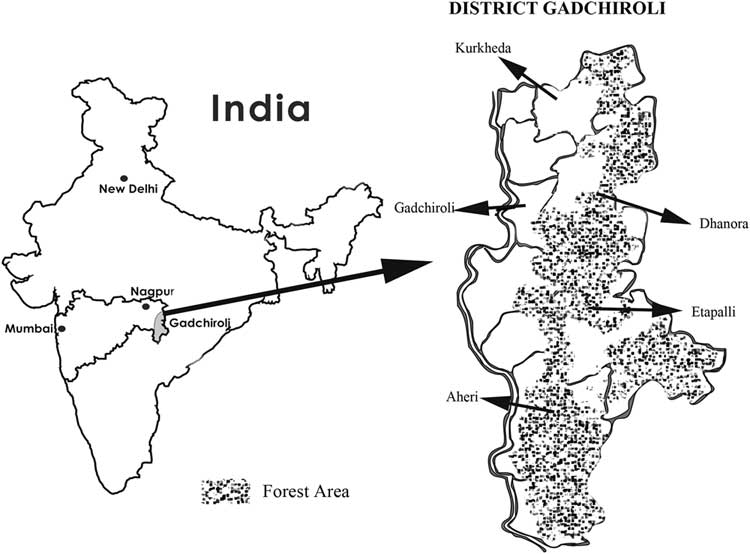
The total population of the district in 2011, according to the census, was 1,072,942. The literacy rate of the district reported by this census was 66.03%. The tribal community population residing in the district was 38.7% of the district population (Census of India, 2011). The major tribes in the district are Gond, Madia, Pardhan and Kolam. Forests cover more than 76% of the geographical area of the district. The study area was purposively selected. The study was undertaken in nine villages distributed in five study blocks in the district (Figure 1).
Map of India showing Maharashtra state, and map of Gadchiroli district showing the five study blocks and forested area.

Survey technique
Focus group discussions (FGDs) including both male and female residents were conducted in the study villages. No prior sample size was set for any participant group, and enrolment was continued until relative data saturation and information redundancy was achieved. Enrolment and FGDs took place directly in the villages and were separated by sex to independently evaluate malaria knowledge by sex and to prevent potential gender dynamics. Inclusion criteria for participation in the FGDs were: a) 16 years of age or older, b) willing to give informed consent and c) a resident in the survey villages and had stayed there for the last 5 years. In-depth interviews of ASHAs in the villages were also conducted. Interviewing guidelines were designed for FGDs and in-depth interviews and these were conducted in the local Marathi language and noted in Hindi by the translators instantly. The interviewers had no prior personal relationships with any of the study participants outside the study.
Information generation
Twelve FGDs were conducted among ordinary village residents, and 26 in-depth interviews with ASHAs. These were conducted in nine forested villages located in five administrative blocks which covered the district from north to south. This was done to capture the local characteristics of the district, so as to ensure the study was representative of the area. The data were collected between 13th and 24th June 2016. The FGDs and interviews were digitally recorded and a brief note was also made by investigators. Written informed consent was collected from all participants.
Data analysis
All FGDs and in-depth interviews were transcribed from the digital recording. The brief notes helped to complete the transcription smoothly. The transcribed information was translated into English, checked to verify that no information was lost during the process, then the content analysed for facts/issues.
Results
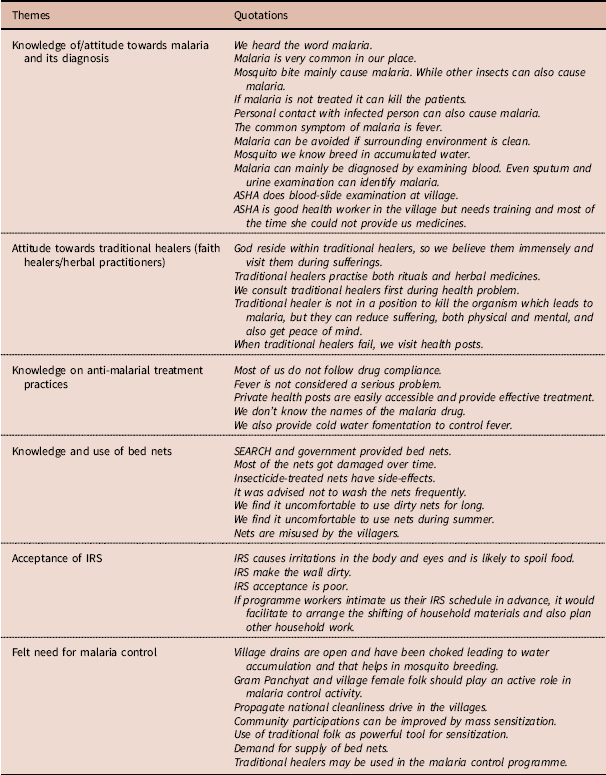
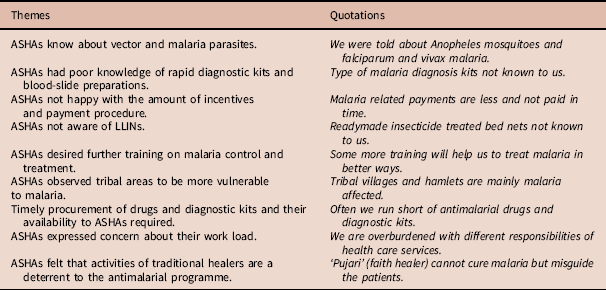
A total of 161 village residents (94 males and 67 females) participated in the FGDs and 26 in-depth interviews were conducted with ASHAs. The broad themes emerging from the FGDs and in-depth interviews and supporting quotations are given in Tables 1 and 2 respectively.
Broad themes emerging from the focus group discussions with village residents and supporting quotations, Gadchiroli district, India, 2016

Broad themes emerging from the in-depth interviews with ASHAs and supporting quotations, Gadchiroli district, India, 2016

Results of focus group discussions
Knowledge of and attitudes towards malaria and its diagnosis
The word ‘malaria’ had been heard by all the participants. Malaria is a major disease in the district, and is reported by most of them. Most of the participants agreed that malaria was caused by mosquito bites. Some of the female participants thought that other insects could also cause malaria. Many of them opined that malaria is a curable disease with treatment, but that delayed diagnosis and treatment may lead to death. Respondents mentioned that malaria is predominant during two-thirds of the year. It was highlighted that malaria was more evident during July to September. The misconception prevails that malarial infection spreads through any type of interpersonal contact. Very few knew that malaria can be cured completely with a complete dosage of anti-malarial drugs. The main symptoms of malaria were reported as fever with chills and rigor, headache, nausea, dizziness, loss of appetite and weakness.
Regarding types of malaria, none of the FGD participants could specifically explain these. However, a few females mentioned cerebral fever and dengue, and some men reported chikungunia, which are diseases similar to malaria, but respondents had no proper knowledge of these.
When asked about the ways in which malaria can be avoided, or how the risk of infection can be reduced, many reported that it is essential to keep the surroundings clean and avoid the open accumulation of water. Participants believe that mosquitoes breed in mire, cow dung and also in accumulated water. They mentioned that pouring kerosene oil or spraying Dichlorodiphenyltrichloroethane (DDT) on accumulated water can control vectors. Most respondents were aware of bed nets as a means of avoiding man–mosquito contact.
Some participants were concerned that mosquitoes could breed in room coolers. Some also mentioned clogged village drains as breeding sources. A few female participants reported using electric fans to divert mosquitoes.
As for the prevention of mosquitoes, very few participants mentioned allowing the use of indoor residual spray (IRS) in every room of the house. The release of larvivorous fish into accumulated water as a means of slowing down the rate of mosquito breeding was also mentioned by a few.
Most participants knew that malaria could be diagnosed by examining the blood. However, there were some individuals who thought that it could be diagnosed by examining the sputum and urine of an infected person. Most were aware of the blood-slide examination done by ASHAs and multi-purpose health workers (MPWs) for diagnosis, and participants considered that it takes longer to procure the reports from the laboratory. However, very few knew about rapid diagnostic test (RDT) kits for malaria.
According to national programme guidelines, it is the ASHA who is supposed to provide the first line of diagnosis and treatment for malaria in the villages. However, some participants thought that they were not equipped with sufficient medicines and RDT kits. Usually the ASHA prepares blood-slides. For malaria-related treatment in the villages, participants reported that this was usually done by auxiliary nurse midwives (ANMs)/malaria radical workers, and that they were better equipped than ASHAs with better knowledge of malaria transmission, handling of patients and availability of anti-malarial drugs and diagnostic kits.
People of all ages and both sexes were considered to be equally exposed to the risk of malaria. However, a few participants felt that pregnant women and children were more vulnerable to infection.
Attitudes towards traditional healers
Most participants believed strongly that traditional healers (faith healers/herbal practitioners, locally known as Pujari), excluding quacks, have special supernatural powers. They mentioned that during any type of illness villagers first consult traditional healers for treatment, as they are usually available locally and are easily accessible. These healers treat patients with indigenously made herbal preparations. Many perform faith or spiritual healing. Patients and family members pay the traditional healers with cash or in kind, depending upon the situation. Some female participants reported that traditional practices were the first line of treatment in the villages, and health posts were consulted later. However, a few participants believed that traditional healers treat and cure many diseases, but are unable to cure malaria. Patients only visit health posts when traditional healers fail to cure them.
Knowledge of anti-malarial treatment practices
Some participants were unaware of the need for a complete dosage of anti-malarial drugs for treatment to be effective. Some mentioned visiting chemist shops to get medicines. Others, especially females, said that they did not consider fever to be very serious and did not consult anybody for treatment with the belief that they will get better within 3–4 days without any intervention. It was reported that during sickness, if the government health posts were closed or if participants were are not financially constrained, they preferred to visit private health posts with the certainty of receiving more effective treatment. A few female participants reported that they kept drugs such as paracetamol for fever at home. Only a handful of participants could name anti-malarial drugs but many could recognize the drugs when shown them during discussions, and also reported having used them in the past.
Some participants reported that during fever, they also consume tea as medicine and some female participants reported to have provided using cloths dipped in cold water on the forehead of patients.
Knowledge and use of bed nets
Most of the FGD participants reported that bed nets had been made available to them, especially by the Society for Education, Action and Research in Community Health (SEARCH) team, but as these nets were provided a long time ago, most of them were damaged and unusable. However, some had purchased nets themselves from the market.
During discussions it was revealed that malaria control programme and SEARCH teams had provided insecticide-treated nets (ITNs) to the community (one net for two individuals and two nets for five individuals). However, it was reported that the distribution was grossly inadequate, particularly for large families. They also spoke of the side-effects of impregnated nets, such as irritation and a burning sensation on the skin and eyes. The distribution of long-lasting insecticide-treated nets (LLINs) had been initiated only recently and people were not aware of it.
Most people reported that bed nets were mostly used at night. Most reported washing bed nets quite frequently, almost every month. However, they were told by the health providers to only wash them once every 6 months in order to retain their medicinal effectiveness. Some participants expressed their displeasure at using dirty ITNs. It was also reported that the extreme heat of the summer prevented them from using nets. The misuse of bed nets for fishing and storing was also reported.
Use of indoor residual spray (IRS)
Most participants reported that spraying with IRS is usually done by workers twice a year. However, due to the displacement of household materials during spraying, fear of contamination of food and side-effects, the take-up rate was poor. Kitchens were invariably not sprayed by villagers for fear that the insecticide will spoil/contaminate food. Respondents also reported that spraying rooms was not only a health hazard but also spoils the walls. They therefore forced the insecticide sprayers to spray outside the house. Only a few agreed to the spraying of their entire house. Some participants described spraying activities as being mostly unplanned. Workers visited the villages on any day without any warning, giving no time for the villagers to prepare.
Felt need for malaria control
Participants expressed the opinion that the village drains should be cleared on a regular basis. Furthermore, it was suggested that the Gram Panchyat (village-level elected administrative body) should be actively involved in malaria control activities. The need for more female participation was stressed as it is they who manage the household chores, provide care during illness and arrange the beds at night.
Some participants thought that there was a need for a national cleanliness drive involving school children, teachers and village health workers. To improve community participation, pre-intimation involving the village head man would be essential. Community sensitization on malaria could be achieved by organizing regular youth rallies in the villages. Some participants mentioned using traditional folk and slide shows to generate awareness. They also stressed the need to provide an adequate number of bed nets to all the families in the villages and inform people on their correct use.
It was felt by many that it is essential to educate traditional healers (Pujari) on the prevention and treatment of malaria to prevent patients getting trapped by them as they often end up with clinical complications and sometimes death. They could be used as agents of change in control programmes.
In-depth personal interviews with ASHAs
Of the 26 ASHAs interviewed, most of them had been trained on handling malaria cases at Primary Health Centres (PHCs) by doctors and nurses. Almost all were able to mention the malaria vector and parasites P. falciparum (Pf) and P. vivax (Pv). Most of the ASHAs said that chloroquine was the main drug given for Pf and Pv. Knowledge of Artimisinin Combination Therapy (ACT) was very poor. Only fourteen interviewees were aware of RDTs. However, they had no knowledge on the type of RDTs. Blood-slide preparation was known to fifteen ASHAs. With the exception of fever, other signs and symptoms of malaria were known to only a handful of ASHAs.
They reported being paid incentives for the diagnosis and treatment of malaria, but the amount paid and payment procedures were not considered to be satisfactory, and only fourteen ASHAs had received payment in the months preceding the survey.
Most ASHAs knew about insecticide-treated bed nets (ITNs), but only a few mentioned long-lasting insecticide-treated nets (LLINs). Bed nets were reported to be usually used at night, but by very few tribal people. Insecticide-treated bed nets are used mostly by lactating mothers and small children. Some of the ASHAs felt the need for further training on malaria prevention, diagnosis and treatment. Most of the ASHAs observed that malaria is more prevalent in tribal areas and is due to a lack of cleanliness in these areas. Their observation is that malaria is more prevalent in villages adjacent to the forest areas and those with more cattle. Discussions revealed a lack of communication between NVBDCP workers and ASHAs, and that more inter-sectorial co-ordination was needed. The interviewees reported receiving anti-malarial drugs from the malaria control programme, but it was felt that the timely procurement of anti-malaria drugs and RDTs needed to be improved. The ASHAs were not strongly aware of the NVBDCP guidelines for malaria control. They reported that in tribal areas people consult ASHAs for diagnosis and treatment of malaria. However, incomplete anti-malarial drug use was also common in the villages. The ASHAs mentioned that they were given new responsibilities quite often and this added to their work load. It was their observation that pregnant women and children under 5 years were more vulnerable to malarial infection; however, none could mention how to treat them. They referred these cases to government health posts and even to other health workers in the village (ANMs, MPWs etc.). They urge for a uniform mass sensitization programme in tribal areas.
The ASHAs stressed that communities’ strong faith in traditional healers usually delays proper treatment seeking for malaria. However, educated tribal youths are showing a changing preference for modern health providers. The overwhelming majority of ASHAs reported maintaining records of the patients they had treated. During the last month preceding the survey only eight had examined fever cases using RDTs and nine prepared blood-slides. Exploring the available stock of anti-malarial drugs and diagnostic kits revealed that only eleven participants had RDTs. Blood-slides, lancets, ACT, chloroquine, primaquine and paracetamol were held by 19, 20, 3, 17, 2 and 18 ASHAs, respectively.
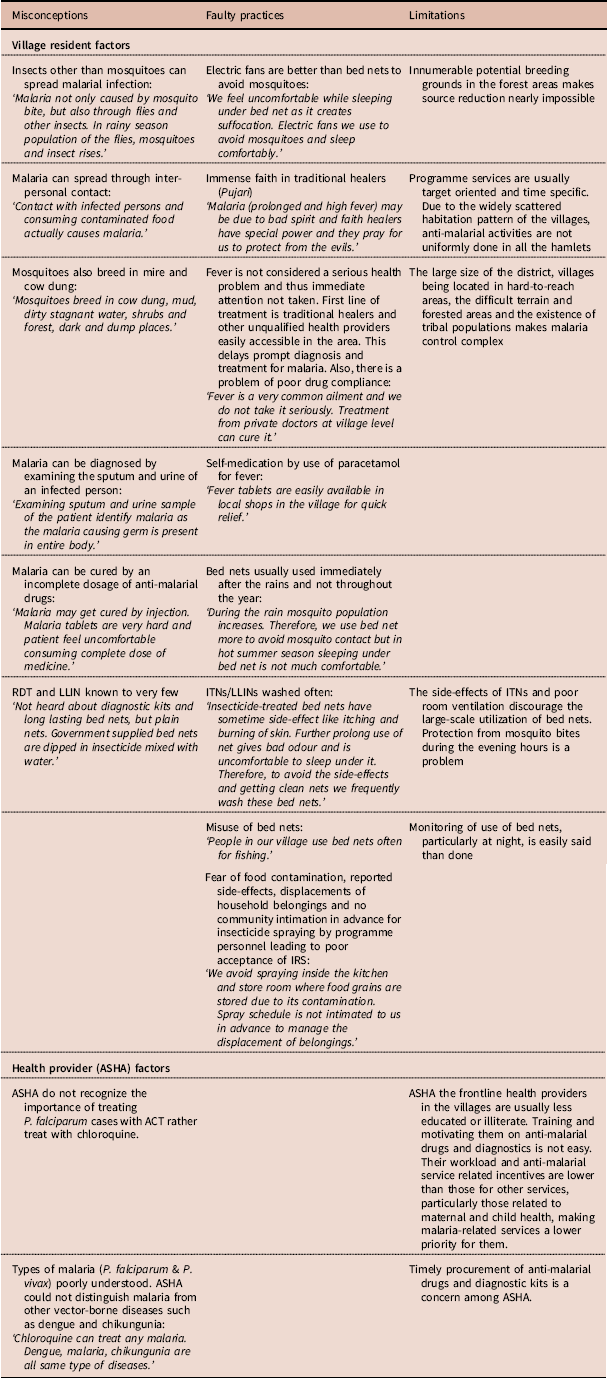
The key misconceptions, faulty practices and limitations to malaria control that emerged from the focus group discussions and interviews, which need correction through a mass sensitization programme, are summarized in Table 3.
Misconceptions and faulty practices related to malaria and limitations to malaria control, Gadchiroli district, India, 2016

Discussions
The SEARCH team is focusing on malaria control and elimination as a stakeholder in the national malaria control programme in the Gadchiroli district of India (Bang et al., Reference Bang, Reddy, Deshmukh, Baitule and Bang2005). However, due to resource limitations it cannot cover and provide services to the entire district. Quantitative studies by Bhasin et al. (Reference Bhasin, Chaturvedi, Sharma and Agarwal2001) and Sharma et al. (Reference Sharma, Aggarwal, Chaturvedi and Bhasin2003, Reference Sharma, Bhasin and Chaturvedi2007) using state government records for the area have mostly focused on epidemiological factors associated with malaria, such as disease prevalence and the association between education level and social group with knowledge of malaria. Socio-behavioural dimensions, have not been adequately covered.
The present qualitative survey, covering a sizable area of Gadchiroli district, shows that malaria is not unknown in the district, yet the population are largely unaware of the various aspects of prevention, diagnosis and treatment of the disease. Using focus group discussions and key informant interviews, the study explored misconceptions and inadequate knowledge of malaria at the community level, the poor practices and opinions of programme-based, village-level health providers, and views on traditional healers and the limitations of effective implementation of the national malaria control programme. These factors have not been covered by previous quantitative studies undertaken in the area.
This information will be helpful in designing IEC strategies for demand generation for malaria services in the area. The study shows the existence of misconceptions about malaria that add to the gravity of the problem of its control. Fever is not considered to be a serious health problem by community members, and this delays initial health seeking. There was strong faith in traditional healers, who are unqualified health practitioners providing the first line of treatment. Patients only seek the help of programme-driven services, including government health posts, when traditional healers fail to provide proper treatment. As a result the NVBDCP emphasis on the provision of prompt diagnosis and treatment for malaria in the villages gets diluted. Furthermore, the inaccessible locations of the villages from the health posts means residents suffer two-fold and government health services in the area are under-utilized.
The use of bed nets by villagers was low, and only some participants knew about long-lasting insecticide-treated nets (LLINs). The nets are usually used for 2 months immediately after the rains with the subsequent increase in mosquitoes, and use is discontinued as the mosquito density decreases. There are studies that suggest that vector density has little to do with malaria (Thomson et al. Reference Thomson, D’Alessandro, Bennett, Connor, Langerock and Jawara1994, Reference Thomson, Connor, Bennett, D’Alessandro, Milligan and Aikins1996). The density is higher during July–August but the malaria peak is sometime in October. So the distribution and use of LLINs has to be promoted in such a way that they are used properly and throughout the year. Protecting people from mosquito bites during the evening hours is complex (Ramasamy et al. Reference Ramasamy, Kulasekera, Srikrishnaraj and Ramasamy1994; Basseri et al., Reference Basseri, Abai, Raeisi and Shahandeh2012). There is a need for mass sensitization to eliminate incorrect practices, correct misconceptions on the way the disease is transmitted, improve prevention strategies, and promote prompt diagnosis and treatment of malaria in the area, particularly in tribal villages. This should cover all the hamlets and involve Gram Panchyat members, unemployed youths and school children. A sensitization programme using local folk and cultural traditions as tools of communication, including local traditional healers and also female folk as communicators, should have a strong impact on the masses.
An IEC-based interventional study conducted in the Dindori district of Madhya Pradesh using school students and unemployed youths as agents of change brought fruitful results in the control of malaria in the area (Saha et al., Reference Saha, Sharma, Mishra, Verma, Tiwari and Singh2015). As the community is educationally and economically poor in Gadchiroli, ideally a door-to-door campaign with IEC tools would be the best way to communicate with the masses. However, this approach is time consuming and demands large resources in terms of both monetary grant and manpower, and thus remains a serious problem for programme managers. The national malaria control programme uses mass sensitization for malaria mostly through electronic and print media such as television, radio and newspapers. However, its coverage and utilization are very poor among the community and thus sensitizing the masses through these media on knowledge, preventive aspects and prompt diagnosis and treatment on malaria remains ineffective and a distant dream. Hence cost-effective sensitization strategies such as regular camp approaches in the villages using IEC culture-based tools could be a more viable option. Also, local weekly markets in tribal areas and middle and high schools could be selected for regular IEC camps. Involving local school-going students and unemployed youths who can volunteer as agents of change within their own villages would strengthen sensitization campaigns by improving community participation.
There is also a need to sensitize ASHAs and other frontline workers and train them further on the promotion of malaria prevention, diagnosis and treatment. They should be sufficiently equipped with anti-malaria drugs, including both ACT and chloroquine, along with RDTs. They should also work in co-ordination with NVBDCP workers. Anti-malarial drugs should be procured in a timely manner so as to improve the efficiency of treatment requirements. In addition, the IRS spraying process needs to be better planned and take place at the convenience of villagers to improve its acceptability. Besides clogged drains and uncovered water storage in the villages, there are innumerable dry but potential pits/ditches in adjacent forest areas and paddy fields that become breeding grounds for mosquitoes during the rains and post-rainy seasons. Furthermore, there are perennial water sources that remain a constant source of mosquitoes throughout the year and which are difficult to eliminate. A planned and client-friendly IRS programme would increase its mass acceptance. Looking at the great size of the district of Gadchiroli and its inaccessible locations, it is challenging to control malaria in the region, but not impossible. A concerted effort on the part of the government machineries existing in the area, and true community participation could make this dream comes true.
Acknowledgments
The authors sincerely thank the Late Dr Neeru Singh, former Director of the ICMR-National Institute for Research in Tribal Health, Jabalpur, and an expert in malariology, for taking an immense interest in the control of malaria in Gadchiroli, and for providing guidance and support during the study. Her sudden demise has created a vacuum. Thanks are due also to Dr Abhay Bang, Director of SEARCH, Gadchiroli, for his guidance and support right from the beginning of the study. The authors would like to thank Mr Mahadhev Satpute, Mr Haridas Sakere, Mr Najuk Jade, Mrs Deola and Mr Anandrao Dudhabale (SEARCH field staff) for their support in the field.
Ethical Approval
The study was approved by the institutional research evaluation committee of the ICMR-National Institute for Research in Tribal Health, Jabalpur. All the study participants gave their informed consent for participation in the study following the ethical guidelines of Indian Council of Medical Research, New Delhi, India.
Funding
This research received no specific grant from any funding agency, commercial entity or not-for-profit organization.
Conflicts of Interest
The authors have no conflicts of interest to declare.