Introduction
Studies of the population genetics of aphids are complicated by their cyclical parthenogenesis. In a typical aphid annual life cycle (a holocycle), a bisexual generation through the winter alternates with a succession of parthenogenetic, all-female generations (clones) through the spring and summer. In some common pest aphid species such as Myzus persicae (Sulzer) (Hemiptera: Aphididae), life cycle variability introduces additional complicating factors. Some lineages have completely or partially lost the bisexual generation and overwinter anholocyclically, either reproducing exclusively by parthenogenesis or contributing only few males (androcyclic genotypes) and/or few mating females (intermediate genotypes) to the sexual phase (Blackman, Reference Blackman1971, Reference Blackman1972). Also, M. persicae is one of many aphid species undergoing annual host alternation, so that the sexual phase occurs on a woody host plant, the peach Prunus persica L. (Rosaceae), that is totally unrelated to the herbaceous host plants of the parthenogenetic phase.
Thus, the winged parthenogenetic females of M. persicae that fly in and establish populations on field crops in spring and summer can come from two different sources, which have very different effects on the genetic structure of the population. A population of M. persicae on a crop in summer can consist of a mixture of clones, and some of these may be new recombinants that have migrated from peach in the spring, while others may be old lineages that came through the previous winter(s) in the parthenogenetic phase on herbaceous plants. The proportions of new and old clones will depend on (i) the availability of peach trees for the sexual phase (Margaritopoulos et al., Reference Margaritopoulos, Tsitsipis, Goundoudaki and Blackman2002) and (ii) the suitability of the climate for overwintering in the parthenogenetic phase (Blackman, Reference Blackman1974). The analysis and interpretation of genetic data has to take full account of the interacting effects of life cycle category, climate and host plant, if it is to provide any realistic assessment of the extent of genetic differentiation and gene flow between populations.
The genetic structure of populations of M. persicae in mainland Greece is of particular interest for two reasons. The first concerns the life cycle variation. There are highly significant differences in the proportions of the different life cycle categories between regions. Margaritopoulos et al. (Reference Margaritopoulos, Tsitsipis, Goundoudaki and Blackman2002) tested the life cycle categories of clonal lineages established from field populations sampled in spring and summer by subjecting them to short photoperiod and reduced temperature in the laboratory. Most clones established from aphids collected within peach-growing regions responded to these conditions by producing a bisexual generation, whereas most of the clones from north-eastern, southern and central areas, away from peach-growing regions, continued parthenogenetic reproduction, i.e. in the field they would be destined to overwinter anholocyclically. It was, therefore, of interest to determine the extent to which the genetic structure of populations reflected these regional differences.
Microsatellite DNA or allozyme markers have been used to provide information on the relationship between life cycle category and genotypic structuring of European populations of the aphid species, Sitobion avenae (Fabricius) (Simon et al., Reference Simon, Baumann, Sunnucks, Hebert, Pierre, Le Galle and Dedryver1999) and Rhopalosiphum padi (Linnaeus) (Delmotte et al., Reference Delmotte, Leterme, Gauthier, Rispe and Simon2002). In microsatellite DNA studies of M. persicae, Wilson et al. (Reference Wilson, Sunnucks, Blackman and Hales2002) found that populations with a sexual phase from different localities in south-east Australia, mostly sampled from peach, generally conformed to Hardy-Weinberg equilibria, had high clonal diversity and showed significant population differentiation. In another study also involving M. persicae lineages from Australia (Victoria), but from herbaceous hosts (Vorburger et al., Reference Vorburger, Lancaster and Sunnucks2003), both winter temperature and availability of peach trees were found to affect the geographical distribution of genotypes of different life cycle category, clonal diversity being highest in populations with a sexual phase. Furthermore, Guillemaud et al. (Reference Guillemaud, Mieuzet and Simon2003) reported that the mode of reproduction of M. persicae in France affected genotypic variability, populations with a bisexual generation being far more variable than those that overwintered parthenogenetically.
The second reason for a particular interest in Greek M. persicae is that their morphology shows significant differences between regions and, in particular, according to the secondary host plant (Margaritopoulos et al., Reference Margaritopoulos, Tsitsipis, Zintzaras and Blackman2000). Multivariate morphometric analysis was performed on clones reared under controlled conditions on the same host plant, indicating that these differences have a genetic basis. Clones originating from tobacco Nicotiana tabacum L. (Solanaceae), and from peach in tobacco-growing regions, differed in morphology from clones collected from other secondary host plants, and from peach away from tobacco-growing regions, and clustered together in spite of regional differences. These results confirmed those of previous studies (Blackman, Reference Blackman1987; Blackman & Spence, Reference Blackman and Spence1992), on samples from tobacco and other plants from many parts of the world, indicating the existence of a closely related, but nevertheless genetically distinct, tobacco-adapted form, for which Blackman (Reference Blackman1987) proposed the name Myzus nicotianae Blackman. The identical DNA sequence at some loci examined (Field et al., Reference Field, Javed, Stribley and Devonshire1994; Clements et al., Reference Clements, Wiegmann, Sorenson, Smith, Neese and Roe2000a), however, suggested that some interbreeding must occur. Recently, subspecific status, Myzus persicae nicotianae Blackman (Margaritopoulos et al., Reference Margaritopoulos, Blackman, Tsitsipis and Sannino2003; Eastop & Blackman, Reference Eastop and Blackman2005), has been proposed for the tobacco-feeding form. It has been proved that adaptation to tobacco involves negative trade-offs that reduce the fitness of tobacco aphids on other crops (Nikolakakis et al., Reference Nikolakakis, Margaritopoulos and Tsitsipis2003) and, along with selection against host migrants, promoted the evolution of an improved host-recognition mechanism in winged migrants (Margaritopoulos et al., Reference Margaritopoulos, Tsourapas, Tzortzi, Kanavaki and Tsitsipis2005; Troncoso et al., Reference Troncoso, Vargas, Tapia, Olivares-Donoso and Niemeyer2005).
DNA studies on M. persicae, including some aimed specifically at comparing tobacco- and non-tobacco-feeding populations, have failed to find consistent diagnostic genetic markers (Fenton et al., Reference Fenton, Woodford and Malloch1998; Margaritopoulos et al., Reference Margaritopoulos, Mamuris and Tsitsipis1998; Clements et al., Reference Clements, Wiegmann, Sorenson, Smith, Neese and Roe2000a,Reference Clements, Sorenson, Wiegmann, Neese and Roeb; Zitoudi et al., Reference Zitoudi, Margaritopoulos, Mamuris and Tsitsipis2001). However, apart from the work by Terradot et al. (Reference Terradot, Simon, Leterme, Bourdin, Wilson, Gauthier and Robert1999), which included only two clones from tobacco, there have as yet been no comparative studies of tobacco- and non-tobacco-adapted forms using microsatellite markers, which are currently the most suitable markers for population genetic analysis. Such studies need to take full account of life cycle category, so as to be able to concentrate on the genotypes that are likely to be participating in sexual reproduction and can, therefore, be used to estimate the genetic differentiation between populations and the extent of gene flow.
Using microsatellites, we have genotyped clonal samples of M. persicae group aphids collected in different regions of Greece on both primary and secondary host plants and in one region in southern Italy. In the present paper, we examine the number and distribution of common genotypes, i.e. those found at more than one time and/or in more than one population, in relation to host plant and regional life cycle variation. These common genotypes are assumed not to be contributing, or to be contributing only irregularly, to the sexual phase on peach. We test this assumption by examining the life cycle traits of the most commonly occurring genotypes. In another paper (Margaritopoulos et al., Reference Margaritopoulos, Malarky, Tsitsipis and Blackman2007), we analyse and compare genotypes that are unique to single populations, and which are, therefore, regarded as contributors to the sexual phase.
Materials and methods
Aphid sampling
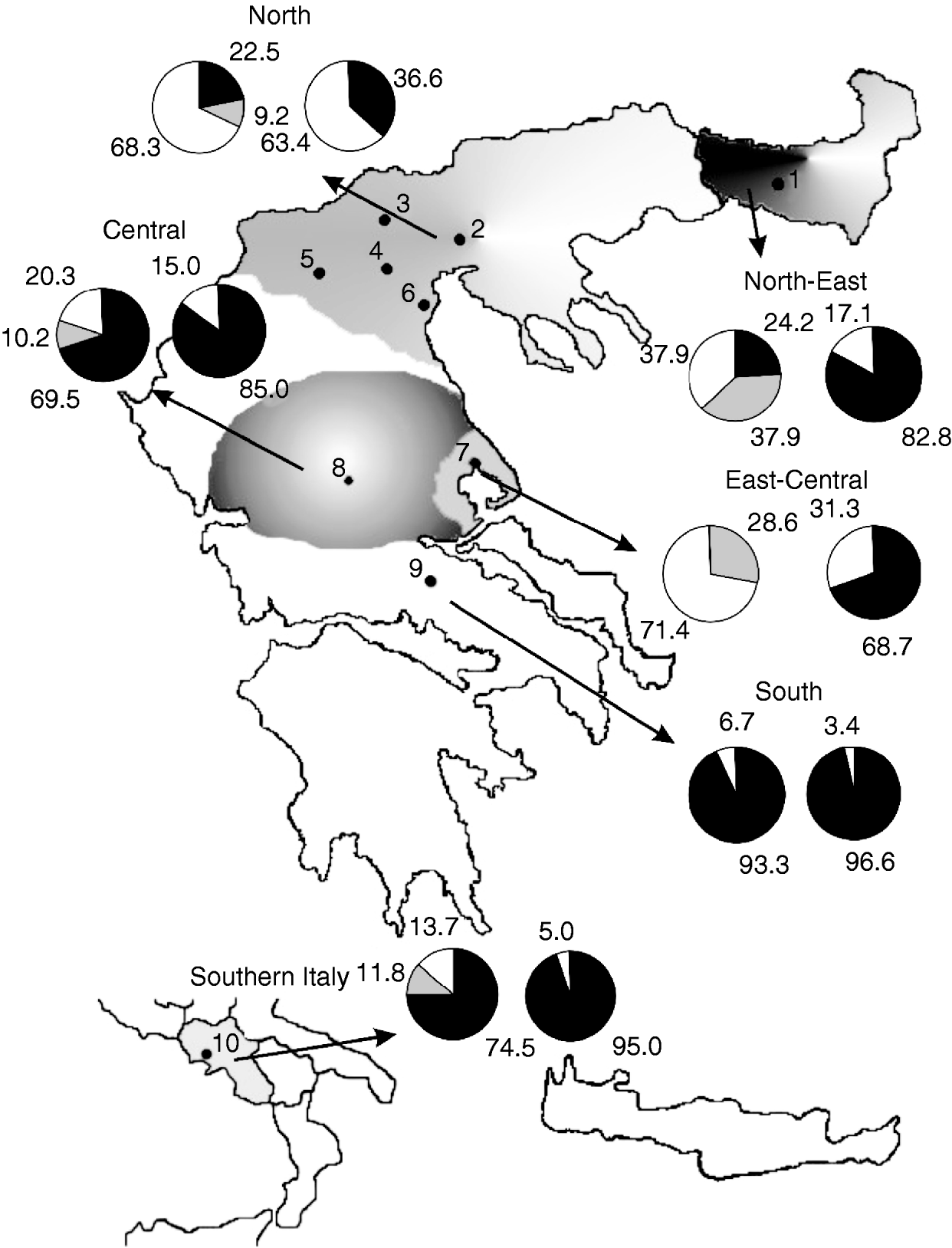
Samples of M. persicae group aphids were collected from peach, tobacco, pepper Capsicum annuum L. (Solanaceae), potato Solanum tuberosum L. (Solanaceae), cabbage Brassica oleracea L. (Brassicaceae) and various weeds, such as shepherd's purse Capsella bursa-pastoris (L.) (Brassicaceae), whitetop Cardaria draba (L.) (Brassicaceae) and common mallow Malva sylvestris L. (Malvaceae), in different regions of mainland Greece during 1997–2000 (fig. 1). Samples were collected from tobacco-growing areas, except for those from the east-central coastal area near Volos, which is about 100 km from the nearest tobacco fields. In addition, samples were collected from tobacco fields in the region of Caserta (near Naples) in southern Italy in 1998. Samples of two to three leaves infested by aphids from single plants were placed in polybags and taken back to the laboratory, where clonal lineages were initiated from one aphid from each polybag, by isolation on an excised potato leaf in a Blackman box (Blackman, Reference Blackman1971). When population sizes were large on peach and tobacco, a method of systematic sampling was used. In tobacco fields, plants were sampled every 4–5 rows and at approximately every 5 m in the row. In peach orchards, samples were taken every 4–5 trees in the row. On other field crops, and in the case of overwintering populations on weeds, numbers were usually too low or too irregularly distributed for systematic sampling, but all samples came from separate plants.
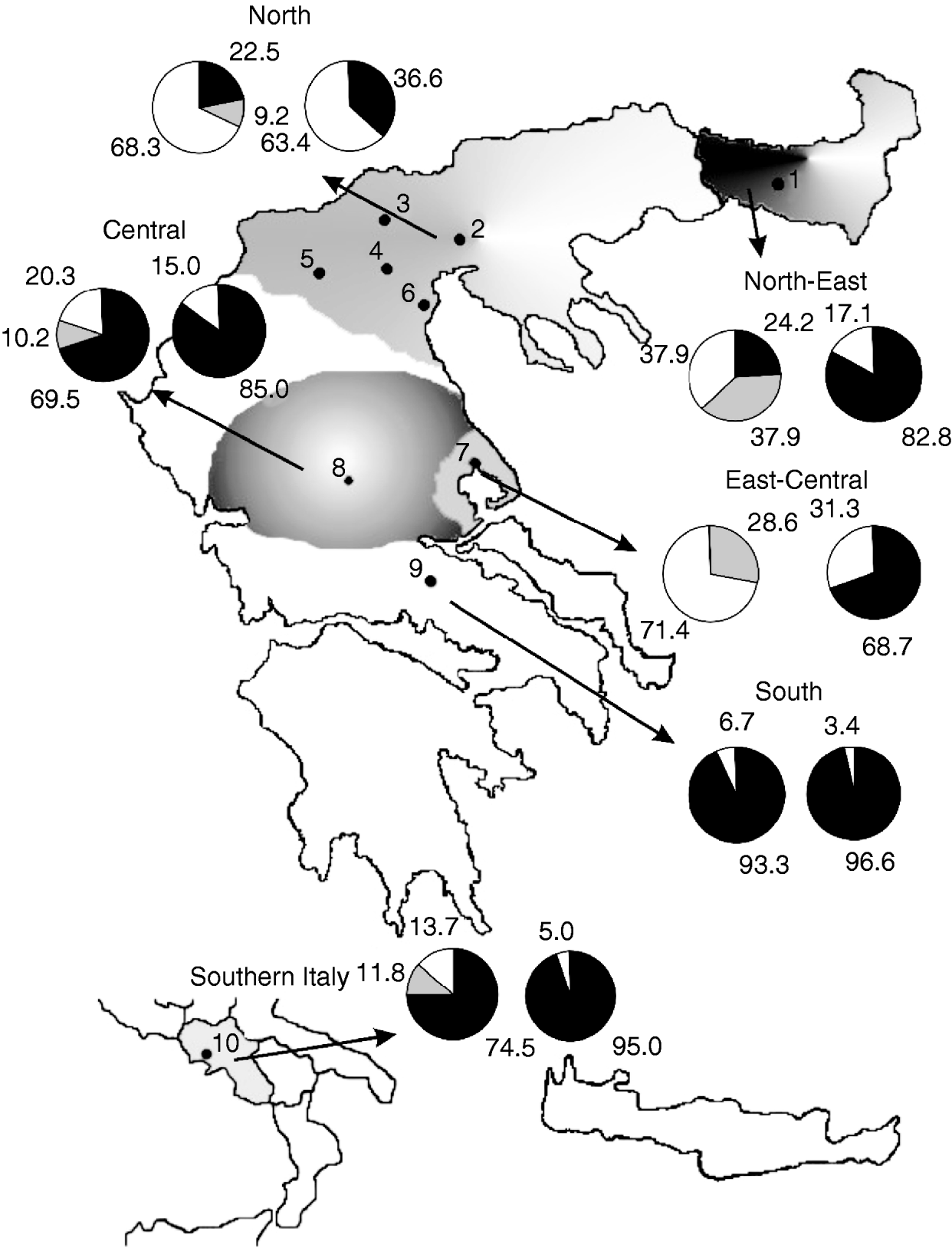
Collection sites of Myzus persicae in mainland Greece and southern Italy (1, Xanthi; 2, Arethousa; 3, Aridea; 4, Alexandria and Meliki; 5, Ptolemaida; 6, Katerini; 7, Velestino, Volos and Lethonia; 8, Karditsa and Anavra; 9, Amfiklia; 10, Caserta, Salerno and Pisani) and percentages of the different genotypes found on summer host plants in each region. Charts with three pie segments show percentages of: (i) common genotypes, i.e. collected at more than one time and place (black area); (ii) genotypes collected multiply, but in a single locality (grey area); and (iii) unique genotypes, i.e. found only one time (white area). Charts with two pie segments show percentages of anholocyclic and genotypes with a sexual phase (black and white area, respectively).
Microsatellite genotypes were obtained for 482 clonal lineages (table 1). Samples of each lineage were kept at −80°C. Before freezing, the colour of each lineage was recorded, and 1–2 individuals were karyotyped for presence or absence of the common A1,3 translocation that is associated with esterase 4-based resistance (Blackman et al., Reference Blackman, Takada and Kawakami1978). The responses of a subset of lineages to a short-day regime (10 h light: 14 h dark at 17°C) were tested to determine life cycle category (Margaritopoulos et al., Reference Margaritopoulos, Tsitsipis, Goundoudaki and Blackman2002, Reference Margaritopoulos, Blackman, Tsitsipis and Sannino2003). Clonal lineages were classified as either holocyclic (responding by producing exclusively males and mating females and, therefore, destined to have an obligatory bisexual generation on peach), or anholocyclic (used here in a broad sense to include all lineages continuing to reproduce parthenogenetically in a short-day regime and, therefore, capable of anholocyclic overwintering, although including some lineages that are able to produce a few males and/or mating females). Some lineages were tested for polymorphism at the glutamate oxaloacetate transaminase-1 (GOT-1) locus using a previously-described method (Blackman & Spence, Reference Blackman and Spence1992).
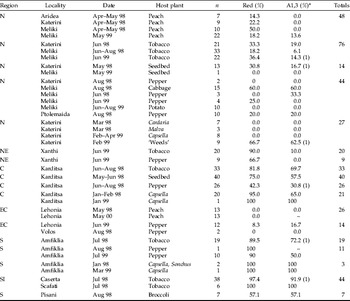
Collection data for samples, colour and karyotype of the 482 clones (n) of Myzus persicae genotyped.

* Clones with A1,3 translocation. In brackets, number of clones not karyotyped.
N, NE, C, EC and S are north, north-east, central, east-central and southern mainland Greece, respectively; SI, southern Italy; seedbed, tobacco seedbed.
Microsatellite analysis
Seven polymorphic microsatellite loci were used in this study. Three, M35, M37 and M40, were previously isolated from an Australian clonal lineage of M. persicae (for primer sequences, see: Sloane et al., Reference Sloane, Sunnucks, Wilson and Hales2001). The additional four loci, myz2, myz3, myz9 and myz25, were isolated by Gavin Malarky from a British clone of M. persicae. These four loci have been used in previous M. persicae studies (Sloane et al., Reference Sloane, Sunnucks, Wilson and Hales2001; Hales et al., Reference Hales, Wilson, Sloane, Simon, Le Gallic and Sunnucks2002a,Reference Hales, Sloane, Wilson and Sunnucksb; Wilson et al., Reference Wilson, Sunnucks, Blackman and Hales2002; Fuentes-Contreras et al., Reference Fuentes-Contreras, Figueroa, Reyes, Briones and Niemeyer2004). Their primer sequences were published in Wilson et al. (Reference Wilson, Massonnet, Simon, Prunier-Leterme, Dolatti, Llewellyn, Figueroa, Ramirez, Blackman, Estoup and Sunnucks2004). Previous studies have shown that these loci have sufficient resolution to identify clonal genotypes (Wilson et al., Reference Wilson, Sunnucks, Blackman and Hales2002).
DNA from individual aphids from each lineage was extracted using a salting-out method (Sunnucks & Hales, Reference Sunnucks and Hales1996), and dissolved in 50 μl of dH2O. Microsatellite amplification was done using fluorescent-labelled forward primers from PE-Applied Biosystems UK. The 40 μl reaction mix contained 1.5 μl DNA, 1.25 units AmpliTaq Gold (Perkin Elmer), 1.5 mm MgCl2, 1×Mg++-free buffer, 170 mm of each dNTP and 0.2 μm forward and reverse primers. The mix was overlaid with a drop of oil. Amplification was carried out using the following cycling conditions in a Hybaid PCR machine: 95°C for 8 min to activate the Taq; 94°C for 40 s; 56°C for 40 s (annealing); 72°C for 90 s (cycle twice, then decrease anneal temperature by 1°C, repeat until cycled at 52°C); 93°C for 40 s; 51°C for 40 s; 72°C for 90 s (repeat for 20 cycles). An aliquot of the product was run out on an agarose gel to determine efficiency of amplification. Products from different loci were diluted and mixed, depending on the result from the agarose gel. One μl from each mix was loaded onto an ABI 373 sequencer with 66 wells, set up for GENESCAN, and run for 3–4 h. Alleles were sized against an internal size standard. Genotype data were generated using ABI GENOTYPER.
Data analysis
The following assumptions were made in organizing the data for analysis:
1. Individuals with identical-sized alleles at all seven loci have identical genotypes and belong to a single clone.
2. Genotypes found only once (termed here unique genotypes) are most likely to be new recombinants from eggs on peach produced by the previous autumn's bisexual generation. These clones are considered in a subsequent paper.
3. Genotypes found on more than one sampling date and/or in more than one location, termed here common genotypes, are either definitely (if collected in more than one year or at widely distant locations) or probably (if found on more than one crop or at more than one location or time) ‘old’ clones that have overwintered parthenogenetically, so that they do not form a regular part of an interbreeding population and should not be included in the data set for population genetics analysis (Sunnucks et al., Reference Sunnucks, De Barro, Lushai, Maclean and Hales1997). The incidence and distribution of these common clones was investigated separately and is the subject of the present paper.
4. A third category consists of genotypes found only at one location and on one sampling date but represented by more than one clonal lineage in the data set. This situation could arise by: (i) multiple colonizations of the crop by winged individuals of the same genotype; (ii) secondary spread by individuals of the same genotype within the crop after a single colonization; or (iii) as an effect of insufficient or poor sampling. In such cases, it is not clear whether the genotype should be treated as a new recombinant, or as an ‘old clone’, so both possibilities were examined in the analysis.
Numbers of common genotypes were compared between host plants and between regions using Chi-squared or using Fisher's exact test for small samples (<10).
Results
Frequency, distribution and properties of common genotypes
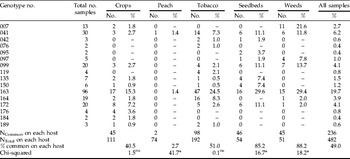
There were a total of 16 common genotypes, comprising about half (49.0%) of the total samples in the data set (table 2). The most frequently collected of these (no. 163) was over three times more common than any other genotype and made up 19.7% of the total data set. The colour, karyotype, GOT-1 genotypes and microsatellite allele sizes at seven loci for genotype 163 and the next five most frequently-collected genotypes (i.e. all those collected more than ten times, and together comprising 40.7% of all samples collected) are given in table 3.
Distribution of the 16 ‘common’ microsatellite genotypes of Myzus persicae among host plants.

Total no. of samples (second column)=number of separate samples collected of that clone. Proportion (%) on crops, peach, etc. is the proportion of total samples from each host that were that clone. Field crops other than tobacco (cabbage, pepper, potato, etc.) are pooled as ‘crops’. Proportion (%) of all samples (final column)=proportion of all 482 samples that were that clone. NCommon on each host=total number of samples from that host that were common genotypes. NTotal on each host=total number of samples from that host. Chi-squared is calculated on the basis of the number of samples of common genotypes expected, if each host had the same proportion (0.490) of common genotypes as the total data set (*P<0.0001). Proportion (%) of common on each host=proportion of total number of samples from that host that were common genotypes.
Colour, karyotype, glutamate oxaloacetate transaminase-1 genotype (GOT-1) and microsatellite allele sizes at seven loci for the six most frequently collected clones of Myzus persicae.

‘Normal’ means of normal 2n=12 karyotype; ‘translocated’ means 2n=12 with autosomal 1,3 translocation; ‘ff’, ‘ss’ and ‘sf’ are, respectively, homozygous fast, homozygous slow and heterozygous forms of GOT-1.
Considered together, the frequency of collection of the 16 common genotypes in populations on field crops, both of tobacco and other crops, did not depart significantly from that expected on the basis of their representation in the total data set. Common genotypes were not collected on peach, except for single collections of each of the two commonest genotypes (041 and 163). They did, however, account for most of the samples taken from tobacco in seedbeds and almost all of the samples collected from overwintering populations on weeds (table 2).
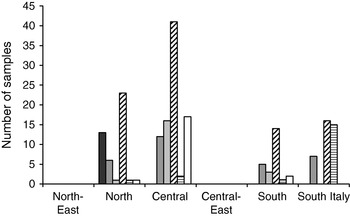
Looking separately at the occurrence of the six commonest genotypes (fig. 2), five of them were collected from both tobacco and non-tobacco crops. Genotype 007 was found on weeds in two successive winters and on pepper in a single region in one year but was never collected on tobacco. However, the numbers were too small for this to be significant. Some of the other ten common genotypes were sampled only either from tobacco crop and seedbeds (e.g. genotypes 042, 076, 095, 97, 119) or from other crops (e.g. genotypes 176, 184), but the numbers were too low for a reliable conclusion.
Distribution of samples of the six commonest genotypes of Myzus persicae on herbaceous hosts in mainland Greece and southern Italy, compared with distribution of all samples. (For further explanation of host plants see table 3.) ( , tobacco;, other crops;, seedbeds;, weeds.)

When Greek regional differences were examined, the frequency of occurrence of common genotypes was found to be highly correlated with the relative abundance of the primary host (fig. 1). In northern mainland Greece, the majority of clones analysed from summer field crops had unique genotypes. Around the sampling sites in this region, the cultivated land devoted to peach constitutes about 95% of the total peach-growing area in Greece. Some commercial peach orchards also occur in the east-central coastal region, near Volos (Anon., 1995), and here samples from pepper also had a majority of unique genotypes. In the other regions of mainland Greece, peach is not cultivated or only scattered small orchards are present. In the central region, c. 150 km further south of the main peach-growing area and c. 100 km west of Volos, the proportions were reversed, with common genotypes predominating in the tobacco-growing region around Karditsa. Further south still, unique genotypes were rarely collected.
In southern Italy, samples were mostly from tobacco and had a high proportion of common genotypes, like those in central and southern mainland Greece. Here there was, however, no correlation with the presence of the primary host, as peach orchards were common in the tobacco-growing areas, as in northern Greece. The contrast between these two regions has already been reported and discussed (Margaritopoulos et al., Reference Margaritopoulos, Blackman, Tsitsipis and Sannino2003).
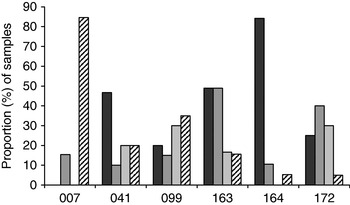
Five of the six commonest genotypes occurred in the north, central and south of mainland Greece, and three of these were also the predominant genotypes on tobacco in southern Italy (fig. 3). However, none of the six commonest genotypes was found on pepper and tobacco at Xanthi in north-east Greece, and on pepper in the east-central region near Volos. Genotype 007, which was found overwintering on weeds but not collected from tobacco, was only collected in the northern region.
Occurrence of the six commonest genotypes of Myzus persicae according to region. (, 007;, 041;, 099;, 163;, 164; □, 172.)

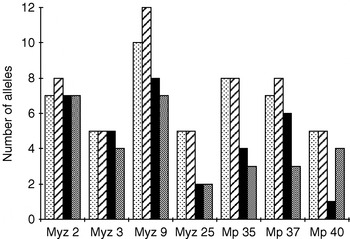
Numbers of alleles per locus tended to be higher in the more northerly populations, but southern populations, consisting almost entirely of common genotypes, were, nevertheless quite polymorphic (fig. 4) because of the low number of alleles they shared.
The number of alleles at each locus of Myzus persicae in each region on summer secondary hosts. (, north;, central; ■, south;, south Italy.)

Correlation of common genotypes with life cycle traits
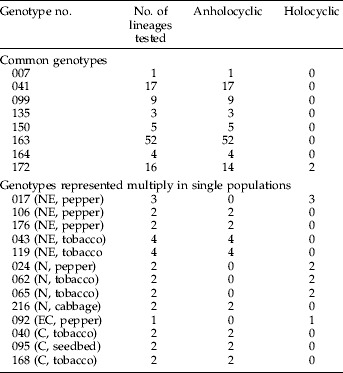
Life cycle categories of eight of the common genotypes were tested as part of a more extensive study of life cycle variation in Greek populations (Margaritopoulos et al., Reference Margaritopoulos, Tsitsipis, Goundoudaki and Blackman2002, Reference Margaritopoulos, Blackman, Tsitsipis and Sannino2003). Almost all of them were classified as anholocyclic (table 4). The holocyclic response of two lineages (out of 16 tested) of genotype 172 was perhaps due to contamination or mislabelling of cultures.
Life cycle categories of genotypes of Myzus persicae multiply represented in the data set, as indicated by their responses to a short photoperiod regime in laboratory tests.

Holocyclic=lineages responding to short day by producing exclusively males and matting females; anholocyclic=functionally parthenogenetic, this category includes all lineages continuing to reproduce parthenogenetically in short days including those able to produce a few males and/or mating females.
The percentages of clonal lineages that were common genotypes in each region were compared with the percentages of anholocyclic lineages obtained from summer crops in the same localities during May–August of 1998–1999 in a more extensive study of life cycle variation in Greece and southern Italy (Margaritopoulos et al., Reference Margaritopoulos, Tsitsipis, Goundoudaki and Blackman2002, Reference Margaritopoulos, Blackman, Tsitsipis and Sannino2003). A few lineages that were tested only in the present study were also included. Correlation across all six regions was not significant (Pearson's correlation 0.73, n=6, P<0.097), but only because the north-east region was markedly deficient in common genotypes, having only three of those found in other regions, although it did have a high percentage of anholocyclic lineages (fig. 1). The north-east differed from the other regions in that only one crop of tobacco and one of pepper were sampled, five days apart. Most of the genotypes in each of these populations were collected more than once, but were outside our definition of common genotypes, because they were found at only one time at one location. Also, in central-eastern Greece, no common genotypes were found, but some genotypes were collected more than once in this locality. When these clonal lineages, plus other genotypes represented more than once in other populations, were added to the numbers of lineages of common clones, there was a very close correlation (Pearson's correlation 0.891, n=6, P<0.02) with the percentages of anholocyclic lineages across all regions (fig. 1). Photoperiodic responses of 13 of the 17 genotypes multiply represented within populations were tested and they were found to exhibit both anholocyclic and holocyclic traits (table 4). Four out of the five north-eastern genotypes were anholocyclic.
Discussion
The incidence and distribution of the common genotypes revealed by microsatellite genotyping can be related to previous findings of patterns of variation in M. persicae populations in mainland Greece (Margaritopoulos et al., Reference Margaritopoulos, Tsitsipis, Zintzaras and Blackman2000, Reference Margaritopoulos, Tsitsipis, Goundoudaki and Blackman2002; Zitoudi et al., Reference Zitoudi, Margaritopoulos, Mamuris and Tsitsipis2001). About half of all samples were common genotypes, and these dominated populations on field crops, especially tobacco, in central and southern Greece. Four of the five commonest genotypes on tobacco were red in colour and account for the predominance of red clones in central and southern tobacco-growing regions. In laboratory tests, common genotypes were found to be predominantly anholocyclic, and this explains their prevalence in populations overwintering on weeds, as well as in tobacco seedbeds, which are colonized early in spring, before the main migration from peach (Tsitsipis et al., Reference Tsitsipis, Sannino, Lahoz, Tarantino, Margaritopoulos, Zarpas, Tsitsipis and Blackman2004). The very marked north–south gradient in the proportion of common genotypes (fig. 1) might seem to be explicable simply in terms of the availability of the primary host. Away from the commercial peach-growing region in the north, few primary hosts are available, so that the predominant genotypes will be those that overwinter parthenogenetically. Peaches are grown in the region of Volos, in eastern central Greece, which explains why the proportion of common genotypes is much lower there than about 100 km inland, in the tobacco-growing region near Karditsa, where there are no peaches. The relative incidence of holocycly and anholocycly in aphids can often be related to the prevailing winter temperature, e.g. in S. avenae (Simon et al., Reference Simon, Baumann, Sunnucks, Hebert, Pierre, Le Galle and Dedryver1999; Dedryver et al., Reference Dedryver, Hullé, Le Gallic, Caillaud and Simon2001), Macrosiphum rosae (Linnaeus) (Wöhrmann & Tomiuk, Reference Wöhrmann and Tomiuk1988), Acyrthosiphon pisum (Harris) (MacKay et al., Reference MacKay, Lamb and Smith1993) as well as M. persicae (Blackman, Reference Blackman1974; Guillemaud et al., Reference Guillemaud, Mieuzet and Simon2003; Vorburger et al., Reference Vorburger, Lancaster and Sunnucks2003), but this does not seem to apply at the local level in Greece. For example, winter temperatures at Karditsa, in central Greece, and Katerini-Meliki, in the north, were similar. Also, further north around Xanthi, most of the genotypes overwintered parthenogenetically (see also Margaritopoulos et al., Reference Margaritopoulos, Tsitsipis, Goundoudaki and Blackman2002). Anholocyclic genotypes of M. persicae can also survive more severe winters, e.g. much further north in western Germany, where all clonal lineages from tobacco were found to overwinter parthenogenetically (Kephalogianni et al., Reference Kephalogianni, Tsitsipis, Margaritopoulos, Zintaras, Delon, Blanco Martin and Schwaer2002). The situation in mainland Greece somewhat resembles that in Victoria, Australia, where the regional availability of peach limits the success of holocyclic genotypes, although winter temperature affects the geographical distribution of anholocyclic clones (Vorburger et al., Reference Vorburger, Lancaster and Sunnucks2003).
A more detailed examination of the results indicates that other factors are also involved. In the north-east, at Xanthi, there is no commercial peach-growing, yet only three of the 16 common genotypes and none of the six commonest were found. Most of the Xanthi genotypes were collected more than once in the two sampled populations, and all except one of the clones tested for life cycle category were functionally anholocyclic (i.e. overwinter parthenogenetically), but fell outside our working definition of common genotypes, because they were neither collected at more than one site nor on more than one occasion. In fact, the populations that were sampled at Xanthi, both on pepper and tobacco, proved to be very distinct genetically from those collected elsewhere (Margaritopoulos et al., Reference Margaritopoulos, Malarky, Tsitsipis and Blackman2007). Evidently these north-eastern populations are somewhat isolated.
The question that arises is why common genotypes, which seem to be somehow tolerant to the winters usually encountered in Greece, do not predominate in the peach-growing regions in the north. The cold resistant diapause egg provides higher opportunities for survival during the winter but the crucial factor may be the rapid increase of aphid populations on peach during spring growth, where spring migrants leaving peach in huge numbers relative to winged females arising from populations that have overwintered parthenogenetically on winter hosts. Other forms of interclonal selection may also exist in the examined populations. Genotypes identified by either their DNA (this study) or by their photoperiodic response (Margaritopoulos et al., Reference Margaritopoulos, Tsitsipis, Goundoudaki and Blackman2002) as having had a sexual phase on peach can rarely be found in localities 100–150 km away from peach-growing regions. Aphids are able to migrate over long distances, e.g. R. padi (Delmotte et al., Reference Delmotte, Leterme, Gauthier, Rispe and Simon2002), S. avenae (Llewellyn et al., Reference Llewellyn, Loxdale, Harrington, Brookes, Clark and Sunnucks2003), the commonest genotypes in this study; but the success rate of migration may be low (Loxdale et al., Reference Loxdale, Hardie, Halbert, Footit, Kidd and Carter1993; Loxdale & Lushai, Reference Loxdale and Lushai1999). Thus, local selection for specific genotypes may be responsible for the low frequencies of unique genotypes in areas away from the peach-growing regions.
The hypothesis that common genotypes prevail solely because of the absence of peaches breaks down completely in southern Italy, where in the region of Caserta there are plenty of peach orchards, often in close proximity to tobacco fields, as in northern Greece. Yet populations sampled on tobacco consist almost exclusively of three common genotypes, and 95% of the clonal lineages examined for life cycle category were functionally anholocyclic. In addition, multivariate morphometric analysis separated the aphids originating from peach in Caserta from those collected on tobacco (Margaritopoulos et al., Reference Margaritopoulos, Blackman, Tsitsipis and Sannino2003). It seems that populations on peaches in southern Italy, unlike those in northern Greece, lack the genetic capability to colonize tobacco. Three of the five commonest genotypes sampled on tobacco in Greece predominated also on tobacco in southern Italy. The commercial production of tobacco in both Greece and Italy is a recent event. We do not know, however, whether these genotypes invaded and dispersed after the establishment of the crop or were created later. Nevertheless, it appears that some genotypes of the tobacco-feeding populations have the ability to succeed in various environmental conditions. Data obtained by high resolution DNA analysis during the last decade have shown that this phenomenon is quite common among aphid species (Sunnucks et al., Reference Sunnucks, England, Taylor and Hales1996; Fenton et al., Reference Fenton, Woodford and Malloch1998; Wilson et al., Reference Wilson, Sunnucks and Hales1999; Haack et al., Reference Haack, Simon, Gauthier, Plantegenest and Dedryver2000; Llewellyn et al., Reference Llewellyn, Loxdale, Harrington, Brookes, Clark and Sunnucks2003; Vorburger et al., Reference Vorburger, Lancaster and Sunnucks2003; Fuentes-Contreras et al., Reference Fuentes-Contreras, Figueroa, Reyes, Briones and Niemeyer2004). The relative advantages of these three widespread clones remain to be determined. Insecticide selection pressure is one probable reason (Zamoum et al., Reference Zamoum, Simon, Crochard, Ballanger, Lapchin and Vanlerberghe-Masutti2005), but these clones may have ‘general-purpose genotypes’ (Lynch, Reference Lynch1984) with broad ecological tolerance and, thus, predominate through interclonal selection in fluctuating environments.
The commonest genotypes (with the exception of 007) identified in this study are clearly very successful colonizers of field tobacco but are also capable of feeding on other crops. Populations on tobacco can be very large, with dense colonies forming particularly on upper parts of stems and young leaves. In contrast, populations on other field crops, even in the vicinity of heavily infested tobacco crops, are very dispersed; and often the aphids can be found only after searching many plants, and then only singly or in small groups on the older leaves. These extreme differences in population levels between tobacco and other crops are an important consideration when looking at genetic variation between crops. Genotypes that can colonize tobacco will tend to be the dominant clones wherever tobacco is grown and are also the clones most likely to be encountered on other crops within tobacco-growing regions. No strong evidence for host association among the common genotypes was noticed, except in the case of one of the six commonest genotypes (007), which was sampled from weeds and crops but never from tobacco, and classified as a non-tobacco feeding clone according to GOT-1 phenotype (homozygous for fast form, ff; Blackman & Spence, Reference Blackman and Spence1992). However, none of the genotypes sampled on pepper in eastern-central Greece, where tobacco is not cultivated, was found in any of the tobacco-growing regions. Previous morphometric studies have discriminated populations from peach and pepper in eastern-central Greece from those collected from tobacco-growing regions either from tobacco or from peach (Margaritopoulos et al., Reference Margaritopoulos, Tsitsipis, Zintzaras and Blackman2000, Reference Margaritopoulos, Blackman, Tsitsipis and Sannino2003). Performance and host-choice experiments (Nikolakakis et al., Reference Nikolakakis, Margaritopoulos and Tsitsipis2003; Margaritopoulos et al., Reference Margaritopoulos, Tsourapas, Tzortzi, Kanavaki and Tsitsipis2005) proved also that tobacco is less preferable and suitable host compared to pepper for the eastern-central populations, while the opposite was observed for those from tobacco-growing regions.
In conclusion, we have shown that common (anholocyclic) genotypes make up a large proportion of populations, except where peaches are grown commercially, and that the climatic selection of sex hypothesis (Blackman, Reference Blackman1974) and its theoretical developments (Rispe et al., Reference Rispe, Pierre, Simon and Gouyon1998), which holds for various aphid species, does not seem to apply at the local level in Greece. In southern Italy, common genotypes predominate on tobacco even in a peach-growing region, because the nearby populations on peach do not have the genetic capability to colonize tobacco. Thus, local factors may determine whether the holocyclic or anholocyclic mode of reproduction predominates in any one population. Several of the common clones occur in both Greece and southern Italy and probably in other parts of the Mediterranean area, if not further afield. Such information is necessary for population genetic studies and in order to study the dispersal of genotypes with economically important traits such as host adaptation and insecticide resistance.
The distinction between the two strategies of overwintering, and their consequences with regard to population structure on crops, is clear enough in the short term, but it needs to be borne in mind that the common genotypes are probably all capable of producing males and thus contributing to the sexual phase. This will eventually result in new recombinants that inherit the ability to overwinter parthenogenetically (Blackman, Reference Blackman1972; Margaritopoulos et al., Reference Margaritopoulos, Tsitsipis, Goundoudaki and Blackman2002). This parallels the situation found in French populations of R. padi (Delmotte et al., Reference Delmotte, Leterme, Bonhomme, Rispe and Simon2001, Reference Delmotte, Leterme, Gauthier, Rispe and Simon2002), where there is similar life cycle variability, and similar multiple origins of asexuality.
Acknowledgements
The authors thank D. Butos, K. Zarpas and S. Goudoudaki of the University of Thessaly, K. Seidos of the Tobacco Institute of Greece and L. Sannino of Istituto Sperimentale per il Tabacco, Scafati, Italy, for help with collecting the samples for cloning and microsatellite analysis, and Alex Wilson for valuable comments on an earlier draft of this paper. This work was supported by the Commission of the European Communities Tobacco Information and Research Fund, project 96/T/18 ‘Management of the insect pests and viruses of tobacco using ecologically compatible technologies’. It does not necessarily reflect the views of the Commission and in no way anticipates its future policy in this area.