Migration: Turkey and Europe
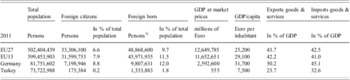
Currently, some 33.3 million foreign citizens live in the EU-27, i.e. 6.6% of the total population of 502 million. The majority of such citizens live in the EU-15, namely 32 million or 95% of all foreigners. Accordingly, in the EU-15 the proportion of foreigners amounts to 8% on average. The number and share of foreign born are even higher with some 49 million migrants in the EU-27, i.e. 10% of the EU-27 population, and 46 million in the EU-15 or 11.5%.1 For a map of Europe and its demographic composition see the article by Heinz Fassmann in this issue.
Migrants from Turkey represent a fairly small proportion of all migrants to the EU. In 2011, some 2.3 million Turkish citizens were counted, i.e. 7% of all foreign citizens in the EU-27 (7.4% of EU-15 foreign citizens) and 0.5% of the total EU-27 population (0.6% of EU-15). Turkish nationals do, however, constitute the largest single third-country national group in the EU-15, namely some 25%. They live mainly in Germany (1.7 million), France (220,000), Austria (113,500) and the Netherlands (88,000). Turkish migrants are increasingly willing to adopt the citizenship of an EU-host country. Accordingly, the number of Turkish foreign born in the EU is somewhat higher, at 2.5 million. If one adds the number of second-generation migrants from Turkey to the foreign born, i.e. those already born in Europe, the total rises to close to 4 million. This constitutes some 5% of the current population of Turkey (2011).
The share of foreign born from Turkey differs markedly among the EU Member States. Austria and Germany have the largest proportions of foreign born from Turkey with close to 2% of the total population of either country. If one includes the second generation of Turkish origin, the proportion rises to more than 3%. Apart from Austria and Germany, the Netherlands (1.2%), Denmark (0.6%) and France (0.4%) have significant proportions of migrants from Turkey in their populations.
Turkey continues to be a country of emigration but is increasingly also a country of immigration. In 2000 (the latest data available for foreign born by country of origin), some 1.3 million or 1.9% of the 67 million inhabitants were foreign born. In the year 2000, the share of Germans in the foreign born population of Turkey amounted to 21.4% (273,500) and of Austrians to 1.1% (14,300).Reference Dustmann and Kirchkamp2 The numbers and the share of Germans and Austrians in the Turkish population are growing, and these are mostly highly skilled second-generation migrants who return to their parents’ home country to take advantage of employment opportunities, as Turkey is rapidly restructuring and in need of skilled workers to support the export-led growth strategy. Between 2005 and 2008 some 40,000 to 45,000 Turks left Europe for Turkey annually, and at the same time between 41,000 and 52,000 migrated from Turkey to Europe. Over that time, net migration was in favour of Turks moving to Europe. Turkey is, however, attracting migrants from other parts of the world, turning it into a country of net-immigration from 2006 to the present.
Economic Development: Turkey and Europe
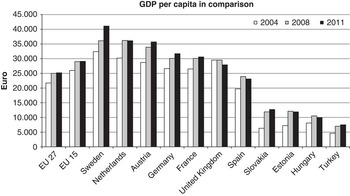
Currently, Turkey is a large country in terms of population size relative to Europe (2011: 14.7% of the EU-27 population) but comparatively small relative to its economic output (2011: 4.4% of EU-27 GDP). With a population size of 73.7 million in 2011, i.e. a population size 10% less than Germany, the value of its GDP at market prices amounted to €555,249 million, i.e., 78% less than Germany. Thus, GDP per capita is only 24% of the German and 30% of the EU-27 level (Table 1, Figure 1).
Population, migration, GDP and trade in comparison: 2011. Source: Eurostat

1) Turkey 2008
GDP per capita in comparison (nominal GDP per capita, Euro per inhabitant). Source: Eurostat.

But Turkey has seen a continuous improvement of its economic performance relative to Europe. In the 1980s, economic growth became dynamic as a result of macro-economic policy and trade reform linked to a steady depreciation of the Turkish currency thereby promoting export growth.Reference Arslan and van Wijnbergen3 The decision to abandon the development strategy of import substitution and to turn to a more market-based export orientation gave a boost to international trade, particularly in the 1980s. The dynamics resulted from increased industrial exports while the value of agricultural exports remained fairly stable over time. The major exported industrial products were textiles, apparel, leather goods, electrical equipment, chemicals, and later also iron and steel industrial products. Turkey sustained a real export growth rate of 20% over the period 1980–1987.
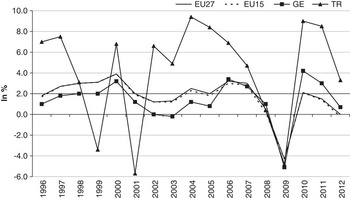
Economic growth was quite volatile, however, particularly from the 1990s onwards (Figure 2). In the wake of a deep recession in 2001, a turnaround in capital flows gave rise to a financial crisis that affected the real economy and led to a 4.8% decline in GDP 2009.Reference Rodrik4 In 2010, economic growth picked up again and reached 9%. Turkey is thus back on the growth path, albeit a volatile one. Turkey's economy remains vulnerable, depending on foreign capital to fuel economic growth. Due to a declared preference for international trade rather than for foreign direct investment (FDI) as a vehicle for economic growth, Turkey failed to attract FDI until recently.Reference Erdilek5 It was not until 2003, when Turkey undertook a legislative reform of FDI offering foreign investors treatment equal to national investors, that FDI inflows started to pick up.
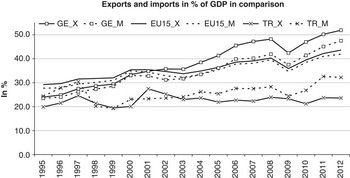
The extent to which Turkish economic growth depends on international trade, above all with Europe, can be taken from trade linkages with Europe.Reference Akkoyunlu, Kholodilin and Siliverstovs6 In 2011, Turkish exports had a value of 24% of GDP; about half of Turkey's exports went to Europe. In addition, the banking system is closely tied up with the euro-zone.7 Compared with many European countries, Turkey has not yet achieved its full potential, given that the share of exported and imported goods and services in percentage of GDP is significantly lower in Turkey. Exports in the EU-15 represent 43.7% of GDP (Germany 50.2%) in 2011 and imports 42.5% (Germany 45.1%).
In contrast, Turkey still depends largely on its domestic market for economic growth. Exports amounted to no more than 23.7% of GDP in 2011 and imports to 32.6%. Exports tend to remain fairly stable relative to GDP, while imports are on a rise, signalling a significant trade deficit, which has been a feature of the Turkish economy for a long time. Trade between Europe and Turkey entails mainly commodities. The main trading partner in Europe is Germany, but increasingly the Middle East, Saudi Arabia and Egypt are becoming important export markets for Turkish products (Figures 2 and 3).
Economic growth rate (real GDP) 1996–2012. Source: Eurostat.

Total exports and imports of goods and services in percentage of GDP: EU 15, Germany and Turkey (1995–2012). Source: Eurostat.

The large gap between exports and imports in Turkey results in a big current account deficit, which creates the need for foreign capital, as the national savings rate is low. But there is reluctance on the part of Turkish policy to curb domestic demand, as many of Turkey's large export markets are struggling to stay competitive. Therefore, great hopes are placed on FDI, with Europe taking a leading role, to promote economic growth.Reference Vural and Zortuk8 In 2011, of the total FDI inflows to Turkey of €12.5 million, 71% originated in the EU27.9 Turkey is amongst those countries with the fastest growth rates of FDI coming from Europe. The sectors receiving the largest share of FDI are the energy sector, financial intermediaries, manufacturing industries, largely refined petroleum products, but also consumer goods (textiles, electrical equipment) and food production as well as trade and real estate.
The major challenge for stable and sustainable economic growth in Turkey is seen to be insufficient investment in the ‘productive potential’ of its workforce.Reference Betcherman, Fares and Sanchez10 This shows up in a comparatively low labour force participation rate, in particular of women (in 2011, 31% compared with 64.9% in the EU-27 and 66.2% in the EU-15). Labour force participation of women has been declining in Turkey since the late 1980s (1989: 36.3%). The decline has been more pronounced than warranted by the decreasing share of agriculture in total employment and the rural-urban population shift.
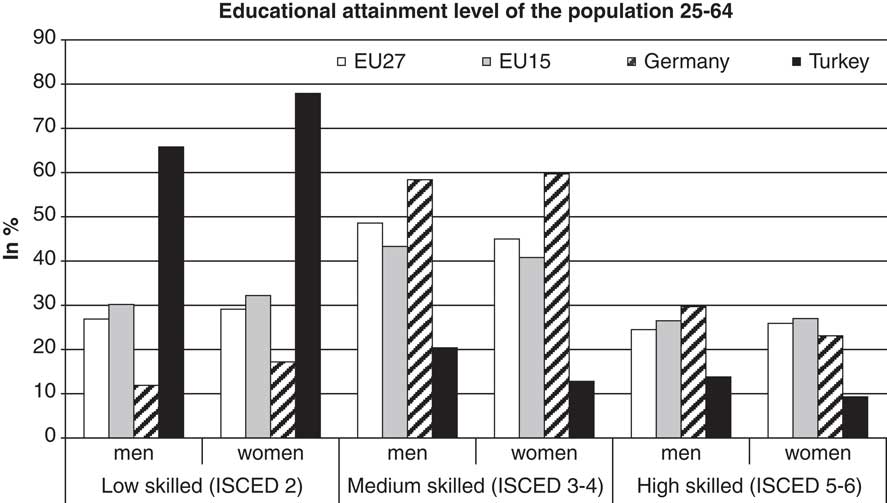
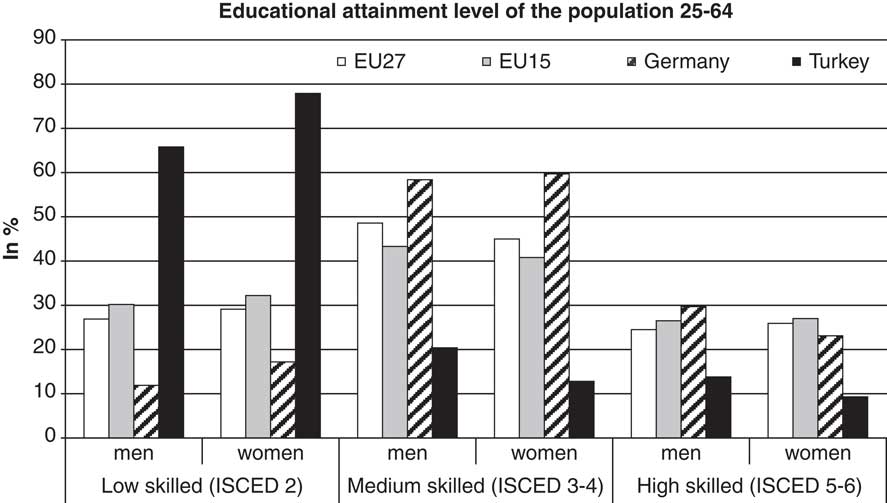
Furthermore, the educational attainment level of the workforce is very low, particularly of women. In 2009, 78% of all 25–64 year old women had lower secondary education as their highest educational attainment level (men 66%) compared with 32% in the EU-15 and 17% in Germany. The composition of skills is highly polarised in Turkey, contrary to countries such as Germany, where some 60% of the 25–64 year olds have medium level skills, often of a vocational nature (compared with some 13% in Turkey). The share of university graduates is comparatively high in Turkey, however, with 14% of men aged 25–64 and 9% of women (Figure 4).
Share of persons by educational attainment level (population 25-64) in comparison: 2009. Source: Eurostat.
The low educational attainment level of the population is all the more worrying as there is slow progress in the educational attainment level of youth. Compulsory schooling was raised from 5 years to 8 years as late as 1997. In 2012, another education reform bill was passed, raising compulsory schooling to 12 years. The latest bill is highly contested because it brings Islamic schools back into the middle school system. The outcome of schooling is, according to PISA surveys, in the lower tier of all countries tested.11 This is also the case of Turkish migrants in Europe, starting from a below average performance level. The PISA results indicate that youth of Turkish migrant background tend to be less successful than other migrant groups.12 However, between 2006 and 2009 Turkey was among those countries with impressive gains from very low levels of performance of 15-year-olds. It has to be taken into account, however, that 35% of 15-year-olds are no longer enrolled in school in Turkey compared with 10% in the OECD on average. It can be assumed that they would not reach level 2 proficiency in reading.11
In the absence of apprenticeship programmes and other forms of vocational education and training comparable to Europe, the Turkish economic development strategy to invest in manufacturing industries, thereby wanting to stabilise economic growth, is facing various challenges, one of which is the acute skill shortage of the workforce. The scarcity of workers in the medium to higher skill segment goes hand in hand with an oversupply of unskilled workers. As a result, the unemployment rates of the 15–24 year olds are high, as are the inactivity rates (out of the labour force). If the Turkish economy does not generate more jobs for its youths and promote their vocational skills, the large youth cohorts can be a source of social unrest and raise the pressure to migrate. This is a matter of concern of the EU in view of the accession of Turkey to the EU.
Role of Migration in Economic Relations of Europe and Turkey
The strong influx of Turkish workers to Europe, in particular to Germany and Austria in the 1950s and 1960s, was a major contributory factor for the ‘Wirtschaftswunder’, i.e. rapid economic growth and catching up. At the same time, the outflow of unused or inefficiently used labour resources from Turkey to Europe released the pressure on Turkey to restructure its economy. The slowdown of Turkish immigration to Europe from the 1980s until today has to be seen as a reaction to changing labour market needs in Europe on the one hand and the persistence of low-skilled outmigration from Turkey on the other. The latter was partly a result of path dependence (family migration), partly a consequence of the slow improvement of the educational attainment of the Turkish workforce.
Migration of Turks to Europe has raised the productive potential of Europe by raising labour supply. It has decreased the inflationary potential by reducing labour scarcities, particularly in the low wage services industries, and promoted trade between Europe and Turkey. The latter resulted on the one hand from the consumption preferences of Turkish migrants in Europe, raising the demand for Turkish goods exported to Europe, on the other from their investment in European products, often durable consumer goods, which are exported to Turkey.Reference Venables13
In Europe, the two countries most interlinked by migration and trade with Turkey are Germany and Austria. It was not until the year 2000 that massive migration flows from Turkey to Germany and Austria came to an end and return-migration set in. In 2008, 9900 Germans, often of Turkish background, migrated to Turkey while at the same time 26,700 Turks moved to Germany (net immigration to Germany of 16,800). In the case of Austria, 5000 Turks migrated to Austria while fewer than 1000 Austrians moved to Turkey.14 Evidently, the migratory process between Turkey and Europe (in particular Germany and Austria) has entered a new stage. As the demand for Turkish migrants declined in the wake of rapid economic restructuring and internationalisation of manufacturing production in Europe, industrialisation of Turkey offers job opportunities for skilled workers, often the children of former émigrés who obtained vocational skills in Europe. This is in stark contrast to the early 1980s, when rising youth unemployment in Europe triggered off repatriation schemes, e.g. in Germany in 1984, mainly aimed at migrants from Turkey, offering financial incentives to return.Reference Hönekopp15 Not many Turks returned to Turkey then. Instead, they increasingly worked on their own account, finding niches in domestic demand, starting up ethnic businesses and bridging Europe and Turkey through trade.Reference Biffl16 The creation of ethnic business gained momentum in the 1990s, indicating de facto settlement. Turkish business start ups have become important drivers of trade between Europe and Turkey, importing Turkish products to satisfy consumer demand and exporting European manufacturing goods to Turkey. Settlement went hand in hand with family re-unification, which explains the constant inflow of family members.
Traditional trade theory suggests that the slowdown in net migration and the onset of reciprocal migration flows between countries such as Germany and Turkey is linked to increasing trade flows, often linked to the relocation of low-tech production from Germany to Turkey and rising intra-country trade. Research results on these interrelationships are ambiguous, however. Akkoyunlu and SiliverstovsReference Akkoyunlu and Siliverstovs17, 18 conclude that trade and migration are complements as far as Turkish migration to Germany is concerned, i.e. reciprocal migration is promoting the economic relationship between Germany and Turkey. While migration from Germany to Turkey tends to reduce the skilled labour shortage of Turkey, thereby promoting the production potential and economic growth, migration from Turkey to Europe raises the demand for Turkish consumer goods in Germany.
BruderReference Bruder19 argues that the linkage between migration and trade is comparatively weak due to the important role of family reunion with Turkish migrants in Germany. Insel and CakmakReference Insel and Sungur Cakmak20 analyse the economic relationship with Turkish migration in Austria, Germany and other major European immigration countries of Turkish citizens during the period 1980 to 2007. They find that Turkish immigrants have an impact on trade with Turkey due to preference and network channels. They demonstrate that Turkey's exports to Europe are strongly influenced by the consumer preferences of Turkish immigrants for home country products, mainly after 1996 in the wake of the Customs Union Agreement of that year. On the other hand, Turkish migrants contribute to Turkey's imports from Europe, in particular of intermediary and capital goods through network channels. By sending on average more than €2 million of remittances annually to Turkey, Turkish migrants in Europe contribute to investment and consumption in Turkey, thereby promoting economic growth. This point is examined in more detail by Akkoyunlu and KholodilinReference Akkoyunlu and Kholodilin21 and Akkoyunlu and Siliverstovs.Reference Akkoyunlu and Siliverstovs22 They conclude that remittances buffer, above all, the negative consequences of economic volatility in Turkey for poor households; thereby, they stabilise consumer demand.
Concluding Remarks
Empirical research indicates that migration and economic relations, such as trade and capital flows, between Europe and Turkey have woven a complex tissue of relationships which, for better for worse, glue the countries together. While the economic development level of Turkey and the legal ramifications are set for manufacturing industries to boost economic growth, the national supply of skilled labour is tight in Turkey, and thus puts a break on economic growth. Consequently, employment opportunities for skilled workers attract migrants from abroad, often descendants of former Turkish emigrants to Europe, putting reverse migration on track. At the same time family re-unification and chain migration fuel a continuous flow of Turkish migrants to Europe. The latter alleviate socio-economic challenges resulting from population ageing while at the same time keeping Turkish culture and traditions alive in Europe. Transnational migration does create not only human networks but also economic linkages, contributing to an increasing diversity of life styles in Europe as well as in Turkey, above all in urban areas.Reference Sassen23, Reference Coskun and Yalcin24 There is a major challenge, however, for a fruitful relationship between Europe and Turkey, namely youth unemployment. If Europe and Turkey fail in providing adequate jobs for large numbers of youth and/or raise their educational attainment level and competencies to improve their employability, migration may become a critical factor for relations between Europe and Turkey.
Gudrun Biffl obtained a PhD in Economics from the University of Newcastle upon Tyne, in the UK, in 1975; thereafter, she joined the Austrian Institute of Economic Research (WIFO) in Vienna, specialising in labour market research. Biffl left WIFO in 2008 for the Danube University Krems, where she is dean of the faculty of economics and globalisation and head of the Department of Migration and Globalisation. She is a consultant to the OECD on migration (SOPEMI correspondent), a member of the expert council on integration in the Ministry of the Interior, a member of the board of directors (Universitätsrat) of the Johannes Kepler University, and a member of the editorial board of the Journal of Immigrant and Refugee Studies. She has published widely on education, labour market, migration and gender issues.