Introduction
Carmine spider mites (Tetranychus cinnabarinus Boisd.) of order Acarina and family Tetranychidae are one of the most menacing polyphagous pests, causing significant harm to crops and vegetables in fields and greenhouses worldwide (Yu et al., Reference Yu, Yue, Dong, Li and Li2016). Mites can cause bronze or tan-coloured leaf stippling after infecting various plants, such as eggplants, capsicums, watermelons, beans and green onions (Schmidt, Reference Schmidt2014). Currently, mites are mainly controlled by chemical synthetic acaricides, and the frequent application of simple chemical drugs always results in rapid development of drug resistance (Kwon et al., Reference Kwon, Clark and Si2014; Diaz, Reference Diaz2016). Furthermore, the use of chemical pesticides causes high mortalities of natural enemies and non-target organisms as well as undesirable effects on humans and the environment (Cavalcanti et al., Reference Cavalcanti, Niculau, Blank, Câmara, Araújo and Alves2010; Nicolopouloustamati et al., Reference Nicolopouloustamati, Maipas, Kotampasi, Stamatis and Hens2016). Therefore, it is crucial that novel, effective, anti-resistant, safe and eco-friendly chemical control alternatives are identified and developed.
Recently, phytogenic acaricides that are non-toxic to mammals and have low to no residual effects on the environment were found to be reasonable candidates for mite management (Benelli et al., Reference Benelli, Pavela, Canale and Mehlhorn2016). Extracts of various plants such as Polygonum aviculare, Stellera chamaejasme, Inula japonica, Juglans regia, Albizzia julibrissin and Mentha piperita show acaricidal activities against mites (Wang et al., Reference Wang, Shi, Zhao, Liu, Yu, Clarke and Sun2007b, Reference Wang, Jia, Chen, Yu and Dai2013; Ren et al., Reference Ren, Shi, Wang, Gu and Wang2009a; Duan et al., Reference Duan, Bu, Ma, Liu, Wang and Shi2012). These phytogenic acaricides have clear inhibitory effects on the growth and reproduction of mites through repellence, oviposition deterrence and growth regulation (Singh & Saratchandra, Reference Singh and Saratchandra2005).
Lettuce (Lactuca sativa), the most popular vegetable in salads (Oyinlola et al., Reference Oyinlola, Obadina, Omemu and Oyewole2017), belongs to the botanical family of Asteraceae and is regarded as a healthy food due to the high contents of vitamin C, flavonols and fibre (Serafini et al., Reference Serafini, Bugianesi, Salucci, Azzini, Raguzzini and Maiani2002; Nicolle et al., Reference Nicolle, Cardinault, Gueux, Jaffrelo, Rock, Mazur, Amouroux and Rémésy2004; Llorach et al., Reference Llorach, Gil and Ferreres2008). The medicinal values of lettuce have been revealed by various studies. In one such study, it was found that methanol extracts of lettuce exhibited a high hydroxyl radical-scavenging activity (IC 50 = 3.5 mg ml−1), low minimum inhibitory concentrations against Gram-positive bacteria (2.5 mg ml−1) and high anti-viral activity against HCMV and Cox-B3 viruses (IC 50 = 200 mg ml−1) (Edziri et al., Reference Edziri, Smach, Ammar, Mahjoub, Mighri, Aouni and Mastouri2011). Extracts of lettuce seeds showed a dose-dependent anti-inflammatory activity in a carrageenan model of inflammation (Sayyah et al., Reference Sayyah, Hadidi and Kamalinejad2004). At 6–42 h post-treatment, the anti-feeding effect of lettuce extracts on Phyllotreta striolata (F.) was 100% (Lai & You, Reference Lai and You2004). However, studies on the acaricidal activity of lettuce extracts are still limited.
In this study, acaricidal activities of lettuce extracts of different plant parts (the leaf, root and seed) using various solvents (petroleum ether, acetone and methanol) were evaluated. Acetone extracts of lettuce leaves harvested in July and September were fractionated and isolated, and an active acaricidal component was identified. Our findings may reveal a novel phytogenic acaricide without resistance or potential hazard to humans and the environment.
Materials and methods
Materials
Lettuce (Crisphead lettuce, Dongshan) seeds were purchased from a local market and identified by Professor Li X.Y. in the College of Horticulture, Southwest University. Lettuce seeds were sown in an experimental plot of Southwest University (Beipei, Chongqing, China) in April and June 2012, and leaf and root samples were harvested in July and September 2012. A T. cinnabarinus Boisd. colony was reared on cowpea plants (Vigna unguiculata) in a laboratory of Southwest University at 26 ± 1°C, 75–80% relative humidity (RH) and a photoperiod of 16:8 h (light:dark). These mites had been maintained for >16 years without exposure to any pesticides (Hou et al., Reference Hou, Wang, Zhang, Wei and Zhang2015). Petroleum ether, acetone, ethyl acetate, methanol and Tween-80 were purchased from Kelong Chemical Reagents Co., Ltd. (Chengdu, China).
Extraction
Lettuce root, leaf and seed samples were dried at 50°C for 3 days and ground into powder and screened through an 80-mesh screen. A total of 50 g pretreated samples were immersed in 60–90°C petroleum ether, acetone or methanol at a proportion of 1.0 ml 0.2 g−1 for 3 days at room temperature. After filtering, crude extracts were evaporated at 40°C using a vacuum rotary evaporator (R-201, Shanghai Shenshen) and kept in glass vials at 4°C until use (Ding et al., Reference Ding, Ding, Zhang and Luo2013).
Isolation of acaricidal components
Acetone extracts of lettuce leaves in July were purified by column chromatography (200–300 mesh, Haiyang Chemical Co. Ltd., Qingdao, China) and eluted with a gradient of petroleum ether:ethyl acetate (10:1, 8:1, 6:1, 4:1, 2:1, 0:1; v/v) and ethyl acetate:methanol (10:0, 5:1, 5:2, 5:3, 5:4, 1:1; v/v). A total of 138 initial fractions (75 ml each) were collected. Based on R f values, 27 fractions were obtained through thin-layer chromatography. Then, the fractions with high acaricidal activities (11th and 12th fractions) were further purified on a silica gel column (Haiyang Chemical Co. Ltd., Qingdao, China) and eluted with dichloromethane:ethyl acetate (200:1, v/v) (Ding et al., Reference Ding, Ding, Zhang and Luo2013).
Bioassays
A modified slide-dip method recommended by the Food and Agriculture Organization (FAO) was used to test the contact toxicity of different lettuce extracts against mites (Annonymous, 1980). A total of 40 adult female mites were fixed on a slide with double-sided adhesive tape using a fine brush and maintained at 26 ± 1°C and 65–80% RH for 4 h. Dead and inactive mites were removed after examination under a stereomicroscope (4×). Thirty remaining active mites were recorded as the starting number. Based on probit analysis in our previous study, 10 mg ml−1 caused 95% corrected mortality and 0.313 mg ml−1 caused 17% corrected mortality in carmine spider mites; therefore, concentrations 0.313, 0.625, 1.250, 2.50, 5.0 and 10.0 mg ml−1 were chosen. Then, slides with mites were dipped into extract dilutions for 5 s. Each millilitre of extract solution contained 2.5 mg extract, 1% Tween-80 and 0.5% acetone (to increase solubility), and the control contained only the same percentage of Tween-80 and acetone. Propargite with 1% Tween-80 and 0.5% acetone was used as positive control. Excess solution on slides was removed using filter paper. Live and dead mites were counted at 24, 48 and 72 h post-treatment. A mite was considered to be dead when its legs or abdomen did not respond to repeated gentle probing with a fine brush. Corrected mortality was calculated using Abbott's formula recommended by FAO (Abbott, Reference Abbott1987):
 $$\eqalign{ {\rm Corrected}\;{\rm mortality} = &\displaystyle{{({\rm Mortality}_{{\rm Treatment}\;{\rm group}} - {\rm Mortality}_{{\rm control}\;{\rm group}} )} \over {(1 - {\rm Mortality}_{{\rm control}\;{\rm group}} )}} \cr &\times 100\% _.} $$
Mite mortalities induced by the 27 fractions (1 mg ml−1) prepared from acetone extracts of lettuce leaves were also analysed. All treatments were tested under the same conditions as described above, and three replicates for each extract were performed.
Ovicidal activity of extracts was measured as previously described (Liu et al., Reference Liu, Hu, Yu, Niu and Li2012). Mite eggs were numbered and placed in the centre of a Petri dish. After immersing in the diluted solution for 5 s, hatching rate was assessed at 120 h post-treatment using the following formula:
 $${\rm Ovicidal}\;{\rm rate} = \displaystyle{{{\rm Number}\;{\rm of}\;{\rm hatched}\;{\rm eggs}} \over {{\rm Total}\;{\rm number}\;{\rm of}\;{\rm eggs}}} \times 100\%. $$
Finally, the median lethal concentration (LC50) value of extracts for eggs and adult mites was determined.
Component analysis
Components of lettuce extracts with high acaricidal activities were further identified by liquid chromatography/mass spectrometry (LC/MS) using a chromatograph (Water 2487-ZQ 4000) with an LC column (10 m, 2.1 mm, 3.5 µm, coated with Xterra C18). Component characteristics were evaluated with infrared (IR) spectra using a Shimadzu Infinity FTIR spectrometer equipped with three reflectional ATR units. Nuclear magnetic resonance (NMR) experiments, including 1H-NMR (300 MHz, CDCl3) and 13C-NMR (75 MHz, CDCl3) were performed using an NMR spectrometer (Bruker Avance 600 MHz, BRUKER, Germany).
Data analysis
All data were expressed as means ± SD. Statistical analyses were performed using SPSS version 17.0 (SPSS Inc., Chicago, IL, USA). Comparison between different groups was determined using one-way or two-way analysis of variance, followed by Duncan's multiple-range test or Bonferroni's test. A P-value of <0.05 was considered to be significantly different. LC50 (complementary log–log model) and 95% confidence intervals were obtained by probit analysis using SAS 8.01 software (Cary, NC, USA) (Kinoshita et al., Reference Kinoshita, Koura, Kariya, Ohsaki and Watanabe1999; SAS, Reference SAS2000).
Results
Acaricidal activities of crude extracts from lettuce
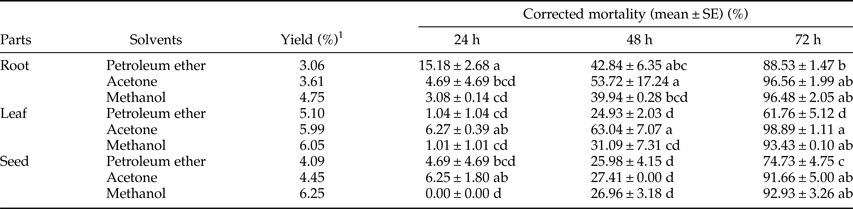
Polar, medium polar and non-polar compounds were extracted from different parts of lettuce (the root, leaf and seed) using different solvents (methanol, acetone and petroleum ether). As shown in table 1, extract yields of lettuce increased with solvent polarity (methanol > acetone > petroleum ether). Meanwhile, extract yields of lettuce leaves were significantly higher than those of roots and seeds.
Yield of extracts from different parts of lettuce by different solvents and corrected mortalities against adult female mites.

1 Yield (%) = (dry weight of extract/dry weight of test plant) × 100%. Different lowercase letter presented significant differences at P < 0.05 by two-way ANOVA with Bonferroni's test.
Mite mortality significantly increased with time on treatment with extracts from different parts of lettuce. The acaricidal activity of leaf extracts was significantly higher than those of root and seed extracts. For leaf extracts, acetone extracts exhibited significantly higher acaricidal activity than petroleum ether and methanol extracts. Further, the related mite mortality induced by acetone extracts of leaves was revealed to be 63.04 and 98.89% at 48 and 72 h post-treatment, respectively (table 1).
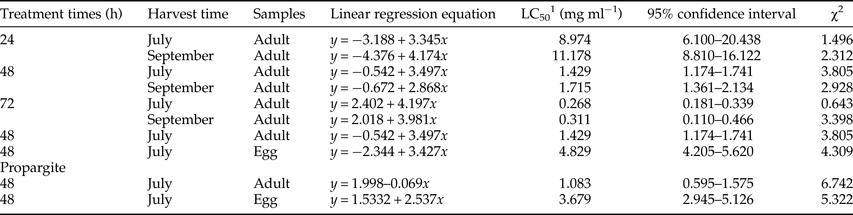
Acaricidal activities of acetone extracts from lettuce leaves at different harvest months
Since acetone extracts of lettuce leaves exhibited relatively high acaricidal activity, the effects of different harvest months were evaluated. As shown in table 2, acetone extracts of lettuce leaves harvested in July were more toxic to adult mites than those harvested in September, exhibiting LC50 of 8.974, 1.429 and 0.268 mg ml−1 at 24, 48 and 72 h post-treatment, respectively. In addition, acetone extracts of leaves harvested in July exhibited higher acaricidal activities against adult mites than eggs at 48 h post-treatment (LC50: 1.429 vs. 4.829 mg ml−1). The toxicity of acetone extracts of leaves harvested in July against adult mites and eggs was almost equal to that of propargite (LC50 adult: 1.429 vs. 1.083 mg ml−1; LC50 egg: 4.829 vs. 3.679 mg ml−1) (table 2).
Toxicity regression analysis of acetone extracts from lettuce leaves in July and September against adult female mites and eggs.

1 Presented significant differences at P < 0.05 by Probit analysis.
Acaricidal activities of different fractions of acetone extracts of lettuce leaves
A total of 27 fractions were obtained from the acetone extracts of lettuce leaves harvested in July with column chromatography. As shown in fig. 1, mite mortalities induced by the 11th and 12th fractions (93.47 and 96.91%) were significantly higher than those induced by the other 25 fractions at 48 h post-treatment. However, yields of the 11th and 12th fractions were relatively low (1.56 and 0.71%). Besides, the 13th, 18th and 23rd fractions also exhibited relatively high acaricidal activities, and the corrected mite mortalities were 85.03, 85.06 and 84.32%, respectively. Furthermore, toxicity regression analyses showed that the 11th and 12th fractions exhibited significantly higher acaricidal activities against adult mites than did total acetone extracts of leaves at 48 h post-treatment (LC50: 0.751 and 1.258 vs. 1.429 mg ml−1) (table 3).
Yield of extracts from different fractions of acetone extracts of lettuce leaves in July and related corrected mortalities against adult female mites at 48 h post-treatment (1 mg ml−1).

Toxicity regression analysis of the 11th and 12th fractions from acetone extracts of lettuce leaves in July against adult female mites.

1 Presented significant differences at P < 0.05 by Probit analysis.
Acaricidal activities of different components in the 11th fraction
A total of five components were isolated from the 11th fraction through column chromatography. Bioassays showed that the corrected mite mortality induced by these components increased with treatment time. At 48 h post-treatment, the highest mite mortality was induced by component 11-b, followed by component 11-a (89.00 and 69.35%, respectively). At 72 h post-treatment, the mortalities induced by these two components reached 100% (table 4). An LC50 of 0.288 and 0.114 mg ml−1 was measured for components 11-a and 11-b, respectively, at 48 h post-treatment (table 5).
Corrected mortality of female adult mites treated with different compounds of the 11th fraction at 1 mg ml−1.

Different lowercase letter presented significant differences at P < 0.05 by one-way ANOVA with Duncan’ multiple test.
Toxicity regression of compounds 11-a and 11-b from the 11th fraction against adult female mites.

1 Presented significant differences at P < 0.05 by Probit analysis.
Characterization of component 11-a
As component 11-b was unstable, component 11-a was further characterized by NMR, IR and LC/MS. Component 11-a exhibited a colourless needle crystal form as deduced from ESI-MS (m/z, %) 414 [M–H+]. By comparing spectral data with literature data, component 11-a was identified as β-sitosterol (C29H50O).
Discussion
Recently, the application of synthetic chemical acaricides has increased pest resistance and environmental pollution. Researchers have shifted their attention to phytochemical studies to discover efficient and environmentally compatible extracts with low toxicity and acaricidal activities (Afify et al., Reference Afify, El-Beltagi, Fayed and Shalaby2011). Secondary metabolites of some medicinal plants, such as neem and chrysanthemum, with potent bioactivities against pests have been identified and exploited to protect crops in field (Chen et al., Reference Chen, Deng, Yin, Wei, Li, Jia, Xu, Li, Song and Liang2014; Stewart et al., Reference Stewart, Shipley, Ireland, Jarrell, Timlin, Shike and Felix2016). In this study, obvious acaricidal activity was revealed from acetone extracts of lettuce leaves harvested in July. The active component from acetone extracts of leaves with high acaricidal activity was isolated and identified as β-sitosterol. Our results provide a valuable reference for the development of novel pesticides for mite control.
Extraction solvents are considered to be a key influential factor in the isolation of acaricidal compounds (Lapornik et al., Reference Lapornik, Prošek and Golc Wondra2005). Methanolic extracts of Andrographis echioides showed maximal larvicidal and acaricidal activities against Aedes aegypti, Culex quinquefasciatus and Rhipicephalus microplus (Mathivanan et al., Reference Mathivanan, Gandhi, Mary and Suseem2017). Compared with methanol and chloroform extracts, petroleum ether extracts of Momordica cochinchinensis exhibited the highest extraction rate and the most effective acaricidal activity against T. cinnabarinus (Huili et al., Reference Huili, Guanglu, Liangxi, Dongfeng and Younian2012). In our study, extract yields of lettuce increased with increasing solvent polarity (methanol > acetone > petroleum ether), and a relatively high acaricidal activity was revealed for acetone extracts compared with those for methanol and petroleum ether extracts. These results indicate that active acaricidal components of lettuce were more likely to be stable in acetone than in methanol and petroleum ether.
As acaricidal components may be concentrated in one part of the plant, researchers attempted to evaluate acaricidal activities of different parts of the plant, such as the root, leaf, seed and fruit (Zahir et al., Reference Zahir, Rahuman, Kamaraj, Bagavan, Elango, Sangaran and Kumar2009; Dantas et al., Reference Dantas, Machado, Araujo, Oliveira-Junior, Lima-Saraiva, Ribeiro, Almeida and Horta2015). For example, acetone extract of Artemisia annua leaf was most toxic to mites, and the corrected mortality was 100% at 48 h post-treatment (Zhang et al., Reference Zhang, Ding, Zhao, Wu and Fan2008). Acetone extract of J. regia leaf exhibited the highest acaricidal activity against T. viennensis (LC50 = 90 ppm) (Wang et al., Reference Wang, Shi, Zhao, Liu, Yu, Clarke and Sun2007a). Consistent with these studies, we found that acetone extracts of lettuce leaves have the highest acaricidal activity against adult female mites. In view of the leaf as a key organ for synthesis and metabolism, active acaricidal components of lettuce appear to be more concentrated in leaves. In addition, the harvest time of leaves could also influence the content and activity of acaricidal compounds (Liu et al., Reference Liu, Ardo, Bunning, Parry, Zhou, Stushnoff, Stoniker, Yu and Kendall2007a; Ferraz et al., Reference Ferraz, Balbino, Zini, Ribeiro, Bordignon and Poser2010). Lettuce harvested in July exhibited higher total phenolic content and anti-oxidant capacity than those harvested in September (Liu et al., Reference Liu, Ardo, Bunning, Parry, Zhou, Stushnoff, Stoniker, Yu and Kendall2007b). Consistent with this, we also found significantly higher extract yields and higher acaricidal activity from lettuce leaves harvested in July than those harvested in September. As July is a growing period with a long photoperiod and high temperatures, more active secondary metabolites may be accumulated in lettuce leaves in this month than in September. Moreover, obvious ovicidal activity against T. Cinnabarinus eggs was first confirmed from acetone extracts of lettuce leaves harvested in July in this study. The toxicity of acetone extracts of leaves harvested in July against adult mites and eggs was almost equal to the toxicity of propargite.
Through bioassay-guided fractionation of acetone extracts of lettuce leaves harvested in July, a total of 27 fractions were obtained and the 11th fraction exhibited the highest acaricidal activity. Among five components in the 11th fraction, relatively high mite mortality was induced by components 11-a and 11-b, and component 11-b was unstable. The characteristics measured by NMR, IR and LC/MS for component 11-a were consistent with β-sitosterol (Trivedi & Choudhrey, Reference Trivedi and Choudhrey2011; Sen et al., Reference Sen, Dhavan, Shukla, Singh and Tejovathi2013). β-sitosterol, a tetracyclic triterpene, is a main type of phytosterols widely found in various medicinal plants. β-sitosterol exhibited obvious anti-insect activity, which could directly induce metabolic imbalance and protein changes in insects (Bu et al., Reference Bu, Li, Wang, Shi, Peng, Han, Gao and Wang2015). It has been reported that an insecticidal ingredient isolated from Thymus monglicus was identified to be β-sitosterol (Feng et al., Reference Feng, Zhang, Bai and Peng2009). Insecticidal, anti-feeding and fungicidal activities were exhibited by β-sitosterol from Nothofagus dombeyi and N. pumilio (Thoison et al., Reference Thoison, Sevenet, Niemeyer and Russell2004). β-sitosterol exhibited obvious larvicidal effects on A. aegypti L, Anopheles stephensi Liston and C. quinquefasciatus, and related LC50 values were revealed to be 11.49, 3.58 and 26.67 ppm, respectively (Abdul et al., Reference Abdul, Gopalakrishnan, Venkatesan and Geetha2008). Petroleum ether extracts of M. piperita were effective against T. Cinnabarinus, exhibiting a mortality rate of 87.05% against adult mites and 93.16% against eggs, and the principal acaricidal component was β-sitosterol (LC50 = 0.546 mg ml−1) (Ren et al., Reference Ren, Shi, Wang, Gu and Wang2009b). All these studies are consistent with our results and further illustrate β-sitosterol as an active acaricidal component in lettuce leaves and a natural acaricidal agent to control mites.
In conclusion, acetone extracts of lettuce leaves harvested in July exhibited relatively high acaricidal activities. The active acaricidal compound of lettuce leaf was identified to be β-sitosterol. Our findings lay the foundation for the development of novel phytogenic acaricides without hazard to humans and the environment. However, this study was performed only in the laboratory and field experiments are still needed. Meanwhile, the mechanisms of β-sitosterol's acaricidal activity still need to be studied.
Acknowledgements
This work was supported by the National Nature Science Foundation (31272058) and the Natural Science Fund of Chongqing (CSTC2011jj80004). The authors thank Dr Du-qiang Luo for assistance in isolation and purification of acaricidal active compounds. The authors also thank Li-juan Ding for technical assistance in processing mites.
Conflict of interest
All authors declare that they have no conflict of interest to state.