In the past decade, more than thirty million people have fled their home country because of violence.Footnote 1 Globally, the total number of refugees is now more than twenty-five million, the highest it has been since the end of World War II. As humanitarian agencies and host-country governments struggle to meet the needs of historic numbers of displaced persons, they have increasingly called on ordinary citizens to welcome refugees into their homes and communities through resettlement and local integration programs.Footnote 2 Building support for these efforts, however, has proven to be a challenge. Particularly in developing countries, large inflows of refugees have been shown to deplete scarce resources, exacerbate ethnic tensions and increase the risk of civil conflict.Footnote 3
Prior research shows that cultural ties and humanitarian concern play an important role in motivating residents to welcome refugees despite the costs and risks associated with doing so.Footnote 4 Conversely, studies have shown that a lack of cultural ties and ethnic divisions can make individuals reluctant to welcome refugees, particularly during times of economic scarcity.Footnote 5 In this article, we extend this literature by evaluating how past experience with violence influences individuals’ willingness to host refugees, focusing in particular on how violence moderates the relative importance of cultural and humanitarian considerations.
Our analysis is motivated by the observation that the vast majority of refugees flee to countries or regions that have experienced civil war or conflict in the past quarter century.Footnote 6 In these settings, many of those called on to host or otherwise assist refugees will have themselves been affected by violence and displacement in the recent past. Do these experiences make individuals less willing to assist refugees from ethnic or religious ‘outgroups’? Or do they develop sympathies that transcend group boundaries and motivate helping behavior regardless of the ethnic or religious identity of those in need?
In considering these questions, we engage with a small but growing body of research on the social legacies of violence in regions recovering from conflict.Footnote 7 This literature offers two competing perspectives. First, consistent with theories of ‘parochial altruism’ in psychology, several studies have suggested that violence increases ingroup allegiance and hardens hostilities toward rival or potentially threatening ‘outgroups’.Footnote 8 To the extent that refugees come from ethnic groups that have previously been in conflict with local communities, or insofar as they heighten competition over scarce resources, activating a sense of group-based threat, this literature implies that prior exposure to violence will reduce support for outgroup refugees.
An alternative perspective links violence to potentially generalized improvements in altruism, community engagement and political participation.Footnote 9 To account for these findings, these studies invoke post-traumatic growth theory (PTGT), which posits a prosocial (re-)orientation of goals, priorities and perspectives in the aftermath of traumatic events. How these changes might influence behavior toward refugees or other outgroups, however, remains unclear: PTGT does not address outgroup behavior, nor does it specify which particular motivations for prosocial behavior might be affected by violence. And because these studies largely come from settings in which ethnic divisions are muted, it is possible that their results capture parochial rather than generalized changes in prosocial behavior.
The emergent literature on violence and prosocial behavior thus does not provide clear predictions regarding how violence might influence behavior toward ethnic or religious outgroups. We address this gap by identifying empathy born of violence as a mechanism by which prior exposure to violence can motivate prosocial behavior across group boundaries. We argue that violence can increase individuals’ capacity to empathize with others, and that such ‘empathy born of violence’ can in turn motivate altruistic behavior across group boundaries. In contrast to theories of parochial altruism, our argument predicts that violence-affected individuals will be more responsive to humanitarian considerations and less responsive to material or cultural considerations when deciding whether to assist those in need.
We test this argument using data on the hosting behavior of nearly 1,500 individuals during the 2010–11 Ivorian refugee crisis in Liberia, during which more than 150,000 Ivorians fled to eastern Liberia, a region itself deeply affected by civil war from 1990–2003. With humanitarian actors unprepared and overwhelmed, Ivorian refugees were forced to find refuge in Liberian towns and villages. The ethnic composition of the refugees mapped onto salient ethnic divisions in Liberia: some shared ethnic and religious ties with the local population, others lacked cultural ties, and some came from groups that had a history of conflict with local communities.
We provide four main results that support the empathy born of violence hypothesis. First, we show that individuals who directly or indirectly experienced violence during the Liberian civil war host more refugees overall – including those coethnic to their former wartime rivals. Secondly, we show that violence-affected individuals host a higher proportion of non-coethnic and Muslim refugees, as well as higher proportions of refugees who had health problems upon arrival or had fled direct violence. Thirdly, we employ a conjoint experiment to show that although biases against outgroup refugees are strong overall, individuals who experienced violence exhibit less bias and have stronger preferences for refugees in distress. And fourthly, by randomizing the survey module on past experience with violence to come immediately before or after the conjoint experiment, we show that preferences for the distressed are greater and outgroup biases are lower when individuals are primed to think about their own experiences with violence and displacement.
We also conducted a series of semi-structured field interviews to explore how Liberians reflected on their experience hosting refugees, and found that sympathies rooted in the shared experiences of hardship and displacement feature prominently in Liberians’ reflections on the crisis. More broadly, we document overwhelming generosity toward refugees amid extreme resource scarcity, consistent with the idea that empathy born of hardship can motivate helping behavior across group boundaries, even in the presence of severe resource constraints.
This article makes four contributions to existing research. First, we add to the literature on immigration, migration and forced displacement, which despite the fact that more than 90 per cent of those forcibly displaced flee to developing rather than developed countries,Footnote 10 has hitherto focused largely on Western attitudes and behaviors toward refugees and asylum seekers. Moreover, while this literature highlights economic and cultural threats as important drivers of individuals’ reluctance to support refugees or progressive immigration policies more generally,Footnote 11 it largely overlooks the potential for past experiences with conflict or hardship to overcome these concerns. We speculate that empathy born of past experiences with conflict, displacement and other hardships may underlie the impressive degree of hospitality toward refugees observed in many of the world’s poorest countries as compared to wealthy countries, where hardships are less common.
We also contribute to the literature on post-traumatic growth, which has struggled to pinpoint the mechanisms through which violence influences prosocial behavior and to discern whether or when these mechanisms motivate prosocial behavior toward outgroups. Addressing these limitations, we show that empathy born of violence can motivate altruistic behavior across group boundaries, even those hardened by wartime violence. We note, however, that our argument does not rule out the possibility that violence may sometimes have parochial effects on prosocial motivation, as many have argued. Rather, we merely show that violence can also (and perhaps simultaneously) affect prosocial motivation in ways that bridge identity boundaries, and that in some settings, these countervailing effects can dominate.Footnote 12
This reasoning has important implications for our broader understanding of violence and prosocial behavior in diverse settings. In particular, it highlights the importance of understanding the potentially numerous mechanisms through which violence may influence behavior, and considering how each may (or may not) influence behavior in a given post-conflict setting. While it is impossible to generalize from the findings of a single study, our focus on empathy suggests the legacies of violence are relatively less likely to be parochial in situations where empathetic motivations for behavior are salient.
The third contribution of our study is empirical. Identifying the effects of violence on intergroup behavior has been complicated in previous studies by the difficulty of measuring intergroup behavior in post-conflict settings – or more specifically, by the fact that our ability to observe intergroup behavior is endogenous to how violence influences outgroup preferences.Footnote 13 Prior research employs lab experiments to overcome these challenges, but these methods are subject to concerns about measurement validity, as several studies have shown that behavior in context-free experiments is a poor predictor of real-world behavior.Footnote 14 Our study avoids these hazards by examining real-world (if self-reported) behavior in a setting where concerns about endogenous interactions are significantly ameliorated by forced displacement resulting from exogenous political developments in a neighboring country. We complement these measures with a survey experiment and an empathetic prime, showing consistent results across all three analyses. To the best of our knowledge, we are the first to show that violence can motivate prosocial behavior across group boundaries in the real world.
Lastly, our study provides important policy lessons for humanitarians and scholars concerned with helping the world’s most vulnerable. In response to the growing incidence of protracted refugee crises and a push to avoid ‘warehousing’ refugees in overcrowded camps, humanitarian actors have increasingly turned to local integration.Footnote 15 This approach has also been seized upon as a way to offer support when refugee flows are variable or unpredictable and established refugee camps are unavailable.Footnote 16 However, despite the challenges that policy makers face in building support for these policies,Footnote 17 there has been little research on what might motivate individuals to support this approach. Our results suggest that framing generosity toward displaced people in terms of shared experiences and common humanity may be effective at generating support for these and other progressive refugee policies.
VIOLENCE, ALTRUISM AND SUPPORT FOR REFUGEES
A large literature in political science and psychology argues that conflict strengthens norms of ingroup allegiance and hardens hostilities toward rival or potentially threatening ‘outgroups’.Footnote 18 Consistent with this view, recent research at the micro level documents a strong association between exposure to wartime violence, hostile attitudes toward outgroups, and prosocial behavior within (but not between) ethnic groups.Footnote 19
While this literature has generally focused on behavior within war-torn countries, there are many reasons to expect the parochial legacies of violence to also influence intergroup behavior during refugee crises. For one, refugee crises often occur in regions where patterns of migration, trade, cultural exchange and conflict transcend national boundaries. In these settings, national ‘borders’ are but one of the many factors that govern the scope of interaction between individuals, communities and ethnic groups in the course of everyday life. As a result, in some circumstances the forcibly displaced may have little choice but to flee to regions where they have a history of antagonistic relations with local groups. In addition, in regions where national borders partition ethnic homelands, local communities may associate refugees with domestic groups with which they have a history of conflict. Both dynamics were at play in our setting, as we discuss below.
Refugees may also introduce the threat of renewed conflict to the host population, activating a sense of group-based threat.Footnote 20 Gleditsch and Salehyan, for example, show that refugees tend to increase the risk of conflict in host countries by spreading arms, altering the ethnic composition of host regions and exacerbating competition over scarce resources.Footnote 21
There is also evidence to suggest that the parochial effects of violence may apply generally to all ‘outgroups’, regardless of their involvement in the conflict. Studying co-operative behavior in post-war Sierra Leone, Bauer et al. find that exposure to war has a lasting, positive effect on willingness to contribute to ‘ingroups’ from the same village but has no effect on willingness to contribute to ‘outgroups’ from a distant village.Footnote 22
Violence and Post-traumatic Growth
Not all research is pessimistic about the legacies of violence. A growing body of micro-level empirical studies has found that violence can lead to greater civic and political participation,Footnote 23 community engagementFootnote 24 and altruism.Footnote 25 Many of these studies attribute their findings to the theory of post-traumatic growth, which posits positive change after traumatic events that alter an individual’s understanding of the world. In the aftermath of trauma, individuals’ tend to undergo a period of intense cognitive processing and life-appraisal, leading to a renewed appreciation for life, an enhanced sense of personal strength and greater pro-social orientation.Footnote 26
In framing their results as evidence of ‘positive’ change after trauma, these studies implicitly assume that survivors’ preferences for prosocial behavior are general rather than parochial. This tendency may reflect the fact that post-traumatic growth theory is itself silent about whether patterns of growth after trauma are parochial or general.Footnote 27 It may also reflect the fact that most studies linking violence to post-traumatic growth come from ethnically homogeneous settings, where identity boundaries are not especially salient. Or it may simply reflect the difficulty of collecting data on intergroup behavior in post-conflict settings, where antagonistic groups are often segregated due to patterns of targeted displacement that may have occurred during the war.Footnote 28
But at a more fundamental level, uncertainty about whether patterns of prosocial growth after trauma are general rather than parochial may also be a consequence of the failure of existing theory to identify precisely which motivations for prosocial behavior are affected by hardship, and how, since this makes it difficult to deduce whether such changes should promote co-operation across or within group boundaries. This gap in the literature is important because the distinction between parochial versus general changes in prosocial orientation has profound implications for patterns of recovery, reconciliation and relapse after violent conflict.
In this article, we address this gap by focusing on one specific psychological mechanism through which violence may influence intergroup co-operation: empathy. In short, we argue that experiencing violence and trauma during war increases the capacity to empathize with others, and that such ‘empathy born of violence’ can in turn motivate altruism across group boundaries.
While intuitive, our argument builds on post-traumatic growth theory in several important ways. Most notably, our argument is conceptually narrower and more precise than the theory of post-traumatic growth. Whereas post-traumatic growth specifies neither the psychological changes that lead to growth nor how they influence behavior in diverse settings, our theory of empathy born of violence identifies a specific psychological response to violence and explains how it in turn influences intergroup behavior in diverse settings. In addition, by virtue of its specificity about the operative mechanism, our argument provides clear implications regarding the conditions under which the legacies of violence are more or less likely to be parochial, as we discuss in the conclusion.
It is important to note, however, that while our argument about empathy born of violence is narrower and more precise than the theory of post-traumatic growth, the two are not incompatible. On the contrary, we suspect that empathy may contribute to the phenomenon of post-traumatic growth, and that some of the behavioral patterns previously attributed to post-traumatic growth may be more precisely interpreted as evidence of empathy born of violence.
In the remainder of this section, we outline our argument in greater detail, starting with a discussion of empathy’s constituent processes and their relevance to various forms of prosocial behavior.
Violence, Empathy and Altruism
Though empathy may be especially influential during refugee crises, it is also critical to a wide range of co-operative endeavors relevant to everyday matters. Often credited with helping to overcome social dilemmas associated with social insurance in ‘stateless’ societies,Footnote 29 empathy is also an important complement to formal institutions. Individuals who are empathetic are more likely to voluntarily contribute to public goods and less likely to harm others for personal gain, reducing the need for institutional mechanisms of enforcement.Footnote 30 They are also more likely to contribute to state-led efforts to care for the downtrodden through co-productive arrangements such as fosterage or state-assisted hosting of refugees.Footnote 31
Our argument linking violence to empathy builds on the theory of empathy-driven altruism,Footnote 32 which positions empathy as a primary driver of altruistic behavior.Footnote 33 We propose that violence can motivate altruism across identity boundaries through the following steps: (1) conflict causes suffering among affected individuals and populations; (2) the experience of suffering increases empathetic capacity for others, particularly (but not exclusively) for those suffering from a similar experience; and (3) empathy transcends identity boundaries, thereby motivating altruistic behavior toward ingroup and outgroup others. In what follows, we define empathy and establish how it motivates altruistic behavior. We then elaborate on each of the steps above.
According to de Waal, empathy entails three processes, each of which motivates altruistic behavior.Footnote 34 The first is emotional contagion (sometimes referred to as vicarious arousal), which occurs when a subject becomes emotionally distressed by observing another in need. Emotional distress motivates helping behavior egoistically: individuals help others so as to reduce their own emotional distress. The second is sympathetic concern, or ‘an affective response that consists of feelings of sorrow or concern for a distressed or needy other’.Footnote 35 Sympathy is other oriented in that it involves feelings for the other, and thereby provides a genuinely other-regarding motivation for altruistic behavior distinct from egoistic motivations.Footnote 36 The final process is perspective taking, which refers to the cognitive ability to accurately perceive another’s internal state. Perspective taking reinforces emotional contagion by enabling the subject to comprehend the state of another in need, and can increase sympathetic responses as well.Footnote 37
The starting point for our argument is the observation that violence causes pain, hardship, trauma and distress. These experiences promote empathy through several channels. The first is perspective taking. Hardship and suffering increase the capacity to understand another’s condition, which amplifies the vicarious arousal and sympathetic components of empathy.Footnote 38 A second channel is perceived similarity with those affected by violence.Footnote 39 When subjects perceive another as similar, they are more likely to feel sympathy and provide assistance.Footnote 40 A final channel operates through sympathetic capacity. When individuals have suffered hardship, they are more likely to feel sympathy for those in need in general, independent of perceived similarity.Footnote 41 This implies that hardship can increase empathetic altruism toward others even if the context of their suffering is dissimilar to the one they experienced. That said, the effect of hardship on altruism should be greater when there is a correspondence between experiences due to the added influence of enhanced perspective taking and perceived similarity.
An important characteristic of empathy is its ability to transcend identity boundaries and motivate altruism toward outgroup others.Footnote 42 Psychologists have identified several possible reasons for this. The capacity to feel sympathy for another’s suffering cuts across group divisions, even if less sympathy may be felt for those of outgroup status.Footnote 43 The ability to empathize is enhanced by perspective taking, which does not depend on identity group status. To the extent that violence-affected individuals feel solidarity with those currently in need, the shared experience of violence may serve as a cross-cutting tie that bridges outgroup identities, just as cross-cutting economic or social ties counteract the salience of ethnicity.Footnote 44
Predictions
Our argument provides three testable hypotheses, which are both general and applicable to refugee crises. First, we expect individuals who have experienced violence to be more likely to help those in need than those who have not. Secondly, when deciding who to help, violence-affected individuals should be more responsive to signs of distress and less responsive to the ethnic or religious identity of those in need. As a result, they should help a higher proportion of distressed and outgroup others, in addition to helping more overall.
SETTING
We test these predictions using data collected shortly after the 2010–11 Ivorian refugee crisis in Liberia. During the crisis, a diverse population of more than 150,000 refugees fled into eastern Liberia, seeking refuge from post-election violence in southwestern Côte d’Ivoire. At the time, residents were still recovering from a civil war that devastated the region from 1990–2003. Against this backdrop, we assess how Liberians’ past experiences with wartime violence influenced their support for refugees during the crisis. This section provides background information on the crisis, focusing on its origins, the prevalence of cross-border ties in the region, the salience of ethnic divisions during the crisis and the practicalities of hosting.
Civil War in Côte d’Ivoire
The origins of the conflict in Côte d’Ivoire date back to development policies adopted in the 1960s.Footnote 45 Following independence from France in 1960, the government sought to foster development by aggressively promoting export-led growth in the agricultural sector. Central to this strategy were policies that encouraged farmers from the northern and central regions of Côte d’Ivoire to immigrate to the fertile and sparsely populated southwest, near the border with Liberia. In the ensuing decades, a steady supply of cheap, migrant labor along with favorable commodity prices made Côte d’Ivoire one of sub-Saharan Africa’s most stable and economically successful countries. However, by the mid-1990s, population growth and reverse rural-to-urban migration following an economic downturn led to conflict between self-identified indigenous and migrant populations over increasingly scarce land.Footnote 46
This period of increasing land scarcity and economic hardship coincided with the introduction of multiparty political competition following the death of Félix Houphouët-Boigny, the country’s long-term president, in 1993. Over the course of the 1990s, ethno-regional divisions between the northern, central and southern parts of the country came to dominate multiparty politics. The southwest emerged as a microcosm of the country’s broader ethno-political divides and a hotbed for political violence, as politicians exploited land conflicts between indigenous and migrant groups to mobilize electoral support.
After nearly a decade of increasingly violent and divisive political rhetoric, a short civil war in 2002 divided the country in two, with rebels representing the country’s northern and central blocks holding territorial control in the north and government forces loyal to Laurent Gbagbo, the preferred leader of the country’s southern regions, holding control of the south.
Ivorian Refugee Crisis in Liberia
After more than 6 years of UN-brokered peace talks, political leaders from the main factions agreed to honor the results of a national election scheduled for October 2010. Despite hopes of an end to the protracted civil crisis that had divided the country since 2002, the election sparked renewed violence when then-President Laurent Gbagbo refused to cede power to rebel leader Alassane Ouattara following his defeat in the second round. In the ensuing months, fighting between supporters of Ouattara and Gbagbo left over 3,000 dead and more than 3,00,000 displaced.
The fighting was particularly intense in southwestern Côte d’Ivoire, along the border with Liberia. Long considered the epicenter of the crisis, armed groups from both sides perpetrated collective targeting based on ethnic identity, causing large numbers of civilians from both sides of the conflict to flee into eastern Liberia.
International Response
Despite warnings of election-related violence more than 6 months before the election,Footnote 47 the international community was poorly prepared to handle the crisis. The first refugee camps were not constructed until April 2011, 5 months after refugees first entered Liberia. After the onset, refugee flows into Liberia remained variable and difficult to predict, making it difficult for relief agencies to know when and where their resources would be needed. And throughout the crisis, bad roads, heavy rains and a lack of infrastructure posed a persistent challenge to the response. With relief agencies unprepared and overwhelmed, refugees from both sides of the conflict were forced to seek refuge with local communities.
Local Integration of Refugees
The process of local integration was complicated by the ethnic and religious diversity of the refugee population and the long history of cross-border, inter-ethnic violence in the region. For refugees from ethnic groups with indigenous ties to the border region, strong cultural ties to the host population facilitated integration.Footnote 48
Refugees from migrant groups, however, were dependent on the willingness of Liberians to host ‘strangers’ with whom they had limited ties. Muslim refugees from the Malinke ethnic group of northern Côte d’Ivoire were particularly vulnerable during this period. Many Liberian residents sympathized with non-Muslim coethnics across the border in what was framed as a struggle to defend their land from perceived encroachment by predominantly Muslim groups of northern Côte d’Ivoire. During both the 2002 and 2010 civil wars in Côte d’Ivoire, for example, fighters from the Krahn and Yacouba groups in Liberia fought alongside their coethnics in southwestern Côte d’Ivoire.Footnote 49 Yet even those who did not directly participate in fighting often were intimately familiar with, and personally affected by, the Ivorian conflict, as nearly half of the residents in the region lived with coethnics across the border during their own exile.
In addition to sympathizing with their coethnics across the border, host communities have a long history of antagonistic relations with the Malinke ethnic group in Liberia. During the Liberian civil war, divisions between the Malinke and the host population – specifically members of the Yacouba and Guere ethnic groups – were responsible for some of the war’s worst atrocities.Footnote 50 Although Liberia has made important progress toward reconciling the divide between Christians and Muslims following the end of its war in 2003, these divisions remained salient at the time of the Ivorian refugee crisis. According to survey data collected shortly before the crisis, for example, the Malinke were viewed as Liberia’s most violent, least friendly and least sanitary group.Footnote 51
Modalities of Hosting
When members of the host population did choose to offer their support, they did so in various ways. In this study, hosting a refugee is defined as welcoming a refugee family to ‘sleep under your roof and eat from your pot’. According to this definition, 80 per cent of our sample hosted at least one refugee. On average, respondents hosted 7.1 refugees for an average of 5 months. Other forms of support included providing meals, water or temporary refuge to refugees on their way to other communities, transfer stations or refugee camps.
To find shelter, refugees walked from village to village until they found a Liberian family that was willing and able to host them. Often they would rest temporarily in a village, hoping that a local family might approach them with an offer of accommodation, or seek help from a village authority who in turn may have looked for volunteers in the community to serve as hosts. Non-governmental organizations (NGOs) sometimes facilitated the movement of refugees, transporting them between villages or, later in the crisis, to newly constructed camps.
Hosting was unlikely to have conferred material gains that outweighed the direct costs of hosting. Ivorian refugees fled with few resources with which to remunerate hosts, and humanitarian providers were unable to adequately provide support to communities hosting refugees, resulting in significant strains on host community food supplies, sanitation facilities and water sources. Situation reports issued during the crisis document the early onset of the ‘hunger season’ and associated coping strategies.Footnote 52 In our sample, only 6 per cent of respondents agreed that the refugees ‘brought benefits to your community’, and only 15 per cent of refugee families remunerated their hosts, most commonly through farming (15 per cent) or NGO-provided rations (6 per cent).
RESEARCH DESIGN
Sample
We employ observational and experimental survey data from sixty-four Liberian villages in the Liberia–Côte d’Ivoire border region. Data were collected in collaboration with the Norwegian Refugee Council (NRC) as part of an evaluation of their programming in the region. Our sample consists of (1) thirty-two villages selected by the NRC to receive an economic recovery program after the crisis,Footnote 53 (2) thirty-two comparison villages selected using pre-treatment census data and Mahalanobois matching and (3) sixteen villages selected by the Government of Liberia to serve as ‘host villages’, where refugees were encouraged to settle and aid agencies encouraged to channel their assistance efforts while more permanent camps were constructed.Footnote 54 In Appendix 1, we use census data to show that villages in our sample are slightly larger than the remaining population of villages in the region but otherwise comparable on measures of wealth, education and health. To ensure that the selective nature of our sample does not bias our results, we use village fixed effects throughout our analysis.
The surveys were conducted in July 2013 and June 2014. In each community, we randomly selected twenty residents to participate via a random walk procedure. The survey covered background characteristics, hosting of refugees, experiences with displacement and violence during the Liberian civil war, and the conjoint survey experiment described below.
Data
Survey Data
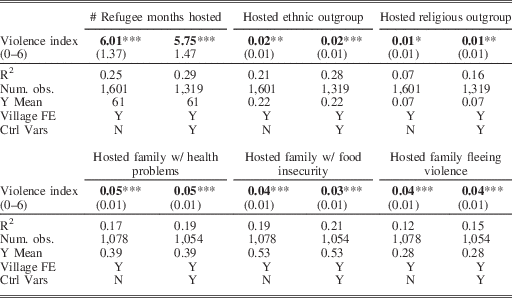
Our main dependent variables include: Refugee-Months Hosted, calculated as refugee family size × duration of stay, summed across all families that were hosted; Hosted Ethnic Outgroup, an indicator for whether the respondent hosted an non-coethnic family; Hosted Religious Outgroup, an indicator for whether the respondent hosted non-coreligious family; Hosted Family with Health Problems, an indicator for whether the respondent hosted a family that had health problems upon arrival; Hosted Family with Food Insecurity, an indicator for whether the respondent hosted a family whose members were ‘hungry’ or ‘starving’ upon arrival; and Hosted Family Fleeing Violence, an indicator for whether the respondent hosted a family that was fleeing direct violence. We also consider the proportion of hosted refugees that (1) were from ethnic and religious outgroups, (2) demonstrated health problems or food insecurity upon arrival or (3) had fled direct violence.
Our main independent variable is exposure to violence during the Liberian civil war, which is measured as the sum of six indicator variables denoting whether the respondent ever experienced: beatings, the burning of their home, serious injury or maiming, serious injury to a family member, the death of a family member due to violence, or was witness to beatings, torturing or executions. The resulting variable, Violvict, has a mean of 2.6 and a standard deviation of 1.6. Alternative constructions using factor analysis or subsets of the input variables have no material effect on the results.
Conjoint Experiment
We complement the survey data with a choice-based conjoint experiment designed to elicit respondents’ preferences over attributes of refugees. Conjoint experiments allow researchers to determine how respondents value different attributes in the context of a particular choice task. In our experiment, we ask respondents to imagine a new crisis in which the number of refugees is greater than the capacity of the community to host them (much like the actual refugee crisis). Respondents were then tasked with choosing one of two hypothetical refugee families whose attributes were randomly assigned across five dimensions: gender of the household head, ethnicity, religion, occupation and whether the refugees were hungry, as summarized in Table 1.
Refugee Attributes Randomized in Conjoint Experiment

Each respondent successively evaluated three pairs of refugees. Because 50 per cent of respondents were illiterate, we used pictographs to display the attributes. The pictographs were designed to depict only the relevant attribute level while maintaining neutrality on other dimensions such as aesthetic appeal. Appendix 2 displays the pictographs as they were presented to respondents.
Our randomization procedure excluded coethnic, not co-religious profiles for respondents who belong to an ethnic group that is predominantly of one religion. This applies to about 30 per cent of our sample.Footnote 55
Semi-Structured Interviews
To inform and validate our analysis with Liberians’ own impressions of the crisis, we conducted 16 semi-structured interviews with community leaders in host communities. The interviews focused on their personal reactions to the crisis, community experiences during the crisis, the practicalities of hosting refugees and the community discourse attending the arrival of the refugees.
Estimation
We estimate the association between Liberians’ past exposure to violence and their support for refugees via:
 $$Y_{{ij}} \,{\equals}\,\alpha _{j} {\plus}\gamma {\rm Violvict}_{{ij}} {\plus}X_{{ij}}^{T} \beta {\plus}{\varepsilon}_{{ij}} $$
where j denotes the village, i denotes the individual, X ij is a vector of fixed and pre-war covariatesFootnote 56 and Violvict is the index of six violent experiences described above. The inclusion of village fixed effects (α j) ensures that the association between violence and hosting behavior (γ) is not driven by local or regional differences in omitted variables; the inclusion of pre-war covariates (X ij) ensures it is not driven by observable differences between individuals.
Interpreting γ as causal requires that the unobserved predictors of violence do not also influence hosting behavior. In Appendix 3, we argue that this assumption is consistent with historical accounts of the war, which highlight how limited information, low mobility, frequent shifts in territorial control, and erratic behavior by combatants limited civilians’ ability to avoid violence.Footnote 57 We also show that violence is uncorrelated with most observed variables (X ij, above), and that those that do predict violence – pre-war livestock ownership, pre-war relations to village chief and gender – are poor predictors of hosting behavior, and are therefore unlikely to confound. Hence, insofar as unobserved predictors are similar to the observed predictors, they too are unlikely to confound.
However, as with all observational studies, we cannot rule out omitted factors entirely, and we take several steps to reduce the likelihood that they account for our results. First, by testing an unusually extensive set of outcomes, each of which is linked to a specific observable implication of our argument, we aim to limit the set of confounders that could account for our results.
Secondly, we conduct a sensitivity analysis following Oster (Reference Oster2017) to assess how confounding omitted factors would need to be in order to account for our results.Footnote 58 The intuition behind this approach is to use the bias eliminated by observed variables to assess the potential bias of unobserved, omitted variables. Substantively, we find that for every outcome in our main analysis (Tables 2 and 3), omitted factors would have to be considerably more confounding than observables to reduce effect sizes to zero (Appendix 3). We believe this is unlikely, and note that this level of robustness exceeds the conservative standards recommended by Oster Reference Oster2017. Moreover, the analysis shows that coefficient stability and changes in R-squared values between our uncontrolled and controlled regressions are consistent with those of experimental studies, suggesting that our conditional exogeneity assumption holds. Full details are provided in Appendix 3.
Wartime Violence and Hosting of Refugees

Note: standard errors clustered by village. Estimates of Equation 2, along with its analog without control variables are presented for each outcome. The survey was updated partway through the survey to include additional outcomes and covariates; sample sizes vary accordingly. ***p<0.01, **p<0.05, *p<0.1
Wartime Violence and the Composition of Hosted Refugees

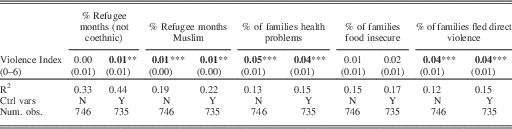
Note: estimates of Equation 2, along with its analog without control variables are presented for each outcome. Outcomes are defined only for those who hosted refugees. ***p<0.01, **p<0.05, *p<0.1
Our final strategy to guard against confounding factors is to use an empathetic prime to validate the observational analysis of violence and preferences. To this end, we randomly assigned whether the survey module on past violence came immediately before or after the conjoint experiment. By increasing the emotional and cognitive salience of past experiences with violence, the module is likely to increase the core components of empathy – vicarious arousal, sympathy and perspective taking – during the selection exercise. We therefore expect the prime to influence preferences over refugee attributes in a similar manner to actual past violence behavior.
RESULTS
Wartime Violence and Hosting
Estimates of γ from Equation 1, with and without X ij, are presented in Table 2. The results show a robust relationship between past violence exposure and support for both ingroup and outgroup refugees. Substantively, exposure to one additional act of violence is associated with six additional refugee-months of hosting overall, a 2-percentage-point increase in the likelihood of hosting non-coethnic refugees, and a 1-percentage-point increase in the likelihood of hosting non-coreligious refugees.Footnote 59 While these figures may seem modest, they are not: they amount to a 10, 9 and 14 per cent increase, respectively, relative to each outcome’s mean (reported in Table 2, Row 5).
Past experience with violence is also associated with greater hosting of refugee families that were experiencing health problems or food insecurity upon arrival, as well as refugee families that fled direct violence. Substantively, one additional act of violence is associated with a 5-percentage-point increase in the likelihood of hosting a family that had health problems upon arrival, a 4-percentage-point increase in the likelihood of hosting a family that was ‘hungry’ or ‘starving’ upon arrival, and a 4-percentage-point increase in the likelihood of hosting a family that fled direct violence. We view these latter results as particularly strong evidence for our empathy born of violence hypothesis, as they are not predicted by rival theories of violence and behavior. Importantly, coefficient estimates change little with the inclusion of additional controls, suggesting that selection into violence is unlikely to be confounding our results.Footnote 60
Wartime Violence and Empathetic Preferences
Because empathy should increase responsiveness to signs of refugees’ distress and reduce the relative importance of refugee identity, we expect violence-affected individuals to host a higher proportion of distressed and outgroup refugees. Table 3 presents the results of this analysis. Consistent with the empathy born of violence hypothesis, we see a large shift toward distressed refugees, as measured by having health problems at arrival, and toward refugee families that were fleeing direct violence. We do not see a significant shift toward food-insecure refugees, though the sign of the coefficient is in the expected direction.Footnote 61
We also find that violence is associated with hosting a greater proportion of non-coethnic and non-coreligious refugee families. Substantively, a one-unit increase in exposure to violence is associated with a 1-percentage-point increase in the proportion of refugee families that are not coethnic and a 1-percentage-point increase in the proportion of refugee families that were Muslim. Overall, these results are consistent with the hypothesis that violence strengthens empathetic preferences that in turn motivate helping behavior across group boundaries.
Conjoint Experiment
To validate the results of the observational analysis, we turn to the conjoint experiment. Following the approach outlined in Hainmueller, Hopkins and Yamamoto (Reference Hainmueller, Hopkins and Yamamoto2013),Footnote 62 we estimate the probability that a hypothetical refugee family is hosted via:
 $${\rm Hosted}_{{ijk}} \,{\equals}\,\beta _{0} {\plus}\gamma _{1} {\rm female}_{{ikj}} {\plus}\gamma _{2} {\rm farmer}_{{ikj}} {\plus}\gamma _{3} {\rm hunger}_{{ikj}} {\plus}\gamma _{4} {\rm coethnic}_{{ikj}} {\plus}\gamma _{5} {\rm coreligious}_{{ikj}} {\plus}{\varepsilon}_{i} $$
where i denotes the respondent, k the round or ‘choice task’, and j the depicted refugee family. In our experiment,  $i\in\{ 1,2,\ldots,1230\} $
,
 $k\in\{ 1,2,3\} $
, and
 $j\in\{ 1,2\} $
. Note that each respondent i yields six observations in this analysis: three rounds, and two choices per round. The unit of analysis is the hypothetical refugee family, the outcome is a binary indicator for whether the family is selected, and the explanatory variables are the family’s attributes. Because each attribute is randomly assigned, Equation 2 returns unbiased estimates of the average effect of each attribute on the probability that a refugee family is hosted.Footnote 63 Standard errors are clustered by individual.
The upper-left panel of Figure 1 displays the average effect of each attribute on whether a refugee family is hosted (for regression tables, see Appendix 5). Consistent with the region’s long history of cross-border ethnic violence, discrimination against non-coreligious (that is, Muslim) refugees is severe, with non-coreligious refugees 15 per cent less likely to be hosted than coreligious refugees. To a lesser degree, respondents prefer to host distressed (that is, hungry) refugees, female-headed households and refugees with farming skills.
Average effects and marginal effects by wartime violence Note: estimated via OLS with standard errors clustered by individual; horizontal bars represent 95 per cent confidence intervals. The density of wartime violence exposure is displayed in the background.

Figure 1 also displays the marginal effects by Violvict among those not primed prior to the experiment (as the prime may crowd out response heterogeneity), showing that bias against non-coreligous refugees decreases with prior exposure to violence. Preferences for distressed (hungry) and vulnerable (female) refugees also appear to increase with prior exposure to violence, though these results are not statistically significant.
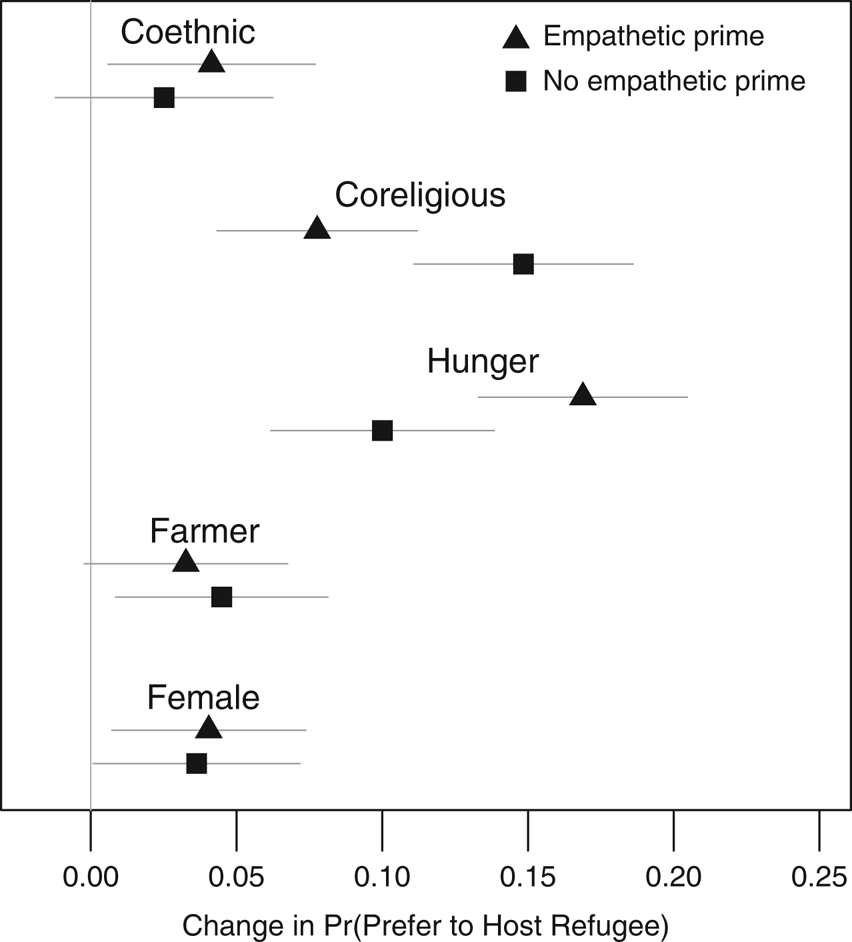
Figure 2 displays the results of the empathetic prime. In the control group, discrimination against non-coreligious refugees is the single strongest predictor of whether a refugee is hosted. However, when individuals are asked to think about their own experiences with violence and displacement prior to deciding who to host, they become significantly more responsive to signs of refugee distress and significantly less biased against religious outgroups. These results help to validate those displayed in Table 3 and Figure 1, and provide another piece of evidence in favor of the empathy born of violence hypothesis.
Marginal effects by empathetic prime Note: OLS estimates with standard errors clustered by individual; horizontal bars represent 95 per cent confidence intervals.

Semi-Structured Interviews
We find additional support for our argument in our field interviews with community leaders. Analysis of transcripts from these interviews suggests that residents’ prior experiences with displacement triggered an empathetic response to the refugee crisis. Leaders commonly described experiences consistent with the three components of empathy, including (1) an emotional response to refugees’ plight; (2) sympathy for refugees; and (3) reference to their own experience during the Liberian civil war in a way that suggests enhanced perspective taking and vicarious arousal.
For example, leaders commonly related experiences of emotional distress during the refugee crisis. One leader explained that when he saw refugees he felt ‘sorrowful’ and ‘mindful [of their] condition’.Footnote 64 This reaction led members of the host communities to act. When asked why they hosted refugees, a leader explained that when he saw a refugee in distress, it was ‘impossible’ to ‘pass by’ the individual in need.Footnote 65 Another explicitly linked feelings of sympathy to the motivation to host, stating: ‘If you go and find a group of people without shelter, with all of their possessions, near your house, it looks sorrowful. So you go there and offer to host them and bring them to your house.’Footnote 66
Leaders also described their decisions to host as specifically influenced by the recollection of their own experience during the Liberian civil war. For instance, when asked why Liberians hosted refugees, one leader stated ‘I recall what we experienced!’Footnote 67 Another explained: ‘We know what it is to be a refugee […] when you are refugees you leave everything in your country […] so when someone is a refugee, you who pass through it before […] you know the pros and cons about it’.Footnote 68
The shared experience of hardship also appears to have made it easier to identify with refugees regardless of their ethnic or religious backgrounds: ‘We Liberians, we experienced war. So when they say war drove them, when they talked about their problems, that the same thing happened to us Liberians before. So we embraced them.’Footnote 69
Robustness Checks and Consideration of Alternative Explanations
In the previous section, we provide support for the empathy born of violence hypothesis using two independent manipulations of our explanatory variable – actual violence experienced and the empathetic prime – and three independent sets of outcomes – absolute levels of hosting, proportions of refugee types hosted and experimentally elicited preferences. We view the consistency of our findings across these tests, in tandem with supporting evidence from semi-structured interviews, as a compelling set of evidence in support of our argument.
Nevertheless, as with any study focused on intrinsic explanations of behavior, we cannot conclusively identify empathy as responsible for our results. Instead, following the advice of King, Keohane and Verba,Footnote 70 our approach has been to test as many observable implications of our argument as possible, leveraging the fact that many of these implications are unique to the empathy born of violence hypothesis. In this section, we complement this approach with several robustness checks and a consideration of alternative explanations.
Post-Traumatic Growth and Prosociality
The theory of post-traumatic growth posits a broad set of generalized changes in the aftermath of trauma, including new goals, improved interpersonal relationships, broader worldviews, greater activism, and a stronger social and prosocial orientation.Footnote 71 Is it possible that our results might reflect these general improvements in social and prosocial behavior rather than empathy in particular?
Perhaps the strongest case against this possibility is that these changes cannot account for the patterns reported in Table 3 and Figures 1 and 2, which are uniquely consistent with the hypothesis that violence strengthens empathetic motivations for hosting relative to identity-based motivations. It is, however, plausible that greater prosociality contributes to the aggregate hosting patterns reported in Table 2. To assess this possibility, we aggregate measures of prosocial behavior from our survey into an index of Prosociality. These include: contributions to public goods in the community in the past 30 days, community group membership and meeting attendance. When included as a control in the context of Equation 1, the effect of violence exposure on refugee hosting (γ) is substantively unaffected. This result is consistent across all measures of hosting behavior included in Tables 2 and 3 (Appendix 4). Following Imai et al.,Footnote 72 we interpret this as evidence against the argument that hosting behavior is driven by greater Prosociality in general.
Social Norms
Theories of public goods provision in small groups emphasize the importance of social rewards and sanctions for motivating altruistic behavior.Footnote 73 In light of this literature, one might be concerned that social rewards or sanctions disproportionately targeted violence-affected Liberians, driving them to host more refugees.
We find no evidence to support this hypothesis. In the 2014 survey, we asked whether the respondent found the refugee family on their own, whether an authority in the community facilitated hosting, and whether an authority or other community members pressured them to host. We find that for 93 per cent of refugee families, the host found them herself; only 5 per cent of families hosted were associated with pressure from village authorities and only 9 per cent of families hosted were associated with pressure from other community members. Further, we find no evidence that these pressures associate positively with past violence victimization (Appendix 4).
Reciprocity
Another potential explanation for our results derives from theories of reciprocity, which predict that those who are helped by others will feel intrinsically obligated to reciprocate in the future. If those who suffered violence during the war were also more likely to rely on Ivorians for assistance, then it is possible that the positive association between violence and hosting is driven by norms of reciprocity rather than empathy.
We certainly do find evidence that norms of reciprocity may have influenced hosting behavior in general during the crisis – nearly three-quarters of our respondents report that they lived abroad as refugees during the war, and 15 per cent reported hosting some of the same families during the crisis as once hosted them. However, we believe it is unlikely that a norm of reciprocity accounts for the association between violence and hosting behavior because empirically, violence does not correlate with having been a refugee (Appendix 4). This implies that those who experienced violence during the war were just as likely to have relied on Ivorians as those who did not experience violence, making it unlikely that they would have subsequently felt a stronger obligation to reciprocate during the Ivorian refugee crisis.
In addition, explanations rooted in theories of reciprocity cannot explain the positive association between violence and outgroup hosting or the shift in preferences toward distressed refugees. Indeed, because the logic of reciprocity hinges on repeated interaction, norms of reciprocity are generally believed to operate within groups, particularly close-knit groups in which repeated interaction is common.Footnote 74 This is certainly the case in our setting, where the vast majority of Liberians who were refugees in Côte d’Ivoire during the Liberian civil war relied on assistance from coethnic Ivorians.Footnote 75 Hence, if violence influences hosting through reciprocity, we would expect it to be associated with greater ingroup hosting. In fact, we find the opposite: violence-affected Liberians host higher proportions of outgroup refugees – including Muslim refugees, who were their coethnic wartime rivals and, over the course of the 1990s, increasingly embroiled in a conflict with their ‘native’ hosts in Côte d’Ivoire. Violence-affected Liberians thus exhibited greater generosity toward precisely the kinds of refugees who would have been the least likely to have offered them support in the past.Footnote 76
Selective Migration
Another concern is selective migration. While this concern does not apply to the priming experiment, it does apply to the observational analysis, where it would confound if those disinclined toward altruistic behavior and victimized by violence were disproportionately likely to permanently flee the villages in our sample. Though we cannot observe those who fled during the war, we can assess whether our results hold among those who were born in the community in which we surveyed them – a sample in which concerns about selective migration do not apply. Appendix 4 shows that the results do not change when we subset to this sample. In tandem with their consistency with the results from the empathetic prime, these results suggest that selective migration is unlikely to confound our analysis. Another reason this seems unlikely is that the correlation between violence and migration between villages is only 0.02, and is not statistically significant.Footnote 77
Validity of the Empathetic Prime
Our approach to priming empathy is similar to those employed in psychology, where researchers have sought to prime empathy by asking subjects to write an essay considering the perspective of another,Footnote 78 reflect on their own experiences with hardship,Footnote 79 or consider their own feelings and emotions while evaluating the position of a disadvantaged other.Footnote 80 However, as with all experiments aimed at manipulating subjects’ internal mental processes, it is impossible to know for sure that our empathetic prime indeed worked as intended. A specific concern is that the experiment primes something other than empathy, such as reciprocity or fear. Though we cannot entirely rule out this possibility, neither fear nor reciprocity strikes us as plausible, since these emotions tend to be associated with ingroup rather than outgroup attachment. In our view, the fact that the results of the experiment adhere so closely to the predictions of empathy (that is, strengthened preferences for refugees in distress and lower bias against outgroup refugees) is the most compelling reason to believe our prime worked as intended – given this pattern of results, what other explanations are plausible?
Generalizability
Whether the link between violence, empathy and intergroup altruism holds outside the context of our study is an outstanding question. While we view this as an important avenue of future research, we offer two reasons to suspect it might apply more generally. For one, our findings are in line with the broader literature on post-traumatic growth after violence. As discussed above, we suspect empathy born of violence may contribute to these broader patterns of growth after violence.
Another reason we believe our results may generalize is that we also observe a positive association between violence and charitable behavior when analyzing intergroup behavior within Liberian towns and villages. We show this using data from the same region collected in 2009 and 2010 by Blattman, Hartman and Blair,Footnote 81 which includes information on religion, ethnicity, wartime violence experiences and charity toward families that were sick in the past month, and covers a large sample of 242 towns and villages. We find that wartime violence is linked to greater charity and that this effect is equally strong in diverse villages. Full details are provided in Appendix 4. This result suggests that the relationship between exposure to violence and greater altruism toward ingroups and outgroups may generalize beyond the Ivorian refugee crisis. Nevertheless, further research will be required to confirm this hypothesis and to better understand the conditions under which violence can promote prosocial behavior through its impact on empathy.
Other Limitations
We study hosting behavior in a setting where refugees are similar to their hosts in terms of their economic, cultural and social backgrounds. We view this as a strength of our study insofar as culturally close relations characterize the majority of interactions between the forcibly displaced and their hosts (given that most flee within their own country or to neighboring countries). But it also raises the question of whether our results extend to refugee–host interactions in developed countries, where refugees may be less familiar with the cultural practices of their hosts and less able to integrate economically. While developed countries host only 14 per cent of the world’s refugees (and an even smaller fraction of the world’s forcibly displaced),Footnote 82 this nevertheless remains an important and largely outstanding question.
Another limitation of our study is that it does not speak to the limits of empathy born of violence. It is plausible, for instance, that empathy fades over time until it no longer offsets the burden of hosting, leading to a breakdown in hosts’ generosity. Our study cannot speak to this possibility because we do not have panel data on hosts’ levels of empathy during the course of the crisis, and more generally, because there are a wide variety of factors that influence how long refugees stay with their hosts. Understanding the limits of empathy born of violence therefore constitutes an important topic for further research.
CONCLUSION
This article proposes that empathy born of violence can motivate altruistic behavior across group boundaries. To test this argument, we examined the association between Liberians’ past experiences with violence and their support of refugees during the 2010–11 Ivorian refugee crisis, showing that those who directly or indirectly suffered violence in the past hosted more refugees overall, exhibited stronger preferences for distressed refugees and less bias against outgroup refugees, and hosted a higher proportion of non-coethnic, non-coreligious and distressed refugees.
In highlighting empathy as a mechanism linking violence to prosocial behavior across group boundaries, we make two contributions to existing theory. First, we distinguish empathy from the broader set of changes enumerated by PTGT. Whereas PTGT fails to specify which mechanisms link trauma to prosocial behavior and is silent about how they influence behavior toward outgroups, our theory of empathy born of violence is not. Rooted in the shared experience of hardship, empathy born of violence can transcend identity boundaries and motivate altruistic behavior toward rival outgroups, even in the poorest regions of the world with histories of extreme intergroup violence.
Our second theoretical contribution relates to the conditions under which the legacies of violence are more or less likely to be parochial. Though our findings depart from conventional arguments emphasizing the parochial effects of violence, we stress that the two perspectives are not mutually exclusive. On the contrary, together they highlight how violence may simultaneously influence the motivations for prosocial behavior in ways that are both parochial and bridging. Violence may, for example, strengthen norms of ingroup solidarity and harden attitudes toward rival groups, even as it enhances empathetic capacity. An important implication of this reasoning is that identifying mechanisms and considering how they interact with context is essential when trying to understand how violence might influence behavior in a given setting. For example, we suspect that the legacy of violence is more likely to be ‘bridging’ in settings where empathetic motivations for behavior are salient (for example, decisions to help those in need, decisions to (not) harm others), but that it may well be parochial in other settings (for example, competition over power or resources in post-conflict settings). This is speculation, of course, and we leave it to future research to uncover whether and why the legacy of violence on intergroup behavior varies across settings.
Finally, our results are of practical import for policy makers. According to the UNHCR,Footnote 832016 saw the highest number of people displaced by violence ever recorded. Yet the sources of support for those fleeing violence remain poorly understood. Our findings suggest that past experiences with violence do not necessarily undercut support for refugees – even when they come from antagonistic groups – and that it may instead be an important source of support. While survivors of violence and hardship should not be expected to bear a disproportionate share of the burden of hosting refugees, empathetic appeals targeted toward the host population generally may be an effective means to cultivate support for the world’s most vulnerable.