INTRODUCTION
Caregiver satisfaction and experience are accepted measures of healthcare quality (Carter et al., Reference Carter, Lewin and Gianacas2011; Roza et al., Reference Roza, Lee and Meier2015). It is not uncommon for surveys to contain both satisfaction and experience questions (Australian Commission on Safety and Quality in Healthcare, 2012). Questions related to experience seek objective information about what care was provided, whereas questions regarding satisfaction pursue subjective responses.
Measuring caregiver perceptions of care through satisfaction and experience surveys assists health professionals in understanding the burden and impact of a patient's illness on the caregiver as well as improving the care provided and guiding service planning (Abernethy et al., Reference Abernethy, Currow and Fazekas2008; Medigovich et al., Reference Medigovich, Porock and Janson1999). The caregiver role can bring many rewards; however, it does not insulate the person providing care from the effects of the patient's illness or death (Kristjanson & Aoun, Reference Kristjanson and Aoun2004). The caregiver has a paradoxical role—that of care provider (caregivers are often responsible for the medical and nonmedical care and support of the patient in the absence of a health professional) and care recipient (often needing support themselves as they prepare for the loss of a loved one) (Kristjanson & Aoun, Reference Kristjanson and Aoun2004). From the caregiver's perspective, the role can result in compromised psychological health, impaired physical health, financial pressure, and social stress (Abernethy et al., Reference Abernethy, Currow and Fazekas2008; Girgis et al., Reference Girgis, Lambert and Johnson2013). Caregivers often have health needs of their own that require attention and management (Currow, Reference Currow2015). The impact of the role can last long after the patient's death and may contribute to a shortened lifespan for the caregiver (Abernethy et al., Reference Abernethy, Currow and Fazekas2008; Teno, Reference Teno2002).
Specialist palliative care (SPC) is delivered in Australia by a multidisciplinary team with recognized palliative care qualifications or expertise. Specialist palliative care teams mostly include doctors, nurses, social workers, counselors, and pastoral care workers (Australian Institute of Health and Welfare [AIHW], 2014). Palliative care is provided in the context of finite health resources to an ageing population, with many care recipients requesting to die in their own homes (AIHW, 2014). With growing pressure on SPC services, health professionals, and families to support patients' end-of-life wishes, more families are proactively involved in the end-of-life care of their loved ones and increasingly accepting of the caregiver role (Carter et al., Reference Carter, Lewin and Gianacas2011; Kristjanson & Aoun, Reference Kristjanson and Aoun2004). To date, there is little published research on caregiver satisfaction and experience with the care and support provided to them and their loved one in an Australian context.
Assessment of caregiver satisfaction and experience with care is still relatively new in palliative care. This is related to the evolution of palliative care into an established clinical discipline in recent decades (Adams, Reference Adams2005; Brazil et al., Reference Brazil, Kaasalainen and Williams2014). It is also due to the complexity of the role and recognition of caregivers alongside the patient as a care recipient. In palliative care, the caregiver is incorporated into the unit of care. (Kristjanson & Aoun, Reference Kristjanson and Aoun2004; Hudson et al., Reference Hudson, Zordan and Trauer2011). The World Health Organization recognizes the complexity of the caregiver role and how challenging meeting caregiver needs can be for health professionals (International Palliative Care Family Carer Research Collaboration, 2016).
Assessing caregivers' perceptions of care is one way that health professionals can gain insight into how caregivers' needs are being met (Ringdal et al., Reference Ringdal, Jordhøy and Kaasa2003). Key to assessment is an understanding of the factors that are often associated with caregiver satisfaction and a positive care experience. At present, there is little consensus as to what these factors are (Ringdal et al., Reference Ringdal, Jordhøy and Kaasa2002). However, a variety of domains have been identified as important to caregivers. Broadly, these include provision of information, communication, practical support, and emotional support (Dy et al., Reference Dy, Shugarman and Lorenz2008; Grunfeld et al., Reference Grunfeld, Folkes and Urquhart2008).
Some valid and reliable survey instruments have been developed to measure these domains of caregiver satisfaction and experience (Grunfeld et al., Reference Grunfeld, Folkes and Urquhart2008; Kristjanson, Reference Kristjanson1993); however, none assess all domains. Additionally, there are few survey instruments validated in the broad range of palliative care settings or across geographical regions (Abernethy et al., Reference Abernethy, Currow and Fazekas2008; AIHW, 2014; Dy et al., Reference Dy, Shugarman and Lorenz2008).
The aim of our paper is to describe caregivers' perceptions of the care that they and their patients received from Australian SPC services and to examine the association between sociodemographic factors (age, gender, geographic location, and service model) and level of satisfaction with and positivity about the experience, as measured with the FAMCARE–2 and the Ongoing Needs Identification: Caregiver Profile (ONI–CP) questionnaires, respectively.
METHODS
Study Design
Our study was a national cross-sectional survey of caregivers of patients diagnosed with a life-limiting illness and receiving care from Australian SPC services enrolled in the Palliative Care Outcomes Collaboration (PCOC) between 2008 and 2011.
Approximately 85% of SPC services in Australia participate in PCOC (n = 115), a quality-improvement program funded by the Australian Government (Palliative Care Outcomes Collaboration, 2015; Pidgeon et al., Reference Pidgeon, Johnson and Currow2015). The services in this program employ a suite of five standardized clinical assessment tools and follow a quality-improvement framework to assess and benchmark patient outcomes. More details on PCOC can be found at their website: http://www.pcoc.org.au/.
Services participating in PCOC were invited to take part in our caregiver survey, which was conducted over a period of one to two months each study year between 2008 and 2011, depending on the size of the service. During the study months, caregivers were approached by one of the members of their patient's care team and invited to complete the questionnaire. Upon completion of each study year, service-specific feedback was provided to the staff at each site to support local quality-improvement initiatives.
For the purposes of the current paper, the term “caregiver” refers to the primary person other than professional palliative care team members on whom the patient relies, partly or completely, for the support and management of the patient's physical, social, financial, medical, psychological, and emotional needs and distress (Kristjanson & Aoun, Reference Kristjanson and Aoun2004).
Ethics Approval
Ethics approval was received from the University of Wollongong Human Research Ethics Committee (HREC) (reference no. HE06/045). Some services also approached their local HREC for approval as per organizational policy. Our survey also fulfills the relevant quality-assurance criteria (Australian Health Ethics Committee, 2003).
Sample
Palliative care services registered in the PCOC program were invited to participate each year from 2008 to 2011. This convenience sample from across Australia included inpatient and community-care settings. To participate, service executive approval was required, as well as an agreement to complete a minimum of 20 questionnaires. Caregiver participation was voluntary. Written information was provided to caregivers, and inclusion followed verbal consent. Consent was implied when the completed questionnaire was returned.
Survey Instrument
To capture a holistic picture of caregiver perception of care and to cover the domains identified as important to caregivers, our questionnaire combined the FAMCARE–2 Scale (Aoun et al., Reference Aoun, Bird and Kristjanson2010) and the four “caregiver support” items from the ONI–CP tool (Centre for Health Service Development, 2014).
The FAMCARE Scale measures caregiver satisfaction with the healthcare provided to the patient and family from the point of view of the caregivers (Ringdal et al., Reference Ringdal, Jordhøy and Kaasa2002). The scale includes four domains (“management of physical symptoms and comfort,” “provision of information,” “family support,” and “patient psychological care”), with 17 items measured on a 5-point Likert-type scale (1 = very satisfied to 5 = very dissatisfied) (Aoun et al., Reference Aoun, Bird and Kristjanson2010). Questionnaire item responses were totaled, with a potential final score ranging from of 17 to 85. The “not applicable” option, available for each item, was recoded as missing for our study. The reliability and validity of the FAMCARE–2 has been tested in Australian palliative care services, and in both inpatient and community settings (Aoun et al., Reference Aoun, Bird and Kristjanson2010).
The ONI–CP is employed in Australia by several state health departments to support community health providers to assess the needs of carers, and to assess their eligibility to receive social support (Eagar & Owen, Reference Eagar and Owen2002). Four questions from the ONI–CP are related to help with practical tasks and training, and whether or not information was provided on support services and carer payments (Eagar & Owen, Reference Eagar and Owen2002). These items measure the caregiver's experience of care rather than their satisfaction with it. Each item was measured on a 4-point Likert-type scale: (1) yes, all the information or help needed was provided; (2) yes, but not enough; (3) I haven't needed any help; and (4) no, no assistance or information was offered or provided (Eagar & Owen, Reference Eagar and Owen2002).
Demographic data about the caregiver (such as date of birth, sex, and ethnicity) were collected on the survey. Furthermore, information about the characteristics of participating services was also collected. Setting of care was recorded on the questionnaire by the service and, if missing, was classified by the research team using PCOC data. The geographical location of services was classified by the researchers as: major city; inner regional; outer regional; remote; and very remote, according to the Australian Statistical Geography Standard Remoteness Structure of 2006 (Australian Government, Australian Bureau of Statistics, 2011).
Procedure
Caregivers of patients receiving care who agreed to participate were provided with a cover letter along with participation instructions and the questionnaire. The survey was administered at least three days after admission to the service. Once completed, the questionnaire was returned to the palliative care service to inform their own care planning for the patient and meet with quality-assurance standards. After such consideration, each service deidentified the completed surveys and then forwarded them to PCOC for further analysis.
Palliative care services that provided at least 20 completed surveys in each round of the survey received a report summarizing the carer responses to each survey item. Pooled responses to each item were included alongside the service results to allow for comparisons. Responses to the free text fields asking carers to comment on their experiences were also synthesized and summarized for each service. Following this activity, the data were further analyzed to inform palliative care practice on a national level.
Analyses
Descriptive analyses were utilized in order to examine the services and caregiver characteristics and the FAMCARE–2 and ONI–CP items. Means and standard deviations were used to describe continuous variables (age) and frequencies to describe categorical variables (sex, service type, geographical location).
The FAMCARE–2 items were grouped into four domains (Aoun et al., Reference Aoun, Bird and Kristjanson2010). Domain means were calculated as a mean of all the items within each domain. Univariate nonparametric tests were employed to explore differences between the FAMCARE–2 domains for age (≤/> 60 years), sex (Mann–Whitney U test), geographical region, and service model variables (Kruskall–Wallis test), and between the ONI–CP items and independent variables (Pearson's chi-squared test). Type I errors were limited by using a level of significance of p < 0.001 (Bonferroni-adjusted for multiple comparisons, i.e., α of 0.05 divided by 16 tests = 0.003125, which was rounded to p = 0.001).
We conducted multivariate logistic regressions in order to identify sociodemographic and service variables independently associated with levels of satisfaction and positive experiences. Domain outcomes were dichotomized (very satisfied/satisfied with all items in each domain) versus other responses. For analyses of the ONI–CP items, responses were coded in binary fashion: yes (all the help/information was given if needed) versus no (the information and help provided was not adequate). A backwards stepwise approach was employed, with all sociodemographic/service variables included initially (i.e., age, sex, geographical location, and service model). Items were eliminated when no significant association was found at a level of p ≥ 0.001.
Missing data were managed by excluding cases with more than 80% of responses absent across the two instruments. This resulted in 26 cases being removed prior to the analyses. A missing data analysis demonstrated no difference in sociodemographic variables for cases removed when compared to the study population. Missing responses for individual items in the remaining cohort ranged from 0.6 to 5% (range of n = 9–79).
Analyses were conducted using SPSS (v. 18 and 22) (SPSS Inc., Chicago, Illinois, USA) and Stata (v. 12) (StataCorp, Collage Station, Texas, USA) software.
RESULTS
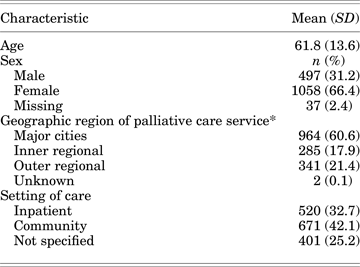
Surveys were completed for 1,592 caregivers. Most of the caregivers were female (68%) and had an average age of 61 years (SD = 13.6; range = 17–100 years) (Table 1). Most were from major Australian cities (61%), with 21% from outer regional Australia and 18% from inner regional Australia. Some 42% of services provided care in a community setting, 38% in an inpatient setting of care, and a further 25% did not specify the setting of care.
Demographic information

* Using the Australian Statistical Geography Standard Remoteness Structure, 2006.
Percentages may not add up exactly to 100% due to rounding. SD = standard deviation.
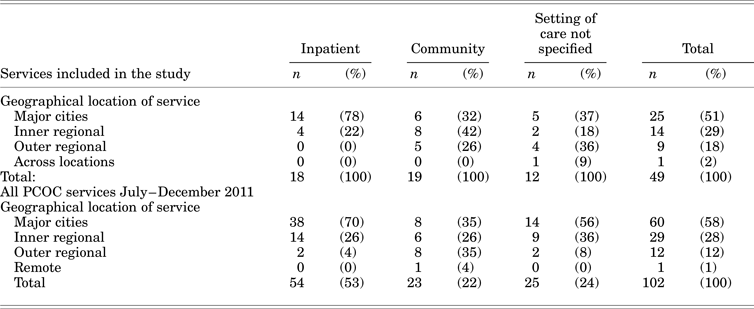
In comparison to SPC services participating in PCOC, for services in an inpatient setting, geographical location was represented similarly, with the exception of outer regional services, where none participated in our survey. For community settings of care, proportionally, this survey had a greater representation of PCOC SPC services providing care in an inner regional location (Table 2).
Characteristics of the services that participated in the survey between 2008 and 2011 compared to all Palliative Care Outcomes Collaboration (PCOC) services that received a report for July–December 2011

Totals may not exactly equal 100% due to rounding. SD = standard deviation.
Results of the FAMCARE–2 Satisfaction Questions
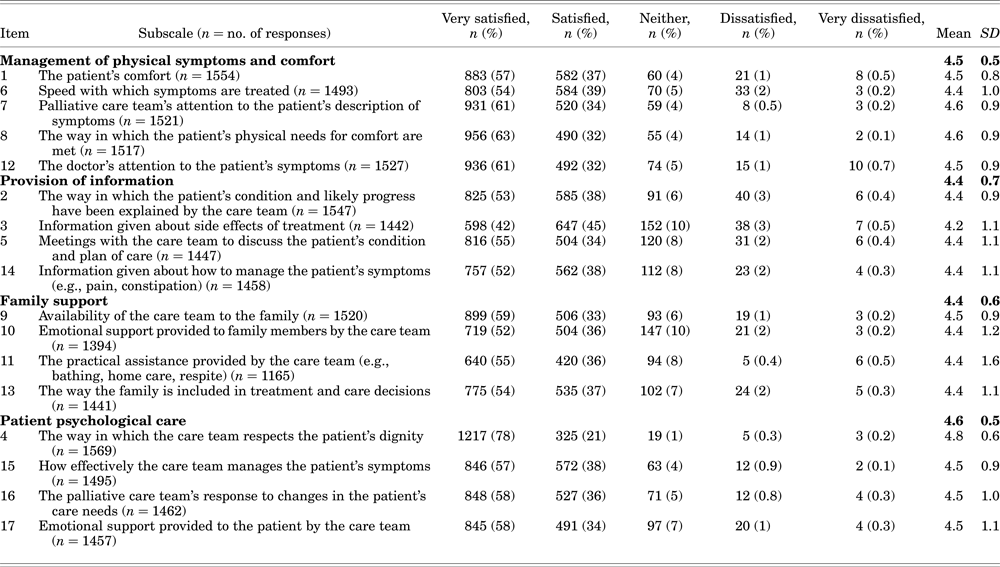
The majority of caregivers were very satisfied with all FAMCARE–2 items ( $\overline x $ = 4.5; SD = 0.6) except for “information given about side effects of treatment,” where 42% were very satisfied and 45% were satisfied (
 $\overline x $ = 4.2; SD = 1.1) (Table 3). In relation to specific FAMCARE–2 items, caregivers were most satisfied with “the way in which the care team respects the patient's dignity” (
 $\overline x $ = 4.8; SD = 0.6); “the way in which the patient's physical needs for comfort are met” (
 $\overline x $ = 4.6; SD = 0.9); and the “palliative care team's attention to the patient's description of symptoms” (
 $\overline x $ = 4.6; SD = 0.9).
Level of caregiver satisfaction with care measured by FAMCARE–2 domains and by individual items

Totals may not exactly equal 100% due to rounding. Maximum possible mean score = 5. Results exclude response “not relevant to me.” SD = standard deviation.
In relation to the FAMCARE–2 domains, caregivers were most satisfied with the domains of “patient psychological care” ( $\overline x $ = 4.6; SD = 0.5) and “management of physical symptoms and comfort” (
 $\overline x $ = 4.5; SD = 0.5); and least satisfied (equally) with the domains of “family support” (
 $\overline x $ = 4.4; SD = 0.6) and “provision of information” (
 $\overline x $ = 4.4; SD = 0.7).
Sociodemographic Factors Independently Associated with Caregiver Satisfaction (by FAMCARE–2 Domains)
Caregivers older than 60 years were more satisfied with the “management of physical symptoms and comfort” domain (z = –2.098; p = 0.036) and the “provision of information” domain (z = –2.384; p = 0.017) than caregivers aged ≤ 60. Caregivers from inner-regional Australia were more satisfied with the “management of physical symptoms and comfort” domain (χ2 = 13.268; p = 0.001), the “family support” domain (χ2 = 10.473; p = 0.005), and the “patient psychological care” domain (χ2 = 8.113; p = 0.017) than caregivers from other geographical regions. Caregivers from inpatient units were more satisfied with the “management of physical symptoms and comfort” domain (χ2 = 10.701; p = 0.013) and the “family support” domain (χ2 = 21.257, p < 0.001) than caregivers receiving care in community settings. However, after Bonferroni adjustment for multiple comparisons, the only statistically significant association was found in caregivers from inpatient units being more satisfied with the “family support” domain than their community-based counterparts (χ2 = 21.257; p < 0.001).
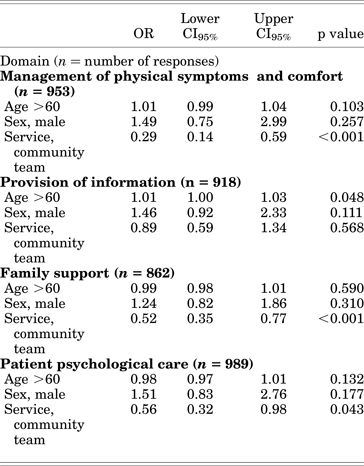
Using logistic regression (Table 4) for the domain “management of physical symptoms and comfort,” caregivers of patients being cared for by community-based palliative care teams were 71% less likely to be satisfied with the “management of physical symptoms and comfort” when compared to inpatients (odds ratio [OR] = 0.29; 95% confidence interval [CI 95%] = 0.14, 0.59; p = 0.001). Caregivers of patients being cared for by community-based palliative care teams were 48% less likely to be satisfied with “family support” when compared to inpatient settings (OR = 0.52; CI 95% = 0.35, 0.77; p = 0.001). Similarly, caregivers from community-based palliative care services were 44% less likely to be satisfied with “patient psychological care” when compared to inpatient settings (OR = 0.56; CI 95% = 0.32, 0.98; p = 0.043). Geographical location was not associated with level of satisfaction in any of the FAMCARE–2 domains.
Caregiver and service characteristics associated with levels of satisfaction (very satisfied/satisfied vs. other) with FAMCARE–2 domains on multivariate logistic regression
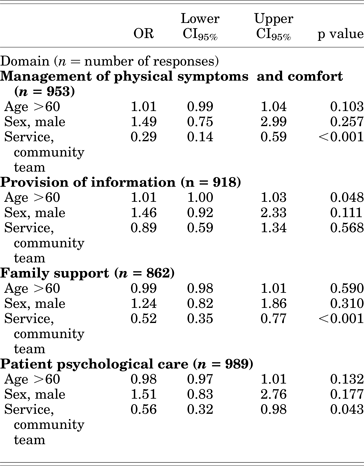
Reference variables: age, <60; sex, female; service, inpatient unit.
CI 95% = 95% confidence interval; OR = odds ratio.
Results of the ONI–CP Experience Questions
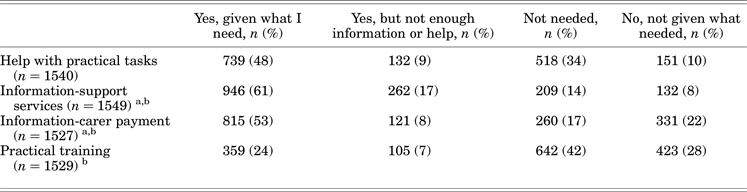
The majority of caregivers reported that they received sufficient “information about support services” (61%) and “information about carer payments” (53%). However, only 48% reported receiving sufficient “help with practical tasks” (Table 5). Some 24% of caregivers were given sufficient “practical training,” but 28% reported that they were not given the “practical training” that they needed. Some 22% of caregivers reported that “information about carer payment support” was needed but not provided. After dichotomizing the ONI–CP items, univariate chi-square analysis showed that significant differences existed between ONI–CP items and region and service model (Table 5).
Caregiver reported adequacy of information and practical assistance provided by palliative care services

Totals may not exactly add up to 100% due to rounding. Excludes missing responses.
a Significant difference between geographical region at p < 0.001 level; b Significant difference between service model at p < 0.001 level.
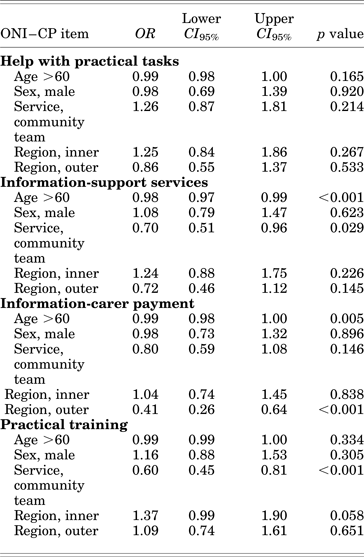
Multiple logistic regressions were then employed to identify sociodemographic factors independently associated with ONI–CP items (Table 6). Caregivers above 60 years of age were 2% less likely to have their information needs met regarding available support services (OR = 0.98; CI 95% = 0.97, 0.98; p < 0.001), and they were 1% less likely to have their information needs met regarding carer payments (OR = 0.99; CI 95% = 0.98, 1.00; p = 0.005). Moreover, caregivers in outer regional areas were 59% less likely to receive the information they needed about carer payments (OR = 0.41; CI 95% = 0.25, 0.64; p < 0.001). In relation to practical training needs, caregivers receiving care from community services were 40% less likely to have their practical training needs met in comparison to inpatient services (OR = 0.60; CI 95% = 0.45, 0.81; p < 0.001). There was no association between the ONI–CP items and the sex of the caregiver.
Caregiver and service characteristics associated with ONI–CP domains on multivariate logistic regression

Reference variables: age ≤ 60 years; sex = female; service = inpatient unit; region = major city.
CI 95% = 95% confidence interval; OR = odds ratio.
DISCUSSION
Our study explored caregiver perceptions about the care that they and their loved ones had received from SPC services across Australia between 2008 and 2011. The majority of caregivers reported being broadly satisfied with all aspects of care; however, they were more likely to be satisfied if the patient was cared for in an inpatient setting rather than in a community setting. Levels of satisfaction did not differ according to the age or sex of the caregiver, or by geographical location of the care setting. Caregivers above 60 years of age reported receiving inadequate information about support services and carer payments, those in outer regional areas required more information about carer payments, and caregivers receiving care from community services reported needing more practical training.
Consistent with previously published research, the caregivers in our study were more likely to be female, above 60 years of age, receiving palliative care in a major city, and satisfied with the care they had received (Adams, Reference Adams2005; Carter et al., Reference Carter, Lewin and Gianacas2011; Ringdal et al., Reference Ringdal, Jordhøy and Kaasa2002). We found that caregivers receiving care from inpatient settings reported higher levels of satisfaction in relation to “physical symptoms and comfort,” “patient psychological support,” and “family support” than did caregivers in community settings. Moreover, caregivers' “practical training” needs were more likely to be met in this setting. This difference may be due to the inpatient setting's capacity to provide more direct and expedient access to medical care and assistance, with practical help available when needed by the caregiver compared to services provided in other care settings (Medigovich et al., Reference Medigovich, Porock and Janson1999).
This study also explored the influence of geographical location on caregiver satisfaction and experience. Australia is a vast country, with the majority (70%) of its population clustered around numerous major coastal cities (Australian Government, Australian Bureau of Statistics, 2011), which is where most palliative care services are located. Rural and remote areas experience challenges in relation to equitable healthcare delivery (Ray et al., Reference Ray, Fried and Lindsay2014), and provision of SPC is no exception. In our study, after adjustment for other factors, the only satisfaction or experience item associated with geographical location was “payment information,” with caregivers located in outer regional areas being less likely to have received adequate information.
Our findings highlight the need for enhanced practical training, communication, and information sharing with caregivers, particularly regarding treatment side effects, financial payments, and the availability of support services (Abernethy et al., Reference Abernethy, Currow and Fazekas2008; Adams, Reference Adams2005; Kristjanson & Aoun, Reference Kristjanson and Aoun2004; McIlfatrick, Reference McIlfatrick2007; Ringdal et al., Reference Ringdal, Jordhøy and Kaasa2002). Previous caregiver research has emphasized the necessity for health professionals to recognize that caregivers' needs change along the patient's illness trajectory (Grunfeld et al., Reference Grunfeld, Folkes and Urquhart2008). Caregivers prefer information to be delivered spontaneously (rather than having to request it), in small amounts, with a minimum of medical jargon (to allow for easy integration and absorption), and verbally rather than in printed format (Kristjanson & Aoun, Reference Kristjanson and Aoun2004; Teno, Reference Teno2002; Wilkes et al., Reference Wilkes, White and O'Riordan2000). The concern that patients and caregivers may forget things they have been told reinforces the need for imparting small amounts of information frequently. Consistent with previous research, we found that caregivers were more likely to be satisfied with the information and assistance provided when they were older than 60 years of age (Adams, Reference Adams2005; Choi et al., Reference Choi, Chang and Song2013). However, in our study, although reporting satisfaction, they were less likely to have their information needs met. Our findings emphasize the need for improved and tailored information provision around support services and carer payments, regardless of service setting of care or location.
Measuring caregiver perception through surveys is one way in which health professionals can determine if they are meeting the caregiver's needs (Choi et al., Reference Choi, Chang and Song2013). Traditionally, the health professional was perceived as the expert in assessing and identifying needs (Nicholas, Reference Nicholas2003). With a shift toward consumer-centered care, for the caregiver, a “carer as expert” model has evolved (Nicholas, Reference Nicholas2003). This model validates the importance of the goals of the caregiver and the caregiver's role. In assessing caregiver perceptions of the care received, regard for the caregiver's opinions is paramount (Navaie-Waliser et al., Reference Navaie-Waliser, Feldman and Gould2002; Nicholas, Reference Nicholas2003), as well as identifying gaps in need and identification of areas previously not considered important by the caregiver—”they don't know what they don't know” (Nicholas, Reference Nicholas2003; Rabow et al, Reference Rabow, Hauser and Adams2004). Caregivers reporting less than positive or satisfied responses to survey questions can also lead health professionals to recognize potential risks to the caregiver (health, social, economic). Identifying and reducing risks are important, but particularly in the ageing caregiver where caregiving is a risk factor for mortality (Rabow et al, Reference Rabow, Hauser and Adams2004).
LIMITATIONS OF THE STUDY
Our study has a number of methodological limitations. In the first place, it was an independent, one-off snapshot of caregiver perceptions of the care provided by Australian SPC services. The original intent was to link the data from this survey with data from a “patient-experience survey” conducted at the same time (Pidgeon et al., Reference Pidgeon, Johnson and Currow2015). This turned out to not be possible because the data linkage keys were not effectively implemented. However, while we could not link at the individual unit record levels, the surveys occurred within the same time period, and the same services were represented (though not necessarily the same patients). When the results from this caregiver study were compared to those of the previously published patient experience study, some important differences emerged. In the patient-experience study, 83% reported pain, including 25% who reported severe pain (Pidgeon et al., Reference Pidgeon, Johnson and Currow2015). In addition, 20% of patients reported severe “other symptoms” and 66% reported depressed feelings, with a higher level of depressed problems experienced by patients receiving care in the inpatient setting (Pidgeon et al., Reference Pidgeon, Johnson and Currow2015). Our results suggest that either our caregivers were not caring for patients with the same degree of symptom burden as those who were in the patient study, or that they were not cognizant of the levels of unmet needs in their loved ones. However, it is not unusual for caregivers to report high levels of satisfaction or positive experiences with healthcare (Aoun et al., Reference Aoun, Bird and Kristjanson2010; Ringdal et al., Reference Ringdal, Jordhøy and Kaasa2003). While these findings may reflect the true nature of the care provided, they may also reflect a social desirability to only report positive outcomes or a reticence by caregivers to complain about the care because of concerns that future care may be compromised. Our caregivers knew that the information they provided was going to be seen by members of the service they were assessing to inform quality improvement. This knowledge may have influenced them to be more positive in their assessments than they would have been had the surveys been truly anonymous. Furthermore, caregivers with limited experience with the healthcare system may have had lower expectations of care. These factors were not assessed in our study.
The services being self-selected to participate potentially resulted in a bias toward services that were more involved in quality improvement. Moreover, palliative care services providing care in community settings were overrepresented compared to the concurrent time period's PCOC service participation rate. Although there is a growing movement toward community care in response to patient preference for place of death (Brazil et al., Reference Brazil, Kaasalainen and Williams2014; Swerissen & Duckett, Reference Swerissen and Duckett2014), this difference in our survey was most likely attributed to the characteristics of the services that self-selected to participate. In addition, 25% of participating caregivers were from services that provided care in both inpatient and community settings, and the specific setting of care was not always clear. These participants were excluded from the analysis that explored the characteristics associated with caregiver satisfaction and experiences. No record was kept regarding the number of caregivers invited to participate, or the number who refused to participate. Consequently, the authors are not able to report a response rate herein.
CONCLUSIONS
While our study's caregivers reported having a positive experience and being satisfied across all domains of care, several areas for improvement in the delivery and experience of palliative care have been identified. Further work is needed to improve symptom management and family support in the community setting, especially in areas related to information. The authors recommend that palliative care services regularly include an assessment of caregiver perceptions as a measure of quality of care along the trajectory of the patient's illness. Such surveys can assist in identification and evaluation of both patient and caregiver distress, as well as unmet needs (Abernethy et al., Reference Abernethy, Currow and Fazekas2008; Brazil et al., Reference Brazil, Kaasalainen and Williams2014).
DISCLOSURES
This survey was conducted through the Palliative Care Outcomes Collaboration (PCOC), funded under the National Palliative Care Program, which is supported by the Australian Government's Department of Health.
COMPETING INTERESTS
The authors hereby declare that they have no competing interests to declare.
ACKNOWLEDGMENTS
The authors wish to express their appreciation to Maree Banfield, and to all of the services and caregivers who supported and/or participated in our survey.