Autism spectrum disorder (ASD) and schizophrenia (SCZ) are distinct conditions, both characterized by pervasive social dysfunction (American Psychiatric Association, 2013). Several decades of research have investigated social cognition, how individuals perceive and process social information (Brothers, Reference Brothers1990), as a potential mechanism for this dysfunction (Pelphrey et al., Reference Pelphrey, Adolphs and Morris2004; Fett et al., Reference Fett, Viechtbauer, Penn, van Os and Krabbendam2011). Social cognition includes varied abilities ranging from basic perceptual skills, such as face and affect recognition, to more sophisticated skills such as mentalizing and attribution formation that involve the inferences of mental states or explanations of social behaviors (Pinkham et al., Reference Pinkham, Penn, Green, Buck, Healey and Harvey2014).
Separate but parallel literature have demonstrated that both adults with SCZ and adults with ASD show impaired social cognitive abilities relative to typically developing (TD) controls, and this has understandably led to the assumption that social cognition is similarly impaired in both disorders (Sasson et al., Reference Sasson, Pinkham, Carpenter and Belger2011; Chung et al., Reference Chung, Barch and Strube2013). However, studies that have directly compared SCZ and ASD have provided conflicting evidence regarding shared v. distinct patterns of impairment. For example, within the domain of emotion recognition, several studies report no difference in abilities between the two clinical groups (Couture et al., Reference Couture, Penn, Losh, Adolphs, Hurley and Piven2010; Sasson et al., Reference Sasson, Pinkham, Weittenhiller, Faso and Simpson2016; Ciaramidaro et al., Reference Ciaramidaro, Bölte, Schlitt, Hainz, Poustka, Weber, Freitag and Walter2018) whereas several others demonstrate poorer emotion identification in ASD relative to SCZ (Bölte and Poustka, Reference Bölte and Poustka2003; Eack et al., Reference Eack, Bahorik, McKnight, Hogarty, Greenwald, Newhill, Phillips, Keshavan and Minshew2013; Sachse et al., Reference Sachse, Schlitt, Hainz, Ciaramidaro, Walter, Poustka, Bölte and Freitag2014). The opposite pattern has also been found for emotion recognition from auditory stimuli, with poorer performance in SCZ as compared to ASD (Tobe et al., Reference Tobe, Corcoran, Breland, MacKay-Brandt, Klim, Colcombe, Leventhal and Javitt2016). A similar lack of consistency across findings is present for mentalizing (for a review, see Tin et al., Reference Tin, Lui, Ho, Hung, Wang, Yeung, Wong, Lam, Chan and Cheung2018), which collectively renders it difficult to draw any conclusions regarding specificity of impairment between disorders or to clarify behavioral phenotypes that could be used to direct genetic research or refine treatment efforts.
A recent meta-analysis attempted to reconcile these discrepant findings and concluded that individuals with ASD appeared to be more severely impaired in emotion recognition than individuals with SCZ but that the two disorders did not differ in mentalizing abilities (Fernandes et al., Reference Fernandes, Cajão, Lopes, Jerónimo and Barahona-Corrêa2018). The authors caution, however, that methodological heterogeneity (e.g. small, unmatched samples) and the complexities of assessing social cognition (e.g. variability of measures assessing the same construct) render the results tentative. Thus, there is a clear need for additional direct comparisons.
The current study sought to systematically compare social cognitive performance in ASD and SCZ. In contrast to many previous studies, we utilized large samples that did not differ on estimated intelligence quotient (IQ) and a broad battery of well-validated tasks to assess multiple theoretical domains of social cognition including emotion processing, social perception, mentalizing, and attributional style (Pinkham et al., Reference Pinkham, Penn, Green and Harvey2016b; Morrison et al., Reference Morrison, Pinkham, Kelsven, Ludwig, Penn and Sasson2019). In broadly assessing social cognition, we hoped to identify patterns of convergence and/or divergence that could help tailor effective treatment programs. Identification of disorder-specific areas of impairment could be leveraged to develop specialized intervention programs that specifically target areas of greatest weakness within each disorder; whereas, confirmation of similar impairments would provide support for applying treatments developed for one disorder to the other (e.g. Turner-Brown et al., Reference Turner-Brown, Perry, Dichter, Bodfish and Penn2008; Eack et al., Reference Eack, Hogarty, Greenwald, Litschge, Porton, Mazefsky and Minshew2018).
Consistent with the meta-analytic results of Fernandes et al. (Reference Fernandes, Cajão, Lopes, Jerónimo and Barahona-Corrêa2018), we hypothesized that individuals with ASD would show greater impairments in skills associated with the perception and classification of social information (i.e. emotion recognition and social perception) but that ASD and SCZ would be comparably impaired in mental state attribution. Direct comparisons of attributional style are sparse, but based on Craig et al. (Reference Craig, Hatton, Craig and Bentall2004) and distinct clinical aspects of the conditions, we also hypothesized that SCZ would show stronger tendencies to blame others for negative events than ASD. Finally, as some previous work has suggested that social cognition may be more closely linked to neurocognitive abilities in SCZ as compared to ASD (Sasson et al., Reference Sasson, Pinkham, Weittenhiller, Faso and Simpson2016), we also conducted exploratory analyses to examine correlations between neurocognitive and social cognitive performance in each group. Investigation of these relationships may shed light on the nature and potential mechanisms of social cognition impairments.
Methods
Participants
Participants were 101 individuals with ASD, 92 individuals with SCZ or schizoaffective disorder, and 101 TD controls. ASD individuals were recruited from The University of Texas at Dallas (UTD) Autism Research Collaborative and had confirmed diagnoses of ASD via the Autism Diagnostic Observation Schedule (Lord et al., Reference Lord, Risi, Lambrecht, Cook, Leventhal, DiLavore, Pickles and Rutter2000). SCZ individuals were a subset of those participating in Phase 3 of the Social Cognition Psychometric Evaluation Study (Pinkham et al., Reference Pinkham, Penn, Green and Harvey2016b), which ran concurrently with data collection for the ASD and TD groups. SCZ participants were selected via the Case-Control Matching feature of SPSS V25 (IBM) to minimize demographic differences, specifically estimated IQ and age, between clinical samples. All individuals had diagnoses of either SCZ or schizoaffective disorder that were confirmed via clinical interview with the Mini International Neuropsychiatric Interview (Sheehan et al., Reference Sheehan, Lecrubier, Sheehan, Amorim, Janavs, Weiller, Hergueta, Baker and Dunbar1998) and Structured Clinical Interview for DSM Disorders Psychosis Module (First et al., Reference First, Spitzer, Gibbon and Williams2002). Participants with SCZ were recruited from Metrocare Services, a nonprofit mental health service provider in Dallas County, TX and from the Outreach and Support Intervention Services (OASIS) program affiliated with the University of North Carolina at Chapel Hill (UNC-CH). TD adults were recruited via advertisements in the local communities of Dallas, TX and Chapel Hill, NC and were screened for history of psychopathology to ensure they did not meet criteria for any developmental disabilities or mental illnesses.
Inclusion criteria required all participants to be proficient in English and between the ages of 18 and 65 (age ranges for the final sample are provided in Table 1). Clinical participants could not have any hospitalizations within the last 2 months and had to be on a stable medication regimen for a minimum of 6 weeks with no dose changes for a minimum of 2 weeks. Additionally, individuals with dual diagnoses of SCZ and ASD were excluded. Exclusion criteria for all groups included: (1) presence or history of intellectual disability (ID) (defined as IQ < 70), (2) presence or history of medical or neurological disorders that may affect brain function (e.g. uncontrolled hypertension, history of seizures, head trauma with unconsciousness for more than 15 min), (3) visual or hearing limitation that would interfere with assessment, and (4) current substance use disorder, except for nicotine. The institutional review boards of UTD and UNC-CH approved the study protocol, and all participants provided written informed consent.
Participant demographic and clinical characteristics

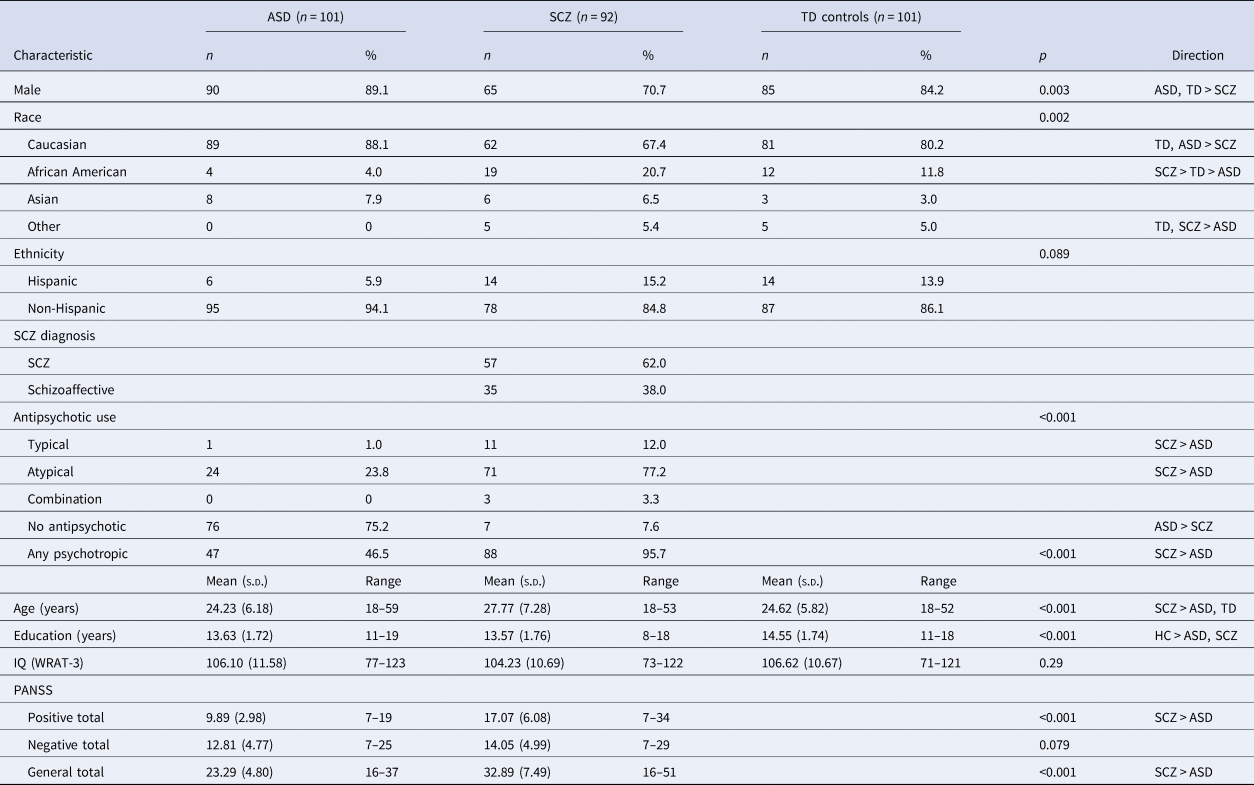
Demographic and clinical characteristics of each group are provided in Table 1. Importantly, groups did not differ on premorbid IQ as estimated with the WRAT-3 (F (2,291) = 1.26, p = 0.29). However, despite relatively small mean differences, groups significantly differed on age (F (2,291) = 8.65, p < 0.001) and years of education (F (2,291) = 9.81, p < 0.001). Groups also differed on sex (χ2 = 11.59, p = 0.003) and race (χ2 = 21.46, p = 0.002) but not ethnicity (χ2 = 4.85, p = 0.09). More individuals in the SCZ group were taking antipsychotic (χ2 = 97.73, p < 0.001) and psychotropic medications (χ2 = 55.26, p < 0.001); however, within the ASD group, approximately one-quarter were taking antipsychotics and half were taking some psychotropic medication. Ratings for positive (t (191) = 10.55, p < 0.001) and general symptoms (t (191) = 10.70, p < 0.001) from the Positive and Negative Syndrome Scale (PANSS; Kay et al., Reference Kay, Opler and Fiszbein1992) were also higher in the SCZ group as compared to ASD, but groups did not differ on levels of negative symptoms (t (191) = 1.77, p = 0.08).
Measures
Social cognition
Full descriptions of the social cognitive measures and their psychometric properties from demographically similar samples have been published recently (Pinkham et al., Reference Pinkham, Penn, Green and Harvey2016b; Morrison et al., Reference Morrison, Pinkham, Kelsven, Ludwig, Penn and Sasson2019). Briefly, these measures assessed four general domains.
(1) Attributional style was assessed with the Ambiguous Intentions and Hostility Questionnaire (AIHQ) (Combs et al., Reference Combs, Penn, Wicher and Waldheter2007) which yields scores for a hostility bias, an aggression bias, and a blame score.
(2) Emotion recognition was assessed with the Bell Lysaker Emotion Recognition Task (BLERT) (Bryson et al., Reference Bryson, Bell and Lysaker1997), the Penn Emotion Recognition Test (ER-40) (Kohler et al., Reference Kohler, Turner, Bilker, Brensinger, Siegel, Kanes, Gur and Gur2003), and the emotional biological motion task (EmoBio; Heberlein et al., Reference Heberlein, Adolphs, Tranel and Damasio2004; Kern et al., Reference Kern, Penn, Lee, Horan, Reise, Ochsner, Marder and Green2013). For these three tasks, participants must identify the emotion displayed by a given stimulus. Outcomes for BLERT and ER-40 are total number correct overall and for each emotion type, and for EmoBio, overall scores and scores for each emotion type are computed to be proportional to responses from the TD sample (EmoBio; Heberlein et al., Reference Heberlein, Adolphs, Tranel and Damasio2004).
(3) Social perception was measured with the relationships across domains (RAD) test (Sergi et al., Reference Sergi, Fiske, Horan, Kern, Kee, Subotnik, Nuechterlein and Green2009), basic biological motion task (Bio Motion; Kern et al., Reference Kern, Penn, Lee, Horan, Reise, Ochsner, Marder and Green2013), and the Benton facial recognition task (Benton; Benton and Van Allen, Reference Benton and Van Allen1968). Both the RAD and Benton are indexed as total correct, and d′ is calculated to index sensitivity for discriminating between biological and random motion.
(4) Mental state attribution was assessed with the Reading the Mind in the Eyes Test (Eyes) (Baron-Cohen et al., Reference Baron-Cohen, Wheelwright, Hill, Raste and Plumb2001), the Awareness of Social Inferences Test, Part III (TASIT) (McDonald et al., Reference McDonald, Flanagan, Rollins and Kinch2003), the Hinting Task (Hinting) (Corcoran et al., Reference Corcoran, Mercer and Frith1995), and the cartoon theory of mind task intentions subscale (CToM Intensions; Brüne, Reference Brüne2003). Each of these tasks is scored as total correct, and TASIT also utilizes total correct for two subscales, Lies and Sarcasm.
Participants also completed the Trustworthiness Task (Trust) (Adolphs et al., Reference Adolphs, Tranel and Damasio1998), which asks individuals to make complex social judgments of trustworthiness from facial images. This task aligns with multiple domains and is therefore listed separately. Performance is indexed by average ratings for trustworthy v. untrustworthy faces defined according to normative data (Adolphs et al., Reference Adolphs, Tranel and Damasio1998).
Neurocognition
Specific cognitive abilities were assessed with a subset of the MATRICS Consensus Cognitive Battery (MCCB) (Nuechterlein et al., Reference Nuechterlein, Green, Kern, Baade, Barch, Cohen, Essock, Fenton, Frese, Gold, Goldberg, Heaton, Keefe, Kraemer, Mesholam-Gately, Seidman, Stover, Weinberger, Young, Zalcman and Marder2008), which is well-validated across both ASD and SCZ (Kuo et al., Reference Kuo, Wojtalik, Mesholam-Gately, Keshavan and Eack2019b). Processing speed was measured with the Trail Making Test: Part A, Brief Assessment of Cognition in Schizophrenia: Symbol Coding, and Category Fluency: Animal Naming. Working memory was assessed with Letter-Number Span, and verbal learning was assessed with the Hopkins Verbal Learning Test-Revised.
Procedures
All tasks were completed in a single lab visit and in counterbalanced order. Bio Motion, Benton, EmoBio, and CToM were added to the battery after data collection began for the SCZ group, resulting in a smaller SCZ sample for these tasks. Additionally, technical difficulties with the Bio Motion task resulted in missing data for some participants in each group. Sample sizes for each task are given in Table 2.
Social cognitive performance

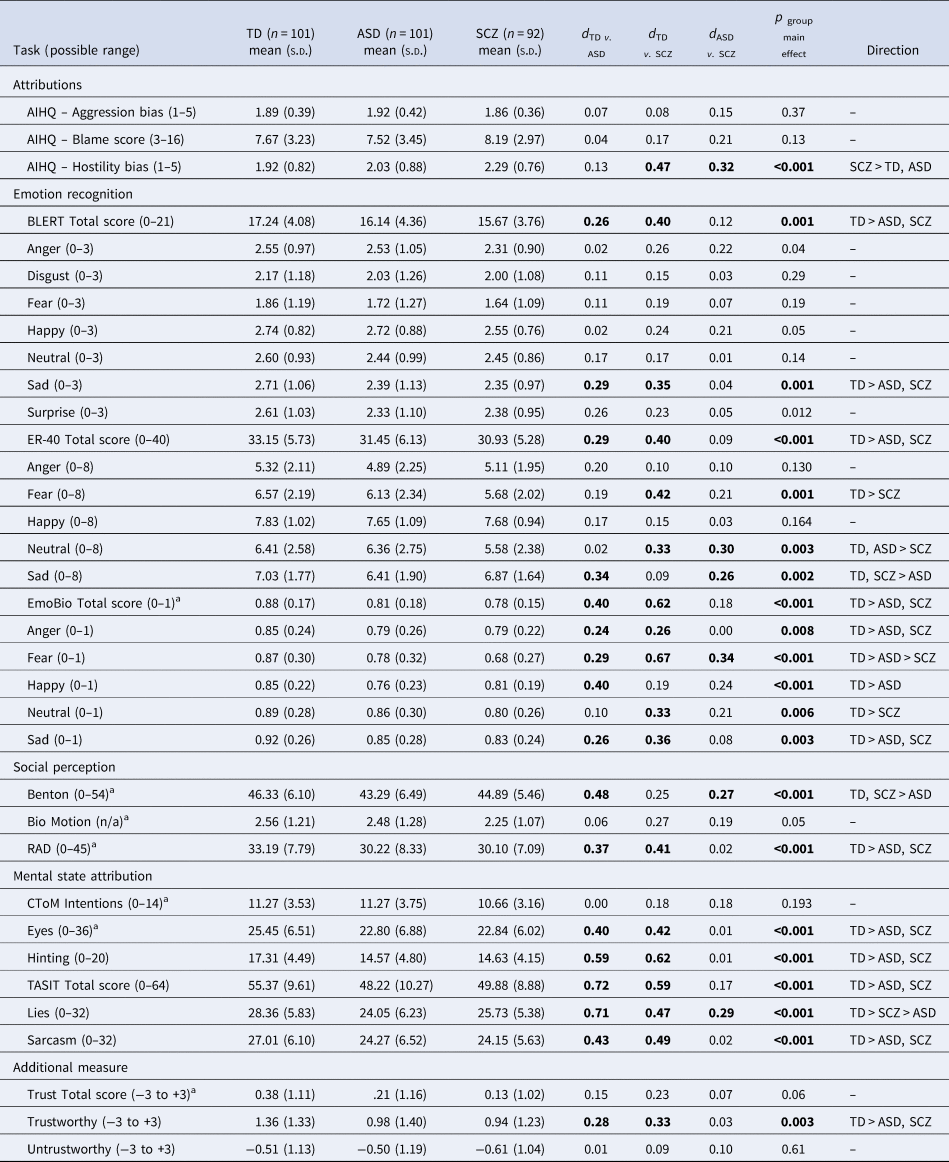
TD, typically developing; ASD, autism spectrum disorder, SCZ, schizophrenia.
Note: Means are presented as estimated marginal means from models accounting for age, gender, and race. Bolded values indicate statistical significance. Main effects of group are statistically significant if p < 0.01, and pairwise group comparisons were evaluated for statistical significance at the Bonferroni-corrected value of p < 0.0167.
a Sample sizes vary for these analyses. They are as follows: EmoBio: TD = 101, ASD = 101, SCZ = 78; Benton and CToM Intentions: TD = 101, ASD = 101, SCZ = 79; Bio Motion: TD = 93, ASD = 96, SCZ = 73; RAD: TD = 101, ASD = 101, SCZ = 89; Eyes and Trust: TD = 101, ASD = 98, SCZ = 92.
Statistical analyses
To provide a detailed level of analysis, group differences on each task were tested separately. All analyses used those demographic variables for which the clinical groups differed (i.e. age, race, and gender) as covariates, and where the assumption of sphericity was violated, Greenhouse–Geisser corrections were used. For tasks that yield a single-dependent variable (i.e. Bio Motion, Benton, CToM Intentions, Eyes, Hinting, and RAD), group differences were assessed via one-way analysis of covariance (ANCOVA). For tasks with well-defined subscales (AIHQ, BLERT, Emo Bio, ER-40, TASIT, and Trust), repeated measures ANCOVAs with group as the between-subjects variable were used. Emotion type was used as the within-subjects variable for all emotion processing tasks, and the three AIHQ subscores were used as the within-subjects variable for AIHQ. TASIT subscales included Lies and Sarcasm, and for the trustworthiness task, subscales included Trustworthy and Untrustworthy. To control for type-I error, main effects and interactions were considered to be significant only at p < 0.01. Additionally, Bonferroni-corrected post-hoc tests were used to probe all significant main effects of group, and significant interactions were followed up with one-way ANCOVAs to identify the specific areas of group difference. Significant main effects of within-subject variables are reported in online Supplementary Table S1. Cohen's d effect size estimates were also calculated for all post-hoc comparisons.
To examine correlations between neurocognition and social cognition, a composite score was first calculated for neurocognition by computing and averaging z-scores for each of the five MCCB tasks. Partial correlations (Pearson's r) controlling for age, race, and gender were then calculated to quantify the relation between the neurocognition composite and the overall summary score for each social cognitive measure. Differences in the strengths of correlations between SCZ and ASD were examined using the Fisher r-to-z transformation.
Results
Group comparisons on social cognitive task performance
Table 2 presents descriptive statistics for each group on each task as well as p values for all of the analyses detailed below. Cohen's d effect size estimates are also presented for all pairwise comparisons.
Attributional style
For the AIHQ, the main effect of group was not significant (F (2,286) = 4.39, p = 0.013), but the group × subscale interaction was (F (4,570) = 5.74, p < 0.001). Univariate tests revealed non-significant group effects on both the Blame (F (2,286) = 2.07, p = 0.13) and Aggression subscales (F (2,286) = 1.0, p = 0.37), but significant group differences on the Hostility bias (F (2,286) = 9.92, p < 0.001). Post-hoc tests demonstrated that SCZ made significantly more hostile attributions than both TD (p < 0.001) and ASD (p = 0.002) who did not differ (p = 0.20).
Emotion recognition
Results were fairly consistent across this domain, with the TD group out performing both ASD and SCZ and relatively few significant differences between the two clinical groups. The main effect of group on overall BLERT scores was significant (F (2,286) = 7.56, p = 0.001) indicating that TD out performed both ASD (p = 0.008) and SCZ (p < 0.001). ASD and SCZ did not differ (p = 0.27). The group × emotion type interaction was not significant (F (10.95,1565.49) = 1.03, p = 0.42).
For ER-40, the main effect of group was significant (F (2,286) = 8.08, p < 0.001), again indicating that both ASD and SCZ performed more poorly than TD (p < 0.001 and p = 0.003, respectively, p = 0.40 for ASD v. SCZ). However, in contrast to BLERT, this effect was qualified by a significant group × emotion type interaction (F (6.78,970.01) = 3.95, p < 0.001). Groups significantly differed in the recognition of sadness (p = 0.002), fear (p = 0.001), and neutral faces (p = 0.003), but not happiness (p = 0.16) or anger (p = 0.13). For sadness, TD and SCZ did not differ (p = 0.39), but both were more accurate than ASD (p = 0.001 for TD and p = 0.015 for SCZ). For fear, only the difference between TD and SCZ was significant (p < 0.001), and for neutral, both TD and ASD were more accurate than SCZ (p = 0.002 for TD and p = 0.005 for ASD).
The main effect of group was also significant on EmoBio (F (2,272) = 16.67, p < 0.001) such that TD correctly recognized more emotions than either ASD (p < 0.001) or SCZ (p < 0.001), who did not differ (p = 0.21). The group × emotion type interaction was also significant for this task (F (8,538) = 4.00, p < 0.001). Follow-up tests indicated that the main effects of group for all emotions were significant (all p < 0.008) but that the pattern of group differences varied across emotions. TD was more accurate than both clinical groups on sadness (p = 0.01 for ASD and p = 0.002 for SCZ), anger (p = 0.016 for ASD and p = 0.005 for SCZ), and fear (p = 0.001 for ASD and p < 0.001 for SCZ). TD was also more accurate than ASD for happy (p < 0.001) and SCZ for neutral (p = 0.001). Clinical groups only significantly differed on fear, where ASD was significantly more accurate than SCZ (p = 0.003).
Social perception
Groups significantly differed on facial recognition as measured by the Benton (F (2,273) = 12.90, p < 0.001). Post-hoc tests revealed that ASD performed worse in both TD and (p < 0.001) and SCZ (p = 0.016), who did not significantly differ from each other (p = 0.025). The main effect of group on Bio Motion was not significant after correction for multiple comparisons (F (2,254) = 3.03, p = 0.05). For RAD, groups significantly differed (F (2,283) = 10.06, p < 0.001), with TD outperforming both ASD (p < 0.001) and SCZ (p < 0.001). ASD and SCZ did not significantly differ (p = 0.89).
Mental state attribution
The main effect of group on CToM intentions was not significant (F (2,273) = 1.66, p = 0.19); however, groups did significantly differ on the other three tasks within this domain with TD outperforming ASD and SCZ. For Eyes, post-hoc tests of the main effect (F (2,283) = 10.85, p < 0.001) demonstrated that TD scored higher than both ASD (p < 0.001) and SCZ (p < 0.001), who did not differ (p = 0.95). The same pattern was found for Hinting (F (2,286) = 24.33, p < 0.001). TD scored significantly higher than both ASD (p < 0.001) and SCZ (p < 0.001), who did not differ from each other (p = 0.90). For TASIT, the significant main effect of group (F (2,286) = 30.65, p < 0.001) again followed the same pattern with TD outperforming both ASD (p < 0.001) and SCZ (p < 0.001), who did not differ (p = 0.11). The group × subscale interaction did not survive correction for multiple comparisons (F (2,286) = 3.19, p = 0.04).
Additional social cognitive measure
While groups did not differ on overall ratings on the Trust task (F (2,283) = 2.79, p = 0.06), the group × face type interaction was significant (F (2,283) = 7.48, p = 0.001). Follow-up univariate analyses showed that groups differed in their ratings of trustworthy faces (F (2,283) = 5.98, p = 0.003) but not untrustworthy faces (F (2,283) = 0.50, p = 0.61). For trustworthy faces, TD ratings were significantly higher than both clinical groups (p = 0.005 for ASD and p = 0.003 for SCZ), but the ratings from clinical groups did not differ (p = 0.78).
Correlations between neuro- and social cognition
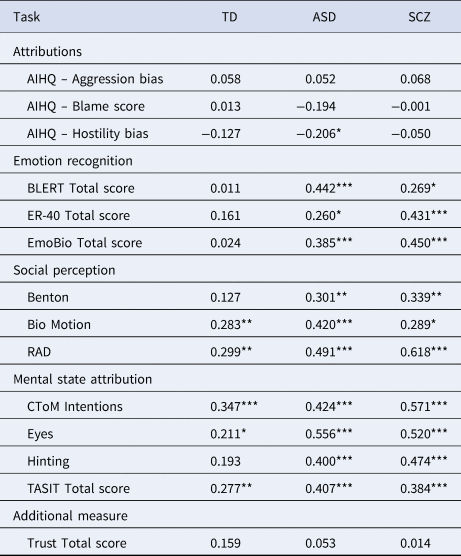
Correlations between the neurocognitive composite score and performance on social cognitive tasks were small to moderate in the TD group, ranging from 0.01 to 0.35. In contrast, both clinical groups showed correlations spanning nil to large effect sizes (0.001–0.62; Table 3). No correlations significantly differed between ASD and SCZ.
Correlations between neurocognition composite score and social cognitive performance

*p < 0.05, **p < 0.01, ***p < 0.001.
Post-hoc analyses
To examine whether significant differences between clinical groups might be related to symptom severity, additional ANCOVAs were conducted while covarying for both positive and general symptom levels. ASD v. SCZ group differences on AIHQ Hostility, Benton, ER-40 neutral faces, and EmoBio fear stimuli were no longer statistically significant when controlling for symptoms. The group difference on recognition for ER-40 sad faces was significant at traditional levels but not our corrected level (F (1,184) = 4.25, p = 0.04). Although group differences on TASIT Lies were not interpreted in the primary analyses due to the non-significant group × subscale interaction, it is interesting to note that this pairwise comparison remained significant even when controlling for symptoms (F (1,184) = 9.69, p = 0.002). Partial correlations (Pearson's r) between social cognitive performance and symptom levels controlling for age, race, and gender are also included in online Supplementary Table S2.
Discussion
This study aimed to systematically and comprehensively compare social cognitive impairments in adults with ASD and adults with SCZ. Consistent with the existing literature, both the ASD and SCZ groups performed more poorly than their TD counterparts. However, in contrast to our hypotheses, there were only minimal differences between the two clinical groups, and those differences that were statistically significant were only of small-to-medium effect sizes and were no longer statistically significant after accounting for symptom severity. The strength of the relationship between social cognition and neurocognition also did not differ between clinical groups. Thus, our results support the conclusion that adults with ASD and SCZ show similar impairments in social cognition.
The current findings contradict the previous meta-analytic finding that ASD shows greater emotion recognition impairment than SCZ (Fernandes et al., Reference Fernandes, Cajão, Lopes, Jerónimo and Barahona-Corrêa2018). However, an important caveat to this finding was that age moderated the effect such that poorer performance for ASD was most pronounced in younger samples. The two studies from the meta-analysis that reported the largest group differences included participants who were in their upper teens (Bölte and Poustka, Reference Bölte and Poustka2003; Waris et al., Reference Waris, Tani, Lindberg, Lipsanen, Kettunen, Kaltiala-Heino, Saarimaa, Reinvall, Voutilainen and Hokkanen2016); whereas those studies using samples aged more similarly to ours found little to no difference, and those with older samples reported greater impairment in SCZ. As noted by Fernandes et al. (Reference Fernandes, Cajão, Lopes, Jerónimo and Barahona-Corrêa2018), this may reflect either prolonged developmental improvement of emotion recognition over time in ASD or illness-related deterioration in SCZ. Given that age-related decline in emotion recognition ability is well established in SCZ (Kohler et al., Reference Kohler, Walker, Martin, Healey and Moberg2009), but that age does not appear to be related to emotion recognition ability in ASD (Uljarevic and Hamilton, Reference Uljarevic and Hamilton2013), the latter explanation may be more likely. Nonetheless, these findings suggest that the developmental time point at which groups are compared could have important implications for the direction and size of group differences. Future longitudinal studies are therefore warranted, as this would allow a direct comparison of trajectories of social cognitive performance and clarify whether any group differences may be more evident in specific developmental stages not investigated here (e.g. adolescence, older adulthood).
Similarity of impairment in social cognition can be viewed within the National Institute of Mental Health's Research Domain Criteria framework, which suggests that classifying disorders based on shared dimensions of observable behaviors may help to pinpoint common mechanisms such as genes or dysfunctional neural circuits (Morris and Cuthbert, Reference Morris and Cuthbert2012). Indeed, a growing literature has identified genetic overlap between SCZ and ASD, particularly in relation to dopaminergic and serotonergic pathways (Khanzada et al., Reference Khanzada, Butler and Manzardo2017; O'Connell et al., Reference O'Connell, McGregor, Lochner, Emsley and Warnich2018), and imaging studies have also highlighted comparable reductions of neural activation in frontolimbic networks and superior temporal sulcus during tasks of social cognition in ASD and SCZ (Pinkham et al., Reference Pinkham, Hopfinger, Pelphrey, Piven and Penn2008; Sugranyes et al., Reference Sugranyes, Kyriakopoulos, Corrigall, Taylor and Frangou2011; Ciaramidaro et al., Reference Ciaramidaro, Bölte, Schlitt, Hainz, Poustka, Weber, Bara, Freitag and Walter2014), for an exception, see Eack et al., (Reference Eack, Wojtalik, Keshavan and Minshew2017). Such findings may point toward shared etiology of social cognitive impairment in both disorders; however, it is also possible that divergent mechanisms may lead to the apparent equifinality reported here. For example, in a relatively recent direct comparison conducted by our group, ASD and SCZ performed similarly on a task of emotion recognition, but concurrent eyetracking demonstrated that, in contrast to the SCZ group, the ASD group failed to prioritize facial information when contextual information was ambiguous (Sasson et al., Reference Sasson, Pinkham, Weittenhiller, Faso and Simpson2016). Given that the current analyses focused only on comparisons of mean level performance, more subtle distinctions between disorders that could identify divergent mechanisms (e.g. error patterns) may have been obscured. We plan to pursue more detailed investigations on these data and encourage future comparisons that pair comprehensive behavioral and neurobiological assessments.
Despite the overall pattern of similarity, a few differences between ASD and SCZ were also evident. In our exploratory analyses, statistically controlling for between-group differences in symptom severity appeared to negate these discrepancies in social cognitive performance. This suggests that clinical phenomenology may serve as potential mechanisms of divergence. For example, increased paranoia has been linked to a greater hostility bias (Pinkham et al., Reference Pinkham, Harvey and Penn2016a), and our SCZ group was significantly more paranoid than the ASD group (t (191) = 8.22, p < 0.001). When controlling for levels of paranoia and positive symptoms, group differences in hostility bias were attenuated, suggesting that paranoia may serve as a mechanism for increased tendencies to make hostile attributions. Considering differences in symptom presentation may therefore aid in identifying potential mechanisms and suggests that distinguishing clinical features of the two conditions may be driving social cognitive discrepancies when they do occur. However, controlling for symptom differences may also artificially reduce the very distinctions that define the disorders, which could then negate the purpose of the comparison. Future research will need to carefully address how differences in clinical presentation should be approached and be mindful that symptomatic differences are likely inherent to the two disorders, and indeed, are part of the basis for separate diagnoses (Sasson et al., Reference Sasson, Pinkham, Carpenter and Belger2011). Here, we presented the results both in their original form and while controlling for symptoms, but we encourage continued debate regarding the optimal approach.
Several limitations should also be considered when interpreting these findings. First, it might be argued that social cognitive measures could perform differently across clinical groups and that transdiagnostic comparisons are therefore inherently invalid. This is an important point; however, the majority of tasks utilized here have been psychometrically validated in each population (Pinkham et al., Reference Pinkham, Penn, Green and Harvey2016b; Morrison et al., Reference Morrison, Pinkham, Kelsven, Ludwig, Penn and Sasson2019), and two recent studies demonstrate that the Mayer–Salovey–Caruso Emotion Intelligence Test (MSCEIT), a well-known emotion processing assessment, and the MCCB are generalizable across ASD and SCZ with partial measurement invariance and full structural invariance (Kuo et al., Reference Kuo, Wojtalik, Mesholam-Gately, Keshavan and Eack2019a, Reference Kuo, Wojtalik, Mesholam-Gately, Keshavan and Eack2019b). The parallel nature of the MSCEIT and the assessments used here suggests that our measures are also transdiagnostically valid; however, this should be confirmed in future analyses. Second, despite the relative comparability of our groups on demographic factors, they statistically differed on age, race, and gender, requiring that these variables be controlled in our analyses. Future comparative studies should continue to strive for well-matched samples. Third, these results apply only to individuals with ASD who do not have co-occurring intellectual disability (ID). Approximately a third of individuals with ASD also meet criteria for ID (Baio, Reference Baio2014), which limits the generalizability of the current results. Finally, the current analyses do not address individual differences in social cognitive ability. Recent work from our group has demonstrated marked heterogeneity in degree of social cognitive impairment in SCZ such that approximately one-quarter of patients show no impairment at all (Hajdúk et al., Reference Hajdúk, Harvey, Penn and Pinkham2018) with the current set of tests. A similar continuum of impairment may be evident in ASD, which would have important implications for the need to assess social cognitive abilities prior to developing treatment plans. It is also important to keep in mind, however, that objective deficits in social outcomes are probably more prevalent in both groups than deficits in social cognitive performance, which raises questions about the degree of overlap between social cognitive and social functioning difficulties that may vary among individuals with these conditions.
Overall, the current findings support similar levels of social cognitive impairment in ASD and SCZ, particularly when accounting for differences in symptom severity. It is still unclear whether these comparable behavioral outcomes result from the same or discrepant mechanisms; however, the shared impairments reported here indicate the potential benefit of applying treatments transdiagnostically.
Supplementary material
The supplementary material for this article can be found at https://doi.org/10.1017/S0033291719002708.
Acknowledgements
We would like to thank Michael Green for providing access to the Biological Motion and Emotional Biological Motion Tasks and Martin Brüne for sharing the Cartoon Theory of Mind task. We would also like to thank all of the individuals who participated in the study, and the non-Pareil Institute in Plano, Texas for help with recruitment.
Financial support
This study was funded by grants from the National Institute of Mental Health at the National Institutes of Health (RO1 MH093432, PIs Harvey, Penn, Pinkham; R15 MH101595, PI Sasson).
Conflict of interest
Dr Pinkham has received consulting fees and travel reimbursement from Roche. In the last 3 years, Dr Harvey has received consulting fees or travel reimbursements from Allergan, Alkermes, Akili, Biogen, Boehringer Ingelheim, Forum Pharma, Genentech, Intra-Cellular Therapies, Jazz Pharma, Lundbeck Pharma, Mindstrong, Inc., Minerva Pharma, Otsuka America (Otsuka Digital Health), Roche Pharma, Sanofi Pharma, Sunovion Pharma, Takeda Pharma, and Teva. All other authors report no conflict of interest.
Ethical standards
The authors assert that all procedures contributing to this work comply with the ethical standards of the relevant national and institutional committees on human experimentation and with the Helsinki Declaration of 1975, as revised in 2008. A statement regarding study approval from the local Institutional Review Boards is included on page 7 of the manuscript.