1. Introduction
Since the current financial crisis hit in 2008, the WTO Secretariat has taken on the task of publishing regular reports on the threat and actual use of protectionist measures by its member states. This important development highlights the role of institutional monitoring in providing timely information and serving as a check against members' propensity to cheat and break commitments. One of the most severe barriers to effective participation by developing countries in the trade regime is the lack of information. With 153 members in the WTO, it is prohibitively costly and inefficient for each country to monitor all other states. The trade regime's information system has evolved over six decades, with the WTO's Trade Policy Review Mechanism (TPRM) representing the most institutionalized form. The TPRM has been a regular feature of the multilateral trade regime since 1989 and shoulders a fundamental responsibility in making the trade regime more transparent. This paper asks: how has the TPRM responded to demands from developing countries for information and transparency?
The paper answers the question by, first, explaining the evolution of the WTO's monitoring system and, secondly, evaluating the TPRM's performance against the task it was assigned. The TPRM, although highly institutionalized, suffers from weaknesses in its limited mandate. Yet, it was given an important role in providing information on members' trade policies. In practice, however, the reports often fail to cover salient issues that are of concern to members' trade partners. The process of review meetings also shows low rates of participation for a majority of the WTO's members, suggesting a lack of confidence in the TPRM's role as a forum for peer review and peer pressure. Even as some developing countries have started to build domestic monitoring capacities, for most members the multilateral information system is still essential for getting credible and timely information. By presenting concrete evidence on the TPRM's functioning, the paper hopes to facilitate a substantive discussion on ways to strengthen monitoring in the WTO.
Two clarifications are important at the outset. As will become evident, information systems include a number of actors and institutions. This is true for the WTO as well but the paper primarily focuses on the TPRM for several reasons. It is a highly institutionalized part of the WTO's information system, is extensive in the scope of countries and issues covered, and absorbs one of the largest proportions of the WTO's budget.
There is another reason for studying the TPRM: to pay attention to the role of information systems in multilateral regimes. Current debates in the WTO, in part focused on improving its monitoring system, highlight this concern. One could argue that if private actors spot protectionist trends and urge their governments to defend their trading interests, why bother with mechanisms like the TPRM? The fact is that those with the capacity to monitor were anyway doing it long before the TPRM came into existence. Institutional monitoring is expected to offer greater marginal benefits to poorer countries. So, it is important that we understand the current challenges facing the TPRM, both in its mandate and its operation. Acknowledging that other sources of information exist in no way guarantees that a majority of the WTO's members have access to that information, have the capacity to analyse such information, or have the political power to apply peer pressure on an individual basis against their trading partners. The TPRM promised all that, hence it deserves closer attention.
A second clarification concerns the measures used to evaluate the mechanism. The framework used in this paper helps to examine the TPRM's design against ideal-type information systems. By extending beyond mere description of the TPRM (which has been the shortcoming of much of the literature), such an approach frames the debate on monitoring in the trade regime in terms of how it could function as against how it is actually designed. But the TPRM's actual functioning is evaluated against its mandate, not against an ideal standard. The paper uses specific metrics: whether TPR reports analyse issues of critical importance to member states, whether different sets of countries raise questions on issues of concern to them, and whether different sets of countries participate in the review meetings. The evidence presented offers an objective insight into one of the least discussed, yet one of the most important, functions of the WTO.
The paper starts by discussing the role of information in promoting international cooperation and outlines how actors' interests, monitoring capacities, and the information gaps they face result in alternative designs of information systems (Section 2). This framework is then used to explain the evolution of surveillance in the trade regime (Section 3). It asks what member states expected out of the TPRM and whether the mechanism was designed to respond to those expectations (Section 4). The paper presents, for the first time, empirical evidence from all trade policy reviews conducted during 1995–2007, with particular attention to the content of reports and the participation of developing countries (Section 5). It discusses the capacity challenges within the WTO Secretariat and briefly outlines efforts made by developing countries to boost surveillance capacity at home (Section 6). The concluding section outlines reform proposals.
2. The demand for and supply of information in international regimes
Information has long been considered central to cooperation among states. What role does information play in promoting compliance and how do information gaps affect the design of information systems?
Just as it would be inefficient for a country to negotiate individual agreements with other countries, it is equally costly for a country to monitor whether each of its treaty partners is complying with the rules or not. The task of monitoring becomes particularly complex in large multilateral regimes, where member states are not only numerous but also at very different stages of development. One of the key reasons that international regimes are demanded is because regimes can help to mitigate imperfect information and increase transparency about members' policies and practices.Footnote 2
Information is crucial for promoting international cooperation. Regimes provide information on members' actions, which reassures other members that, once agreed, a treaty will be abided by.Footnote 3 Actors comply if they have complete information that others are complying as well.Footnote 4 The same information that helps states monitor compliance by others, in turn, raises the cost of defection because of the threat of retaliation (say, in a security regime) or the loss of benefits from cooperation (say, from an agreement to jointly share a natural resource).
The motivations for compliance vary in international relations (IR) literature. For institutionalists, compliance is rational because it increases efficiency in international negotiations. Also, reciprocity promotes compliance with agreements especially when a long shadow of the future can be guaranteed. And with diffuse reciprocity comes greater trust between members of a regime as states seek to maintain their reputations.Footnote 5 Ronald Mitchell calls this ‘treaty-induced’ compliance, as opposed to ‘coincidental compliance’ that realists propound, the idea that conforming behaviour would have occurred even in the absence of the treaty.Footnote 6
Sole reliance on reputation as an explanation of treaty compliance is unhelpful because it does not explain why states comply with some treaties and not with others. Reputations are not entirely fungible across issue areas. States make their own assessments about the importance of different regimes and end up having multiple reputations across issue areas. Downs and Jones argue that the contribution of reputation in sustaining international law would be most for agreements that are considered highly beneficial and least for agreements that are believed to be of only marginal significance.Footnote 7
Whether it is a concern for its reputation or the threat of retaliation, a state's decision to comply would ultimately rest on the chances of its non-compliant behaviour being found out.Footnote 8 Any hypothesis about generally compliant behaviour by states would be contingent upon monitoring and enforcement mechanisms. If there were any chance that deviant behaviour would not be spotted, then a state would have an incentive to renege on its commitments if the short-term payoffs from defection are greater than the discounted long-term benefits of cooperation. The decision to cooperate or defect is solely determined by the fear of being caught and having to face retaliatory measures or lose reputation. The manner in which monitoring (fear of being caught) and enforcement (fear of retaliatory measures) happens is crucial. But the theory on the demand for regimes provides no clear explanation about how exactly regimes collect and disseminate information.Footnote 9
Scholars agree that states face information asymmetries when trying to cooperate. But the exact nature of information gaps affecting states, particularly developing countries, remains under-theorized. If information gaps create a demand for information, we need to understand its supply through information systems.
Information systems in international regimes are the sets of institutions, actors, and procedures involved in collecting, analysing, and disseminating information about members' actions and the regime's effectiveness. Institutions can operate both at the international level (the regime secretariat) and at the domestic level (parliamentary committees, government departments). Actors refer to state actors (bureaucrats, ministers, legislators) and non-state actors (NGOs, firms, business associations). The procedures in information systems pertain to the formal and informal mechanisms through which different actors obtain information about member states' policies and actions.
Recent literature offers deductive theories to investigate what kinds of information systems are likely to emerge in regimes, given prevailing conditions (nature of issue area, incentives and capacities of actors, exogenous factors). Ronald Mitchell's work has focused on the need for and sources of transparency in environmental regimes.Footnote 10 More recently, Xinyuan Dai has explored the distinction between individual and state interests in the context of surveillance.Footnote 11 Similarly, Kal Raustiala has distinguished between institutionalized versus citizen-driven monitoring.Footnote 12
While existing literature has concentrated on self-reporting by member states or reporting by citizens, it has paid inadequate attention to the role of regime secretariats in collecting, collating, analysing, and disseminating information.Footnote 13 In reality, there can be several types of information systems or even a combination of self-, other-, or institutional reporting. Nor has the literature conceptualized the different functions of information systems or how different stakeholders are expected to use the information. Further, institutional choice is assumed to be static. Existing theories of information systems develop hypotheses based on assumptions about the fixed characteristics of the regime. In reality, the capacity of actors to monitor developments not only varies across regimes but also within regimes. The variation within regimes also occurs over time, thereby affecting the interests of actors interested in monitoring.
Information gaps and the demand for information
In order to understand variations in the designs of information systems, we need to understand the demand for information by outlining the information gaps that countries seek to bridge. What does imperfect information really mean? Information is a necessary input in all phases of regime design and sustenance: agenda-setting, negotiation, implementation, monitoring, and enforcement.Footnote 14 Information gaps hamper attempts to enhance cooperation among states during all of these phases. Not all information gaps, however, are of the same variety. Institutional IR theory recognizes that information asymmetries imply that one actor has more information than another. But it does not explain how these asymmetries affect different stages of a regime or different categories of states. Moreover, information gaps afflict states not just in a relational sense (as asymmetries) but in an absolute sense as well (absence of salient and credible information for all parties). Viewed this way, we can conceptualize information gaps, which would incorporate both the relational as well as the absolute aspects of information barriers to international cooperation.
Issue uncertainty
Issue uncertainty results from a lack of sufficient information to understand preferences on an issue area under negotiation. Negotiators are often uncertain about their counterparts' true preferences and, therefore, are concerned about unfair outcomes. Issue uncertainty hampers successful agenda-setting and negotiations because states are unsure of the value other parties attach to the issue and become excessively defensive against new issue areas.Footnote 15 It is also conceivable that actors might be unaware of their own preferences.Footnote 16 When new and complex issues come on the agenda, states and non-state actors (NSAs) might not be in a position to take an informed decision about what their interests are and what their negotiating positions ought to be.Footnote 17 This can result in extreme defensiveness and opposition to the issue altogether.
Hidden/inaccurate information
A second type of information gap results from hidden or inaccurate information, which arises when states deliberately withhold or supply inaccurate information about their activities.Footnote 18 Here, the intentional abuse of information and the systematic bias in the availability of information among parties undermines trust in the regime and reduces incentives for compliance and cooperation. The threat of inaccurate information is particularly problematic during the implementation, monitoring, and enforcement phases. Abbott identified two strategies for producing information: verification of others' actions, and giving assurance about one's own actions.Footnote 19 Both strategies work on the assumption that other parties would not assist in the collection of information; states rely on their own monitoring. But, given the costs involved, verification need not be comprehensive. The more cooperative assurance strategy would be undermined if states fear being misled by inaccurate data. Thus, the design of the regime's information system – whether led by states, NSAs, or international organizations – becomes crucial to ensure objective, accurate, and timely information about members' actions. For developing countries, which might not have independent sources of information, hidden/inaccurate information is a major challenge to enforcing compliance by other, more powerful states.
Resource-constrained information
Information gaps also arise because of a lack of resources. States have to invest considerable time and money to gather information during the negotiation phase as well as to formulate implementation strategies and monitor other states. In regimes with large membership, effective monitoring can become a prohibitive exercise. Resource-constrained information gaps are particularly problematic for developing countries, which suffer from a lack of financial and technical resources to collect and analyse the necessary information.
Of course, not all non-compliance need be deliberate. There are several reasons why states might find themselves in non-compliance of a treaty without wilfully wanting to be so: ambiguity in the actual agreement, incapacity of states to fulfil a commitment, and the temporal dimension to account for the period between treaty conclusion and implementation.Footnote 20 Axelrod and Keohane argue that international regimes reduce this uncertainty and help to avoid mistaken disputes.Footnote 21
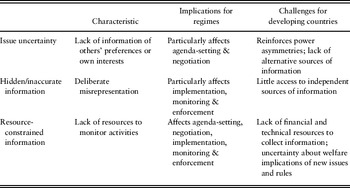
Table 1 summarizes the information gaps and their implications for regimes and developing countries. Issue uncertainty during negotiations is doubly problematic for developing countries since they are uncertain about their own preferences as well. This could be partly resolved if countries invest in additional research, but the lack of financial and technical resources can hinder their efforts. Hidden/inaccurate information is problematic if developing countries remain unaware of non-compliance by other states. In the trade regime, protectionist policies abroad affect a country's export interests. But, while in rich countries, export-oriented groups can be expected to monitor actions elsewhere, such capacities are limited for developing countries. Even governments are constrained in their ability to monitor policies due to a lack of resources. For developing countries, it is ultimately the resource-constrained information gap that is the most critical. It adversely affects the potential for developing countries to participate in all phases of a regime.
Information gaps and their impact on regimes and states

Alternative designs of information systems
The design of information systems depends on a range of factors. The framework presented here extends existing literature by accounting for more types of information systems and for variations in them over time. Information systems are designed based on the nature of information gaps affecting regimes and their member states, the power imbalances between states and their incentives towards the regime, and the capacities of state and non-state actors to monitor developments. The interaction of these variables – information gaps, actors' interests, actors' capacities – yields five design types.
• No reporting – Although all regimes require information, it is conceivable for some to have no explicit reporting or information gathering mechanism. We should expect this outcome when regime membership is small and behaviour is clearly observable. We should also expect no reporting where members are similar in size and capacity, resulting in a degree of trust among the states.
• Self-reporting – States report on their own activities, policy direction, and legislative changes to show compliance or justify non-compliance with regime obligations. We should expect this outcome when the number of actors increases, the threat of hidden/inaccurate information increases, but where states are unwilling to cede sovereignty to the regime secretariat. Self-reporting would also be more acceptable where inaccurate information is the predominant threat, but behaviour is observable with relative ease.
• Other-reporting – States gather and report information about the actions of others, whether states or non-state actors. We should expect this outcome when states face hidden/inaccurate information hurdles, but there is reasonable equivalence in the capacities of members to monitor others.
• Institutional reporting – The regime secretariat collects information on members' actions and the functioning of the regime as a whole. We should expect this outcome when regime membership is large, the wide scope of issues adds to more uncertainties, and a high proportion of states are resource-constrained.
• Non-state actors (NSA) reporting – Non-state actors collect and analyse information, to report on member states' behaviour and on the impact of the regime on an NSA's interests in a particular issue area. We should expect this outcome when the incentives of states and NSAs do not coincide, when states are resource-constrained, or when states suffer from issue uncertainty in new areas of negotiations.
In practice, information systems in international regimes are often a combination of these designs. The next section explains how information gaps and members' interests and capacities influenced the trade regime's information system, in particular the TPRM.
3. Watchdog, not judge – explaining the evolution of surveillance in the trade regime
The demand for surveillance in the multilateral trade regime has been a long-standing one. But the manner in which surveillance has been conducted has radically changed over the decades: at times ad hoc, other times focused on a few specific areas, and later calls for more regular and strengthened surveillance grew. This section explains why and how contracting parties with different interests agreed to create an institutionalized monitoring system.
1950s: ad hoc reviews
During the GATT's initial years (1947–1955) its membership was small (only 33) and developing countries accounted for less than half the membership (48%). Information gaps would have been minimal in the mostly developed country-dominated trade regime. As a result, there was no institutionalized monitoring mechanism in these early years (a case of ‘no reporting’).
The earliest example of formal surveillance emerged in the mid-1950s. The GATT's 9th Session (28 October 1954–18 March 1955) was unique in its history in that it served as a Review Session as well. The previous session had recognized that ‘international trade continues to be restricted by high tariff barriers…’ There was also a perception that trade was being hampered ‘by widespread application of other restrictions [including quantitative restrictions]’.Footnote 22 Contracting parties recognized the need to garner information about whether these measures were being legitimately used or not.
The Review Session looked into quantitative restrictions, schedules and customs administration, other barriers, and organizational questions. Following the submission of working party reports, regular consultations were established to review quantitative restrictions maintained for balance-of-payments purposes.Footnote 23 Thus, limited surveillance was established to counter a potential threat of hidden information on non-tariff barriers. But contracting parties decided not to extend additional authority to the GATT Secretariat to conduct reviews on other trade issues.
Another example of ad hoc institutional reporting occurred in 1958. The small number of developing countries in the GATT continued to assert that their interests were not being taken into account. Nor did they have the capacity or resources to undertake a detailed review of rich countries' trade policies on their own. Largely in response to such complaints, contracting parties established a Committee under the chairmanship of Gottfried Haberler, a Harvard-based trade economist. The Haberler Report, noting the decline in the terms of trade for primary commodity producers, argued that the trade policies of developed countries were hindering less developed ones from participating in the trade regime. In response, a Committee dealing with agricultural trade conducted consultations with 40 contracting parties during 1959–61 on agricultural policies.Footnote 24 With the Common Agricultural Policy emerging in 1962, the Committee also held consultations with the European Economic Community.Footnote 25 These were, however, rare examples of systematic reviews of whether the GATT system was achieving its objectives for a growing proportion of its membership. Thus, although a case of institutional reporting, the incentives of contracting parties remained issue-specific and the regime was not yet large enough for members to mandate a more permanent information system.
1960s–1970s: mixed information systems
The situation began to change as the GATT grew in size, the proportion of developing countries increased, and issues that are more complex started dominating the trade agenda. By the end of the 1960s, GATT membership had more than doubled to 75. The issues under negotiation also broadened in scope, such as those concerning balance-of-payments restrictions, agriculture, various multilateral trade negotiations (MTN) codes, and textiles. The risk of hidden information increased in a heavily laden trade agenda, and contracting parties developed an incentive to monitor issues of specific interest to them.
Several ad hoc and sector-specific surveillance mechanisms were established in the 1960s and 1970s. The Committee on Balance-of-Payments Restrictions consulted annually with relevant developed countries, and biennially with developing countries. The Textile Surveillance Body, set up under the Multi Fibre Agreement (MFA), had a ‘small but geographically representative membership, meeting as often as necessary’.Footnote 26 It received annual notifications on textile restrictions from all MFA signatories, and reviewed bilateral and unilateral actions by the signatories. The Textiles Committee also established a Sub-Committee on Adjustment in 1981 to review measures adopted to facilitate adjustment. The various MTN codes were also subject to notification requirements for contracting parties that had signed the codes. Some countries independently conducted surveillance over the implementation of the codes as well. However, all documentation was restricted only to the code signatories and observers.
The 1960s and 1970s were a mix of self-reporting (textiles, MTN codes, BoP restrictions), other reporting (the European Community and the United States conducted their own surveillance targeted at major trading partners), but minimal institutional reporting. Contracting parties recognized the need for surveillance on specific issues. But, given that signatories to specific agreements were fewer than the larger GATT membership, reporting behaviour was more easily observable. Thus, countries were not yet willing to give a strong mandate to the GATT Secretariat.
Early 1980s: issue-specific institutional reporting
It was not until the 1980s that a series of proposals for strengthened institutional surveillance in the GATT came forward. In 1979, the Tokyo Round had concluded with an Understanding Regarding Notification, Consultation, Dispute Settlement, and Surveillance, which provided for special GATT Council meetings to review developments in the trading system.Footnote 27 Furthermore, although tariffs had been cut significantly, there was a growing need to monitor the use of non-tariff barriers. From 1980 onwards, Special Council meetings were held biannually with the Secretariat submitting a note detailing developments in the preceding six months. In 1983, the scope of the meetings was broadened to ensure that trade policies were consistent with GATT principles and to ‘avoid measures which would limit or distort international trade’.Footnote 28 This was largely due to issue uncertainties in the negotiations, growing concern about hidden information on non-tariff barriers, and a poor record on compliance with notifications.
Surveillance on issues of concern for developing countries also increased to some extent via the Committee on Trade and Development (CTD). The CTD had emerged as a result of the inclusion of Part IV in the GATT in 1964, which focused on the special circumstances and needs of less developed countries.Footnote 29 In 1979, when poor countries comprised 70% of the GATT membership, the Sub-Committee on Protective Measures was established to monitor actions by rich countries that could block imports from developing ones. Also, the Sub-Committee on Trade and Least Developed Countries was made responsible for reviewing trade policy developments of interest to this category of contracting parties. After a GATT Ministerial Declaration in 1982, the CTD adopted a programme of consultations ‘to examine how individual contracting parties have responded to the requirements of Part IV’.Footnote 30 But no conclusions were reached until the start of the Uruguay Round.
Developing country concerns did not translate into wider institutional review. Although developing countries were increasing in number, their engagement with the trading system was very limited in the 1960s and 1970s, focusing on securing preferential access to markets. Thus, the degree to which issue uncertainty would have hindered their negotiating capacities was limited. Instead, they were largely affected by hidden information about rich countries' policies and were constrained by a lack of resources to undertake reviews themselves; hence, the call for institutional reporting within the CTD. At the same time, developing countries had been traditionally very protective of their sovereignty; they were reluctant to let the GATT Secretariat monitor trade policies more regularly.Footnote 31 So, a combination of limited issue-specific interests and resource-constrained information gaps resulted in limited surveillance oriented towards developing country interests.
Late 1980s: debating and designing the TPRM
In 1985, an Eminent Persons Group (EPG, chaired by Dr Fritz Leutwiler), arguing that ‘governments should be required regularly to explain and defend their overall trade policies’, so as to ‘prevent departures from the [GATT] rules’, proposed that ‘countries should be subject to regular oversight or surveillance of their policies and actions …’Footnote 32 The GATT Secretariat was to collect and publish this information and the Secretariat would initiate studies of trade policy changes. But the group made it clear that the Secretariat would act ‘as watchdog (though not judge)’ on behalf of the trading system.Footnote 33 A watchdog, by definition, acts as the guardian of others' rights. So, an appropriate surveillance mechanism for the EPG would not only review members' trade policies but would also raise the alarm when non-compliance affected other members' rights in the system. For developing countries, the value of a multilateral watchdog would become evident only if they perceived it to be defending their trade interests.
Until the mid-1980s, there was no mechanism that involved the periodic review of all contracting parties as well as of the trade system as a whole. There was a growing perception among developing countries that an ‘unwarranted asymmetry’ existed in surveillance obligations: some countries had to get their trade policies reviewed under balance-of-payments consultations and as conditions of accession to the GATT, but there was no surveillance of the policies of major trading powers.Footnote 34 Moreover, there was the question of neutrality and credibility of information. A chief concern among contracting parties was that the only available review of global trade policies was one published by the United States Trade Representative (expectedly, these reports steered clear of US trade barriers).Footnote 35
The Punta del Este Ministerial Declaration that launched the Uruguay Round committed ‘to enhance … surveillance in the GATT’ with regular monitoring of trade policies and their impact on the trade system. On 28 January 1987, a Surveillance Body was established to monitor the standstill and rollback provisions in the Declaration. By relying on notifications (self-reporting), the Surveillance Body would submit reports to the Trade Negotiations Committee. Thus, surveillance in this case was a way of increasing confidence in the GATT system while a major trade round was being negotiated.Footnote 36
During the Uruguay Round, a negotiating group on the Functioning of the GATT System (FOGS) was established. In the first proposal submitted to the group, Australia criticized the existing system of surveillance through biannual reviews, pointing to ‘arbitrary data collection, and lack of quantification of support measures and their trade effects’.Footnote 37 The United States wanted the Secretariat to prepare country reviews, so that the GATT would engage in ‘enhanced surveillance’ of countries' trade regimes. It also wanted greater economic analysis and research and quantification of the effects of trade measures.Footnote 38 The European Community wanted to rationalize existing GATT notification and surveillance mechanisms. It demanded that the country reports be policy-oriented, highlighting the objectives, challenges, and direction of a country's trade policies.Footnote 39
Among the similarities in developed country positions was recognition that surveillance activities should serve not only as an ‘early warning system’ but should also be ‘used to ensure compliance with contractual obligations …’. Multilateral surveillance would provide a ‘counter-weight to pressures from domestic special interest lobbies’.Footnote 40
In principle, developing countries also favoured a multilateral surveillance system. Strengthening the existing surveillance procedures meant regular monitoring of the trade policies of major trading powers, ‘so as to ensure symmetry in surveillance in the GATT’.Footnote 41 At the same time, developing countries did not want any new obligations. Instead, they wanted a new surveillance mechanism to target richer countries.
Jamaica (a member of the more moderate coalition, the Group of Twenty) was keen to ensure that the TPRM ‘does not explicitly require any new obligations …’.Footnote 42 Arguing that the credibility of the GATT system was undermined by the actions of ‘those having major shares and stakes in world production and trade’, Jamaica contended that any effort to improve the GATT system had to start with ‘trade policy … at the national level’.Footnote 43 It insisted on rationalizing the several GATT bodies that carried out surveillance activities; improving the monitoring of MTN codes, the functioning of the Textiles Surveillance Body, the surveillance of a strengthened Article XIX; and reviewing the liberalization of trade in agriculture.Footnote 44
Several developing countries echoed similar sentiments during negotiations. They argued that the GATT system needed new mechanisms less, and improved adherence to existing principles more.Footnote 45 The Leutweiler Group had noted that GATT surveillance was meant to ‘strengthen the ability of all countries – and especially the smaller and developing countries – to defend their trade interests’.Footnote 46 India, submitting a note on behalf of developing countries, pointed out that the reviews were not intended to lead to any binding conclusions or recommendations, or to establish a legal process.Footnote 47 But, it also hoped that the process would lead to improved adherence with GATT rules. Developing countries warned that GATT surveillance should not become another means to pressure them to change their trade policies.Footnote 48 Negotiations on the GATT system had to address the issue of special and differential treatment.Footnote 49
At the Mid-term Review of the Uruguay Round in Montreal in December 1988, contracting parties agreed to a proposal to set up a Trade Policy Review Mechanism; the decision was confirmed on 12 April 1989. At a time when developing countries were opposed to several changes in the trade regime, why did they agree to the TPRM? The debates reveal that parties did not disagree on the need for surveillance, but had differing interests in establishing such a mechanism. If rich countries wanted to inject a degree of formality to institutional monitoring, poor ones had their own expectations.
Among the incentives, as already pointed out, was a desire to fix the asymmetry in surveillance obligations in the regime. Here was a chance for poorer countries to influence the functioning of the GATT system (the Uruguay Round provide ‘a useful opportunity for a review of the institutional framework of the GATT’).Footnote 50 As one former GATT/WTO official put it, ‘Developing countries wanted to use the resulting TPRs to put developed countries on the block.’Footnote 51 According to this view, given that developing countries had little recourse to the dispute mechanisms in the GATT, they decided that moral suasion would be a better option.
Secondly, periodic surveillance could serve as a ‘multilateral stamp of approval’ for their policies.Footnote 52 At a time when many developing countries were under pressure from international financial institutions to reform their economies, a TPR would have been a legitimate forum to defend one's trade policies. Countries also expected the reviews to be an opportunity to attract investment. In other words, a positive review would be a ‘signal’ to the markets that the country had a conducive environment for investment.Footnote 53 Joseph Francois argues that TPRs increase the credibility of domestic policy reform and strengthen trade-promoting policies.Footnote 54 By reducing uncertainty about conditions in export markets, it should also increase investments in tradable sectors. The reduction in risk, in turn, would have a salutary effect in reducing the cost of capital for poor countries.
Thirdly, there was a potential benefit of improved policymaking within countries. A senior WTO official who had been involved in the TPRM in its early days argued that the reviews ensured coordination between government agencies that would not otherwise have communicated with each other.Footnote 55 The TPRM was expected to have a demonstration effect by highlighting the beneficial impact of trade liberalization. Donald Keesing writes that the TPRM ‘imposes a useful discipline’ by forcing members to re-evaluate their own trade policies.Footnote 56 The information generated in the reviews, by being available to NGOs, businesses and academics, would add to the pressure for change in policies. Several officials claimed that one of the chief attractions of the TPRM was its value in stimulating policy reform.Footnote 57 The reviews were an opportunity ‘to ask GATT/WTO staff to do what domestic reformers [could not] do politically’.Footnote 58
Developing countries were also aware of the limits to their capacity and resources to gather and process information. As Keesing notes, by making information about foreign trade practices a public good, the TPRM has the greatest marginal value to small countries that do not have the resources to collect information by themselves.Footnote 59 For the first time in the trade regime, the TPRM promised to become a source of ‘neutral and unbiased information’ and reduce hidden information by making barriers in export markets more transparent.Footnote 60 The TPRM could also reduce issue uncertainties that poor countries encountered during the Uruguay Round. Developing countries were unsure about new trade issues, including services and intellectual property. They hoped that a neutral information system would assist them in understanding the issues and in demanding changes to rules that adversely affected their welfare.
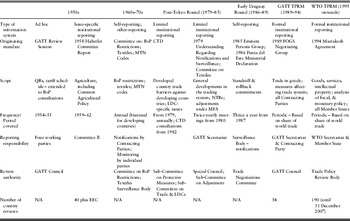
Table 2 illustrates how surveillance has evolved in the trade regime over the past half a century. Unlike existing theoretical literature, the analytical account presented here can explain variations over time within a single regime. Developing countries agreed to the TPRM for reasons that had to do with their incentives in the trade regime, monitoring capacities, and the information gaps they faced. At the Marrakesh Ministerial in 1994, which heralded the close of the Uruguay Round, the Jamaican Trade Minister said that his country strongly supported a monitoring mechanism in the WTO because ‘there [was] a difference of opinion as to the benefits to be derived …’.Footnote 61 Monitoring would evaluate the negative effects from multilateral trade liberalization so that the losing parties could seek appropriate redress. Thus, for developing countries institutionalized monitoring could reveal hidden information and reduce issue uncertainties for future negotiations.Footnote 62
Evolution of surveillance mechanisms in the multilateral trade regime

4. Institutionalizing peer pressure – explaining the purpose of the TPRM
Information systems perform different functions in international regimes. This section investigates the mandate given to the TPRM and compares it with the functions expected of an ideal-type information system. The trade regime's members differed on what they wanted the mechanism to do and how it would link to other functions of the GATT/WTO.
Functions of an ideal-type information system
Relevant and timely information yields many benefits. It creates a level playing field for rich and poor members of a regime, while giving an opportunity for members to justify their policies. Further, information generated through periodic reviews could influence policymaking and promote compliance within countries.Footnote 63 Moreover, monitoring not only facilitates compliance, it can also provide in-depth analysis, alert regime members to potential risks, and evaluate the effectiveness of the regime itself, thus helping to develop new norms.Footnote 64 Thus, three functions for information systems can be identified:Footnote 65
• Information dissemination – International regimes review national policies by comparing them with international standards and the commitments that states have made. The task of collecting and disseminating information is in response to hidden information problems as well as resource constraints. Information collection and dissemination by neutral organizations is necessary to reduce the risk of systematic information biases.
• Compliance promotion – Where deviations from commitments are found, surveillance systems can recommend corrective action. This is the task of promoting compliance, whether by means of peer pressure among member states, the threat of use of explicit sanctions following litigation, or by pressure from NSAs whose interests are directly affected by non-compliance. The use of independently collected information for the purposes of improving compliance is also a response to the risk of deliberate deception by member states.
• Regime evaluation – Regime evaluation occurs in response to issue uncertainty as well as resource constraints. When countries are unsure about the preferences of other parties they would be less committed to implementing the rules themselves. By evaluating the impact of the regime (or its underlying rules) on different states, monitoring informs negotiators more clearly about others' preferences. The same exercise can reduce general uncertainty about the impact of the regime on global welfare and thereby shape preferences for the development of new norms and rules.Footnote 66
High expectations but restricted mandate for the TPRM
So, what did GATT contracting parties expect the TPRM to do? The TPRM's aim was to promote ‘improved adherence’ to rules and commitments through ‘regular collective appreciation and evaluation’ of members' policies and practices.Footnote 67 But it was not clear how exactly contracting parties expected to use the information generated in the TPRs.
Most countries agreed to make TPRs available to the public. Although Japan had initially suggested that only press releases would be issued,Footnote 68 the function of ‘information dissemination’ was largely uncontested. Delegations expected the reviews to be used to exert pressure to encourage internal debates on policy questions.Footnote 69 However, members also had the autonomy to decide how widely the reviews would be circulated.
There was also the hope that the information collected during the reviews would be useful in future negotiations. Delegations suggested that the reports had to be relevant and useful, so that parties could ‘keep track of how political pressures on trade policies were developing’.Footnote 70 After the WTO started functioning, member states suggested that they should be free to use the TPRs as reference material in WTO committees.Footnote 71 This was the first time that member states had explicitly recognized the use of TPRs in negotiations, rather than think of them as merely information-gathering exercises. The TPRM was potentially a response to the resource-constrained information gaps that developing countries encountered in negotiations and post-negotiation phases.
Some developed countries highlighted the importance of using reviews to encourage changes in non-compliant policies. For instance, Canada argued that while surveillance was the ‘fundamental question’ for the Negotiating Group, there was also the need to consider what the follow-up to the surveillance would be and its relationship with the dispute settlement system.Footnote 72 Canada had pursued improved transparency and trade policy coordination at the domestic policy level since the late 1970s, so its position was consistent in GATT negotiations as well.
Yet, no proposal clarified how the expected policy changes would occur in practice. Information derived from the TPRs could not be used in dispute settlement proceedings or to enforce specific GATT obligations.Footnote 73 If adherence to GATT rules had to improve, then countries could only rely on ‘moral suasion’ or ‘peer pressure’. But how would peer pressure work when the power asymmetries between contracting parties were so vast? The ‘power of large numbers’, drawn from developing country coalitions, would not work because ultimately all decisions are based on consensus.Footnote 74 Without majority voting, there was little scope for poorer countries to exert collective pressure on richer ones to change their policies. Consequently, developing countries resisted any explicit provision to change policies, fearing that it would be asymmetrically applied against them. Thus, ‘compliance promotion’ remained an implicit aim for the TPRM.
As regards ‘regime evaluation’, the Nordic countries and the European Community wanted the Secretariat to make periodic assessments of trends in trade policies based on TPRs.Footnote 75 India stated that since Special Sessions of the GATT Council had served as ‘early warning mechanisms’ in the past, enhanced surveillance should encompass an overview of general developments affecting the trading system.Footnote 76 In fact, according to the Indian delegation, the concept of ‘enhanced surveillance’ had a stronger connotation of moral suasion for developing countries than did ‘trade policy review’.Footnote 77
But there was no consensus on the yardsticks that would measure the welfare impact of the regime. The limited demands for regime evaluation translated into an institutionalized ‘overview of developments in the trading environment which are having an impact on the multilateral trade system’.Footnote 78 The procedure involved annual meetings of the GATT Council, assisted by a report from the Director-General. This form of enhanced surveillance, it was believed, would ‘strengthen the existing “early warning” aspect’ of Council meetings.Footnote 79 Annual overviews would be the closest the trade regime would come to having an explicit regime evaluative mandate.
The mandate of the TPRM limits the ability of the mechanism to perform the three surveillance functions. Reporting requirements could increase transparency and force countries to explain their policies to others. But the impact of reviews depends on how widely information is disseminated, a decision that was left to individual countries. For domestic policy, compliance promotion depends on the extent of consultations between state and non-state actors. There are no structured follow-up procedures to promote compliance abroad; it depends on whether members choose to apply pressure in negotiations or via disputes.
Finally, it was possible for the TPR to have what Asif Qureshi called a ‘prescriptive trait’ or an evaluative role.Footnote 80 As WTO Director General Pascal Lamy noted in a recent speech, the surveillance function requires the WTO to offer a forum to discuss ‘how best to operationalize … market opening’ as well as ‘the need for measures that translate the results of negotiations into real benefits for all Members’.Footnote 81 But there was no decision on which issues/rules to evaluate and for what purposes.
It was evident from the beginning that, without structural changes in the trade regime's governance, any new information system would only have limited impact. Julius Katz, the Chairman of the negotiating group and a prime mover of the TPRM, wanted countries to exert ‘moral suasion’ over each others' trading practices.Footnote 82 But developing countries feared that too broad an interpretation of surveillance spelled more chances for abuse of the process. Economic analysis of trade policies could easily slide into the realm of economic prescription of ‘good’ policies, which would then be imposed on them. They did not expect the reviews to give them greater flexibility or influence within the trade system.
As the first mechanism by which developed countries would offer their policies for scrutiny and criticism by developing countries, the TPRM represented the first attempt to ‘institutionalize peer pressure’ in the multilateral trade regime.Footnote 83 But the TPRM was not a standalone mechanism; its effectiveness depended not only on its own design but also on how developing countries could leverage their power in a new multilateral trade institution.
5. Challenges with the practice of the TPRM
The TPRM's mandate might have been narrower than an ideal information system, but how has it performed in the tasks assigned to it? At the inception of the WTO, monitoring was listed as one of the organization's primary tasks. TPRs are now a regular feature of the WTO. Almost all countries have undergone a review at least once. Technical assistance and additional funding has been offered since 2000 to conduct reviews of LDCs. Each TPR is a combination of reporting by the Secretariat and the government, formal questioning by other member states, and active debate and discussion during review meetings. This section provides evidence from an analysis of all TPRs held during 1995–2007 to outline the challenges with the content of reports and participation in review meetings.
Content-related challenges
Trade delegates, WTO officials, and business groups all note the importance of the material contained in TPR reports. At the same time, many officials call for more analysis and better presentation of data as necessary changes to make the reports salient and usable. Set against these contradictory views, we need a scientific basis for evaluating the content of the WTO Secretariat's reports. The Secretariat has the task of preparing reports that cover the macroeconomic environment, the domestic institutional structures for trade policymaking, and full examination of trade policies by measures and by sectors. It cannot make legal judgments about members' policies, but can provide economic analyses. Although it relies on official government data, it also uses other documents and sources for the reports.
Transparency via the TPR process is important for members in two ways: when a country is itself under review, and when its major trading partners are under review. Much existing scholarship focuses on the former, the belief that domestic transparency could strengthen the hands of trade policy reformers.Footnote 84 But there is no analysis of the latter aspect. If the reports have to be relevant, they should contain information and analysis on issues that are of greatest concern to member states.Footnote 85 I use this standard of ‘issue salience’ to evaluate the content of a large sample of TPR reports. The TPRM has the potential to increase compliance with trade rules at home and abroad.
What are the critical or salient issues? I conduct an analysis that links the content of government and Secretariat reports to the Dispute Settlement Mechanism (DSM). The disputes that a member initiates are treated as proxy indicators of the most important trade concerns for that country. The analysis asks whether information about these issues and concerns were revealed in TPR-related documents.
Note that this analytical link between TPRs and the DSM does not claim any causal link between multilateral surveillance and legal dispute settlement. It merely evaluates the ‘information dissemination’ and ‘compliance promotion’ functions of the WTO's information system, namely that of revealing information that would be useful in promoting better adherence with the regime's rules. That, indeed, is the mandated purpose of the TPRM.
For the analysis, I construct a database of dispute-dyads of complainants and respondents in the DSM. A total of 172 dispute-dyads were analysed. The complainants in the dispute-pairs cover all developing, least developed economies and transition economies that had initiated a dispute at the WTO (until end-2007).Footnote 86
Each dispute might have more than one complainant, but every complainant is treated separately, in order to consider its interests in the issue under contention. The focus, however, is on the TPRs of the respondent in each dispute. The objective of the analysis is to examine whether the respondent's TPR refers to, analyses, or criticizes the policy that is disputed. For each dispute, the database gives evidence from the TPR reports that both preceded and followed the request for consultations on a dispute.
The rationale for examining the preceding report is to check if the report highlighted the contentious policy. It also helps to examine whether WTO members other than the complainant also use the TPR as an opportunity to raise questions about the disputed issue.
After analysing 172 dispute-dyads, the results reveal interesting insights. In some cases, the Secretariat reports did mention policies that would eventually be taken up by complainants as formal disputes. This occurred only 53% of the time for TPRs of respondents preceding the initiation of disputes, by no means a signal of extensive coverage. Further, only 15% of the reports had any detailed policy analysis or criticism of the contentious policies. There is no significant difference between the reports of developed and developing countries. For the former, the average is 54% and for the latter it is 50%. But analysing the reports by year we find that after 2000 the coverage of critical issues for developing countries increased a great extent from negligible levels; for developed countries' reports, the share remains more or less stable.
The rationale for examining the succeeding report (after disputes are initiated) is slightly different. It relates to the dynamic of peer pressure by which the TPRM is expected to promote compliance. If succeeding reports highlight and analyse the issue under contention, they serve to apply pressure on the respondent. Moreover, the Dispute Settlement Body almost invariably defers the establishment of a panel, which gives parties time to resolve the dispute via consultations. A TPR during this period provides a further opportunity to analyse the merits of a disputed trade measure.
After disputes had been initiated, the Secretariat reports mentioned or analysed the contested policies 80% of the time but in many cases, it was only a footnote mention. Policy analysis or criticism could be found in only 16% of the reports. In fact, since 2003 there has been a downward trend in the average coverage of disputed issues. The proportion of reports covering such issues fell from a high of 90% in 1997 down to 43% in 2004 and 50% in 2006. This is accounted for largely in the reports of developed countries: in 2005 and 2006, only a third of the reports of developed country respondents mentioned or analysed the contentious issues under dispute. Finally, just a quarter of the government reports even mentioned the disputed policies; even fewer offered any clarification on them.
The above trends reveal a real content-related challenge for the TPRs. The Secretariat has a vast amount of information to collect and collate in the report with limited resources at its disposal. In the process of aiming to be comprehensive, it is perhaps falling short in highlighting the more critical aspects of members' policies, aspects that would be relevant for other members of the WTO.
Participation-related challenges
Participation in review meetings takes many forms. Members are allowed to pose questions in advance of the meetings. Members also raise issues of concern during the meetings. Both avenues of peer pressure require that delegates actively engage with the process. A third way is participation by mere presence, since TPRs are also learning exercises from which even passive participants could gain. No empirical evidence currently exists on any aspect of participation.
When it comes to applying peer pressure on the critical/disputed issues, the record is poorer. Prior to disputes, in only 24% of the cases members pose questions on issues that they consider critical enough to request consultations. After disputes had been initiated, whether reports mention or analyse the issue should be irrelevant to complainants. Yet, the most surprising result is that the proportion of complainants submitting advance questions after disputes had been initiated fell to 19%. Thus, contrary to what the TPRM had been envisaged for, in general member states do not consider the TPR process to be an effective forum for applying pressure. Moreover, declining trends in recent years suggest a growing disillusionment with the purpose or use of the mechanism.
Peer pressure can also be applied by countries other than dispute complainants. In fact, this is the advantage of a multilateral review process. Thus, for each dispute-dyad we also investigated how other members behaved. The results are more encouraging: on average, prior to a dispute, other states sent in advance questions on the contested issue 61% of the time. After the onset of disputes, other parties continued to submit written questions 55% of the time. Although complainants have not submitted advance questions, the reviews have given opportunities for the WTO's membership as a whole to collectively apply pressure on each other. However, comparing the number of questions members submit when their biggest trading partners are under review with how many questions they get in return for their own reviews, we find that the direction of peer pressure is largely skewed against developing countries.
A related challenge pertains to participation in review meetings. Many supporters of the TPRM stress that simply participating is a good exercise in transparency and learning. The meetings hold an important status in the WTO. The Trade Policy Review Body is equivalent to the General Council, comprising all member states and giving developing countries equal opportunities to review the policies of richer members. Among other international economic institutions, this is a very different setup, compared to say the weighted voting system in the IMF, which limits the voice of poor countries, or OECD reviews in which developing countries cannot participate.
However, developing country participation in the TPR meetings remains poor. I measure which members raise questions or make statements during the meetings. I use documents from all TPR meetings held during 1995–2007 (190 in total, barring nine apparently random cases where some documents were missing) to measure participation by different countries. The analysis records the participation of 70 countries: the top 20 trading powers, additional member states that have initiated disputes, leaders of negotiating coalitions, and LDCs that have undergone a TPR. This survey presents the first comprehensive account of participation in TPR meetings (arguably, the first in any monitoring mechanism in the GATT/WTO).
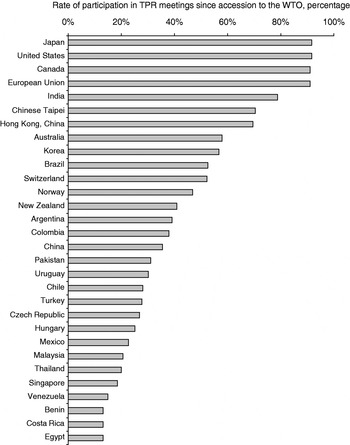
Contrary to expectations for larger trading powers, the results show very low levels of participation even among major developing countries. The top four traders almost always participate in review meetings. But even among the next 16, there are only a few active participants: only a minority has participated in more than half the meetings (Figure 1). Worse still, an average LDC has participated in just three meetings. The likelihood that an LDC will ask questions or raise a point is just 2%.
A majority of WTO members has not participated in even half the TPR meetings

How can we explain the low participation of even the larger developing countries? The strength of delegations in Geneva, the scheduling of meetings, and the challenges of analytical capacity are only partial explanations. A bigger problem is the lack of political interest in the reviews. Although there is no recorded evidence, anecdotal accounts suggest that countries often send middle-ranking officials, whether they are under review themselves or they are participating in other members' reviews.Footnote 87 Another reason for low participation is the unwillingness of members, especially developing countries, to ask each other embarrassing questions. My own observations of the review meetings found that much of the commentary was a repetition of what was already in the Secretariat's reports. And where delegates did speak up, it was usually to praise the country under review or make long statements about the historical and cultural links between countries, issues that had little to do with trade policy.
TPR meetings, instead of being opportunities to debate members' policies, have increasingly become forums for ‘negotiated reviews’ at best, according to one Latin American delegate.Footnote 88 At worst, because of the lack of interest and the low levels of participation, the meetings are so lacklustre that another ambassador suggested they were ‘boring to death’.Footnote 89
Despite some exceptions, the general trends reject our initial conjectures that at least larger traders, with offensive interests in the regime, would participate more actively in its monitoring mechanism. And the fact that countries do not raise questions even on issues directly affecting them suggests that the peer pressure envisaged for the TPRM does not work. For developing countries, the TPRM proves to be weak on both content and pressure: not only are TPR reports often silent on controversial issues, TPR meetings are toothless as well.
6. Capacity challenges, at home and at the WTO
The content- and participation-related challenges with TPRs have underlying political and technical causes. In earlier sections, I have discussed the conflicting expectations from multilateral surveillance, which resulted in a weak political mandate for the TPRM. This section analyses procedural and technical hurdles, the most important being inadequate staff capacity and financial resources.
The pressure to write timely and comprehensive reports has increased since 1995 with WTO membership rising from 111 to 153, and with the need to cover services, IPRs (International Property Rights) and SPS/TBT (Sanitary and Phytosanitary/Technical Barriers to Trade) standards, and with greater attention being paid to non-tariff barriers, including anti-dumping and countervailing duties.
The length of the reports reflects the changing scope of reports. Since 1995, reports have become shorter on the whole, partly due to better editing and partly because subsequent reviews give only updates on policy changes. At the same time, the average lengths of chapters III (trade policies by measure) and IV (on sectors) have remained more or less stable, reflecting members' demand that reviews focus on trade-related issues rather than on what they considered peripheral macroeconomic or domestic policy topics.
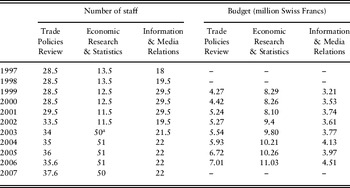
But with growing WTO membership, there is constant pressure to increase the frequency of reviews. According to senior Secretariat staff, improved staff efficiency, better communication links with capitals, and the reliance on joint reviews have aided the increase in intensity of research and reporting.Footnote 90 More staff and finances were devoted to the Trade Policies Review Division (Table 3) but not to the extent needed. Compared with other WTO divisions, resource allocation to the TPRD does not fare too poorly. It is the second largest division, barring general secretarial work (language services, informatics). The share of annual budget increased marginally from 3.6% in 1999 to 4.1% in 2006.
Staff and budgetary allocations for TPRs have increased in recent years

Note: a In 2003 the Economic Research and Statistics divisions were merged, increasing the reported staff numbers, but, for administrative reasons, the budget was treated differently.
Source: WTO Secretariat.
The capacity challenge becomes more evident when compared with the IMF. In the late 1990s, at least four IMF staff members would go on country missions. In 2005, the IMF used 9% of its staff resources on multilateral surveillance and 29% on bilateral monitoring.Footnote 91 By contrast, the TPRD accounts for 6% of the WTO's staff (8% for Economic Research and Statistics).
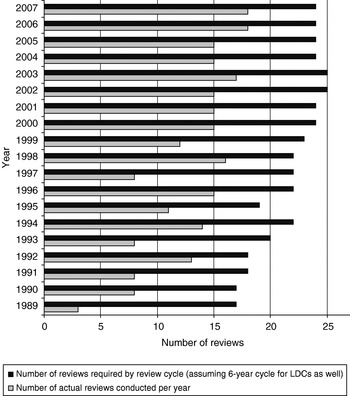
Thanks, in part, to capacity constraints, the TPRM has never been able to match the number necessary to maintain the cycle of reviews (Figure 2). The discrepancy between desired and actual reviews in the early years is justified by the fact that the mechanism was new and tentative. However, two decades since it first began operating, the TPRM continues to struggle to conduct the necessary number of reviews.
The WTO has never completed sufficient number of reviews in a given year

What are the implications of delayed reviews? The most important victim is transparency. For a majority of the WTO's membership reviews occur once in six years. If even this frequency is not maintained, then the purpose of improving transparency is undermined. TPRs force countries to provide up-to-date information. A mechanism that suffers from lags would fail to exploit opportunities to urge countries to provide relevant information that other countries need. Secondly, there are adverse implications for domestic policymaking. Six-year or longer gaps are often beyond the electoral cycle of many policymakers, thereby reducing pressure on them to reform policies. Finally, delays could also adversely affect the TPRM's credibility. Long gaps between reviews could mean that members would not take the mechanism seriously.
The problem of capacity constraints at the WTO is compounded by insufficient domestic capacity to engage in trade monitoring. The publishing of new trade measures is not sufficient to ensure transparency. As Lamy puts it, ‘Full transparency also requires an understanding of what is being notified.’Footnote 92 Thus, members not only have to be aware of changes in each others' policies, but should also have the capacity to analyse such changes in terms of the implications for their own commercial interests. Lamy notes that the chances of developing countries being able to litigate against market-restricting measures are low, whereas peer review mechanisms allow them to put collective pressure on developed countries. Thus, ‘active transparency’ would only work when members are able to analyse, evaluate, and use the information in existing and forthcoming transparency mechanisms.
There is growing acknowledgment of the need to boost domestic capacities to engage in trade monitoring. Debates prior to the creation of the TPRM focused on domestic transparency to highlight policies that could have adverse welfare impacts. Now, developing countries are increasingly keen on monitoring developments elsewhere, even as they continue to rely on multilateral information systems.
External trade monitoring can take various forms. At a basic level, most trade delegates interviewed for this research mentioned commercial counsellors in their diplomatic missions as the officials responsible for collecting commercial intelligence. In some cases, specialized agencies have been established or strengthened for trade monitoring:
• Much of India's trade monitoring continues to be the responsibility of the government. The Directorate General of Commercial Intelligence and Statistics collects and disseminates trade data. A revitalized Board of Trade is expected to draw in India's embassies through an electronic platform for real-time trade intelligence.Footnote 93 There are now 65 commercial counsellors posted abroad who monitor changes in regulations.Footnote 94
• In China, the need for regular monitoring is being filled increasingly by three WTO Affairs Consultation Centres that have opened in Beijing, Shanghai, and Shenzhen. They directly service firms and occasionally give information to the government. The Shanghai Centre, established in 2000 as a collaboration between government agencies and universities, operates an early warning system and disseminates information through a Consultation Online Hotline via its website and a WTO Reference Centre.Footnote 95 It first targeted US textiles safeguards actions and by 2004 was also monitoring AD actions.
• Brazil has chosen to focus on agriculture. A dedicated research institute, the Institute for International Trade Negotiations (ICONE), focuses on global agribusiness, bio-energy, and international trade.Footnote 96 Agribusinesses regularly send in questions to an inter-ministerial forum (CAMEX) regarding their concerns for trade barriers elsewhere. ‘Permanent coordination’ between the government and private sector representatives has been a key factor behind Brazil's leadership of the G-20 coalition during the Doha Round.Footnote 97
• The Korea Trade-Investment Promotion Agency (KOTRA) operates 93 Korea Trade Centres in 68 countries and the embassies contact these offices to solicit questions for upcoming TPRs.Footnote 98
• Hong Kong's Trade Development Council (TDC), a statutory organization, has established its own boards and committees to collect commercial and market intelligence.Footnote 99
• Mexico relies, among other sources, on the network of offices belonging to ProMexico, another specialized government agency.
• Singapore's Ministry of Trade and Industry gets inputs from the Economic Development Board and International Enterprise Singapore. The latter generates market information, trade statistics, and operates an Advisory Centre with online databases.
Another trend is the use of official publications to highlight trade barriers in various markets. This practice preceded the TPRM in major developed countries, for instance the USTR's National Trade Estimates on Foreign Trade Barriers, and the EU's Market Access Database. In developing countries, similar products include:
• India's Directorate General on Anti-Dumping and Allied Duties (DGADAD), responsible for investigating claims of dumping, publishes an annual report on its investigations, while the Ministry of Commerce and Industry's annual report has a section on non-tariff barriers against India's exports.Footnote 100
• China's Foreign Market Access Report (published since 2003) targets 25 major trade partners.
• South Korea's Ministry of Foreign Affairs and Trade publishes the Korea Trade Barriers Report and an Annual World Trade Report.
• Hong Kong regularly publishes Commercial Information Circulars, categorized by region with notes on trade actions taken by key trading partners.
• Chile's Department of Foreign Trade in the Ministry of Economy has been publishing the annual ‘Catastro Nacional Sobre Barreras Externas al Comercio’ since 2000 and covers 34 countries.
The efforts among major developing countries to both boost their domestic institutional and analytical capacities for trade monitoring is a learning process, the benefits of which will only be known in time. For a majority of developing countries, which have not yet adopted new processes for monitoring and surveillance in international trade, the multilateral information system is still the prime source of periodic monitoring. Even as domestic transparency gains importance, the WTO will continue to have to think about making its surveillance processes more credible, timely, and effective.
7. Conclusion – Priorities for TPRM reform and multilateral trade monitoring
This paper has explained the evolution of the trade regime's information system into its most institutionalized form, the TPRM. Several common threads run through each stage in the evolution of trade surveillance. The first was a desire to bring discipline into the trade regime. Secondly, confidence in a rule-based system would only increase if all members were subject to periodic monitoring. Thirdly, a distinction was drawn between monitoring and enforcement, although it was also recognized that the latter depended on the former. Fourthly, all proposals involved some form of consultation with the party under review, in order to give it a chance to explain its policies. Surveillance was not simply the monitoring of specific policies against commitments, it was a learning process.
Yet, evaluating the TPRM's performance against its own mandate shows that it is not generating information specific to the needs of developing countries and much of the WTO membership does not participate in review meetings. Most developing countries are failing to engage effectively with the process. Meanwhile, recent negotiations have yielded new monitoring mechanisms under the WTO, namely for regional trade agreements, sanitary and phytosanitary measures, and for aid-for-trade.Footnote 101
The TPRM has much scope to improve the quality of reports and meetings even within the given limited mandate. But if multilateral surveillance in the trade regime has to provide developing countries with information, they need and can use, member states and the WTO Secretariat would have to focus on a broader set of priorities.
Relevant content for developing countries
WTO members need to identify minimum standards for surveillance. Much discussion about the scope of issues to be covered occurs at a general level. But member states need advance warning of policy changes to lower the risk of hidden/inaccurate information. Policymakers have to decide which policies monitoring mechanisms (whether the TPRM or issue-specific ones) would highlight, and to establish templates for factual and timely reporting.
The Secretariat could also use more sector- and country-specific expertise for drafting TPR reports. Collaboration and coordination between its divisions could be made more formal for the purposes of monitoring. Moreover, developing countries might prefer other forums like the Committee on Trade and Development to have an input in the review process. They have secured this provision for RTA monitoring.Footnote 102 Overcoming issue uncertainties by drawing on multiple sources of expertise could greatly increase confidence in the quality of reporting and provide information on flexibilities for implementing rules.
Reviews should also analyse the systemic impact of policies in major trading countries. This is not restricted to developed countries, but large developing countries as well. Resource-constrained members would support analyses that explain how regulations in a major country affect their trading interests. Assigning desk officers who would engage in regular research (not just at the time of TPRs) would be a step towards building such capacity. Similarly, analysing the systemic impact of the regime's rules warrants a closer working relationship between individual committees, the TPRD, and the Economic Research and Statistics Division. It also means that coordination between the WTO and the IMF/World Bank would have to increase: building tariff and related databases, evaluation of macroeconomic conditions, impact analyses of trade negotiations, and linkages between technical assistance needs and development assistance.
Alternative sources of information
Although many agencies and actors research trade policies, their efforts are not always coordinated in a way that countries could benefit from timely information.
Therefore, domestic transparency and monitoring has to improve, with particular emphasis on the processes of consultation and coordination. Among developing countries, Brazil, Chile, China, India, Hong Kong, and Korea are among the countries that already have wide-ranging consultation processes, albeit to varying degrees of success. National trade policy forums could draw in legislators, business groups, and NGOs in periodic dialogues on trade policy and get inputs from multiple sources about regulatory changes abroad. Long gaps between multilateral reviews often result in forgotten policy lessons. Therefore, interim national reviews could take stock of changes and improvements in policies.
The role of non-state actors in monitoring should not be underestimated. The more states remain reluctant to strengthen WTO-led monitoring, the greater will be the potential of NSAs to close the information gaps.Footnote 103 Existing literature often assumes that in the trade regime, non-state actors would be equally disposed towards trade monitoring. In reality, their capacity varies greatly across countries. Capacity building efforts that focus on explaining WTO rules to domestic actors would need to be supplemented with measures to improve the policy review and monitoring capabilities of non-state actors.
Resource-constrained countries could also gain from better regional surveillance. The aid-for-trade review process has already incorporated this dimension and the TPRM also undertakes a few regional reviews. Regional peer review could increase the availability of timely data, discussion on the appropriate models and frameworks for analysis, and generate more options for policy implementation. These dynamics could also translate into more effective peer pressure.
More effective forums for peer pressure
The record of WTO surveillance shows that members are reluctant to incorporate strong follow-up procedures for monitoring exercises, fearing that they could lead to disputes. So, it would be unreasonable to expect new monitoring mechanisms to buck the trend. Nevertheless, there are other means to increase peer pressure and promote compliance.
Members could target each others' reporting behaviour. Thus, stronger provisions for notifications would have to be combined with pressure against non-reporting countries. Failure to report on changes in policies should attract more explicit criticism in various WTO committees as well as during TPRs. As opposed to sanctioning non-compliance, which has been the main worry for members, an emphasis on better notifications would sanction non-reporting and increase the available information.
Another route is continuing to push for procedural changes in review meetings. Although this has had limited impact in the past in the absence of other reforms, improvements could continue incrementally, by using external discussants, by ensuring that reviews do not clash with other meetings, and by making high-level representation in meetings mandatory.
Further, members and the WTO have to think about greatly increasing the dissemination and visibility of reports and their use. This implies generating more media coverage of the reviews and permitting non-state actors to participate as observers. Moreover, within the WTO, coordinators of negotiating coalitions could outline the implications of their trade rivals' policies, so that reviews feed into negotiations and a structured process of demanding policy change. It also means that, at least on less controversial issues, specific procedures are in place to follow-up after reviews. More structured links with the Integrated Framework and with wider aid-for-trade efforts could go a long way in giving poor countries a stake in more effective monitoring.
Effective monitoring is a necessary condition for international cooperation. By undertaking an in-depth empirical investigation of the TPRM, this paper has offered ideas to experiment with new innovations in the trade system. With a growing demand for information, trust in multilateral monitoring would increase when it shines the light on issues that matter to developing countries and is seen to have an impact.