Introduction
The glass industry is providing materials for a wide range of applications related to consumer electronics, transportation, medicine, energy, information technology and communications, and defense. These widespread applications have become possible because the properties and functionalities of glasses can be tuned by proper design of the chemical composition. Despite the commercial success of inorganic oxide glasses over their 5000-year history, the glass industry faces several challenges, such as high energy requirements and high manufacturing costs, and the brittle characteristics of glasses that limit their future advanced applications. Moreover, there is a critical need to accelerate the design and engineering of new glass compositions with tailored properties and suitable manufacturing attributes, which have traditionally been developed through tedious trial-and-error experiments.
The properties of glasses are not easy to predict due to their inherent noncrystalline structure and nonequilibrium nature. Reference Greaves and Sen1 Glass properties are not only a function of chemical composition (x), temperature (T), and pressure (P), but also of the entire thermal and pressure history of the material. As for other classes of materials, the properties of glasses are ultimately controlled by their atomic structure, and advanced experimental and computational capabilities are required to analyze critical structural and topological characteristics of glassy materials. The main challenge is to make the quantitative connection between structure and properties, since simple structural rules are typically not obeyed even by simple binary oxide glasses. To this end, emerging rigidity theory approaches (see the Introductory article in this issue) such as temperature-dependent constraint theory offer solutions to overcome these challenges.
Topological constraint theory, introduced by Phillips in 1979 and extended in collaboration with Thorpe, Reference Phillips2,Reference Phillips and Thorpe3 focuses on the key microscopic physics governing the macroscopic properties of glasses by comparing the atomic degrees of freedom in a system with the number of interatomic force-field constraints. As such, unnecessary details that are found not to affect the properties to a significant extent are deliberately filtered out and the complicated noncrystalline structures are simplified to mechanical trusses. The later work of Gupta and Mauro in 2009 Reference Gupta and Mauro4,Reference Mauro, Gupta and Loucks5 accounted for the chemical differences among various network constraints by introducing a temperature dependence, specifically by comparing the amount of available thermal energy with the amount of energy required to break a constraint. Several physical properties such as viscosity, Reference Gupta and Mauro4,Reference Mauro, Gupta and Loucks5 hardness, Reference Smedskjaer, Mauro and Yue6 subcritical crack growth, Reference Smedskjaer and Bauchy7 and dissolution rate Reference Pignatelli, Kumar, Bauchy and Sant8 depend on the calculated number of temperature-dependent constraints.
In this article, we provide a concise review of recent advances in glass-structure determination and modeling, and demonstrate how this information can be used as input to compute the number of constraints associated with both network-forming and network-modifying atoms. We then show how important properties such as viscosity and hardness are predicted and, in turn, how novel industrial glasses can be topologically engineered to obtain desired functional properties and manufacturing attributes.
Glass-structure determination and modeling
The network structure of inorganic glasses has been studied for well over eight decades using a variety of scattering and spectroscopic techniques. Early reports addressed the tetrahedral network structure of silica and other glasses, generally supporting the random network view of glass structure proposed by Zachariasen. Reference Zachariasen9 Recently, advances in instrumentation and methodology have contributed to a surge in our understanding of glass structure at both short- and intermediate-range length scales.
Nuclear magnetic resonance (NMR) spectroscopy, first applied to characterize glass former coordination numbers by Silver and Bray in 1958, Reference Silver and Bray10 has been one such tool to undergo a substantial improvement in capability due to advances in instrumentation (e.g., larger magnetic fields and faster sample spinning). New methodologies, including multiple quantum magic-angle-spinning (MQMAS) NMR and multinuclear correlation NMR, and especially, the powerful combination of NMR spectroscopy and molecular dynamics simulation, have allowed researchers to extract even more structural information from readily measured NMR spectra. Reference Ispas, Charpentier, Mauri and Neuville11 These advances have led to an increase in structure–property understanding for a large number of inorganic glass systems, namely those comprised of NMR-friendly nuclei. Fortunately, for industrially relevant glass compositions, most include B2O3, SiO2, P2O5, and Al2O3, all of which have nuclear isotopes that are amenable to high-resolution NMR study.
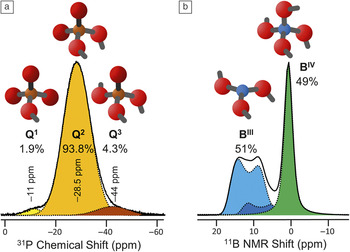
The ability to perform Reference Ispas, Charpentier, Mauri and Neuville11 B, Reference Hermansen, Guo, Youngman, Mauro, Smedskjaer and Yue27 Al, and Reference Mauro, Tandia, Vargheese, Mauro and Smedskjaer29 Si, and 31P NMR allows for identification of local coordination environments for these network-forming cations. If analyzed properly, these NMR data can also generate highly quantitative information on short-range structure in glasses. For example, as shown in Figure 1 , considering relaxation times and radio-frequency pulse width requirements, carefully collected 31P and Reference Ispas, Charpentier, Mauri and Neuville11 B magic-angle spinning (MAS) NMR data for typical borophosphate glasses can be fitted to a series of resonances belonging to different structural units. In the case of phosphate groups, deconvolution of the overlapping Gaussian peaks gives the amount of phosphorus present in different Q n groups, where Q n denotes a network-forming cation bonded to n bridging oxygens. Similarly, accurate collection and description of Reference Ispas, Charpentier, Mauri and Neuville11 B MAS NMR line shapes allow one to separate the different boron coordination environments (e.g., BIII and BIV), yielding highly accurate information on the amount of boron involved in the different network polyhedra. In many cases, careful analysis of Reference Ispas, Charpentier, Mauri and Neuville11 B MAS and MQMAS NMR data provide additional information on intermediate-range structure, including, for example, the amount of BIII in ring and nonring environments (as shown by the two BIII peaks in Figure 1b). These studies have also provided a means to further develop and optimize structural models of many common glass compositions, including boroaluminosilicate glasses that constitute the majority of technological glasses in use today. Reference Smedskjaer12 These models can then be used to calculate topologically controlled properties for entire glass families. Reference Smedskjaer, Mauro, Youngman, Hogue, Potuzak and Yue13
Example of nuclear magnetic resonance (NMR) spectra for (a) 31P and (b) Reference Ispas, Charpentier, Mauri and Neuville11 B nuclei in borophosphate glasses. Reference Hermansen, Youngman, Wang and Yue25 Dashed lines denote fitted curves for the various phosphate and borate units. Concentrations of the structural units are denoted in bold.

Basically, interrogation of each glass cation (e.g., B, Al, and Si) provides a quantitative description of coordination numbers, and thus the fraction of boron, in three- and fourfold coordination, populations of aluminum in four-, five-, and sixfold coordination, and numbers of bridging and nonbridging oxygen (NBO) atoms on silicon and boron. Counting of these structural units is a necessary step in evaluating the number of topological constraints controlled by the glass composition and network structure.
As with any experimental method, there are limitations in the understanding of glass structure provided by NMR spectroscopy. Foremost is the inability to collect data for much of the periodic table. This is most apparent when considering the environment of modifier and charge-balancing cations like the alkali and alkaline earth elements. Some of these are readily accessible by NMR, and there have been significant advances in the ability to study Mg and Ca in glasses, but most of the information on the role of such cations in glass is obtained indirectly by measuring NBO content, or the coordination number of boron or aluminum.
Gupta–Mauro temperature-dependent constraints
Atoms in network glasses are constrained by their chemical bonds and bond angles, and the strengths of these constraints depend on the local topology and the chemical nature of the elements. Therefore, detailed structural information about the atomic coordination numbers (CN) of the network formers (polyhedral building blocks) is required to compute the number of constraints per atom (n c). With this information at hand, the combination of linear-bond stretching (n c,linear = CN/2) and angular-bond bending (n c,angular = 2CN – 3) constraints can be computed for each network-forming atom. Reference Greaves and Sen1 While the original Phillips–Thorpe theory enumerates constraints at 0 K, where the constraints cannot be broken by thermal activation, the Gupta–Mauro temperature-dependent constraint theory considers that each constraint is associated with an onset temperature T i , above which a significant fraction of the constraints are broken and therefore should not be counted. The onset temperature is a measure of the strength of chemical bonds and angles, enabling a distinction among otherwise topologically equivalent isovalent systems, such as Group IV chalcogenides or modified oxide glasses with different alkali cations. Reference Gupta and Mauro4,Reference Mauro, Gupta and Loucks5
Specifically, the Gupta–Mauro formulation introduces a two-state thermodynamic function q(T), quantifying the fraction of rigid constraints at a given temperature. Any constraint will be completely intact at low temperature (q(T → 0) = 1, as in the original Phillips–Thorpe theory) or completely broken at high temperature when the associated energy is less than k B T (q(T → ∞) = 0). Based on an energy landscape approach, a continuous form of q(T) has been proposed: Reference Gupta and Mauro4
 $$q\left( T \right) = {\left[ {1 - exp\left( { - {{\Delta F_i^*} \over {{k_{\rm{B}}}T}}} \right)} \right]^{v{t_{{\rm{obs}}}}}}$$
,
where
 $\Delta F_i^*$
is the activation energy for breaking constraint i, v is the vibrational attempt frequency, and t
obs is the observation time. This form is found to fit estimated q(T) functions from molecular dynamics simulations.
Reference Bauchy and Micoulaut14
For simplicity, a discrete step-like function can alternatively be applied when calculating certain properties.
Reference Mauro, Gupta and Loucks5
Beyond network formers: Modifiers and their subnetwork
In oxide glasses, network modifiers are metal oxides that play a supporting role in the glass network, such as charge stabilization of network former polyhedra or depolymerization of the network by creation of NBO. Network modifiers can be distinguished from network formers by their single bond strength to oxygen. Network formers such as SiO2, B2O3, and P2O5 exhibit high bond strengths (>80 kcal), while network modifiers such as Na2O, CaO, and La2O3 have low bond strengths (<60 kcal). Reference Sun15
Bond constraints associated with the network modifiers have traditionally not been counted, Reference Phillips2,Reference Gupta and Mauro4 but the structure of modified glass is essential for understanding outstanding problems such as the compositional variation of density and the pronounced mixed-alkali effect on properties. A qualitative understanding of these issues is possible through the modified random network theory, Reference Greaves and Sen1 which considers a primary network of the network formers and an interpenetrating subnetwork of modifiers. In analogy to modifier-containing minerals, this subnetwork takes the form of channels or sheets of modifiers in the glass structure. Reference Greaves and Sen1
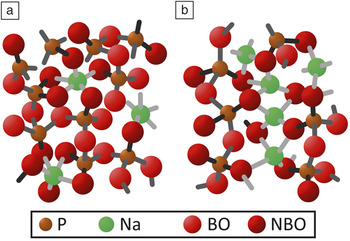
Taking alkali phosphate glasses as an example, an anomalous minimum occurs in the compositional dependence of density around 20 mol% alkali oxide. The structural interpretation of this minimum is that the alkali polyhedra at low concentrations occur in isolated pockets in the phosphate network, but at higher concentrations, they create more densely packed chains. The native phosphate tetrahedron has a double-bonded oxygen (DBO) at one vertex, which is available to coordinate to the alkali. At low-modifier concentrations, there is an excess of DBO available for coordination to the alkali, and the alkali polyhedra occur isolated in the glass network, as illustrated in Figure 2a for a sodium phosphate glass. When the alkali oxide concentration exhibits a value equal to the inverse of the coordination number of the alkali polyhedra, sufficient number of DBOs and NBOs are available to satisfy the alkali ions’ coordination requirements. Above this threshold, the alkali ions must share NBOs (i.e., the alkali polyhedra must share corners or faces, thereby creating a subnetwork of chains or layers, as illustrated in Figure 2b). Reference Hermansen, Mauro and Yue16
Glass network structures of two sodium phosphate glasses. (a) In a 20 mol% Na2O composition, the Na+ ions are present in isolated pockets. (b) In a 50 mol% Na2O composition, the Na+ ions create a subnetwork of chains. Note: BO, bridging oxygen; NBO, nonbridging oxygen.

If the constraints on the modifier polyhedra are assessed in the same manner as the network formers, then they will often appear to be overconstrained. This result stands in contrast to our intuition that the modifier is the weakest part of the network. The reason for this is that though the bond strength is low, the ionicity of bonding is high, and therefore, the linear and angular constraints can easily be broken by thermal energy. In order to still apply constraint theory, the fraction of intact constraints, q(T), must be assessed as in Equation (1). The number of intact constraints at T g, the glass-transition temperature, for common modifiers has been found to depend linearly on the charge-to-distance ratio, which is a measure of the Coulombic interaction between the modifying cation and the coordinating NBO. Reference Hermansen, Rodrigues, Wondraczek and Yue17
Engineering of glasses with tailored properties
The calculated number of constraints at a given temperature for glass with composition x (n c(x,T)), has been found to correlate with certain properties. Here, we focus on liquid shear viscosity (η), which controls flow behavior and deformation, and indentation hardness (H), which is the resistance to elastoplastic deformation and thus important for scratch resistance.
The viscosity of glass-forming liquids can increase by more than 12 orders of magnitude upon cooling from the 1 Pa•s viscous liquid to the solid glass at T g. At least for silicate liquids, the temperature dependence of viscosity for a given composition can be described by two parameters: glass-transition temperature T g(x) and liquid fragility index m(x), Reference Mauro, Yue, Ellison, Gupta and Allan18 since the high-temperature limit of viscosity is found to be a constant. Reference Zheng, Mauro, Ellison, Potuzak and Yue19 T g corresponds to η(T g) = 10 Reference Smedskjaer12 Pa•s, Reference Yue20 while m is the slope at T g in the plot of log η versus T g/T. By combining the Adam–Gibbs model, which connects viscosity to the configurational entropy S c, Reference Adam and Gibbs21 with the result that S c is proportional to the number of floppy modes f = 3 – n c, Reference Naumis22 the following expression for computing T g(x) has been derived: Reference Gupta and Mauro4
 $${T_{\rm{g}}}\left( x \right) = {T_{\rm{g}}}\left( {{x_{\rm{R}}}} \right){{{S_{\rm{c}}}\left( {{T_{\rm{g}}}\left( {{x_{\rm{R}}}} \right),{x_{\rm{R}}}} \right)} \over {{S_{\rm{c}}}\left( {{T_{\rm{g}}}\left( x \right),x} \right)}} = {T_{\rm{g}}}\left( {{x_{\rm{R}}}} \right){{3 - {n_{\rm{c}}}\left( {{T_{\rm{g}}}\left( {{x_{\rm{R}}}} \right)} \right)} \over {3 - {n_{\rm{c}}}\left( {{T_{\rm{g}}}\left( x \right)} \right)}}$$
,
where x R is a reference composition with known T g value. The expression for m(x) can be derived similarly: Reference Gupta and Mauro4
 $$m\left( x \right) = {m_0}\left( {{{\left. {1 + {{\partial ln{S_{\rm{c}}}(T,x)} \over {\partial lnT}}} \right|}_{T = {T_{\rm{g}}}(x)}}} \right) = {m_0}\left( {{{\left. {1 + {{\partial lnf(T,x)} \over {\partial lnT}}} \right|}_{T = {T_{\rm{g}}}(x)}}} \right)$$
,
where m 0 ∼ 15 is the fragility of a strong liquid. Reference Gupta and Mauro4,Reference Mauro, Gupta and Loucks5
The combination of Equations (2) and (3) has been successfully applied to predict the viscosity of chalcogenide, Reference Gupta and Mauro4 borate, Reference Mauro, Gupta and Loucks5,Reference Smedskjaer, Mauro, Sen and Yue23 borosilicate, Reference Smedskjaer, Mauro, Youngman, Hogue, Potuzak and Yue13 phosphate, Reference Hermansen, Mauro and Yue16 borophosphate, Reference Jiang, Zeng, Liu, Ren, Chen, Wang, Sun and Zhao24,Reference Hermansen, Youngman, Wang and Yue25 and phosphosilicate Reference Zeng, Jiang, Liu, Li, Ren, Chen, Liu and Peng26,Reference Hermansen, Guo, Youngman, Mauro, Smedskjaer and Yue27 glass-forming liquids. A future challenge in viscosity prediction relates to an improved estimation of the constraint onset temperatures instead of relying on model assumptions.
When glasses are subjected to sharp contact loading, as during indentation, they deform both elastically and plastically, including densification and shear flow, and the combination of imprint size and applied load determines the hardness. Even for specified loading and testing conditions, hardness has traditionally been challenging to predict without seeking empirical models or models relying on other measured properties such as elastic moduli. Reference Yamane and Mackenzie28 Recently, it has been shown that hardness scales with n c at room temperature: Reference Smedskjaer, Mauro and Yue6
 $$H\left( x \right) = \left( {{{\rm{d}H} \over {\rm{d}{n_{\rm{c}}}}}} \right)\left( {{n_{\rm{c}}}\left( x \right) - {n_{{\rm{c}},crit}}} \right)$$
,
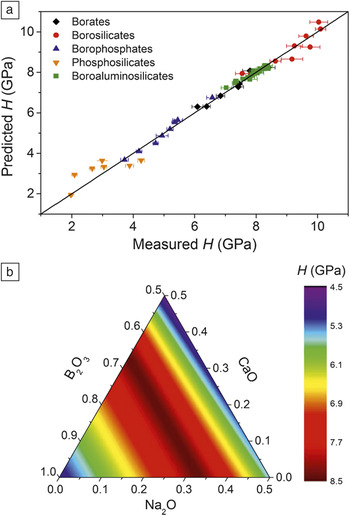
where dH/dn c is a load-dependent constant, typically in the range of 7–10 GPa, and n c,crit = 2.5 is the minimum number of constraints per atom required for the material to display nonzero hardness. Reference Smedskjaer, Mauro and Yue6 This simple relation has been found to work well for a range of oxide glasses, Reference Smedskjaer, Mauro and Yue6,Reference Smedskjaer12,Reference Smedskjaer, Mauro, Youngman, Hogue, Potuzak and Yue13,Reference Hermansen, Youngman, Wang and Yue25,Reference Hermansen, Guo, Youngman, Mauro, Smedskjaer and Yue27 as shown in Figure 3a. A future challenge in hardness prediction relates to understanding and predicting the load dependence of the proportionality constant dH/dn c and its possible relation to bond strength and atomic packing density.
(a) Predicted versus measured Vickers hardness (H) using Equation (4) with n c,crit = 2.5. Data included for soda lime borate (dH/dn c = 9.9 GPa), Reference Smedskjaer, Mauro and Yue6 soda lime borosilicate (dH/dn c =10.4 GPa), Reference Smedskjaer, Mauro, Youngman, Hogue, Potuzak and Yue13 calcium borophosphate (dH/dn c = 9.4 GPa), Reference Hermansen, Youngman, Wang and Yue25 sodium phosphosilicate (dH/dn c = 7.5 GPa), Reference Hermansen, Guo, Youngman, Mauro, Smedskjaer and Yue27 and sodium boroaluminosilicate (dH/dn c = 7.3 GPa) Reference Smedskjaer12 glasses. (b) Model calculations of H for soda lime borate glasses using Equation (4) with n c,crit = 2.5 and dH/dn c = 9.9 GPa.

Since the models of viscosity and hardness are grounded in fundamental physical principles and not obtained through empirical fitting, they are useful for extrapolating beyond the composition ranges used for model validation. As such, they can be used to topologically design new glass compositions producible on an industrial scale with tailored properties (Figure 3b). Such topological engineering of industrial glass compositions has already shown to be successful when considering that a high-performance Corning Gorilla Glass 3, an ion-exchanged aluminosilicate glass, was designed using some of the modeling approaches presented herein. The modeled composition turned out to be the optimal one out of more than 50 compositions subsequently melted. Reference Mauro, Tandia, Vargheese, Mauro and Smedskjaer29
Conclusions
Temperature-dependent constraint theory can give accurate predictions of the composition dependence of glass properties such as viscosity and hardness. However, detailed structural information, as obtained from NMR spectroscopy studies, is required to reveal the fraction and nature of the atomic constraints. As such, the combination of detailed structural understanding and topological constraint theory paves the way for design of new multicomponent glasses with tailored properties.
Acknowledgments
We thank J.C. Mauro and Y.Z. Yue for the collaboration on temperature-dependent constraints over the years. M.M.S. acknowledges support of the Danish Council for Independent Research (Sapere Aude Starting Grant), Lundbeck Foundation, and VILLUM Fonden.

Morten M. Smedskjaer is Professor with Specific Responsibilities in the Department of Chemistry and Bioscience at Aalborg University, Denmark. He received his PhD degree in materials chemistry from the same university in 2011, and worked as a research scientist at Corning Inc. from 2011 to 2012. His current research focuses on the structure, topology, dynamics, and mechanical properties of oxide glasses. He has nine patent applications (two granted) and over 90 journal articles. His awards include the Norbert J. Kreidl Award and Best PhD Award from the Danish Academy of Natural Science. Smedskjaer can be reached by phone at +45 5142 7672 or by email at mos@bio.aau.dk.

Christian Hermansen is a research chemist at NamZ Pte. Ltd., Singapore. He received his PhD degree in materials chemistry from Aalborg University, Denmark, in 2015; during this time, he collaborated with Nippon Electric Company and Corning Inc. He has published six journal articles on the compositional dependence of glass properties. Hermansen can be reached by phone at +65 8143 7930 or by email at christian@namz.com.sg.

Randall E. Youngman is a senior research associate with Corning Inc. He received a BS degree in chemistry from Fort Lewis College in 1991 and a PhD degree in physical chemistry from Indiana University in 1996. His research interests include structure of inorganic glasses and polymer dynamics using solid-state NMR spectroscopy. He has six granted US patents and has published over 50 journal articles. Youngman is a Fellow of The American Ceramic Society (ACerS), and served as chair of the Glass & Optical Materials Division of ACerS from 2015 to 2016. Youngman can be reached by phone at 607-974-2970 or by email at youngmanre@corning.com.