Introduction
The lichen genus Lobaria (Schreb.) Hoffm. includes a number of closely related taxa that are morphologically very similar, except for the production of sexual fruiting bodies or vegetative propagules, and are considered typical examples of species pairs sensu Poelt (Reference Poelt1970, Reference Poelt1972). Yoshimura (Reference Yoshimura1971) mentioned five species pairs in this genus; two of them in the Lobaria retigera group: L. kurokawae Yoshim./L. retigera (Bory) Trev. and L. pseudopulmonaria Gyeln./L. isidiosa (Müll. Arg.) Vain. The first species of each pair reproduces sexually with apothecia, while its counterpart propagates mainly asexually with isidia.
The current understanding of the genus Lobaria is still controversial. While phylogenetic research based on nuclear and mitochondrial rDNA by Wiklund & Wedin (Reference Wiklund and Wedin2003) demonstrated that Pseudocyphellaria is paraphyletic and Lobaria formed a monophyletic group, Thomas et al. (Reference Thomas, Ryan, Farnden and Galloway2002), Stenroos et al. (Reference Stenroos, Stocker-Wörgötter, Yoshimura, Myllys, Thell and Hyvonen2003) and Miądlikowska & Lutzoni (Reference Miądlikowska and Lutzoni2004) using nuclear rDNA showed that both Lobaria and Pseudocyphellaria are polyphyletic. However, these divergent results seem to reflect incongruence between nuclear and mitochondrial DNA that can only be resolved by a multi-gene approach combined with an extensive dataset of Lobaria s. lat. Yoshimura (Reference Yoshimura1971) distinguished different sections of Lobaria based on ascospore characteristics and the species on further morphological and chemical attributes, but rejected the photobiont as a character of taxonomic value above the species level. Within the Lobaria retigera complex he defined species according to chemical characteristics, distinguishing L. kurokawae from the morphologically very similar L. pseudopulmonaria by the absence of the stictic acid complex. Furthermore, he referred to terpenoids for both taxa but did not identify them. Rao et al. (Reference Rao, Sarma and Seshadri1965, Reference Rao, Sarma and Seshadri1966) first described the terpenoids, retigeradiol and retigeranic acid, from samples of the Lobaria retigera group but with uncertain taxonomic specifications. Thin layer chromatography (TLC) analysis of Takahashi et al. (Reference Takahashi, Chiang, Aimi, Tanaka and Shibata1972) confirmed the diagnostic system of Yoshimura (Reference Yoshimura1971) distinguishing L. kurokawae and L. retigera from L. pseudopulmonaria and L. isidiosa by the absence of stictic acid and the occurrence of retigeric acids A and B. In addition, the authors described a new compound as characteristic for L. pseudopulmonaria and L. isidiosa that was identified as retigeranic acids A and B by Kaneda et al. (Reference Kaneda, Takahashi, Iitaka and Shibata1972) and Sugawara et al. (Reference Sugawara, Kasuya, Iitaka and Shibata1991).
Yoshimura (Reference Yoshimura1971) also considered the production of soredia, isidia or lobules as characteristics for delimiting species; thus, the asexual taxa were treated as different species from their fertile counterparts. Poelt (Reference Poelt1970, Reference Poelt1972) and Tehler (Reference Tehler1982) understood asexual species as genetically isolated clones because they were considered unable to recombine with sexual relatives. Tehler (Reference Tehler1982) also recognized intermediate forms bearing isidia and apothecia that, over time, would lose sexual reproduction completely. However, Mattsson & Lumbsch (Reference Mattsson and Lumbsch1989) argued that sterile species were genetically variable and that it is probably wrong to regard sterile lichens as evolutionary dead ends. The authors further suggested that sterile taxa might have the chance of generating new ones. In fact, all phylogenetic studies on species pairs to date have shown that sterile species are genetically diverse (Lohtander et al. Reference Lohtander, Källersjö and Tehler1998a, Reference Lohtander, Myllys, Sundin, Källersjö and Tehlerb, Reference Lohtander, Källersjö, Moberg and Tehler2000; Kroken & Taylor Reference Kroken and Taylor2001; Myllys et al. Reference Myllys, Lohtander, Källersjö and Tehler1999, Reference Myllys, Lohtander and Tehler2001; Buschbom & Mueller Reference Buschbom and Mueller2006). In addition, these analyses demonstrated that neither the sexual nor the vegetative reproducing species were monophyletic. Tehler (Reference Tehler1982) suggested that the asexual form of species pairs may have developed on multiple occasions from the fertile ones and should only be treated as independent taxa if they have irreversibly lost the ability to produce fruiting bodies. A recent study on evolutionary processes in the species pair Porpidia flavocoerulescens and P. melinodes may contribute to this debate. Buschbom & Mueller (Reference Buschbom and Mueller2006) proposed that the mycobiont might reproduce predominantly with vegetative, symbiotic propagules until interaction with a more favourable photobiont triggers a switch to the sexual reproductive mode. Consequently, some currently sterile species might gain fertility in a later generation.
In recent years, molecular studies have contributed to our understanding of the phylogenetic relationships between sexual and asexual taxa of lichen forming fungi. The internal transcribed spacers (ITS) of the nuclear rRNA gene cluster have been successfully used in infra-familiar and infra-generic reviews (Arup & Grube Reference Arup and Grube2000; Lohtander et al. Reference Lohtander, Källersjö, Moberg and Tehler2000; Ihlen & Ekman Reference Ihlen and Ekman2002; Thomas et al. Reference Thomas, Ryan, Farnden and Galloway2002), for delimiting species (Tehler & Källersjö Reference Tehler and Källersjö2001; Miądlikowska et al. Reference Miądlikowska, McCune and Lutzoni2002), in diverse analyses of species pairs (Lohtander et al. Reference Lohtander, Källersjö and Tehler1998a, Reference Lohtander, Myllys, Sundin, Källersjö and Tehlerb; Kroken & Taylor Reference Kroken and Taylor2001; Myllys et al. Reference Myllys, Lohtander, Källersjö and Tehler1999, Reference Myllys, Lohtander and Tehler2001), or in studies of the infraspecific genetic variability (Martín et al. Reference Martín, Winka, Llimona and Lumbsch2000; Crespo et al. Reference Crespo, Molina, Blanco, Schroeter, Sancho and Hawksworth2002).
The aim of the present study is to examine the phylogenetic relationship between apotheciate and isidiate taxa of the Lobaria retigera group. Lobaria kurokawae and L. pseudopulmonaria consistently form apothecia but never soredia or isidia, whereas L. retigera and L. isidiosa produce abundant vegetative propagules and rarely form apothecia in addition to the vegetative propagules (Yoshimura Reference Yoshimura1971). We investigated if the species L. kurokawae, L. retigera, L. pseudopulmonaria and L. isidiosa form monophyletic groups. Furthermore, we assessed the taxonomic significance of the chemical compounds by determining whether their differentiation of the two species pairs could be confirmed by the molecular data.
Material and Methods
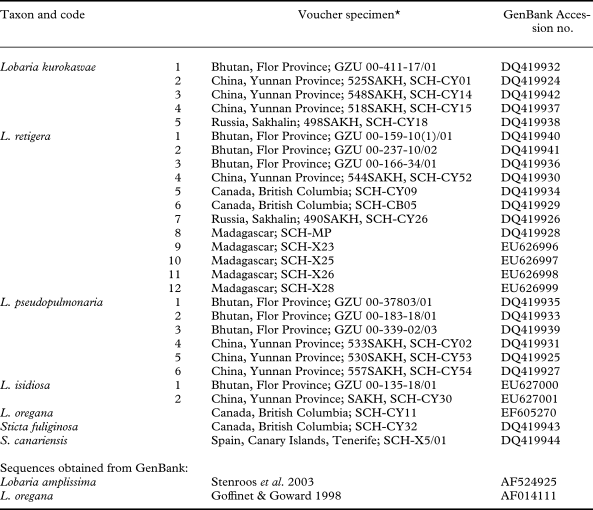
The specimens studied were collected in Bhutan, Canada, China, Madagascar and Russia. To test the phylogenetic status of the ingroup, we included two species of Lobaria from different infrageneric units, L. amplissima (Scop.) Forss. and L. oregana (Tuck.) Müll. Arg. Sticta fuliginosa (Hoffm.) Ach. and S. canariensis (Bory) Bory ex Delise were used as outgroup taxa. Information on the taxa, herbarium number and GenBank accession numbers are given in Table 1.
Taxa used in this study and the GenBank accession numbers of the ITS nrDNA sequenced for the present study or obtained from GenBank
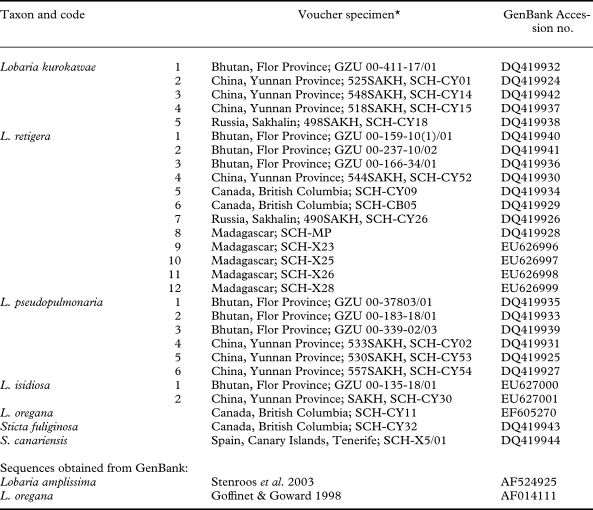
* Abbreviations for the herbaria. SAKH: Sakhalin Botanical Garden; GZU: Institut für Botanik, Universität Graz; SCH: frozen specimen, collected by C. Scheidegger at WSL.
Chemical analyses
The chemical analyses were performed using standard TLC techniques (Culberson & Ammann Reference Culberson and Ammann1979; White & James Reference White and James1985). Secondary substances were extracted in acetone for approx. 10 min. at 40°C. The extracts were spotted on precoated Merck silica gel F254 plates and eluted in A: toluene : dioxan : acetic acid (180:45:5 ml); B: hexane : diethylether : formic acid (130:100:20 ml); C: toluene : acetic acid (200:30 ml). For each solvent system A, B, and C, we used separate plates with the same extracts. The plates were examined first by UV light at 254 nm and 366 nm wavelengths. The plates were then immersed briefly in a sulphuric acid bath, air dried and heated in an oven at 100°C for approx. 15 min. Identification of the substances was made by comparison with known references from our laboratory. The metabolites of 33 samples were analysed with TLC.
DNA isolation and sequencing
The DNA was isolated using the GenElute Plant Genomic DNA Miniprep Kit (Sigma-Aldrich) according to the manufacture’s protocol. The fungal-specific primer ITS1-F (Gardes & Bruns Reference Gardes and Bruns1993) and the universal primer ITS4 (White et al. Reference White, Bruns, Lee, Taylor, Innis, Gelfond, Sninsky and White1990) were employed to amplify the internal transcribed spacers (ITS 1 and 2) including the 5.8S sequence of the ribosomal RNA gene. The ITS-PCR was performed with 2 μl DNA extract in a total volume of 50μl containing 1 × PCR buffer (Sigma-Aldrich), 2·0 mM MgCl2 (Sigma-Aldrich), 40 μM each dNTP (Promega), 80pM each primer, and 0·025 units Taq polymerase (Sigma-Aldrich). The cycling conditions for the ITS region were as follows: a) 2min 94°C, b) 30sec 94°C, c) 30s 57°C, d) 30s 72°C, e) b–d 29 cycles, and f) 10min 72°C.
All PCR products were purified with the QIAquick PCR Purification Kit (QIAGEN), labelled with the Big Dye Terminator v3.1 Kit (Applied Biosystems) and cycle sequenced as follows: 25 cycles of 20s 96°C, 5s 50°C, 2min 60°C. Post-reaction cleanup was carried out in Performa DTR Gel Filtration Cartridges (Edge BioSystems) following the manufacturer’s protocol. Sequences were detected in an ABI PRISM 3100 Avant (Applied Biosystems) and checked in the GenBank by nucleotide BLAST searches.
PCR of herbarium specimens
Because several specimens were herbarium samples collected up to ten years ago, the extracted DNA was often of poor quality. PCR amplifications failed in many cases and made the analyses of single-copy genes impossible. Since we had only herbarium samples of the isidiate taxa with retigeranic acid, we applied the following procedures. The ITS PCR was performed as described above and repeated with the first PCR product as template. This method produced the desired PCR fragment but also other artefact fragments. The selected bands were excised from agarose gel (1·5% in TBE Buffer) and purified with the MinElute Gel Extraction Kit (Qiagen) according to the manufacturer’s protocol. The cleaned product was used for direct sequencing as described above. The ITS sequences of the specimens L. isidiosa 1 and 2 were obtained by this technique.
Alignment and phylogenetic analysis
The sequences were assembled pairwise using AutoAssembler 1.4.0 (Applied Biosystems) and optimized by eye. The trimmed sequences were aligned with ClustalX (Thompson et al. Reference Thompson, Higgins and Gibson1994) with default settings except the following modification of the pairwise and multiple alignment parameters: gap opening 10·00 and gap extension 0·10. In addition, poorly aligned regions were improved using the realign option of ClustalX. The alignment quality was assessed with TuneClustalX (Hall Reference Hall2004) before and after using modified parameters and the realign option.
Phylogenetic tests were implemented in PAUP* 4.0b10 (Swofford Reference Swofford1998). A heuristic search was carried out with maximum parsimony as criterion and 1000 random-addition-sequence replicates, TBR branch swapping, multrees option in effect, saving all trees and collapsing branches with maximum branch length equal to zero. Gaps were treated as missing data. We set the character polarity by defining in PAUP* S. fuliginosa and S. canariensis as outgroup. First, we performed two phylogenetic analyses with the unchanged alignment that resulted from ClustalX. Second, ambiguously aligned regions in the ITS sequence were delimited by eye, recoded using the software INAASE 2.3b according to the author’s indications (Lutzoni et al. Reference Lutzoni, Wagner, Reeb and Zoller2000) and re-integrated into the dataset.
The branch support was estimated by bootstrap analysis (Felsenstein Reference Felsenstein1985) with full heuristic search, 1000 bootstrap replicates, retaining groups with frequency >50%, 100 random-addition-sequences per bootstrap replicate and by saving all trees. Additionally, we calculated Bayesian posterior probabilities with Markov Chain Monte Carlo (MCMC) (Metropolis et al. Reference Metropolis, Rosenbluth, Rosenbluth, Teller and Teller1953; Hastings Reference Hastings1970) as implemented in MrBayes 3.1 (Huelsenbeck & Ronquist. Reference Huelsenbeck and Ronquist2001; Ronquist & Huelsenbeck Reference Ronquist and Huelsenbeck2003). Because the substitution model selected by Modeltest (Posada & Crandall Reference Posada and Crandall1998) could not be implemented in MrBayes, we executed the analysis with the default substitution model GTR. Nevertheless, the model was simplified assuming equal rates over sites (no gamma variation) to reduce arising burn-out problems (Ronquist et al. Reference Ronquist, Huelsenbeck and van der Mark2005). The Bayesian analysis was run 115 000 generations, every 10th tree was sampled and the first 2 875 trees were excluded as burn-in.
Reconstructing character evolution
MacClade (Maddison & Maddison Reference Maddison and Maddison2001) was used to map the occurrence of vegetative propagules and to reconstruct the evolution of this character based on the parsimony criterion and assuming a non-directional evolution. We applied the MP2 tree to infer the reconstruction of the states «with» (0) or «without» (1) vegetative propagules for each taxon. Additionally to these character states, the matrix contained 91 parsimony informative, un-ambiguous nucleotides of the ITS alignment.
Results
Secondary metabolites
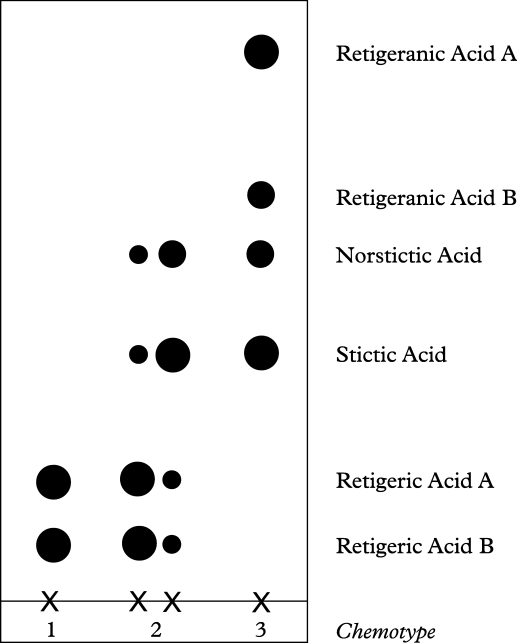
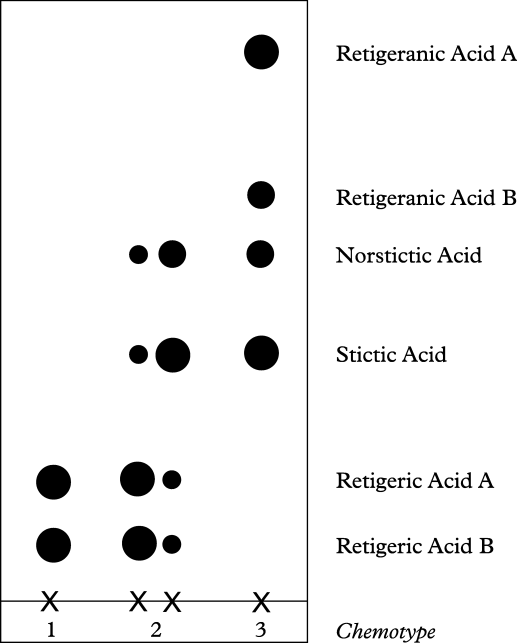
All isidiate specimens from Madagascar and one from Bhutan contained abundant retigeric acids A and B (chemotype 1). Other specimens that contained retigeric acid had varying amounts of stictic and norstictic acid (chemotype 2). Finally, chemotype 3 showed copious amounts of the stictic and norstictic acids as well the retigeranic acids A and B. In this chemotype, retigeric acid was not found. If the specimens contained stictic and norstictic acids, the biogenetically related substances, constictic or norconstictic acid, were regularly found. Telephoric acid was consistently found in all specimens and was therefore not used for characterization of the chemotypes. The results of TLC analyses are summarized in Fig. 1.
Summary of chemical patterns found in TLC analysis of Lobaria retigera group. Chemotypes 1 and 2 are characteristic of the L. retigera lineage and chemotype 3 of the L. isidiosa lineage. Lichens which contain large amounts of retigeric acid (large circles) were observed to produce less (small circles, chemotype 2) or no stictic acid.
ITS analysis
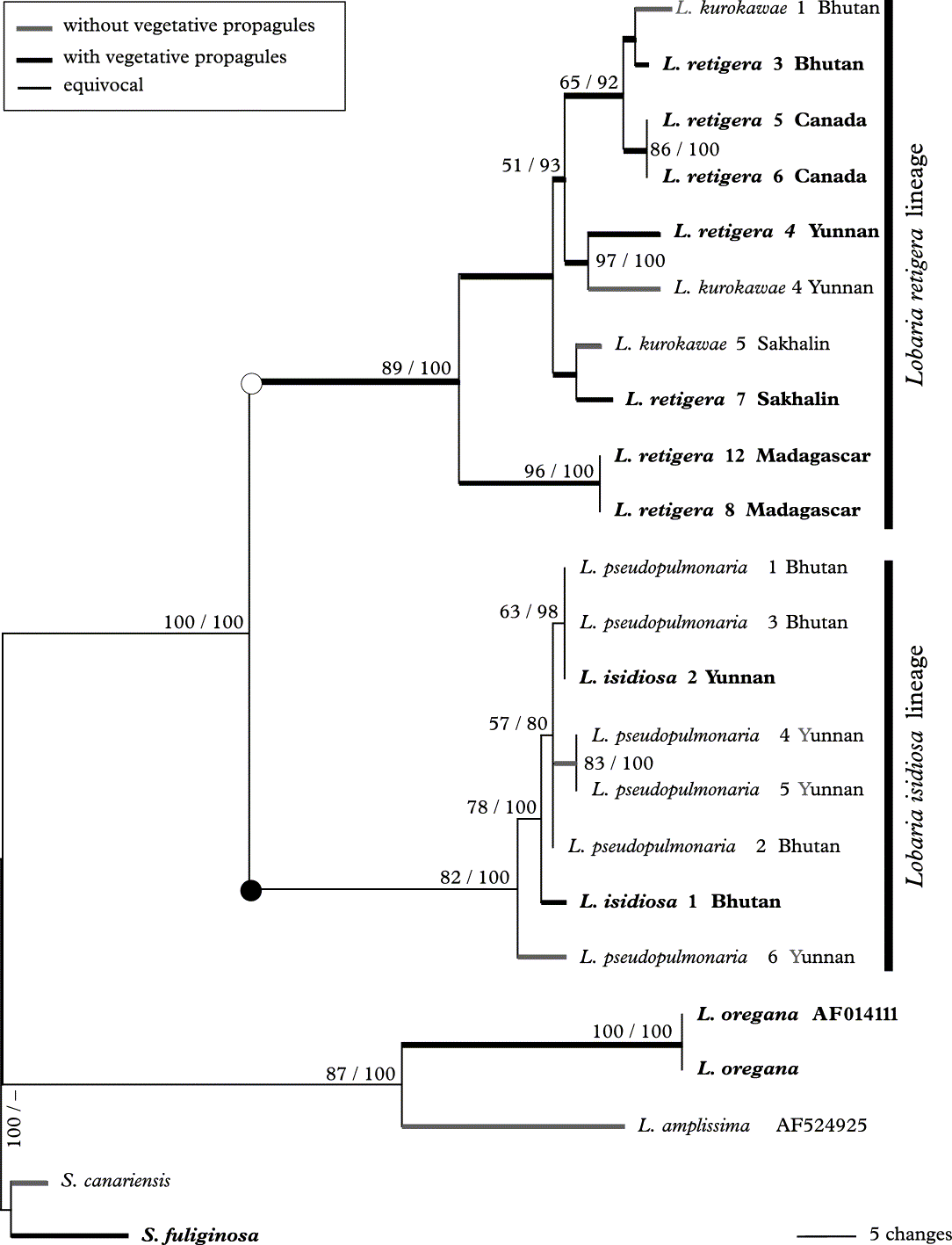
A total of 28 sequences was produced, but not all were used for phylogenetic analysis. Nevertheless, all sequences were submitted to GenBank (Table 1). The dataset included 23 sequences of apotheciate taxa and their counterpart species as well as L. oregana, L. amplissima and the two outgroup taxa. After sequences were trimmed so that they had a concerted beginning and end point, the dataset consisted of 476 nucleotide sites. The first heuristic search was performed in PAUP* with maximum parsimony including all nucleotides (MP1). PAUP* defined gaps as missing, excluded 330 constant sites and carried out the heuristic search with 112 nucleotides that were parsimoniously informative. This analysis produced one most parsimonious tree of 255 steps length with the tree score indices CI=0·773 and RI=0·841. Second, for the MP2 analysis 385 gapped, ambiguously aligned, constant or parsimony uninformative sites were excluded as performed by the command include/exclude characters in PAUP* and the remaining 91 informative sites resulted in two phylogenetic trees of 164 steps, CI=0·726 and RI=0·845. Finally, for the MP3 analysis, a total of 91 nucleotides, located in 13 ambiguously aligned regions, were excluded and replaced by 13 recoded characters (INAASE). Further, 324 gapped, constant or uninformative nucleotides were excluded, thus 74 parsimony informative characters could be integrated into the heuristic search. The MP3 analysis revealed 47 most parsimonious trees of 167 steps, CI=0·802 and RI=0·866. All three analyses produced phylogenetic trees with very similar structure except for some terminal branches. The bootstrap cladograms implemented in PAUP* did not resolve all branches of the phylogenetic trees and not all nodes obtained enough bootstrap support (>75%). The resulting phylogenetic tree obtained with MrBayes was very similar to the MP phylograms. However, the posterior probabilities tree positioned the L. oregana-L. amplissima branch out of the ingroup. Consequently, no posterior probability was obtained for this node. As there were no contradictions for the ingroup studied among the MP1, MP2, MP3 trees and the Bayesian phylogram, the MP2 tree with fewest substitutions (164 steps) was chosen for presentation (Fig. 2).
One of two most parsimonious trees produced by phylogenetic analysis of the ITS 1 and 2 sequences and the 5.8S gene showing the relationship of the isidiate species L. retigera and L isidiosa and their apotheciate counterparts L. kurokawae and L. pseudopulmonaria. Sticta canariensis and S. fuliginosa were defined as the outgroup. ○, chemotype 1+2: retigeric acids A & B + stictic and norstictic acids; •, chemotype 3: retigeranic acids A & B + stictic and norstictic acids. Numbers beside internodes represent the percentage of 1000 bootstrap replicates (left) and the Bayesian posterior probabilities (right). Only values ≥50% are shown; Cl: 0·726, Rl: 0·845. Species names in bold type with vegetative propagules; species names in normal type without vegetative propagules.
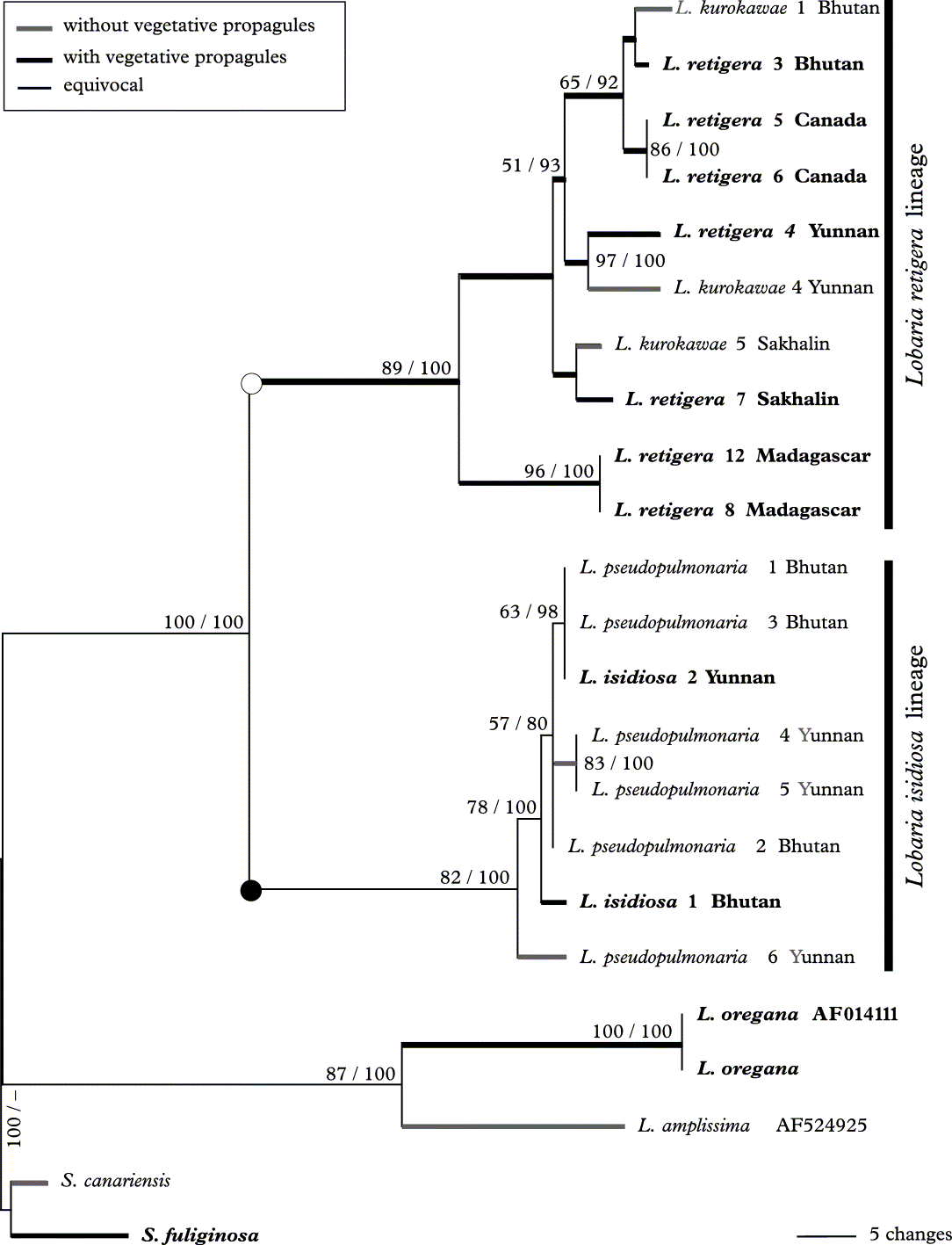
Outgroup rooting in the MP2 analysis led to a cluster with L. oregana and L. amplissima basal to the ingroup in question. The ingroup was maximally supported (b=100; MrB=100) and revealed two lineages. Each lineage included both apotheciate and isidiate specimens with high bootstrap support (b=89; MrB=100 and b=82; MrB=100), but within each lineage, apotheciate and isidiate taxa were intermingled. The order of taxa in the first clade indicated in some cases geographical patterns, for example, Malagasy (b=96; MrB=100) or Canadian specimens (b=86; MrB=100) fit together with high bootstrap support. This was not found in the L. isidiosa lineage. The MP2 position of the Sakhalin specimens was supported neither by bootstrap analysis nor by posterior probabilities. In the posterior probability tree these specimens formed one clade together with the Malagasy samples, although with minor support (MrB=71).
Discussion
We did not examine any type material in this study and as only a limited number of recently collected specimens was available for molecular studies, our data do not allow us to draw nomenclatural conclusions from the chemical and molecular investigations. The oldest name at the species level in the L. retigera group is L. retigera, described from La Réunion (Bory Reference Bory de Saint-Vincent1804; see Yoshimura Reference Yoshimura1971 for a nomenclatural discussion). It is likely that the name L. retigera applies to the specimens belonging to the retigeric acid chemotype from Madagascar. The name L. kurokawae is widely used in literature for apotheciate specimens but would be a younger facultative synonym of L. retigera if the African, Asian and American populations of the retigeric acid chemotype were to be considered conspecific. In this study, L. kurokawae is used for apotheciate specimens that produce retigeric acid but chemical analyses should reveal if facultative synonyms of L. retigera would have nomenclatural priority if additional molecular analyses revealed a regional subdivision of the chemotypes 1 and 2. For chemotype 3, L. isidiosa would have nomenclatural priority and in our study the name L. pseudopulmonaria is solely used to indicate apotheciate specimens that belong to chemotype 3.
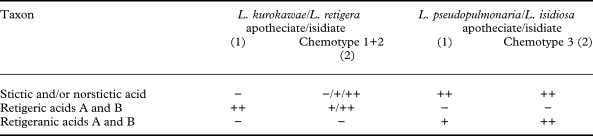
The presence or absence of stictic or norstictic acids showed no relation to the clades found in the ITS phylogeny. While the chemical pattern of the L. retigera lineage is characterized by the production of retigeric acid (chemotypes 1 and 2), TLC analyses indicate that L. pseudopulmonaria and L. isidiosa differ from the other Lobaria species studied by the presence of retigeranic acid (chemotype 3). In addition, we observed that lichens of the chemotypes 1 and 2, which contain large amounts of retigeric acid, have less or no stictic acid indicating a negative correlation between these metabolites (Fig. 1).
On the basis of the presence of retigeric or retigeranic acids and on the ITS phylogeny, two lineages showing a high bootstrap support were distinguished (Fig. 2). One lineage includes the apotheciate taxon L. kurokawae and the isidiate taxon L. retigera and the second lineage contains the apotheciate L. pseudopulmonaria and the isidiate L. isidiosa. In addition, the phylogenetic tree shows that the apotheciate and the isidiate forms within each lineage are not monophyletic. Highly supported groups within the L. retigera lineage are formed among specimens originating from the same geographical region but from different localities. This was found among specimens where only isidiate forms were available from regions such as Madagascar and the forests of British Columbia, but the same pattern was also found if the specimens showed different reproduction modes. For example, the apotheciate and isidiate specimens from Yunnan form a highly supported clade. These results suggests a strong geographical structure in the L. retigera lineage, among the populations in Canada, Madagascar, Bhutan, Yunnan (China), and Sakhalin (Russia), of this widely distributed taxon. It is likely that these isolated populations have evolved over geologically long periods, and, independent of their reproductive mode and taxonomic rank, these geographically differentiated clades may deserve the status of evolutionarily significant units (Moritz Reference Moritz1995) for biological conservation. No comparable levels of genetic differentiation have so far been found in the L. isidiosa clade where the samples originated from a more restricted area (Bhutan and Yunnan).
The evolution of the character, vegetative propagules, shows an equivocal presence/ absence of isidia at the base of the L. isidiosa lineage. A more intensive taxon sampling will be needed to identify the ancestral character state in this clade. However, in the L. retigera lineage the internal nodes were revealed to be isidiate and only three terminal nodes developed into the non-isidiate character state that is typical for the apotheciate taxon. On the other hand, morphs of L. isidiosa and L. retigera bearing both isidia and apothecia (Yoshimura Reference Yoshimura1971) show that sexual reproduction of thalli is suppressed rather than lost and hence recombination between apotheciate and isidiate lineages can be expected. Recently, Buschbom & Mueller (Reference Buschbom and Mueller2006) showed in Porpidia flavocoerulescens and P. melinodes that the transition from the vegetative to the sexual state happens more frequently than vice versa which implies that the isidiate morphs may not have completely lost the ability to build fruiting bodies. All studies to date, including the present study, have demonstrated that sexually and vegetative reproducing species pairs are not monophyletic and, consequently, question the hypothesis of genetic isolation of vegetative lineages. Moreover, unlike other studies where the sorediate specimens supposedly arose several times at different geographical locations from fertile lineages (Lohtander et al. Reference Lohtander, Källersjö and Tehler1998a, Reference Lohtander, Myllys, Sundin, Källersjö and Tehlerb; Myllys et al. Reference Myllys, Lohtander, Källersjö and Tehler1999; Myllys et al. Reference Myllys, Lohtander and Tehler2001), our study of L. retigera shows that apotheciate clades have developed repeatedly from rarely fertile, isidiate morphs.
In contrast to Poelt’s (Reference Poelt1972) hypothesis of species pairs, published studies reveal transitions from isidiate morphs that have the potential to form apothecia rarely, towards apotheciate morphs that produce no vegetative propagules. The widespread green-algal Lobaria pulmonaria has a combined reproductive strategy, i.e., it always produces soredia but only rarely forms apothecia. Zolleret al. (Reference Zoller, Lutzoni and Scheidegger1999) suggested that L. pulmonaria is heterothallic and is likely to remain sterile in populations with low genetic diversity. Species with infrequent formation of apothecia were often shown to be heterothallic (Zoller et al. Reference Zoller, Lutzoni and Scheidegger1999; Kroken & Taylor Reference Kroken and Taylor2001; Scherrer et al. Reference Scherrer, Zippler and Honegger2004; Seymour et al. Reference Seymour, Crittenden, Dickinson, Paoletti, Montiel, Cho and Dyer2005; Honegger & Zippler Reference Honegger and Zippler2007). Because several examples of abundantly fertile heterothallic species such as Ramalina fastigiata, R. fraxinea, Physcia aipolia and P. stellaris (Honegger & Zippler Reference Honegger and Zippler2007) are known, it remains unclear if a change in the frequency of apothecia is paralleled by a transition from heterothallism to homothallism within a lichen species such as L. retigera.
Diagnostic characteristics of Lobaria species involved in this study
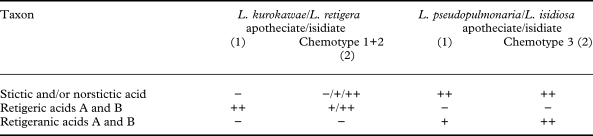
(1) Takahashi et al. (Reference Takahashi, Chiang, Aimi, Tanaka and Shibata1972);
(2) results of this study
− Not found;
+ traces;
++ abundant
We are very grateful to W. Obermayer (Graz) and C. Keller (Birmensdorf) for collaborating on chemical analysis and U. Kamm (Birmensdorf) for providing the specimen from Tenerife. We wish to thank S. Werth (Birmensdorf) and the anonymous referees for constructive comments. S. Chabanenko and C. Scheidegger were supported by a research grant from the Swiss National Science Foundation (Scopes 7SUPJ062353 and IB73AO-111137/1).