Cushing’s syndrome, an endocrine disorder more frequent in females, female/male ratio: 8:1, is undoubtedly rare in childhood and adolescence. It is characterised by the hypersecretion of cortisol generally due to the presence of an adrenocorticotrope hormone-secreting hypophyseal adenoma. Less common causes are primary adrenal diseases, ectopic adrenocorticotrope hormone secretions, and exogenous assumption of corticosteroids. Therefore, patients affected by Cushing’s syndrome may also feature cardiovascular diseases, such as arterial hypertension, that may persist even after successful surgical cure.Reference Cushing1–Reference Colao, Pivonello and Spiezia4 It means that this surgery often proves to be a palliative.Reference Hunt, Roizen, Tyrrell and Biglieri5 It may depend on previous high plasmatic levels of cortisol, which are able to induce an early endothelial dysfunction persisting even after disease remission.Reference Baykan, Erem and Gedikli6 Recent studies about the biophysical characteristics of carotid arteries of patients with Cushing’s syndrome revealed both a higher intima-media thickness and a lower systolic lumen diameter and distensibility coefficient, implying that the elastic properties of the carotid wall were not preserved.Reference Faggiano, Pivonello and Spiezia7, Reference Arnaldi, Angeli and Atkinson8 This may be related to the accumulation of aberrant ceramides and other sphingolipids.Reference Summers and Nelson9 An increased vascular oxidative stress was present in small arteries of patients with Cushing’s syndrome’ as well, as shown by increased levels of superoxide anions, cyclooxygenase-1, and endothelial nitric oxide synthase in the microvessels.Reference Rizzoni, Porteri and De Ciuceis10
On the other hand, a loss of the natural aortic elasticity may be responsible for blood pressure abnormalities in the 24-hour ambulatory blood pressure monitoring of patients with Cushing’s syndrome, even after successful surgical cure.Reference Zacharieva, Orbetzova and Stoynev11, Reference Panarelli, Terzolo and Piovesan12 However, the cellular pathophysiologic mechanism responsible for secondary hypertension remains unidentified. The hypothesis of increased arterial stiffness despite satisfactory correction of this syndrome, which could be responsible for this complication, was proposed.Reference Faggiano, Pivonello and Spiezia7, Reference Fallo, Sonino and Barzon13 At this time, there is still a considerable debate about the exact mechanism responsible for persistent hypertension after surgery for Cushing’s syndrome and no comparative review can be considered definitive.
The QKd interval is the time measured in milliseconds between the onset of depolarisation on the electrocardiogram (Q) and the detection of the last Korotkoff sound (K) at the level of brachial artery during cuff deflation, corresponding to diastolic blood pressure (d). As this interval is inversely related to pulse wave velocity, QKd measurement provides valuable information about arterial distensibility.Reference Gosse, Guillo, Ascher and Clementy14 This is calculated on an arterial segment including the ascending aorta and a portion of the subclavian and brachial arteries.
This study aims to demonstrate that arterial compliance, evaluated by automated recording of the QKd interval, is lower in a group of children and adolescents with surgically corrected Cushing’s syndrome compared with a control group of healthy subjects.
Methods
Selection of study participants
We included 23 female patients aged between 11 and 18, with a mean age of 15.3 plus or minus 1.2 years, who had undergone a successful surgical cure of Cushing’s syndrome in our study. They were studied at a mean time of 4.1 plus or minus 1.1 years from surgery. The patients affected by Cushing’s syndrome in the study included 18 with a pituitary adenoma, three with a primary adrenal disease, and two with ectopic adrenocorticotrope hormone secretion.
They had been hypercortisolemic for a mean period of 22.5 plus or minus 3.1 months. The biochemical documentation of endogenous hypercortisolism was based on measurements of 24-hour urine-free cortisol excretion, and on the lack of circadian rhythmicity in plasma cortisol concentrations.
All patients with pituitary adenomas underwent successful transphenoidal surgery. Of the three patients with primary adrenal disease, two had micronodular adrenal disease and underwent bilateral adrenalectomy, and one had an adrenal adenoma and underwent the surgical excision of the tumour. Of the two patients with ectopic adrenocorticotrope hormone secretion, one had a thymoma, the other had a thymic carcinoma, and both had a total thymectomy.
All patients were cured after the surgical excision of the tumour and their levels of both urinary and plasma cortisol were monitored for at least a year after surgical cure at 3, 6, 9, and 12 months postoperatively.
They were considered cured if urinary cortisol values were less than 10 micrograms per 24 hours and morning plasma cortisol values were less than 1 microgram per decilitre on the third day after surgery. Postoperatively, they were treated with replacement hydrocortisone given in the morning until the complete recovery of their hypothalamic–pituitary–adrenal axis. The postoperative recovery of this axis was evaluated periodically with serial standard adrenocorticotrope hormone tests and was confirmed by a plasma cortisol value higher than or equal to 18 micrograms per decilitre, 60 minutes after the administration of adrenocorticotrope hormone.
These patients were compared with a control group of 23 healthy subjects paired with respect to gender, age, height, and weight. The criteria of exclusion were the conditions that increase the pre-ejection period (severe subvalvular aortic stenosis) and that might impair the interpretation of the QKd interval, such as hyperthyroidism or the presence of a pacemaker.
A 24-hour ambulatory blood pressure monitoring with QKd interval measurement and a transthoracic echocardiography were performed for each patient of the study. In the post-surgery Cushing’s syndrome group, seven patients were taking a single antihypertensive drug, while two patients were taking two antihypertensive agents. We avoided the possible influence of pharmacologic therapy on both blood pressure values and arterial stiffness by interrupting it 4 weeks before the beginning of our study.
All the young patients’ parents gave their informed written consent to the study, which was conducted according to the Declaration of Helsinki.
QKd measurement
The authors undertook a 24-hour ambulatory blood pressure monitoring in the auscultatory mode coupled with the measurement of the QKd interval, in order to evaluate the rigidity of the large arteries. In practice, the 24-hour ambulatory blood pressure monitoring is performed using an appropriate size cuff for the children’s upper left arm circumference.Reference Clark, Lieh-Lai, Sarnaik and Mattoo15 A microphone was located in the cuff on the brachial artery and three electrodes were placed on the chest to detect the QRS complexes. The QKd interval was measured along with concomitant cardiac frequency and blood pressure values every 15 minutes over a 24-hour period, approximately 96 values for each patient. The variations of QKd interval were automatically performed by a monitoring device with specific software (Dyasis Integra from Novacor, Rueil Malmaison, France). This index gives an estimate of arterial distensibility derived from the pulse wave velocity, so that a reduction in arterial compliance results in a reduction of the QKd interval.
The device allowed us to automatically derive the QKd100–60 index, which is the value of QKd for a systolic blood pressure of 100 millimetres of mercury and a heart rate of 60 beats per minute, and is totally independent of the blood pressure levels. It reduces the influence of the pre-ejection time (which is linearly correlated to the heart rate) and makes comparison among subjects with different levels of blood pressure easier.Reference Gosse, Braunstein and Clementy16 In fact, as known, many patients develop residual hypertension even after surgical cure of Cushing’s syndrome.Reference Fallo, Sonino and Barzon13 Values of QKd100−60 higher than 200 milliseconds are considered normal.Reference Gosse, Braunstein and Clementy16
Echocardiography
The same trained physician performed a transthoracic echocardiographic study before evaluating arterial compliance by measurement of the QKd interval. The left ventricular mass was calculated using Devereux’s formula.Reference Devereux and Reichek17
Statistical analysis
We compared the results of the entire study population, which includes 23 patients, to those of the control group including 23 healthy subjects using the non-parametric Mann-Whitney U-test. As for the QKd index, before the age of 30 years it is related to height, but not to age. There is no difference in the gender. Its analysis was performed with respect to the reference values obtained in previous studies conducted on subjects who had either normal or high blood pressure.Reference Gosse, Jullien, Lemetayer, Jarnier and Clementy18 Values of p less than 0.05 were set as the minimum level of statistical significance throughout the paper.
We studied the relationships among the various parameters using the univariate analysis. Multivariate analysis was not applied because the sample size was not large enough for this statistic test.
For all the analyses, commercially available computer software (SPSS version 16.0, SPSS Inc., Chicago, Illinois, United States of America) was used.
Results
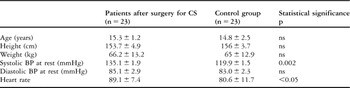
Table 1 shows the main clinical characteristics of the 23 Cushing’s syndrome post-surgery patients, compared to those obtained in the control group. A significant difference was found, at rest, for both systolic blood pressure and heart rate.
Clinical characteristics (mean values plus or minus standard deviation) of the 23 operated patients for Cuhing’s syndrome compared with those of the 23 healthy subjects of the control group.

BP, blood pressure; CS, Cushing’s syndrome; ns, non-significant
Table 2 shows the patients divided into two groups – children previously affected by Cushing’s syndrome after successful cure and the control group. The Cushing’s syndrome group showed some significantly disadvantageous difference for 24-hour ambulatory blood pressure monitoring values in comparison with the control group.
Data from 24-hour ambulatory blood pressure monitoring (mean values plus or minus standard deviation).

CS, Cushing’s syndrome; DBP, diastolic blood pressure; MAP, mean arterial pressure; ns, non-significant; SBP, systolic blood pressure
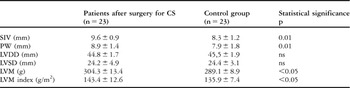
The echocardiographic data are shown in Table 3. There were significant differences in left ventricular mass, and in the septal and posterior wall thicknesses, between the two groups.
Echocardiographic findings (mean values plus or minus standard deviation).
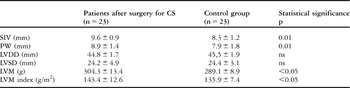
CS, Cushing’s syndrome; IVS, interventricular septum; LVDD, diastolic diameter of the left ventricle; LVM, left ventricular mass; LVSD, systolic diameter of the left ventricle; ns, non-significant; PW, posterior wall
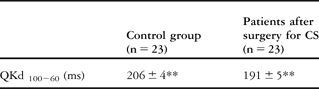
The results of the QKd100–60 index are summarised in Table 4. We found significant differences between the values of the QKd100–60 index in the control group and the corresponding values found in the patients operated for Cushing’s syndrome, with p-value less than 0.01. In univariate analysis, we observed a significant relationship between the Qkd interval and both the increased blood pressure values and left ventricular mass, r equal to 0.47, p equal to 0.026 and r equal to 0.43, p equal to 0.024, respectively. No other significant relationships were found.
Observed QKd100–60 interval values.
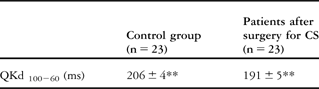
CS, Cushing’s syndrome after surgery
**p < 0.01
Discussion
To our knowledge, no other studies have been conducted to evaluate the profile of arterial stiffness in patients undergoing a successful surgical approach for Cushing’s syndrome. Our findings confirm the previous hypothesis of increased rigidity of the large arteries in children operated for Cushing’s syndrome, compared with the results obtained in healthy subjects.Reference Faggiano, Pivonello and Spiezia7, Reference Fallo, Sonino and Barzon13 Moreover, in this study we show that arterial compliance is decreased in Cushing’s syndrome post-surgical treatment subjects more than in controls, representing the QKd values, based upon pulse wave velocity measurement, lower in Cushing’s syndrome group than in controls. That outlines a severe deterioration in the arterial physical properties of patients with Cushing’s syndrome. Until now, differences in arterial distensibility among Cushing’s syndrome subjects after surgery have been fleetingly evaluated calculating only the systolic lumen diameter and distensibility coefficient.Reference Faggiano, Pivonello and Spiezia7 This method provides an evaluation only at the moment of the examination, while the QKd interval technique provides a complete profile of circadian variations in pulse wave velocity that would be more appropriate than a single measurement in assessing arterial elasticity.
The evaluation of arterial distensibility by QKd measurement has the advantages of being non-invasive, completely automated, reproducible, and avoiding inter-operator variability. It is a useful ancillary to 24-hour ambulatory blood pressure monitoring, without any extra discomfort to the patients. In our opinion, it would be considered the study of the development and prognosis of cardiovascular complications after surgical repair of Cushing’s syndrome, such as secondary hypertension. Our data indicate disadvantageous differences in arterial rigidity after Cushing’s syndrome repair, which could explain the difference in blood pressure values. The vascular damage induced by the previous hypercortisolism may be probably responsible for this issue.Reference Lodish, Sinaii and Patronas19 On the other hand, in our report no significant correlation was found between QKd interval values and cortisol levels before Cushing’s syndrome surgery. These findings are explained mainly by the narrow range of patients in the study.
According to previous studies on hypertensive patients, we found a relationship between QKd interval values’ reduction and increased blood pressure values, confirming the already well-established importance of blood pressure in arterial compliance.Reference Gosse, Guillo, Ascher and Clementy14, Reference Benetos, Laurent, Asmar and Lacolley20 Regarding the cardiac repercussions of reduction in arterial compliance, we found a significant relationship between the QKd interval and left ventricular mass, according to previous observations in essential hypertension.Reference Gosse, Gasparoux, Ansoborlo, Lemetayer and Clementy21
The main limitation of this study is the small number of patients, with the consequent need to implement it. This will probably be complicated by the rarity of this disease in paediatric age. In addition, going on monitoring QKd for a long time would be very interesting in order to investigate a possible correlation with arteriosclerosis, which develops as time passes. Finally, other factors potentially contributing to the reduction in arterial compliance in Cushing’s syndrome should be considered, that is, stimulation of mineralocorticoid and glucocorticoid receptors, insulin resistance, and overexpression of the renin–angiotensin system).Reference Sacerdote, Weiss, Tran, Rokeya Noor and McFarlane22
In conclusion, our data show that patients with Cushing’s syndrome after successful surgery have increased arterial stiffness. Remission from hypercortisolism results in improvement, but not normalisation of vascular damage. Therefore, the past exposure to cortisol excess should be considered a condition associated with high cardiovascular risk, and these patients should be included in a lifelong follow-up.
Acknowledgements
We gratefully thank the little patients who took part in the study.