


In in vitro fertilization (IVF) cycles, it is sometimes necessary to transfer two embryos (ESHRE Guideline Group on the Number of Embryos to Transfer, 2024). When both embryos implant and continue their development, bypassing ‘the vanishing twin’ defence (Magnus et al., Reference Magnus, Ghaderi, Morken, Magnus, Romundstad, Skjærven, Wilcox and Håberg2017), a supra-physiological process begins. A critical question arises: How can these two fetuses achieve adequate and synchronous growth under these unique circumstances?
A major obstacle in studying the growth dynamics of twin pregnancies is a set of conceptual issues. The application of standard growth percentiles — developed for singleton fetuses — is a persistent source of debate (Hiersch et al., Reference Hiersch, Barrett, Fox, Rebarber, Kingdom and Melamed2022). This, in turn, makes the diagnosis of small for gestational age (SGA) inherently controversial in twins. Nevertheless, the diagnosis continues to rely on the fundamental criterion of a birth weight below the 10th percentile for gestational age (Khalil et al., Reference Khalil, Sotiriadis, Baschat, Bhide, Gratacós, Hecher, Lewi, Salomon, Thilaganathan and Ville2025).
The definition of discordance is also subject to ongoing debate, albeit less contentious than that for SGA. Cut-off values of 15% and 18% are the two most prominent thresholds for diagnosis (Amyx et al., Reference Amyx, Albert, Bever, Hinkle, Owen, Grobman, Newman, Wapner, Skupski, Ranzini, Iqbal, Wing, Nageotte and Grantz2020; Khalil et al., Reference Khalil, Sotiriadis, Baschat, Bhide, Gratacós, Hecher, Lewi, Salomon, Thilaganathan and Ville2025). Furthermore, it is possible to approach and quantify discordance not only as a present-absent dichotomy but also on an ordinal scale, such as mild-moderate-severe (ACOG Practice Bulletin, Number 231, American College of Obstetricians and Gynecologists, 2021; Amyx et al., Reference Amyx, Albert, Bever, Hinkle, Owen, Grobman, Newman, Wapner, Skupski, Ranzini, Iqbal, Wing, Nageotte and Grantz2020).
In assisted reproductive technology (ART) clinics, the ‘freeze-all’ strategy is increasingly becoming the first-line approach, progressively displacing the conventional ‘transfer the fresh embryo first’ policy to a secondary option (Zaat et al., Reference Zaat, Zagers, Mol, Goddijn, van Wely and Mastenbroek2021).
Initially adopted to reduce ovarian hyperstimulation syndrome (OHSS) risk and later supported by apparently superior clinical outcomes, frozen ET has become the new routine (Geng et al., Reference Geng, Lu, Li, Chen, Wei and Liu2023; Kalinderis et al., Reference Kalinderis, Kalinderi, Srivastava and Homburg2021, Zaat et al., Reference Zaat, Zagers, Mol, Goddijn, van Wely and Mastenbroek2021). However, a critical knowledge gap remains regarding the comparative prenatal findings and perinatal outcomes in dichorionic diamniotic (DCDA) twin pregnancies conceived via frozen versus fresh ET.
In singleton pregnancies, the process leading to placental dysfunction and consequent fetal growth restriction is well known to be associated with impaired uterine artery remodeling and abnormal placental biomarkers (Redman & Sargent, Reference Redman and Sargent2010). In contrast, the relationship between uterine artery hemodynamics — particularly its longitudinal assessment throughout the first and second trimesters — and fetal growth dynamics in IVF-conceived DCDA twin pregnancies remains unclear and has been scarcely investigated.
With this background, we utilized our single-center, longitudinal cohort of serially monitored DCDA twin pregnancies conceived via IVF to investigate and compare the risk factors for discordant growth and fetal growth restriction between fresh and frozen ET policies.
Our analysis proceeded in two sequential stages. First, we compared baseline maternal and perinatal characteristics between the two ET groups to determine whether the resulting pregnancies could be justifiably pooled for a unified analysis of fetal growth disorders. Following the confirmation that pooling was methodologically sound, we proceeded to the second stage, which focused on our primary outcomes: the development of SGA and significant growth discordance, and the analysis of their clinical predictors.
Materials and Method
Study Population and Design
This retrospective longitudinal cohort study included all dichorionic-diamniotic (DCDA) twin pregnancies conceived through IVF at our center between December 1, 2020, and November 1, 2024, and had ongoing follow-up at our clinic at least until the end of the first trimester. This criterion ensured the availability of first and/or second trimester screening data for all participants. Exclusion criteria were as follows: (1) fetal reduction from triplets to twins, (2) monochorionic twin pregnancies, and (3) cases with missing essential pregnancy outcome data.
Clinical and Ultrasonographic Protocol
IVF procedures were performed by two physicians (A.B. and U.I.). All perinatal ultrasonographic examinations, including biometry and Doppler measurements, were conducted by a single experienced perinatologist (S.K.) using a Samsung HS70 (Samsung Healthcare, Korea) device. Estimated fetal weight was calculated using the Hadlock 4 formula (Hadlock et al., Reference Hadlock, Harrist, Sharman, Deter and Park1985). The uterine artery pulsatility index (UtA-PI) was measured in the first and second trimesters using the transabdominal technique described in the relevant literature (Bhide et al., Reference Bhide, Acharya, Baschat, Bilardo, Brezinka, Cafici, Ebbing, Hernandez-Andrade, Kalache, Kingdom, Kiserud, Kumar, Lee, Lees, Leung, Malinger, Mari, Prefumo, Sepulveda and Trudinger2021; Plasencia et al., Reference Plasencia, Maiz, Bonino, Kaihura and Nicolaides2007) and society guidelines (Bhide et al., Reference Bhide, Acharya, Baschat, Bilardo, Brezinka, Cafici, Ebbing, Hernandez-Andrade, Kalache, Kingdom, Kiserud, Kumar, Lee, Lees, Leung, Malinger, Mari, Prefumo, Sepulveda and Trudinger2021). The antenatal monitoring and clinical management of all DCDA twin pregnancies were carried out in strict adherence to these international protocols (Khalil et al., Reference Khalil, Sotiriadis, Baschat, Bhide, Gratacós, Hecher, Lewi, Salomon, Thilaganathan and Ville2025). In line with ACOG guidelines, low-dose aspirin was initiated at the 11–14 week scan for all IVF DCDA twins in our cohort, as they are considered high-risk for preeclampsia (ACOG Committee Opinion No. 743, American College of Obstetricians and Gynecologists, 2018).
Data Analysis and Handling of Abnormalities
The degree of intertwin birth-weight discordance was quantified as a percentage. This was derived by taking the absolute birth-weight difference, dividing it by the birth weight of the larger twin, and expressing the result as a percentage. This calculation was performed utilizing the online discordance calculator available at Perinatology.com (https://perinatology.com/calculators). The ΔUtA-PI (change in uterine artery pulsatility index) was calculated by subtracting the first-trimester value from the second-trimester value.
Cases with major fetal structural abnormalities diagnosed prenatally were described in the overall cohort characteristics but were excluded from the specific analyses of uterine artery Doppler parameters and perinatal outcomes to avoid confounding.
The study was approved by the T.R. Ministry of Health Tepecik Training and Research Hospital Non-invasive Research Ethics Committee (Protocol No: [2024/11-03], Date: [04/12/2024]). The requirement for informed consent was waived by the Ethics Committee due to the retrospective nature of the study.
The Main Clinical IVF Protocols
Controlled ovarian stimulation (COS), triggering of final oocyte maturation, and oocyte retrieval were performed according to a previously described antagonist protocol (Kolibianakis et al., Reference Kolibianakis, Venetis, Kalogeropoulou, Papanikolaou and Tarlatzis2011). Following a baseline ultrasound examination on cycle days 2−3, daily gonadotropin treatment (e.g., Pergovaris, Merck Türkiye; Fostimon and Meriofert, IBSA Türkiye; Gonal-F, Merck Türkiye) was initiated. The dosage was adjusted based on patient age, BMI, previous ovarian response, and antral follicle count. A daily dose of 0.25 mg GnRH antagonist (Cetrotide, Merck Türkiye) was administered from stimulation day 5 onwards, or when the leading follicle reached 12−14 mm in diameter, and continued until the day of the hCG trigger. Final oocyte maturation was triggered with recombinant hCG (Follitropin alpha 0.25 mg; Ovitrelle, Merck Türkiye) and/or a GnRH agonist (Triptorelin 0.1/0.2 mg; Gonapeptyl, Ferring Türkiye) when at least two leading follicles reached a diameter of ≥17 mm. Oocyte retrieval was scheduled 34−36 hours after trigger administration. The decision for fresh or frozen embryo transfer was based on the patient’s COS response, couple characteristics, and their preferences.
For patients undergoing fresh ET, luteal phase support (LPS) was initiated on the day of oocyte retrieval with 600 mg/day vaginal micronized progesterone (Progestan, Kocak Farma Türkiye) and 4 mg/day oral 17β-estradiol (Estrofem, Novo Nordisk Türkiye). LPS was continued until the pregnancy test, performed 12 days after ET. In cases of a positive test, micronized progesterone supplementation was maintained until 10−12 weeks of gestation.
For frozen-thawed ET cycles, endometrial preparation was carried out using an artificial cycle with exogenous hormonal supplementation. Oral 17β-estradiol (Estrofem, Novo Nordisk Türkiye) was commenced on menstrual cycle day 2 or 3 at an escalating dose to support endometrial proliferation and suppress follicular growth. After 10−12 days, a transvaginal ultrasound was performed to confirm the absence of a dominant follicle and to assess endometrial thickness. Once the endometrial thickness reached ≥7 mm, vaginal micronized progesterone (400 mg twice daily; Progestan, Kocak Farma Türkiye) was added to the regimen. A serum β-hCG test was performed 12 days after ET. Upon confirmation of pregnancy, hormonal support was continued until 10−12 weeks of gestation.
Statistical Analysis
The primary objective of our study was to identify clinical and ultrasonographic variables with predictive power for fetal growth disorders, specifically small-for-gestational-age (SGA) neonates and significant birth-weight discordance, in twin pregnancies. All statistical analyses were performed using SPSS software (Version 25.0, SPSS Inc., Chicago, IL, USA).
Comparison of Study Groups
Variables from fresh and frozen embryo transfer pregnancies were compared as follows: Continuous variables were assessed for normality using the Shapiro-Wilk test. Data with normal distribution are presented as mean ± standard deviation and were compared using the independent samples t test. Data with nonnormal distribution are presented as median (interquartile range) and were compared using the Mann-Whitney U test. Categorical variables are presented as numbers (percentages) and were compared using the chi-square (χ2) test or Fisher’s exact test, as appropriate. A two-sided p value of <.05 was considered statistically significant.
Regression Analysis and Prediction Model
The predictors of the two primary outcomes (the presence of at least one SGA neonate and birth-weight discordance ≥15%) were investigated using binary logistic regression. First, univariate logistic regression analysis was employed to identify potential predictor variables, with a liberal inclusion criterion of p < .1. Subsequently, variables meeting this criterion were entered into a stepwise (bidirectional elimination) multivariate logistic regression model to identify independent predictors. The goodness-of-fit of the final multivariate models was assessed using the Hosmer-Lemeshow test, where a p value > .05 indicates a well-calibrated model. Variables that retained statistical significance (p < .05) in the final multivariate model were used to construct a nomogram for outcome prediction.
Results
The study cohort consisted of 169 dichorionic diamniotic twin pregnancies, of which 30 (17.8%) were conceived via fresh embryo transfer (ET) and 139 (82.2%) via frozen ET.
First-Trimester Characteristics
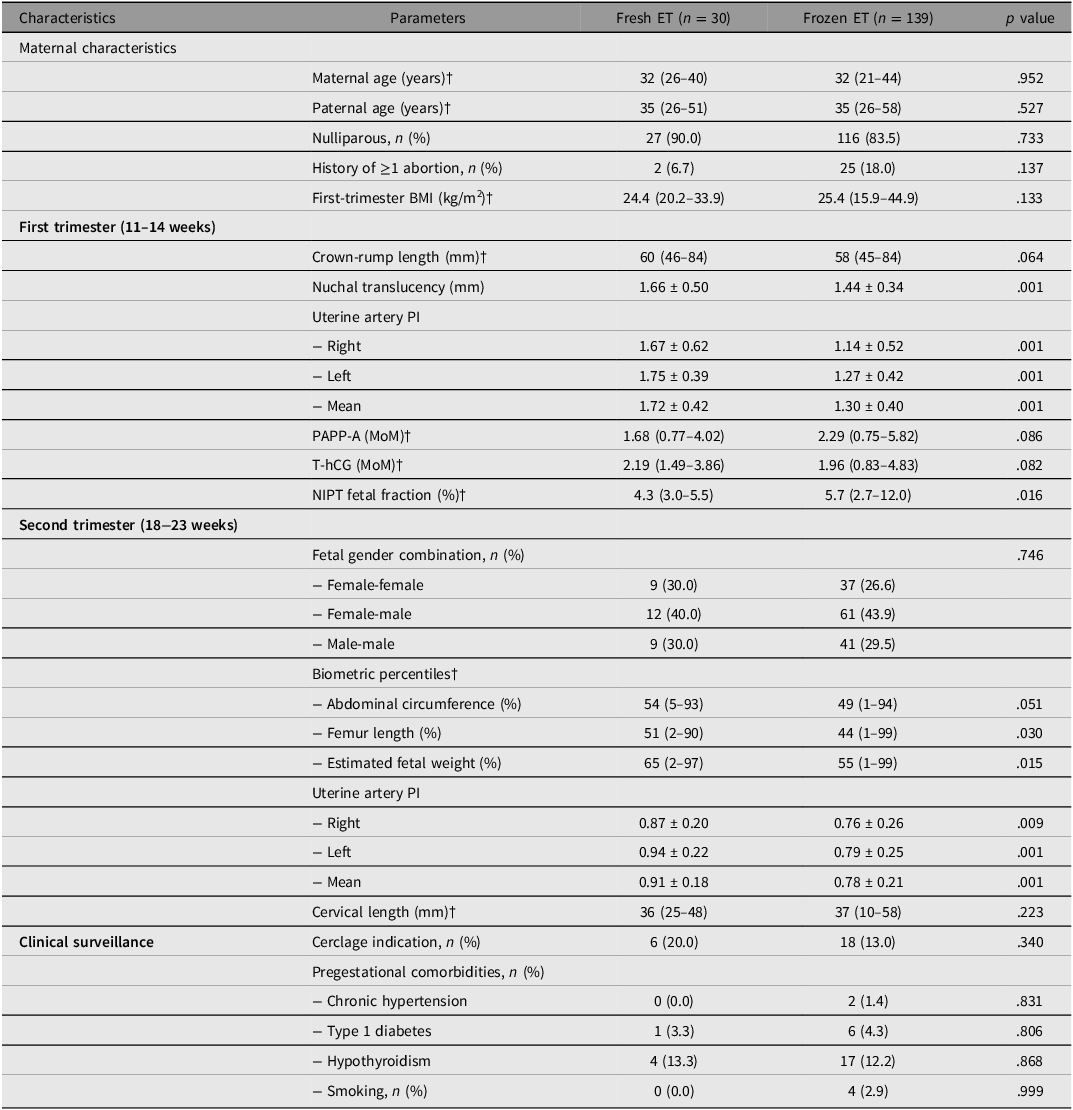
The baseline clinical and demographic characteristics of the two groups were comparable (Table 1). The median maternal age was not different between the groups: 32 years (range: 26−40) in the fresh ET group and 32 years (range: 21−44) in the frozen ET group (p = .952). The median paternal age was also similar: 35 years (range: 26–51) and 35 years (range: 26–58), respectively (p = .527). The frequency of nulliparous women was not significantly different between the groups (90.0% in the fresh ET group vs. 83.5% in the frozen ET group; p = .733). The body mass index (BMI) during the first-trimester screening was similar in both groups: 24.4 (range: 20.2–33.9) vs. 25.4 (range: 15.9–44.9); p = .133. During the first-trimester (11–14 weeks) sonographic and biochemical screening, the median crown-rump length (CRL) of the fetuses was similar: 60 mm (range: 46–84) vs. 58 mm (range: 45–84); p = 0.064. However, the mean nuchal translucency (NT) was significantly higher in the fresh ET group compared to the frozen ET group (1.66 ± 0.50 mm vs. 1.44 ± 0.34 mm; p = .001). The Doppler indices of the uterine artery (UtA) were also higher in the fresh ET group. The mean UtA-PI was significantly higher in the fresh ET group (1.72 ± 0.42 vs. 1.30 ± 0.40; p = .001). The biochemical markers of the first-trimester combined test (FTCT) were compared between the groups when available (fresh ET, n = 12; frozen ET, n = 79). Neither the median pregnancy-associated plasma protein A (PAPP-A) multiple of the median (MoM) (1.68 [range: 0.77–4.02] vs. 2.29 [range: 0.75–5.82]; p = .086) nor the median total human chorionic gonadotropin (T-hCG) MoM (2.19 [range: 1.49–3.86] vs. 1.96 [range: 0.83–4.83]; p = .082) were significantly different between the two groups. The cell-free DNA/non-invasive prenatal testing (NIPT) acceptance rate was not significantly different between the groups: 10 couples (33.3%) in the fresh ET group and 56 couples (41.2%) in the frozen ET group requested NIPT (p = .426). The median fetal fraction (FF) was significantly lower in the fresh ET group (4.3% [range: 3.0–5.5] vs. 5.7% [range: 2.7–12.0]; p = .016).
Main clinical characteristics of the study population according to embryo transfer groups

Table 1. Long description
A table comparing clinical characteristics of study populations by embryo transfer groups. The table has 30 rows and 5 columns. The columns are labeled Characteristics, Parameters, Fresh ET (n = 30), Frozen ET (n = 139), and p value. The rows are grouped into Maternal characteristics, First trimester (11–14 weeks), Second trimester (18–23 weeks), and Clinical surveillance. Row 1: Maternal age (years), 32 (26–40), 32 (21–44), 0.952. Row 2: Paternal age (years), 35 (26–51), 35 (26–58), 0.527. Row 3: Nulliparous, n (%), 27 (90.0), 116 (83.5), 0.733. Row 4: History of ≥1 abortion, n (%), 2 (6.7), 25 (18.0), 0.137. Row 5: First-trimester BMI (kg/m^2), 24.4 (20.2–33.9), 25.4 (15.9–44.9), 0.133. Row 6: Crown-rump length (mm), 60 (46–84), 58 (45–84), 0.064. Row 7: Nuchal translucency (mm), 1.66 ± 0.50, 1.44 ± 0.34, 0.001. Row 8: Uterine artery PI - Right, 1.67 ± 0.62, 1.14 ± 0.52, 0.001. Row 9: Uterine artery PI - Left, 1.75 ± 0.39, 1.27 ± 0.42, 0.001. Row 10: Uterine artery PI - Mean, 1.72 ± 0.42, 1.30 ± 0.40, 0.001. Row 11: PAPP-A (MoM), 1.68 (0.77–4.02), 2.29 (0.75–5.82), 0.086. Row 12: T-hCG (MoM), 2.19 (1.49–3.86), 1.96 (0.83–4.83), 0.082. Row 13: NIPT fetal fraction (%), 4.3 (3.0–5.5), 5.7 (2.7–12.0), 0.016. Row 14: Fetal gender combination - Female-female, n (%), 9 (30.0), 37 (26.6), 0.746. Row 15: Fetal gender combination - Female-male, n (%), 12 (40.0), 61 (43.9), 0.746. Row 16: Fetal gender combination - Male-male, n (%), 9 (30.0), 41 (29.5), 0.746. Row 17: Biometric percentiles - Abdominal circumference (%), 54 (5–93), 49 (1–94), 0.51. Row 18: Biometric percentiles - Femur length (%), 51 (2–90), 44 (1–99), 0.303. Row 19: Biometric percentiles - Estimated fetal weight (%), 65 (2–97), 55 (1–99), 0.015. Row 20: Uterine artery PI - Right, 0.87 ± 0.20, 0.76 ± 0.26, 0.009. Row 21: Uterine artery PI - Left, 0.94 ± 0.22, 0.79 ± 0.25, 0.001. Row 22: Uterine artery PI - Mean, 0.91 ± 0.18, 0.78 ± 0.21, 0.001. Row 23: Cervical length (mm), 36 (25–48), 37 (10–58), 0.223. Row 24: Cerclage indication, n (%), 6 (20.0), 18 (13.0), 0.340. Row 25: Pregestational comorbidities - Chronic hypertension, n (%), 0 (0.0), 2 (1.4), 0.831. Row 26: Pregestational comorbidities - Type 1 diabetes, n (%), 1 (3.3), 6 (4.3), 0.806. Row 27: Pregestational comorbidities - Hypothyroidism, n (%), 4 (13.3), 17 (12.2), 0.868. Row 28: Pregestational comorbidities - Smoking, n (%), 0 (0.0), 4 (2.9), 0.999.
Note: Data presented as mean ± standard deviation. ET, embryo transfer; BMI, body mass ındex; PI: pulsatility ındex; PAPP-A,: pregnancy-associated plasma protein-A; MoM, multiple of median; T-hCG, total-human chorionic gonadotropin; NIPT: nonınvasive prenatal testing. †Data presented as median (interquartile range).
Second-Trimester Characteristics
The distribution of fetal gender combinations was similar in both groups (p = .746), with the highest frequency being female-male pairs: 12 (40.0%) in the fresh ET group and 61 (43.9%) in the frozen ET group. Regarding second-trimester (18–23 weeks) biometric measurements, the median abdominal circumference (AC) percentile was not significantly different between the groups: 54% (range: 5–93) in the fresh ET group and 49% (range: 1–94) in the frozen ET group (p = .051). The median femur length (FL) percentile was significantly higher in the fresh ET group (51% [range: 2–90] vs. 44% [range: 1–99]; p = .030). The median estimated fetal weight (EFW) percentile was also significantly higher in the fresh ET group (65% [range: 2–97] vs. 55% [range: 1–99]; p = .015). The second-trimester re-evaluation of the UtA-PI was compared between the groups. The mean right UtA-PI was significantly higher in the fresh ET group (0.87 ± 0.20 vs. 0.76 ± 0.26; p = .009). The mean left UtA-PI was also significantly higher in the fresh ET group (0.94 ± 0.22 vs. 0.79 ± 0.25; p = .001). Consequently, the mean UtA-PI was significantly higher in the fresh ET group (0.91 ± 0.18 vs. 0.78 ± 0.21; p = .001). The median cervical length was not significantly different between the groups: 36 mm (range: 24–48) in the fresh ET group and 37 mm (range: 10–58) in the frozen ET group (p = .223).
Obstetric and Neonatal Outcomes
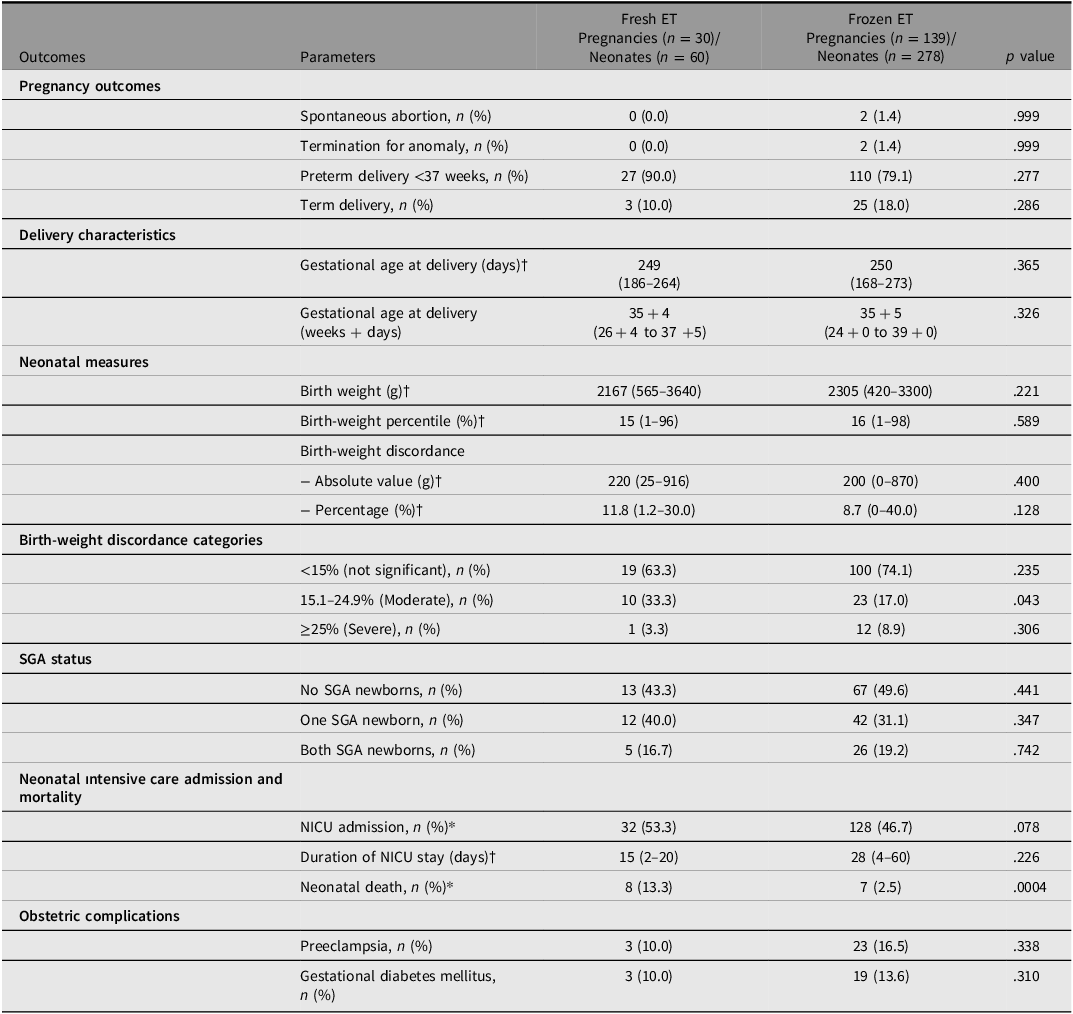
Obstetric and neonatal outcomes of the two embryo transfer policies were also compared and are presented in Table 2. In the frozen ET group, 2 (1.4%) pregnancies resulted in spontaneous abortion, and 2 (1.4%) required feticide for an anomalous fetus; these cases were excluded from the fetal growth pattern analyses. The preterm delivery ratio was not significantly different between the groups: 27 (90.0%) in the fresh ET group and 110 (79.2%) in the frozen ET group delivered before 37 weeks (p = .277). The median gestational age at delivery was similar: 249 days (range: 186–264) [35 weeks + 4 days] in the fresh ET group and 250 days (range: 168–269) [35 weeks + 5 days] in the frozen ET group (p = .365). The median neonatal birth weight was 2167 grams (range: 565–3640) in the fresh ET group and 2305 grams (range: 420–3300) in the frozen ET group (p = .189). The median neonatal birth weight percentile was also similar between the groups (14% [range: 1–96] vs. 17% [range: 1–98] respectively; p = .276). The median neonatal birth weight discordance was similar between the groups, both in absolute terms (220 grams [range: 25–916] vs. 200 grams [range: 0–870]; p = .400) and as a percentage (11.8% [range: 1.2–30] vs. 8.8% [range: 0–40]; p = .128). The distributions of discordance categories were compared. The frequency of twins with <15% birth-weight discordance was similar (63.3% in the fresh ET group vs. 74.1% in the frozen ET group; p = .235). However, the frequency of moderate discordance (15.1–24.9%) was higher in the fresh ET group (33.3% vs. 17.0%; p = .043). The frequency of severe discordance (≥25%) was similar between the groups (3.3% vs. 8.9%; p = .360). The frequency of newborns with appropriate for gestational age (AGA) weight was similar between the groups (43.3% in the fresh ET group vs. 49.6% in the frozen ET group; p = .441). In 40.0% of fresh ET pregnancies and 31.1% of frozen ET pregnancies, one newborn was small for gestational age (SGA). The frequency of pregnancies resulting in two SGA neonates was also similar (16.7% vs. 19.2%, respectively; p = .441). The number of newborns requiring neonatal intensive care unit (NICU) admission was not significantly different between the groups (53.3% in the fresh ET group vs. 46.7% in the frozen ET group; p = .05). The median duration of NICU stay was also not significantly different (15 days [range: 2–20] vs. 28 days [range: 4–60]; p = .226). However, the neonatal death rate was significantly higher in the fresh ET group (13.0% vs. 2.6%; p = .0004).
Obstetric and neonatal outcomes according to embryo transfer groups

Table 2. Long description
A table comparing obstetric and neonatal outcomes between fresh and frozen embryo transfer groups. The table has 21 rows and 6 columns. The columns are labeled Outcomes, Parameters, Fresh ET Pregnancies (n = 30)/Neonates (n = 60), Frozen ET Pregnancies (n = 139)/Neonates (n = 278), and p value. The rows are grouped into categories: Pregnancy outcomes, Delivery characteristics, Neonatal measures, Birth-weight discordance categories, SGA status, Neonatal intensive care admission and mortality, and Obstetric complications. Row 1: Spontaneous abortion, n (%), 0 (0.0), 2 (1.4), 0.999. Row 2: Termination for anomaly, n (%), 0 (0.0), 2 (1.4), 0.999. Row 3: Preterm delivery <37 weeks, n (%), 27 (90.0), 110 (79.1), 0.277. Row 4: Term delivery, n (%), 3 (10.0), 25 (18.0), 0.286. Row 5: Gestational age at delivery (days), 249 (186–264), 250 (168–273), 0.365. Row 6: Gestational age at delivery (weeks + days), 35 + 4 (26 + 4 to 37 + 5), 35 + 5 (24 + 0 to 39 + 0), 0.326. Row 7: Birth weight (g), 2167 (565–3640), 2305 (420–3300), 0.221. Row 8: Birth-weight percentile (%), 15 (1–96), 16 (1–98), 0.589. Row 9: Birth-weight discordance, Absolute value (g), 220 (25–916), 200 (0–870), 0.400. Row 10: Birth-weight discordance, Percentage (%), 11.8 (1.2–30.0), 8.7 (0–40.0), 0.128. Row 11: <15% (not significant), n (%), 19 (63.3), 100 (74.1), 0.235. Row 12: 15.1–24.9% (Moderate), n (%), 10 (33.3), 23 (17.0), 0.043. Row 13: ≥25% (Severe), n (%), 1 (3.3), 12 (8.9), 0.306. Row 14: No SGA newborns, n (%), 13 (43.3), 67 (49.6), 0.441. Row 15: One SGA newborn, n (%), 12 (40.0), 42 (31.1), 0.347. Row 16: Both SGA newborns, n (%), 5 (16.7), 26 (19.2), 0.742. Row 17: NICU admission, n (%), 32 (53.3), 128 (46.7), 0.078. Row 18: Duration of NICU stay (days), 15 (2–20), 28 (4–60), 0.226. Row 19: Neonatal death, n (%), 8 (13.3), 7 (2.5), 0.0004. Row 20: Preeclampsia, n (%), 3 (10.0), 23 (16.5), 0.338. Row 21: Gestational diabetes mellitus, n (%), 3 (10.0), 19 (13.6), 0.310.
Note: ET, Embryo transfer; SGA, small for gestational age; NICU, neonatal ıntensive care unit. †Data presented as median (interquartile range). *Denominator for percentage calculations: Fresh ET neonates (n = 60), Frozen ET neonates (n = 278)
Risk Factor Analysis for SGA and Discordance
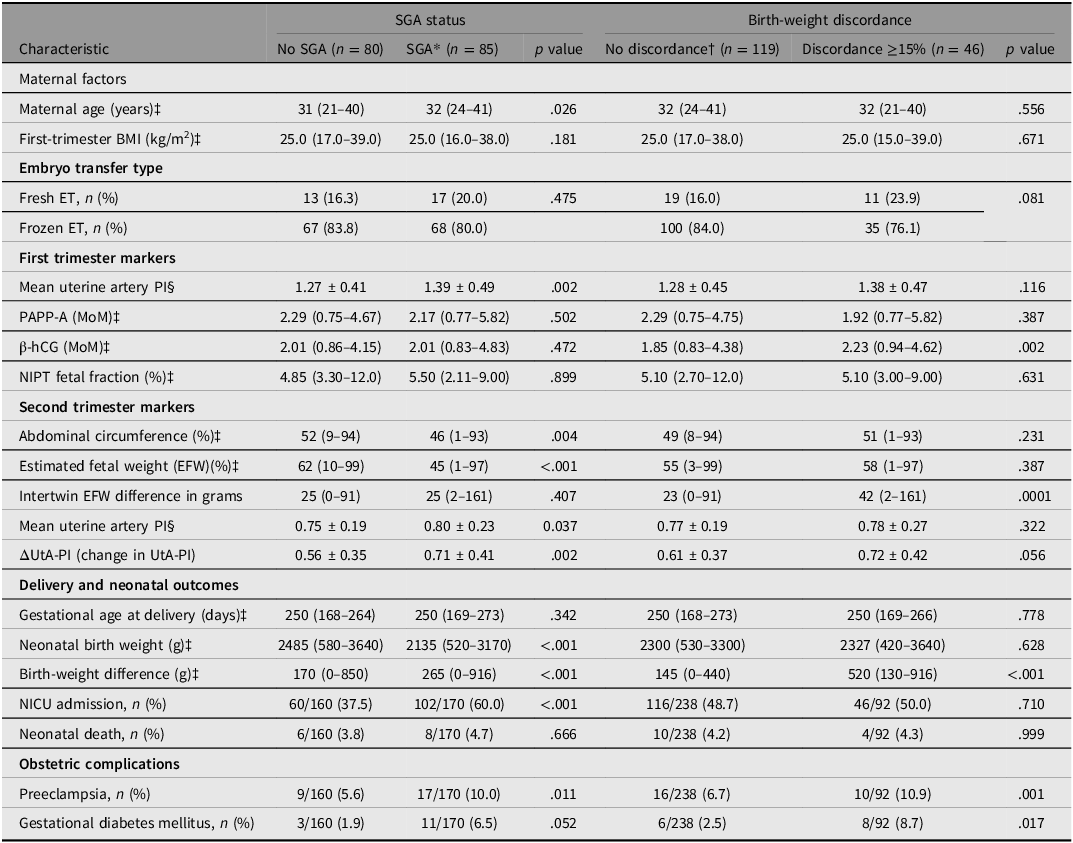
We compared subgroups of twin pregnancies to determine factors contributing to SGA and/or discordance development (Table 3). The median maternal age was higher in the SGA group (32 years [range: 24–41] vs. 31 years [range: 21–40]; p = .026). The mean first-trimester UtA-PI was significantly higher in the SGA group (1.39 ± 0.49 vs. 1.27 ± 0.41; p = .002). The second-trimester median AC percentile (46% [range: 1–93] vs. 52% [range: 9–94]; p = .004) and EFW percentile (45% [range: 1–97] vs. 62% [range: 10–99]; p = .0001) were significantly lower in the SGA group. The mean second-trimester UtA-PI was also significantly higher in the SGA group (0.80 ± 0.23 vs. 0.75 ± 0.19; p = .037).
Characteristics of twin pregnancies according to presence of small-for-gestational-age neonate or significant birth weight discordance

Table 3. Long description
The table compares characteristics of twin pregnancies based on the presence of small-for-gestational-age (SGA) neonate or significant birth weight discordance. It has 25 rows and 10 columns. The columns are labeled as follows: Characteristic, SGA status (No SGA (n = 80), SGA* (n = 85), p value), and Birth-weight discordance (No discordance† (n = 119), Discordance ≥15% (n = 46), p value). The rows are grouped into Maternal factors, Embryo transfer type, First trimester markers, Second trimester markers, Delivery and neonatal outcomes, and Obstetric complications. Each row provides specific data points for each subgroup. For example, the Maternal age (years) row shows median values and ranges for each subgroup. The table includes various markers and outcomes such as First-trimester BMI, Mean uterine artery PI, PAPP-A, β-hCG, NIPT fetal fraction, Abdominal circumference, Estimated fetal weight, Intertwin EFW difference, Mean uterine artery PI, ΔUtA-PI, Gestational age at delivery, Neonatal birth weight, Birth-weight difference, NICU admission, Neonatal death, Preeclampsia, and Gestational diabetes mellitus. Each cell contains specific values or percentages relevant to the characteristic and subgroup.
Note: SGA, small for gestational age (at least one neonate <10th percentile); ET, embryo transfer; UtA-PI, uterine artery pulsatility ındex; PAPP-A, pregnancy-associated plasma protein-A; MoM: multiple of median; T-hCG, beta-human chorionic gonadotropin; NIPT, nonınvasive prenatal testing; NICU, neonatal ıntensive care unit.
†Discordance: Birth-weight difference ≥15%; ‡Data presented as median (interquartile range). §Data presented as mean ± standard deviation.
The difference in second-trimester EFW was significant in the context of discordance (42 [2–161] vs. 23 [0–91] grams, p = .001) but not for SGA (25 [0–91] vs. 25 [2–161] grams, p = .407) (Table 3).
The UtA-PI improvement was significantly higher in the SGA group compared to the non-SGA group (0.71 ± 0.41 vs. 0.56 ± 0.35 respectively; p = .002) (Table 3). In contrast, the difference in UtA-PI improvement between the groups with and without discordance did not reach statistical significance (0.72 ± 0.42 vs. 0.61 ± 0.37 respectively; p = .056) (Table 3).
The median neonatal birth weight was significantly lower in the SGA group (2135 grams [range: 520–3170] vs. 2485 grams [range: 580–3640]; p = .0001), and the median birth weight difference was significantly higher (265 grams [range: 0–916] vs. 170 grams [range: 0–850]; p = .0001). NICU admission rates were significantly higher in the SGA group (60.0% vs. 37.5%; p = .0001). Neonatal death rates were not significantly different (3.7% in the non-SGA group vs. 4.7% in the SGA group; p = .666). Preeclampsia was significantly more frequent among pregnancies with SGA (10.0% vs. 5.6%, p = .011) and among those with intertwin birth-weight discordance ≥15% (10.9% vs. 6.7%, p = .001).
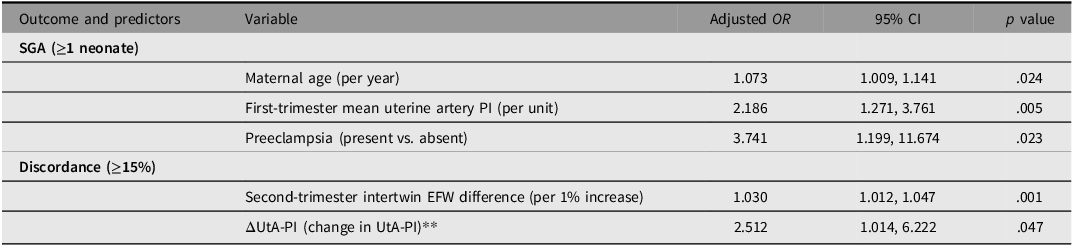
Logistic regression analysis identified three significant predictors of SGA in IVF twins (Table 4). Maternal age remained a significant predictor, with each additional year associated with 7.3% higher odds of SGA (OR 1.073, 95% CI [1.009, 1.141], p = .024). Mean UtA-PI values demonstrated a strong association, indicating 2.2-fold higher odds of SGA per unit increase (OR 2.186, 95% CI [1.271, 3.761], p = .002). Most notably, the presence of preeclampsia emerged as a powerful risk factor (OR 3.741, 95% CI [1.199, 11.674], p = .023). The model correctly classified 60.0% of the cases.
Multivariable logistic regression analysis of predictors for growth disorders in IVF twin pregnancies

Table 4. Long description
A table titled ‘Multivariable logistic regression analysis of predictors for growth disorders in IVF twin pregnancies’ with four rows and three columns. The columns are labeled ‘Outcome and predictors’, ‘Variable’, ‘Adjusted OR’, ‘95% CI’, and ‘p value’. The table is divided into two sections: SGA (≥1 neonate) and Discordance (≥15 percent). Under SGA (≥1 neonate), the variables listed are ‘Maternal age (per year)’, ‘First-trimester mean uterine artery PI (per unit)’, and ‘Preeclampsia (present vs. absent)’. The corresponding Adjusted OR values are 1.073, 2.186, and 3.741, with 95% CI values of 1.009 to 1.141, 1.271 to 3.761, and 1.199 to 11.674, and p values of .024, .005, and .023, respectively. Under Discordance (≥15 percent), the variables listed are ‘Second-trimester intertwin EFW difference (per 1 percent increase)’ and ‘ΔUtA-PI (change in UtA-PI)’. The corresponding Adjusted OR values are 1.030 and 2.512, with 95% CI values of 1.012 to 1.047 and 1.014 to 6.222, and p values of .001 and .047, respectively.
Note: OR, odds ratio; CI, confidence interval; SGA, small for gestational age; PI, pulsatility index; UtA-PI, uterine artery pulsatility index; EFW, estimated fetal weight.
**ΔUtA-PI was defined as a reduction in the mean uterine artery PI value from the first to the second trimester. All analyses were adjusted for other variables in the model.
Only two variables were significant independent predictors of >15% discordance: the EFW difference in the second trimester and the degree of reduction in UtA-PI from the first to the second trimester (Table 4). For each 1% increase in the estimated weight difference between fetuses, the odds of significant discordance increased by 3% (OR 1.03, 95% CI [1.01, 1.05]; p = .001). UtA-PI improvement was also a significant predictor (OR 2.51, 95% CI [1.01, 6.22]; p = .047). This logistic regression model correctly classified 80.0% of the cases.
Discussion
This single-center, longitudinal study aimed to identify predictors of SGA and growth discordance in IVF-conceived DCDA twin pregnancies.
To contextualize our findings, the reported incidences of SGA and discordance in the literature vary, particularly when comparing fresh and frozen embryo transfer (ET) cycles. Our observed rate of SGA (19.2%) aligns with the pooled rate of 18.4% reported in a meta-analysis by Marleen et al. (Reference Marleen, Kodithuwakku, Nandasena, Mohideen, Allotey, Fernández-García, Gaetano-Gil, Ruiz-Calvo, Aquilina, Khalil and Thangaratinam2024), which found no significant difference in perinatal outcomes between fresh and frozen ET cycles. This general lack of a consistent differential effect is further illustrated by conflicting results across studies: while Shavit et al. (Reference Shavit, Miller, Schreiber, Asali, Ravid, Harlev, Levitas, Har-Vardi and Berkovitz2019) reported a lower incidence of SGA with frozen ET compared to fresh (9.2% vs. 15.9%), they found no significant difference in the rate of discordance ≥20%. Conversely, Shlush et al. (Reference Shlush, Sarhan, Hammudi, Aiob, Livoff, Mikhail, Lowenstein and Sgayer2025) found no significant differences in the rates of either SGA (5.8% vs. 3.3%) or discordance (15.8% vs. 14.0%) between the two ET methods. Given this heterogeneity in the literature and the absence of a clear, consistent superiority of one ET protocol over the other regarding growth outcomes, we justified the methodological decision to analyze our cohort collectively. This approach enhances the statistical power for identifying overarching predictors of growth disorders in IVF-conceived DCDA twins, independent of the ET type.
Logistic regression identified first-trimester mean uterine artery PI (UtA-PI) as a significant independent predictor for the development of SGA in at least one twin, alongside maternal age and preeclampsia (Table 4). Specifically, each unit increase in UtA-PI increased the odds of SGA by a factor of 2.2 (OR 2.186, 95% CI [1.271, 3.761], p = .002). This underscores the pivotal role of early uteroplacental hemodynamics. While UtA-PI is generally lower in twin pregnancies — likely due to more extensive remodeling from a greater trophoblastic mass — an elevated value signifies a failure of this adaptation (Rizzo et al., Reference Rizzo, Pietrolucci, Aiello, Capponi and Arduini2014; Tian & Yang, Reference Tian and Yang2022). This suboptimal remodeling, leading to functional narrowing in the placental circulation, can create a competitive in-utero environment, ultimately manifesting as SGA or growth discordance.
The UtA-PI was significantly higher in the fresh ET group than in the frozen ET group during both the first and second trimesters (Table 2). This finding suggests that uterine artery remodeling and the consequent reduction in vascular resistance are suboptimal in fresh ET pregnancies. This phenomenon likely stems from the adverse impact of COH on endometrial receptivity and early placentation (Geng et al., Reference Geng, Lu, Li, Chen, Wei and Liu2023, Kalinderis et al., Reference Kalinderis, Kalinderi, Srivastava and Homburg2021). The frozen ET strategy avoids this immediate post-stimulation environment, allowing for more physiological uterine artery remodeling and thus explaining the lower UtA-PI in this group.
In our study, the frequency of preeclampsia was significantly higher in the discordance group (10.9% in the ≥15% discordance group vs. 6.7% in the <15% group; p = .001; Table 3), and preeclampsia was an independent predictor of SGA development in at least one of the neonates (Table 4).
The literature presents a complex, potentially reciprocal relationship between preeclampsia and growth discordance. Some studies establish preeclampsia as an independent predictor of discordance (Chen et al., Reference Chen, Cao, Qiao, Liu and Ying2025), whereas others frame discordance itself as a risk factor for preeclampsia (Čebron et al., Reference Čebron, Rupar, Verdenik and Premru-Sršen2025). Rather than a simple causal sequence, this relationship represents interconnected pathological pathways. Placental ischemia associated with fetal growth restriction and discordance may provoke a systemic inflammatory response leading to preeclampsia. Conversely, the maternal syndrome of preeclampsia can critically impair placental function, pushing a vulnerable twin pair into a state of significant growth restriction and discordance.
The predictors for discordance differed from those for SGA. While this may appear to be a contradiction at first glance, it is consistent with the notion that SGA and discordance represent different faces of the same adaptive process.
Regarding the development of discordance, the significant predictors were the inter-twin estimated fetal weight (EFW) difference in the second trimester and an improvement in the UtA-PI from the first to the second trimester (Table 4).
Our analysis revealed a significantly larger second-trimester EFW difference in pregnancies that subsequently developed substantial (≥15%) birth-weight discordance compared to those that did not (42 [2–161] grams vs. 23 [0–91] grams, p < .001; Table 3). This finding was reinforced by logistic regression analysis, which established the second-trimester EFW difference, along with improvement in uterine artery PI, as one of two significant independent predictors for this outcome (Table 4). This aligns with the recent work of Vayenas et al., who confirmed that while EFW discordance is the best available antenatal tool, its predictive accuracy for major birthweight discordance remains limited; sensitivity 49.1%, PPV 57.0% for >20% (Vayenas et al., Reference Vayenas, Rahimi and Melamed2025). We could therefore posit that while second-trimester biometrics alone lack the precision to perfectly forecast neonatal weight, they can identify an early trajectory of significant growth discordance that often persists or worsens.
An important finding of this study is the potential role of UtA transformation from the first to second trimester in the development of SGA and discordance (Tables 3 and 4). While impaired UtA remodeling is a well-established paradigm in preeclampsia and FGR, with second-trimester UtA-PI offering superior predictive value (Vayenas et al., Reference Vayenas, Rahimi and Melamed2025), the quantitative impact of its improvement — whether spontaneous or medication-induced — on fetal growth had not been previously investigated. Our findings introduce the concept of ‘UtA-PI change’ suggesting its role in SGA and discordance. The UtA-PI improvement, defined as its decrease from the first to the second trimester, was significantly higher in the SGA group compared to the non-SGA group (0.71 ± 0.41 vs. 0.56 ± 0.35, respectively; p = .002) (Table 3) and the change in the UtA-PI was also one of the two significant predictor of discordance ≥15% (OR 2.51, 95% CI [1.01, 6.22]; p =.047) (Table 4). Both the SGA and the discordance groups exhibited a significantly greater reduction in the UtA-PI between the first and second trimesters compared to the non-SGA and concordant groups respectively.
The fundamental two-stage model of UtA remodeling, leading to low-resistance circulation and prevention of placental ischemia, is well documented (Redman & Sargent, Reference Redman and Sargent2010; Springer et al., Reference Springer, Anzböck, Worda, Karner and Worda2025) and pregnancies experiencing an optimal ‘second wave’ of trophoblast invasion may achieve advanced placental development and perfusion (Lyall,LReference Lyall2005). The association we observed between the improvement in uterine artery doppler indices and increased discordance in DCDA-IVF twins may be linked to this mechanism. We hypothesize that an improvement in uterine artery impedence may enable a fetus, initially programmed for slower growth due to high first-trimester resistance, to catch up to an average growth trajectory.
In DCDA twin pregnancies, inadequate uteroplacental perfusion, due to impaired uterine artery remodeling, may trigger a recalibration of fetal growth programming (Costa, Reference Costa2016). This adaptive response, mediated by paracrine and autocrine signals, can manifest as one or both twins being SGA. Improvement in UtA-PI by the second trimester — through mechanisms like secondary trophoblast invasion (Lyall Reference Lyall2005) or medical interventions (e.g., low-dose aspirin; Roberge et al., Reference Roberge, Nicolaides, Demers, Hyett, Chaillet and Bujold2017) — can facilitate a recovery in fetal growth trajectories.
The rationale for our ΔUtA-PI variable — which quantifies the improvement in uterine artery impedance — stems from the pathophysiological concept that the transformation of the uterine arteries between trimesters is a stronger predictor of complications than isolated assessments. This concept, initially termed ‘two-tailed screening’ by Springer et al. (Reference Springer, Anzböck, Worda, Karner and Worda2025), posits that the dynamic change itself is the most critical indicator. We posit that a limited need for this transformation reflects either adequate remodeling from the outset, predicting concordant and average growth in both fetuses, or a shared adaptation to a restricted environment, resulting in minimal inter-fetal discordance.
The UtA-PI, acting as a signal of the need to modulate fetal growth, may improve until the second trimester through mechanisms such as secondary trophoblast invasion (Lyall, Reference Lyall2005) or medical interventions (Roberge et al., Reference Roberge, Nicolaides, Demers, Hyett, Chaillet and Bujold2017). This improvement can lead to a recovery in the growth trajectory of one or both fetuses. Consequently, the detection of a significant discrepancy in the estimated fetal weight (EFW) between the twins by the second trimester can be interpreted as a manifestation of this reprogrammed fetal growth. A significant correction in the uterine artery hemodynamics may signal the underlying pathophysiology of emerging and establishing discordance.
To our knowledge, no prior study has directly compared the predictive performance of prenatal ultrasound for significant intertwin birth-weight discordance versus SGA in the same cohort. However, a recent large-scale retrospective study by Rosen et al. (Reference Rosen, Gold-Zamir, Lopian, Weissbach, Kassif and Weisz2023) demonstrated that most EFW measurements in twin pregnancies are overestimated, particularly for the nonpresenting co-twin, which may inherently limit the accuracy of SGA prediction (Rosen et al., Reference Rosen, Gold-Zamir, Lopian, Weissbach, Kassif and Weisz2023). This could explain, at least in part, why our model achieved a higher correct classification rate for discordance than for SGA, as discordance reflects a relative difference between twins rather than an absolute EFW threshold.
These findings lead us to a crucial conclusion for clinical practice: In the era of NIPT, where the importance of the 11–14 week scan might be underestimated, UtA Doppler assessment remains a key tool for predicting normal fetal growth trajectory in DCDA twin pregnancies. In cases with high first-trimester UtA resistance, prophylactic treatments (such as low-dose aspirin) and supplementation may reduce the likelihood of both SGA and discordance. Furthermore, meticulous biometric assessment in the second trimester allows for the identification of cases at risk for discordance and facilitates targeted planning, including follow-up biometric scans and Doppler evaluation of the three arterial vessels around 30 weeks of gestation (Prasad et al., Reference Prasad, Ayhan, Mohammed, Kalafat and Khalil2025).
Limitations
A notable limitation of this study stems from the inherent characteristics of IVF pregnancies. Even before the initiation of placentation, these pregnancies involve exposure to an intensive medication protocol, particularly estrogen and progesterone preparations. Furthermore, the methods used for endometrial preparation (e.g., hormone therapy, natural and modified-natural preparation regimens) have the potential to influence almost all pregnancy outcomes, including fetal growth patterns.
Nevertheless, it is probable that DCDA twin pregnancies conceived via IVF share more similarities than differences with spontaneously conceived DCDA twins. Therefore, the inferences we have drawn regarding normal and abnormal growth patterns are likely not exclusive to IVF pregnancies. The common underlying mechanism of uterine artery remodeling probably allows our findings to be projected onto all DCDA twin pregnancies.
Finally, since all DCDA twin pregnancies in our cohort received aspirin prophylaxis for preeclampsia prevention, our Doppler findings reflect aspirin-modified hemodynamics rather than the natural course. This should be considered when generalizing our results.
Conclusion
SGA and discordance may not represent two distinct complications but rather appear to be interconnected manifestations of a shared, multifactorial pathological pathway. The transformation of uterine artery hemodynamics from the first to the second trimester is proposed as one potential mechanism underlying the continuum observed between SGA and growth discordance.
Although the status of the uterine artery appears to be a primary stimulus in the development of SGA in twin fetuses, it is highly probable that additional modifying factors (alterers) are involved (e.g., angiogenic and antiangiogenic factors). Future prospective studies are needed to incorporate these potential variables into a more comprehensive model of the condition.
Data availability statement
The data supporting this study’s findings are available from the corresponding author upon reasonable request. ScholarOne upload is not viewed favorably as data sharing jeopardizes ethical standards or legal requirements. However, it will be shared with the journal editor in the case of necessity.
Author contributions
All authors contributed to the study conception and design, read, and approved the final manuscript.,Semir Köse: Writing — original draft, Project administration, Conceptualization, Data curation, Methodology, Formal analysis. Çağlasu Sancaktar: Writing — review & editing. Alper Biler: Data curation, Writing — review & editing. Umit Inceboz: Data curation, Investigation, Writing – review and editing.
Funding
This research received no specific grant from any funding agency in the public, commercial, or not-for-profit sectors.
Conflicts of interest
The authors declare no conflicts of interest.
Ethics statement
This study was approved by the Non-Interventional Research Ethics Committee of the T.R. Ministry of Health Tepecik Training and Research Hospital (Protocol No: 2024/11-03, Date: 04/12/2024).
Consent to participate
Not applicable. This study was based on retrospective analysis of anonymized data, and informed consent was not required as per the institutional ethics committee approval (approval no: [2024/11-03]).
Consent to publish
Not applicable. This manuscript does not contain any individual person’s data in any form (including individual details, images, or videos).