1. Introduction
While spoken French has been an important focus of variationist sociolinguistic inquiries, there is a pressing need to explore linguistic variables in other contexts, particularly in relation to the supposed innovative effect of new media technology on language. As we will see, these means of expression provide new sources of data to explore the vernacular.
French text messages offer a great opportunity to study variation. Because written French is so different from spoken French, this language is an ideal candidate to evaluate Crystal’s (Reference Crystal2011) claim that text messages are truly a hybrid form between writing and speech. Unlike written Standard French, which is highly codified and stable, text messages constantly change. Their distinctive featuresFootnote 1 include abbreviations, truncations, dialectal traits and numerous features associated with speech, as shown by the following example from the Belgian corpus.
(1)
(BG, user 69)

Example (1) shows many instances of abbreviations (c for c’est, mnt for maintenant, pr for pour, v for vais, + for plus, jtexplikrè for je t’expliquerai, 2m1 for demain; one case of truncation (reco for reconnecter); the use of non-stardard orthography (vwala for voilà, fè for fait, conecT for connecter, kil for qu’il, é for et, sora for saura. Other features include the omission of the first person pronoun je (obligatory in both spoken and written French), and phonetic characters (letters as in conecT and numbers as in 2m1). In addition, example (1) contains many features of spoken French. Some of these features are phonetic, reflecting the neutralization of e/ε, ɘ/ø and œ̃/ɛ̃ in European French, such as the use of v [ve] for vais [vε], expliquerè [εksplikrε] for expliquerai [εksplikre] and demain [dəmɛ̃] written as 2m1 [dømœ̃]. Others are lexical, such as the use of savoir instead of pouvoir, a case of variation well attested in Belgium. The fact that text messages include dialectal traits is an important feature indicating that text messages reflect speech, rather than written Standard French.
In this article, we complement previous research on computer-mediated communication by providing a variationist analysis of Future Temporal Reference (FTR) in two corpora of text messages (SMS) from Belgium (Fairon, Klein and Paumier, Reference Fairon, Klein and Paumier2006) and Québec (Langlais, Drouin, Paulus, Rompré Brodeur and Cottin, Reference Langlais, Drouin, Paulus, Rompré Brodeur and Cottin2012)Footnote 2, Footnote 3.
Over the last 50 years, numerous analyses of large oral corpora have documented both social and regional variation in the use of the FTR variable. The three main variants involved are the Synthetic Future, the Analytic Future and the Futurate Present.Footnote 4 Example (1) illustrates the use of the Analytic (v me conecT) and Synthetic (expliquerè/saura) Futures; example (2) from the Québec corpus illustrates the use of the Futurate Present.
(2)
(QC, user 112314)

There are a number of reasons to study FTR in French text messages. First, there is an important difference between spoken French and written French (Standard): written French largely favours the use of Synthetic Future (Lesage, Reference Lesage1991; Lesage and Gagnon, Reference Lesage, Gagnon, Crochetière, Boulanger and Ouellon1992; Waugh and Bahloul, Reference Waugh and Bahloul1996; Wales Reference Wales2002), while colloquial spoken French generally favours the use of Analytic Future as demonstrated in numerous variationist analyses starting with Emirkanian and Sankoff (Reference Emirkanian, Sankoff, Lemieux and Cedergren1985). This quantitative difference is useful to establish whether text messages pattern with spoken or written French, and thus assess the alleged hybridity of text messages. Second, the three variants are not stigmatized in spoken French. Consequently, texters are not likely to be socially aware of their choice of variants, which increases the likelihood that text messages truly reflect their unmonitored use of the three FTR variants. Third, because mobile phones are used for planning events, all three variants are frequent in text messages, including the Futurate Present, which has often been excluded from studies based on its rarity in semi-directed interviews. The frequent use of the Futurate Present in text messages allows us to describe the linguistic factors governing its distribution, and assess its role in the variation. Finally, most studies of FTR in Canadian French have been anchored in the notion of speech community and have provided information about the use of FTR in one community at a time (with the exception of Comeau, Reference Comeau2016). Our comparative study of text messages from Belgium and Québec departs from this tradition. The comparative sociolinguistic methodology used in the present study provides a more comprehensive understanding of the variable, and takes dialectal variation into account.
By comparing text messages in two varieties of French, this article makes several contributions to the literature. First, we contribute to the debate on the nature of computer-mediated communication by providing empirical evidence that text messages pattern with speech. Our results demonstrate how, as a hybrid form of communication, text messages share many features with oral/conversational data, while to some extent being influenced by written French. Second, while many previous studies have excluded the Futurate Present from the analysis, our study reintegrates this variant and shows its role in the variation. We show that, while the use of the Futurate Present is not subject to dialectal variation, the two dialects show differences in their choice of the Synthetic Future vs the Analytic Future. Such differences are illustrated not only in terms of the frequency of the variants but also in terms of the linguistic constraints on variation. Finally, our study highlights the importance of widening the types of corpora, by contrasting the conversational nature of text messages with semi-directed interviews.
The discussion is organized as follows. In the next section of the article, we offer a brief overview of FTR in French, with particular attention to varieties and variants studied, types of corpora, and factors favouring the use of the variants. Section 3 addresses the challenges associated with the description of the variable context. Section 4 is devoted to the methodology (corpora, exclusions, coding procedures and statistical analyses). We report the results of our analysis in section 5. Finally, section 6 discusses the interpretation of our results: we first explore the relationship between variants, morphologically marked (the Analytic and Synthetic Futures) or not (the Futurate Present), and conclude with a discussion of the conversational nature of text corpora.
2. Future Time Reference (FTR) in French
2.1 Overview of varieties and variants studied
The use of FTR has generated a lot of attention in variationist sociolinguistics and has been widely researched across many varieties of spoken French. Since Deshaies and Laforge (Reference Deshaies and Laforge1981), the variable has been studied extensively in a large number of dialects of Canadian French: Acadian French (Chevalier, Reference Chevalier, Dubois and Boudreau1996; King and Nadasdi, Reference King and Nadasdi2003; Comeau, Reference Comeau2011, Reference Comeau2015), Québec French (Deshaies and Laforge, Reference Deshaies and Laforge1981; Emirkanian and D. Sankoff, Reference Emirkanian, Sankoff, Lemieux and Cedergren1985; Zimmer, Reference Zimmer1994; Blondeau, Reference Blondeau2006; Wagner and G. Sankoff, Reference Wagner and Sankoff2011; G. Sankoff, Evans Wagner and Jensen, Reference Sankoff, Evans Wagner and Jensen2012), Ontario French (Grimm, Reference Grimm2010, Reference Grimm2015; Grimm and Nadasdi, Reference Grimm and Nadasdi2011) and other varieties of Laurentian FrenchFootnote 5 (Stelling, Reference Stelling2008). In comparison, European varieties of spoken French have been under-represented (Wales, Reference Wales1983; Jeanjean, Reference Jeanjean, Blanche-Benveniste, Churvel and Gross1988; Hansen and Strudsolm, Reference Hansen, Strudsolm, Andersen, Birkelund and Hansen2006; Fleury and Branca-Rosoff, Reference Fleury and Branca-Rosoff2010; Lindschouw, Reference Lindschouw2011; Edmonds, Gudmestad and Donaldson, Reference Edmonds, Gudmestad and Donaldson2017; Abouda and Skrovec, Reference Abouda and Skrovec2015; Villeneuve and Comeau, Reference Villeneuve and Comeau2016; Gudmestad, Edmonds, Donaldson and Carmichael, Reference Gudmestad, Edmonds, Donaldson and Carmichael2018).
Early studies on FTR in French focused on the distribution of the two morphological futures: the Synthetic Future (e.g. il saura) and the Analytic Future (e.g. il va savoir) without consideration for the Present that is routinely used for the same function in future contexts. The exclusion of the Present has been justified by different reasons or subsets of reasons: 1) representing less than 10 per cent of future markings, it was considered too rare to be included in quantitative analyses (Deshaies and Laforge, Reference Deshaies and Laforge1981; Emirkanian and D. Sankoff, Reference Emirkanian, Sankoff, Lemieux and Cedergren1985; Blondeau, Reference Blondeau2006; Poplack and Dion, Reference Poplack and Dion2009; Grimm, Reference Grimm2010; Comeau, Reference Comeau2011; Grimm and Nadasdi, Reference Grimm and Nadasdi2011; Roberts, Reference Roberts2012); 2) present coding co-occurred with temporal expression, such as adverbs (King and Nadasdi, Reference King and Nadasdi2003; Blondeau, Reference Blondeau2006; Wagner and G. Sankoff, Reference Wagner and Sankoff2011); and 3) the stability of the Present over time contrasted with the change affecting the rise of the Analytic Future at the expense of the Synthetic Future (Poplack and Dion, Reference Poplack and Dion2009; Wagner and G. Sankoff, Reference Wagner and Sankoff2011).
So far, only a few studies have considered all three variants (Poplack and Turpin, Reference Poplack and Turpin1999; Poplack and Dion, Reference Poplack and Dion2009; Grimm, Reference Grimm2015; Blondeau and Labeau, Reference Blondeau and Labeau2016; Edmonds et al., Reference Edmonds, Gudmestad and Donaldson2017; Gudmestad et al., Reference Gudmestad, Edmonds, Donaldson and Carmichael2018). The exclusion of the Present from the analysis is partly due to the fact that most of the variationist studies have been based on data from semi-directed sociolinguistics interviews, where the Present variant is rare. Only recently have other types of corpora been studied: natural conversations (King and Nadasdi, Reference King and Nadasdi2003; Hansen and Strudsholm, Reference Hansen, Strudsolm, Andersen, Birkelund and Hansen2006; Comeau, Reference Comeau2015; Edmonds et al., Reference Edmonds, Gudmestad and Donaldson2017, Gudmestad et al., Reference Gudmestad, Edmonds, Donaldson and Carmichael2018), weather reports (Blondeau and Labeau, Reference Blondeau and Labeau2016), and text messages (Labeau, Reference Labeau2014). These studies reported a larger presence of the Present variant, which warrants its integration in the analysis.
2.2 Previous findings
2.2.1 Frequency of the variants
In previous studies focusing on sociolinguistic interviews, the rate of Present reported is generally below the 10 per cent threshold. Poplack and Turpin (Reference Poplack and Turpin1999) observed a rate of 7 per cent, in comparison with the two morphological futures, which were at 20 per cent for the Synthetic Future and 73 per cent for the Analytic Future respectively. However, recent studies report a higher frequency of Present, 32 per cent in informal conversations collected in France (Edmonds et al., Reference Edmonds, Gudmestad and Donaldson2017; Gudmestad et al., Reference Gudmestad, Edmonds, Donaldson and Carmichael2018), and 27.5 per cent in France vs. 42 per cent in Québec in prepared oral speech data (Blondeau and Labeau, Reference Blondeau and Labeau2016).
When the Present is excluded, the Analytic Future rate is largely superior to the Synthetic Future rate in most varieties of spoken French analysed. However, the frequency differs across varieties and studies. In work on Hexagonal French, the use of Analytic Future amounts to 42 per cent in Jeanjean (Reference Jeanjean, Blanche-Benveniste, Churvel and Gross1988), 59 per cent in Roberts (Reference Roberts2012), 62 per cent in Villeneuve and Comeau (Reference Comeau2016), 66 per cent in Edmonds et al. (Reference Edmonds, Gudmestad and Donaldson2017) and 66 per cent in Abouda and Skrovec (Reference Abouda and Skrovec2015). In Laurentian French, the rates are even higher and vary from 78 per cent (Poplack and Turpin, Reference Poplack and Turpin1999) to 90 per cent in Grimm (Reference Grimm2010). In Acadian French, the Analytic Future is less common than in Laurentian French, ranging from 62 per cent in Baie Sainte-Marie (Comeau, Reference Comeau2015) to 41 per cent in St Louis, Prince Edward Island (King and Nadasdi, Reference King and Nadasdi2003).
These differences in terms of rate of use among varieties are difficult to interpret since such differences might be due to many issues, such as the definition of the variable context, the data collection procedures and the position of the variable in the language change process. This is why we turn to the factors at play, which can provide interesting insights on the FTR variability. While social factors have been discussed in the literature, there is no clear consensus on their role. Even the age factor, which was considered as an indication of a change in progress in earlier studies has been reevaluated in the light of lifespan change (see Wagner and Sankoff, Reference Wagner and Sankoff2011). The linguistic factors might therefore be indicative of the structure of the variable.
2.2.2 Linguistic factors
A number of linguistic factors have been analysed in the FTR literature. Here, we focus on those that have proven to be significant in a reasonable number of studies, namely Polarity, Temporal Distance, Adverbial Specification and Contingency. Other potential factors have also been explored in previous studies, such as Subject Number and Grammatical Person (Söll, Reference Söll and Hausmann1983; Poplack and Turpin, Reference Poplack and Turpin1999; King and Nadasdi, Reference King and Nadasdi2003; Poplack and Dion, Reference Poplack and Dion2009; Grimm and Nadasdi, Reference Grimm and Nadasdi2011; Roberts, Reference Roberts2012, Lindschouw, Reference Lindschouw, Jeppesen Kragh and Lindschouw2013), the combination with quand (Deshaies and Laforge, Reference Deshaies and Laforge1981; Emirkanian and D. Sankoff, Reference Emirkanian, Sankoff, Lemieux and Cedergren1985; Chevalier, Reference Chevalier, Dubois and Boudreau1996; King and Nadasdi, Reference King and Nadasdi2003; Grimm and Nadasdi, Reference Grimm and Nadasdi2011) and with si (Grimm and Nadasdi, Reference Grimm and Nadasdi2011), but they were found to have a weak effect on variation. They are therefore not further explored here. We do however add another factor: Verb Type (Poplack and Turpin, Reference Poplack and Turpin1999), as we will discuss in section 4.
The first factor, much discussed in the literature, refers to the negative or positive polarity of the sentence. Since the work of Deshaies and Laforge (Reference Deshaies and Laforge1981), all variationist studies focusing on Québec French have found a strong effect of the Polarity constraint, with negative contexts favouring the Synthetic Future (Emirkanian and D. Sankoff, Reference Emirkanian, Sankoff, Lemieux and Cedergren1985; Zimmer, Reference Zimmer1994; Poplack and Turpin, Reference Poplack and Turpin1999; Blondeau, Reference Blondeau2006; Poplack and Dion, Reference Poplack and Dion2009; Wagner and G. Sankoff, Reference Wagner and Sankoff2011). A similar effect has been identified in other varieties of Laurentian French, although not to the same extent (Grimm, Reference Grimm2010, Reference Grimm2015; Grimm and Nadasdi, Reference Grimm and Nadasdi2011). In Hexagonal French, Roberts (Reference Roberts2012) identifies the Polarity effect as the most influential factor, though again not to the same extent as in Québec French. In most varieties of Acadian French, this constraint is not operative (King and Nadasdi, Reference King and Nadasdi2003; Comeau, Reference Comeau2015), a phenomenon that has been interpreted as a reflection of the conservative nature of these varieties.Footnote 6
The Temporal Distance factor refers to the period of time between the moment of speech and the future event.Footnote 7 While Temporal Distance has been the main criterion cited by prescriptivists to distinguish between the Synthetic and Analytic Futures, this factor is only at play in some varieties. Temporal Distance is not operative or shows a weak effect in Laurentian French (Poplack and Turpin, Reference Poplack and Turpin1999; Blondeau, Reference Blondeau2006; Grimm and Nadasdi, Reference Grimm and Nadasdi2011), but it is significant in Acadian French (King and Nadasdi, Reference King and Nadasdi2003; Comeau, Reference Comeau2015), in Vimeu French (Villeneuve and Comeau, Reference Villeneuve and Comeau2016), and Martinique French (Roberts, Reference Roberts2014, Reference Roberts2016), where distal events favour the Synthetic Future and proximal events tend to be expressed with the Analytic Future, a result in line with the prescriptive claims offered by grammarians.
Adverbial Specification has been observed in most of the previous studies but with no clear agreement on its role. Non-specific adverbs favour the Synthetic Future, the absence of adverbial specification is associated with the Analytic Future, and specific adverbs favour the Present variant (Poplack and Turpin, Reference Poplack and Turpin1999). However, there are conflicting results and no real consensus emerges since the adverbial constraint plays a role in some studies on Laurentian and Acadian French (Poplack and Dion, Reference Poplack and Dion2009; Comeau, Reference Comeau2015) but not in others (excluding the Present) (King and Nadasdi, Reference King and Nadasdi2003;Footnote 8 Blondeau, Reference Blondeau2006). Two more recent studies based on a corpus of informal conversations in France analyze adverbs with other discursive cues in the referential context that encourage the use of the Present (Edmonds et al., Reference Edmonds, Gudmestad and Donaldson2017; Gudmestad et al., Reference Gudmestad, Edmonds, Donaldson and Carmichael2018).
Finally, Contingency, first proposed in Deshaies and Laforge (Reference Deshaies and Laforge1981), has proven significant in Québec French (Poplack and Turpin, Reference Poplack and Turpin1999; Blondeau, Reference Blondeau2006; Wagner and G. Sankoff, Reference Wagner and Sankoff2011), where the Synthetic Future was associated with uncertainty in a future eventuality and the Analytic Future with certainty. The way to define and operationalize the Contingency factors has been extensively discussed in Wagner and Sankoff (Reference Wagner and Sankoff2011). In Acadian French, this factor group was also selected as significant (King and Nadasdi, Reference King and Nadasdi2003), although a more recent study (Comeau, Reference Comeau2015) showed that this is not the case in some Acadian communities.
In sum, varieties distinguish themselves in relation to two main linguistic factors: Polarity and Temporal Distance. The Synthetic Future has proven frequent in negative contexts in Québec French (Emirkanian and D. Sankoff, Reference Emirkanian, Sankoff, Lemieux and Cedergren1985; Poplack and Turpin, Reference Poplack and Turpin1999; Wagner and G. Sankoff, Reference Wagner and Sankoff2011, among others), while other studies have shown evidence of a Temporal Distance effect in Hexagonal and Acadian French (King and Nadasdi, Reference King and Nadasdi2003; Roberts, Reference Roberts2012). There is no consensus about the role of the Present variant, which has been under-investigated.
3. The challenge of circumscribing the variable context of FTR
The first step of any variationist study is generally devoted to the delimitation of the envelope of variation. An explicit definition of the linguistic variable under scrutiny, as well as a statement about the principled decisions regarding the delimitation of what counts and does not count are considered essential to ensure replicability. On the one hand, one can advocate for a stricter delimitation of the envelope of variation to only include cases of alternation that are in a close relationship, such as Blake’s (Reference Blake1997) analysis of copula in African American English. On the other hand, one can advocate for a more extensive or inclusive definition of the envelope, such as Aaron’s (Reference Aaron2010) study of the grammaticalization process involved in FTR variation in Spanish. The decision of what tokens to include or not to include constitutes a crucial issue closely related to the research questions. In this article, following previous work on FTR in French (Edmonds et al., Reference Edmonds, Gudmestad and Donaldson2017; Poplack and Dion, Reference Poplack and Dion2009) and Spanish (Kanwit, Reference Kanwit2017), we advocate for a function-based approach to variation. As we saw in the previous sections, three variants can be used to express Future Temporal Reference in French: the Analytic Future, the Synthetic Future and the Present. The Principle of Accountability requires the inclusion of all three variants in the analysis (Gudmestad et al., Reference Gudmestad, Edmonds, Donaldson and Carmichael2018). The inclusion of Futurate Present in the envelope of variation raises further questions related to the relationship between variants, which we discuss in section 6.2.
As recently pointed out by Labov, the issue of covariation of form and meaning remains a challenge ‘in the background – and often foreground’ of variationist studies (Reference Labov2017: 519). The linguistic variable has initially been argued to be subject to a Synonymy Principle (Labov, Reference Labov1972:118). While this synonymy, or referential equivalence, is unproblematic for phonological and some morphosyntactic variables, such as the variable presence of the suffix –s in third person singular contexts in English, the extension of sociolinguistic inquiry ‘above and beyond’ phonology (G. Sankoff, 1973) led to a debate about which variants meet this criterion (Labov, Reference Labov1978; Lavandera, Reference Lavandera1978). Do the forms that vary need to be two ways of saying the same thing (strict synonymy), or do they merely have to have the ‘same function in discourse’ (Dines, Reference Dines1980)? Form-based approaches consider only variants that alternate with each other in a single (non-complementary) context or variants that are used for an identical meaning. In contrast, a function-based approach considers a linguistic function and includes in the envelope of variation all variants that convey that function. Such an approach ‘side-steps the requirement of strict semantic equivalence of variants’ (Walker, Reference Walker, Podesva and Sharma2013: 443) to the advantage of a ‘weak equivalence’ (D. Sankoff and Thibault, Reference Sankoff, Thibault, Johns and Strong1981).
In their review of five centuries of grammatical injunctions about the FTR in French, Poplack and Dion (Reference Poplack and Dion2009) demonstrated that the quest to establish a strict equivalence has led linguists and grammarians to identify semantic differences that were not supported by empirical data and were often contradictory. These considerations led us to adopt a function-based approach – which provides a weak equivalence answer to the Synonymy problem - and thus to include in the envelope of variation all forms, and only forms, that convey the FTR function. In accordance with Labov’s Principle of Accountability (Labov, Reference Labov1972:72), this means that the envelope of variation also encompasses all instances where the variants could have occurred but did not. This is generally meant to allow the researcher to then quantify usage percentage for each variant, including zero variants. In the case of FTR, this means that the set of variants contains not only forms morphologically marked for future tense, be they Analytic or Synthetic, but also the non-morphogically-overt variant – the Futurate Present. The Futurate Present, being non-morphologically-marked for Future tense, instantiates the zero variant of the Tense morpheme.
As we saw in section 2.2.1, low rates of Futurate Present in semi-directed interviews often prevented previous studies on FTR from considering this variant in the envelope of variation. Fortunately, corpora of text messages do not face the same problem. On the contrary, because of their conversational nature,Footnote 9 we observe very high rates of the Futurate Present in this context. Text messages thus provide a unique opportunity to explore the linguistic and extra-linguistic conditioning of the Futurate Present in a naturalistic environment, and the relation of this variant with the other two.
4. Methods
4.1 Corpora
For the present study, we used two corpora of text messages from Québec and Belgium from the international sms4science project (http://www.sms4science.org) coordinated by the CENTAL in Belgium. The two corpora were collected on a voluntary basisFootnote 10 via a campaign ‘Faites don de vos textos à la science’, which encouraged the public to send text messages they had written to the project. Because of the way the data was collected, the two corpora only contain individual text messages, and not the whole conversations they were part of.
The corpus from Belgium, sms4science (Fairon et al., Reference Fairon, Klein and Paumier2006), contains 30,000 text messages written by 2,436 authors, aged between 12 and 65 years. Some groups are over-represented: 57.2 per cent of the corpus was provided by female informants; over 60 per cent of informants fell in the 15–24 age range; and most were university-educated (Cougnon and François, Reference Cougnon, François and Bolasco2010). The Québec corpus Texto4science (Langlais et al., Reference Langlais, Drouin, Paulus, Rompré Brodeur and Cottin2012; Langlais and Drouin, Reference Langlais and Drouin2012) comprises 6,870 text messages collected in 2009–2010. Of the 298 participants, 54 per cent were between 20 and 29 years old, 63 per cent were female and 60 per cent were university-educated. The two corpora thus show similar bias towards younger, educated female participants. This similarity in sampling ensured the comparability of the two corpora.
Each text message was normalized as illustrated in (3) from the Belgian corpus:
(3)
(3’)
(BG, user 69)


4.2 Extraction and exclusions
We first extracted a total of 3,092 tokens (1,564 from the entire Québec corpus and a similar number of 1,528 text messages from Belgium) and then excluded fixed expressions such as on verra ‘we’ll see’, and the forms not pertaining to Future Temporal Reference such as verbs of movement (4a), or ambiguous cases of verbs of movement (4b), and habitualsFootnote 11 (4c). After the exclusion process, we retained a total of 2,600 tokens: 1,326 from the Québec corpus and 1,274 from the Belgium corpus.
(4)

4.3 Coding the factors
For the analysis, we coded for a total of seven factor groups. The two extralinguisticFootnote 12 factor groups were Community (Belgium or Québec) and Gender (female, male or undeclared). In total, we coded data from 233 participants, 125 participants from the Québec corpus (64 Females, 23 Males and 38 undeclared gender), and 108 participants from the Belgium corpus (62 Females, 45 Males and 1 undeclared gender).
The five linguistic factor groups were: Temporal Distance, Adverbial Specification, Contingency, Polarity, and Verb Type. As we saw in section 2.2.2, the first four factors have proven significant in a number of previous studies. To better understand the possible role of the morphological class of the verb, we included a fifth factor, Verb Type.
An important factor group discussed in all previous studies is the effect of Temporal Distance.Footnote 13 Therefore, we coded to specify the distance of the future event from the moment of speaking. For comparative purposes, we opted for a quadripartite categorization, distinguishing future events occurring within 24 hours (today) (5a), within the next day (tomorrow) (5b), greater than a day (after tomorrow) (5c), and unspecified (5d).
(5)

For the Polarity effect, we adopted the binary coding used by most previous studies opposing positive and negative. As mentioned in section 2.2.2, polarity has been shown to be a strong predictor in Québec French, but not in Acadian French. We wanted to test if Polarity was also a factor distinguishing the Québec and Belgium French corpora.
The first study of FTR suggested that the certainty of future eventualities was influential in the variation, the Analytic Future being associated with more certainty than the Synthetic Future (Deshaies and Laforge, Reference Deshaies and Laforge1981). This notion of Contingency was also tested by Poplack and Turpin (Reference Poplack and Turpin1999) who distinguished contingent and assumed future events. To operationalize the Contingency effect, and in order to establish a comparison with a previous study on spoken data (Blondeau, Reference Blondeau2006), we opposed non-contingent future eventualities with contingent ones, and, among the latter, distinguished two sub-categories of contingent events introduced by if (6a) or by when (6b) (Blondeau, Reference Blondeau2006).
(6)

To see if and how Adverbial Specification was constraining the variation, we followed previous studies and coded for absence vs. presence of FTR adverbs, further distinguishing between specific adverbs (demain ‘tomorrow’, à 9h ‘at 9’) and non-specific ones (bientôt ‘soon’, plus tard ‘later’).
Finally, given that the variable at hand involves morphological variants, we investigated the effect of the morphological class of the verb on the choice between variants. We coded for the type of verb, an aspect often neglected in other studies of FTR in spoken French (with the exception of Poplack and Turpin, Reference Poplack and Turpin1999). Since the degree of regularity of the verb had an effect on the variation in prepared speech in Québec and in France (Blondeau and Labeau, Reference Blondeau and Labeau2016), we wanted to further explore this hypothesis by refining the categories. Therefore we distinguished regular –er verbs (such as arriver ‘to arrive’ and regarder ‘to look at’) from various types of irregular verbs such as avoir ‘to have’, être ‘to be’, modal verbs (such as pouvoir ‘can’, devoir ‘must’), and remaining irregular verbs (such as partir ‘to leave’, boire ‘to drink’). This allowed us to explore the role of various semantic or morphological distinctions among irregular verbs.
4.4 Statistical analyses
We used the variable rule program GoldVarb Lion (Rand and D. Sankoff, Reference Rand and Sankoff1990; D. Sankoff, Tagliamonte and Smith, Reference Sankoff, Tagliamonte and Smith2005) to conduct the multivariate analysis. We first measured the effect of Community by running all the data together. Once the effect of Community was shown to be significant, in line with comparative sociolinguistics (Poplack and Tagliamonte, Reference Poplack and Tagliamonte2001; Tagliamonte, Reference Tagliamonte, Chambers, Trudgill and Schilling-Estes2002), we ran distinct multivariate analyses for each community, recording similarity in the patterning of variability – similarity in significance, range and ranking – as an indication of similar underlying grammars. Conversely, dissimilarities in significance, range and ranking were interpreted as an indication of different underlying grammars.
5. Results
5.1 General tendencies
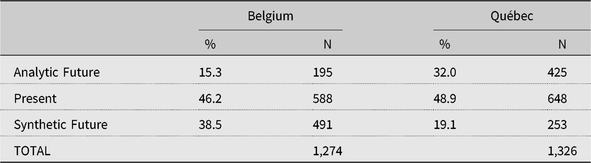
The overall distribution of the three major variants of FTR is given in Table 1. This table shows that the Present is the preferred means of expressing FTR in both communities, accounting for close to half of the data.Footnote 14 Moreover, while in Belgium, the Synthetic Future closely follows the Futurate Present, in Québec, the Analytic Future comes second. While these results corroborate empirical reports of Canadian French, the much higher rate of Synthetic Future in the Belgian corpus is a relatively new finding,Footnote 15 which will need corroboration to see how this dialect is different from other varieties of European French. Indeed, these results have yet to be compared with other results from Belgium.
Distribution of FTR variants in Belgium and Québec corpora of text messages

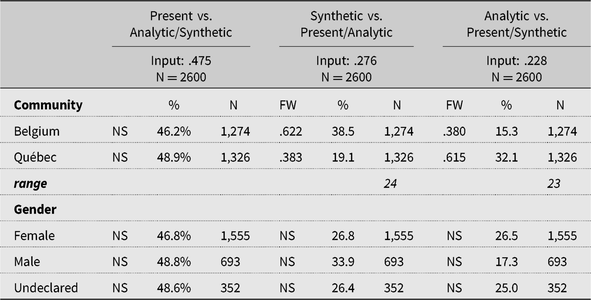
In the spirit of Poplack and Turpin (Reference Poplack and Turpin1999), we first opposed each variant with the two other competing variants.Footnote 16 Table 2 displays the results of the variable analyses with respect to the two extralinguistic factor groups. While Gender is never significant, we observe a Community effect only for the Synthetic and the Analytic Future, but not for the Present, which is used at rates well above 40 per cent in both Belgium and Québec.
Effect of Community and Gender on choice of the three FTR variants

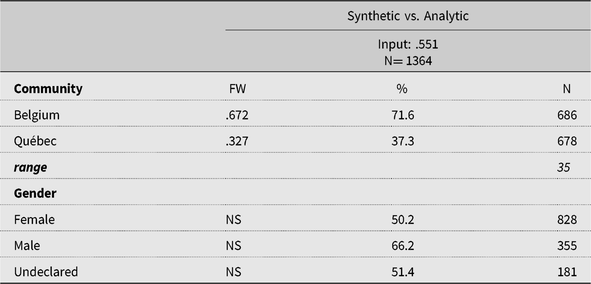
However, the inclusion of the Present in the analyses of Table 2 weakens the community effect observed in the choice of the Synthetic or Analytic Future. The community effect is even stronger when the Present is excluded, as shown in Table 3.
Effect of Community and Gender on choice of the Synthetic vs. Analytic Future

To summarize, the choice of the Present versus the other two variants does not appear to be conditioned by the community,Footnote 17 and dialectal variation lies strictly in the choice of the Analytic versus the Synthetic Future. The next two sections confirm this claim by looking at the linguistic factors constraining the use of the three variants in each community.
5.2 Present vs. morphological future
We first compare the effect of the linguistic factors in the choice of the Present over the two morphological futures in the two communities. Table 4 shows that not only are the rates of the Present similar, but also that the underlying grammar governing the choice of the variant is strikingly similar. First, the same two factor groups were rejected by the analysis as non-significant: Polarity and Temporal Distance. These results confirm the findings of Poplack and Turpin (Reference Poplack and Turpin1999), who also found that the choice of the Present variant was not subject to these two factor groups. Second, as shown in previous studies (Poplack and Turpin, Reference Poplack and Turpin1999; Edmonds et al., Reference Edmonds, Gudmestad and Donaldson2017), the absence of Adverbial Specification, whether specific or non-specific, disfavours the use of the Present. Furthermore, with respect to Contingency, our results show that the Present is favoured in the context of a clause introduced by quand, but disfavoured in the context a clause introduced by si. Finally, not only has Verb Type proven to be significant, but we observe the same pattern with modal and irregular verbs favouring the Present, and regular verbs and être disfavouring it. The hierarchy of factors in this group seems to indicate that the choice of Present is sensitive to the semantic, rather than morphological, class of the predicate.
Effect of the linguistic factors on choice of the Present variant in Québec and Belgium

To summarize, the use of the Present over the morphological future is not sensitive to dialectal variation. Both communities use the Present to the same extent, and share the constraints governing its use. The next section shows that the situation is quite different when the two morphological futures are contrasted.
5.3 Synthetic vs. Analytic Future
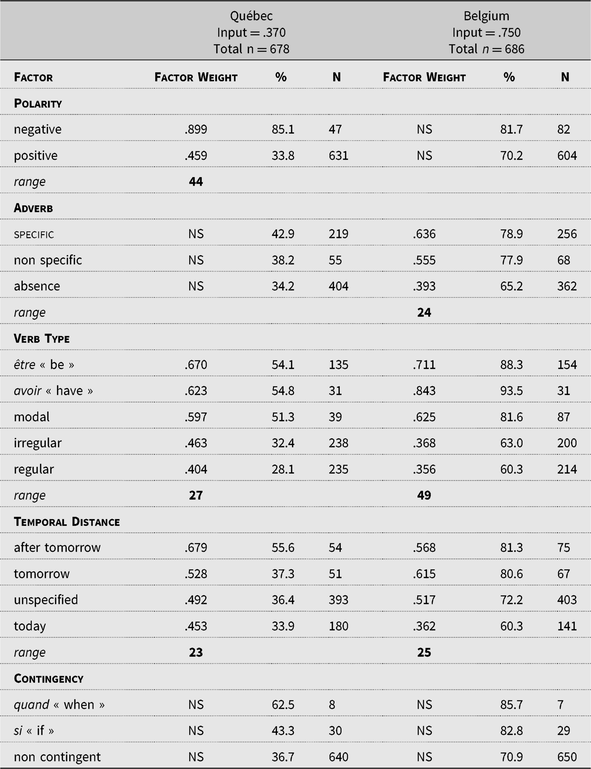
We now compare the effect of the linguistic factors on the choice of the Synthetic Future over the Analytic Future in the two communities. For the current analysis, the application value is the Synthetic future. As shown in Table 5, the two communities are similar with respect to Contingency, which was not selected as significant, and Temporal Distance, which is significant and patterns similarly in both communities, with greater Temporal Distance favouring the Synthetic Future. These results contrast with previous studies on Canadian French. We have seen in section 2.2.2 that numerous studies based on semi-directed interviews have shown that this factor group is not significant in Laurentian French. Our results for the Québec corpus are the only ones to attribute a role to the temporal distance for this variety. We will return to this question in the discussion. With respect to Contingency, the Synthetic Future has been associated with certainty in previous research on Canadian French (Poplack and Turpin, Reference Poplack and Turpin1999; King and Nadasdi, Reference King and Nadasdi2003).
Logical regression analyses of internal factors contributing to the probability of the Synthetic Future over the Analytic Future to express FTR in Québec and Belgium

The two communities diverge however with respect to Polarity and Adverbial Specification. In Québec, the use of the Synthetic Future is strongly favoured in negative environments, as indicated by the range of 44, a result in keeping with previous research on Laurentian French. The situation is different in Belgium, where this factor group was not selected as significant, as in Acadian French. Conversely, Adverbial Specification is not significant in Québec, but is significant in Belgium, where the presence of (specific) adverbs favours the use of the Synthetic Future.
The two communities also converge with respect to Verb Type. The same Verb Types favour the Synthetic Future: to be, to have and modals. Other verbs disfavour the use of the Synthetic Future. The two communities contrast, however, in that the range is 27 in Québec, and 49 in Belgium, which indicates that this factor group has a stronger effect in the latter community. Table 5 thus shows that morphological complexity is at stake in both communities: the more irregular the paradigm, the more likely the use of the Synthetic Future. Presumably, such irregular forms need to be learned and stored in the mental lexicon, which in turn facilitates lexical access. The use of the Synthetic form in such cases may indicate that such stored forms are more accessible than words that need to be formed online. This may also be linked to a frequency effect.
To summarize, Table 5 shows that the choice of the Synthetic Future over the Analytic Future is subject to dialectal variation. The underlying grammars governing the choice of the Synthetic Future over the Analytic Future share some features, such as the lack of significance of Contingency, and similar trends in the distribution of verb types and adverbials categories, but clearly differ in the significance of the presence of an adverbial and especially in the role played by negative Polarity, which confirms the affinity of Synthetic Future with negation, a characteristic of Laurentian varieties.
6. Discussion
6.1 The relationship between FTR variants
The inclusion of the Futurate Present in the envelope of variation poses a conceptual challenge: since this variant is not overtly marked for future tense, it is not clear whether this variant should be considered on a par with the other two variants, or rather singled out as qualitatively different. The results of our comparative study of text messages in Belgian and Québec French allow us to explore this issue.
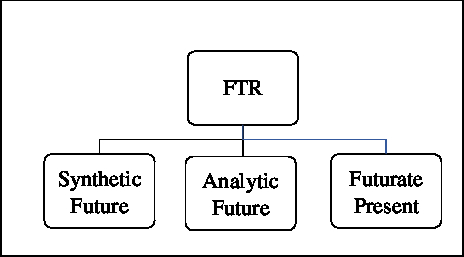
On the one hand, one can treat the Futurate Present, the Analytical Future and the Synthetic Future as three morphological variants of FTR. Under this view there would be only one, non-hierarchical variable context as illustrated in Figure 1.
Non-hierarchical structure

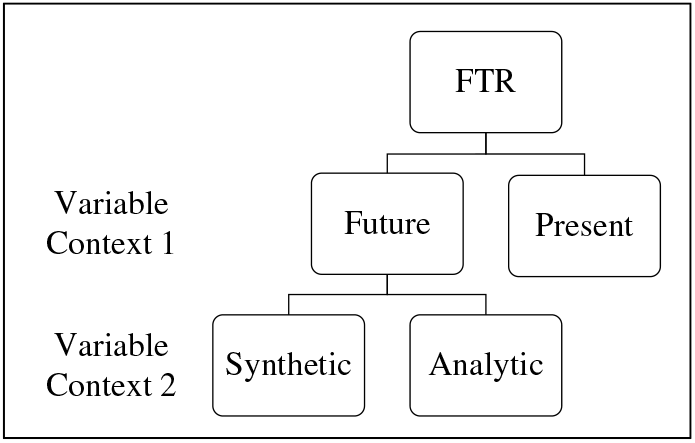
Another possibility would be to oppose the Present and the two morphological futures. Under this view, only the Synthetic and Analytic Futures are morphological variants of FTR. In contrast, the Present, which is not morphogically-marked for future tense, is a covert variant of FTR. This identifies two distinct variable contexts which we represent with the hierarchical structure displayed in Figure 2. The two variable contexts are: 1- Overt T (the Future) vs. Covert T (the Present); and 2- the Synthetic Future and the Analytic Future are morphological variants of Overt T.
Hierarchical structure

The two hypotheses make different predictions with respect to dialectal variation. Consider first the hypothesis that the three variants are morphological variants (Figure 1). Under the assumption that morphology is the locus of cross-linguistic differences (Chomsky Reference Chomsky1995), we would expect all three variants to be sensitive to dialectal variation: different dialects would have different rates for all three variants, including the Futurate Present, and the three variants would be subject to different linguistic constraints. Moreover, since there is no principled motivation to single out any of the three morphological variants with respect to the presence or absence of contextual cues, we do not expect the choice of any of the three variants to be sensitive to the interactional context: conversations and semi-directed interviews would not display different rates of any of the three morphological variants.
The hypothesis that there are two variable contexts (Figure 2) leads to different predictions. Since Covert T is semantically under-determined, it must rely heavily on contextual cues. We thus expect the choice between Covert T (the Present) and Overt T (the Future) to be sensitive to the interactional context, as some contexts provide more such contextual cues than others. No prediction is made with respect to dialectal variation, as Covert T is not a morphological variant of Overt T. We expect the choice between the Synthetic and the Analytic Future to show the exact opposite. First, we do not expect the choice between the Synthetic and the Analytic future to be sensitive to the interactional context, as neither form is semantically under-determined and thus neither must rely of contextual cues. However, if dialects show differences in their use of the FTR variants, we expect these differences to be limited to the choice between the two morphological variants, that is the Synthetic and the Analytic Future, since only these two forms are morphologically-marked for future tense.
Our comparative analysis of text messages from Belgium and Québec supports the claim that the FTR envelope of variation is structured as in Figure 2. First, our results show that the choice of between Covert T and Overt T is sensitive to the interactional context: text messages in both communities present much higher rates of Futurate Present than has been reported in studies based on semi-directed interviews. This is expected given the conversational nature of text messages. Second, the choice between Covert T (the Present) and Overt T (the morphological futures) does not appear to be sensitive to dialectal variation, as both communities show similar rates and have similar grammars. Dialectal variation is limited to the choice between the two morphological variants: the Synthetic Future and the Analytic Future. Not only do the two communities display very different rates of these two variants, but the underlying grammars governing the choice of the Synthetic over the Analytic Future are also different in the two communities.
Finally, diachronic evidence provides further support for the two-context hypothesis. We just saw that this hypothesis predicts that only the choice between the Analytic and Synthetic variants, but crucially not the choice between the Present and the morphological futures, will be subject to dialectal variation. With respect to change over time, the two-context hypothesis also predicts that diachronic variation should show a similar partition. This prediction is supported by Poplack and Dion (Reference Poplack and Dion2009), who report the stability of the Present over time (119 years) in terms of both rate and conditioning in Québec French. This contrasts with the change observed in the Analytic Future, which increases at the expense of the Synthetic Future during the same period.
6.2 The conversational nature of text messages
Text messages constitute a valuable resource in corpus linguistics, as interactions of such proximity give us access to the vernacular. Text messages are often very informal conversations between intimates and, because they do not rely on an interviewer, they reduce the observer’s paradox. People text in their day-to-day lives not only to plan upcoming events, but also to share feelings, maintain contact or, as in the examples below, wish good night.
(7)

Text messages have often been decried as deviant from the written standard. Rather than being deviant, our study shows that text messages obey a different set of norms, closer to that of spoken language. Just like speech, texting is not codified and thus highly variable. Just like vernacular speech, texting is often highly informal. Just like speech, texting follows a set of implicit social and linguistic norms (Tagliamonte and Denis, Reference Tagliamonte and Denis2008; Tagliamonte, Reference Tagliamonte2014; Tagliamonte, Uscher and Kwok, Reference Tagliamonte, Uscher and Kwok2016). These features of text messages account for many of the major findings of the present study.
First, we have seen high rates of the Present variant, which relies on the interactional context of proximity. Our results show a much higher rate of Present (over 40%) than had been reported in previous studies based on semi-directed interviews (under 10%). Gudmestad et al.’s (Reference Gudmestad, Edmonds, Donaldson and Carmichael2018) study of FTR in conversations shows that informal conversations provide more of such cues, which accounts for the higher rate (26%) of the Present variant in their study.Footnote 18 Given that the interpretation of the Futurate Present relies on contextual cues, whether implicit or explicit, higher rates of the Present variant are expected to be found in conversations.
Second, the rate of use of the Analytic variant over the Synthetic variant sets text messages apart from written Standard French, and more in keeping with oral corpora. When we exclude the Present variant and compare the rates of Synthetic Future in natural conversations to the rate of Synthetic Future in semi-directed interviews, we find very similar rates, both in France and in Canada. For Hexagonal French, Edmonds et al. (Reference Edmonds, Gudmestad and Donaldson2017) report a rate of 34 per cent Synthetic in conversations, which is similar to the rate of 41 per cent reported in Roberts’ (Reference Roberts2012) study based on semi-directed interviews. Similarly, for Québec French, the rate found in the present study of text messages (37%) is also close to that found in Poplack and Turpin’s (Reference Poplack and Turpin1999) study (22%), but very different from the rates above 95 per cent found in Québec newpapers (Lesage and Gagnon, Reference Lesage, Gagnon, Crochetière, Boulanger and Ouellon1992).
Finally, we have seen that text messages are subject to dialectal variation, another feature which associates it with informal speech. We have shown that dialectal variation can be observed in the different rates and constraints in the use of the Analytic vs. Synthetic Future. The first person singular is particularly prone to encode dialectal features of the FTR variable. We mentioned in section 1 that the use of v [ve] for vais [vε], and expliquerè [εksplikrε] for expliquerai [εksplikre] in example (1) illustrate the neutralization of e/ε in Belgian French. The use of va [vα] for vais in example (8a) and ma [mα] in (8b) for je vais illustrate the vas/mas/vais variable, characteristic of Québec French.
(8)

7. Conclusion
This article has provided a comparative study of the expression of Future Temporal Reference in text messages in two varieties of French. Three variants were considered: the Futurate Present, the Synthetic Future and the Analytic Future. The results of the multivariate analyses show that the two communities (Belgium and Québec) display very similar grammars in the use of the Futurate Present. This variant is found at comparable rates in the two varieties. Moreover, the factors conditioning the use of the Futurate Present are strikingly alike in both varieties: morphological Verb Type, Adverbial Specification and Contingency are good predictors, while Polarity and Temporal Distance are not significant. Our results further reveal that dialectal variation is limited to the choice between the Synthetic and the Analytic Future. The factors conditioning the choice of the Synthetic Future vs. the Analytic Future show distinct configurations: 1- while Polarity is the strongest factor in Québec, it is not significant in Belgium; 2- non-specific adverbs strongly favour the presence of the Synthetic Future in Belgium, but not in Québec. However, Temporal Distance is significant in both varieties, with the Analytic Future being favoured by proximal future events. This last result tends to show that the Analytic and Synthetic Futures are not strictly semantically equivalent. However, the fact that these two forms are not mutually exclusive and heavily subject to dialectal variation indicate that the distinction is nevertheless blurry, which argues in favour of the weak equivalence approach adopted in this article. Finally, both varieties are sensitive to the morphological complexity of verbal paradigms: the most irregular verbs (être, avoir, modals) favour the Synthetic variant, while other regular and irregular verbs favour the Analytic Future.
The present study contributes to research on future-time expression in French at the empirical, methodological and theoretical levels. At the empirical level, we add to the large body of literature on FTR in French a variationist study that includes the Futurate Present. Second, we consider a type of corpus that has seldom been studied in variationist research, which is often based on semi-directed interviews, rather than naturally-occurring conversations. The inclusion of text message corpora adds a new dimension to the analysis of the variable. Our study also contributes to the developing field of inquiry on the morphosyntax of text messages in French (Stark, Reference Stark2011, Reference Stark, Cougnon and Fairon2012; Blondeau et al., Reference Blondeau, Tremblay and Drouin2014; Labeau, Reference Labeau2014, among others), and documents the hybridity of this form of communication. On the one hand, text messages are not exempt from the influence of written French, as shown by the use of Synthetic Future forms in affirmative sentences in the Québec corpus, where the range of 44 is much narrower than in sociolinguistic interviews (Blondeau, Reference Blondeau2006 reports a range of 56 in the 1971 and 1984 corpora, and a range of 63 in the 1995 corpus). On the other hand, our results show patterns of use that are more in line with oral/conversational corpora as reflected by the dialectal variation observed. Third, we provide a comparative study of two dialects offering a deeper understanding of the constant vs. variable properties of FTR in French. Finally, while Québec French has been the focus of numerous variationist studies over the last 50 years, Belgian French has been relatively neglected by sociolinguists. The present study thus contributes to documenting the specific features of that largely understudied variety.
In terms of methods, many studies have excluded the Futurate Present in the analysis on the grounds that this variant is too rare. A posteriori, our study provides additional, more principled motivations for the possible exclusion of this variant from the analysis. Even studies which include the Futurate Present in the analysis need to distinguish between two variable contexts. Context 1: Covert T vs Overt T. Context 2: Synthetic vs Analytic morphological future. Moreover, the choice between Covert T vs Overt T is subject to different sets of constraints than the choice between the Synthetic vs. Analytic future. While the former appears to be stable over time and across varieties, the latter is subject to dialectal and diachronic variation. Consequently, studies concerned with dialectal and diachronic variation could focus on the linguistic factors constraining the choice between the Synthetic vs the Analytic Future, without the inclusion of the Futurate Present in the analysis. However, the inclusion of this variant would be crucial for studies concerned with the role of context in the identification of Covert T, or with the contribution of pragmatic factors. Ultimately, the decision to include or not the Futurate Present in the envelope of variation should not only be determined by the frequency of the variants, but also by the subject of inquiry.
Finally, our study has theoretical consequences for our understanding of Labov’s Principle of Accountability. This principle requires that the analyst examine all relevant forms in the system of grammar under investigation. This is often understood as an indication to include all variants, including zero variants, as long as the zero variants are semantically equivalent, or weakly equivalent, to the overt variants. The present study argues that the decision to include a given variant or not in the analysis (in the set of variants) also depends on the linguistically defined variable context which is relevant to the research question.