Introduction
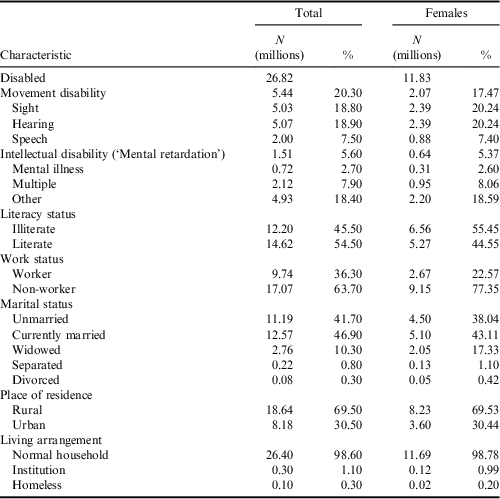
Globally, more than a billion people, or about 15% of the world population, live with some form of disability, and the vast majority of these live in developing countries (WHO & World Bank, 2011). Although persons with disabilities (PwDs) constitute only 2.2% of the total population of India, in absolute terms this translates into about 26.8 million (see Table 1). Of these, the majority (56%) are male and most (69%) reside in rural areas of the country (Registrar General of India, 2011). However, these figures could be underestimates as many PwDs, particularly women, might have been excluded from the enumeration process due to perceived stigma and by families trying to hide disabled female members (TARSHI, 2010), given the patriarchal nature of most parts of India. Alternative estimates suggest that the actual prevalence of disability in the country could be over 40 million, and as even as high as 80–90 million if more inclusive definitions of mental illness and intellectual disability are used (World Bank, 2009).
Background characteristics of the disabled population in India, 2011 Census

Source: Census of India, Disability Tables C20, C21, C29 (Registrar General of India, 2011).
Despite these large numbers, PwDs are one of the most marginalized groups in India (WHO & World Bank, 2011). They generally experience poorer health outcomes, lower educational achievements, lower economic participation and higher rates of poverty than their non-disabled counterparts (WHO & World Bank, 2011). About 55% are literate and 36% are employed (Table 1), and for women with disabilities (WwDs) these percentages are even lower, at about 20% and 10% respectively (Registrar General of India, 2011). Low educational attainment, poor employment prospects and stigma mean that PwDs and their households are notably worse off than average (World Bank, 2009). A recent report by the UN Population Fund (UNFPA) revealed that among the disabled population, women are the most ‘invisible’ and are discriminated against both socially and economically (UNFPA, 2013).
Over the years, the international disability rights movements and the United Nations have attempted to integrate PwDs into mainstream society. The focus, however, has remained largely on providing entitlements such as an inclusive physical environment and access to employment and education. Fertility, sexual behaviour and sexual and reproductive health and rights have been largely ignored (WHO & UNFPA, 2009; WHO & World Bank, 2011; Frohmader & Ortoleva, Reference Frohmader and Ortoleva2013).
Prejudice and discrimination against persons with disabilities, particularly women, are persistent globally and have resulted in multiple and often extreme violations of sexual and reproductive health and rights (WHO & UNFPA, 2009; Frohmader & Ortoleva, Reference Frohmader and Ortoleva2013; UNFPA, 2013). Across the world, women with disabilities have been subjected to forced sterilization, limited contraceptive choices, menstrual and sexual suppression, poorly managed pregnancies, forced abortions, termination of parental rights, denial of, or forced, marriage and other forms of violence (Frohmader & Ortoleva, Reference Frohmader and Ortoleva2013). Women with disabilities are two to three times more likely to be the victims of physical or sexual abuse than their non-disabled counterparts (UNFPA, 2013). The sexual health of WwDs is largely neglected due to the persistence of false and prejudiced beliefs that view them as asexual, unsuitable for marriage and unable to manage their own fertility or raise children (UNFPA, 2013). Women with disabilities constitute a group whose sexual and reproductive health and rights have been largely neglected across the world, including in India (WHO & UNFPA, 2009; Frohmader & Ortoleva, Reference Frohmader and Ortoleva2013; UNFPA, 2013).
The objective of this study was to highlight the paucity of research on the sexual and reproductive health concerns of PwDs, particularly women, in the Indian context using existing literature in India and to identify the possible reasons for this neglect. The study also attempted to describe the obstacles faced by PwDs, particularly women, to accessing good sexual and reproductive health information and services using evidence from empirical studies. Given the paucity of research in this area in India, this largely came from studies conducted elsewhere in the world.
The concept of disability is very complex and has undergone major changes over time. Globally, the Convention of the Rights of Persons with Disabilities (UNCRPWD) and the Biwako Millenium Framework for Action and Biwako Plus Five (ESCAP 2003) marked a shift from a medical to a social model of disability. In the medical model, disability lies within individuals, and individuals with certain physical, intellectual, psychological and mental conditions (impairments) are regarded as pathologic or abnormal and in need of a cure. The social model of disability argues that disability does not lie in individuals, but in the interactions between individuals and society.
Realizing that defining and measuring disability is a complex issue, different definitions of disability conditions have been introduced in India for various purposes, mostly with a medical perspective. These have been based on various criteria for ascertaining abnormality or pathologic conditions of persons that provide practical benchmarks to ascertain whether a person is disabled or not. These definitions are important because they determine people’s legal and practical entitlement to various forms of assistance through welfare schemes. Primarily, there are three official definitions of disability in India. According to the Persons with Disabilities (Equal Opportunities, Protection of Rights and Full Participation) Act, 1995, a ‘Person with Disability’ (PwD) means ‘a person suffering from not less than 40% of any disability (blindness, low vision, leprosy cured, hearing impairment, locomotor disability, ‘mental retardation’ [referred to as intellectual disability in the 2016 RPWD Act] or mental illness) as certified by a medical authority (any hospital or institution, specified for the purposes of this act by notification by the appropriate government)’. This definition is not, however, very useful for estimating the disabled population in a country the size of India.
The Census of India, which is conducted once every 10 years, states that ‘the concepts and definitions of disabilities, coupled with measuring its extent and its types contained in the PWD Act, 1995, were found to be extremely difficult to canvas, even in normal circumstances assuming people had time, were willing and forthcoming to share this information and there was an expert investigator to elicit this information’ (Government of India, 2011). Hence, the Census used its own definition and included five types of disability, i.e. sight, speech, hearing, movement and mental (refer to the 2001 Census of India for specific details of each category). This helped to estimate the total number of disabled population, but didn’t provide the actual number with different types of disability, as for a person with more than one disability only one was considered based on the individual’s desire to be considered for that particular type of disability. The 2011 Census further classified disability into eight categories, including disability in sight, hearing, speech, movement, ‘mental retardation’ (intellectual disability), mental illness, any other disability and multiple disabilities. The National Sample Survey Office (NSSO), which conducts periodic surveys in India on various socioeconomic issues, only considered physically disabled persons until its 36th round special comprehensive survey on persons with disabilities in 1981 and the second survey (47th round) in 1991 (Government of India, 2011). Since the 36th round of the NSS (1981) an extended definition has been used to cover all persons with one or more of the following three physical disabilities: visual, communication (i.e. hearing and/or speech) and locomotor. The third and latest comprehensive survey on persons with disabilities was carried out in the 58th round of the NSS in 2002, where the coverage was extended to include mental disability, keeping all other concepts, definitions and procedures for physical disability the same as in the 47th round. The most recent was the one adopted in the Rights of Persons with Disabilities (RPWD) Act of 2016, which replaced the PWD ACT 1995. This is the most comprehensive and classifies disabilities into physical (including locomotor, visual and hearing), intellectual, mental behaviour based, those based on chronic neurological conditions, blood disorders and multiple disabilities.
The above brief discussion illustrates the complexity of defining disability with a single definition in India. Hence, the study restricted disability to physical disabilities, including locomotor and sensory impairments, and covered their sexual and reproductive health (SRH) needs. The paper does not explicitly highlight the complexities that people with different types and degrees of disabilities face in terms of SRH concerns. The idea is not to universalize their SRH experience, but rather to draw attention to the non-recognition of the SRH concerns of PwDs in India and to argue that these affect all individuals, irrespective of their physical and intellectual abilities. The paper synthesizes the available evidence on the SRH needs of PwDs, particularly women, with special reference to India.
The sexual and reproductive health of PwDs in the India
Table 1 provides a brief overview of the profile of PwDs in India in 2011, showing the figures for women separately. Among the total disabled population of 26.82 million, WwDs constituted a significant proportion (44%). In India, 20% of the disabled population had disability in movement, 19% in seeing, another 19% in hearing and 8% had multiple disabilities. The majority (70%) resided in the rural areas; about 55% were literate and 36% were workers. Among the female disabled population less than half (45%) were literate and only 23% were employed (Registrar General of India, 2011).
The issue of the sexual and reproductive health of PwDs has been neglected in India over the last three decades, both at the policy level and by researchers. National-level engagement with the issue of SRH started over two decades ago in India, following the International Conference on Population and Development (ICPD) held in Cairo in 1994. This was a watershed, introducing the SRH approach in India. Prior to the ICPD, the focus of population activities was largely on family planning and population control. Amid such a narrow understanding, the sexuality and sexual health concerns of the population did not feature in national health/population policies and programmes in the country. India was one of the signatories of ICPD and demonstrated its commitment to the new initiative by promptly abolishing its target-based approach to family planning in 1996 (Hardee et al., Reference Hardee, Agarwal, Luke, Wilson, Pendzich and Farrell1999). Starting in the 1990s, India reoriented its national policies and programmes and radically shifted its approach from family planning to maternal and child health and the much broader concept of ‘sexual and reproductive health’ (SRH) (Srinivasan, Reference Srinivasan2006; Kulkarni, Reference Kulkarni2009). Alongside the changing policy environment, this era also saw a massive surge in studies on various facets of SRH. Research revolved around concerns such as sexual risk behaviour, and SRH situation and needs (Verma et al., Reference Verma, Rangaiyan, Singh, Sharma and Pelto2001; Santhya & Jejeebhoy, Reference Santhya and Jejeebhoy2003; Jejeebhoy, Reference Jejeebhoy2007); knowledge, attitudes and practices related to SRH (McManus & Dhar, Reference McManus and Dhar2008); prevalence of gynaecological and obstetric morbidities (Bhatia & Cleland, Reference Bhatia and Cleland1996); health care access and utilization for SRH concerns (Barua & Kurz, Reference Barua and Kurz2001; Mohanty, Reference Mohanty2012; Sabarwal & Santhya, Reference Sabarwal and Santhya2012); unmet need and knowledge, attitudes and practices related to contraception use (Ravindran, Reference Ravindran1993; Ghosh, Reference Ghosh2001; Santhya, Reference Santhya2004; Visaria et al., Reference Visaria, Ramachandran, Ganatra and Kalyanwala2004; Stephenson et al., Reference Stephenson, Koenig and Ahmed2006; IIPS & Macro International, 2007; Hall et al., Reference Hall, Stephenson and Juvekar2008); RTI and STI including HIV/AIDS (Prasad et al., Reference Prasad, Abraham, Kurz, George, Lalitha and John2005; Santhya & Jejeebhoy, Reference Santhya and Jejeebhoy2007); maternal and child health (Prakash et al., Reference Prakash, Singh, Pathak and Parasuraman2011; Mohanty, Reference Mohanty2012); infertility and abortion (Varkey et al., Reference Varkey, Balakrishna, Prasad, Abraham and Joseph2000; Santhya & Verma, Reference Santhya and Verma2004; Visaria et al., Reference Visaria, Ramachandran, Ganatra and Kalyanwala2004; Jejeebhoy et al., Reference Jejeebhoy, Kalyanwala, Zavier, Kumar and Jha2010; Kalyanwala et al., Reference Kalyanwala, Zavier, Jejeebhoy and Kumar2010); and domestic violence, including sexual abuse or non-consensual sexual activity (Ravindran & Balasubramanian, Reference Ravindran and Balasubramanian2004; Stephenson et al., Reference Stephenson, Koenig, Acharya and Roy2008; Decker et al., Reference Decker, Seage, Hemenway, Raj, Saggurti and Balaiah2009; Khalid & Aras, Reference Khalid and Aras2012). The sexual and reproductive health of PwDs seems to have been overlooked, or excluded entirely, both from programmes and research studies.
Most SRH research conducted in India over recent decades has not represented PwDs, and women in particular, in their study populations, despite these constituting a significant proportion of the population. One of the first studies on the reproductive health of WwDs was conducted quite recently by Murthy et al. (Reference Murthy, John and Sagar2014). This study examined the reproductive health of WwDs, and drew attention to the need to develop specific interventions to improve their pregnancy outcomes. Contrary to the popular belief that WwDs are asexual and unfit to marry or bear children, this study demonstrated that WwDs have the same biological and reproductive needs as other women. Moll (Reference Moll2007) looked at the issues of HIV/AIDS and disability in India and emphasized the need to provide comprehensive information on sexual health and appropriate sexual behaviour to PwDs. The study estimated that although there were about 319,000 PwDs living with HIV in India in 2007 (estimates based on National AIDS Control Organization’s HIV prevalence rates of 0.91% during that period), only 0–2% had access to intervention programmes. Addlakha (Reference Addlakha2007) reflected on the alienation faced by PwDs in the sphere of intimate relationships, and how socialization and early conditioning to view themselves as undesirable erects strong psychological barriers in the form of low self-esteem and body image, which undermine their sexual identities. Limaye (Reference Limaye2003) demonstrated how physical imperfections condemn a person to be asexual and affect healthy sexual development. Recounting her experience of working with young women with sensory disabilities, Limaye illustrated how ill-informed these women were about their bodies and how they often struggled with basic labelling of their body parts. The most recent study, conducted in North India in 2015, provides evidence on how WwDs are at a ‘health disadvantage’ in terms of SRH, and how they continue to face multiple barriers (inaccessible transport, lack of ramps, inappropriate examination tables, long waiting hours, inaccessible toilets and negative provider attitudes) both within and outside health facilities, which impedes their access to SRH services (Sharma et al., Reference Sharma, Singh, Suri and Kaur2015).
These are, however, among the few studies conducted on sexuality, SRH and disability in India. This not only reflects on the silence pervading the arena of SRH and disability, but also underscores the need to understand and timely respond to the SRH needs of PwDs, particularly women. With the exception of those with severe multiple and/or intellectual disabilities, WwDs face similar SRH concerns to their non-disabled counterparts, and all individuals have an equal right to sexual and reproductive desires, hopes and good health. There is a need for extensive research into the sexual and reproductive behaviour, needs, knowledge, health-seeking practices and challenges faced by PwDs, and how the health system in India can respond effectively to the needs of people with varied degrees and types of disabilities. Research is required on almost all aspects of disability and SRH, including HIV and AIDS, sexual abuse, same-sex relations and decisions regarding pregnancy, childcare, adoption, sexuality information, sexual assistance and contraception. The lack of understanding of the SRH concerns of PwDs has translated into a gap in policy formulation, strategic design and planning for intervention programmes and services (TARSHI, 2010).
The neglect of the SRH of PwDs at the policy level is also evident from the fact that none of the national health and population policy documents and programmes (Family Planning Programme (FPP); National Health Policy (NHP), 1986; Reproductive and Child Health Programme, 1997; National Population Policy, 2000; NHP, 2002; RMNCH+A 2013; NHP, 2017, amongst others) directly or indirectly touches upon this. A review of national acts (Mental Health Act 1987; Rehabilitation Council of India Act 1992; the Persons with Disabilities Act 1995; National Trust Act 1999) concerning PwDs also suggests that while issues of education, inclusion, employment and rehabilitation have received attention, SRH remains largely neglected (TARSHI, 2010). In 2008, India ratified the UN Convention on the Rights of Persons with Disabilities (CRPD), which stipulates that PwDs not only have the need for access to SRH services and information but also the right. Although the convention has been in force since 2008, only recently did the RPWD Act 2016 mention the need to take measures, and introduce programmes, to promote the health care of PwDs, particularly the sexual and reproductive health of women.
The SRH concerns of PwDs are not well documented in the literature, but some troubling incidents in the past in India have been documented that reflect the appalling way some women with disabilities have been treated. In 2008, the government of Maharashtra recommended performing hysterectomies on mentally challenged women, citing concerns about menstrual hygiene (Mishra, Reference Mishra2008). This not only disregarded the women’s rights to reproductive autonomy, but also failed to recognize that such operations can compound the problem of mental illness by causing hormonal imbalance. In 1994, fourteen mentally challenged girls were forced to undergo hysterectomies at Sassoon General Hospital in Pune, India, again to deal with the problem of menstrual hygiene (Ghai, Reference Ghai2002). However these incidents did not initiate a large-scale dialogue on the need to oppose the criminal acts of enforced sterilization of women with disabilities. Another small survey conducted in Orissa, India, found that virtually all women and girls with disabilities were beaten at home, 25% women with intellectual disabilities had been raped and 6% of women with disabilities had been forcibly sterilized (Mohapatra & Mohanty, Reference Mohapatra and Mohanthy2004). In only a small number of cases did the women report the abuse to their families, and in the vast majority of cases the reaction of the family was either not to listen or to pretend nothing had happened. Such events highlight the importance of strengthening the discourse on disability sexual health in India.
Why are the sexual and reproductive health concerns of PwDs neglected?
Two plausible explanations for the neglect of the sexual and reproductive health of PwDs have been identified. First, sexual health is directly related to an individual’s sexual behaviour, which in turn is part of an individual’s sexuality. Sexuality encompasses a whole range of issues such as sex, gender roles, sexual orientation, eroticism, pleasure intimacy and reproduction (WHO, 2006). In other words, it is about how people express their sexual feelings, attractions and preferences. In many countries, particularly in South Asia, sexuality to date has been a highly taboo subject (Wellings et al., Reference Wellings, Collumbien, Slaymaker, Singh, Hodges and Patel2006; Hindin & Fatusi, Reference Hindin and Fatusi2009). Issues relating to it are largely kept under wraps and are managed and moderated through societal rules, regulations, norms and ideals (TARSHI, 2010). The issue becomes even narrower in the case of India because the only accepted legitimate space within which sexuality can be expressed in the Indian socio-cultural setting is within the institution of marriage and hetero-normative contexts. In such a scenario, even the majority ‘able-bodied’ population might find it difficult to express their SRH needs and seek services and information, let alone PwDs, who in the popular imagination are not considered sexual beings (TARSHI, 2010). In addition, differential gender norms might interplay with the impairment condition, making women with disabilities face the double burden of being ‘disabled’ and ‘women’.
Women with disabilities often have to bear the status of being ‘lesser’ women, as they might not always be able to fulfil the normative feminine roles of homemaker, wife and mother. Rather than being nurturing and caring, which is expected of women, they might be in need of care themselves (Addlakha, Reference Addlakha2007). Under such circumstances, marriage and motherhood are not considered an option for many. They are often either married to older married men, or to men in ill health or from a lower socioeconomic background, or if their disability is minor families might try to conceal it. There is also the overriding fear that women with disabilities will produce children with disabilities (TARSHI, 2010). Such a perception not only makes marriage a relationship of ‘obligation and compromise’ for women with disabilities, but also has implications for their ability to exercise their sexual reproductive rights (Habib, Reference Habib1995). As they are seen to be unmarriageable, and hence asexual, they are also not seen as requiring any sexuality or sexual health information or services. Ghosh (Reference Ghosh2016) illustrated, in West Bengal, India, how women with locomotor disabilities are given subtle messages from a young age about the impossibility of marriage and the way the social process works to deny and suppress their sexuality and growing feelings of femininity and desirability. Marriage offers are also influenced by degree of disability and are received mainly from disabled men, in a process involving dowry negotiation and their constant devaluation as women (Ghosh, Reference Ghosh2016). Similar results have been found in the Indian states of Tamil Nadu and Uttar Pradesh where, along with these challenges, higher rates of divorce and abandonment were found to be common in the marriages of women with disabilities, and the social attitudes towards marriage and family life were largely negative (World Bank, 2009).
A possible second explanation for the neglect relates to the non-recognition of PwDs as sexual beings. Historically, there has been a tradition in almost all cultures and societies of treating PwDs in two opposing ways: as asexual (uninterested or unable to take part in sexual activity) or sexually threatening (sexual monsters) (Anderson & Kitchin, Reference Anderson and Kitchin2000; Groce, Reference Groce2005; Addlakha, Reference Addlakha2007; TARSHI, 2010). Focusing on women with disabilities, Basson (Reference Basson1998) noted that various myths prevail in society, which result in the neglect of their sexual well-being. These include:
…disabled women are asexual; only independently functioning women can handle sexual relationships; disabled women who are single are celibate; disabled women cannot be mothers; all disabled women are heterosexual; disabled women should be grateful for sexual relationships; disabled women are different; youth and beauty are essential to sexuality (Basson, Reference Basson1998, p.1).
These assumptions underscore the social denial of PwDs as sexual beings and implicitly suggest that sexual expression or sexuality is publicly associated with certain standards of attractiveness, and thus are domains of the ‘able-bodied’. For men, these standards mostly relate to power and wealth and for women to physical appearance. Lonsdale (Reference Lonsdale1990) illustrated that in every society, women in particular are from a very early stage taught to be conscious of their body shape, size, smell, hair, facial expressions and dress style. These concerns are usually not conveyed for fitness or health objectives, but with a preoccupation to conform to societal ideals of attractiveness. Such ideals can often be difficult, if not impossible, for women with disabilities to attain because it might entail certain basic features such as being a certain height or having two ordinary functioning arms and legs. As a consequence, those who cannot conform to the accepted ideal are often considered abnormal or ‘other’ in society (Lonsdale, Reference Lonsdale1990). Along with these markers come a whole range of assumptions and perceptions about people’s bodily capabilities, capacities and functioning. Some of these assumptions reinforce the view that sexuality and disability are mutually exclusive (Ghai, Reference Ghai2002; Addlakha, Reference Addlakha2007; TARSHI, 2010). The same understanding also leads to the belief that PwDs do not get sexually assaulted or abused as no one will desire bodies that are unattractive or unfit (TARSHI, 2010).
Popularly imagined as sexually disenfranchized sections of society, PwDs are thus not perceived to be at risk of STIs, unintended pregnancies, coerced abortion or sexual abuse. Consequently, they are mostly excluded from sexual health information or awareness programmes (Becker et al., Reference Becker, Stuifbergen and Tinkle1997; Nisha, 2006; WHO & UNFPA, 2009; TARSHI, 2010; Altuntug et al., Reference Altuntug, Ege, Akın, Kal and Sallı2014). WHO and UNFPA (2009) reported that:
…in many communities health workers, social workers, and midwives provide SRH services in people’s homes. These workers may skip the homes of persons with disabilities, however, assuming that they do not need services.
These myths/assumptions create multiple barriers that prevent PwDs accessing SRH information and services (Anderson & Kitchin, Reference Anderson and Kitchin2000; UNFPA, 2009; Ahumuza et al., Reference Ahumuza, Matovu, Ddamulira and Muhanguzi2014).
Barriers to sexual and reproductive health: evidence from across the world
There is very little empirical research about the sexual and reproductive health needs of people with disabilities in India, and hence little understanding of their specific needs and concerns. As a consequence, PwDs, particularly women, do not feature in SRH policies and programmes in India. However, studies from across the globe suggest that they, and particularly women, face multiple challenges in acquiring good SRH information and services. Some of the global literature is discussed below, and this underscores the need for extensive research in India.
Informational and educational barriers
There is a lack of information and education on safe sexual practices and behaviours for PwDs (see Ahumuza et al., Reference Ahumuza, Matovu, Ddamulira and Muhanguzi2014, for Uganda; Anderson & Kitchin, Reference Anderson and Kitchin2000, for Northern Ireland; Becker et al., Reference Becker, Stuifbergen and Tinkle1997, for Austin, Texas, USA). This is a direct consequence of the perception that PwDs are asexual and hence do not require SRH information. A study conducted in Northern Ireland found family planning clinics to be ‘landscapes of exclusion’ for PwDs in terms of both physical and informational access. Since PwDs were not ‘expected’ to be using the services (for consultations, treatment, or to access information) in these clinics, staff members were not equipped to provide them with information on sex education, family planning and sexual health (Anderson & Kitchin, Reference Anderson and Kitchin2000). Similar results were found in a study conducted in Kampala, Uganda (Ahumuza et al., Reference Ahumuza, Matovu, Ddamulira and Muhanguzi2014). In addition, the negative attitudes of health workers, long queues at health facilities, the long distances to health facilities, high cost of services and lack of experience among health workers in disability issues were also identified as barriers. Furthermore, the same study revealed that women with physical disabilities experienced all these barriers at a higher level than their male counterparts. The need for information for women with disabilities was echoed in studies conducted in the San Francisco Bay Area by Vaughn et al. (Reference Vaughn, Silver, Murphy, Ashbaugh and Hoffman2015) and Wong (Reference Wong2000).
Research reveals that PwDs are denied access to SRH information and services by a range of groups and organizations, including the family, social workers and health care providers (see TARSHI, 2010, for India; and WHO & UNFPA, 2009). Families see no need to educate their children about healthy sexual practices as PwDs are often seen as dependent and childlike throughout their lives (TARSHI, 2010; Ahumuza et al., Reference Ahumuza, Matovu, Ddamulira and Muhanguzi2014). For WwDs, denial of SRH information is even starker (TARSHI, 2010; Addlakha, Reference Addlakha2007, for India). Since they might not be considered suitable for marriage, the question of imparting SRH knowledge to them usually becomes irrelevant for families (Addlakha, Reference Addlakha2007; Lonsdale, Reference Lonsdale1990; TARSHI, 2010). The only information that is imparted usually relates to menstrual management and hygiene for girls. Information about safer sex, contraception and other SRH concerns is not given as it is considered irrelevant (TARSHI, 2010). Health care personnel have also been shown to fail to impart SRH information to PwDs (Basson, Reference Basson1998; Anderson & Kitchin, Reference Anderson and Kitchin2000; Quint, Reference Quint2003, for Canada; TARSHI, 2010). Anita Ghai, as a woman with disabilities and a disability rights activist and academic from India, noted from the personal experience of that:
Professionals like gynaecologists and teachers have a very unfriendly and negative approach towards queries. You need to be married to ask questions related to your sexual and reproductive health. The attitude with which you are given any information is always preceded with the question, why do you need this information at all? (TARSHI, 2010).
Likewise, PwDs often miss out on SRH information conveyed through print and social media (Becker et al., Reference Becker, Stuifbergen and Tinkle1997; Wong, Reference Wong2000; Anderson & Kitchin, Reference Anderson and Kitchin2000; WHO & UNFPA, 2009; Ahumuza et al., Reference Ahumuza, Matovu, Ddamulira and Muhanguzi2014), as information is often not tailored to meet the specific requirement of PwDs; for instance, not being in Braille for the blind, or a lack of trained sign language interpreters for the deaf. A national study from the United States among women with physical disabilities highlighted a different aspect of informational barriers (Nosek et al., Reference Nosek, Howland, Rintala, Young and Chanpong2001). The authors noted that even if some did receive information, the social construct of asexuality was imbibed and internalized by them to such an extent that they thought that because they had a disability, the information didn’t apply to them.
Since SRH issues are neither discussed at home nor with care providers, often friends (who themselves have several myths and misconceptions), books or even unfortunate experiences become the prime sources of information. In such cases, the accuracy of information becomes questionable (Nosek et al., Reference Nosek, Howland, Rintala, Young and Chanpong2001; Quint, Reference Quint2003). People with disabilities thus largely miss out on SRH information that could help them to make informed decisions. Such denial of information increases their vulnerability to SRH problems and also weakens their power to negotiate for safe sexual relationships (TARSHI, 2010; Ahmunza et al., Reference Ahumuza, Matovu, Ddamulira and Muhanguzi2014). A study conducted in south-west Nigeria among adolescents with physical disabilities found a poor level of knowledge of sexuality issues such as unprotected sex, teenage pregnancy, STIs/HIV/AIDS and contraceptive awareness. Friends were the main source of information and parents were mostly ill equipped to play their role as educators (Oladunni, Reference Oladunni2012). An Australian study focusing on people with physical disabilities noted that PwDs had very little opportunity to discuss the accuracy of sex information or to normalize sexuality as being just another aspect of their lives, as it was never discussed openly within families or with friends. A low level of sexual knowledge is a major concern as it is directly related to high levels of sexual abuse among PwDs (McCabe et al., Reference McCabe, Cummins and Deeks2000). Similar results have been found in studies conducted in Nigeria (Groce et al., Reference Groce, Yousafzai and Maas2006b) and Swaziland (Groce et al., Reference Groce, Yousafzai, Dlamini, Zalud and Wirz2006a) among the deaf population and in the United Sates among women with physical disabilities (Nosek et al., Reference Nosek, Howland, Rintala, Young and Chanpong2001). The WHO and UNFPA (2009) study reports that PwDs are at an increased risk of risk factor for HIV/AIDS. However, misconceptions surrounding their sexual and reproductive lives often impede the dissemination of SRH information and services. Similar results were revealed in a global survey to assess the impact of the AIDS epidemic on the disabled population (see Groce, Reference Groce2005, for a global survey).
People with disabilities, like everyone else, have SRH needs throughout their lives and require age-appropriate and relevant information on all aspects of their SRH at different stages in their lives. The aforementioned studies suggest that inadequate information on issues related to SRH and disability is a major concern for PwDs. There is a dearth of research in the Indian context on their informational needs, level of knowledge, sources of information, challenges faced in accessing information, and parental and provider perspectives on the barriers to accessing SRH information.
Barriers at the provider level
A negative attitude among health care providers has been identified as another major limiting factor in PwD’s access to SRH services and information. In discussions on key SRH issues, health care providers’ attitudes have been described as ‘uncomfortable’, ‘insensitive’ and ‘reticent’ by people with disabilities (Altuntug et al., Reference Altuntug, Ege, Akın, Kal and Sallı2014, for Turkey; Shah et al., Reference Shah, Norlin, Logsdon and Samson-Fang2005, for Utah, USA; and Nosek et al., Reference Nosek, Howland, Rintala, Young and Chanpong2001; and Becker et al., Reference Becker, Stuifbergen and Tinkle1997, for Austin, Texas, USA). Primarily, two factors have been identified to explain these negative attitudes. The first relates to the fact that even health care providers are a part of society that largely perceives PwDs as asexual or childlike. These assumptions directly or indirectly influence their behaviour towards PwDs. For instance, Becker et al. (Reference Becker, Stuifbergen and Tinkle1997) in a study conducted in Austin, Texas, noted that because WwDs are treated as childlike, health care personnel often do not engage in direct communications with them. They rather prefer talking to the person accompanying them. In addition, if a WwD wants to discuss birth control options, the response is usually preceded with the question ‘Why do you need this information?’ Discomfort among health professionals when providing SRH care to PwDs has also been described in a study in Utah (Shah et al., Reference Shah, Norlin, Logsdon and Samson-Fang2005).
Second, health care providers might not have sufficient training to address the SRH issues of PwDs (Lonsdale, Reference Lonsdale1990; Ahumuza et al., Reference Ahumuza, Matovu, Ddamulira and Muhanguzi2014). For instance, in the case of childbirth, physicians might not have sufficient understanding of the effects of pregnancy or labour on a women’s impairment. As a result, they might become over-cautious in recommending them to go ahead with a pregnancy (Lonsdale, Reference Lonsdale1990; Becker et al., Reference Becker, Stuifbergen and Tinkle1997; Altuntug et al., Reference Altuntug, Ege, Akın, Kal and Sallı2014). Lipson and Rogers (Reference Lipson and Rogers2000) examined the pregnancy, birth and postpartum experiences of women with physical disabilities in the United States. They observed that the obsteric care of WwDs was biased towards a reliance on technology, such as doctors recommending that a Caesarean section would be ‘easier’ for a WwD without acknowledging the effects of anaesthesia on some disabilities and postpartum recovery. A study in Turkey, focusing on women with physical disabilities, highlighted that sexual dysfunction is a commonly encountered problem in women with physical disabilities. There is, however, a dearth of medical guidance on the sexual health issues of PwDs in Turkey, and no model or educational programme from another country is available to guide health care professionals (Altuntug et al., Reference Altuntug, Ege, Akın, Kal and Sallı2014). Inadequate professional training has also been highlighted in a study in Canada (Milligan & Neufeldt, Reference Milligan and Neufeldt2001). These factors, combined with informational and physical barriers, have been shown to cause women with disabilities to avoid regular health checkups, which in turn can lead to poor sexual and reproductive health (Becker et al., Reference Becker, Stuifbergen and Tinkle1997; Lipson & Rogers, Reference Lipson and Rogers2000; WHO & UNFPA, 2009; Ahumuza et al., Reference Ahumuza, Matovu, Ddamulira and Muhanguzi2014; Piotrowski & Snell, Reference Piotrowski and Snell2007, for the USA).
The 2009 World Bank Report People with Disabilities in India: From Commitments to Outcomes provides some statistics about the general health-seeking behaviour of PwDs. This states that women with disabilities are around 13% less likely than men with disabilities to seek treatment, and are also less likely than men to receive aids and appliances to help them overcome their mobility and accessibility issues. The report states that negative provider attitudes, and the limited knowledge on disability issues of health care providers, have a significant impact on PwDs’ ability to access health services (World Bank, 2009). The report also reports the findings of research conducted in hospitals in Orissa, India, which found that less than 40% of providers were aware of entitlements under the PWD Act, and that close to 40% considered PwDs to be a burden. This evidence, although not specific to SRH, suggests that the picture could be even grimmer for health seeking in the context of SRH services, and more so for women. The silence and stigma around SRH issues might prevent women from articulating their needs, let alone seeking services.
Physical and infrastructural barriers
Physical barriers to PwDs accessing SRH care have been highlighted in all of the studies mentioned above (Becker et al., Reference Becker, Stuifbergen and Tinkle1997; Anderson & Kitchin, Reference Anderson and Kitchin2000; WHO & UNFPA, 2009; WHO & World Bank, 2011; Ahmunza et al., Reference Ahumuza, Matovu, Ddamulira and Muhanguzi2014). These include lack of transport facilities, wheelchair-friendly parking spaces, ramps, adapted examination tables, adjustable beds (especially in labour rooms) and disability-friendly toilets. This makes entering health facilities very difficult for PwDs, particularly for pregnant women gaining access to antenatal and childbirth health facilities (Ahmunza et al., Reference Ahumuza, Matovu, Ddamulira and Muhanguzi2014). Often this is so difficult that many women with disabilities avoid regular gynaecological visits (Becker et al., Reference Becker, Stuifbergen and Tinkle1997). Thus the specific needs of PwDs are clearly not taken into consideration when designing health facilities. It also emphasizes on how deeply engrained in society is the assumption that PwDs are not expected to be using SRH services.
In the India, the physical inaccessibility of health facilities has been found to be a major factor in inhibiting PwDs from seeking health care (World Bank, 2009). However, there is no evidence on whether, and to what extent, the built environment of health facilities is conducive to the SRH care of PwDs in India. It is therefore essential that the experiences of PwDs, and particularly women, when accessing SRH health facilities are documented, and taken into account when designing interventions to make them more suitable to their specific needs.
Individual barriers
The barriers discussed so far reflect supply-side bottlenecks impeding PwDs’ access to SRH services and information. A study conducted in Bangkok, Thailand, noted that assumptions about the sexual lives of PwDs can also affect the demand side of such services (Cheausuwantavee, Reference Cheausuwantavee2002). This might happen when societal perceptions of asexuality are internalized to such an extent that PwDs see no need to demand these services. Milligan and Neufeldt (Reference Milligan and Neufeldt2001) noted that it was very difficult for PwDs to avoid internalizing social values and attitudes, which devalue them and deny their sexual nature. Often negative sexual messages about PwDs fuel negative attitudes and misguided beliefs about sexual potential and affect sexual self-esteem. Low sexual self-esteem, combined with physical limitations, diminished sensation, lack of escalating arousal, difficulty with ejaculation or difficulty with orgasm may make sex and sexual relationships seem pointless, and may reaffirm unexpressed beliefs of asexuality leading PwDs to conclude ‘why bother’ (Tepper, Reference Tepper2000, for the United States). Similar responses were found in an earlier mentioned Australian study (McCabe et al., Reference McCabe, Cummins and Deeks2000).
Additionally, it is essential to understand that disability leaves the individual in a compromised position, not only for biological reasons, but also as a consequence of a complex combination of factors such as gender, caste, class, place of residence, nature of kinship and family structure. Every society has its own way of understanding disability and coping with its disabled population. For instance, in the context of WwDs residing in rural Haryana, India, Mehrotra (Reference Mehrotra2006) noted that disability was not a primary disadvantage, but rather an additional burden in their marginalized gendered position.
Social acceptance for WwDs in such a society is largely influenced by type and degree of their disability. Physical deformities that are more visible are considered to be more disabling than those that are not apparent at first sight, like hearing or speech disabilities. Additionally, albeit disabled, a women might still be considered complete and hence suitable for marriage if she is able to fulfil prescribed gendered roles such doing hard manual work (work in the fields and household chores) and producing offspring. Since a woman’s destiny is largely viewed in terms of marriage, parents mostly do not invest in educating their disabled girl children. In contrast, for men with disability, the study found that parents consciously invested in their sons’ education to help them get better jobs and assume the breadwinner position in a family, which is mostly expected of men (Mehrotra, Reference Mehrotra2006).
In the Indian socio-cultural context in general, where women embody family honour, girls with disabilities are more often kept hidden at home by families and denied their basic rights of mobility, education and employment. Parents become more protective and restrictive, especially when adolescent girls reach puberty. Travelling to school is seen as a double burden of transport difficulties coupled with their vulnerability to sexual abuse. Furthermore, families believe that there is no point investing in a disabled girl’s education, as she will never be able to earn. They therefore remain confined to their homes or close social circles, and many never actually receive any information and education on sexual and reproductive health issues (Addlakha, Reference Addlakha2007; WHO & UNFPA, 2009). The WHO and UNFPA (2009) report states that very few PwDs, particularly women, remain in school beyond the primary level, and hence largely miss out on the SRH information imparted in schools. As a result, many PwDs cannot read or write and even those who are literate may not have enough education to be health literate. This dimension of PwD sexual health has not been much explored in the literature.
Conclusions
People with disabilities have the same sexual feelings and desires and need for sexual and reproductive health care as people in general, yet their concerns have been overlooked by India society, including by health care professionals, special educators, service providers, families and in many cases, themselves. The neglect of the sexual health concerns of women with disabilities is even starker because of the intersectional nature of discrimination associated with their gender and disability. Being a person with a disability, they are stereotyped as dependent, non-productive and undesirable, while as women they are often considered unfit to perform the normative feminine roles of homemaker, wife and mother. They are thus mostly rendered invisible. Their inability to ‘fit’ into the social definition of normalcy deems them ineligible for marriage and relationships.
The need to address the sexual health concerns of women with disabilities is not felt by Indian society as sexual relations, or expressions of sexuality outside the institution marriage, have no legitimate space in the conservative socio-cultural setting of India. This neglect is evident from the sheer lack of evidence-based research and general knowledge about the core barriers and facilitators of effective policies, services and practices regarding the SRH concerns of PwDs. This has been justified on the basis that other issues, such as education, employment and rehabilitation, are more important for PwDs, and because of the persisting myth that PwDs are asexual. Added to this are the taboos and negative attitudes associated with articulation of the SRH needs by PwDs, and the difficulty of accessing SRH services and information, particularly for women, due to multiple factors, including the difficulty of accessing physical spaces.
The 2011 Census of India suggests that a large proportion of PwDs reside in rural areas, and a significant proportion have no employment (Table 1). Those residing in rural parts of the country are less likely to seek health care than those residing in urban areas (World Bank, 2009). Although existing evidence is not specific to sexual and reproductive health, given the silence and stigma surrounding SRH and disability it can be surmised that research on PwDs’ sexual health care seeking behaviour will be less or perhaps even non-existent. Additionally, lower levels of education and employment, and higher rates of poverty among PwDs compared with the general population, could mean higher financial barriers to health care access, given that most health care services are provided by the private sector in India (World Bank, 2009). Also, access to health care has been found to increase with higher levels of education (World Bank, 2009).
Globally, over the years there has been an increasing awareness of the inequality in access to sexual and reproductive health care by PwDs, and particularly women. These include lack of information and education about sexuality and SRH concerns, physical or infrastructural inaccessibility, judgemental provider attitudes, limited provider knowledge about disability issues and individual factors, including inhibitions about seeking health care. The existence of these barriers clearly reflects how social attitudes and prejudices, and not the impairment condition per se, disable an individual to the extent that they are denied an innate aspect of being human – their sexuality. As a consequence, the need to address their SRH concerns is not felt strongly by society at large. This also suggests that access to SRH services and information by PwDs could be facilitated, to some extent, by factors that can be modified. For instance, research has highlighted that a positive attitude on the part of health care providers can significantly improve WwDs’ access to SRH services and ensure that they continue to use these services (Becker et al., Reference Becker, Stuifbergen and Tinkle1997; Piotrowski & Snell, Reference Piotrowski and Snell2007; Ahumuza et al., Reference Ahumuza, Matovu, Ddamulira and Muhanguzi2014). Health care providers should therefore undergo integrated training on sexuality and SRH in the context of disability during their pre-service and in-service tenure. Piotrowski and Snell (Reference Piotrowski and Snell2007) showed that health care providers who had these clinical experiences as students demonstrated greater empathy and felt more comfortable when caring for persons with disabilities. If women with disabilities were involved in such training programmes it could help providers to become sensitive to their needs.
Another barrier discussed in this paper relates to the inability of WwDs to articulate their SRH needs due to a lack of knowledge and/or assertiveness. To overcome this: (a) Educational institutions, i.e. schools, should incorporate sexuality education in their curricula, so in addition to human anatomy, they should also cover feelings, values, attitudes and communication skills, and how to make responsible sexual decisions. This would help address the concerns/apprehensions of adolescents with disabilities and boost their self-esteem. Parents and teachers also need to be guided to appropriately and accurately address the questions of their children with disabilities (Oladunni, Reference Oladunni2012). (b) Rehabilitation models could be adopted at rehabilitation centres to educate WwDs about sexuality and SRH issues, and to encourage them to ask questions on how to access SRH services, and so become informed consumers. Also, health care providers need to be trained to initiate frank and open discussions with WwDs about their SRH needs. (c) National advocacy groups could make available SRH information targeted at the special needs and concerns of WwDs. Alternative formats for information that bypass barriers should be used, including Braille and other non-print media (Becker et al., Reference Becker, Stuifbergen and Tinkle1997). Sexual and reproductive health facilities should be made more inclusive, and barriers that impose the cultural myth that disabled people are asexual and not in need of SRH services removed. The general public needs to be sensitized, through media and educational forums, about the SRH needs and rights of PwDs.
These solutions would not require huge financial investments, but instead changes in outlook on the SRH concerns of PwDs. In India, various programmes and policies are already in place to cater for the SRH needs of the population. These just need to be sensitized to the specific requirements of PwDs, with staff and key stakeholders being trained to address the specific needs of disabled people. As a starting point, however, extensive research, both qualitative and quantitative, is required, not only to understand the specific SRH concerns of PwDs, but also to understand the concerns of stakeholders, including parents, health care providers, special educators, institutional care providers and activist working in the field of sexual health and disability, so that an integrated approach can be adopted.
Acknowledgments
The authors would like to acknowledge the critical yet encouraging feedback received from the anonymous reviewer which enriched this paper. The authors benefited immensely by responding to this critical feedback.
Ethical Approval. This paper is based on a review of secondary literature, and citations for all the studies are given appropriately.
Conflicts of Interest. The authors have no conflicts of interest to declare.
Funding. This research received no specific grant from any funding agency, commercial entity or not-for-profit organization.