


Introduction
Rates of depression and anxiety are high among US Military Veterans, both of which can have a significant effect on Veterans’ health and functioning. A study by Hoge et al. (Reference Hoge, Castro, Messer, McGurk, Cotting and Koffman2004), found that 15 and 17% of Veterans deployed to Iraq screened positive for depression and anxiety post-deployment, respectively. Veterans with depression and anxiety have high rates of suicide risk (Pfeiffer et al., Reference Pfeiffer, Ganoczy, Ilgen, Zivin and Valenstein2009), eating, alcohol and nicotine disorders (Curry et al., Reference Curry, Aubuchon-Endsley, Brancu, Runnals and Fairbank2014), pain (Runnals et al., Reference Runnals, Van Voorhees, Robbins, Brancu, Straits-Troster and Beckham2013), and unemployment (Cohen et al., Reference Cohen, Suri, Amick and Yan2013), demonstrating the health burden of these conditions.
Unfortunately, provider-delivered treatment for depression and anxiety are underutilized among Veterans. In a large national study (Mott et al., Reference Mott, Hundt, Sansgiry, Mignogna and Cully2014), only 23–26% of Veterans diagnosed with depression or anxiety sought out US Department of Veterans Affairs (VA) provider-delivered mental health services, and those who did often failed to complete the recommended course of treatment. Similarly, in a study of Operation Enduring Freedom/Operation Iraqi Freedom (OEF/OIF) Veterans enrolled in the VA between 2002 and 2008, 9–27% of Veterans with post-traumatic stress disorder (PTSD) and other (e.g. depression) mental health diagnoses were found to have attended the recommended number of treatment sessions suggesting that relatively few Veterans with these conditions obtain appropriate care (Seal et al., Reference Seal, Maguen, Cohen, Gima, Metzler and Ren2010).
Several factors may contribute to low rates of using provider-delivered mental health treatments among Veterans with depression and anxiety. Barriers to mental health help seeking include distrust of providers, feeling embarrassed or weak (Hoge et al., Reference Hoge, Castro, Messer, McGurk, Cotting and Koffman2004), stigma (Mittal et al., Reference Mittal, Drummond, Blevins, Curran, Corrigan and Sullivan2013), unfavourable prior treatment experience(s) (Fox et al., Reference Fox, Meyer and Vogt2015), being too busy (Garcia et al., Reference Garcia, Finley, Ketchum, Jakupcak, Dassori and Reye2014), and difficulty seeking help and scheduling an appointment (Pietrzak et al., Reference Pietrzak, Johnson, Goldstein, Malley and Southwick2009). Therefore, alternatives to provider-delivered interventions that help overcome potential barriers to help seeking are needed to help Veterans utilize appropriate mental health care.
Computer-delivered cognitive behavioural therapy (cCBT) is an effective alternative to provider-delivered care for treating depression and anxiety (Proudfoot et al., Reference Proudfoot, Ryden, Everitt, Shapiro, Goldberg and Mann2004). A large review of 26 randomized controlled trials (RCTs) found that cCBT can reduce symptoms of depression among adults with subthreshold depression (Cohen's d range = 0.30 to 0.65), major depressive disorder (Cohen's d = 0.65), and anxiety disorders, including panic disorder and social phobia (Cohen's d range = 0.29 to 1.74; Griffiths et al., Reference Griffiths, Farrer and Christensen2010). A recent meta-analysis concluded that cCBT interventions can result in small but significant reductions in depressive symptoms post-treatment (Cohen's d = 0.28), with treatment effects sustained at 12-month follow-up (Cohen's d = 0.27) for adults with subthreshold levels of depression or major depressive disorder (Cuijpers et al., Reference Cuijpers, Donker, Johansson, Mohr, van Straten and Andersson2011). Similarly, a computer therapy meta-analysis (Andrews et al., Reference Andrews, Cuijpers, Craske, McEvoy and Titov2010) identified 22 RCTs from systematic reviews and meta-analyses and determined that cCBT for depression and anxiety is practical, acceptable and effective, especially for those who do not wish to engage in clinic-based care.
Despite the effectiveness of cCBT, high attrition is a significant challenge to its utilization as an approach to treatment for depression and anxiety, especially when it is used as a stand-alone intervention with no person-delivered support (Cavanagh, Reference Cavanagh2010). Among people with mild to moderate depression receiving eight sessions of cCBT, researchers found that 38% of patients did not complete the initial session and only 14% completed all sessions (de Graaf et al., Reference de Graaf, Gerhards, Arntz, Riper, Metsemakers and Evers2009). One large literature review showed that few individuals (median 38%) with depression and anxiety recruited for clinical trials completed an initial session of cCBT, about half of those (median 56%) completed a full course of treatment, and cCBT participants were twice as likely to drop out as those in control conditions (Waller and Gilbody, Reference Waller and Gilbody2009). These data suggest that there is a need to develop methods for improving utilization and engagement of cCBT among people with anxiety and depression, especially Veterans, who report many challenges to utilizing mental health care.
Peer support is a feasible and promising approach to improving engagement to cCBT among Veterans. Veteran peers are currently being utilized by the VA to improve engagement to mental health services (Chinman et al., Reference Chinman, Lucksted, Gresen, Davis, Losonczy and Sussner2008). Peer support specialists (PSS) can increase Veterans’ attendance to out-patient mental health treatment (Craig et al., Reference Craig, Doherty, Jamieson-Craig, Boocock and Attafua2004; Chinman et al., Reference Chinman, Young, Hassell and Davidson2006), improve in-person treatment participation (Chinman et al., Reference Chinman, George, Dougherty, Daniels, Ghose and Swift2014), and may be feasible personnel for supporting Veterans in using cCBT (Nelson et al., Reference Nelson, Abraham, Walters, Pfeiffer and Valenstein2014). Furthermore, the VA has recently hired several hundred PSS in accordance with the VA Mental Health Strategic Plan (Department of Veterans Affairs, 2004) making peers a feasible personnel option for addressing this care challenge.
Research consistently finds that combining brief in-person support with cCBT can result in greater reductions in depression and anxiety symptoms than when cCBT is used alone (Spek et al., Reference Spek, Cuijpers, Nyklicek, Riper, Keyzer and Pop2007; Newman et al., Reference Newman, Szkodny, Llera and Przeworski2011; Andersson et al., Reference Andersson, Cuijpers, Carlbring, Riper and Hedman2014). The effectiveness of a cCBT intervention depends in large part on the consistency with which it is used. Adherence to the intervention and utilization of cCBT components have long been recognized as being strongly associated with short-term outcome and predictive of long-term outcome (McHugh et al., Reference McHugh, Murray and Barlow2009). Unfortunately, treatment fidelity has been inadequately addressed in the literature on cCBT for depression and anxiety, although researchers have begun to address it more fully in the last few years. For example, van Ballegooijen and colleagues (Reference Tenhula, Nezu, Nezu, Stewart, Miller and Steele2014) examined treatment adherence in a meta-analysis of internet-based versus face-to-face CBT for depression, and found that adherence did not differ between the two modalities when guidance and clear goals for completion were provided, underscoring the critical role of peer support.
Peer-delivered support may include orienting the person to the components of cCBT; presenting ways in which cCBT and associated skills may be relevant to their presenting problems; clarifying expectations about potential outcomes; providing technical support; and helping with planning and scheduling interactions with a cCBT protocol (Marks & Cavanagh, Reference Marks and Cavanagh2009; Cavanagh, Reference Cavanagh2010). A recent meta-analysis found larger treatment effects (Cohen's d = 0.61) for studies that added brief person support to cCBT when compared with studies using cCBT alone (Cohen's d = 0.25; Andersson and Cuijpers, Reference Andersson and Cuijpers2009). Another meta-analysis found that when combined with brief support from a provider, cCBT for depression and anxiety produced larger symptom reductions (Cohen's d = 1.0) than cCBT alone (Cohen's d = 0.24; Spek et al., Reference Spek, Cuijpers, Nyklicek, Riper, Keyzer and Pop2007), highlighting the benefit of adding brief, person-delivered support to cCBT protocols. However, to date, no peer-support protocols have been developed specifically for supporting Veterans in using online mental health protocols. This study attempts to address this gap in the literature by developing a peer-based engagement intervention to support Veterans with depression and anxiety in using a cCBT-based protocol developed by VA: Moving Forward. To achieve this aim, we conducted four focus groups with Veterans (n = 24) screening positive for depression and/or anxiety to obtain feedback on their preferences for (a) preferred activities of VA PSS in helping Veterans utilize and engage in Moving Forward, and (b) feedback on preferred methods for delivering support to Veterans using this programme.
Methods
Participants
Focus group participants were recruited through the Central Arkansas Veterans Healthcare System (CAVHS) outreach programme for Veterans serving in OIF/OEF, and via flyers placed in the waiting areas and examination rooms of the OIF/OEF primary care clinic. Inclusion criteria included: not currently on active duty; 18 years of age or older; a score of 10 or greater on the Patient Health Questionnaire (PHQ-9; Kroenke et al., Reference Kroenke, Spitzer and Williams2001) or a score of 10 or greater on the Generalized Anxiety Disorder scale (GAD-7; Spitzer et al., Reference Spitzer, Kroenke, Williams and Lowe2006); and English speaking (Moving Forward is only available in English). Eligible Veterans received $50 in compensation for their participation in the focus group. The study was approved by the CAVHS Institutional Review Board and Research and Development Committee.
Focus groups
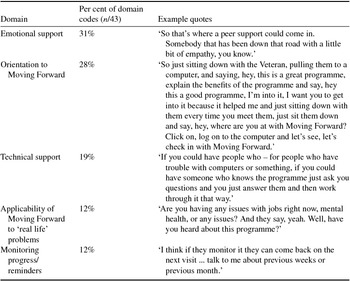
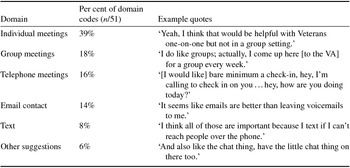
Eligible Veterans were invited to participate in a one time, 2-h focus group (Basch, Reference Basch1987) held at CAVHS. We conducted four separate focus groups with Veterans (n = 24; 5–7 per group), all of whom had a positive screen for depression and/or anxiety. The focus groups consisted of two parts: first, Veterans were given an overview of the Moving Forward programme, including a description of contents and modules, example webpages, videos, a questionnaire, and a basic outline of the content provided in each module. The focus group leader then presented the focus group objectives: to obtain feedback from focus group participants on the potential role(s) of a VA PSS in supporting Veterans in using and engaging in Moving Forward. Veterans were presented with examples of roles that may be served by a VA PSS based on the literature (e.g. Cavanagh, Reference Cavanagh2010). These included: orienting to the Moving Forward protocol; technical support; helping Veterans understand the applicability of Moving Forward skills to ‘real life’ problems; and monitoring progress and providing reminders. Opinions and feedback were also elicited from focus group members about the desirability and feasibility of a menu of methods for delivering support to be included in the prototype peer-support protocol (see Table 1).
Veteran-preferred peer activities for supporting use of Moving Forward

Moving Forward
Moving Forward (http://www.veterantraining.va.gov/movingforward/index.asp) is a cCBT-based intervention designed by the US Veterans Administration and Department of Defense as part of a larger suite of web interventions designed to support Veterans in adjusting from military to civilian life. The programme was developed over many years, beginning with its inception as a face-to-face intervention to improve quality of life and functioning in Veterans with mild to moderate distress (Tenhula et al., Reference Tenhula, Nezu, Nezu, Stewart, Miller and Steele2014). Moving Forward is grounded in problem-solving therapy, a transdiagnostic, CBT-based intervention that has a strong efficacy evidence base (Nezu et al., Reference Nezu, Nezu and D'Zurilla2012) and is classified by the American Psychological Association as an Empirically Supported Treatment for depression. The programme takes approximately 4–8 weeks to complete. Interactive exercises that incorporate animation, games, live video, self-assessment and practice tools are utilized throughout the programme. Programme content includes: CBT-based psychoeducation on the relationship between thoughts, feelings and behaviours, and the learning of skills for identifying unhelpful ways of thinking (Beck, Reference Beck1979); learning behaviour therapy techniques such as relaxation, deep breathing and meditation (Masters and Burish, Reference Masters and Burish1987); and learning and applying problem-solving skills (Nezu et al., Reference Nezu, Nezu and D'Zurilla2012) for improved coping with common problems and experiences including depression and anxiety associated with readjustment from military to civilian life.
Data analytic plan
Template analysis (King et al., Reference King, Cassell, Symon, Cassell and Symon2004) was used to deductively develop a template with two domains reflecting study goals – to identify Veterans’ preferred activities of the PSS and preferred methods for the PSS to engage in those activities (see Tables 1 and 2). Two experienced qualitative analysts reviewed each of the focus group transcripts separately. The analysts then identified elements of each domain and recorded them in the appropriate domain on the template for each focus group. The analysts then compared the items placed in each domain and resolved any discrepancies via discussion. When the two analysts had separately completed a template for a focus group, the lead analyst compared and contrasted their findings, then summarized them into a final (i.e. combined) template for each focus group. The analysts used the results of the template analysis phase to conduct a matrix analysis (Nadin and Cassell, Reference Nadin, Cassell, Cassell and Symon2004). The lead analyst constructed matrices describing Veteran suggestions for each domain, which are provided in Tables 1 and 2.
Preferred methods for delivering Moving Forward-related peer support

Results
A total of 24 individuals agreed to participate in the focus groups. Mean age of the sample was 48 years (SD = 11.17) and most participants were male (n = 17; 71%). As a group, participants indicated symptoms consistent with moderate to severe depression and/or anxiety. The mean score on the PHQ-9 was 15.04 (SD = 5.06), and the mean for the GAD-7 was 13.58 (SD = 5.60; cut-points of 5, 10 and 15 represent mild, moderate and severe levels of depressive and anxiety symptoms on the PHQ-9 and GAD-7, respectively). Twenty-two out of 24 participants (92%) said they would be willing to use the Moving Forward programme if they were having problems with depression or anxiety, and this number rose to 23 (96%) when asked if they would be more willing if they had someone like a Veteran peer to help use it.
Preferred PSS activities
Table 1 summarizes Veteran preferences for PSS activities to promote use and engagement to the Moving Forward protocol. Veterans reported the desire to have VA PSS serve five primary roles in supporting Veterans in using Moving Forward.
A. Emotional support
Statements consistent with a need for PSS to provide emotional support were common among Veterans in our focus groups, with 31% of all peer activity-related comments fitting this category. When asked about the challenges of learning the Moving Forward programme, a Veteran suggested, ‘So that's where a peer support [specialist] could come in. Somebody that has been down that road with a little bit of empathy, you know?’ Veterans also talked about fear and difficulty associated with addressing their mental health problems and seeking treatment, including online resources. For example, one Veteran said it would be helpful, ‘To see someone that actually took the courage to go through it [Moving Forward] and see the results of what it did for them, for them to be a facilitator, to be an example and say, “Hey, I don't know everything you are going through, but I can simulate or I can relate to some of the things you are going through.”’
B. Orientation to Moving Forward
Twenty-eight per cent of focus group feedback focused on the importance of having a PSS be familiar with the pragmatic aspects of Moving Forward. For example, one Veteran said, ‘I think I would need that peer support more than anything. Somebody that has already been through it and knows the programme.’ Beyond the need for practical guidance, Veterans also emphasized the role that the PSS could play as having another Veteran motivate them to use Moving Forward. When asked how a PSS might help them to get the most out of the programme, another Veteran said, ‘. . .I would be more willing [to use Moving Forward] if I had a Veteran peer to help.’ This suggests that Veterans may be more open to using the programme when another Veteran is guiding them through the protocol.
C. Technical support
A significant percentage (19%) of Veteran comments were focused on a need for technical support to promote its use. Veterans emphasized the importance of being able to ask another person about completing the various modules of Moving Forward ‘. . .to kind of help you, help navigate through it with help.’ Other Veterans anticipated the need to assist ‘people who have trouble with computers’ more generally, in addition to providing programme-specific guidance.
D. Applicability of Moving Forward to ‘real life’ problems
Veterans also discussed the importance of more nuanced guidance to help apply the skills learned in Moving Forward to ‘real life’ problems. Twelve per cent of the responses from our focus groups fit within this domain. One Veteran suggested that, as part of mental health services assessment and triage, Moving Forward could be offered as ‘one aspect of [mental health] treatment.’ Another Veteran suggested that a PSS might ask Veterans whether, ‘[they are] having any issue with jobs right now, mental health, or other issues?’ and then suggested that a PSS could help with personalizing the Moving Forward programme to help address their specific concerns or problems. Veterans also discussed the challenge of using the Moving Forward programme in the face of difficulties such as having a disability, stress associated with limited income, and the potential effect these challenges have on the Veteran's sense of pride and self-sufficiency, and overall well-being. One Veteran added that ‘everybody needs some encouragement’ in the face of such challenges and that a PSS could play an important role in helping Veterans use Moving Forward and connecting to other needed services, when appropriate.
E. Monitoring progress
Veterans (12%) described the benefits of a PSS monitoring Veterans’ progress while using the Moving Forward programme to help encourage engagement to the protocol. One Veteran said, ‘I think if they monitor [use of Moving Forward], they [PSS] can come back on the next visit and say, “Well, look, this is what we are trying to do on this [module]”, and talk to me about previous weeks or previous month, or whatever.’
Preferred PSS methods
Table 2 summarizes Veterans’ preferences for methods for delivering preferred PSS activities. The highest percentage of comments mentioned individual, in-person meetings with a PSS (38%), and Veterans also showed some support for group, in-person meetings (18%), whereas telephone, email and ‘chat’ options received relatively less support.
When asked about frequency of meetings, Veterans did not indicate a strong preference, but the most common responses were ‘once per week’ and ‘twice per week’.
Discussion
The present study obtained feedback from Veterans to guide the development of a peer-based engagement intervention to support Veterans with depression and anxiety in using Moving Forward, a cCBT-based protocol developed by VA. Focus group content was designed to solicit Veteran preferences for (a) preferred activities of VA PSS in helping Veterans utilize and engage in the Moving Forward programme, and (b) preferred methods for delivering PSS-based support to Veterans using Moving Forward. Findings from this study show that Veteran preferences for PSS activity fell into five categories of potential roles for a VA PSS. Three of these roles focused on practical aspects of using Moving Forward, including orientation to the programme, technical support, and monitoring progress. However, preferences also suggested more personal roles for the PSS, including emotional support, as well as application of Moving Forward to ‘real life’ problems.
One of the most commonly reported needs identified by Veterans for promoting engagement to Moving Forward was for a PSS to provide emotional support while using the programme. This finding is consistent with previous research showing that positive peer relationships can increase Veterans’ use of provider-delivered mental health treatment (Chinman et al., Reference Chinman, Oberman, Hanusa, Cohen, Salyers and Twamley2013). For example, one study (Sells et al., Reference Sells, Davidson, Jewell, Falzer and Rowe2006) compared patients with severe mental illness who were assigned to regular case management with those assigned a peer provider. The peer-provider group reported feeling more liked, understood and accepted by their providers, which predicted higher levels of self-reported treatment motivation 6 months later, as well as greater community treatment utilization at 12-month follow-up. Furthermore, during the first few months of the study, number of provider contacts increased among the peer-provider group, whereas the non-peer group's contacts decreased over time. Our findings extend this literature by identifying emotional support as Veteran-preferred component of a peer-support protocol designed to enhance use and engagement of online, patient-facing mental health protocols.
Veterans also reported a desire for guidance from a PSS to apply Moving Forward skills to ‘real life’ situations. This finding is consistent with prior research showing that Veterans report the need to see how skills learned in the context of mental health treatment can be used to solve ‘real world’ problems (e.g. improving relationships and managing uncomfortable emotional experiences; Sayer et al., Reference Sayer, Noorbaloochi, Frazier, Carlson, Gravely and Murdoch2010). Veterans in the present study reported that they would prefer that the PSS help them customize the Moving Forward programme to meet their individual needs beyond the general goal of reducing depression or anxiety symptoms. Veterans expressed confidence that a Veteran PSS with knowledge of the individual Veteran and experience with the VA would be able to help them apply skills to a wide array of problems. Potential target problems such as finding a job or a place to live can be varied and complex, and may not be immediately obvious in how they relate to depression and/or anxiety. Research on problem-solving describes the concept of a ‘problem’ as a life situation, present or anticipated, that (a) requires an adaptive response in order to prevent immediate or long-term negative consequences, and (b) wherein an effective response is not immediately apparent or available to the person experiencing the situation due to the existence of various obstacles or barriers (Nezu et al., Reference Nezu, Nezu and D'Zurilla2012). Veterans in this study mentioned several ‘real life’ problems consistent with this definition, including getting the most out of VA benefits, improving relationships, managing work problems, and obtaining employment. Importantly, Veterans said they believe that a PSS could offer problem-solving help above what they might get from Moving Forward alone because the PSS would have knowledge of both the Veteran and their individual problems, as well as experience with the Moving Forward programme that would allow them to target strategies in a meaningful way for the Veteran. Research suggests that adding a PSS to clinic-based CBT treatment may contribute to improved ‘real life’ outcomes, such as work stability, education and training by increasing a sense of empowerment in the patient (Repper & Carter, Reference Repper and Carter2011). For example, Craig et al. (Reference Craig, Doherty, Jamieson-Craig, Boocock and Attafua2004) found that patients with severe mental illness assigned a PSS reported improved social functioning and fewer problems and needs in areas such as work, physical health and child care. Similarly, among Veterans with severe mental illness, Chinman et al. (Reference Chinman, Oberman, Hanusa, Cohen, Salyers and Twamley2013) found that peer-supported Mental Health Integrated Case Management (MHICM) yielded improvement in life domains encompassing the ‘real life’ areas mentioned by the Veterans in our focus groups, including quality of life, and social relationships. Our findings are important in that they highlight and further extend the PSS literature by showing the expressed preference of Veterans to have a PSS help them apply skills learned in a cCBT intervention for depression and anxiety to ‘real life’ situations.
The remaining activities identified by Veterans tended to focus on practical aspects of using the Moving Forward programme, including orientation to the overall programme, technical support, and help with monitoring progress. Veterans emphasized the importance of a PSS with knowledge about the Moving Forward programme to help them understand what the programme can offer in terms of skills, and also familiarity with the Moving Forward structure, interface and functionality (e.g. software compatibility problems) to help them continue through the programme. Whereas access and acceptability are acknowledged prerequisites to the implementation of an effective intervention, it is equally important to make sure the patient has the ability to use and benefit from it (Murray, Reference Murray2012). Factors including computer literacy and health literacy can impact a patient's capacity for navigating a potentially complex process of reading, understanding and interpreting mental health information and applying it to their particular situations, contributions that the Veterans in our groups reported wanting from a PSS.
Veterans endorsed in-person support as their preference for connecting with a PSS to receive support while using Moving Forward. This preference over less personal (telephone or email) approaches to connecting with a PSS is consistent with research showing that Veterans are often interested in connecting with other Veterans when they need help (Laffaye et al., Reference Laffaye, Cavella, Drescher and Rosen2008). Although civilian life often lacks the structure and support provided by the military, working together with other Veterans may help to ‘bridge that gap’, particularly because many Veterans believe that they understand each other better than civilians do and that shared experience makes it easier to connect (Chinman et al., Reference Chinman, Young, Hassell and Davidson2006).
These findings are also consistent with a recent study comparing two versions of cCBT for depression in a primary care setting (Gilbody et al., Reference Gilbody, Littlewood, Hewitt, Brierley, Tharmanathan and Araya2015). The authors report no statistically significant difference between face-to-face and cCBT interventions, indicating that the cCBT interventions were at least as effective as treatment as usual. This study also produced a companion paper (Knowles et al., Reference Knowles, Lovell, Bower, Gilbody, Littlewood and Lester2015) in which the authors asked patients about their experiences with cCBT. They reported that the majority of participants had a mixed reaction to the programme, citing a recognition of the potential benefits against a desire for greater support when struggling with the content and delivery of the materials. The study reported in both papers utilized support that was limited to reminder calls and encouragement to participate, which participants deemed insufficient. Participants reported wanting more substantial support and monitoring, which is consistent with feedback from the Veterans in our study. The authors also noted and participants acknowledged that a higher level of support is desired and important but probably beyond the capacity of a general practitioner, which suggests a role for a blended approach in which cCBT is supplemented with support from a person and which the authors recommended be studied in their discussion. Our study represents the early stages of just such an investigation with an emphasis on support from a relatable peer and feedback from Veterans on what exactly they want from peer support to enhance engagement in a cCBT protocol. We argue that this is especially germane to Veterans who are motivated to receive care outside of a typical clinical setting.
This study has some important limitations, including its sample, which was limited to Veterans recruited in a single VA clinic and, thus, from a localized geographic area. Therefore these findings may not generalize to Veterans in other geographical locations, or to Veterans not using VA health care services. Additionally, this study investigated Veterans’ preferences for PSS activities and methods for delivering such activities for the purpose of promoting engagement to Moving Forward. However, our data do not indicate whether these preferences translate into improved engagement to Moving Forward or other cCBT-based interventions, which should be the focus of future research. Despite these limitations, the findings from this study help identify Veteran-informed activities, delivered by a PSS, which may help improve engagement to an online cCBT-based intervention. Future studies are needed to determine whether these preferred activities translate into better engagement and outcomes to online cCBT protocols among Veterans with depression and anxiety.
Acknowledgements
We are grateful to all the Veterans who took part in this research.
Ethical statements: The authors assert that all procedures contributing to this work comply with the Helsinki Declaration of 1975, and its most recent revision, and with the ethical standards of the Central Arkansas Veterans Healthcare System Institutional Review Board (no. 617407–14) and Research and Development Committee. Both governing bodies provide expert peer review of study procedures and methods to ensure they meet ethical and scientific standards of research.
Financial support: This research was supported by a Pilot Grant awarded to M.A.C. by the Department of Veterans Affairs South Central Mental Illness Research, Education, and Clinical Center (MIRECC).
Conflicts of interest: The views expressed are those of the authors, and do not necessarily reflect those of the VA. The authors have no conflicts of interest with respect to this publication.



Comments
No Comments have been published for this article.