Introduction
Cisplatin is widely used for the treatment of human solid tumours such as ovarian, testicular, cervical, head and neck, lung, and bladder cancers. However, ototoxicity can limit its utility and therapeutic profile.Reference Hartmann and Lipp1 Though the ototoxic effects of cisplatin are not limited to the auditory hair cells, outer hair cell degeneration is most commonly reported.Reference Hamers, Klis, Gispen and Smoorenburg2 Cisplatin generates reactive oxygen species such as superoxide anion, and increased reactive oxygen species inactivate antioxidant enzymes.Reference Dehne, Lautemann, Petrat, Rauen and de Groot3, Reference Pigeolet, Corbisier, Houbion, Lambert, Michiels and Raes4 This can result in calcium influx within hair cells, leading to apoptosis.Reference Clerici, DiMartino and Prasad5 Cisplatin ototoxicity can be reduced by various antioxidants which counteract this response.Reference Rybak and Kelly6
Green tea contains many polyphenolic compounds that are generally known as catechins, including: (-)-epicatechin, (-)-epigallocatechin, (-)-epicatechin gallate and (-)-epigallocatechin-3-gallate (EGCG).Reference Wei and Meng7 (-)-Epigallocatechin-3-gallate is known to have the highest antioxidant potency among all tea catechins.Reference Guo, Zhao, Li, Shen and Xin8 For this reason, the benefit of green tea is largely from EGCG. The phenolic hydroxyl groups in EGCG account for its anti-oxidative properties.Reference Mandel, Amit, Kalfon, Reznichenko and Youdim9 Biological effects of EGCG have been reported in cancer research: EGCG has been shown to reduce and inhibit the growth of various tumours.Reference Landis-Piwowar, Huo, Chen, Milacic, Shi and Chan10 Furthermore, several studies have shown that EGCG protects against a range of stimuli-induced oxidative stresses and apoptosis in vitro.Reference Choi, Jung, Lee, Bae, Baek and Suh11–Reference Yao, Ye, Zhang, Tan, Tang and Zhang14
The House Ear Institute-Organ of Corti 1 (HEI-OC1) cell line is a well-established auditory cell line to study cisplatin-induced apoptosis and cell death. This cell line was derived (postnatally) from the organ of Corti of a transgenic immortomouse.Reference Park, Park, Chang, Choi, Jung and Im15 The cell line has been used as a potential model system to screen for ototoxic chemicals and to investigate mechanisms of action. It is useful because it displays a variety of phenotypes, and because it expresses molecular markers of inner-ear sensory cells, including math1, myosin 7a and prestin, in addition to markers of non-sensory cells.Reference Chen, Hill, Guan, Schacht and Sha16
This study aimed to investigate the effect of EGCG on cisplatin-induced ototoxicity in HEI-OC1 cells and establish a potential application of EGCG for the prevention of ototoxicity after cisplatin chemotherapy.
Materials and methods
Cell culture
House Ear Institute-Organ of Corti 1 cells are extremely sensitive to ototoxic drugs and express molecular markers that are characteristic of organ of Corti cells. House Ear Institute-Organ of Corti 1 cells were cultured in high-glucose Dulbecco's modified Eagle's medium (Gibco-BRL, Grand Island, New York, USA) supplemented with 10 per cent fetal bovine serum (Lonza, Walkersville, Maryland, USA) at 33°C in a humidified incubator with 5 per cent carbon dioxide (CO2).
MTT assay
House Ear Institute-Organ of Corti 1 cells were seeded in a 24-well plate with 10 000 cells per well. They were incubated in Dulbecco's modified Eagle's medium with 10 per cent fetal bovine serum at 33°C with 5 per cent CO2. Cells were divided into four groups: control, cisplatin, EGCG and cisplatin plus EGCG. (-)-Epigallocatechin-3-gallate was purchased from Sigma (St Louis, Missouri, USA). The cells for all groups were incubated for 24 hours. In order to investigate the effects of EGCG on cisplatin ototoxicity, the cells in the cisplatin plus EGCG group were pre-treated with EGCG (50 µM) for 1 hour and exposed to cisplatin (30 µM) for 24 hours. For the MTT (3-(4,5-dimethylthiazol-2-yl)-2,5-diphenyltetrazolium bromide) assay, 50 mg/ml of MTT solution (Sigma) was added to 0.5 ml of cell suspension. The plates were then incubated for 4 hours at 33°C with 5 per cent CO2. The formazan crystals were dissolved by the addition of 500 µl per well of dimethyl sulphoxide (Sigma). Optical density was measured using a spectrophotometer (BioTek, Winooski, Vermont, USA) at 570 nm.
Hoechst 33258 staining
Hoechst 33258 staining is used to identify cells undergoing apoptosis. The viability of HEI-OC1 cells was determined by evaluating the nuclear morphology. The cells of each group were incubated with 10 µg/ml Hoechst 33258 (Sigma) for 30 minutes. After washing twice with phosphate buffered saline, the cells were detached by trypsinisation and fixed with 4 per cent paraformaldehyde for 10 minutes at room temperature. The cells were placed over the slides and mounted with glycerol after air-drying. The cells were examined using a fluorescence microscope (DM5000; Leica, Wetzlar, Germany).
Western blot analysis
The cells of each group were washed with phosphate buffered saline and lysed at 0°C for 30 minutes in lysis buffer (20 mM 4-(2-hydroxyethyl)-1-pipera-zineethanesulfonic acid (HEPES) at pH 7.4; 2 mM ethylene glycol tetra-acetic acid; 50 mM glycerol phosphate; 1 per cent Triton X-100; 10 per cent glycerol; 1 mM dithiothreitol; 1 mM phenylmethylsulfonyl fluoride; 10 µg/ml leupeptin; 10 µg/ml aprotinin; 1 mM sodium orthovanadate; and 5 mM sodium fluoride). The protein contents were measured using a Bio-Rad dye-binding microassay (Bio-Rad, Hercules, California, USA). The contents were heated for 5 minutes at 98°C in Laemmli sample buffer and were subjected to sodium dodecyl sulphate polyacrylamide gel electrophoresis (‘SDS-PAGE’) on gels. Separated proteins were transferred to nitrocellulose membranes. The membranes were blocked for 2 hours with Tris-buffered saline with Tween (10 mM Tris-HCl at pH 7.4, 150 mM sodium chloride and 0.1 per cent Tween-20) containing 5 per cent skim milk at room temperature. These were then incubated overnight at 4°C with primary antibodies: actin (Santa Cruz Biotechnology, Santa Cruz, California, USA), caspase-3 and poly-ADP-ribose polymerase (PARP; Cell Signaling Technology, Danvers, Massachusetts, USA). After 4 washes for 15 minutes with Tris-buffered saline with Tween, the membranes were incubated with the appropriate secondary antibodies (1:4000; Santa Cruz Biotechnology) in blocking buffer for 2 hours, and re-washed. The blotted proteins were detected using the Super Signal West Pico chemiluminescence kit (Thermo scientific, Waltham, Massachusetts, USA), and signals were acquired with an image analyser (LAS-3000 imaging system; FujiFilm, Tokyo, Japan).
Intracellular reactive oxygen species analysis
The intracellular reactive oxygen species level was measured using a fluorescent dye, 2',7'-dichlorofluorescein diacetate (DCFH-DA; Sigma). Briefly, the cells of each group were washed with phosphate buffered saline. This was followed by incubation with 10 µM DCFH-DA working solution for 30 minutes in the dark at 33°C. After the incubated cells were detached by trypsinisation, the cells were washed twice with phosphate buffered saline, and re-suspended in 300 µl of phosphate buffered saline. Flow cytometric analyses (10 000 events per sample) were performed using a FACSCalibur system (BD Biosciences, San Jose, California, USA) and the data were analysed with CellQuest software (BD Biosciences). The mean fluorescence intensity was used to quantify responses.
Data analysis
Statistical analysis of the results was performed using the Statistical Package for the Social Sciences software, version 19.0 (SPSS, Chicago, Illinois, USA) with the significance level set at p < 0.05. The Student's t-test was used for pairs of data.
Results
MTT assay results
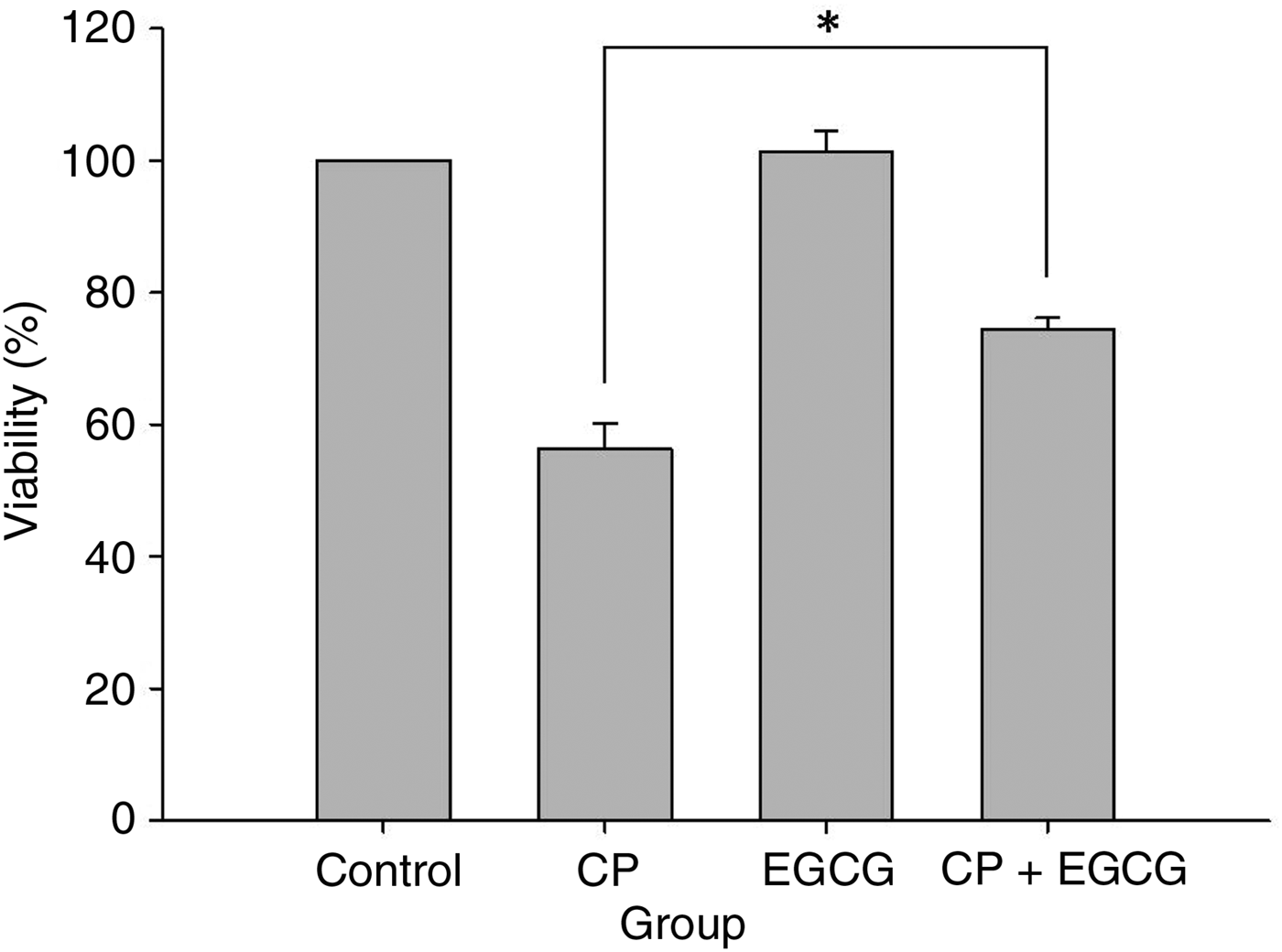
In order to investigate whether EGCG protected the cells against cisplatin-induced apoptosis, cell viability in HEI-OC1 cultures was determined by MTT assay. Figure 1 shows the cell viability of HEI-OC1 cells. When the cells were exposed to 30 µM of cisplatin for 24 hours, the viability was 54 ± 3.9 per cent. The viability of the HEI-OC1 cells was not affected by a 50 µM concentration of EGCG (viability was 101 ± 3.1 per cent). After pre-treatment with 50 µM EGCG for 1 hour, the cells were exposed to 30 µM cisplatin for 24 hours. The viability of these cells was 73 ± 1.6 per cent (Figure 1). (-)-Epigallocatechin-3-gallate protected the HEI-OC1 cells from cisplatin cytotoxicity.
Cell viability results for group cultures, as determined by MTT assay (*p < 0.05, Student's t-test). CP = cisplatin; EGCG = (-)-epigallocatechin-3-gallate

Hoechst 33258 stain results
Apoptosis was determined by the appearance of nuclei on Hoechst 33258 staining. The nuclei of the normal control cells were of a rounded shape with homogeneous intensity (Figure 2a). The reduction in HEI-OC1 cell viability was indicated in the cisplatin group, which was exposed to 30 µM of cisplatin for 24 hours. This group showed apoptotic morphology, condensation and fragmentation, with heterogeneous intensity in the nuclei (Figure 2b). Cells treated with 50 µM of EGCG alone for 24 hours showed a normal appearance, like the nuclei of control cells (Figure 2c). Pre-treatment with 50 µM EGCG for 1 hour before 30 µM cisplatin exposure for 24 hours reduced the apoptotic features of nuclei (Figure 2d). (-)-Epigallocatechin-3-gallate appeared to protect against cisplatin-induced apoptotic features.
Apoptosis results, as revealed by Hoechst 33258 staining, for: (a) control group, (b) cisplatin group (cells showed apoptotic morphology of pyknotic and condensed nuclei (arrows)), (c) (-)-Epigallocatechin-3-gallate (EGCG) group and (d) cisplatin plus EGCG group.
Western blot results
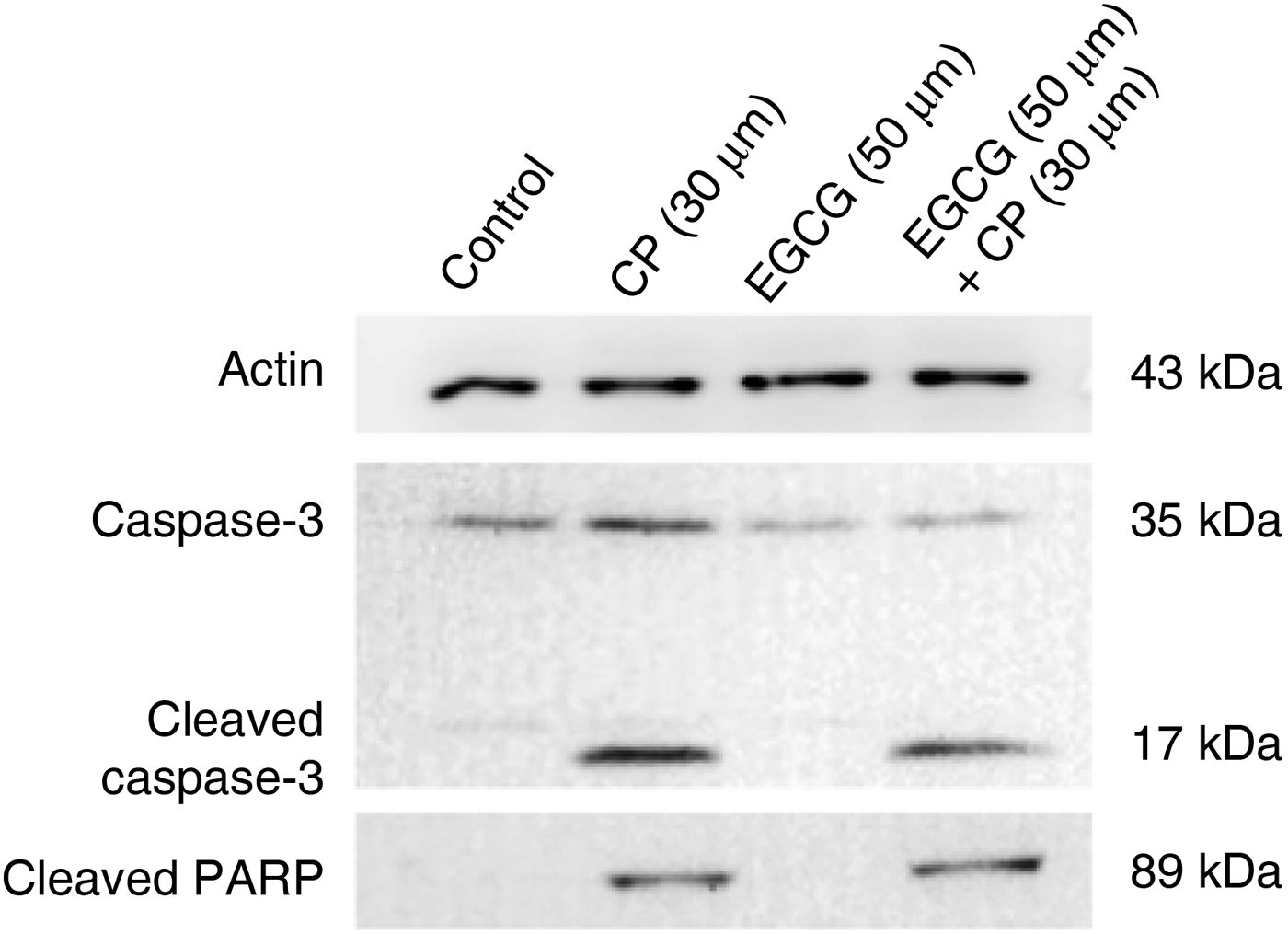
Western blot analysis was conducted to evaluate whether EGCG inhibited cisplatin-induced caspase activation. Cisplatin exposure significantly increased cleavage of caspase-3 and PARP. When cisplatin was pre-treated with EGCG, EGCG inhibited the expression of cleaved caspase-3 and caspase-3 (Figure 3). This again indicates that EGCG was able to protect HEI-OC1 cells from cisplatin-induced apoptosis by inhibiting the activation of apoptotic effectors.
Cisplatin-induced caspase activation results for each group, as revealed by Western blotting. CP = cisplatin; EGCG = (-)-epigallocatechin-3-gallate
Intracellular reactive oxygen species production
In order to investigate whether EGCG was capable of scavenging cisplatin-induced reactive oxygen species accumulation, the generation of intracellular reactive oxygen species was examined. The results revealed a significant increase of reactive oxygen species when cisplatin was applied. However, when the cells were pre-treated with EGCG for 1 hour before cisplatin exposure for 24 hours, the amount of reactive oxygen species increase was less. The cisplatin group showed a 1.81 ± 0.15 fold increase in reactive oxygen species generation, while the group pre-treated with EGCG showed a 1.22 ± 0.12 fold increase (Figure 4). This indicates that EGCG inhibited cisplatin-induced cytotoxicity by acting as a reactive oxygen species scavenger.
Intracellular reactive oxygen species (ROS) production results for each group, as determined by flow cytometry, showing: (a) intracellular reactive oxygen species cell count and (b) reactive oxygen species dependent fluorescence (*p < 0.05, Student's t-test). CP = cisplatin; EGCG = (-)-epigallocatechin-3-gallate
Discussion
Cisplatin causes cell death primarily through apoptosis; however, tumour cells in vitro may undergo necrosis in high concentrations of cisplatin.Reference Wang and Lippard17 This mechanism induces ototoxicity which limits cisplatin's usefulness. Cisplatin generates reactive oxygen species, which can deplete cochlear tissues of antioxidant protective molecules such as glutathione and antioxidant enzymes (superoxide dismutase, catalase, glutathione peroxidase and glutathione reductase). This leads to lipid peroxidation, which subsequently increases calcium influx and apoptosis in cells of the cochlea.Reference Lee, Nakagawa, Kim, Endo, Shiga and Iguchi18, Reference Alam, Ikeda, Oshima, Suzuki, Kawase and Kikuchi19 Reactive oxygen species also can activate Bax in the cytosol, leading to the release of cytochrome c from injured mitochondria into the cytosol. Cytochrome c can in turn activate caspases-9 and -3. This results in the breakdown of DNA by caspase-activated deoxyribonucleaseReference Watanabe, Inai, Jinnouchi, Baba and Yagi20 and the cleavage of fodrin within the cuticular plate of outer hair cells damaged by caspase-3, leading to apoptosis.Reference Wang, Ladrech, Pujol, Brabet, Van De Water and Puel21
Antioxidant compounds can ensure upstream protection of the cochlea before activation of the apoptosis pathway programmes cells to die and may function as free radical scavengers.Reference Rybak and Whitworth22 House Ear Institute-Organ of Corti 1 cells demonstrate decreased viability associated with an increase in reactive oxygen species production, lipid peroxidation and DNA fragmentation after cisplatin exposure.Reference Rybak, Whitworth, Mukherjea and Ramkumar23 (-)-Epigallocatechin-3-gallate has been shown to have strong anti-oxidative activity (as it reacts with oxygen free radicals), and could be an attractive protective candidate because of its lack of significant toxicity in normal cells.Reference Ahmad, Feyes, Nieminen, Agarwal and Mukhtar24 It also has many other benefits such as anti-inflammatory, anti-carcinogenic and hepatoprotective effects.Reference Lin and Lin25 Previous studies have revealed that treatment with EGCG inhibits tumour incidence and metastasis to other organs such as skin, lung, liver, breast, prostate, stomach, mammary gland and colon.Reference Mukhtar and Ahmad26 A recent study suggested that epigallocatechin can protect an auditory-like cell line from cisplatin toxicity, presumably via its antioxidant effects.Reference Kim, Kang, Pyun, Lee, Hwang and Lee27 However, of the several catechins, EGCG alone has been specifically recognised as the polyphenol primarily responsible for the chemotherapeutic effects of green tea extract.Reference Chen, Milacic, Chen, Wan, Lam and Huo28 (-)-Epigallocatechin-3-gallate has been reported to protect neurons from toxic insults in diverse in vitro studies.Reference Koh, Kwon, Kim, Kim, Kim and Yu29 Approximately 60 per cent of the catechins in green tea are EGCG. The potent anti-oxidative properties of EGCG are due to two triphenolic groups in the structure that are sensitive to oxidation and can generate quinone.Reference Jin, Shen and Zhao30 (-)-Epigallocatechin-3-gallate is also a potent radical scavenger and protects neurones from oxidative damage; it can restore cell viability and inhibit apoptosis in pro-oxidant conditions.Reference Choi, Rhee, Park, Park, Kim and Rhee31
In this study, cell viability was assessed using an MTT assay. This measures cell viability by detecting the damage in mitochondria function. Apoptosis was investigated by utilising Hoechst 33258 staining. The results of Hoechst 33258 staining and MTT assay showed that cisplatin promoted apoptotic changes, such as nuclear condensation, fragmentation and cell death, and that EGCG protected against cisplatin-induced apoptosis in the HEI-OC1 cells.
Many studies have reported that antioxidant defence systems play a key role in protecting against free radical induced tissue oxidative damage by preventing the formation of radicals, scavenging them or promoting their decomposition.Reference Young and Woodside32 (-)-Epigallocatechin-3-gallate attenuates reactive oxygen species accumulation by inhibiting the signal transducer and activator of transcription 1 (STAT1) transcription factor. The latter has been implicated in reactive oxygen species production, indicating a direct free radical scavenging effect.Reference Nie, Jin, Cao, Shen and Zhao33 In this study, EGCG significantly attenuated cisplatin-induced reactive oxygen species production. The findings indicate that the anti-apoptotic effects of EGCG on cisplatin-induced apoptosis may be related to the antioxidant potential of EGCG and its ability to scavenge reactive oxygen species.
• This study investigated anti-apoptotic and anti-oxidative properties of (-)-epigallocatechin-3-gallate (EGCG) against cisplatin-induced cytotoxicity in House Ear Institute-Organ of Corti 1 cells
• EGCG protected auditory cells from cisplatin-induced cytotoxicity
• The protective effect of EGCG was due to anti-apoptotic and anti-oxidative properties
The biochemical process of apoptosis proceeds via two main pathways: extrinsic (cytoplasmic) and intrinsic (mitochondrial) pathways. Both pathways converge to lead the activation of caspase-3. Caspase-3 serves important functions in apoptosis, such as DNA fragmentation and the formation of apoptotic bodies which are then phagocytosed.Reference Gonçalves, Silveira, Teixeira and Hyppolito34 We demonstrated that cisplatin enhances caspase-3 activity, while EGCG attenuates the activation of caspase-3 in HEI-OC1 cells.
In the current study, we analysed the protective effects of EGCG in cultured HEI-OC1 cells, and showed that EGCG significantly suppressed cisplatin-induced apoptosis and increased cell viability in HEI-OC1 cells. This suggests that EGCG reinforces anti-apoptotic and anti-oxidative activity and can therefore play a preventive role against cisplatin-induced ototoxicity.
Conclusion
Ototoxicity is a frequent side effect of cisplatin chemotherapy. The ototoxicity appears to be triggered by reactive oxygen species, which leads to apoptosis of the outer hair cells. (-)-Epigallocatechin-3-gallate prevents the generation of reactive oxygen species and thus blocks the downstream cascade that leads to cell death. Therefore, EGCG has the potential to act as a preventive agent against cisplatin-induced ototoxicity because of its anti-apoptotic and anti-oxidative properties.
Acknowledgement
This study was supported by research funding from Chosun University (awarded in 2012).