Motivation for additive manufacturing of aluminum alloys
Aluminum alloys (AAs) are in great demand in many sectors, including the automotive, aerospace, and aircraft industries. With advances in additive manufacturing (AM) techniques, process time and cost of building Al-based components can be greatly reduced. Reference Gibson, Rosen and Stucker1,Reference Chua and Leong2 Options for fabricating complex geometries as one piece have opened up. The main conceptual fields of applications where AM of AAs would be disruptive include:
-
1. Lightweighting—AM permits the fabrication of hollow or shell-type structures, or the use of lattice configurations for the design of lightweight components. Functional and ultralight parts can now be considered. Included in this concept is the replacement of castings with configurations that were previously unattainable, such as thinner construction than the minimum wall thickness technologically feasible through casting.
-
2. Components with conformal cooling channels—AAs are often used in applications where cooling is present or could be added to increase the service performance of the component. Included in this concept are thermal management designs, where increased control over heat dissipation can be obtained.
-
3. High-cost AAs—AM is recognized to reduce the buy-to-usage ratio (or the proportion of raw material wasted) when compared to conventional manufacturing. In that context, better management of high-cost alloys can be achieved. Reference Gibson, Rosen and Stucker1,Reference Chua and Leong2
Despite these applications, technological challenges remain to be elucidated to reduce processing problems and metallurgical defects to allow fabrication of repeatable and reliable components. The aim of this article is to highlight the main challenges and the current state of this technology.
Challenges underpinning AM of AAs
Before describing the current status of the technology, a few considerations underpinning AM of AAs must be discussed, as they can hinder the production of high-quality and high-density components. Solidification of the molten metal powder during selective laser melting (SLM) is comparable to solidification phenomena observed in the welding process (see the Introductory article in this issue). The inherent physical properties of AAs, such as surface oxide scale, high thermal conductivity, high coefficient of thermal expansion and high solidification shrinkage, wide solidification temperature range, and high solubility of hydrogen, dictate their weldability. Reference Lampman3 Several techniques and procedures, described elsewhere, Reference Lampman3 have been developed to overcome these issues in the context of a weldment. Included in a nonexhaustive list is pretreatment of the material, proper selection of the alloy composition, addition of a grain refiner, or modification of the heat input to disrupt the solidification behavior. Reference Lampman3 These guidelines are key for the production of sound Al AM parts using either foil or wire as a starting material.
However, as the key starting material utilized in the AM industry is metallic powder, the challenges related to the weldability of AAs are amplified. The main issues, which are addressed next, are powder flowability, high thermal conductivity, and natural surface oxide film.
Powder flowability
Powder flowability and associated characteristics, such as apparent density, are critical for consistent powder spreading, which in turn is one of the major factors driving porosity of the final part. Poor Al powder flowability is due to its light weight. Reference Gu, Meiners, Wissenbach and Popraw4 Additionally, agglomeration of fine-powder particles and powder bridging during fabrication will further hinder its flowability or quality of the spread layer. Reference Louvis, Fox and Sutcliffe5,Reference Manfredi, Calignano, Krishnan, Canali, Ambrosio and Atzeni6 The powder particle size distribution also plays an important role in the flowability. Small particle sizes typically exhibit increased oxide contamination that influences the interparticle interactions and agglomeration caused by van der Waals forces that dominate the lightweight particles.
High thermal conductivity
Al and AAs are known to possess very high thermal conductivities when compared to the other materials used in AM. The immediate consequence is that the laser-energy density must be increased to promote effective melting. On the other hand, increased input energy can lead to loss of alloying elements and other problems associated with solidification such as lack of fusion or the balling effect (when the molten metal forms balls instead of flowing freely). Reference Cao, Wallace, Poon and Immarigeon7
Natural surface oxide film
The presence of a surface oxide film on the Al powder is another challenge. The natural oxide films have a higher melting temperature than the powder particle itself. Alloying elements also produce scales with different compositions, such as spinel or mullite, that are more difficult to disrupt or eliminate. During SLM, melting of the oxide films can deteriorate melt pool stability and hinder wettability. Reference Louvis, Fox and Sutcliffe5,Reference Olakanmi8 Any unmelted oxides trapped inside the melt pool lead to pores and defects in the final product. Reference Louvis, Fox and Sutcliffe5 These solid inclusions can also act as fracture initiation sites.
Processes compatible with AM of AAs
Despite the described challenges inherent to AM of AAs, part manufacture was found to be possible using processes such as powder bed and direct energy deposition. The following briefly describes these processes and how the challenges were overcome (also see the Introductory article in this issue). Gibson et al. Reference Gibson, Rosen and Stucker1 discuss process schematics and a more detailed description of the respective peculiarities.
One of the most explored AM technologies for the production of near-net shape Al components in the last five years is SLM. Reference Louvis, Fox and Sutcliffe5,Reference Manfredi, Calignano, Krishnan, Canali, Ambrosio and Atzeni6,Reference Olakanmi8–Reference Zhang, Zhu, Qi, Hu and Zeng18 SLM uses a powder bed to provide the powder material for the construction of a near-net shaped product. The typical building steps begin with the spreading of a powder layer, usually <100 µm in thickness, delivered by a recoating mechanism such as a blade or roller. It is then selectively melted and solidified by the laser raster path. The build platform is then lowered by one layer increment, and the previously described cycle combining recoating, melting, and lowering of the build platform is repeated until complete part fabrication is achieved. Welding parameters are optimized in order to develop the highest part density, approaching 100%. Selective laser sintering (SLS) is identical to SLM aside from the fact that in this case, the laser sinters the powder as opposed to complete melting. The components produced are thus porous and necessitate a subsequent infiltration step to reach full density.
Direct energy deposition (DED) processes involve the direct feed of the starting material into the heat source at the desired location. This family of AM processes can be subdivided into two categories: powder deposition and wire deposition. In the former, AA powders are delivered through a coaxial or concentric nozzle using a gas delivery system. A nozzle-centered laser beam produces the melt pool, and the computer-control process precisely adjusts the delivery of melt powder and x–y motion, creating an individual deposit layer. Controlled iteration of the procedure in the z-axis ultimately leads to product fabrication. Reference Gibson, Rosen and Stucker1 The processing concept for the latter family, DED wire, is similar other than a welding wire being used for the deposited material. A larger number of heat sources were found to be effective to build Al parts by DED, including laser, electron-beam, plasma transferred, and metal inert-gas welding.
Microstructure and properties of AA AM parts
There are three main AA families: pure Al, casting alloys, and wrought alloys, of which the latter are subdivided into nonheat-treatable and heat-treatable alloys. Each of these alloys has well-balanced alloying element content, added to obtain specific properties. The following discussion summarizes the existing processing–microstructure–properties characteristics for these different AA families.
Pure aluminum
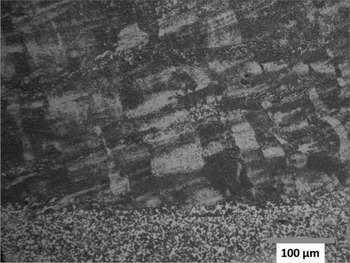
Pure metals, aside from precious alloys, have not received significant attention in terms of AM process optimization. Including Al, the main reason is the limited mechanical properties of pure metals when compared to their alloy counterparts. Work by the current authors on SLM of commercial pure Al (cp-Al) using Valimet H-15 powder has shown the development of large columnar grains from epitaxy, as shown in Figure 1 , similar to that obtained from welding of pure Al. Correspondingly, the associated mechanical properties are similar to those obtained from welding. The microhardness of pure Al constructs revealed an average value of 39 ± 2 HV, which is similar to the hardness obtained for pure Al welds, Reference Olson, Siewert, Liu and Edwards19 and twice the reported value for cast products (≈21 HV). Reference Xu and Langdon20–Reference Zhilyaev, Oh-ishi, Langdon and McNelley22 By association, forecasted mechanical properties should fall within the range of the pure Al welds data: 31–41 MPa for yield strength, 90–93 MPa for ultimate tensile strength, and 23–29% for elongation. Reference Olson, Siewert, Liu and Edwards19
Grain structure emerging from the base plate for printed cp-Al (commercial pure) using Valimet H-15 powder through the selective laser melting process.

Casting alloys
The most studied AA family in AM is foundry alloys, commonly known as Al-Si alloys. The high Si-content in these alloys, ranging from 7–20%, significantly modifies melt properties such as fluidity, thus facilitating the fabrication of sound components. In that context, many AM processes were shown to be viable.
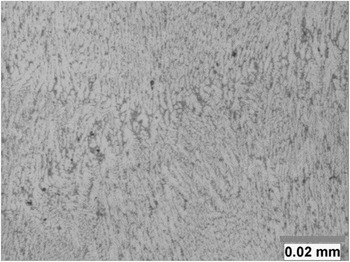
The bulk of the available data is for the AlSi10Mg and AlSi12 systems. Several works have shown microstructure–processing parameters optimization, and key interrelations such as optimal energy density, small hatch spacing, and altering scan strategies were found to minimize porosity and improve the mechanical properties. Reference Olakanmi, Cochrane and Dalgarno23–Reference Brandl, Heckenberger, Holzinger and Buchbinder25 In addition, powder-pretreatment, such as drying, was found to be beneficial for good quality of the builds. Reference Li, O’Donnell and Sercombe26 Figure 2 shows a typical solidification structure for an AlSi10Mg alloy, where Al dendrites surrounded by Al-Si phase segregated at the interdendritic region can be observed. The additional advantages of SLM enhance the ability to tailor/refine the microstructure, thus providing additional strength to AM parts. From the solidification characteristics of this system, epitaxial growth is to be expected, which could yield to a certain degree of anisotropy. Thijs et al. have shown that control of the microstructure texture can be obtained by tailoring the laser scan raster path, thus reducing the anisotropy. Reference Thijs, Kempen, Kruth and Van Humbeeck27 They also showed that by proper optimization of the processing parameters, an extremely fine microstructure, hence high strength, can be obtained. Reference Thijs, Kempen, Kruth and Van Humbeeck27 Work by Chou et al. has shown very attractive results in terms of further refining and altering the microstructure. Reference Chou, Milligan, Paliwal and Brochu13 Specifically, the size of the solidification features was reduced by one-half, suggesting a possible strength increase and disruption of the epitaxial growth where the grain columnar growth remained within each individual solidified melt pool.
Typical microstructure of a solidified AlSi10Mg alloy, where Al islands are surrounded by gray Si walls.

Another important aspect for this family of alloys is their age-hardening response. Several studies have shown that the solution step of the typical T6 heat treatment has the effect of transforming the dendritic microstructure into a globular silicon second phase in an Al matrix Reference Brandl, Heckenberger, Holzinger and Buchbinder25,Reference Li, Wang, Saunders, Suvorova, Zhang, Liu, Fang, Huang and Sercombe28 and removal of the microstructural refinement, resulting in a loss of strength. However, Brandl et al. found that the T6 heat treatment improved the fatigue properties of SLM-built A110SiMg. Reference Brandl, Heckenberger, Holzinger and Buchbinder25 Li et al. found that solution heat treatment improved the ductility of SLM built A112Si. Reference Li, Wang, Saunders, Suvorova, Zhang, Liu, Fang, Huang and Sercombe28 Chou et al. also observed this Ostwald ripening phenomenon and associated reduction in strength and hardness, and increase in ductility. Reference Chou, Ghosh, Chou, Paliwal and Brochu29
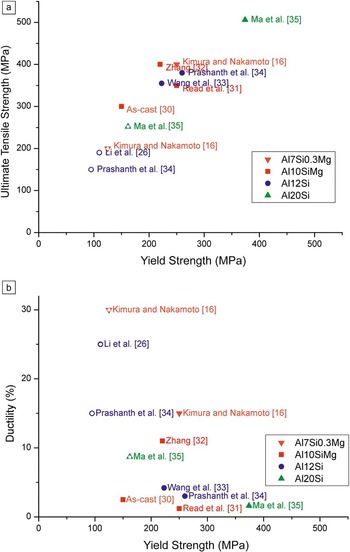
Figure 3 Reference Kimura and Nakamoto16,Reference Li, O’Donnell and Sercombe26,Reference Kempen, Thijs, Van Humbeeck and Kruth30–Reference Ma, Prashanth, Scudino, Jia, Wang, Zou, Wei and Eckert35 shows a mapping of the existing literature data of the mechanical properties for the Al-Si alloys. Figure 3a shows the relationship between yield strength (YS) and ultimate tensile strength (UTS), while Figure 3b shows the UTS–ductility relationship. As demonstrated in both figures, heat treatment increases ductility, while tensile strengths (both UTS and YS) are sacrificed.
Relationships between mechanical properties (as reported in literature) of Al-Si alloys processed by selective laser melting. Ultimate tensile strength is plotted versus yield strength in (a), and ductility is plotted against yield tensile strength in (b). Open symbols represent data acquired after heat treatment, and solid symbols represent data acquired without heat treatment.

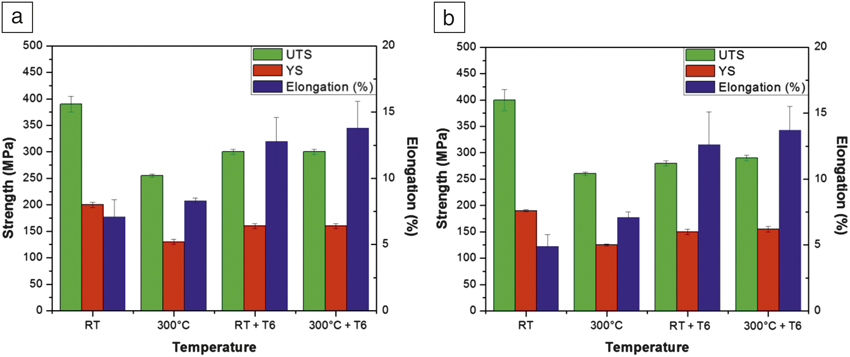
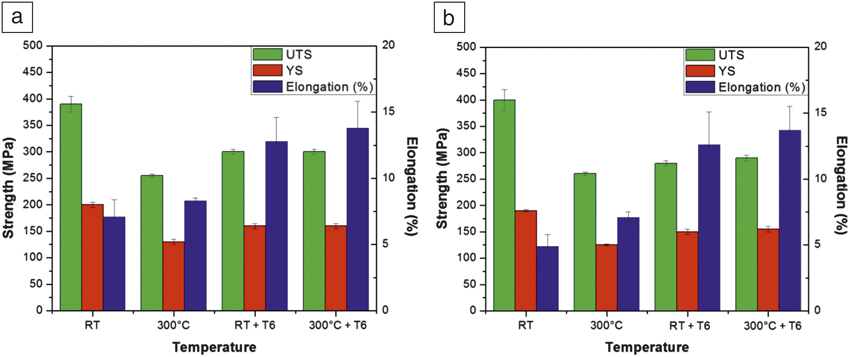
Another casting alloy investigated by Buchbinder Reference Buchbinder36 is AlSi9Cu3. Similarly to the previously described studies, with optimization of the processing parameters, densities of >99% can be achieved. Similar to AlSiMg-based alloys, the microstructure of this Cu-containing alloy is composed of Al dendrites, with the Al-Si phase located at the interdendritic region. The microhardness data reported match the microstructure, where within the matrix of build temperature and build speed, the data ranged between 90 and 115 HV, with the lower hardness associated with the built condition favoring a coarse microstructure. This alloy is also heat treatable under the T6 condition. As for the AlSiMg alloys, this heat treatment produces Ostwald ripening of the interdendritic phase. The available mechanical data for this alloy are shown in Figure 4 . Reference Buchbinder36
Mechanical properties (ultimate tensile strength [UTS], yield strength [YS], and elongation) of AlSi9Cu3 fabricated by selective laser melting, along the (a) x-direction and (b) z-direction, for parts printed at room temperature (RT) or 300°C, and with and without the T6 heat treatment. Reference Buchbinder36
With respect to DED powder, only a few studies using AlSi10Mg Reference Javidani, Arreguin-Zavala, Danovitch, Tian and Brochu37 and AlSi11 Reference Dinda, Dasgupta and Mazumder38 are available in the open literature. The solidification conditions imposed during this process are intermediate to the SLM and the welding-based AM processes, and thus the initial few layers were shown to have a cellular structure with a transition toward columnar dendritic with fibrous eutectic for the bulk of the component. The cooling rate reported, using the dendrite arm spacing methodology, ranged in the 103–104°C/s magnitude. The reported hardness value was 60 HV for the AlSi10Mg, while a hardness of 107 HV, associated with increased Si content and refined solidification structure, was measured for the AlSi11 alloy. In both cases, mechanical properties have not been reported.
With respect to the DED wire, the results available in the literature suggest that DED wire using a welding process will yield similar or slightly better properties than an as-cast part, due to the refined microstructure. Heard et al. studied AM of the alloy 4047 using the controlled-short-circuit metal inert-gas welding process. Reference Heard, Brophy and Brochu39 The microstructure resulting from this AM process is a fine primary Al dendrite with dendrite arm spacing (DAS) ranging between 2.0 and 4.8 µm. Despite the similarity with a casting microstructure, the solidification condition yielded a fibrous morphology, indicating that the solidification front velocity exceeded the transitional value of 0.9 mm/s, at which the Si eutectic becomes fibrous. The mechanical properties were slightly superior to the equivalent 4047 as-cast condition associated with the fibrous morphology. A hardness value of 70 HV was measured. Bending strength and ductility of 388 ± 35 MPa and 18 ± 2%, respectively, for the AM part versus 357 ± 11 MPa and 9 ± 1%, respectively for the as-cast comparison were obtained. Haselhuhn et al. reported similar work in gas metal arc welding of AA4043 (which has a slightly lower Si content), showing a DAS of 7 µm and an associated hardness of 50 HV. Reference Haselhuhn, Wijnen, Anzalone, Sanders and Pearce40
As expected, the microstructure–processing–properties relationship for the casting alloys is favorable for AM. The high fluidity provided by the high Si content permits obtaining high-quality parts. The next key concepts to be mastered are their response to dynamic loading conditions—data that should be available in the years to come.
Nonheat-treatable wrought alloys
This category of alloys includes the 3XXX and the 5XXX family, in which strength is obtained by the insertion of solid-solution elements, such as Mn for the former and Mg for the latter. These alloys have not received significant attention for AM to date. Particularly for the Al-Mg system, the presence of Mg changes the surface oxide film toward a spinel (MgAl2O4); Reference Dunkley41 a scale that is harder to disrupt during fabrication. Moreover, the addition of Mg reduces the surface tension and increases the melt viscosity, reducing wettability, thus yielding poor density. The high vapor pressure of Mg allows to vaporize during fabrication, with the possibility of lower-alloy content than the specific composition. Work by Olakanmi et al. Reference Olakanmi8 showed that an average density of 1.4 g/cm3 and a hardness of 85 kgf/mm2 for Al-6Mg were achieved by SLM. Reference Olakanmi8 Park et al. Reference Park, Hur, Kim, Ahn and Ha42 reported similar findings.
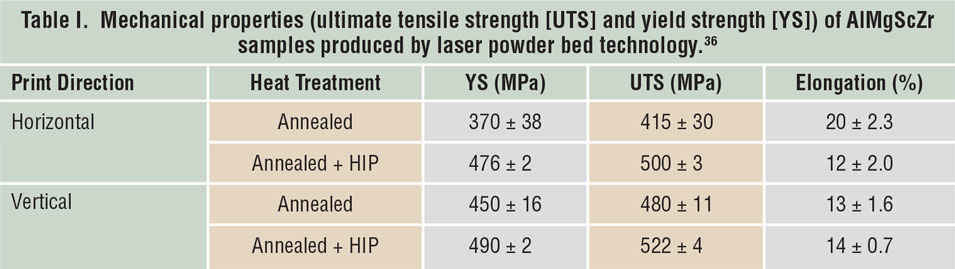
The development of new alloys is key to circumventing the previously reported issues—the AlMgSc-based alloy is a key example. These alloys, also known as Scalmalloy, are described as corrosion-resistant materials with the specific strength of titanium and simultaneously high ductility. Reference Gehm43 A report by Buchbinder Reference Buchbinder36 showed that a Al3Sc (+Zr) L12 phase acts as a grain refiner during the primary solidification phase for these alloys. Upon proper combination of AM processing parameters and heat treatment, the as-built hardness ranged between 80–110 HV, while after a heat treatment, hardness of 160 HV was measured. The reported mechanical properties as a function of the different processing parameters are shown in Table I .
Mechanical properties (ultimate tensile strength [UTS] and yield strength [YS]) of AlMgScZr samples produced by laser powder bed technology. Reference Buchbinder36

Annealed: 300°C for 4 h; annealed + hot isostatic pressing (HIP): 300°C for 4 h followed by HIP at 300°C for 4 h.
Heat-treatable wrought alloys
This category of alloys comprises the Al-Cu-Mg (2XXX), Al-Si-Mg (6XXX), and Al-Zn-Mg-Cu (7XXX) families. They all exhibit a key response to the precipitation-hardening heat-treatment cycle that is composed of a high-temperature solution stage, quench, and either natural or artificial aging. A complete description of the metallurgical phenomenon for these alloys can be found in a report by Lumley. Reference Lumley44 The key challenge related to any process involving solidification of these alloys is solidification cracking. The complex competitive interactions involve thermal, chemical, and mechanical aspects, where cracking occurs from the rupture of the thin liquid film present in the interdendritic region when exposed to tensile stress near terminal solidification. As described by Kou, Reference Kou45 in each of these alloy systems, a critical content of solute exists that corresponds to this thin-liquid-film formation. Alloys possessing solute concentrations in this range are considered unweldable and thus are not readily applicable to AM. Alloys containing either higher- or lower-solute concentrations are not affected by this phenomenon and thus are more compatible with AM.
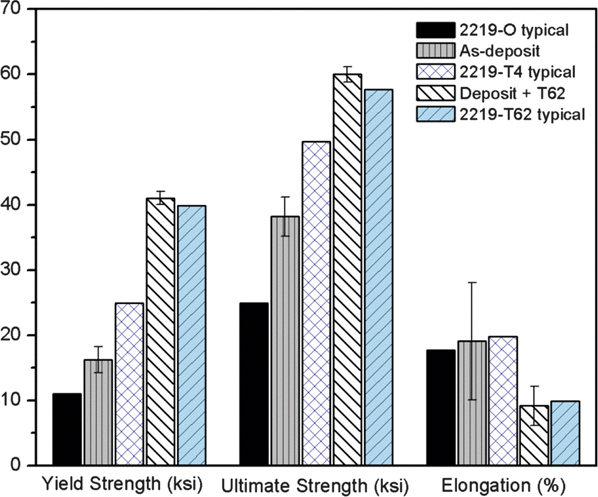
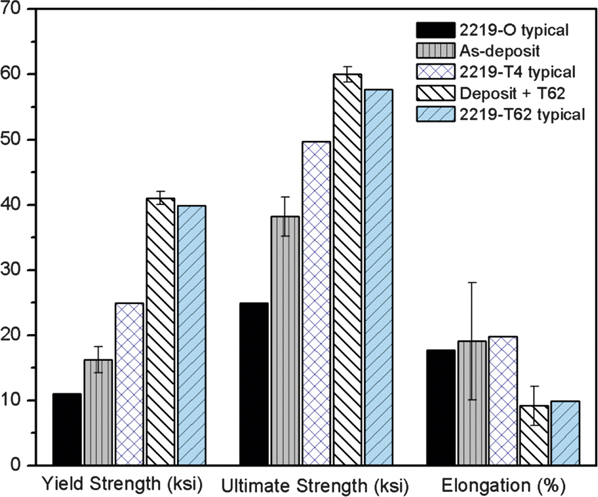
With respect to the Al-Cu-Mg (2XXX) family, a noteworthy example is electron-beam freeform fabrication (EBF Reference Lampman3 ) of alloy 2219, Reference Taminger and Hafley46 an alloy containing 6% Cu, which is outside the crack sensitivity range. Microstructurally, deposits with very little porosity, no cracking, and complete fusion between deposited layers were obtained. Bands of dendrites between the grain boundaries defined the interpass region, which is remelted by the subsequent layers. Additionally, the authors reported that with a combination of high translation speed and feed rates, the cooling rate can be increased, which gives rise to a homogeneous small equiaxed grain structure with no evidence of dendrite coarsening in the interpass region. The mechanical properties in the T62 condition matched the typical T62 temper of commercial sheet and plate fabricated by traditional methods, as shown in Figure 5 .
Comparison of mechanical properties of alloy 2219 after different processes. Reprinted with permission from Reference Reference Taminger and Hafley46. © 2002 The University of Texas at Austin.
Zhang et al. Reference Zhang, Zhu, Qi, Hu and Zeng18 studied the SLM of the Al-4.24Cu-1.97Mg-0.56Mn alloy using a continuous wave laser. The authors reported AM parts free of imperfections and cracks with a density of 99.8% when an energy density of 340 J/mm3 was employed. The obtained microstructure from this alloy consisted of large regions with cellular structures ranging from 1–2 µm in size and separated by thin boundaries with a coarse-dendritic structure. The resulting mechanical properties in the as-fabricated condition were a microhardness value of 111 HV, an ultimate tensile strength of 402 MPa, and a yield strength of 276 MPa, which were slightly higher than those achieved with a 2024-O temper heat treatment but lower than the T6 condition.
Regarding the Al-Si-Mg (6XXX) family, Louvis et al. Reference Louvis, Fox and Sutcliffe5 achieved the production of 89.5% dense parts of AA6061 using a continuous-wave laser with an energy output of 100 W. Their work was mainly focused on clarifying the importance of oxide films during SLM processing of AAs. Thus, the mechanical properties of AM parts of this alloy were not presented.
One strategy deployed to overcome the solidification cracking issue for these alloys was reported by Sercombe and Schaffer, who used a SLS-infiltration process to produce AM aluminum parts made of a 6061 Al alloy bonded by Al-Cu or Al-Si-Mg alloys. Reference Sercombe and Schaffer47 An SLS preform was originally fabricated and infiltration with the molten alloy at a temperature of up to 570°C was carried out, yielding densities higher than 95%. The reported tensile strength when the Al-Cu infiltrant was used was 230 MPa with negligible ductility. The fracture in the samples propagated at the interface with the infiltrant.
Summary
AM of Al alloys is a technological field that is still in its infancy in terms of industrial adoption. Al alloys can be classified into three families: pure, cast, and wrought alloys. They have in common the presence of a tenacious oxide scale, high thermal conductivity, and large solidification shrinkage—physical properties that are prone to metallurgical defects. This article has demonstrated that alloys with properties favoring weldability and castability are more suitable for AM. In addition, the processing strategies developed over the years to improve manufacturing are also beneficial for their additive manufacturability. The growing interest and progression of research work is expected to bring AM of Al alloys closer to full industrial adoption soon.