In 1995 Mel Bay Publications of St. Louis issued a collection of jigs, reels, hornpipes, and other instrumental tunes titled Ryan's Mammoth Collection.Footnote 1 Although authorship is attributed to musician Patrick Sky, this work was not new, but a somewhat modified and incomplete reprint of a tune collection published in Boston in 1883 by Elias Howe, Jr., and compiled by a local Boston musician named William Bradbury Ryan.Footnote 2 Pat Sky contributed a historical introduction to the reprint that included some biographical information about Ryan and Howe, as well as other materials that help put Ryan's Mammoth Collection in historical context.Footnote 3
Many North American fiddlers were already familiar with the musical contents of Ryan's even if they did not necessarily realize it; the music had been in print for years in the guise of One Thousand Fiddle Tunes, published by the M. M. Cole Company of Chicago in 1940.Footnote 4 Commonly, if improperly, called “Cole's,” this edition of the collection is widely known and has been used as a source of tunes by fiddlers as geographically dispersed and stylistically diverse as Texan Benny Thomasson, Alabaman James Bryan, and Cape Bretoner Winston Fitzgerald. It was the first printed collection of fiddle tunes that I personally encountered, soon after I began my exploration of the instrument and its music in the early 1970s.
The musical content of the collection is quite diverse. Jigs, reels, and hornpipes dominate, but there are also many Scottish strathspeys—a variant form of the reel featuring dotted-eighth/sixteenth-note rhythmic patterns—and over forty “straight jigs”—highly syncopated tunes in 2/4 time from the blackface minstrel repertoire. The original edition of Ryan's Mammoth Collection contains separate listings in the table of contents for “Jigs”—that is, tunes in 6/8 or 9/8 time—and “Straight Jigs.” This distinction was not retained in the tables of contents in either the M. M. Cole or Mel Bay editions. Also, in the table of contents of the original edition, the jigs in 9/8 time—commonly called “slip jigs” in Irish tradition—carry the indication “slip” in parentheses following the tune title. This designation appears nowhere else in any edition of the collection.
Even fiddlers who are not well versed in Irish tradition easily recognize that the book has a large Irish component, both because of musical characteristics—the large number of “regular” jigs (approximately 234) and the nature of many of the reels—and because of the many tune titles that reflect or suggest an Irish pedigree: “Farewell to Erin,” “Dublin Lasses,” “Old Maids of Galway,” “Flowers of Limerick,” “Muldoon's Favorite,” “Billy O'Rourke's,” “Connaught Man's Rambles,” and “Kilkenny Rovers,” to name just a few. Some of these pieces, and others in the book, enjoy currency in Irish music today.
Because the M. M. Cole edition and the Irish element of the collection have been so familiar to so many for so long, the enthusiastic reception accorded the Mel Bay reprint in today's Irish music community, especially in Ireland, came as something of a surprise. Judging from the attention the new edition garnered, it is apparent that earlier incarnations of the work were little known in Ireland.Footnote 5 Scholar Breandán Breathnach had access to a copy of One Thousand Fiddle Tunes, or possibly the original edition of Ryan's, because he cites it in his annotations in Ceol Rince na hÉireann.Footnote 6 There is some thought that certain Irish fiddlers were familiar with the collection, but to a great many people in Ireland the Mel Bay edition was their introduction to this body of tunes.Footnote 7 The publication of the reprint sparked a brisk flurry of chat on Internet discussion groups.
One by-product of this new awareness of the Ryan collection in Irish music circles was speculation about the possibility that Ryan's Mammoth Collection served as an uncredited source for Capt. Francis O'Neill in compiling his own tune collections at the beginning of the twentieth century.Footnote 8 Again, this idea was by no means new, as numerous U.S. scholars and enthusiasts, myself included, had long suspected that the good captain had drawn material from the earlier work, and that the Mammoth Collection ought to be viewed as the first important collection of Irish American tunes.Footnote 9 Following the appearance of the new reprint, however, a fresh set of minds and eyes turned to the question. Musicians and tune scholars Caoimhín Mac Aoidh, Paul de Grae, and Philippe Varlet are among those whose curiosity was aroused, and the four of us have compared notes on tunes and settings that are common to Ryan's and O'Neill's collections.Footnote 10 Mac Aoidh quite neatly discovered a pattern that linked certain tunes printed by O'Neill in his Music of Ireland with tunes from Ryan's. He published the results of his research in his recent book The Scribe: The Life and Works of James O'Neill, a biography of the man who collaborated with Capt. Francis O'Neill.Footnote 11
Exploring this link to O'Neill has been fascinating, but it leaves unanswered what is, to me, the fundamental question regarding the Mammoth Collection: where did Ryan get his tunes? This issue has intrigued me from the time I first encountered the collection (in the form of One Thousand Fiddle Tunes) in 1971. Even as naïve about fiddling and tune collections as I was at the time, I recognized that the book led into musical territory quite different from the world of southern old-time and bluegrass music with which I was familiar. The typography was old-fashioned, and many of the tune titles evoked the nineteenth-century North rather than the twentieth-century South: “The Boston Reel,” “President Grant's Hornpipe,” “Telephone Hornpipe,” “‘Swallow’ Sloop of War Reel,” “General Sheridan's Reel,” “Belles of South Boston,” “Cape Cod Reel,” and many others. Where did these tunes come from? Were there fiddlers somewhere, at some time, who had them in their active repertoires?
As it happened, my own budding interest in fiddling coincided with a general blossoming of the study of traditional U.S. instrumental music in the 1970s. One of the fruits of this activity was that a bit of information about the history of the Cole collection came to light. In his annotation for the LP American Fiddle Tunes from the Library of Congress, fiddler and scholar Alan Jabbour confirmed that One Thousand Fiddle Tunes was, indeed, a reprint of an earlier work: Ryan's Mammoth Collection [of] 1050 Reels and Jigs, Hornpipes, Clogs, Walk-arounds, Essences, Strathspeys, Highland Flings and Contra Dances, with Figures, and How to Play Them, published by Elias Howe in Boston, in Reference Ryan William1883.Footnote 12 The original edition of the Mammoth Collection carries no attribution of authorship, but Jabbour identified the “Ryan” who compiled it as William Bradbury Ryan, presumably by searching the copyright records at the Library of Congress. Jabbour did not delve further into the history of the collection, or at least not in any published work.Footnote 13
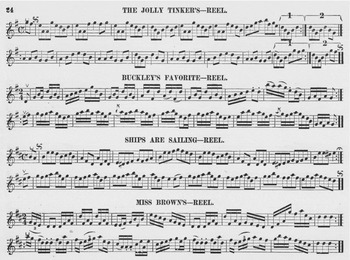
The M. M. Cole edition is not an exact facsimile of the original. In its initial incarnation, as published by Elias Howe, the book was in the old oblong format, approximately 8 inches high by 10.75 inches wide, usually with four tunes per page (see Figure 1). One Thousand Fiddle Tunes is printed in modern upright song folio format, approximately 11.5 inches high by 8.75 inches wide. The music was reduced so that two pages from the Mammoth Collection were combined to form one in One Thousand Fiddle Tunes. Twelve pages of music, containing forty-seven tunes, as well as the “Forty Introductory Studies for the Violin . . .” that are noted on the cover and title page of Ryan's original, were unaccountably omitted from the Cole edition (see footnote 4).
Sample page from Ryan's Mammoth Collection(1883). Most of these reels are still played in modern Irish tradition. Author's collection.

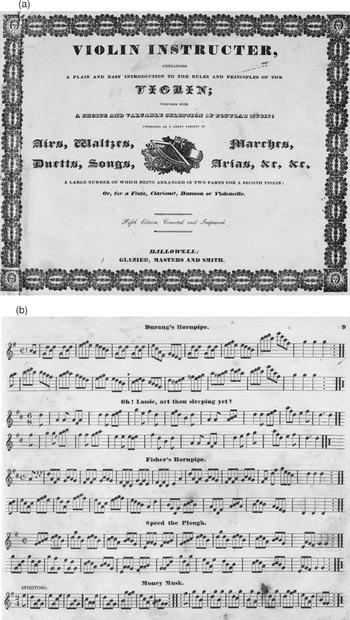
The Mammoth Collection is, by any measure, an extraordinary work, and in comparison to other nineteenth-century U.S. tunebooks, it stands out as an exceptional production. Although instrumental tutors and tunebooks containing jigs, reels, and hornpipes have been printed in the United States from the early nineteenth century onward, none can compare with the Mammoth Collection in scope or character. Collections such as Riley's Flute Melodies, New and Complete Preceptor for the Violin, and Violin Instructer [sic] have a smattering of traditional dance tunes, mixed in with marches, melodies of popular songs, and operatic airs (see Figure 2).Footnote 14 The few collections that predate the Mammoth Collection that do consist primarily of fiddle tunes are much smaller works, containing fewer than 150 pieces.Footnote 15
Cover and sample from Violin Instructer (Hallowell, ME, 1828). The inclusion of hornpipes and reels alongside popular song airs was typical of instrumental tutors of the era. Author's collection.

Although these collections provide historians with a sense of what tunes were in circulation at the time they were published, they by no means document the depth and breadth of the repertoire, and reflect oral tradition in only a limited way, at best. To employ Charles Seeger's terminology, they are examples of prescriptive rather than descriptive notation; that is, the tune settings in them are intended to serve as models of how to play particular tunes, rather than to illustrate how these tunes are played by practitioners of a certain stylistic tradition, or to document the full range of the repertoire in that tradition.Footnote 16
The Mammoth Collection, on the other hand, has all the earmarks of a descriptive collection—even if it probably was not intended as such. The repertoire is much deeper than that found in contemporaneous tunebooks. It contains not just a few jigs, reels, and hornpipes, but consists almost entirely of them. Certain standard tunes turn up in many tune collections, and often these “standards” are all that one finds.Footnote 17 Although Ryan includes all of these common tunes, they form only a small part of the total contents. Furthermore, the settings of these tunes often differ from those in other collections, a point discussed below.
At least as important a determinant as comprehensiveness of repertoire in characterizing Ryan's as a descriptive collection is the frequent appearance of multiple settings of the same melody, or variants of it, under different titles. In some cases the individual settings are virtually identical, but in others there is variation ranging from small, incremental divergences, to more significant alterations such as changes of key, to enough disparity in melodic detail to render the relationship between settings somewhat arguable.Footnote 18 Some observers regard this phenomenon as evidence that Ryan padded the collection to make it seem as though purchasers were getting more tunes than they really were.Footnote 19 This characterization, however, is off the mark. Anyone familiar with the workings of oral tradition will recognize that what really is going on here is documentation of precisely the sort of variation that occurs within a healthy traditional music community. Players are expected to put something of their own stamp on tunes, and it is not at all unusual for two contemporary players to have settings of a particular tune that differ enough so that the two people cannot play them together without clashing. Again, this matter will be considered more fully anon.
Elias Howe, Publisher of Ryan's Mammoth Collection
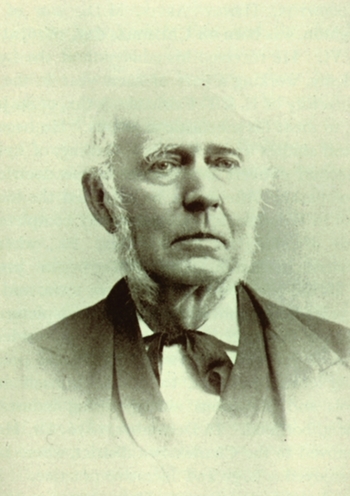
As far as we know, Ryan left no record of his motives or methods in compiling his tunebook; so we must turn to external evidence in an effort to support the hypothesis that the Mammoth Collection is a field collection of sorts. We can begin by considering the work of his publisher, Elias Howe, Jr., who was one of Boston's leading music entrepreneurs of the nineteenth century (see Figure 3).
Elias Howe, Jr. From Herndon, Boston of Today: A Glance at its History and Characteristics (Reference Herndon1892). Photographer and date unknown.

Howe was born in Framingham, Massachusetts, on 9 August 1820, the son of Elias Howe, Sr., and Hannah (Perry) Howe.Footnote 20 He was not the same Elias Howe, Jr. who invented the sewing machine, though the two have sometimes been conflated, and they had a common ancestry.Footnote 21 Our Howe was a fiddler. The standard biography of him includes a tidy, Horatio Alger–like account of how he got his start in the music business:
As a boy he was naturally musical, and, having obtained an apology for a violin, used to spend his spare hours fiddling the old tunes then popular. At that time there were few or no collections of music that could be bought, as it [i.e., music] was only published singly or in sheet-music form, and sold at a high price per sheet; and as it was beyond his means to have a collection of printed music, he was in the habit of copying in a blank book every tune he heard played or could get hold of. In this way, in the course of time, he had gathered a large collection of music in his book, and it was in great demand by all the musicians the country round, who used frequently to borrow it to use at dances. Early in 1840, when nineteen years old and working on a farm, it occurred to him that he might make some money if he could but get his book published.Footnote 22
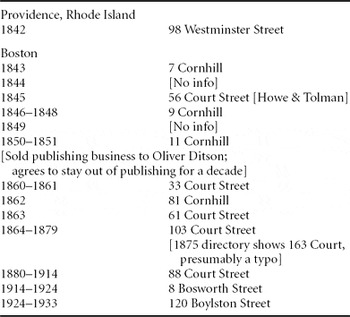
The Boston firm of Wright & Kidder agreed to print copies of the book, titled The Musician's Companion, which Howe then purchased with borrowed money and sold on his own. He was successful enough in this venture that in 1842 he opened his first music store, not in Boston, but in Providence. He moved back to Boston in 1843 and established a business at 7 Cornhill.Footnote 23 Howe occupied various addresses on Cornhill for the remainder of the decade and was in partnership briefly with Henry Tolman. Howe sold his publishing business to Oliver Ditson around 1850, with the understanding that he would stay out of music publishing for ten years.Footnote 24 During this time he apparently served as manager of the South Reading Ice Company, although he continued to compile and edit music collections that were published by other firms.Footnote 25 Ditson republished many items from Howe's catalog under his own imprint and copyrighted them in his name with a new copyright date, factors that complicate and confuse the publication history of these works.
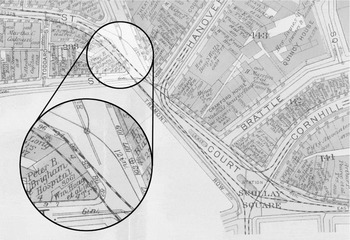
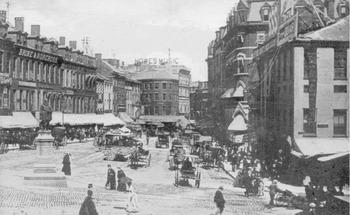
Howe resurfaced as a music publisher and instrument dealer in 1861, doing business at 33 Court Street, in the same general neighborhood in which he had previously operated. He moved to new locations in each of the next two years, before settling in at 103 Court Street from 1864 to 1879, and then at 88 Court in 1880 (see Figure 4).Footnote 26 The firm occupied 88 Court Street until 1914, which was nine years after Elias himself passed away. Following Elias's death his sons incorporated the business as the Elias Howe Company. They moved to 8 Bosworth Street in 1914 and finally relocated to 120 Boylston Street in 1924. By this time the firm had become primarily a violin dealership. They ceased operations in 1933 (see Table 1).
Business Addresses of Elias Howea

aInformation compiled from Boston city directories and copies of Howe publications.
Detail of map titled “Ward 5, City of Boston,” publisher and date unknown, but probably from the 1898 edition of Atlas of the City of Boston, published by G. W. Bromley & Co. (The subway was extended to Scollay Square in 1897; the station is indicated on this map.) The map shows the area in which Howe did business. Early in his career he occupied various addresses on Cornhill, and following his return to business in 1861 he moved along Court Street. By the time of the publication of Ryan's Mammoth Collection in 1883 he was doing business at 88 Court, a location the business occupied from 1880 to 1914. This address is visible on the left side of the map, slightly above center, near where Court, Sudbury, and Tremont Row come together; see inset. The identifying information at the various locations apparently indicates ownership of the building rather than occupancy. Author's collection; inset map created by David A. Wells.

Ryan's Mammoth Collection was published in 1883, during the period when Howe was doing business at 88 Court Street (see Figure 5). By the time of its publication, he had a catalog of several hundred items. From the earliest days of his business, Howe's stock in trade was self-instruction books for various instruments, as well as collections of instrumental music.
Postcard of Scollay Square, probably before 1897. “Howe's Music” is clearly visible in the center, with the building number “88,” for 88 Court Street, barely discernable. Author's collection.

It is important to realize that although many of Howe's publications included jigs, reels, and hornpipes, these forms were always in the minority—a fact that contradicts the common perception of Howe as primarily a publisher of fiddle tunes, a perception that can be traced to Richard Herndon's account of Howe's entry into the publishing business. Herndon characterized Howe's first book, The Musician's Companion (1840), as a collection of fiddle tunes, but in fact such tunes form only 15–20 percent of the book's contents. The proportion is somewhat higher—about 25 percent—in the Howe's School series that included volumes for flute, violin, “clarionett,” fife, and flageolet, with the same music in each one. In this regard Howe's early publications were quite similar to other instrumental collections of the era. They were mixed bags of tune types, and Howe clearly was catering to a broad musical market, not only dance fiddlers.
Other scholars who have probed the history of Ryan's Mammoth Collection have posited that it grew out of these earlier collections published by Howe. Charles Wolfe, writing of the music in The Musician's Companion, said: “A number of these tunes were to remain standards in Howe's later publications, all the way through the Ryan's 1050 [sic] collection some forty years later. What this statement suggests is that the core of the 1,000 Fiddle Tunes might well have been created from these early transcriptions made by Howe from rural Massachusetts fiddlers in the late 1830s.”Footnote 27
Wolfe's suggestion has a certain amount of truth to it, inasmuch as Howe's early books contained a group of fiddle tunes that he kept reprinting in subsequent collections. Chris Goertzen has identified what could be called Howe's “Top Forty,” that is, the tunes that are included most often in his various compilations.Footnote 28 Although Ryan also included nearly all of these tunes in the Mammoth Collection, his settings of them almost always differ from Howe's standard versions.
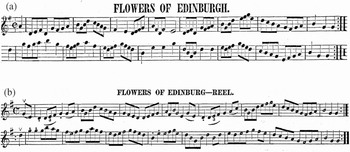
Figure 6 shows two settings of the well-known reel “Flowers of Edinburgh,” a tune Goertzen identifies as one of Howe's most frequently published melodies. The top setting comes from Howe's School for the Violin, published in 1843, but it is identical with one that Howe used in the Musician's Companion and again in the first number of the Musician's Omnibus (1861). The same setting turns up yet one more time in Howe's Original Violin School: Without a Master, published in 1894—eleven years after Ryan's Mammoth Collection was issued. The bottom version is the one that Ryan used in his collection. I have not seen it in any other books published by Howe. It is clear that Howe had a stock of standard settings that he used again and again, and that he even dragged out for books published after the Mammoth Collection, but that William Bradbury Ryan had his own sources for fresh tunes and settings.
Two settings of the reel “The Flowers of Edinburgh,” from Howe's School for the Violin (Boston: Elias Howe, Jr., 1843) (6a) and Ryan's Mammoth Collection (1883) (6b).

William Bradbury Ryan's Musical Community
What might Ryan's sources have been? Some aspects of Ryan's Mammoth Collection, which suggest that it should be regarded as something of a descriptive field collection, have already been discussed, and the fact that Ryan was not just recycling Howe's settings of tunes lends support to this idea. Is there other evidence to justify accepting the book as a snapshot of an active musical community and, if so, what might we be able to learn about this community?
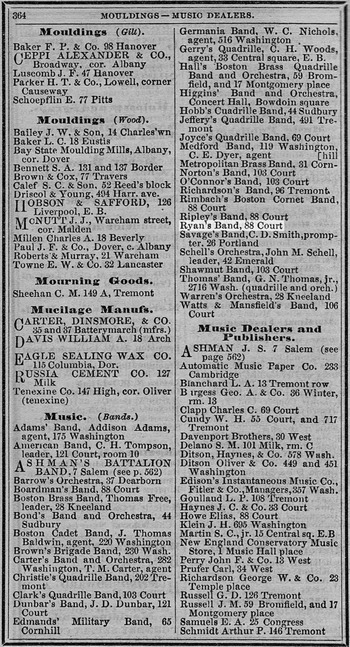
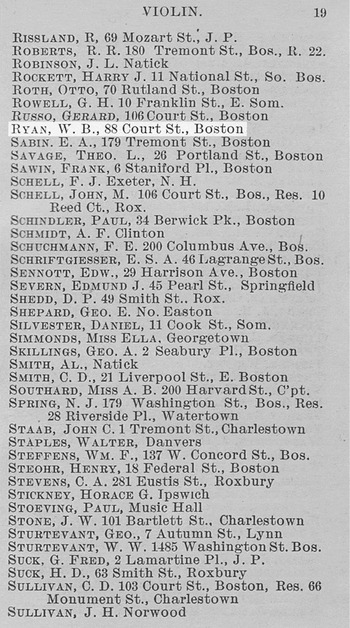
We know from Pat Sky's research that William Bradbury Ryan was a Boston musician and Howe employee. This information is significant, as it places him in a context in which he was perfectly positioned to compile a work such as the Mammoth Collection. In addition to working for Howe, we know that Ryan was a violinist, dance prompter, and band leader and thus was himself a member of the community of musicians whose activities were centered around the same area in downtown Boston—Court Street, Cornhill, Tremont Street, and Washington Street—that was home to the local music publishing industry. Many bands, including Ryan's, are listed in city directories with the same address as that of Elias Howe, although the significance of that information is unclear. It could have been the case that the Howe firm, or someone on the staff—Ryan?—served as a booking agent for the bands. Alternatively, there may just have been separate businesses operating in the same building. Some listings for bands in city directories specify a room number in addition to the street address; so it may well have been the case that multiple concerns occupied different suites within the same building (see Figures 7 and 8).
Page from the Boston city directory of 1882 showing ads for bands. Several, including “Ryan's Band,” share the 88 Court Street address with Elias Howe. Others operate out of 103 Court, Howe's previous location. Author's collection.

Page from the Musician's Directory and Diary of Boston and Vicinity (1890) showing listing for “Ryan, W.B., 88 Court St, Boston,” among the violinists. Note also the entry for C. D. Sullivan; see p. 417. Author's collection.

Using city directories and the Musician's Directory and Diary [for] 1891, a remarkable source discovered only recently, it is possible to trace other individuals whose names are associated with tunes in the Mammoth Collection and establish that they, too, were musicians who were contemporaries of Ryan.Footnote 29 “Hobb's Favorite,” a reel, may be associated with Michael Hobbs, a musician whose business addresses usually were the same as Howe's and who was a violinist, cornet player, and dance prompter. Dan Backus was also a violinist and dance prompter, and surely was the musician with whom the reel “Dan Backus' Favorite” was associated. Edwin Christie, noted as composer of ten tunes in the Mammoth Collection, was apparently part of a family of performers that also included George, Henry, Kate, and Helen. One of these Christies also led a quadrille band that worked out of 103 Court Street in the 1870s, which was Howe's address at the time.Footnote 30 These examples are just a few that could be cited.
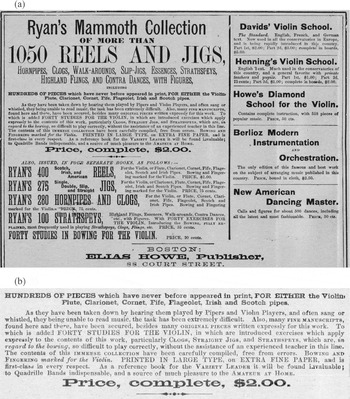
Even more compelling evidence that Ryan was a field collector is the claim made in the ads for his book that the tunes had “been taken down by hearing them played by Pipers and Violin Players, and often sang [recte: sung] or whistled, they being unable to read music, the task has been extremely difficult. Also, many fine manuscripts, found here and there, have been secured, besides many original pieces written expressly for this work” (see Figures 9a and 9b). Peculiar grammar notwithstanding, this ad copy is a striking indication that Ryan was something of an ethnomusicologist, long before that term had been coined, and even though he was working as a businessman rather than an academic.
Ad for Ryan's Mammoth Collection. Note that separate publications devoted to particular tune types were also available. Note also the language regarding the methodology used in gathering material for the collection. This advertisement is the only known statement of Ryan's working methods. Author's collection.

If we accept the hypothesis that Ryan's Mammoth Collection documents the repertoire of the Boston musical community of the late nineteenth century, the presence of so many Irish tunes in it—tunes for which there are no clear precedents in print—obviously suggests that there was a strong Irish component to this community—hardly surprising, given the large Irish population in the city. The influx of Irish to Boston began in the 1840s, and by the 1870s they formed one-seventh of the total population of the state of Massachusetts.Footnote 31 However, almost no research has been done on music within the Irish community at the time, and numerous challenges are associated with doing so.
Few overtly Irish names appear among the musicians associated with Ryan's Mammoth Collection. Searching through the Irish names in city directories for people who give their occupations as musicians is not especially productive because for most traditional players music is their avocation rather than their vocation.
Francis O'Neill wrote of a few New England musicians in Irish Minstrels and Musicians, one of his two prose works that supplement his tune collections, but finding further information on them is difficult.Footnote 32 One exception is Daniel Sullivan, of whom O'Neill writes: “Everybody in Boston and the adjoining towns, and not a few from other parts of this broad land, knew or heard of ‘Dan’ Sullivan, the great Irish fiddler, who departed this life at the end of June, 1912.”Footnote 33 O'Neill goes on to note that Sullivan was “the most famous professional Irish fiddler in the eastern states.” This man was the father of the person who led Dan Sullivan's Shamrock Band in the 1920s and 1930s, a group that made many 78 rpm recordings.Footnote 34 He is presumably also the person referenced in the title “Dan Sullivan's Favorite,” a reel printed in Howe's Musician's Omnibus No. 7.Footnote 35
O'Neill does not tell us when the senior Sullivan emigrated to the United States, and trying to trace him in Boston directories is a frustrating, if amusing, effort. In 1858 there were twenty-seven Daniel Sullivans listed; the next year there were thirty-eight. By 1875 there were eighty-four, two years later there were ninety-six, and by 1890 the total had swelled to one hundred thirty-six. Most gave their occupation as laborers of one sort or another, but there is one Daniel Sullivan who is identified as a “musician” in the 1883 directory and one who may or may not be the same person who is listed as a “violinist” in 1890. There is also a listing for a violinist named “C. D. Sullivan” in the Musician's Directory and Diary of 1891.Footnote 36
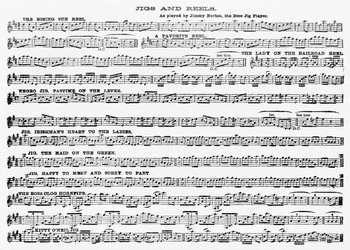
Evidence of another professional musician who may have been Irish comes not from Ryan but from Elias Howe himself. In spite of the general character of the Musician's Omnibus series as comprising material gathered from earlier print sources, some tunes seem as though they might have come directly from musicians.Footnote 37 The tunes on two pages in Musician's Omnibus Number 6 carry the notation that they are “as played by Jimmy Norton, the Boss Jig Player” (see Figure 10).Footnote 38 The name Norton may or may not indicate an Irishman, but at least some of the tunes that Howe attributes to him would be recognized as Irish tunes and are in circulation today. Norton is easily traced in directories from the early 1860s to the early 1890s. Often his business address was the same as Howe's.
Page from Howe's Musician's Omnibus No. 6, showing a number of Irish tunes gathered from “Jimmy Norton, the Boss Jig Player.” A “James Norton, musician” appears regularly in Boston city directories from the 1860s to the 1880s. Author's collection.

Clearly much work remains to be done before we are to have anything approaching a clear picture of the nature of Irish music in Boston in the late nineteenth century. However, I suggest that Ryan's Mammoth Collection is one portal through which we can begin to pursue such research in earnest. It is a remarkable collection that has never been properly recognized for one of its major distinctions—that it is the first great field collection of Irish American tunes. If William Bradbury Ryan had had a cultural agenda behind his work rather than a purely commercial one, or had rallied others to his cause and left accounts of how he carried out his work, he, rather than Capt. Francis O'Neill, would surely be regarded today as the first great documentarian of Irish traditional music in the United States.