INTRODUCTION
After pediatric traumatic brain injury (TBI), children face significant challenges as they return to school and everyday activities. In addition to impairments in cognitive processing skills, self-regulatory abilities, and academic performance (Ganesalingam, Sanson, Anderson, & Yeates, Reference Ganesalingam, Sanson, Anderson and Yeates2006; Max et al., Reference Max, Lansing, Koele, Castillo, Bokura, Schachar and Williams2004; Yeates, Reference Yeates2000), children also commonly experience impaired social functioning, as well as internalizing and externalizing problems (Chapman et al., Reference Chapman, Wade, Walz, Taylor, Stancin and Yeates2010; Karver et al., Reference Karver, Wade, Cassedy, Taylor, Stancin, Yeates and Walz2012; Yeates et al., Reference Yeates, Swift, Taylor, Wade, Drotar, Stancin and Minich2004). Although psychosocial outcomes among children with TBI have been a focus of recent research (for a review, see Yeates, Bigler, et al., Reference Yeates, Bigler, Abildskov, Dennis, Gerhardt, Vannatta and Taylor2013), relatively little is known regarding the interplay among injury-related factors and individual characteristics, such as children’s sensitivity to peer rejection and how such sensitivity may perpetuate social, emotional, and behavioral dysfunction after TBI. Therefore, the current study sought to examine whether interactions among injury and rejection sensitivity (RS) were predictive of children’s emotional and behavioral adjustment, their engagement in social activities, and their self-esteem and self-perceptions of competence in various domains of functioning.
Poor psychosocial outcomes have been consistently documented for children with TBI. According to their peers, children with TBI are less popular, more often victimized, and less likely to have a reciprocal best friend in school (Yeates, Gerhardt, et al., Reference Yeates, Gerhardt, Bigler, Dennis, Rubin, Stancin and Vannatta2013). Findings from the same study further indicate that peers also describe children with TBI as more sensitive, isolated, and withdrawn. One study showed that 30–73% of children with TBI are restricted in at least one domain of social participation (e.g., social, school, community), even several years after their injury (Bedell & Dumas, Reference Bedell and Dumas2004). Furthermore, 55–64% of these children with TBI also demonstrated elevated behavioral and psychological problems.
Children with TBI are known also to demonstrate both internalizing and externalizing behavior problems (Chapman et al., Reference Chapman, Wade, Walz, Taylor, Stancin and Yeates2010; Karver et al., Reference Karver, Wade, Cassedy, Taylor, Stancin, Yeates and Walz2012). They endorse more feelings of loneliness, and they have significantly lower levels of social competence and self-esteem compared to healthy peers (Andrews, Rose, & Johnson, Reference Andrews, Rose and Johnson1998). Furthermore, children with TBI are rated as more aggressive, inattentive, and hyperactive, and they also demonstrate poor temper control and impulsivity (Max et al., Reference Max, Castillo, Bokura, Robin, Lindgren, Smith and Mattheis1998; Taylor et al., Reference Taylor, Yeates, Wade, Drotar, Klein and Stancin1999). These difficulties have been found to increase over the first several years post-injury, with the highest levels reported among children with more severe injuries (Fletcher, Ewing-Cobbs, Miner, Levin, & Eisenberg, Reference Fletcher, Ewing-Cobbs, Miner, Levin and Eisenberg1990; Kinsella, Ong, Murtagh, Prior, & Sawyer, Reference Kinsella, Ong, Murtagh, Prior and Sawyer1999). For example, in children ages 6–12 years old at the time of injury, behavior problems decreased among children with orthopedic injuries (OIs), remained stable for children with moderate TBI, and increased in children with severe TBI (STBI) up to an average of 4 years post-injury (Schwartz et al., Reference Schwartz, Taylor, Drotar, Yeates, Wade and Stancin2003). Taken together, these findings highlight the need to better understand the factors that influence children’s psychosocial adjustment following TBI.
One factor that may contribute to poor psychosocial outcomes after TBI is RS, which is the dispositional tendency to anxiously expect or readily perceive and overreact to cues of rejection in the behaviors of one’s peers (Downey & Feldman, Reference Downey and Feldman1996). The emergence of RS is believed to stem from early experiences, most commonly in the form of early rejection by caregivers (Feldman & Downey, Reference Feldman and Downey1994). RS has been found to remain relatively stable during early and late adolescence, as well as in adulthood (Downey & Feldman, Reference Downey and Feldman1996; Downey, Lebolt, Rincon, & Freitas, Reference Downey, Lebolt, Rincon and Freitas1998; London, Downey, Bonica, & Paltin, Reference London, Downey, Bonica and Paltin2007; Marston, Hare, & Allen, Reference Marston, Hare and Allen2010).
In typically developing children, high RS has been linked to defensive behavioral tendencies (e.g., peer-directed aggression, social withdrawal). These defensive tendencies further impair relationships with peers (Downey et al., Reference Downey, Lebolt, Rincon and Freitas1998) and increase the risk for internalizing problems like depression, loneliness, social anxiety, and withdrawal (Feldman & Downey, Reference Feldman and Downey1994; Harper, Dickson, & Welsh, Reference Harper, Dickson and Welsh2006; London et al., Reference London, Downey, Bonica and Paltin2007). Peer rejection and other negative peer experiences further contribute to children’s internalizing problems and feelings of powerlessness for preventing rejection (Ayduk, Downey, & Kim, Reference Ayduk, Downey and Kim2001; Downey et al., Reference Downey, Lebolt, Rincon and Freitas1998; Sandstrom, Cillessen, & Eisenhower, Reference Sandstrom, Cillessen and Eisenhower2003), which may subsequently reduce social participation and diminish self-esteem and self-perceptions of competence (see Rubin, Bukowski, & Bowker, 2015 for a relevant review).
Children with TBI who are also highly sensitive to rejection may be at especially high risk for maladaptive outcomes given their injury-related impairments in social, emotional, and behavioral functioning. Moreover, deficits in social competence may have harmful effects on children’s self-esteem, social self-perceptions, and even their goals for partaking in social activity altogether (Rubin, Coplan, & Bowker, Reference Rubin, Coplan and Bowker2009). Considering the psychosocial difficulties experienced by children with TBI, a better understanding of the factors that contribute to ongoing social and behavioral dysfunction is needed, particularly those that may decrease quality of life even into adulthood.
To the best of our knowledge, researchers have not yet examined the impact of RS on children’s social, emotional, and behavioral adjustment following pediatric TBI. Therefore, the goal of the current study was to examine the moderating role of RS in predicting children’s self-perceptions and self-esteem, internalizing and externalizing problems, and social participation, after complicated-mild, moderate, or severe TBI. We predicted that children with TBI, especially those with more severe injuries, would demonstrate lower social participation, more internalizing and externalizing problems, lower overall self-esteem, and less positive self-perceptions of their social acceptance, physical appearance, and athletic ability, compared to children without TBI who sustained OI. We further hypothesized that the magnitude of these group differences would vary as a function of RS; specifically, group differences were expected to be larger at high levels of RS and smaller at low levels of RS.
METHOD
Participants and Procedures
As part of the larger Social Outcomes for Brain Injured Kids (SOBIK) project (Yeates, Bigler, et al., Reference Yeates, Bigler, Abildskov, Dennis, Gerhardt, Vannatta and Taylor2013), families were recruited from three metropolitan children’s hospitals in the United States and Canada 12 to 63 months after hospitalization for either a TBI or OI. At the time of injury, children were at least 3 years of age, with the majority of children at least 4 years of age. At the time of study participation, children were 8–13 years of age. Participants in the TBI group included children with complicated-mild to severe TBI, as defined by the post-resuscitation Glasgow Coma Scale (GCS) score reported by a physician within 24 hr of the child’s injury. Children classified as having an STBI included those with a lowest post-resuscitation GCS score of 8 or less; moderate TBI was defined based on a GCS score from 9 to 12; and complicated-mild TBI was defined based on a GCS score of 13 to 15 in association with trauma-related abnormalities on neuroimaging at the time of hospitalization.
Participants in the OI group included children who sustained orthopedic fractures without loss of consciousness or other indications of brain injury (e.g., facial fracture). For the current study, children were grouped into those with STBI, those with complicated-mild/moderate TBI (MTBI), and those with an OI.
The following exclusion criteria were applied to all participants: (a) additional history of brain injury requiring medical attention (i.e., before the target injury), or injury resulting from child abuse or assault; (b) diagnosis of premorbid neurological disorder, intellectual disability, or any sensory or motor impairment that would interfere with administration and completion of measures for the study; (c) history of severe psychiatric disorder requiring hospitalization before the injury; (d) primary language other than English; (e) full-time placement in a special education setting; and (f) medical contraindication to magnetic resonance imaging.
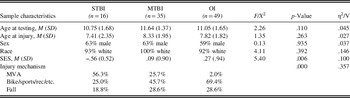
All procedures were approved by the institutional review boards at participating institutions. Before enrolling in the study, parents and children provided informed consent and assent, respectively. Of those eligible for the study and approached for recruitment, 82 children with TBI (47%) and 61 children with OI (26%) agreed to enroll. Despite significant differences in participation rate between groups, groups did not differ in age at injury or age at study contact, sex, race, or socioeconomic status (SES) based on census tract median family income. Among children with TBI, participants and non-participants did not differ on measures of injury severity. Cross-sectional data were collected at two separate visits (time between visit 1 and 2: M=6.84 months, SD=5.40 months) during which parents completed measures assessing family demographic factors and various aspects of their child’s social, emotional, and behavioral functioning, while children completed measures assessing their perceptions of their own social, emotional, and behavioral functioning. Participation in the second study visit was limited to children who were able to arrange for a friend to accompany them; during that visit, additional measures assessing social functioning and behaviors were administered. Information regarding the child’s injury was abstracted from the medical record.
Inclusion in the current study was limited to participants who completed the second study visit, when a measure of RS (CRSQ; Children’s Rejection Sensitivity Questionnaire, see below) was administered. Of the 143 participants in the larger parent study, 16 children with STBI, 35 children with MTBI, and 49 children with OI met this requirement, for a total sample consisting of 100 children and their parent informant (69.9% of the total sample). Child demographic characteristics can be found in Table 1. Parent informants were primarily biological mothers (82%) or fathers (14%), and mostly married or partnered (83%). For maternal education, 21% of the sample indicated high school graduate or less, 37% indicated some college, and 42% were college graduates or higher.
Demographic and injury characteristics of STBI, MTBI, and OI Groups

Note. Age at testing reflects age at visit 2 when rejection sensitivity was assessed. SES (socioeconomic status) was measured using a standardized composite of parental education, parental occupational status, and census track median family income.
STBI=severe traumatic brain injury; MTBI=complicated-mild/moderate traumatic brain injury; OI=orthopedic injury; MVA=motor vehicle accident; rec=recreation.
No differences were found between those included versus those excluded from analyses in terms of age at injury, sex, SES (measured using a standardized composite based on parental education, parent occupational status, and census tract median family income), or mechanism of injury. Children with TBI were marginally more likely to be excluded than children with OI, χ2 (143,2)=5.53, p=.06, and age at participation was related to exclusion, with older children (M age=10.64; SD=1.56) less likely to be excluded than younger children (M age=10.07; SD=1.55; t(141)=−2.00; p=.048). Race was also related to exclusion, with proportionally fewer white children excluded for missing data compared with black or multiracial children (exclusion rates of 22.9%, 75.0%, and 71.4%, respectively; χ2(137, 2)=20.17; p<.001).
Anecdotally, some children with TBI did not return for the second visit because of difficulties arranging for a friend to accompany them, as required by the study protocol. However, social participation as measured by the Child and Adolescent Scale of Participation (CASP) was the only outcome found to differ between those who were included versus those who were excluded (t(140)=−2.32; p=.022), with children who were included having higher ratings of social participation (M=97.50; SD=5.72) than those who were excluded (M=94.70; SD=8.23). No significant differences were found between those included versus excluded in terms of internalizing problems, externalizing problems, self-esteem, or social self-perceptions.
Demographic and participant characteristics for the three groups are presented in Table 1. The injury groups did not differ in age at injury, age at study participation, sex, or race. However, the groups did differ in SES and mechanism of injury, with motor vehicle accidents being most common among the children with TBI and sports/recreational injuries being most common among children with OI.
Group differences in SES were not significant when injury mechanism was taken into account, consistent with epidemiological studies showing that the risk of TBI, particularly those linked to motor vehicles, is highest for children of lower SES and minority status (Brown, Reference Brown2010; Howard, Joseph, & Natale, Reference Howard, Joseph and Natale2005; Langlois, Rutland-Brown, & Thomas, Reference Langlois, Rutland-Brown and Thomas2005). Because SES differences appeared to be intrinsic to the injury groups, we did not treat SES as a covariate in data analysis (Dennis, Agostino, Roncadin, & Levin, Reference Dennis, Agostino, Roncadin and Levin2009).
Measures
Rejection sensitivity was assessed using a modified version of the Children’s Rejection Sensitivity Questionnaire (CRSQ), which operationalizes RS as the extent to which children (1) anxiously or angrily expect rejection, (2) feel disliked or rejected following an ambiguous rejection, and (3) overreact to rejection (Downey et al., Reference Downey, Lebolt, Rincon and Freitas1998). After reading six vignettes depicting potential rejection situations involving their peers (e.g., “You hear some kids whispering…You wonder if they are talking about YOU”), children were asked to rate how nervous and how mad they would feel in each situation (e.g., “How (NERVOUS/MAD) would you feel, RIGHT THEN, about whether or not those kids were badmouthing you?”), on a scale from 1 (not nervous/mad) to 6 (very, very nervous/mad). Children were also asked to rate their likelihood of being rejected in each situation (e.g., “Do you think they were saying bad things about you?”) on a scale from 1 (“NO!!!”) to 6 (“YES!!!”). The total RS score was created by multiplying the ratings for each negative affect (anxiety, anger) by the rejection expectation rating, and then averaging the products. Final averaged scores ranged from 2 to 33, with higher values reflecting greater levels of RS. Internal reliability was adequate (α=.78).
Social participation was measured using the CASP (Bedell, Reference Bedell2004). Parents were asked to report on their child’s participation in activities at home, at school, and in the community (e.g., engaging in recreation with others). The measure yields a total participation score, ranging from 0 to 100, with higher scores indicating a greater degree of age expected social participation. The CASP has demonstrated good test–retest reliability (r=.94) and internal consistency (α≥.96; Bedell, Reference Bedell2004).
Social self-perceptions were assessed using the Self-Perception Profile for Children (SPPC; Harter, Reference Harter1985). This 36-item self-report questionnaire measures children’s self-perceptions of competency in domains involving social acceptance, scholastic and academic ability, and physical appearance. The measure also includes an additional subscale that assesses children’s self-esteem, or global self-worth (GSW), which is independent from ratings in the competence domains. Lower scores in each of the competency domains and GSW reflect poorer perceptions of competency and lower self-esteem, respectively. The SPPC has demonstrated acceptable reliability and validity (Harter, Reference Harter1985).
Emotional and behavioral problems were assessed based on parent’s ratings on the Behavior Assessment System for Children-Second Edition (BASC-2; Reynolds & Kamphaus, 2004). The BASC-2 assesses both adaptive and problem behaviors, which are rated on a 4-point Likert scale from “never” to “almost always.” The present study assessed emotional and behavioral adjustment using the BASC-2 Internalizing and Externalizing Problems subscales, as well as subscales measuring symptoms of withdrawal, anxiety, and depression. The BASC-2 is well standardized and has shown good internal consistency and test–retest reliability.
Data Analysis
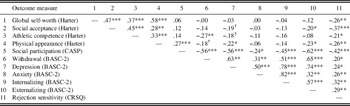
The goal of the primary analyses was to examine RS as a moderator of injury group differences in social participation, internalizing and externalizing problems, GSW, and self-perceptions of competency in domains related to social acceptance, physical appearance, and athletic ability. Before testing for group differences and their moderation by RS, pooled within-group correlations were computed to examine the associations among outcome measures (Table 2). Across the entire sample, RS was significantly associated with all outcomes, such that higher RS predicted worse outcomes.
Pooled within-group correlations between outcome measures

Note. STBI=severe traumatic brain injury; MTBI=complicated-mild/moderate traumatic brain injury; OI=orthopedic injury; Harter Self-Perception Profile for Children; CASP=Child and Adolescent Scale of Participation; BASC-2=Behavior Assessment Scale for Children-2nd Edition; CRSQ=Children’s Rejection Sensitivity Questionnaire.
† p<.1.
*p<.05.
**p<.01.
***p<.001.
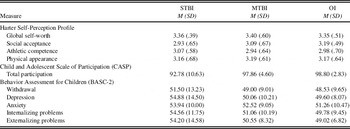
To examine injury group differences on each of the 10 outcomes (i.e., social participation, externalizing problems, internalizing problems, depression, withdrawal, anxiety, GSW, and self-perceptions of social acceptance, physical appearance, and athletic competence; see Table 3), and RS as a potential moderator, 10 separate moderation models were analyzed using the PROCESS macro for SPSS (version 2.15; Hayes, Reference Hayes2013). The macro yields unstandardized beta coefficients for each pathway of the model; these coefficients are scaled according to the measurement of the variables included in each path, and are preferable over standardized coefficients in this type of modeling, particularly when independent variables (i.e., the group variable) are categorical (Deegan, Reference Deegan1978).
Group means on psychosocial, emotional, and behavioral outcomes

Note. STBI=severe traumatic brain injury; MTBI=complicated-mild/moderate traumatic brain injury; OI=orthopedic injury; Harter Self-Perception Profile for Children; CASP=Child and Adolescent Scale of Participation; BASC-2=Behavior Assessment Scale for Children-2nd Edition.
In each model, injury group (coded as two dummy variables comparing each TBI group to the OI group) and RS were entered as independent variables, and moderation was examined by testing mean-centered interaction terms (injury group × RS) using 95% bias-corrected confidence intervals based on 5000 bootstrap re-samples. Interactions with confidence intervals not containing 0 were considered significant. Significant interactions were explored by examining conditional effects, that is, group differences at varying levels of RS: low (−1 SD below the overall group mean), average (overall group mean), and high (1 SD above the overall group mean).
RESULTS
Rejection Sensitivity
The injury groups did not differ significantly in mean RS ratings on the CRSQ, F(2)=.353, p=.703, η 2 =.01.
Social Participation
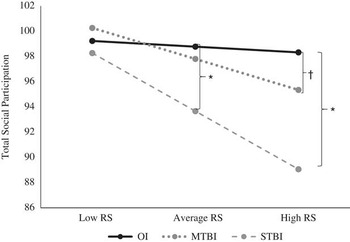
The STBI and OI groups differed significantly on social participation (b=−5.11; p<.001), but the STBI×RS interaction was also significant, providing evidence of moderation of the group difference by RS (b=−0.78; p<.001). The contrast between the MTBI and OI groups was not significant (b=−0.97; p=.35), but the MTBI × RS interaction trended toward significance (b=−0.38; p=.07). Together, the two interactions accounted for a significant change in R 2 of .08, F(2,94)=6.20, p=.003. Examination of conditional effects at varying values of the moderator (see Figure 1) showed that, at high levels of RS, children with STBI showed significantly lower social participation than the OI group (b=−9.26; p<.001; confidence interval (CI) [−12.68, −5.85]). The MTBI group also showed lower levels of social participation at high levels of RS compared to OI controls, and this difference trended toward significance (b=−2.98; p=.055; CI [−6.01, 0.06]). At average levels of RS, social participation remained significantly lower for the STBI group compared to the OI group (b=−5.11; p<.001; CI [−7.80, −2.43]); however, the MTBI group no longer differed from the OI group at average levels of RS. At low levels of RS, neither TBI group differed from the OI group.
Interaction of injury group and rejection sensitivity (RS) for social participation. OI=orthopedic injury; MTBI=complicated-mild/moderate traumatic brain injury; STBI=severe traumatic brain injury.

Internalizing Problems, Withdrawal, Depression, and Anxiety
The injury groups did not significantly differ on internalizing problems, nor did RS moderate the association between STBI and internalizing problems. No significant main effects or interactions were found for injury group or RS predicting depression, withdrawal, or anxiety.
Externalizing Problems
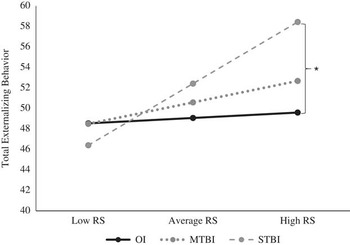
Injury group differences were not significant for externalizing problems. Although the MTBI × RS interaction did not reach statistical significance, the STBI × RS interaction was significant (b=1.05; p=.019). Together, the interactions accounted for a change in R 2 of .06, F(2,87)=2.98; p=.056. Examination of the conditional effects of RS (see Figure 2) demonstrated that the STBI and OI groups did not differ in externalizing problems at low or average levels of RS, but the STBI group had significantly more externalizing problems than children with OI at high levels of RS (b=8.84; p=.008; CI [2.40 to 15.28]).
Interaction of injury group and rejection sensitivity (RS) for externalizing problems. OI=orthopedic injury; MTBI=complicated-mild/moderate traumatic brain injury; STBI=severe traumatic brain injury.

Global Self-worth and Self-perceptions of Competence
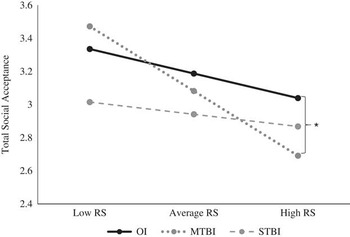
The injury groups did not differ on GSW or self-perceptions of athletic competence or physical appearance, nor were any injury group×RS interactions significant for those outcomes. Furthermore, injury group differences were not significant for self-perceptions of social acceptance, and the STBI×RS interaction also did not reach statistical significance. However, the interaction between MTBI×RS trended toward significance (b=−0.05; p=.058), and the two interactions together accounted for a change in R 2 of .05, F(2,94)=3.01, p=.054. Examination of the conditional effects of RS (see Figure 3) showed that the MTBI and OI groups did not differ at low or average levels of RS, but at high levels of RS, children with MTBI showed lower self-perceptions of social acceptance than children with OI (b=−0.35; p=.052; CI [−0.69 to 0.00]).
Interaction of injury group and rejection sensitivity (RS) for social acceptance. OI=orthopedic injury; MTBI=complicated-mild/moderate traumatic brain injury; STBI=severe traumatic brain injury.

DISCUSSION
After TBI, children experience a range of psychosocial difficulties. This study examined the combined contributions of TBI and children’s sensitivity to rejection to better understand the factors underlying poor social, emotional, and behavioral outcomes after TBI. The injury groups differed significantly in levels of social participation, such that children with STBI demonstrated lower levels of social participation on average compared to children with OI, consistent with previous findings (Bedell & Dumas, Reference Bedell and Dumas2004). However, neither TBI group showed overall deficits in their ratings of GSW, self-perceptions of physical appearance or athletic ability, or parent-rated internalizing and externalizing problems. Although the lack of differences in self-perceptions may be partially attributable to a lack of self-awareness (Wolfe et al., Reference Wolfe, Bigler, Dennis, Gerhardt, Rubin, Taylor and Yeates2015), the lack of differences in internalizing and externalizing problems cannot be accounted for on this basis, because those outcomes were assessed based on parent ratings.
Instead, group differences varied as a function of RS for three outcomes: parent-rated social participation and externalizing problems, and self-rated perceptions of social acceptance. For social participation and externalizing problems, children with STBI demonstrated significantly worse outcomes than children with OI at high levels of RS, but the STBI and OI groups did not differ significantly at low levels. At high levels of RS, the MTBI group also showed marginally lower social participation than the OI group, but the groups did not differ at average or levels of RS. For self-ratings of social acceptance, children with MTBI rated themselves lower than children with OI, but only at high levels of RS. No evidence of moderation was found for other self-ratings or for internalizing problems. Thus, the findings provide partial support for the moderating role of RS in predicting psychosocial outcomes after childhood TBI, suggesting that TBI, especially when it is severe, results in poorer outcomes primarily for children with higher levels of RS.
A noteworthy feature of the findings is the particularly salient social nature of the outcomes for which evidence of moderation by RS was found. Social participation, self-perceptions of social acceptance, and externalizing problems were all moderated by RS, and are all important indicators of social behavior and adjustment. This may reflect a coalescence of factors, as research has supported close associations among social withdrawal, peer rejection, and negative self-perceptions of social functioning (Hymel, Rubin, Rowden, & LeMare, Reference Hymel, Rubin, Rowden and LeMare1990; Rubin et al., Reference Rubin, Coplan and Bowker2009).
Researchers have demonstrated that some children withdraw from their community of peers because they experience rejection and exclusion and infer that others would rather not interact with them (see Rubin et al., Reference Rubin, Bukowski and Bowker2015 for a relevant review). Anger caused by feeling isolated by peers may thus contribute to the expression of externalizing behaviors, further perpetuating rejection by a child’s peers. According to Downey and colleagues (1998), RS can lead to a vicious cycle of rejection, whereby children who are highly rejection sensitive tend to respond to rejection by engaging in defensive behavioral patterns, such as aggressing against (i.e., externalizing) or withdrawing from peers. Findings from the current study are consistent with this pattern of defensive responses to peer rejection and indicate that associations among these closely related areas of functioning may be even more pronounced after STBI, particularly when children are highly sensitive to rejection.
In contrast, internalizing problems, GSW, and self-perceptions of appearance and athletic ability (i.e., the outcomes not moderated by RS), are conceptually more self-focused and less directly relevant to social functioning and behavior as compared to social participation, social self-perceptions, and externalizing behaviors. Thus, RS may have a particularly strong influence on more socially specific outcomes for children with TBI, while exerting less influence on their other types of self-perceptions or psychological adjustment.
The injury groups did not differ in levels of RS, suggesting that children with TBI are not more likely to demonstrate higher RS than other children. This finding is consistent with the developmental origins of RS, which is rooted in early interactions with caregivers (Feldman & Downey, Reference Feldman and Downey1994); therefore, we did not expect to find differences in RS as a result of TBI. However, the current findings suggest that RS may influence some psychosocial outcomes more strongly for children with TBI than children with OI. This is evidenced by the finding that higher levels of RS correspond to particularly poor social and behavioral outcomes for children with TBI compared to children with OI.
While the current study offers important insights into understanding the moderating role of RS on psychosocial outcomes for children with TBI, certain limitations should be noted. First, the cross-sectional design of the study imposes limitations on making causal conclusions related to the impact of injury on psychosocial outcomes. Future investigations may benefit from longitudinal examination of the relationship between children’s sensitivity to rejection and psychosocial outcomes following pediatric TBI to better understand the developmental trajectory by which injury-related factors and RS influence social, emotional, and behavioral functioning. For example, ample evidence suggests that persons with developmental vulnerabilities who have high RS may be at increased risk for later emerging sequelae. In one study, difficulties on a delayed gratification task during early childhood were associated with lower adult self-esteem and educational levels, and higher rates of substance abuse, but only in adults with high RS (Ayduk, Mendoza-Denton, Mischel, Downey, Peake, & Rodriguez, Reference Ayduk, Mendoza-Denton, Mischel, Downey, Peake and Rodriguez2000).
The study was also limited by a small sample of children with STBI, largely due to attrition at the second data collection visit when the measure of RS was administered. The fact that many of these children forewent their second visit because of difficulty securing a friend to participate may likely be redolent of particularly poor social adjustment and potentially higher RS. Unfortunately, the absence of these children means we were unable to capture the impact of RS on their psychosocial outcomes. Nonetheless, we found evidence of the moderating influence of RS even in the more restricted sample, which showed better social participation than the children who were excluded. Relatedly, inclusion in the study also was limited to children who did not receive full-time placement in a special education setting or have major physical disabilities, and were able to return to school. Therefore, children with the most severe levels of impairment following STBI were not able to participate. Levels of RS among children placed in full-time special education or with severe physical handicaps may vary from those in the current sample of children with STBI.
Despite previous work linking heightened RS to poor emotional functioning, the current study found limited indication of this association after TBI. Specifically, children’s internalizing problems, as rated by the child’s parent, did not vary as a function of children’s self-rated RS. However, this may be in part due to the reliance on parent report for assessing children’s emotional adjustment. Future studies should also assess children’s self-reported internalizing problems to examine the potential moderating role of RS.
More generally, future research should examine additional risk and protective factors related to RS and children’s psychosocial adjustment after TBI that may account for some of the unexplained variance in outcomes examined in this study. For example, higher quality relationships with parents and peers have been suggested as protective factors against maladaptive emotional functioning among children high in RS (McDonald, Bowker, Rubin, Laursen, & Duchene, Reference McDonald, Bowker, Rubin, Laursen and Duchene2010). Children high in RS who report a lack of social support from both parents and peers have been found to show the highest rates of depression compared to children high in RS who believed they had the support of either their parents or their peers (Laible, Carlo, & Raffaelli, Reference Laible, Carlo and Raffaelli2000).
Previous research suggests that RS affects how children think, feel, and behave in social situations, including interactions with peers and teachers (Downey et al., Reference Downey, Lebolt, Rincon and Freitas1998). Our findings suggest that children with TBI, especially those with more severe injuries who also experience moderate-to-high levels of RS, are at the highest risk for poor social and behavioral adjustment. Therefore, our findings may have important implications for clinical interventions aimed at improving social and behavioral outcomes for children with TBI, suggesting that treatments may need to be designed to reduce RS or promote greater resilience in the context of high levels of RS. The delivery of intervention programs designed to meet these goals within school settings, possibly with the assistance of children’s teachers, may be especially likely to promote better social outcomes after childhood TBI.
ACKNOWLEDGMENTS
This research was supported in part by grant 5 R01 HD048946 from the National Institute of Child Health and Human Development to Keith Owen Yeates. No competing financial interests exist.