INTRODUCTION
Euphausiids are an important component of the ecosystem of the sub-Arctic and boreal North Atlantic (Mauchline & Fisher, Reference Mauchline and Fisher1969; Tarling, Reference Tarling2010). They are mainly omnivores that feed on phytoplankton, detritus and small zooplankton, such as the copepod Calanus finmarchicus (Mauchline, Reference Mauchline1980a; Bamstedt & Karlson, Reference Bamstedt and Karlson1998). Many of the boreal euphausiids are also important food items for higher predators, including baleen whales (Balaementella physalus) and several commercially-targeted fish species (e.g. Sebastes mentella, Mallotus villosus and Gadus morhua) (Pearcy et al., Reference Pearcy, Hopkins, Grönvik and Evans1979; Astthorsson & Pálsson, Reference Astthorsson and Pálsson1987; Vikingsson, Reference Vikingsson1997; Gonzalez et al., Reference Gonzalez, Bruno and Paz2000). Most species that occur in boreal waters perform diurnal vertical migrations (DVM) and, through such behaviour, contribute to the export of carbon from the surface to the mesopelagic depths (Noji, Reference Noji1991). Euphausiids therefore have a key role in transferring energy through the pelagic food web in the North Atlantic.
Several species of euphausiid are found commonly in the North Atlantic (Mauchline & Fisher, Reference Mauchline and Fisher1969). In terms of both abundance and biomass, the two dominant species are Meganyctiphanes norvegica and Thysanoessa longicaudata, and a number of studies have focused on various biological and ecological aspects of these species in the North Atlantic (Einarsson, Reference Einarsson1945; Mauchline, Reference Mauchline1960; Jörgensen & Matthews, Reference Jörgensen and Matthews1975; Lindley, Reference Lindley1978; Falk-Petersen & Hopkins, Reference Falk-Petersen and Hopkins1981; Boysen & Buchholz, Reference Boysen and Buchholz1984; Astthorsson & Gislason, Reference Astthorsson and Gislason1997, Saunders et al., Reference Saunders, Ingvarsdottir, Rasmussen, Hay and Brierley2007; Thomasson et al., Reference Thomasson, Johnson, Stromberg and Gaten2003; Tarling, Reference Tarling2010). Three other species often encountered in lower abundance in the North Atlantic are Thysanopoda acutifrons, Thysanoessa inermis and Nematobrachion boöpis (Mauchline & Fisher, Reference Mauchline and Fisher1969; Mauchline, Reference Mauchline1985). However, there have been few studies on these species, particularly T. acutifrons and N. boöpis, and there is a paucity of information on their seasonal distribution of abundance, growth and population dynamics in this region.
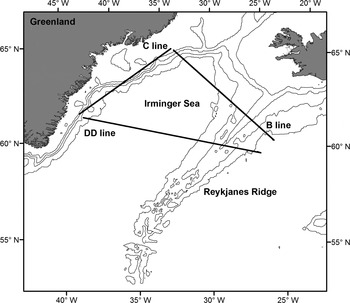
The North Atlantic is subject to decadal-scale variations, including the North Atlantic Oscillation (NAO). Recent interest in the possible impacts of climate change on global circulation, and the potential consequences for the ecology of the North Atlantic, have put the Irminger Sea firmly in the spotlight (Dickson et al., Reference Dickson, Yashayaev, Meincke, Turrell, Dye and Holfort2002; Beaugrand, Reference Beaugrand2003; Greene et al., Reference Greene, Pershing, Conversi, Planque, Hannah, Sameoto, Head, Smith, Reid, Jossi, Mountain, Benfield, Wiebe and Durbin2003; Richardson & Schoeman, Reference Richardson and Schoeman2004). The Irminger Sea (Figure 1), bounded to the west and north by the continental shelves of Greenland and Iceland, and to the east by the Mid-Atlantic Ridge, is remote and often experiences adverse weather. As a consequence, information on zooplankton dynamics within the Irminger Sea has been very limited, particularly during the winter season (Heath et al., Reference Heath, Rasmussen, Ahmed, Allen, Anderson, Brierley, Brown, Bunker, Cook, Davidson, Fielding, Gurney, Harris, Hay, Henson, Hirst, Holliday, Ingvarsdottir, Irigoien, Lindeque, Mayor, Montagnes, Moffat, Pollard, Richards, Saunders, Sidey, Smerdon, Speirs, Walsham, Waniek, Webster and Wilson2008). Existing net haul data on euphausiids in this region are few, and for many species, net data are restricted to the spring and early summer seasons (Einarsson, Reference Einarsson1945). Data from Continuous Plankton Recorder (CPR) surveys have provided much information on the ecology of euphausiids in the North Atlantic, but these data are restricted to regions outside of the Irminger Sea (Lindley, Reference Lindley1977, Reference Lindley1978). The CPR surveys are also limited to the upper 10 m of the water column and are not suitable for the larger (>20 mm) and deeper-living euphausiid species, such as T. acutifrons and N. boöpis (Mauchline & Fisher, Reference Mauchline and Fisher1969). More comprehensive net haul data are clearly required to understand the possible impacts on euphausiids of long-term, broad-scale environmental change in the Irminger Sea. Also, further studies are required to quantify the function and ecological role of less abundant euphausiid species within the Irminger Sea ecosystem.
The Irminger Basin and location of the sampling transects. The 500 m, 1000 m, 1500 m and 2000 m depth contours are also shown.

In this paper we present new data on the seasonal distribution and abundance of three poorly studied euphausiids, T. acutifrons, T. inermis and N. boöpis, in the Irminger Sea. Seasonal changes in population dynamics were examined, and modes in length–frequency data were tracked through seasons to determine growth rates. Our data were derived from net samples collected during spring, summer and winter 2001–2002, and comprise the most comprehensive euphausiid survey in the Irminger Sea to date. This study adds to the findings of Saunders et al. (Reference Saunders, Ingvarsdottir, Rasmussen, Hay and Brierley2007), which investigated the ecology of the more abundant euphausiid species in the Irminger Sea during the same surveys.
MATERIALS AND METHODS
Field sampling
Euphausiids were collected as part of the UK's Natural Environment Research Council (NERC) Marine Productivity thematic programme in the Irminger Sea. Four multi-disciplinary research cruises were conducted on-board RRS ‘Discovery' during winter 2001 (D258: 1 November–18 December), spring 2002 (D262: 18 April–27 May), summer (D264: 25 July–28 August) and winter 2002 (D267: 6 November–18 December), and sampling was concentrated along three transects (Figure 1). These transects were repeated to a varying degree between surveys, according to prevailing weather conditions.
Euphausiid samples were collected using a custom built Dual Methot net (Methot, Reference Methot1986). The net system comprises two 1.5 m2 Methot nets with 1.5 mm mesh that can be opened and closed at a pre-programmed depth interval via an on-board control logger that is triggered by a depth sensor. The system was deployed with net 1 open to a pre-set depth (e.g. 100 m). This net then closes, and net 2 opens and fishes to the maximum desired deployment depth (e.g. 200 m). The system resets to net 1 as it passes the pre-programmed depth interval on its return to the surface, such that two discrete strata are sampled. The volume of water filtered by each net is calculated using a calibrated flow meter appended to the net frame and net deployment details (e.g. haul durations, opening/closing times and positions) are determined by combining the net system log with the ship's navigation log. Also, each net deployment was monitored in real-time using an acoustic depth sensor system (SCANMAR). For this investigation, the net was configured to sample from 0–800 m, and to provide two depth-discrete samples between 0–400 m and 400–800 m. The net was towed at a speed of 1.5–2.0 knots, with each net open for approximately 45 minutes. On occasion, the net system failed to collect two depth-discrete samples, and during such instances (20 from 62 deployments), both net samples were combined to give an integrated haul between 0 and 800 m.
All zooplankton samples were fixed in 4% borax-buffered formaldehyde solution for taxonomic and morphometric analysis back at the laboratory. During each cruise, regular temperature and salinity measurements were recorded from conductivity, temperature and depth (CTD) profiler casts on each transect. Chlorophyll-a and inorganic nutrient concentrations were also measured from seawater samples collected during the CTD casts. These data and associated methodology are detailed in Sanders et al. (Reference Sanders, Brown, Henson and Lucas2005) and Holliday et al. (Reference Holliday, Waniek, Davidson, Wilson, Brown, Sanders, Pollard and Allen2006).
Zooplankton analysis
Large Dual Methot net samples were sub-divided quantitatively using a Folsum splitter, usually to an aliquot of 1/8th, and from net catches containing fewer than 100 individuals all euphausiid specimens were examined. All euphausiids were identified to species level and total length (front of eye to tip of telson) was measured to the nearest millimetre for a random sub-sample of 100 individuals from each depth stratum. Sex and maturity status were recorded where possible for T. acutifrons using the classification of Boysen & Buchholz (Reference Boysen and Buchholz1984), as adapted from Makarov & Denys (Reference Makarov and Denys1981). The more generalized classifications of Lindley (Reference Lindley1978) and Mauchline (Reference Mauchline1985) were used for T. inermis and N. boöpis, because the secondary sexual characteristics are less visible for the smaller euphausiid species.
Estimates of total dry mass per species per net haul were calculated using the regression provided by Lindley (Reference Lindley1978):
 $$W = 1.3337L^{2.916}$$
where W is dry weight (μg) and L is total length (mm). This equation was based on euphausiids that were measured using standard length 1 (tip of the rostrum to the tip of the telson) as the measurement of total length (Mauchline, Reference Mauchline1980b), which is slightly different from the measure used in this study. However, analyses by Saunders et al. (Reference Saunders, Ingvarsdottir, Rasmussen, Hay and Brierley2007) showed that measurements from the two total length standards did not differ significantly from 1:1 for a range of euphausiid species in the Irminger Sea, so the error incurred in our biomass calculations using the equation of Lindley (Reference Lindley1978) can be considered negligible.
Effects of DVM
A Wilcoxon rank-sum test was conducted to determine the effects of DVM on the vertical distribution of euphausiid abundance throughout the sampling regime. The test was performed for all samples, for samples collected during daylight hours (sunrise +1 to sunset) and for samples collected during the night time (nautical twilight end to nautical twilight start). Analyses were not performed on samples obtained during twilight hours because this was the time of most rapid vertical movement.
Length–frequency analysis
A series of Kolmogorov–Smirnov tests were conducted on the upper and lower net length–frequency distributions (1 mm bins) to investigate possible differences in population structure between depth strata. These tests were performed for each species at stations where there were >60 individuals in both nets. For all species, only 2 stations showed significant (P < 0.05) differences in length–frequency distribution between nets. Therefore, it was assumed that individuals between 0 and 400 m were from the same population as those from 400–800 m, and the data were combined between depth strata. This also facilitated comparisons with stations where the non-depth-stratified hauls were obtained. Due to the spatial mismatch in sampling locations between seasons (particularly in winter) and the relatively low number of specimens (<60 individuals) in many of the net hauls, it was not possible to explore spatial patterns of similarity in length–frequency distribution robustly. Length–frequency data were therefore pooled from each net haul for each species to give composite length–frequency distributions for the Irminger Sea as a whole.
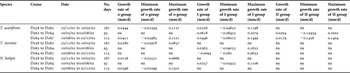
Component-fitting software (CMIX: de la Mare, Reference de la Mare1994) was used to fit normal distributions to the composite length–frequency data and identify modes. This method fits a mixed distribution using a maximum likelihood estimator that assumes that the data have an Aitchison delta distribution (Aitchison, Reference Aitchison1955). The number of expected cohorts present in the data must be specified by the user before initiating the fitting procedure. We conducted a series of runs based on the presence of one, two or three cohorts in the data and then determined the best component fit to the observed data using a Chi-squared test. No constraints were placed on the mean length, variance or proportions expected within each component when fitting the mixed distributions. Growth rates were determined by tracking modes in the composite length–frequency data between seasons. The difference in modal size was expressed as a rate of growth (mm/d) relative to the number of days that had elapsed between the mid-sampling dates of the hauls during each survey. Estimates of maximum and minimum growth rates were calculated similarly using the ±95% confidence intervals (CI) of the fitted distributions instead of the modes of the tracked cohorts. For example, the maximum growth rate of a cohort was calculated as the difference between the upper 95% CI in season 2 (e.g. summer) and the lower 95% CI in season 1 (e.g. spring).
RESULTS
Investigation area and physical environment
The primary current flow in the Irminger Sea is counter-clockwise around its margins (Lavender et al., Reference Lavender, Davis and Owens2000). The Irminger Sea can be divided into at least three distinct regions based on the oceanographical properties of the upper 500 m of the water column (Holliday et al., 2006): the Central Irminger basin, which contains an oligotrophic gyre; the region to the west of the crest of the Mid-Atlantic Ridge dominated by the northward flow of the Irminger Current; and the region over the Greenland Shelf slope dominated by the intense southerly flow of the East Greenland current (Lavender et al., Reference Lavender, Davis and Owens2000). The Irminger Current carries relatively warm and saline water from the North Atlantic Current, and retroflects at the northern end of the basin to join the East Greenland Current that flows over the shelf slope. This water mass becomes progressively cooler and fresher towards the south as it interacts with cool and fresher water both of polar origin, which flows over the shelf as the inner branch of the East Greenland Current, and from the oceanic waters of the Central Irminger basin.
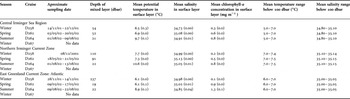
Detailed descriptions of the physical oceanographical regime during this investigation are given in Sanders et al. (Reference Sanders, Brown, Henson and Lucas2005) and Holliday et al. (Reference Holliday, Waniek, Davidson, Wilson, Brown, Sanders, Pollard and Allen2006), so only an overview is given here. In general, temperature, salinity and chlorophyll-a concentrations were relatively low throughout the study region during the autumn/winter season (November/December 2001: Table 1). These three parameters increased in the spring (April/May 2002), and by summer (July/August 2002) a temperature-dominated pycnocline had developed in each region of the Irminger Sea. The shallow mixed layers were also substantially warmer and fresher during this time. Post-phytoplankton-bloom conditions were apparent in the summer period and chlorophyll-a concentrations were similar to those observed during the spring time.
Mean oceanographical conditions in the Irminger Sea during 2001–2002. Standard deviations are given in parentheses. These data are summarized from Holliday et al. (Reference Holliday, Waniek, Davidson, Wilson, Brown, Sanders, Pollard and Allen2006) and were presented in Saunders et al. (Reference Saunders, Ingvarsdottir, Rasmussen, Hay and Brierley2007).

Throughout the sampling period, the Central Irminger basin region typically had lower temperatures and lower, but highly variable, salinities throughout the water column compared to the other regions (Table 1). The physical regime of the Northern Irminger Current Zone was notably different from the Central Irminger Sea, but in terms of surface production, the two regions were very similar throughout the sampling period. Both regions had relatively low chlorophyll-a concentrations (0.2–0.8 mg m−3) during each season and only a small spring bloom was apparent from the data. The highest chlorophyll-a values in the Irminger Current were found over the northern regions of the Reykjanes Ridge (maximum of 2.0 mg m−3). The Greenland Current Zone has complex oceanographical characteristics because the East Greenland Current (EGC) carries several different water types (Lavender et al., Reference Lavender, Davis and Owens2000). During this investigation the zone was separated into two sub-zones: the Polar-Origin EGC Zone and the Atlantic-Origin EGC Zone (Holliday et al., 2006). The main features of the Polar-Origin EGC Zone throughout the seasons were low temperatures and salinity (3.0–6.1°C and 33.95–34.98 °C) and strong near-surface stratification dominated by freshwater. This zone also had a strong spring bloom during the spring time and mean chlorophyll-a concentrations were high (3.2 mg m−3). However, no net trawls were possible in this sector due to ice cover. Temperature and salinity in the EGC Atlantic Zone were lower than in the Northern Irminger Current Zone during each season, but chlorophyll-a was notably higher. Chlorophyll-a concentration in the EGC Atlantic Zone was also higher than in the Central Irminger basin region. Surface water in the EGC Atlantic Zone was generally cooler and fresher than in the Central Irminger Sea, however, the water temperature and salinity at depth (below 100 dbar) was typically higher in the EGC Atlantic Zone.
Vertical distribution of euphauiids
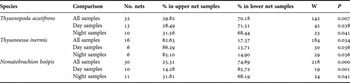
A total of 62 Dual Methot net hauls were deployed in the Irminger Sea and adjacent regions during the investigation, of which 42 were depth-stratified. Comparisons of euphausiid densities between depth strata for all nets combined (both day and night) showed that T. acutifrons density was significantly (W = 142, P < 0.01) higher in the 400–800 m region of the water column than in the 0–400 m region (Table 2). Around 70% of T. acutifrons density occurred in the lower depth strata, and a similar percentage occurred in this zone during both day and night, suggesting that there was little DVM into the 0–400 m region. The density of N. boöpis was also significantly (W = 218, P < 0.001) greater in the lower portion of the water column for all samples combined (~75%) and for samples collected during the daytime (~86%; W = 19, P < 0.001). The density of N. boöpis in the upper strata was higher at night than during the daytime (~14% in daytime compared to ~32% at night), suggesting some DVM to the upper sector at night, but the overall density was still significantly greater between 400 and 800 m during this time (W = 24, P < 0.05). In contrast to T. acutifrons and N. boöpis, the density of T. inermis was significantly higher in the upper regions of the water column, with around 83–85% of the overall density occurring between 0 and 400 m regardless of the time of day (Table 2; P < 0.05).
Vertical distribution of euphausiid abundance and results of the Wilcoxon rank-sum test to compare differences between the 0–400 m and 400–800 m depth strata. Nine net samples were collected during hours of twilight and these samples were omitted for further analysis.

Distribution of abundance and biomass
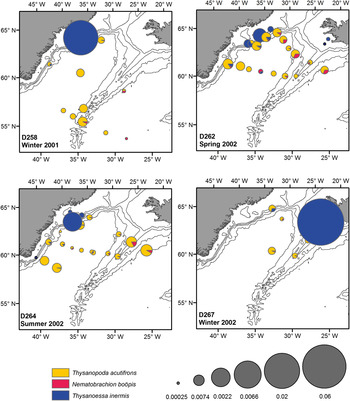
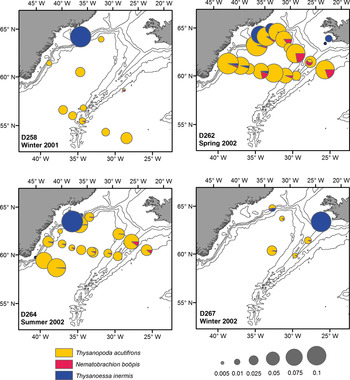
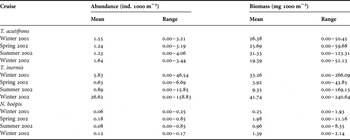
Although the distribution of winter stations was limited in the Irminger Sea, there was evidence of spatial heterogeneity in euphausiid distribution and abundance in each season (Figures 2 & 3). Total euphausiid abundance and biomass differed for each station and the proportion of species present was not uniform across the study region. During each season, T. inermis was the most numerically abundant of the three species in the Irminger Sea, with mean densities between 0.63 and 26.62 ind. 1000 m−3 (Table 2). The greatest concentrations of T. inermis abundance occurred over the east Greenland shelf-break and regions in close proximity to the Iceland Shelf, where the species was predominantly found throughout the study (Figure 2). The species also comprised a relatively high proportion of biomass in these sectors (mean biomass: 3.92 to 41.74 mg 1000 m−3; Figure 3 and Table 2). Both T. inermis numerical density and biomass was highest during the two winter seasons. However, seasonal trends were difficult to substantiate due to low sampling coverage in the winter seasons. The density of T. acutifrons was generally low throughout the Irminger Sea during the four surveys (mean: 1.23 to 1.64 ind. 1000 m−3), but the species still contributed a high proportion of biomass (mean: 19.39 to 31.33 mg 1000 m−3) at most stations due to its large body size (Figures 2 & 3). The species occurred in most off-shelf/shelf-break stations in the Irminger Sea, but was notably absent from the more-on-shelf regions (<500 m) in the northern East Greenland Coast sectors. Again, seasonal trends in T. acutifrons abundance were difficult to elucidate given the low numbers of specimens encountered, but the greatest biomass of T. acutifrons appeared to occur during the summer period from the available data. Nematobrachion boöpis was the least abundant of the three species in the Irminger Sea, with densities around 0.06–0.18 ind. 1000 m−3. The species also had a comparatively low biomass throughout the four surveys (mean: 0.25–1.98 mg 1000 m−3). Nematobrachion boöpis was predominantly distributed in regions around the Reykjanes Ridge and the northern sectors of the Irminger Basin, and seldom occurred in the cooler waters around East Greenland and the Central Irminger Sea.
Seasonal distribution of Thysanopoda acutifrons, Thysanoessa inermis and Nematobrachion boöpis density in the Irminger Sea (between 0 and 800 m) during 2001–2002. The sizes (diameter) of the pie charts are proportional to the log total of the densities sampled per net (ind. m−3).

Seasonal distribution of Thysanopoda acutifrons, Thysanoessa inermis and Nematobrachion boöpis biomass in the Irminger Sea (between 0 and 800 m) during 2001–2002. The sizes (diameter) of the pie charts are proportional to the log total of the biomass sampled per net (mg m−3).

Population structure
The terminology of Einarsson (Reference Einarsson1945), Tesch (Reference Tesch and Ricker1971) and Falk-Petersen & Hopkins (Reference Falk-Petersen and Hopkins1981) has been adopted to describe the population structure of euphausiids (i.e. 0-group covers the period from hatching until 30 March of the following year; I-group covers the period 1 April to 30 March the next year; II-group covers the subsequent period from 1 April until 30 March, and so on).
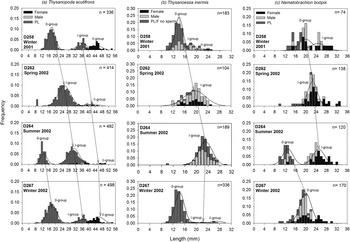
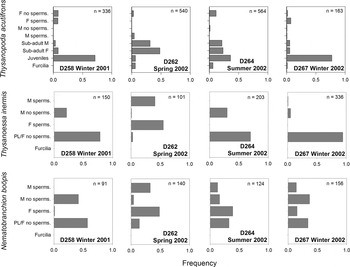
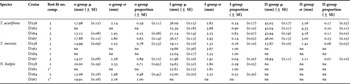
Length–frequency histograms for T. acutifrons showed that three size-, and presumably age-, classes were present in the overwintering population in 2001 (Figure 4A): <1 year old (0-group; mode: 18 mm), 1 year old (I-group; mode: 36 mm) and 2/2+ year old (II-group; mode: 45 mm; Table 4). The largest portion of the population at this time was the juvenile 0-group (Figures 4A & 5A). The I-group predominantly comprised sub-adult individuals that had not yet reached sexual maturity, indicating that the species does not reproduce until the second year of its life. The II-group consisted exclusively of female individuals with around half of these mature individuals bearing spermatophores (Figure 5A). This suggests that mating took place around November/December. By spring (April/May) 2002, the 0-group had increased in size and recruited into the I-group (i.e. became 1 year old; mode: 25 mm). These individuals had also advanced from juveniles to sub-adults by the spring season and few juveniles remained in the population. A few early furcilia stages (~9 mm in size) appeared in the population during spring, indicating that some spawning and larval development had occurred prior to this time (Figures 4A & 5A). Also during the spring time, there was evidence that the previous winter (2001) I-group had recruited into the II-group (i.e. become 2 year olds; mode: 42 mm), however, this cohort represented a small proportion of the population, and it is possible that this group contained individuals >3 years old. The newly spawned 0-group (mode: 13 mm) was evident in the population by summer 2002 (July/August) and these individuals were mostly juvenile stages, although some furcilia stages were also present. Both the I-group (mode: 31 mm) and II-group (mode: 44 mm) were present at this time and both groups had increased in modal size from the spring season (Figure 4A; Table 4). Of the sexually mature component present in the summer population, none had spermatophores indicating that the reproductive season had ended (Figure 5A). The population structure in winter 2002 (November/December) was very similar to that observed in the previous winter season; the juvenile 0-group (mode: 18 mm) represented the main cohort in the population, and both the sub-adult I-group (mode: 36 mm) and mature II-group (mode: 47 mm) were present as smaller components. Again, the II-group consisted of all females, the majority of which had spermatophores attached.
Seasonal length–frequency distribution of Thysanopoda acutifrons, Thysanoessa inermis and Nematobrachion boöpis in the Irminger Sea during 2001–2002.

Sex and maturity status of Thysanopoda acutifrons, Thysanoessa inermis and Nematobrachion boöpis in the Irminger Sea during 2001–2002; sub-adult F, sub-adult female; sub-adult M, sub-adult male; M sperms, adult male with spermatophores at the genital aperture or petasma; M no sperms, adult male without external spermatophores; F sperms, adult female with spermatophores; F no sperms, adult female without spermatophores; PL/F no sperms, post larvae and females without spermatophores.

Mean abundance and biomass of Thysanopoda acutifrons, Thysanoessa inermis and Nematobrachion boöpis in the Irminger Sea. There were 57 net hauls in the Irminger Sea area (D258: N, 9; D262: N, 20; D264: N, 22; D267: N, 6).

Fitted components for Thysanopoda acutifrons, Thysanoessa inermis and Nematobrachion boöpis using CMIX software.

na, not applicable; CMIX could only fit one distribution of the data denoted (*).
During winter 2001, there were three cohorts evident in the T. inermis population, with the 0-group (mode: 15 mm) forming the largest component (78%) (Figure 4B; Table 4). The presence of the I-group (mode: 19 mm) and II-group (mode: 24 mm) cohorts indicate that T. inermis may have a life span of two years or greater in this region. Almost all animals had spermatophores in the spring when they attained sexual maturity at one year of age (I-group; mode: 20 mm), and there was a greater ratio of males: females (at least 3:1) in most size-classes (Figures 4B & 5B). I-group and II-group cohorts present in the winter data were absent in spring, suggesting that they may have died out of the population. By summer time, the new I-group had increased in size (mode: 23 mm) and no animals were bearing spermatophores. This indicates that the reproductive season had ended and that the species had a narrow breeding window in the Irminger Sea. Adult females were not distinguishable from post-larval stages during this time, but a high proportion of males were still present in the population. There was no evidence of the newly spawned 0-group in the summer and the group was most likely still in the early larval development stages that were too small to be sampled by the Dual Methot net. However, the newly spawned 0-group (mode: 14 mm) was clearly evident in the winter 2002 season. The data also suggest that a large proportion of the I-group had died out by this time, as only a few animals from this cohort were present in the winter population. Some II-group (mode: 27 mm) animals were present in the population similar to that observed in winter 2001, but they comprised only a small proportion (7%).
The population structure of N. boöpis appeared to be bimodal in the first winter period (0-group: 20 mm and I-group: 25 mm; Table 4), suggesting a life cycle of over one year. However, there were relatively few length–frequency measurements obtained for this species during this time (Figure 4C). Most of the population did not have spermatophores during the first winter season, but there was a residual component of mature females that did have spermatophores attached (Figure 5C), suggesting that some mating had occurred just prior to the overwintering period. In the spring, the newly recruited I-group (mode: 23 mm) was present and most animals were bearing spermatophores indicating that the main reproductive season had started. The newly spawned 0-group was evident in the population by the summer and the majority of the larger I-group animals present at this time were female. A large proportion of mature adults still had spermatophores appended in the summer and this persisted into the subsequent winter season. This suggests that N. boöpis has a prolonged spawning period in the Irminger Sea. In the winter period there was only one cohort evident in the population, the newly spawned 0-group (mode: 20 mm), and it appears that the predominant I-group had died out of the population. Again, the largest part of the population present in this season were sexually mature, suggesting that N. boöpis has a fairly rapid maturation rate from hatching and is capable of breeding in the first winter of its life cycle.
Growth
Through all seasons the rate of growth for each euphausiid species was mostly positive and there was little evidence of animals regressing in size (Table 5). Growth rates for T. acutifrons were around 0.04 mm d−1 for the 0-group, 0.04–0.06 mm d−1 for the I-group and 0.02 mm d−1 for the II-group. The highest rate of growth occurred between the spring and summer periods for this species. However, other growth rates were very similar between seasons. Growth rates for T. inermis were around 0.03 mm d−1 for both the 0-group and I-group, and growth rates were only marginally higher between the spring and summer periods. There was very little growth for this species between summer and winter, and it appears that there could have been a slight regression in body size between these two periods. Nematobrachion boöpis had growth rates that differed between seasons. The lowest rates of growth were for the 0-group between winter and spring (0.02 mm d−1). Growth of the I-group was around 0.03 mm d−1 during the period between spring and summer and the highest growth rates for the species occurred between summer and winter (~0.06 mm d−1) for the newly spawned 0-group. The species therefore appears to have a more rapid growth rate in the 0-group stage during this period.
Seasonal growth rates of Thysanopoda acutifrons, Thysanoessa inermis and Nematobrachion boöpis in the Irminger Sea during 2001–2002.

DISCUSSION
Thysanoessa inermis
Our results show that T. acutifrons, T. inermis and N. boöpis exhibit different life history and distribution patterns in the Irminger Sea, which is in broad agreement with previous, albeit limited, findings. Thysanoessa inermis was the most abundant of the three euphausiid species in this study and the highest densities and biomass were generally found in the winter time (Table 3). The species was predominantly distributed in the upper 400 m of the water column in regions around the shelf-break regions surrounding the Basin. This accorded well with several studies in the North Atlantic (Einarsson, Reference Einarsson1945; Lindley, Reference Lindley1977, Reference Lindley1980; Falk-Petersen & Hopkins, Reference Falk-Petersen and Hopkins1981; Dalpadado & Skjoldal, Reference Dalpadado and Skjoldal1996; Astthorsson & Gislason, Reference Astthorsson and Gislason1997) that have shown T. inermis to be mainly an on-shelf/shelf-break species. Our data suggest that T. inermis had a life span of two to three years in the Irminger Sea. Thysanoessa inermis growth rates were in accordance with those observed in other cold water regions in most seasons, although growth rates were notably lower in the Irminger Sea during spring/summer compared to waters around North Iceland and the Gulf of Alaska (Astthorsson & Gislason, Reference Astthorsson and Gislason1997; Pinchuk & Hopcroft, Reference Pinchuk and Hopcroft2007). This might be attributable to the markedly higher levels of productivity, and hence food availability, that was evident in these two regions during the spring bloom period (maximum chlorophyll-a: <1 mg m−3 in the Irminger Sea compared to ~7 and ~2 mg m−3 around north Iceland and the Gulf of Alaska, respectively). The data also indicate that the species has a relatively narrow reproductive window around April/May. This pattern in reproductive strategy is broadly similar to that observed in other regions of the North Atlantic in that mature individuals have spermatophores attached and reproduction appears to occur at similar times during the spring season. It has been suggested that the spawning season of T. inermis is timed to coincide with the seasonal spring phytoplankton bloom (Astthorsson & Gislason, Reference Astthorsson and Gislason1997). In most regions of the North Atlantic, including the Barents Sea, Icelandic coastal waters and Norwegian Sea, the spring-spawned 0-group is usually evident in the population by the summer (July/August), with animals of around 8–12 mm in size forming a relatively high proportion of the population (Lindley, Reference Lindley1980; Falk-Petersen & Hopkins, Reference Falk-Petersen and Hopkins1981; Dalpadado & Skjoldal, Reference Dalpadado and Skjoldal1996; Astthorsson & Gislason, Reference Astthorsson and Gislason1997). However, the newly spawned 0-group was not evident in the water column in the Irminger Sea in July/August, suggesting that animals in this group were still in the early larval stages (calyptopis/nauplii) at this time (see Saunders et al. (Reference Saunders, Ingvarsdottir, Rasmussen, Hay and Brierley2007) for descriptions of larval stages during the study). This marked absence of the 0-group in July/August was also observed in waters around West and East Greenland (including the Irminger Sea) in previous studies (Einarsson, Reference Einarsson1945), which suggests either that early larval development is prolonged in the Irminger Sea compared to other regions, or that eggs are spawned slightly later in the region, even though the timing of breeding is apparently the same throughout the North Atlantic.
Temperature is considered to be the main driver of egg and early larval development rates in marine plankton, and the observed delay in larval development of T. inermis in the region could be related to low water temperatures at the time of spawning (Ross et al., Reference Ross, Quetin and Kirsch1988). Also, the timing of the spring phytoplankton bloom may be a factor controlling spawning times in the region. For example, our data suggest that chlorophyll-a concentrations were highest during the summer period during the study (Table 1), so spawning may have been delayed in the Irminger Sea to coincide with this period of high food availability. Modal sizes for T. inermis cohorts in the Irminger Sea were similar to those reported previously around Greenland and Iceland in each season (Einarsson, Reference Einarsson1945). However, all cohorts of T. inermis, including the newly spawned 0-group, were larger (~2–4 mm) than their counterparts observed in the Barents Sea (Dalpadado & Skjoldal, Reference Dalpadado and Skjoldal1996) and Norwegian Sea (Einarsson, Reference Einarsson1945; Falk-Petersen & Hopkins, Reference Falk-Petersen and Hopkins1981) at similar times of year. Animals were also larger than those observed in more temperate waters in the North Sea area (Lindley, Reference Lindley1980). A possible feature of the high latitude regions could be that, although the 0-group recruits into the population later in the Irminger Sea than elsewhere, these animals may still attain a greater body size by their first winter than those in regions where the 0-group is recruited early. Thus the apparent delay in larval development or spawning of the 0-group in the Irminger Sea could be offset by greater post-larval growth than in other regions. A further possibility is that the 0-group observed during the winter period were immigrants from other regions and were not representative of the cohort spawned in the Irminger Sea in the spring/summer period. If so, the apparent increased post-larval growth between summer and winter could simply be a function of the high temporal and spatial variation in sampling within the dynamic ecosystem. This type of caveat should also be considered when interpreting any growth rates from sequential length–frequency distributions using the natural cohort technique, as it is difficult to substantiate the assumptions that individuals from the same populations are sampled over time in deep water pelagic ecosystems, and that the mortality of individuals is not size-dependent (Quetin et al., Reference Quetin, Ross, Frazer, Amsler, Wyatt-Evens and Oakes2003).
The increased body size, increased longevity and possible delay in larval development/egg spawning of T. inermis in the Irminger Sea suggests a difference in life cycle strategy compared to that in other cold water regions in which the species occurs. This adaptation could be a function of different underlying oceanographical parameters in the Irminger Sea, such as temperature and food availability. The life cycles of other northern species in the genus Thysanoessa appear to be adaptations to different oceanographical conditions at different latitudes within the boreal to Arctic regions of both the Atlantic and Pacific (Siegel, Reference Siegel2000a, Reference Siegelb). Thysanoessa longicaudata, T. raschi and T. inermis demonstrate strong plasticity in age structure, body size and maturity development in the Arctic and sub-Arctic regions compared to their more southern contemporaries (Jörgensen & Matthews, Reference Jörgensen and Matthews1975; Kulka & Corey, Reference Kulka and Corey1978; Lindley, Reference Lindley1980; Saunders et al., Reference Saunders, Ingvarsdottir, Rasmussen, Hay and Brierley2007). In general, conditions appear to be more favourable for survival of these species in colder waters at high latitudes, where animals attain a greater body size and an older age at maturation. Slow growth, larger maximal body size and prolonged larval development times are common features of high latitude marine species (Hirst et al., Reference Hirst, Roff and Lampitt2003; Peck et al., Reference Peck, Webb and Bailey2004). The contrasting situation occurring between the Irminger Sea and the other high latitude regions could be related to prevailing ocean currents and environmental conditions in the regions. For example, T. inermis in the Barents Sea is predominantly distributed in regions where waters of Atlantic origin prevail, and very few animals occur in cold, Arctic waters north of the Polar Front (Dalpadado & Skjoldal, Reference Dalpadado and Skjoldal1996). In contrast, T. inermis in the Irminger Sea is distributed mainly in regions such as the East Greenland Shelf, where the East Greenland Current prevails along the East Greenland continental slope. The East Greenland Current is highly dynamic and carries cold and mixed water of polar origin from the Arctic and Nordic Seas (Lavender et al., Reference Lavender, Davis and Owens2000). The species is therefore often subjected to cold water conditions in this region, which might impact growth and development throughout its life cycle. Cold water conditions also prevail around the Icelandic shelf and this region also receives influx of waters from regions at higher latitudes. Furthermore, both these regions are shelf/shelf-break areas that typically sustain greater levels of productivity, and therefore higher food availability, than oceanic regions (Sanders et al., 2005), and this may have an impact on the species physiology and life cycle in the Irminger Sea. The high availability of food resources in these regions may explain the apparent increased growth of the 0-group in the Irminger Sea compared to other high latitude regions (Ross & Quetin, Reference Ross and Quetin1989; Ross et al., Reference Ross, Quetin, Baker, Vernet and Smith2000). Another possibility is that a large proportion of the T. inermis population around the East Greenland Shelf and Iceland Shelf are advected into the region from waters farther north via prevailing ocean currents, such as the East Greenland Current. Thus the population in the Irminger Sea may contain a large number of animals of polar/sub-polar origin, where the species typically grows larger and lives longer due to the different environmental conditions (temperature and food availability) and physiological adaptations. Given that the Irminger Sea is a highly dynamic region (Holliday et al., 2006), and that its waters are mixed from several sources, complex interactions could influence the population dynamics of T. inermis there.
Thysanopoda acutifrons
Thysanopoda acutifrons had a low abundance in the Irminger Sea, but the species still comprised a high proportion of biomass due to its large body size. Biomass was generally highest in the summer period, but seasonal trends were difficult to elucidate due to low spatial coverage in the winter. Our data showed that the species had a life cycle of over two years and that the species has similar, but relatively low, rates of growth throughout each season. The species only becomes sexually mature in the second year of its life and the main breeding season appeared to be during the autumn/winter period (November/December). The trends are similar to those observed by Mauchline (Reference Mauchline1985) at more temperate latitudes and by Einarsson (Reference Einarsson1945) in the Irminger Sea and adjacent regions, suggesting little regional variation in population dynamics for the species. In this study, T. acutifrons was predominately distributed in the deeper oceanic and shelf-break regions (<500 m) of the Irminger Basin and did not occur in the more-onshore locations. The main vertical distribution of T. acutifrons was below 400 m in this investigation, further suggesting that the species is deep-dwelling (Tattersall, Reference Tattersall1911; Einarsson, Reference Einarsson1945). Indeed, the species has previously been reported in net samples as deep as 2000 m in the North Atlantic, and it has been suggested from limited data that its main vertical distribution may be at depths greater than 1000 m (Tattersall, Reference Tattersall1911; Einarsson, Reference Einarsson1945). In light of these studies, it is possible that the vertical range of T. acutifrons was not covered fully in this investigation, as the net hauls were deployed to a maximum depth of 800 m. This may have consequences for the abundance estimates of T. acutifrons presented here, as there could be a portion of the population not sampled at depth. However, the exact vertical distribution of the species remains unclear, as previous data were not obtained from depth-discrete net hauls. Therefore, it is not possible to dismiss or substantiate our estimates of abundance until the exact vertical distribution pattern of T. acutifrons has been resolved fully.
Mauchline (Reference Mauchline1985) reported seasonal length–frequency data for T. acutifrons from non-depth-discrete net hauls deployed between 0 and 2000 m at one site in the Rockall Trough between 1973 and 1976. Length–frequency plots of these data were very simlar to those of this study and the population structures were in high accordance in each season. In both studies, the same cohorts were present in each season, with a high overlap in each cohort mode, cohort proportion and cohort sex/maturity status. Einarsson (Reference Einarsson1945) suggested that there was a distinct vertical separation in size-classes for T. acutifrons in the North Atlantic, with small juvenile/sub-adult individuals occurring no deeper than about 700 m and the larger adults distributed around 1000–2000 m. We would therefore expect our net data (0–800 m) to be biased towards the smaller size-classes if our sampling was problematical, with larger adults notably absent, or under-represented in the length–frequency plots. This was not evident from comparisons with both Einarsson's (1945) and Mauchline's (1985) data (from various depths between 0 and 5000 m wire-out), suggesting that the data collected in this investigation was representative of the T. acutifrons population in the Irminger Sea.
Nematobrachion boöpis
Nematobrachion boöpis was the least abundant of the three species sampled in the Irminger Sea. The species has been described as having a more-temperate distribution and as a ‘southern guest' at higher latitudes in the North Atlantic (Einarsson, Reference Einarsson1945; Mauchline, Reference Mauchline1985). Our data support these observations, as the species was found mainly in regions where waters of Atlantic origin prevail in the Irminger Basin (i.e. in the northern Irminger Basin and over the Reykjanes Ridge where the Irminger Current flows as a branch of the North Atlantic Current). However, it seems apparent that regional variation in oceanographical conditions enables more temperate euphausiids to survive in the Irminger Sea region throughout the year. Our data showed that N. boöpis has variable rates of growth in the region and that the reproductive season is prolonged throughout the year, with relatively high proportions of the adult population bearing spermatophores from spring (April/May) and into the overwintering period (November/December). Our data also indicate that N. boöpis has a life cycle of over one year in the Irminger Sea region, and that the species appears to have rapid rates of sexual maturation and is capable of breeding within the first six months of its life cycle. This life cycle strategy is in general accordance with that observed by Mauchline (Reference Mauchline1985) in the Rockall Trough, and is quite different from that of the other boreal euphausiids in the Irminger Sea that tend to have notably longer rates of maturation (usually 1 year) and relatively short and pronounced windows of reproduction that appear to be timed with the onset of the spring phytoplankton bloom (e.g. M. norvegia, T. longicaudata and T. inermis). Nematobrachion boöpis appeared to be a deeper-dwelling euphausiid species in this study and was predominantly distributed below 400 m, similar to T. acutifrons. These two deeper-dwelling species appeared to display limited DVM behaviour from the available depth-stratified data, so they are probably less reliant upon surface production as direct food sources and feed more on small zooplankton and detritus at depth. Studies have shown that N. boöpis is a carnivorous species that predominantly feeds on cyclopoid copepods and T. acutifrons is generally regarded as an omnivore from the limited data available (Mauchline, Reference Mauchline1980a; Kinsey & Hopkins, Reference Kinsey and Hopkins1994). Therefore, the reproductive strategy of N. boöpis and T. acutifrons are probably less geared towards the timing of the main spring phytoplankton bloom that occurs above their vertical range, and reproduction occurs either throughout the year, as with N. boöpis, or at other times of the year, such as autumn/winter in the case of T. acutifrons. The late-season reproductive strategy of T. acutifrons, for example, might be more focused upon the seasonal deepening of food sources, such as zooplankton, than the spring phytoplankton bloom in the upper layers in the Irminger Sea. Acoustic studies on the deep scattering layers (DSL) in this region have shown that there is a distinct seasonal deepening of the DSL in the winter time, so it is possible that the breeding season of the deep-dwelling euphauiids is timed to coincide with this downward movement of available food resources. Also, studies have shown that some species of calanoid copepods overwinter in the deeper regions and enter a state of diapause in the late-season (Hind et al., Reference Hind, Gurney, Heath and Bryant2000; Heath et al., Reference Heath, Rasmussen, Ahmed, Allen, Anderson, Brierley, Brown, Bunker, Cook, Davidson, Fielding, Gurney, Harris, Hay, Henson, Hirst, Holliday, Ingvarsdottir, Irigoien, Lindeque, Mayor, Montagnes, Moffat, Pollard, Richards, Saunders, Sidey, Smerdon, Speirs, Walsham, Waniek, Webster and Wilson2008), which may also be important food sources for deep-dwelling euphausiids during the reproductive season.
Potential euphausiid niche separators in the Irminger Sea
Differences in seasonal life cycle strategies, vertical distribution and diets are key niche separators in marine ecosystems (Barange, Reference Barange1990), and may explain, to a certain extent, the relatively high diversity of co-existing euphausiid species in the Irminger Sea. From data presented in this study and by Saunders et al. (Reference Saunders, Ingvarsdottir, Rasmussen, Hay and Brierley2007), it appears that T. acutifrons, T. inermis, N. boöpis, M. norvegica and T. longicaudata each have different niches in the Irminger Sea (Table 6). Thysanopoda acutifrons, for example, is a deep-dwelling species with a life cycle that seems adapted to cold water environments. The species attains a large body size and has slow maturation rates, typical of a predominantly cold water organism. Unlike most euphausiids in the region, the breeding season appears to be late in the year and not timed directly to the spring phytoplankton bloom. The species also appears to exhibit little DVM behaviour (in terms of vertical extent) and is considered a trophic generalist that feeds mostly on food resources (zooplankton and detritus) at depth rather than phytoplankton in the surface layers (Mauchline & Fisher, Reference Mauchline and Fisher1969). Nematobrachion boöpis is a smaller, deep-dwelling euphausiid that appears to spawn throughout the year and has a life cycle that seems to be adapted to warmer and more temperature latitudes. The species occurs mainly in the warmer waters of Atlantic origin around the Irminger Basin, has a relatively short life cycle, a predominantly carnivorous diet, and exhibits rapid development rates after the post-larval stages that enable breeding early in its life cycle. This species therefore seems to have a very different niche to that of T. acutifrons. Similar differences in life cycle characteristics, and hence niche roles, seem apparent between the two Thysanoessa species that occur in the upper regions of the water column in the Irminger Sea. Thysanoessa inermis has a larger body size than T. longicaudata and occurs predominantly in shelf-break areas, whereas T. longicaudata has a much more oceanic distribution. The two species have very different diets, with T. inermis being herbivorous and T. longicaudata largely carnivorous (Falk-Petersen et al., 2000), and T. inermis appears to have a slightly longer life cycle than T. longicaudata, although within-basin variation may occur (Saunders et al., 2007). There is also some evidence that recruitment in T. inermis might be delayed slightly compared to T. longicaudata, even though both species appear to have the same spawning window, and this may be a strategy to avoid inter-specific competition for resources in the early feeding stages. Although there is some overlap in the horizontal distribution pattern between M. norvegica and the other euphausiids, its life cycle in the Irminger Sea appears different from that of the other species. Meganyctiphanes norvegica has a relatively large body size, exhibits strong vertical migratory behaviour and has a broader vertical range than the other species. This may enable the species to utilize different food resources at different depth intervals to those exploited by the other species and this could be an important factor for the co-existence of this species in the region.
Life cycle characteristics of the main euphausiid species in the Irminger Sea. Data on Meganyctiphanes norvegica and Thysanoessa longicaudata were taken from Saunders et al. (Reference Saunders, Ingvarsdottir, Rasmussen, Hay and Brierley2007) and information on euphausiid diet was obtained from Mauchline (Reference Mauchline1980a), Kinsey & Hopkins (Reference Kinsey and Hopkins1994) and Falk-Petersen et al. (Reference Falk-Petersen, Hagen, Kattner, Clarke and Sargent2000).

Conclusions
The data we have presented are the most comprehensive for these euphausiids in this area and the first collected in the region since the early 1930s (Einarsson, Reference Einarsson1945). Such data provide important baselines for understanding the ecology of the Irminger Sea ecosystem and for understanding, and ultimately, predicting the impacts of longer-term, broad-scale climate change in this region. There is increasing evidence that the North Atlantic ecosystem is changing. For example, studies have shown that sea surface temperatures are rising and that regime shifts in plankton communities have occurred in recent years, which may have large consequences for the euphausiid component of the Irminger Sea ecosystem (Dickson et al., Reference Dickson, Yashayaev, Meincke, Turrell, Dye and Holfort2002; Beaugrand, Reference Beaugrand2003; Greene et al., Reference Greene, Pershing, Conversi, Planque, Hannah, Sameoto, Head, Smith, Reid, Jossi, Mountain, Benfield, Wiebe and Durbin2003, Richardson & Schoeman, Reference Richardson and Schoeman2004). The ecology of euphausiids in the Irminger Sea is different in many respects and each species' may respond differently to broad-scale environmental change. The potential impacts of such change on euphausiid ecology and the Irminger Sea ecosystem are also likely to be complex, further confounding our ability to model the situation. At present there are few data available to substantiate any firm conclusions about which euphausiid species are most susceptible to population depletion, large-scale shifts in distribution, or large changes in life cycle and behavioural characteristics. Therefore, there is clearly a pressing need for more data on the ecology of all euphausiid species in the region, so that different hypotheses on the likely outcomes of various ocean-warming scenarios to aid effective ecosystem management strategies can be tested.
ACKNOWLEDGEMENTS
This work was funded by the Natural Environment Research Council, UK, under the Marine Productivity Thematic Programme. We thank the Marine Productivity Summer School participants at the University of Aberdeen, especially A. Ingvasdottir, S. Hay, S. McRobert and I. Roberts, for assistance with processing zooplankton samples, K. Anderson for help with statistical analysis and J. Hunter for assisting with net sampling during all four cruises. We are also grateful to the Masters, officers and crew of RRS ‘Discovery' for their assistance at sea. R.A.S. and G.A.T. were supported by the Ecosystems Programme at the British Antarctic Survey during the writing of the manuscript.