INTRODUCTION
At the dawn of the new millennium, the commitment of the international community to the millennium development goals has placed the fight against poverty as the top priority on the agendas of international donor and recipient countries. Concurrently, international financial institutions (IFIs) have launched the ‘Poverty Reduction Strategy’ programme (PRSP). This new, country-led, poverty-alleviating framework replaced the previous system of Structural Adjustment Programmes (SAPs). With over 60 countries having reached the PRSP implementation phase, this strategy has become the standard framework for development strategies. It also functions as an access gate to international financial aid (e.g. Poverty Reduction and Growth Facilities, and debt alleviation under the HIPCFootnote 1 initiative).
Rwanda entered the PRSP process in 2000. The government first elaborated an interim PRSP that was later transformed into the final PRSP-1 document. The strategy was endorsed by the IFIs in 2002, and implemented from 2002 until 2005. IMF joint staff assessments largely appraised the Rwandan policy document as well as PRSP progress reports describing the programme's implementation process (IMF 2004a; IMF 2005a; IMF 2006a). In early 2006, the Rwandan government began to elaborate a second PRSP policy. This strategy, the ‘Economic Development and Poverty Reduction Strategy’ (in this paper referred to as EDPRS or PRSP-2), is to be finalised in 2007. It will be implemented over the following five years, financed to a large extent by bilateral and international donors.
The agricultural sector is considered crucial in all of Rwanda's strategic documents on poverty reduction. One of the ‘six pillars’ in the Vision 2020 document was defined as the ‘transformation of agriculture into a productive, high-value, market-oriented sector with forward linkages to other sectors' (GoR 2000). PRSP-1 also identified rural development and agricultural transformation as one of the six pillars for poverty reduction, i.e. ‘actions that most directly affect poor peoples’ ability to raise their incomes' (GoR 2002: 35). Further, each PRSP progress report has devoted a special section to progress in this sector.
This is hardly surprising given that agriculture employs almost 90% of Rwanda's active working population and represents about 45% of its GDP. Moreover, it is in the rural environment, rather than in urban areas, that poverty is most prominent and severe. Based on a national poverty line of 250 Rwandan francs (FRw, US$0.44 at nominal 2006 prices) per adult per day, 61·7% of the rural population is considered poor (2006 figures). The incidence of urban poverty is considerably lower, at 10·4% in Kigali city and 17·8% in other towns) (UNDP 2007). In absolute numbers, about 4·93 million of the 5·38 million poor live in rural areas (GoR 2007a).
With the end of Rwanda's first PRSP implementation period, the country's experience allows us to reach preliminary conclusions with regard to the results and usefulness of the PRSP strategy. The identified strengths and weaknesses may help to enhance the efficiency of the new EDPRS policy. But the lessons drawn from the Rwandan case are equally relevant in other contexts. Many countries are facing a similar challenge to enhance the participation of the poor in overall growth. The World Development Report 2006 (World Bank 2006a) is entirely devoted to the relationship between equity and development, trying to answer the major question of how to increase the participation of the poor in overall development. The analysis of the Rwandan case in this paper addresses some of the pitfalls in defining pro-poor policies.
Furthermore, many African countries are increasingly challenged by natural resource constraints. They all face the question of what role to attribute to the agricultural sector in an environment under stress, and which strategic choices to make within that sector. With respect to this issue, Rwanda is a rather extreme case study, given the problematic degree of land scarcity combined with sustained population growth. The lessons drawn from this case can certainly inspire policy-makers to elaborate inclusive solutions in other contexts.
In the first part of this paper, we focus on the dangers of a growth-led strategy for poverty reduction, and then look at the role of rural development as a growth engine in PRSP policy.Footnote 2 In the second part, we analyse the current agricultural and land policies that support rural development. These policies should serve as a blueprint for the EDPRS programme in which the rural sector will be at the fore. A third part looks at how rural policies will affect the welfare and bargaining positions of different types of farmer. In the concluding part of the paper, we question whether there is, indeed, an unavoidable trade-off between output growth and equity considerations.
THE FIGHT AGAINST POVERTY: SETTING THE RIGHT PRIORITIES?
Depending on the trickle-down effect? The danger of a growth-led strategy for poverty reduction
After four years implementing poverty-combating policies, we can now conclude whether the assumptions made in Rwanda's PRSP-1 were realistic. Targets for annual growth per capita in the first Rwandan PRSP were set at 4–5% for the next 15 to 20 years. This implies 7–8% per annum overall real growth (GoR 2000). Projections were, however, later reduced to 6–7% for the PRSP-1's 2002–05 implementation period (GoR 2002). In subsequent PRSP progress reports and IMF statistical documents, growth projections were typically set at about 6%. Two important questions then arise. First, have these growth expectations been realistic. Second, to what extent did growth translate into poverty reduction?
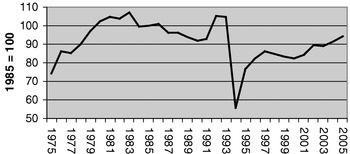
These ambitious projections for the first PRSP implementation period seemed to be justified based on Rwanda's solid post-civil-war economic recovery, with average annual growth of 8·6% between 1996 and 2001. There are, however, some critical observations to add. Figure 1 shows how the average period growth rate is influenced by exceptional growth figures in the first years (i.e. the steep slope), which moderate a few years later. From a longer-term perspective, economic performance has still not reached mid-1980s levels. Moreover, Rwanda benefited from the receipt of substantial aid funds, which significantly exceeded the sub-Saharan African average (Ansoms Reference Ansoms2005). The country also benefited from financial transfers out of the DRC during the years of Rwanda's military involvement there (Cassimon & Marysse Reference Cassimon, Marysse, Marysse and Reyntjens2001). It seems likely that these capital inflows fuelled Rwanda's exceptional economic recovery in the immediate post-war period.
Rwanda: evolution of GDP per capita.

In more recent years (i.e. 2003–06), annual growth did not meet the projected rate of about 6% (IMF 2005b, 2006b). This recent trend illustrates the vulnerability of Rwanda's economy to structural limitations, including overpopulation, resource scarcity and a limited potential for economic diversification. Further, overall growth targets for the coming years were lowered to between 4% and 4·5%. This would dampen per capita growth to a modest 2·1–2·6%,Footnote 3 far below the rate of 4–5% targeted in PRSP-1.
With reference to the above, the first issue to consider is whether growth will be substantial and sustainable enough in the near future, or whether current economic trends will signal the onset of more temperate times. The second principal issue is the degree of economic growth's ‘pro-poorness’. There are two dominant views on what constitutes pro-poor growth (Page Reference Page2006). One definition highlights the importance of reducing inequality by defining pro-poor growth as growth that disproportionably benefits the poor (Kakwani & Pernia Reference Kakwani and Pernia2000; Klasen Reference Klasen2003). Another definition regards economic growth as pro-poor when the living conditions of the poor improve in absolute terms, and poverty thus decreases (Kraay Reference Kraay2006; Ravallion & Chen Reference Ravallion and Chen2003). The main issue then is how much growth is pro-poor. This can be measured in several ways, for example with the country's growth elasticity of poverty index.
Cross-country evidence situates the average growth elasticity of poverty within the interval −2 and −3. This implies that positive (or negative) growth of 1% should lead to a 2–3% decrease (or increase) in the incidence of poverty, as measured by the percentage of people living below the poverty line of US$1 PPP per head (Adams Reference Adams2004; Ravallion Reference Ravallion2001; Ravallion & Chen Reference Ravallion and Chen1997; World Bank 2000). Adams found that this elasticity may differ for individual countries, depending on their initial inequality levels. Countries with higher inequality levels (i.e. Gini >0·4) have lower poverty elasticity rates and vice versa.
Turning to Rwanda, the growth elasticity of poverty for the recent post-conflict period is not very promising in comparison with other developing countries. In the immediate post-genocide period (1994–2000), each percentage point of economic growth led only to a 0·37% decrease in the incidence of poverty, this is an elasticity of −0·37 (Ansoms Reference Ansoms2005). Rwanda's case thus seems to be a clear example of the highly negative impact of inequality upon the pro-poor effect of growth (GoR 2002). The high inequality rate of 2001 (Gini of 0·451) contrasts dramatically with the rate in the mid-1980s when Rwanda qualified as a low-inequality country, with a Gini of 0·289 (Ansoms Reference Ansoms2005).Footnote 4
Moreover, inequality has further increased over the PRSP-1 implementation period, with the Gini reaching 0·51 in 2006. For the same period, the incidence of poverty decreased from 60·3% to 56·9% based on the national poverty line, which is different from the US$1 PPP per day poverty line (GoR 2006a).Footnote 5 In combination with an average annual growth of 4·6%, this results in a growth elasticity of poverty of −0·40. Although this figure is not comparable with the cross-country average (due to the difference in poverty lines), the result is clearly disappointing. The pro-poor character of Rwandan economic growth is thus extremely weak, despite the implementation of the PRSP policy.
Overall, the disappointing derived effect of post-conflict growth on poverty incidence, in combination with more moderate growth projections for the coming years, tempers the potential of a successful growth-reliant strategy for poverty reduction in Rwanda.
The agricultural sector as a growth engine in PRSP policy
Even more challenging is the PRSP's ambition to transform the rural sector into an engine for growth. Over decades, development theory has been influenced by the presumption of the need for the structural transformation of an economy to achieve modern economic growth. As stated by Kuznets (Reference Kuznets1973: 248),Footnote 6 ‘(these) major aspects of structural change include the shift away from agriculture to non-agricultural pursuits … with a corresponding change in the occupation status of labour’, i.e. ‘changes in the distribution of the labour force between agriculture and the non-agricultural production sectors’. Based on Western experience, less-developed countries were pushed to strive for economic emancipation through the modernisation of their own economies with a decreased reliance on the primary sector (i.e. agricultural activities).
However, the African experience has been characterised by decades of unfruitful attempts to shift away from the agricultural sector.Footnote 7 More recently, with the ‘fight against poverty’ at the forefront of the international agenda and due to high rural poverty rates, the need for rural-led development and economic growth has resurfaced in popular development theory (see Mwabu & Thorbecke Reference Mwabu and Thorbecke2004). As a result, appreciation of the agriculture sector's importance has returned, though the continued need for households to diversify their incomes by shifting away from pure subsistence agriculture towards other activities, both in the farm and non-farm economy, is still recognised (see, e.g. Abdulai & CroleRees Reference Abdulai and CroleRees2001; Yaro Reference Yaro2006).Footnote 8
Indeed Rwanda's PRSP also highlights the crucial importance of the rural sector for the country's economic future. The agriculture and livestock sector are presented as ‘the primary engine of growth’, though the document also stresses the importance of finding other new growth engines (GoR 2002: 30). PRSP-1 projections for agricultural performance were ambitious, as ‘primary growth is predicted to start at 5·2% and accelerate over the period’ (GoR 2002: 75). This estimate corresponded with projections made by Mellor (Reference Mellor2002a), who predicted that 75% of this growth would be due to improved fertiliser use, 16% to more intensive farming and 9% to the swamp reclamation programme.
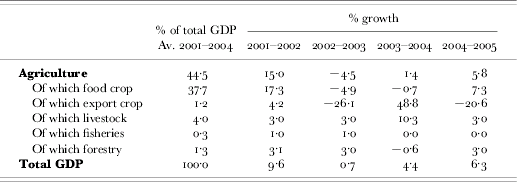
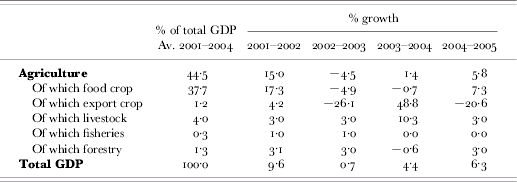
However, between 2002 and 2004 agricultural activity stagnated and even contracted (Table 1). These statistics probably underestimate the sector's poor performance, given that estimates provided by the Minagri/Food Security Research Project (FSRP – available only for 2000–02) are significantly lower. The FSRP's statistics seem to be more appropriate for measuring food production than national account data (IMF 2004b).Footnote 9 The most straightforward explanation for contractions in agricultural activities is the impact of poor weather on food production. As mentioned in the PRSP progress report, growth in agricultural output is largely ‘at the mercy of good weather’ (GoR 2004a: 17). Agricultural growth between 2004 and 2005 again met the PRSP target; however Rwanda was once again affected by bad weather in 2006 and early 2007.
Agricultural growth in Rwanda, 2001–05
Source: GoR 2005a: 113. For a recent update, see Ruzindaza Reference Ruzindaza2006.
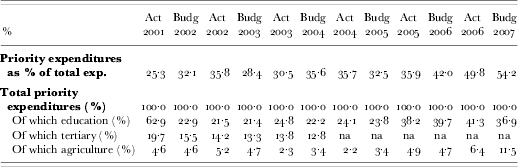
These figures clearly illustrate the failure of the first PRSP strategy to transform the agricultural sector into a stable engine for growth. The poor performance might also be due, in part, to weak budgetary commitments to the rural economy (see Table 2), where two dominant problems emerge. First, agriculture-related spending represents only 2–5% of the priority budget (actual figures) between 2002 and 2005.Footnote 10 The share of agriculture-related spending is small in comparison to the financial commitments directed, for example, to tertiary education (about 14% of the 2002–03 priority budget). These figures indicate how the Rwandan government presents spending targeted at the urban elite as pro-poor priority expenditure. A second major problem lies in the low absorptive capacity of the agricultural sector, illustrated by the discrepancy between budgeted and actual spending in 2003 and 2004. Despite some improvements towards 2006, agricultural activity and the broader rural sector in general have not received sufficient budgetary commitments. It is not surprising therefore that the rural economy did not meet PRSP forecasts.
Agriculture-related priority expenditures, 2001–07
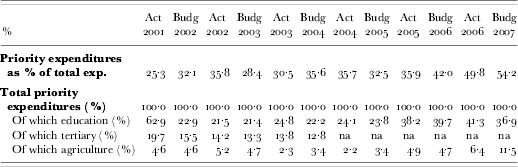
‘Act’=actual expenditures, ‘Budg’=budgeted expenditures.
Sources: Purcell et al. Reference Purcell2005; GoR 2006b; GoR 2007b.
How pro-poor is agricultural growth?
There seems to be increased awareness in Rwanda's second poverty reduction strategy (EDPRS), now being prepared, of agriculture's importance as ‘the pillar for rural development’ (GoR 2004b: 1). During interviews in early 2006, EDPRS ministerial stakeholders expressed their hopes that the new document would accentuate the rural sector, and transform it into a real engine for growth through agricultural transformation.Footnote 11 The goal then is to realise the ambition of the first PRSP, ‘because Rwanda's growth strategy is based on agriculture, it is specifically designed to be pro-poor’ (GoR 2002: 31).
But is it naïve to assume that growth, per se, even when sought in the rural economy, would be pro-poor? Growth in the agricultural sector does have a greater impact on poverty reduction than growth in other sectors (Christiaensen & Demery Reference Christiaensen and Demery2007; Gallup et al. Reference Gallup, Radelet and Warner1997). Moreover, agricultural growth spills over to other activities in the rural economy (Irz et al. Reference Irz, Lin, Thirtle and Wiggins2001; Thirtle et al. Reference Thirtle, Irz, Lin, McKenzie-Hill and Wiggins2001). But the impact of agricultural growth on poverty reduction depends on the extent to which the poor participate in this growth. One World Bank study (2005) found that the participation of poor rural households in agricultural growth could differ greatly depending upon the local context. They identify several policies that can improve the pro-poor character of agricultural growth, all relating to improving the institutional environment of smaller and poorer producers, such as access to markets, technology and risk-coping mechanisms. Other studies emphasise the importance of a relatively equal distribution of assets, particularly land, to achieve an optimal pro-poor growth effect (Deininger & Squire Reference Deininger and Squire1998; de Janvry & Sadoulet Reference De Janvry and Sadoulet1996; Ravallion & Datt Reference Ravallion and Datt2002). A recent (2006) OECD report highlights the importance of small-scale agriculture, with its potential to create a win-win outcome for economic growth and poverty reduction.
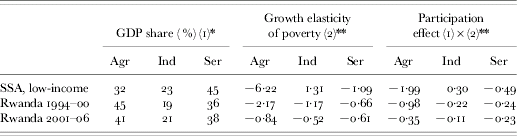
The potential of the economy's sectors to reduce poverty through growth can be measured by comparing the growth elasticity of poverty for each sector. The sector's elasticity multiplied by the sectoral share of GDP gives the participation effect for each sector to overall poverty reduction. Christiaensen & Demery (Reference Christiaensen and Demery2007) have estimated both effects for sub-Sahara African (SSA) low-income countries (Table 3, SSA-low income results) from the following equation:

where πx is the elasticity of poverty of sector xFootnote 12, sx is the share of sector x in GDP, and πx*sx is the participation effect.
Growth elasticity of poverty and participation effect for different sectors
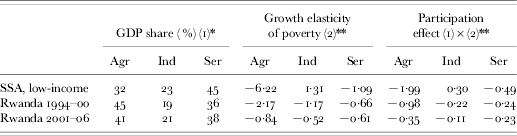
‘Agr’=agricultural sector; ‘Ind’=industrial sector; ‘Ser’=service sector.
* GDP shares for Rwanda are based on the average between 1994 and 2000, and the average between 2001 and 2005.Footnote 27
** The growth elasticity of poverty and the participation effect for Rwanda 2001–06 are not comparable with the other figures, given that a different poverty line has been used to calculate these figures.
Sources: For SSA data, Christiaensen & Demery Reference Christiaensen and Demery2007; for Rwandan data, Ansoms Reference Ansoms2007.
Similar calculations for Rwanda (Table 3) show that the growth elasticity of poverty for the agricultural sector is low; this means that the correlation between agricultural growth and poverty reduction is limited. For the period 1994–2000, the elasticity is almost three times lower than that of the average SSA low-income country. Nonetheless, Rwandan statistics for this period are consistent with cross-country findings, to the extent that agricultural growth is correlated with considerably more poverty reduction than growth in the secondary and tertiary sectors. However, for the period 2001–06, the situation seems to have worsened. Though these figures cannot be compared with other Rwandan and SSA statistics (as a different poverty line has been used for the calculations), we can nonetheless observe that the elasticity and participation effect of the Rwandan agricultural sector are very low, and are no longer significantly different from those of the other two sectors (Ansoms Reference Ansoms2007). It matters little whether growth is realised in the agricultural or in the other two sectors: the overall correlation with poverty reduction is weak.
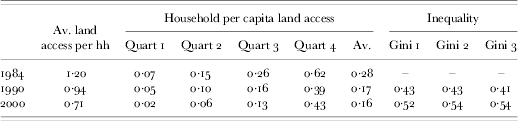
Overall, the pro-poor impact of agricultural growth over the PRSP-1 implementation period is thus problematic. This can be explained by a low participation of the poorer rural categories in agricultural growth. As we show later in this paper, there are many institutional constraints that Rwandan small-scale peasants face (e.g. the lack of access to markets, credit and risk-insurance opportunities, and fertilisers). Further, Rwanda is characterised by a high degree of land inequality (Table 4), and small-scale peasants have been increasingly marginalised in terms of land ownership over the past decades. According to Jayne et al. (Reference Jayne, Yamano, Weber, Tschirley, Rui, Chapoto and Zulu2003), average land availability has strongly declined for all quartiles between 1990 and 2000, except for the richest. In line with cross-country evidence (Deininger & Squire Reference Deininger and Squire1998; de Janvry & Sadoulet Reference De Janvry and Sadoulet1996; Ravallion & Datt Reference Ravallion and Datt2002), the Rwandan example thus illustrates how highly unequal distribution of land holdings contributes to the weakening of the linkage of land-poorer groups to agricultural growth.
Land distribution
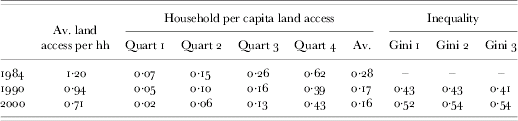
Gini 1 is defined in terms of land per household, Gini 2 in terms of land per capita, and Gini 3 in terms of land per adult.
Source: Jayne et al. Reference Jayne, Yamano, Weber, Tschirley, Rui, Chapoto and Zulu2003: 262.
TRANSFORMING THE RURAL SECTOR: NEW POLICIES FOR ACHIEVING AGRICULTURAL GROWTH
The previous analysis highlights the importance of evaluating poverty combating and particularly rural sector policies on both their growth-enhancing and poverty-reducing character. In this section, we therefore look at the most recent Rwandan rural policy documents.
Agricultural policy
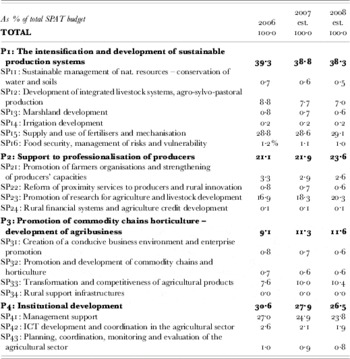
Current Rwandan agricultural policy (the National Agricultural Policy or NAP) was elaborated and then operationalised in the 2004 Strategic Plan for Agricultural Transformation (SPAT). Both documents serve as blueprints for the elaboration of EDPRS policy. The NAP's global objective is ‘to create conditions favourable to sustainable development and promotion of agricultural and livestock produces, in order to ensure national food security, integration of agriculture and livestock in a market-oriented economy and to generate increasing incomes to the producers’ (GoR 2004a: 11). This policy outline has been translated into action plans in the SPAT document, which are to be realised over a year-year period, starting with a pilot phase in 2005 and followed by a three-year implementation period. It aims to transform the agricultural sector from a subsistence production orientation towards a professional, commercial and competitive economic activity. The SPAT document (Table 5) focuses on four priority programmes sub-divided into 17 sub-programmes (GoR 2004b).
SPAT strategy and budgetary priorities

Source: Rutagwenda Reference Rutagwenda2006 (an earlier indicative budget was published in GoR 2004b).
On different occasions, SPAT refers to its mission to improve the living conditions of the rural poor by guaranteeing that ‘different categories of agricultural farmers, especially the most vulnerable, benefit from the economic growth that is being advocated’ (GoR 2004b: 7). However, of the seventeen sub-programmes only one (SP16 – food security, management of risks and vulnerability) has a clear pro-poor character. This sub-programme focuses on reducing food and nutritional deficits, reducing vulnerability in food deficit zones and affected population groups, and creating massive employment through labour-intensive works targeting vulnerable categories.
There seems to be a clear ambition to satisfy the population's food needs with national production.Footnote 13 However, the approach advocated focuses on the supply side by striving for maximum output growth, instead of concentrating on how vulnerable groups will take part in creating this growth and will thus acquire the necessary purchasing power to access food supplies. Little attention is given to preventing those processes or events that increase the economic vulnerability of these peoples' lives.
Also problematic is the conceptualisation of the term ‘vulnerable groups’. This term appears in both SPAT and the PRSP to relate to female or child-headed households, genocide survivors and demobilised/resettled households (GoR 2002; GoR 2004b). This interpretation, based on gender or war-related identities, is very restrictive and disregards the multidimensionality of vulnerability in the rural context. As a result, there is no effort to identify other vulnerable groups (e.g. nearly landless peasants), their current challenges and needs, and how rural development strategy might impact on or improve their living conditions.
The remainder of the SPAT document focuses on agricultural modernisation, intensification, professionalisation and enterprise development to transform the primary sector into a growth engine. Growth is expected to emerge from two sources, ‘those which are linked to export potential within the commodity chains and those which are related to internal market development’ (GoR 2004b: vii). The commodity chains to be promoted include maize, rice, and traditional export crops such as tea and coffee, exactly the crops where SPAT foresees a major private sector role (ibid.: 20–1). SPAT also puts effort into developing integrated livestock systems and exploiting opportunities for agribusiness (e.g. fruit processing enterprise) (ibid.: 39).
The SPAT strategies seem to be tailormade for larger farmers whose farm structure and risk-coping abilities allow them to invest in new, high-potential production systems. However, access to these modernised and professionalised techniques seems less straightforward for risk-averse small peasants. The SPAT document reflects two somewhat different views of smallholders' capacities to transform their agricultural production systems. Some parts recognise the constraints that small peasants face. The document, for example, refers to the lack of credit,Footnote 14 and the inability of smallholders to insure themselves against shocks and setbacks. However, it does not develop a strategic plan to ensure access of these small-scale peasants to the modernised production techniques that rural policy-makers promote. Other parts of the document mention the ignorance and resistance of peasants to adopting recommended productivity-enhancing measures that go beyond traditional subsistence farming (e.g. see GoR 2004b: 6, 17). As such, their lack of capacity to embrace ‘modernised’ farming is attributed to a ‘wrong mentality’ problem, a view that disregards the institutional barriers these peasants face.
In fact, Rwanda's rural policy has the ambition to reduce the agriculture-dependent population to 50% by 2020, considerably less than today's 87% (GoR 2004a, 2004b). The plan foresees that a growing primary sector will then ‘create progressive development of secondary and tertiary sectors in rural areas, which could help create employment outside agriculture’ (GoR 2004b: 59). The land policy takes it further: ‘the Rwandan family farm unit is no longer viable. … The re-organization of the available space and technological innovations are necessary in order to ensure food security for a steadily and rapidly increasing population’ (GoR 2004c: 16). This process is described by Alison Des Forges (2006) as the government's ambition to ‘winnow out the chaff’.
SPAT, in terms of budgetary commitments, also mentions how ‘allocation of government financial resources will be done with priority towards most competitive actions and productions’ (GoR 2004b: viii). This objective is translated into budgetary planning (Table 5). The ‘pro-poor’ sub-programme (SP16) represents only 1% of the total SPAT budget, clearly not the first priority in financial terms. Next to one-quarter of the budget allocated to management costs, the top priorities for the coming years are the promotion of fertilisers and mechanisation, and the promotion of research for agriculture and livestock development. The main objective of the fertiliser strategy is to increase chemical fertiliser use from 10 to 42 kg per hectare per annum over the next five years, which could, indeed, also reach small-scale peasants. However, further analysis of constraints on fertiliser use is necessary. By putting the blame on peasants' supposed ignorance regarding the profitability of fertiliser use, other institutional barriers are ignored (e.g. their lack of purchasing power, and the limited or non-availability of access to credit and insurance mechanisms to overcome setbacks).
Land policy and land law
The recently adopted land policy and law show a similar commitment in favour of competitive and commercial farmers. The land law was adopted in 2005 after a long process of drafting and negotiation,Footnote 15 and seeks to formalise land rights through official titling. During the elaboration phase of the land law, the PRSP stated that ‘the design of the land policy to encourage security of tenure is central’ (GoR 2002: 36). The new land law aims to break with a past of informal land arrangements and transfers built upon customary traditions. Although customary land rights are recognised as a basis for acquiring official rights, land registration is made compulsory; and in the future, land arrangements are to be regulated through formal legal procedures (article 26). The Rwandan government hopes that secure official land titles will encourage increased investment in land conservation and quality improvements (GoR 2004c: 24). However, in line with the new law, official titles can only be acquired through a formal procedure of registration with proof in the form of a certificate. More privileged groups have a clear advantage to use this as an additional tool in their ‘struggle for land’. Studies that largely praise the beneficial effects of official land registration recognise the problem of unequal access to information in the registration process, ‘the introduction of a modern registration system to replace a customary (and typically less formal) system may provide opportunities for “land grabbing” by those who are better informed, are more familiar with formal processes, and have better access to officials and financial means to undertake procedures for registration’ (Feder & Nishio Reference Feder and Nishio1998: 38).
The land law further aims to solve the problems of land fragmentation and unproductive use. Fragmentation of land holdings has since long been conceived as a major problem by Rwandan policy-makers. The previous land policy (dating from March 1976) aimed to counter this by only allowing land transfers (with specific permission) when the seller's property remained at a minimum of 2 hectares, and when the buyer had no more than 2 hectaresFootnote 16 (Décret-Loi n°09/76, art. 2–3, March 1976). Given that average land holdings in the 1970s were about 1·4 hectares per household, this policy aimed to redistribute land by restricting transfers from the land-poor to the (relatively) land-rich. The question is, however, to what extent this policy was followed. The informal land market which emerged during the period to arrange the transfer of land titles, even with written documents used as validation, almost never followed formal policy prescriptions (Platteau Reference Platteau2000).
The new land policy tackles the problem of land fragmentation in a very different way. Article 20 prohibits dividing land parcels of 1 hectare or less. For the division of plots between 1–5 hectares, the owner has to apply to the land commission for authorisation. However, this rule does not apply to cases where authorities ‘approve the consolidation of small plots of land in order to improve land management and productivity’ (article 20).Footnote 17 The Rwandan government thus aims to consolidate small parts of land into larger plots, and to consolidate land into the hands of fewer, more efficient farmers. The land law, for example, sets no upper limits on the maximum size of landholdings. A ceiling of 50 hectares foreseen in an earlier version of the new land law did not appear in the final approved version. The objective behind this choice appears clear: create economies of scale. Larger plots would become suitable for more modern intensive techniques. Larger farms could be managed more productively and become professional partners with agribusiness concerns. (In the next section, we will question these assumptions.)
A major question is whether land fragmentation is indeed a problematic issue in the Rwandan context. Pre-war evidence for Rwanda showed that land fragmentation could be advantageous for farmers' risk management. Based on this finding, Blarel et al. (Reference Blarel, Hazell, Place and Quiggin1992) questioned the beneficial impact of consolidation on land productivity, and even concluded that concentration-promoting programmes could have a negative impact on farmers' well-being.Footnote 18 Likewise, Pottier (Reference Pottier2006) challenges the usefulness of consolidation strategies, which he sees as a potential source for future land conflict.
Taking this into consideration, will the prohibition to divide plots of less than 1 hectare have serious consequences for the majority of Rwandan peasants? The average total land surface occupied by rural households is well below 1 hectare (in 2000 this was 0·71 hectares, spread over an average of 2·44 plots). By 2002, landholdings had become even more fragmented (calculations based on Food Security Research Project agricultural dataset, 2000–02). By the letter of the law, small-scale landholders in times of setbacks would only be allowed to sell their integral plot so as to avoid further land fragmentation. Further, their chances of buying back land would be diminished, as they would have to buy either an adjacent plot or a plot of 1 hectare in total.
The new land law includes another ‘guarantee’ for sound land management by giving the authorities the right to ‘impose sanctions … against the landlord or any other person allowed to lease the land who fails to respect the obligation of efficiently conserving the land and productively exploiting it’ (article 73). Productive land use, appropriate protection and sustainable productivity mean, ‘to protect it (i.e the land) from erosion, safeguard its fertility and ensure its production in a sustainable way’ (article 62), and ‘shall be based on the area's master plan and the general structure on land allocation, organization and use and [the adoption of] specific plants certified by relevant authorities’ (article 63).
The goal would be for each region to specialise in certain specific crops based on agro-bio-climatic conditions and in accordance with market needs. This is a return of the 1970s argument to consider the comparative agro-climatic advantage of each region as a main element in agricultural planning (see Pottier & Nkundabashaka Reference Pottier, Nkundabashaka, Parkin and Croll1992). In accordance with current policy the local authorities, in the name of the local peasants, will determine in which crop(s) the region has a comparative advantage. In SPAT, a pilot exercise with a few districts resulted in the identification of three agricultural products per district. The document mentions the need to guide producers in their choice towards commercial production systems and away from subsistence agriculture (GoR 2004a). This seems to be a first indication that the participation of peasants in the choice of those crops would be limited.
The strategy of specialisation could however indeed result in economies of scale in terms of production, and increase the commercial bargaining position of local farmers in regional markets. On the other hand, the strategy should regard possible variations in soil types and climatic conditions within the local setting. Forcefully restricting farmers to a few crops at an aggregate scale might thus make little sense. An additional concern is whether small-scale, non-commercial peasants will be able to confine themselves (even partly) to the prescribed crops, as they usually opt for a diversification in crop types based on risk-averse considerations. If the new policy does not offer them any additional risk insurance, they will not be inclined to go for crop specialisation. Another important question is whether small-scale peasants will be able to defend their interests on the regional markets, or whether power positions in the bargaining process over food prices will be occupied by intermediary traders.
In some regions, peasants are already obliged by the authorities to abandon and even destroy certain food crops. For example, in early January 2007 the governor of the Eastern Province, Mr. Mutsindashyaka, initiated a ban on sweet potatoes. Although the minister of state for agriculture later withdrew this declaration (New Times 2007), such campaigns can and generally do cause a lot of uncertainty and fear among local peasants.
When land is not effectively conserved and productively used, or in more specific terms when it is degraded or has not been used for three consecutive years, the land law provides for sanctions. These typically take the form of requisitioning the land for a period of three years (article 74). Local authorities are delegated extensive powers over managing, requisitioning and even reallocating land: ‘The requisitioned land may be entrusted to another person who so requests and who demonstrates ability to efficiently conserve the land and productively exploit it’ (article 74). Further, in cases of dispossession, the owner can only request repossession in writing, explaining how he or she will commit him/herself to the productive exploitation of the plot in question. When rejected, the only further option is to appeal to court. The formality of these procedures typically leaves little room for illiterate peasants with limited means to pursue their cases.
This legislation gives local authorities considerable freedom in interpreting specific situations according to their own agendas. Pottier (Reference Pottier2006) points out that this might turn out positively for the population when local government agents use their power and discretion to honour people's rights. However, it may also result in the abuse of local power to favour the rights of well-placed individuals.
TRANSFORMING THE RURAL SECTOR: THE POOR AT THE FOREFRONT OR REMAINING OFF-STAGE?
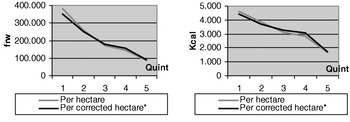
The preceding analysis suggests that current ‘agricultural transformation policies’ tend to enhance the opportunities of high-potential larger farmers at the expense of smaller-scale peasants. The principal issue is whether small-scale peasants are indeed less productive in output terms than larger farmers. In fact, this is not the case in the current Rwandan context when considering productivity in terms of output per land unit. This is even recognised by SPAT which states, ‘small production units perform better per land unit than larger ones’ (GoR 2004b: 10). The following graph (Figure 2) illustrates the inverse relationship between farm size and productivity, given that the land-poorest quintiles are the most productive, both in terms of kilocalories produced per hectare, as well as in terms of added value of production per hectare. This can be explained partly by the fact that smaller farmers tend to have soils of better quality than larger farmers. But even when this factor is considered (looking at corrected hectare data), the land-poor quintiles are still more efficient per land unit.Footnote 19
Median added value (FRw) and median caloric value (Kcal) of production per land unit for each quintile (2001 figures).
* Accounting for differences in soil quality: land surface is multiplied by a soil quality index (above 1 for households with higher than average soil quality, and below 1 for households with lower than average soil quality).

However, Rwandan policy-makers count on the high growth potential of larger farms to significantly upgrade their productivity, which should have a strong positive effect on aggregate output growth. Conversely, we found that before the implementation of these policies the participation effect of agricultural growth in poverty reduction has been disappointingly low for the post-war period. The main question is thus how rural policy, by focusing upon these high-potential larger farmers, will affect the well-being of the majority of non-competitive, non-professional, subsistence-oriented rural agents.
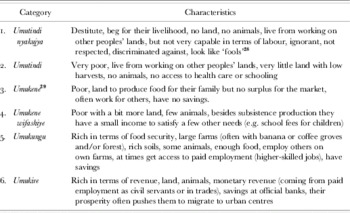
The rural sector is predominantly populated by ‘small family farms (over 90% of all production units) … with an average of less than one hectare in size, integrating polyculture – animal production systems’ (GoR 2004b: 10). Most of these families depend, to a large extent, on subsistence production and are found among the 66% group of ‘rural poor’. The nationwide Participatory Poverty Assessment (PPA) exercise (2001–03) provides further details on the different categories of peasants in Rwanda (Table 6).
Population groups defined by PPA methodology

Source: Reformulated from GoR 2001b, GoR 2004b: 12–13
There are no aggregated country-level data on the proportion of each farmer type in the total household population. However, SPAT mentions that about 11·5% of all households are landless (GoR 2004b: 10), and thus would normally fall in the umutindi category. During our own field research in six imidugudu Footnote 20 in the Southern provinceFootnote 21 (May–July 2007), we counted the frequency of each category. In five out of six, the majority of the households were classified in the umukene categories.Footnote 22 The umukungu and umukire categories together accounted for a very small part of the total population.
Our main goal is now to analyse how agricultural growth has affected or will affect the well-being of these different categories of peasants. When growth results from increased efficiency and productivity – central objectives in Rwandan rural policies – then its impact on household incomes is twofold. On the one hand, there is a direct effect on agricultural output (i.e. a first-order effect), combined with induced changes in prices, wages and employment (i.e. second-order effects, see Christiaensen & Demery Reference Christiaensen and Demery2007). Although these second-order effects receive little attention in the literature, they may be very important in helping to measure the pro-poor effects of agricultural growth (see Minten & Barrett Reference Minten and Barrett2006). On the other hand, growth in the agricultural sector may also induce growth in rural non-farm sectors by increasing demand for non-agricultural products and services, and by facilitating the supply of such products and services due to lower nominal wages (i.e. an indirect effect, see Byerlee et al. Reference Byerlee, Diao and Jackson2005; Christiaensen & Demery Reference Christiaensen and Demery2007; Delgado et al. Reference Delgado, Hopkins and Kelly1998). A second type of indirect effect, omitted in the literature, is the impact of rural policies on the bargaining position of different farmer types. Changes in power relations may have a strong effect on their on-farm activities, off-farm employment, and overall well-being. Each of these effects requires further examination.
The direct first-order effect of increased crop productivity positively affects farmers with landholdings. However, as highlighted in several studies, the impact of this effect depends on the initial distribution of land (Deininger & Squire Reference Deininger and Squire1998; de Janvry & Sadoulet Reference De Janvry and Sadoulet1996; Ravallion & Datt Reference Ravallion and Datt2002), and on the participation of the poorer farmer categories in productivity gains (World Bank 2005). Given Rwanda's policy focus on larger farmers, with their greater (presumed) potential for professionalisation, productivity gains will not be equally distributed over all farmer groups.
Increased agricultural output will further result in downward pressure on food prices. The impact of lower food prices on a farmer's welfare depends upon whether the farmer is a net food seller or a net food buyer, and is dependent upon the price elasticity of demand. However, little is known about the price elasticity of food in the Rwandan context. Inflation or deflation of food prices mostly affects those households that are active on the monetary food market. Most small-scale peasants are not, however, among that group. For them, food price changes may have an indirect effect on exchanges in the non-monetised barter economy, a sector that is, until now, poorly understood (GoR 2002).
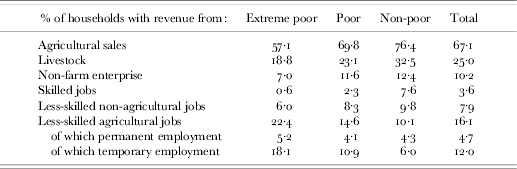
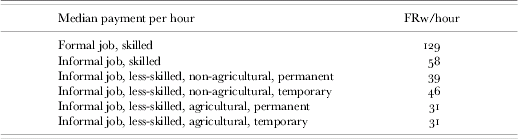
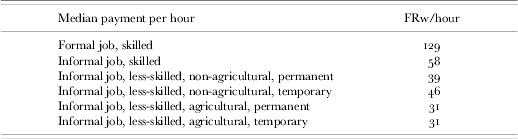
Declines in food prices, in turn, allow nominal wage rates for unskilled labourers to fall. As a result, the demand for such labour may increase; certainly when agricultural growth is reinvested into the expansion of agricultural activities. For Rwanda, Mellor (Reference Mellor2002a) estimates that a projected 5·3% agricultural growth in output would result in a direct 3·2% increase in on-farm employment. On the other hand, the supply of unskilled labour is already extremely high in rural areas, and will only increase when a growing number of peasants become (near)-landless. Further, employment in the agricultural sector is mostly limited to daily wage labour (typically paid in cash, though sometimes only with food). Only extremely poor households generally undertake these informal food-for-work jobs. The availability of informal money-for-work jobs is highly volatile and uncertain. People in less-skilled agricultural jobs usually do this work on a temporary basis for low wages. Moreover, ‘having to work on someone else's field’ strongly diminishes a person's perceived social status in Rwanda. Agricultural jobs are linked with ‘being poor’ and one's inability to ‘take care of oneself’ (GoR 2001b). Table 7 illustrates this: the percentage of extreme poor (22·4%) involved in these jobs is higher than the percentage of non-poor (10·1%). Table 8 illustrates that the hourly wage rate of informal, less-skilled agricultural jobs is much lower than informal jobs in the non-farm sector.
Percentage of rural households involved in different income-generating activities (2001 data)
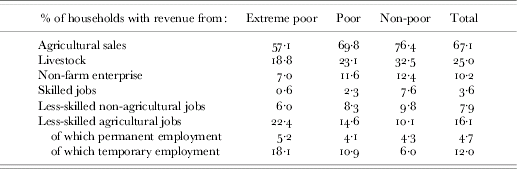
Notes: The extreme poor are defined as those living with less than 175 FRw (US$0.28) per adult equivalent per day; the poor as those living with 175–250 FRw (0·28 US$0.28–0.40) per adult equivalent per day, the non-poor as those living with more than 250 FRw (US$0.40) per adult equivalent per day. Amounts in FRw are based on 2006 prices, and would correspond to 123 FRw (instead of 175 FRw) and 175 FRw (instead of 250 FRw) in 2001 prices.
Source: McKay & Loveridge Reference McKay and Loveridge2005, income estimates based on GoR 2001a.
Income per hour for different types of job (2001 data)
Source: Calculations based on GoR 2001a.
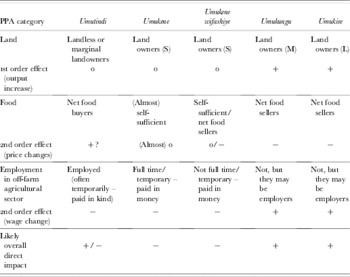
Taken together, the main question relevant to the Rwandan peasant is whether the direct impact of the second-order effects (i.e. price and wage changes) in combination with the first-order effect (i.e. increased output) is positive or negative (Christiaensen & Demery Reference Christiaensen and Demery2007). To determine this requires us first to differentiate between various types of farmers. We adapt the typology of Christiaensen & Demery to the Rwandan context (Table 9) and combine it with the PPA categories.
The direct impact of increased productivity in the agricultural sector (as outlined in current rural policy) on different types of farmer in Rwanda

Symbols: (S)=small-scale; (M)=medium-scale; (L)=large-scale.
Source: Reinterpretation from Christiaensen & Demery Reference Christiaensen and Demery2007.
For the umutindi categories (no or little land, working as agricultural labour force), the picture is complex. Given their landless status, they are unaffected by the first-order effects of increasing productivity. Whether they gain or lose depends on whether the positive effect of decreased food expenditures is greater or smaller than their loss in wage income.Footnote 23 The overall direct effect of agricultural growth on this category is therefore unclear.
For both umukene categories (land but no surplus or savings), the first-order effects of increased productivity could be positive if these peasants directly participate in agricultural growth. However, it is unlikely that these groups will play an important role in commercialised and professionalised agriculture. The potential for the rapid spread of new agricultural techniques (e.g. fertiliser use) to smaller peasants is limited. The financial capacity of the abakene (plural of umukene) to invest in such technologies is also limited, due to other expenditures that are considered more urgent (e.g. education of children). Rural credit and insurance systems could compensate for such a lack of financial capital, but they are not open to poorer groups (GoR 2002). The second-order effects of price and wage changes, on the other hand, negatively affect their well-being. In instances of occasional production surpluses, the abakene will have more problems to compete with the lower-priced food of more professional farmers. As a result, market access for this category will deteriorate, further pushing these peasants into a ‘subsistence-agriculture trap’, and limiting their potential to diversify towards more commercially oriented crops.
Finally, the umukungu (larger farms and savings) and umukire (monetary income) categories of farmers have the highest chance of profiting from both land and agricultural policies. In most cases, these households have the means to increase their landholdings and invest in new production techniques. Moreover, they are less bound by risk-averse considerations than the other categories. This gives them the opportunity to follow the new commercial orientations promoted by the government. As a result, their output should increase, thus protecting their share on a more competitive food market with reduced prices. As potential employers, they will likely face lower wage costs, which should allow them to further expand their agricultural activities by hiring additional labour.
Overall, the direct impact of the new rural policies seems positive for more prosperous farmers, while discriminating against the poorer categories. However, there is also an indirect impact of agricultural growth on the well-being of different categories. Christiaensen & Demery (Reference Christiaensen and Demery2007) divide this trickle-down effect into three sub-groups: the inter-sectoral linkages (i.e. forward linkages to agro-processing and backward linkages to supply sectors); the final demand effects (i.e. increased agricultural incomes lead to increased demand for local non-farm products); and the wage effects (i.e. wage decreases in non-agricultural sectors).
Mellor (Reference Mellor2002a) focuses on one of these indirect effects, highlighting the derived impact of agricultural growth on the non-agricultural sector. He argues that a major increase in production, and thus in the incomes of more prosperous farmers, should have a considerable and favourable indirect impact on employment and poverty reduction for small-scale farmers, through increased demand in the non-farm sectors. He quantifies this indirect impact; estimating that projected agricultural growth of 5·3% would produce (substantial) employment growth of 6·0% in the labour-intensive, rural non-farm sector.
In the current economic environment, however, jobs are much scarcer than Mellor estimates.Footnote 24 Nonetheless, he expects this off-farm sector to boom as a derived effect of increased agricultural growth. He states, ‘Although increased incomes may commence in the hands of the already more prosperous, that does not decrease the efficacy of the employment impact. That is because even those with large holdings by Rwandan standards are still small farmers who are fully integrated into their rural communities’ (Mellor Reference Mellor2002a: 17). He stresses that for agricultural growth to deliver increased employment and poverty reduction, a crucial assumption must be met: growth should be realised mainly by farmersFootnote 25 who reinvest their profits in the local non-farm market, which in turn increases the overall demand for labour and the wage rates of the so-called ‘labouring class’. However, the increased well-being of more prosperous farmers may reduce their embeddedness in the local rural community. One of the characteristics of the umukire category, mentioned in the Participatory Poverty Assessment and by many respondents in field research (May–July 2007), is that households in this category tend to migrate to urban centres. It is thus unclear whether these richer farmers will spend their additional incomes on rural goods and services, or, instead, on ‘urban status symbols’.
Overall, it is doubtful whether agricultural growth will rapidly flow down to poorer farmers. Moreover, there will be other indirect effects, such as changes to bargaining positions between different groups of farmers. When larger farms receive the main benefits from agricultural growth and are transformed into highly productive units, they will tend to drive less commercial and market-oriented farmers out of the market. Thus, as already mentioned, abakene categories might become trapped in subsistence farming, unable to surmount barriers towards commercially oriented farming. Moreover, in a nation of extreme land scarcity, richer high-potential farmers, with their financial power, will be able to block the necessary expansion of small-scale subsistence-oriented farms and, in the long run, may render them unprofitable.
The danger exists that current rural policies will increasingly enfeeble small-scale peasants. Many may, at some time, be forced into distressed land sales and, without realistic prospects for re-purchase, will lose their self-subsistence productive capacities and livelihoods. As a result, the number of employment seekers would grow, thus even further depressing wage rates. Overall, these processes will result in a ‘survival of the fittest’, or more accurately a ‘survival of the largest’ within the agricultural sector, with alternative employment unsure for those disregarded by these new rural policies.
CONCLUSION: OUTPUT GROWTH VERSUS EQUITY CONSIDERATIONS: AN UNAVOIDABLE TRADE-OFF?
The concluding action plan of the SPAT identifies ‘the conciliation of the commercial orientation with the development orientation’ as a major challenge for agricultural policy-making. But based on the observations made in this paper, we conclude that the pro-poor ambition of the current agricultural policy remains largely rhetoric. It lacks strategic plans and budgetary commitments to counter those undesirable processes that weaken or threaten peoples' livelihoods and lives. The recently adopted land policy and law show a similar discrepancy between pro-poor rhetoric on one hand, and actual commitments in favour of competitive and commercial farmers on the other. Rwanda's rural policies focus on maximum output and growth, without regard for equitable wealth distribution. This paper has illustrated how so-called pro-poor policies can introduce or reinforce institutional barriers for many, while facilitating access and enhancing opportunities for the few. This may render vulnerable those who are not so yet; it may also force existing vulnerable groups into a poverty trap; and finally, it may even increase conflict risk by enlarging the mass of rural poor with few if any employment chances outside the agricultural sector.
This brings us to our first concluding question: is there, indeed, an unavoidable trade-off between output growth and equity considerations, or are there alternatives that combine both? Rural policies might have aimed for empowering and actively involving the large community of small-scale peasants in agricultural development strategies. Many have a high productive capacity, but are confronted by institutional constraints in diversifying their activities away from subsistence production. This would, however, require a complete reversal of the current rural policy logic. A crucial step then lies in defining institutional barriers for divergent farmer groups; and in analysing how specific policies could remove those barriers. It would, perhaps, result in more modest growth projections for the agricultural sector, and should still, indeed, be combined with ‘charity measures’ for marginalised groups without much productive potential (e.g. due to lack of physical capacity). But it would certainly result in a more equitable distribution of agricultural growth, and could pro-actively prevent households from falling into the vulnerability trap. By removing institutional barriers for many instead of for the few, rural policy would acknowledge the ability of the large number of rural peasants to seize the opportunities at their disposal.
A second intriguing question is why current Rwandan policy-makers do not take this alternative into consideration. Answering this question requires insight into the political economy of the current Rwandan society. There are two main features that characterise the current power holders, a largely urban-based elite. First, policy-makers are strongly convinced of the ‘trickle-down’ potential of rapid agricultural growth. This vision coincides with the ambitions of Rwanda's elite to develop a ‘new’ economy and transform their country. Other illustrations of this can be found in the first PRSP. There, for example, information technology development is identified as an important activity to help move (or ‘jump’) Rwanda's subsistence-based economy to a ‘service-sector driven, high-value added information- and knowledge-based economy that can compete on the global market’ (GoR 2002: 69). Current Rwandan policy-makers adhere to the idea of social engineering through law, as conceived by Pound (Reference Pound1968). They see policy and law as tools for shaping society, but often neglect the local conditions and institutional environment into which new laws and policies are to be implemented. This contextual background preconditions the potential effectiveness of all new policies in achieving their goals.
Another feature of the current Rwandan elite is their limited connection with rural life. Pre-1994 elites had strong roots in rural Rwanda, which brought them closer to rural life and the problems Rwandan peasants were confronted with. The Habyarimana regime relentlessly championed the idea of an agrarian society (see Verwimp Reference Verwimp2000). On the downside, this often resulted in preferential treatment for certain regions over others, depending upon the power holders' origins. And indeed, pro-peasant rhetorics coincided with anti-peasant policies. Pottier (Reference Pottier1993) for example illustrates how during the 1989 drought, the regime failed to distribute the available food aid. André & Platteau (Reference André and Platteau1998) point out that the circumstance and prospects for rural farmers were already extremely problematic by the late 1980s, and illustrate how pre-war land conflicts even inspired people to take part in genocidal violence, providing them with an opportunity to reshuffle land properties. Nonetheless, the strong link between the regime and the peasant class enhanced the elite's appreciation of the agrarian society. Unlike their predecessors, current elites have very few ties with Rwandan rural life. Many come from neighbouring countries where they lived either in urban areas or in dissimilar rural environments (e.g. as cattle farmers). As a result, ties between the Kigali-based ‘elites’ and ordinary Rwandan subsistence peasants are weak (see Ansoms & Verschueren Reference Ansoms and Verschueren2007).
This has two major consequences. First, it has led to a paternalistic view of Rwanda's urban elite regarding peasants' ability to realise modern agricultural opportunities. Even official policy documents refer to the ignorance of peasants and their resistance to new productivity-enhancing measures that go beyond their traditional subsistence farming logic. In its most blatant form, this conviction reduces the problem of rural poverty to one of bad mentality. A second result is that urban elites have little personal interest in improving living conditions for the rural masses. Whereas the pre-1994 elite largely depended on a rural power base to maintain their position, the current elite depends almost exclusively on an urban peer group and the international donor community for support.
The stated ambition of EDPRS policy is to ‘refocus on equitable growth, sustainable development, and poverty reduction’, with rural development as an important priority.Footnote 26 These are equally the main challenges for many other African countries. The Rwandan case has elaborately illustrated that striving for pro-poor growth, however, cannot be restricted to ‘looking for growth in the sector where the poor are located’. The major challenge for policy-makers and international donors worldwide is to shift their attention away from a purely output-led logic of agricultural transformation towards more integrating, distribution-oriented rural development policies. In other words, the challenge is to reconcile efficiency in creating economic growth with equity and, perhaps, to put equity first.