1. Introduction
The present study sets out to demonstrate that the German progressive, canonically expressed by means of am V-inf sein ‘at V-inf be’ and henceforth referred to as the am-progressive, can be used to indicate that a certain situation somehow runs counter to the conceptualizer's expectations or norms.Footnote 1 These uses do not constitute a German idiosyncrasy: Many (present) progressive constructions in various languages seem to be particularly disposed to expressing meanings of noncanonicity. This has been demonstrated most convincingly for the English progressive, which has, as many authors have noted, a puzzlingly wide array of uses. Its most prototypical function is to refer to dynamic situations (that is, events) going on at reference time. Yet in addition, the progressive is shown to appear with futurate events, with temporary habits, and has been said to evoke a range of (inter)subjective readings that reflect the speaker's attitude toward the epistemic status of the proposition or toward the hearer. According to De Wit & Brisard Reference De Wit and Brisard2014, such (inter)subjective uses directly instantiate the basic meaning of epistemic contingency of the English present progressive.Footnote 2 That is, events reported by means of the progressive are argued to be nonstructural: Real though they may be, they are—and we are here adopting a formulation suggested by Slobin & Aksu (Reference Slobin, Aksu and Hopper1982:195) to describe the semantics of the Turkish -miş perfect—not readily “assimilable to the [speaker's] mental sets of the moment” on the basis of general knowledge or previous experience. Consider, for instance, the examples in 1.Footnote 3
(1)

In 1a, the speaker is referring to a temporally extended situation, which could in principle be reported by means of the simple present, yet instead the progressive is used to stress the atypicality of the denoted situation. Often, this atypical nature leads to a sense of irritation on the part of the speaker. In 1b, the speaker first uses a simple present, presumably to refer to the expected interpretation, but then switches to the progressive to emphasize the actual situation and to contrast it with what is commonly assumed. This use of the English progressive to spell out not readily interpretable states of affairs has been coined the “interpretative” use by Ljung (Reference Ljung1980). These and similar uses of the English progressive have furthermore been described and analyzed by Calver (Reference Calver1946), Dowty (Reference Dowty1975), Goldsmith & Woisetschlaeger (Reference Goldsmith and Woisetschlaeger1982), Williams (Reference Williams2002), and De Wit & Brisard (Reference De Wit and Brisard2014).
The progressive in French, expressed by means of être en train de ‘be in the style/motion of’ + V-inf, is less grammaticalized than its English counterpart (for one, its use is not obligatory when reporting present-time events, which also allow a simple-present construal).Footnote 4 Yet, as demonstrated by De Wit & Patard (Reference De Wit and Patard2013) and De Wit et al. (Reference De Wit and Patard2013), its range of uses not only includes aspecto-temporal usage types, but also (inter)subjective ones, just like its English equivalent. This is illustrated in the following example:Footnote 5
(2)
Although it would be possible to use the simple present in 2, the outstanding characteristics of the situation referred to make the use of the progressive more appropriate. This sense of atypicality associated with the French progressive has also been observed by Franckel (Reference Franckel1989) and Lachaux (Reference Lachaux, Shyldkrot and Le Querler2005).
There are indications that in other languages, too, the progressive is predisposed to epistemic readings of counterexpectation. Güldemann (Reference Güldemann2003) demonstrates that focus and progressivity are often expressed isomorphically in Bantu languages. Although focality and epistemic notions of incongruity are not quite the same (in the sense that what is in focus is not necessarily incongruous in the eyes of the speaker), they do exhibit some similarity in that, typically, events that are considered divergent in some way are also put in focus. Closer to German, it appears that certain Dutch posture verb constructions (such as zitten te ‘sit to’ + V-inf), which are used to express progressivity, are also naturally used to convey a sense of atypicality, as illustrated in 3 (from Lemmens Reference Lemmens2005).
(3)
In this paper, we demonstrate on the basis of a detailed corpus study that in spite of its low degree of grammaticalization, the German am-progressive is not only used to express various aspecto-temporal meanings, but also to generate pragmatic notions of (inter)subjectivity, just like progressive constructions in other languages. The paper is structured as follows. Section 2 addresses the main semantic and formal properties of the German am-progressive. Section 3 discusses the selection of corpus data for our study, the results of which are presented in section 4. Finally, section 5 provides a summary of the main findings.
2. The German Am-Progressive
Until the late 20th century, the am-progressive received little attention in German linguistics, often being discarded as a regionalism or substandard speech (see, among others, Erben Reference Erben1972:75, footnote 230; Duden Reference Duden and Drosdowski1995:91, footnote 1).Footnote 6 Studies from the late 1990s onwards, however, have shown that the am-progressive is now well established in large parts of Germany, Austria, and Switzerland (Reimann Reference Reimann1998, Krause Reference Krause2002, Elspaß & Müller Reference Elspaß and Müller2003, Van Pottelberge Reference Van Pottelberge2004). Although the construction is no longer regarded as substandard, its use is still primarily associated with spoken language (Duden Reference Duden and Dudenredaktion2005:434), and speakers' acceptability judgments of specific progressive utterances can vary. Restrictions underlying the use of the am-progressive have therefore been the primary topic of interest in previous studies, either in comparison to competing progressive constructions in German (for example, Krause Reference Krause2002, Van Pottelberge Reference Van Pottelberge2004, Gárgyán Reference Gárgyán2014) and/or Germanic or European equivalents (for example, Bertinetto et al. Reference Bertinetto, Ebert and de Groot2000, Ebert Reference Ebert2000, Krause Reference Krause1997, Reference Krause2002, Van Pottelberge Reference Van Pottelberge2004, Behrens et al. Reference Behrens, Flecken and Carroll2013). These studies have shown (among other things) that the German am-progressive is indeed subject to severe syntactic restrictions in that it typically features verbs in intransitive or absolute usage. Direct objects seem to be allowed in certain regions only (see Elspaß & Müller Reference Elspaß and Müller2003 for an overview), whereas constructions with incorporated objects constitute a productive, yet not frequently used alternative. In the Kleines Wörterbuch der Verlaufsformen im Deutschen (Engelberg et al. Reference Engelberg, Meyer and Sokolowski2013), which contains 4,138 examples of the am-progressive, only 12 instances co-occur with a direct object, as in 4a, and 88 carry an incorporated object, as in 4b. Footnote 7
(4)
As to the function of the am-progressive, the literature quite unanimously agrees on an analysis of the am-progressive as a marker of internal perspective, which allows language users to portray a particular activity or situation as ongoing, as in progress, whereby the temporal boundaries of the depicted situation are defocused (for example, Zifonun et al. Reference Zifonun, Hoffman and Strecker1997:1877, Reimann Reference Reimann1998:10, Krause Reference Krause2002:25, Duden Reference Duden and Dudenredaktion2005:417–418, Behrens et al. Reference Behrens, Flecken and Carroll2013). Van Pottelberge (Reference Van Pottelberge2004:329, Reference Van Pottelberge, Leuschner, Mortelmans and De Groodt2005:169, Reference Van Pottelberge2007:109) assumes one function for the German progressive, that is, expressing the course of an action (“Verlauf der Verbalhandlung”), which he does not further elaborate on. The assumption of a straight-forward meaning of the am-progressive on the one hand, and the traditional focus on formal aspects on the other hand, seem not to have encouraged adequate analyses of the semantic variety that the am-progressive portrays. Gárgyán Reference Gárgyán2014:85–87 constitutes a notable exception, as the author lists eight different functions of the am-progressive, the first of which is described as the continuousness of an activity (“das Anhalten […] einer Handlung”). Other functions include presenting a situation from an internal perspective, the expression of limited duration, the expression of a background scene, habituality, iterativity, future reference and intensity/emotional tension. Unfortunately, Gárgyán neither explains the various distinctions nor does she try to relate them to each other.
In what follows, De Wit & Brisard's (Reference De Wit and Brisard2014) analysis, which discusses the various aspecto-temporal and (inter)subjective uses of the English present progressive and unites them in a semantic network, is applied to German corpus data. Before embarking on the presentation of our findings, we elaborate on the compilation and categorization of the corpus data.
3. Corpus and Methodology
The data for this study are gathered from the Kleines Wörterbuch der Verlaufsformen im Deutschen (Engelberg et al. Reference Engelberg, Meyer and Sokolowski2013), an online dictionary that contains 5,026 examples of three types of progressive forms in German (the am-progressive accounts for 82% of all cases). Engelberg et al. (Reference Engelberg, Meyer and Sokolowski2013) dictionary originates from extensive searches in the German Reference Corpus (DeReKo, IDS-Mannheim) conducted in 2009.Footnote 8 Due to the periphrastic form of the am-progressive and its low frequency, previous studies on the basis of DeReKo (for example, Van Pottelberge Reference Van Pottelberge2004, Gárgyán Reference Gárgyán2014) were rather restricted.Footnote 9 For instance, Gárgyán's (Reference Gárgyán2014) collection of progressive examples in DeReKo is based on searches for specific verbs (for example, the verb arbeiten ‘to work’), and therefore cannot provide a satisfactory account of the semantic subtleties of the progressive. By searching for partial structures such as am ∗ieren, am aus∗en, and am ver∗en, Van Pottelberge (Reference Van Pottelberge2004) was able to examine a wider range of verbs, yet he, too, misses out on a considerable number of verbs that can be combined with the am-progressive.
Engelberg et al. (Reference Engelberg, Meyer and Sokolowski2013) project was the first to counterbalance this common distortion. For the am-progressive, utterances were searched containing a form of the lemma sein ‘to be’ within a distance of five words to a sequence like am A∗en (repeated for all letters of the alphabet), the results of which were then manually filtered. The final product is an online dictionary connected to a database of examples with a few sorting options (main verb, presence of an object, presence of an incorporated object, presence of a reflexive pronoun, and country).
For the purposes of our study, we extracted a total of 419 examples, that is, approximately 10% of all the am-progressives in the dictionary (4,138). These examples all constitute direct quotes and can therefore be considered near to spoken language.Footnote 10 As such, this sample allows us to examine the am-progressive on a larger scale presuming that its use in written standard language is more heavily restricted, whereas its use in spoken language can be assumed to display more semantic and formal variation.
Each of the examples has been analyzed semantically according to the classification employed by De Wit & Brisard (Reference De Wit and Brisard2014). De Wit & Brisard (Reference De Wit and Brisard2014) propose a semantic network for the English present progressive, in which each node constitutes a certain aspecto-temporal or (inter)subjective usage type.Footnote 11 A critical claim they put forward is that the English present progressive is modal at the most basic level of analysis (see also De Wit et al. Reference De Wit and Patard2013 for a similar analysis of the French present progressive). That is, the meaning of epistemic contingency is analyzed as the construction's core meaning, instantiated in any of its uses. The crucial difference between the English simple present and present progressive is that the latter always indicates that the predicate involved denotes situations whose occurrence at the time of speaking could not be fully predicted: Real though they may be, these situations have a phenomenal/contingent (as opposed to a structural/necessary) status in the speaker's conception of current reality (Goldsmith & Woisetschlaeger Reference Goldsmith and Woisetschlaeger1982).
According to De Wit & Brisard (Reference De Wit and Brisard2014:68), this meaning of contingency is intrinsically connected to the dynamicity and boundedness of the events with which the progressive by definition collocates. That is, a defining characteristic of progressive constructions in any language, including German, is that they select dynamic verbs, which by definition denote bounded situations, in the sense of Langacker Reference Langacker1991:93. Langacker (Reference Langacker1991:93) argues that dynamic situations are bounded to the extent that they “typically occur in ‘bounded episodes’ rather than continuing indefinitely.” This also holds true for so-called activities, which do not involve inherent boundaries (for example, walking, sleeping, wearing (a sweater), dreaming, swimming) and are therefore not regarded as bounded in the Vendlerian tradition. Thus, in Langacker's view, boundedness is connected to the basic distinction between dynamic (bounded) and stative (unbounded) situations rather than to their telic or atelic character.Footnote 12 Telicity, then, refers to the situation's inherent endpoint. Crucially, progressives impose an internal perspective on these dynamic situations, such that their boundaries are out of focus.
Yet those boundaries are still part of the overall semantic configuration of progressive aspect (since, again, it only collocates with dynamic predicates). This results in a less than complete view on a dynamic situation that is by definition not consolidated in the speaker's conception of reality: Its (not necessarily predictable) further development and final boundary are out of sight, that is, this situation is not fully known.
The contingent status of progressive situations is most clearly reflected in English in those instances in which the use of the progressive is not required for aspecto-temporal reasons, such as 1a and, especially, the interpretative use in 1b. The primary trigger for using the progressive in such cases is some (inter)subjective purpose: The simple present would yield a more factual, less outstanding presentation. Although De Wit & Brisard (Reference De Wit and Brisard2014:84–86) distinguish some purely (inter)subjective uses (such as the interpretative use), which directly instantiate the meaning of epistemic contingency, the large majority of examples are (also) aspecto-temporal, since the English progressive is obligatorily used to report present-time events. As we demonstrate, this is different for the German progressive, which is not obligatory and whose use might thus be primarily motivated by a need to convey an (inter)subjective meaning. Let us, before embarking on those German data, briefly look into the usage types attested by De Wit & Brisard (Reference De Wit and Brisard2014) for the English present progressive, since they serve to guide our German corpus study.
The most prototypical and most frequently occurring aspectotemporal usage type of the English present progressive is current ongoingness. In examples that belong to this category, the progressive is solely used to present events as currently ongoing, without any additional qualifications. Other, more specific aspecto-temporal usage types are analyzed as extensions of this prototypical meaning of current ongoing-ness, slightly qualifying it. With the category historical present, events that are actually ongoing at some past reference point are construed as if they occurred in the present (typically for reasons of narrative vividness). Similarly, the category futurate is used to denote events that will actually take place in the future, but whose future occurrence has been arranged in the present. Temporary validity and limited duration are particularly concerned with the ongoing event's temporal boundaries. In the case of temporary validity, these boundaries are emphasized. Thus, the event is explicitly said to be ongoing only for a specific span of time. In contrast, with limited duration, the situational boundaries are backgrounded. Examples belonging to the category of limited duration could be paraphrased by means of English keep on.
While the categories mentioned above all involve singular ongoing situations, the categories iteration and habitual involve a series of repeated events. The difference between the two is that, with the former, events are rapidly repeated within a short time span overlapping with the time of speaking, while the latter involves a larger temporal interval between the various subevents that make up the habit.
It is important to note that each of these aspecto-temporal uses are still considered to be modal at the most basic level of analysis in the sense that they, by definition, involve contingent situations. This core meaning of contingency gives rise to (inter)subjective connotations of surprise, tentativeness, irritation, and intensification that frequently accompany the aspecto-temporal uses of the English present progressive.
Building on De Wit & Brisard's (Reference De Wit and Brisard2014) definitions and classification, we categorize the uses of the German am-progressive into various aspecto-temporal categories and identify the (inter)subjective conno-tations accompanying these uses, thereby also relying on contextual cues. We share De Wit & Brisard's (Reference De Wit and Brisard2014:69) contention that such contextual cues elaborate semantic elements present in the meaning of the progressive construction. Since such an elaboration can only take place if the meaning of the contextual element is compatible with that of the grammatical construction, we regard context as a reliable indication of the presence of a certain meaning element (such as surprise or temporary validity; see also Langacker Reference Langacker1987:304–306). Although we model our corpus analysis on De Wit & Brisard's, we of course leave open the option of finding other usage types or connotations that are not relevant for English. For example, the connotation of evasiveness, which we show is particularly entrenched in German, was not explicitly discerned for English by De Wit & Brisard (Reference De Wit and Brisard2014), although it is closely related to their tentativeness. Additional differences are (i) we do not solely concentrate on present-tense uses, but instead also take into account past-progressive instances, and (ii) we do not distinguish purely (inter)sub-jective usage types, since each example of the am-progressive can also be categorized as instantiating a specific aspecto-temporal category (see section 4.2).
4. Findings
4.1. Aspecto-Temporal Usage Types
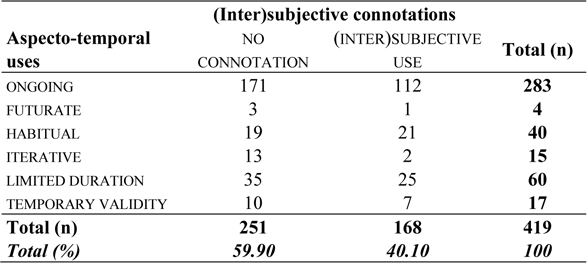
Table 1 presents an overview of the various aspecto-temporal usage types. It shows that in about 40% of all selected items, the am-progressive gives rise to particular (inter)subjective qualifications related to its basic meaning of epistemic contingency. Before elaborating on these, we briefly discuss the different aspecto-temporal categories.
Aspecto-temporal and (inter)subjective uses of am-progressives.

Table 1 shows that the intersection of the prototypical category ongoingness and no-connotation contains the largest number of examples: In roughly four out of ten cases in our corpus, the speaker uses the am-progressive to refer to ongoing events without any additional aspecto-temporal or (inter)subjective qualifications, as in 5a. This category thus constitutes the most entrenched use of the am-progressive. We further attest habitual and iterative situations, as exemplified in 5b and 5c, respectively, and utterances which emphasize the duration of a process (limited duration), as in 5d, or its temporary validity, as in 5e. Contextual clues are often indicative of a particular aspecto-temporal interpretation; we have underlined them in the examples below.
(5)
Present progressive forms referring to future events were classified as futurate uses. In our corpus, futurate is the most marginal category of all aspecto-temporal uses, as it seems to appear exclusively in conditional contexts. In 6a, for instance, the speaker uses the progressive to refer to an event that is to happen in the future. A simple present, however, would be felicitous as well (compare 6b). Still, the latter sentence does not necessarily convey that the speaker wants to quit at a point when he is winning races, that is, when he is at the very peak of his career, as 6b could also refer to the speaker having won a specific race.
(6)
Previous authors have claimed that the German am-progressive most naturally combines with dynamic and atelic predicates, that is, dynamic verbs that do not denote events with an inherent endpoint (see, for instance, Krause's Reference Krause1997, Reference Krause2002 and Gárgyán's Reference Gárgyán2014 discussion of semantic constraints on the main verb in terms of Vendler's 1957/1967 typology of verb classes). This is clearly reflected in the top 10 most frequent verbs in our sample. The most frequent one is the atelic activity verb laufen ‘to run, to be ongoing’ (27 instances), followed by überlegen ‘to consider, to think over’ (21 instances), verzweifeln ‘to despair’ (16 instances), verhandeln ‘to negotiate’ (15 instances), kochen ‘to cook’ (14 instances), arbeiten ‘to work’ (11 instances), kämpfen ‘to fight’ (8 instances), and wachsen ‘to grow’ (8 instances), as shown in 7.
(7)
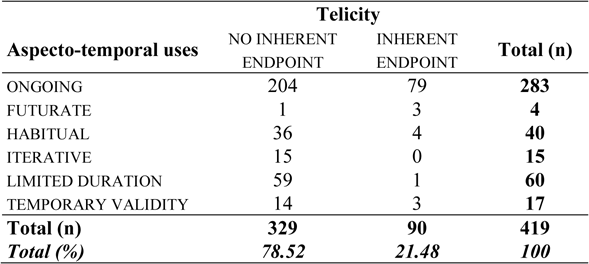
Two among the 10 most frequent verbs denote telic events, that is, events with an inherent endpoint: kippen ‘to tip over’ (12 instances) and verhungern ‘to die of starvation’ (9 instances). In our entire sample, telic verbs feature in one fifth of all the progressive occurrences, as shown in table 2.
Aspecto-temporal uses and verb telicity.
When using a progressive construction with such telic predicates, the speaker does not specify whether the endpoint is or will actually be reached. Most verbs that denote events with an inherent endpoint (68 out of 90) are prefixed intransitive verbs (in the generative literature, they would be termed unaccusative verbs) such as verdursten ‘to die of thirst’, verhungern ‘to starve’, verschwinden ‘to disappear’, verrecken ‘to peg out’, verrotten ‘to rot’, ersticken ‘to choke’, ertrinken ‘to drown’, erfrieren ‘to freeze to death’, absterben ‘to die off’, zerbrechen ‘to break’, zerfallen ‘to fall into ruin, disintegrate’ and zusammenbrechen ‘to collapse’, which form the perfect tense with sein ‘to be’ and typically carry a fatality meaning, as illustrated in the examples in 8.
(8)
Interestingly, in some of these examples, the am-progressive cannot be considered a mere alternative to the aspectually more neutral simple tense. This is particularly clear with past-tense forms, where the am-progressive is semantically different from the simple past tense: The former renders the reported event as incomplete, as in 9a, whereas the latter typically evokes a completeness reading, as in 9b. The simple past of telic verbs is, in other words, not fully neutral with respect to (in)completion. In our sample, this is reflected in the increased association of past-tense progressives with telic predicates as compared to present-tense uses, that is, 32% of the past progressives in our corpus convey a sense of incompletion (as opposed to 19% of the present progressives).Footnote 13
(9)
When dealing with telic verbs, it thus seems that the past progressive is a viable grammatical means to indicate that someone “almost V-ed.”Footnote 14 This context might be considered a possible locus for further grammaticalization of the am-progressive.
In present-time contexts, telic verbs in the simple present have been argued to evoke a future reading; a present reading of telic verbs is said to be only possible with a progressive form, which then focuses on the process preceding the actual change of state (Reimann Reference Reimann1998:13–14). This opposition is illustrated in the constructed examples in 10. Even though Reimann seems to make a valuable point for some cases, her position is too extreme, since present-tense instances of telic verbs give rise to both future and present-time readings (as in 10a). The present progressive 10b, however, seems to underscore the idea of present incompletion, that is, of not reaching the event's final boundary at this very moment.
(10)
In sum, the aspecto-temporal uses found in the corpus are in line with Gárgyán's (Reference Gárgyán2014) function types of the am-progressive (see section 2). As shown in section 3, the aspecto-temporal usage types can be analyzed as extensions of ongoingness. We also found that with telic predicates, the progressive is used to underscore the idea of incom-pletion, which is less pronounced when using the simple present and typically absent when using the simple past or perfect.
4.2. Subjective and Intersubjective Uses
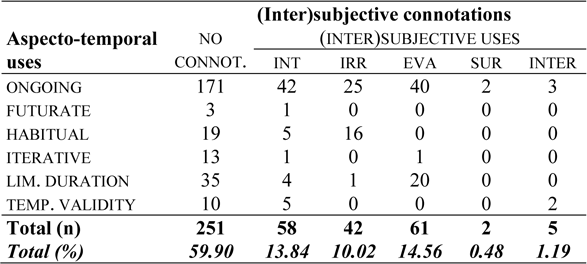
This part of the analysis concentrates on the (inter)subjective connotations that accompany many uses of the am-progressive. Recall that De Wit & Brisard (Reference De Wit and Brisard2014) analyze the basic meaning of the English present progressive in terms of epistemic contingency, and that an analogous account is proposed by De Wit & Patard (Reference De Wit and Patard2013) and De Wit et al. (Reference De Wit and Patard2013) for the French present progressive. Since the association of progressivity with backgrounded boundaries and dynamicity is a universal phenomenon—the crosslinguistic progressive gram by definition only collocates with dynamic verbs—we assume that the basic meaning of contingency is also relevant for the semantic analysis of the German am-progressive, and we predict that this meaning is reflected in the frequent occurrence of (inter)subjective readings. This prediction is borne out: In our corpus, 40% of all progressive tokens feature some kind of nonaspectual qualification. In those cases, the speaker expresses her subjective attitude—for example, irritation or surprise—toward a situation that diverges from what is expected.
Aspecto-temporal uses and types of (inter)subjective connotations.
As observed in section 3, we speak of connotations rather than proper usage types, since each example that evokes an (inter)subjective interpretation can also be classified as instantiating a particular aspecto-temporal category. It is important to emphasize, however, that there are quite a few examples in which the motivation for using the progressive is not (primarily) aspecto-temporal but serves some (inter)subjective purpose. Since the use of the German progressive (like that of the French progressive) is generally not grammatically obligatory, we presume that, even when there is an additional sense of ongoingness, the use of the progressive can be properly triggered by subjective considerations.
The different (inter)subjective connotations, some of which could also be discerned in the examples in the previous section, are discussed in more detail below. For this group of examples, it is shown that the German progressive is most often found in contexts that involve a sense of intensity, irritation, or evasiveness. A sense of intensification of the described event is manifested in a total of 58 sentences (13.84%). Consider the following examples, in which the progressive underscores the intensity of the situation at hand:
(11)
It is not impossible to use the simple present in examples such as 11, yet in that case the sense of intensity would be less conspicuously present.
Closely related to intensification are emotional overtones of irritation, which constitutes a well-established and frequently discussed usage type of the English present progressive. An oft-cited example in this respect is John is silly versus John is being silly (see Nehls Reference Nehls1974:109), where the former characterization is construed as structural (John is a silly person), while the latter is temporal, that is, contingent (John is behaving as a silly person at the moment). The atypicality of the situation might lead to irritation on the part of the speaker. This irritation can be expressed by using the progressive rather than the simple present, which is neutral in this respect. In fact, such a sense of irritation can be discerned in 10% of all utterances in our sample. Consider, for instance, the following examples:
(12)
In 12a, it is evident from the writer's comments that the person quoted is irritated by the designated events. This can be deduced from the topicalized phrase überspitzt gesagt ‘to put it bluntly’. Example 12b is interesting because the progressive and simple form are juxtaposed, which illustrates how a particular aspectual construal reflects the speaker's subjective conception of reality. Thus, the simple present used by Wissel ought to present his judgment as more objective, in contrast with the emotionality of Linda Ising's utterance, where the progressive is used to voice the speaker's irritation about the current events. In these examples, the progressive construal reflects the speaker's irritation, rather than being motivated by mere aspecto-temporal considerations.
Both intensification and irritation seem to be present in the colloquial die Kacke ist am Dampfen, as in 13, which translates as ‘this means trouble’ lit. ‘the shit is steaming’. Note that this expression only works in the progressive form; die Kacke dampft is not correct. In this context, it is also revealing that although the Dutch equivalent of die Kacke ist am Dampfen, namely, de poppen zijn/gaan aan het dansen lit. ‘the puppets are/start dancing’, draws on entirely different lexical sources, the progressive element is equally obligatory.
(13)
The third (inter)subjective expression type, which we call evasiveness, was attested 61 times (14.56%) and is largely restricted to present-time contexts. In English, the present progressive enables the speaker to soften a statement that—when using the simple form—would sound harsher or more definite (De Wit & Brisard Reference De Wit and Brisard2014:83). In our data, too, the present progressive is systematically exploited to create a sense of vagueness and lack of commitment. The category thus covers tentative and evasive statements, which, like sentences characterized by intensi-fication or irritation, have a contingent quality, that is, the proposition is depicted as a “non-structural part of […] reality” (De Wit & Brisard Reference De Wit and Brisard2014:83). By depicting a situation as such, the speaker is less committed to the full realization of this situation. In the following examples, the progressive can be said to underscore the contingency of the situation as qualified by the speaker:
(14)
In example 14a, Renate Götschl tries to account for the disappointing results. First, she describes the slope using the simple present; then she turns to the am-progressive to express that until now she has only been trying, she has not reached the limits of her capacity (note also the presence of ein bisschen ‘a little’). In 14b,c, the writer witnesses a sense of carefulness on the part of the speaker, indicated by sehr vorsichtig ‘very carefully’ and zurückhaltend ‘aloof, unresponsive’: The speaker is deliberately avoiding making any definitive statements about the topic.
The quoted am-progressives function as a kind of hedging device, which is “associated […] with a kind of defensiveness, an evasiveness, a sliding out from under. Hedging in this view is the politician's craft” (Skelton Reference Skelton, Markkanen and Schröder1997:43). Indeed, in our sample, evasive statements are regularly expressed by politicians or other officials, representatives of associations, and sports coaches. In one particular example, the speaker seems to be ridiculing this common practice by using the am-progressive in combination with a nonagentive subject, which creates an ironic effect.
(15)
Note, finally, that in our corpus, the two most frequently used main verbs in progressive constructions are repeatedly associated with evasiveness, namely, laufen ‘to run, to be ongoing’ and überlegen ‘to consider, to think over’, with 27 and 21 instances, respectively.
(16)
The two remaining categories are only marginally attested in our corpus. In only two examples do we find that the progressive is used to evoke a sense of surprise. The category interpretative, too, is represented by merely a few scattered instances. Consider the following conversation between the director-general and an attorney:
(17)
The situation is initially rendered in the simple past (war schwer krank) by the director-general. By shifting to the progressive (war doch am Ersticken), the attorney is correcting what he believes to be a misrepre-sentation of the facts. Just as in example 1b in section 1, the am-progressive is employed to emphasize what was really going on, thereby reclassifying previous portrayals.Footnote 15
5. Conclusion and Future Research
The findings confirm that the am-progressive, like its English counterpart and many other progressive constructions in the world's languages, displays a variety of aspecto-temporal usage types and is susceptible to (inter)subjective readings. Since the German progressive is not as grammaticalized as the progressive in other languages and is not obligatorily used for concurrent event reporting, we even presume that an urge to express (inter)subjective qualifications might properly trigger the use of the am-progressive. Our analysis of the aspecto-temporal uses of the am-progressive shows that the construction prototypically indicates ongoingness. More specific extensions of this meaning give rise to other aspecto-temporal categories: habituality, iterativity, temporary validity, limited duration, and futurate. The German am-progressive is found to carry an (inter)subjective connotation in approximately 40% of the cases. On the basis of our sample, five different subtypes have been discerned. The categories intensification, irritation, and evasiveness account for 95.83% of all (inter)subjective readings, whereas the categories surprise and interpretative are only marginally attested. The study thus provides corroborating evidence for the hypothesis that contingency lies at the basis of the progressive's semantics in German too. It might even be argued that the progressive functions as a mirative marker in languages such as English, French, and German (and possibly other languages as well), that is, as a construction specifically exploited to convey a sense of surprise or atypicality on the part of the speaker (see, among others, DeLancey Reference DeLancey1997, Reference DeLancey2001, Reference DeLancey2012).
Whereas this general observation may hold true across various languages (though to substantiate this claim more studies on other languages are required), there are naturally also language-specific conditions that could affect the use of the progressive. Even if such conditions are not within the scope of the present paper, they constitute an interesting topic for further investigation. We have already indicated that the German progressive can be specifically exploited to convey a meaning of incompletion (especially in the past), and that this use might constitute a potential locus of grammaticalization for the construction. Another interesting question is how the formal characteristics of the German am-progressive tie in with the observation that the verbal paradigm in German in general is becoming more analytical. This change manifests itself through the rise of the perfect (see 18a) as an analytical past tense form (see Nübling et al. Reference Nübling, Dammel, Duke and Szczepaniak2006 and references there) as well as through the tendency to replace the synthetic past subjunctive (hülfe ‘would help’, kaufte ‘would buy’) by an analytical construction consisting of past subjunctive würde + V-inf (würde helfen, würde kaufen), as in 19a. These analytic structures provide adequate structural patterns to realize the so-called Verbalklammer ‘brace construction’, a frequently used sentence structure in present-day German with a finite verb form in second position and a nonfinite verb in final position (Nübling et al. Reference Nübling, Dammel, Duke and Szczepaniak2006:91).
(18)
(19)
(20)
Interestingly, the am-progressive displays a similar structural pattern as the perfect or the analytical past subjunctive. As illustrated in 18–20a, the German perfect, the analytic würde-subjunctive, and the am-progressive are alike: They appear in complex two-place predicate constructions whose first, finite element (hat, würde, war) contains grammatical information pertaining to tense and mood, whereas the second, clause-final and nonfinite element codes lexical information (Thurmair Reference Thurmair, Šimečková and Vachková1997). As Sieberg (Reference Sieberg1984, Reference Sieberg2002, Reference Sieberg, Orosz and Herzog2004) has shown, the German perfect construction (in its function as a past tense form) is preferably used with simple lexical verbs (for example, lachen in ich habe laut gelacht lit. ‘I have loudly laughed’), whose simple past tense forms do not realize the brace construction (for example, ich lachte laut lit. ‘I laughed loudly’).
The simple past tense, however, still occurs with verbs that normally appear in analytical constructions (like modal and auxiliary constructions) and as such easily comply with the favored brace construction. Past tense modals and auxiliaries typically build a two-piece analytical predicate structure, where (i) the finite verb is rhythmically simple (“rhythmisch einfach”), that is, it consists of only one or two syllables, for example, [wollte … ausziehen], [wird… sagen] (Sieberg Reference Sieberg2002:245–246), and (ii) the nonfinite verb carries the crucial semantic information. Since the same structural pattern is displayed by the am-progressive, the question arises whether these syntactic principles can also (at least partly) account for the use and possible future spread of the am-progressive.Footnote 16 An element indicating that formal matters indeed play a role in the development of the German am-progressive seems to be its outspoken preference for either morphologically simple (for example, wachsen ‘to grow’, schreiben ‘to write’, rechnen ‘to calculate’, planen ‘to plan’, arbeiten ‘to work’) or complex but nonseparable (for example, ermitteln ‘to identify’, ersticken ‘to choke’, verhandeln ‘to negotiate’, verzweifeln ‘to despair’) verbs, which account for 88% of all am-progressives in our corpus. With these verbs, nonanalytic simple tense forms typically do not instantiate the preferred structural pattern (for example, ich verzweifle ‘I get desperate’, ich verzweifelte ‘I got desperate’), whereas the am-progressive provides a means to realize the brace construction (ich bin/war am Verzweifeln ‘I am/was getting desperate’).