INTRODUCTION
Environmental policy integration in other sectoral (for example agricultural or energy) policies is one of the few universally acknowledged principles of sustainable development (Gale Reference Gale1991; Lafferty & Hovden Reference Lafferty and Hovden2003; Norris Reference Norris2008). There is ongoing discussion as to how this should be achieved. One argument is that environmental policy integration is an adjunct layer in the policy-making process, according to which, sectoral policies should allow for trade-offs with environmental goals (Collier Reference Collier1994; Lenschow Reference Lenschow2002; Zhang & Wen Reference Zhang and Wen2008). Other scientists emphasize the need to consider environment as a guiding principal when making any policy (Gladwin & Royston Reference Gladwin and Royston1975; Hertin & Berkhout Reference Hertin and Berkhout2003). Much discussion is also focused on more technical aspects, such as on how to achieve this integration, for example by means of strategic environmental assessment of each policy (Wescott Reference Wescott1992; Eggenberger & Partidario Reference Eggenberger and Partidario2000), sustainability appraisal (Simon Reference Simon1989; Hezri Reference Hezri2004; Tzanopoulos et al. Reference Tzanopoulos, Jones and Mortimer2012) or by more structural and personal interactions among different organizations and institutions (Lundqvist Reference Lundqvist2000).
Several policies are aimed explicitly at conserving the natural environment, principal among which is the establishment and management of protected areas, which are geographically defined, legally recognized areas and managed explicitly for protecting nature, ecosystem services and cultural values thereof (Bertzky et al. Reference Bertzky, Corrigan, Kemsey, Kenney, Ravilious, Besançon and Burgess2012). Several policies related to the designation of protected areas are associated with more or less strict regulation of human activities and land uses (Margules & Pressey Reference Margules and Pressey2000; Locke & Dearden Reference Locke and Dearden2005; Dudley Reference Dudley2008). Natura 2000 is the main network of European Union (EU) protected areas, established in 2000 across all EU member states according to two directives known as the Birds (79/409/EEC) and Habitats (92/43/EEC) Directives. This network comprises more than 27 661 sites in total, covers 17.9% of the EU territory (Araújo et al. Reference Araújo, Alagador, Cabeza, Nogués-Bravo and Thuiller2011) and worldwide is the largest network of designated protected areas under a common framework. It consists of both newly-designated and pre-existing protected areas. This network serves the EU's goal to avert biodiversity loss and conserve ecosystem services by the year 2020 (COM [Commission of the European Communities] 2011).
Although the concept of environmental conservation has permeated other sectoral policies (Baldock & Beaufoy Reference Baldock and Beaufoy1993; Mascia et al. Reference Mascia, Brosius, Dobson, Forbes, Horowitz, McKean and Turner2003), less attention has been given to how environmental conservation policies could be integrated with other sectoral policies and spatial planning could assist this. There is currently an effort to combine different policies in the management of coastal and marine Natura 2000 sites (Queffelec et al. Reference Queffelec, Cummins and Bailly2009; Mackelworth Reference Mackelworth2012). For the terrestrial sites, forming most of the network, the case is different. For example, the Common Agricultural Policy has special provisions on the types of agricultural activities and agri-environmental schemes subsidized within and around protected areas, placing an emphasis on environmentally friendly agricultural practices. Nevertheless the integration of protected areas into policies of differing focus is limited and has rarely been successful (Yu & Tapling Reference Yu and Tapling1997; Barthel et al. Reference Barthel, Colding, Elmqvist and Folke2005; Nilsson & Eckerberg Reference Nilsson and Eckerberg2007).
In this study, we examine how the Natura 2000 network could serve the purposes of the EU Environmental Noise Directive (END) regarding the assessment and management of environmental noise and vice-versa (Directive 2002/49/EC). The END seeks to mitigate the detrimental effects of environmental noise on human health. Approximately 20% of the EU population is exposed to noise levels provoking concern to scientists (Passchier-Vermeer & Passchier Reference Passchier-Vermeer and Passchier2000), while 30% of EU citizens are living in areas with severe noise annoyance during the daytime (COM 1996). People exposed to high levels of noise have reported mainly psychological, but in some cases also somatic, symptoms (Stansfeld et al. Reference Stansfeld, Haines and Brown2000; Belojevic et al. Reference Belojevic, Paunovic, Jakovljevic, Stojanov, Ilic, Slepcevic and Saric-Tanaskovic2011). Countries like USA and Sweden have highlighted the value of quietness (Mace et al. Reference Mace, Bell and Loomis2004; Gidlöf-Gunnarsson & Öhrstöm Reference Gidlöf-Gunnarsson and Öhrström2007); the END calls for the identification and protection of Quiet Areas (QAs), defined as places lacking noise produced by traffic, industry or recreational activities. Quietness in protected areas could ensure the preservation of wildlife (Barber et al. Reference Barber, Crooks and Fristrup2009) while the protection of QAs could contribute to visitors’ health and wellbeing (Mace et al. Reference Mace, Bell and Loomis2004; Nielsen & Hansen Reference Nielsen and Hansen2007; Benfield et al. Reference Benfield, Bell, Troup and Soderstrom2010; Karjalainen et al. Reference Karjalainen, Sarjala and Raitio2010), as well as to the restoration of cultural and recreational ecosystem services (Waugh et al. Reference Waugh, Durucam, Korre, Hetherington and O'Reilly2003; Bastian Reference Bastian2013) with reciprocal benefits from the combined implementation of the two policies. Even though the focus of the END is on the quiet urban areas of high population density, there is explicit provision for QAs in open country (Directive 2002/49/EC, articles 3m, 11c). Protected areas are places where biodiversity conservation and ecological processes are often associated with the lack of human noise sources and the propagation of natural sounds (Carles et al. Reference Carles, Barrio and de Lucio1999). Thus, QAs in natural areas, may serve as potential noise refuges contributing towards the conservation of species and habitats protected under the Bird and Habitats Directives (Wallace Reference Wallace2008). In this framework, the Netherlands included nature reserves and areas protected according to the Ramsar Convention, while Slovakia included protected areas in its designated QAs (Vernon et al. Reference Vernon, Ganzleben, Salado, Belin, Polinder, Zarogiannis, Vencovsky and Candell2010). As Haren (Reference Haren2007) and Hatch et al. (Reference Hatch, Clark, Merrick, Van Parijs, Ponirakis, Schwehr, Thompson and Wiley2008) have demonstrated, QA preservation could simultaneously protect highly vagile species while obviously an effectively protected area can also maintain quietness.
Using Greece as an example, the aim of this study is to examine the applicability of spatial planning as a tool integrating environmental noise reduction policy and nature conservation policy, and thus highlight the potential for protected areas to offer a service to society. We examine the results of overlapping the networks that could serve the purposes of the two Directives and how their simultaneous implementation might affect each other. We design an integrated network that simultaneously offers biodiversity and acoustic value in Greece.
METHODS
Study area
Greece, covering an area of 131957 km2, with a 2011 census human population of 10787690 inhabitants and a member state of the EU, introduced the END into Greek legislation in 2006 (Common Ministerial Decision 13586/724/2006, Greek Official Gazette 384B/28.3.2006). However, no common national methodology, as required by the END, exists for the designation and delimitation of noise action plans in Greece (Vernon et al. Reference Vernon, Ganzleben, Salado, Belin, Polinder, Zarogiannis, Vencovsky and Candell2010).
Greece currently has 419 designated sites in the Natura 2000 network, 202 Special Protection Areas (SPAs) and 241 Sites of Community Interest (SCIs). Many SPA and SCI sites overlap. After taking account of the overlaps, there are 371 sites covering 42 949 km2 (27.2% of Greek terrestrial area and 6.12% of its territorial waters). Greece has designated Natura 2000 sites based on existing or newly protected areas under national (law drafts 86/1969 and 996/1971, law 1650/86) and European (Directive 79/409, Directive 92/43) legislation. The Greek Natura 2000 network includes 158 different habitat types, according to Annex I of the Habitats Directive, 19 of which are priority habitat types, containing species particularly vulnerable and mainly or exclusively found in the EU (article 1d of 92/43/EEC). The Greek government has established 28 management agencies, which actually constitute the administrative authorities responsible for the efficient management, monitoring and conservation of 83 protected areas covering 32.78% of the Greek Natura 2000 network. A high percentage of the Greek Natura 2000 protected areas comprises agricultural areas, which are usually accompanied by human activities (Kallimanis et al. Reference Kallimanis, Tsiafouli, Pantis, Mazaris, Matsinos and Sgardelis2008; Tsiafouli et al. Reference Tsiafouli, Apostolopoulou, Mazaris, Kallimanis, Drakou and Pantis2013) and could thus entail a source of human-induced noise.
Mapping and assessment of the integrated network
We identified the Greek QAs using a distance-based assessment of open country QAs (Votsi et al. Reference Votsi, Drakou, Mazaris, Kallimanis and Pantis2012), since we were interested in the spatial overlap of protected and QAs. We defined eight basic human-induced noise sources and each one was buffered based on the distance at which the sound pressure level falls below the critical threshold. As far as the cumulative effect of multiple noise sources is concerned, the energetic average was obtained by the combined effect of two or more noise sources (Appendix l, Table S1, see supplementary material at Journals.cambridge.org/ENC; see Votsi et al. Reference Votsi, Drakou, Mazaris, Kallimanis and Pantis2012).
We overlaid the QA network with the Natura 2000 network, the integrated network constituting of the common areas of the two networks, with selected areas characterized by both biodiversity and acoustic value. Given that very small sites cannot adequately support the goals of conservation of several pretentious ecosystems and species (Gaston et al. Reference Gaston, Jackson, Nagy, Cantú-Salazar and Johnson2008), the inclusion of such numerous but small reserves has often been omitted during procedures of protected area selection and planning (Green & Pain Reference Green and Paine1997; Groves et al. Reference Groves, Jensen, Valutis, Redford, Shaffer, Scott, Baumgartner, Higgins, Beck and Anderson2002; Leroux & Kerr Reference Leroux and Kerr2013; Mikkonen & Moilanen Reference Mikkonen and Moilanen2013). We therefore excluded from the combined network those that were smaller than 4 km2. In total, 0.56% of the total area of the integrated network was thus excluded.
Landscape characteristics of the integrated network
To analyse the landscape context of the integrated network and compare it with the landscape composition of the Natura 2000 network, we used the Corine Land Cover 2000 database (see URL http://www.eea.europa.eu/data-and-maps/data/corine-land-cover-2000-clc2000-seamless-vector-database), which provides detailed spatial information on land cover types.
Using the Natura 2000 dataset (see URL http://www.eea.europa.eu/data-and-maps/data/natura-2000), we estimated the area, number and habitat types included in the integrated network and compared them with the corresponding features of established management agencies of the Natura 2000 network in order to assess whether QAs encompass the EU's management priorities introduced by the Greek legislation.
Biodiversity elements of the integrated network
We explored whether site characteristics were associated with the incorporated QAs. We further tested whether QAs in protected areas were associated with the presence or absence of three large mammal species (Canis lupus [Greek red data book designation: vulnerable], Ursus arctos [endangered] and Rupicapra rupicapra [least concern]; Legakis & Maragkou Reference Legakis and Maragkou2009), species presence data being derived from the Natura 2000 database. National authorities of each member state of the EU have submitted an extensive description of each Natura 2000 site, including species and habitat information, which has been validated in order to form a wide database. The presence or absence of these species has been recorded in all Greek Natura 2000 sites, since they are conservation priority species (Appendix 1, Table S2, see supplementary material at Journals.cambridge.org/ENC). We employed logistic regression analysis to study the predictive ability of the percentage of QAs within a given site along with other parameters (including area of the conservation site, mean altitude, and total area of 11 land use types listed as artificial surfaces, agricultural areas, forest and semi-natural areas). The detailed spatial information on land cover types per conservation site was derived from the Corine Land Cover 2000 database. The importance of each variable was verified using both the Wald statistic for each variable, and the likelihood-ratio test between models; the former indicates if any of the interactions contributed significantly to the model. Hosmer–Lemeshow and Nagelkerke R2 were used to assess the goodness of fit of the models.
We examined if site status (SPAs, SCIs, spatially overlapped) was related to the percentage of quietness, habitat and priority habitat types in the Natura 2000 (see URL http://www.eea.europa.eu/data-and-maps/data/natura-2000) and integrated networks by performing Kruskal-Wallis non-parametric tests in SPSS ver.15.0. Altitudinal range and area were compared between quiet and noisy Natura 2000 sites (defined according to the occupied percentage of quietness) using Mann-Whitney U tests in SPSS software.
After testing for normality, we used linear regression to examine the potential relationship between habitat and priority habitat diversity, as well as the diversity of recorded human activities in relation to the percentage of quietness in the Natura 2000 network. Data on 155 types of human activity were recorded, under the framework of the EU wide database, for each Greek Natura 2000 site according to the Natura 2000 Data Standard Form. A total of 3341 records of human-related activities were available for 241 out of the 371 protected areas in Greece.
RESULTS
Areas of high acoustic and biodiversity value
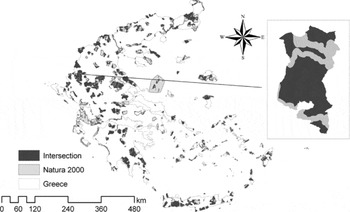
The QA network (area 65125 km2, 49.35% of Greece) consisted of 765 sites, while the integrated network, of both quiet and protected areas, covered a total area of 21040 km2, (15.94% of Greece). Fifty-eight per cent of the total area of the Natura 2000 network was identified as QA, whereas more than 32% of the QA network within the Greek territory was part of a Natura 2000 site. The combined network included part or the entire area of 315 out of the 371 Natura 2000 sites and 382 of the 765 sites of QA network (Fig. 1).
The integrated network of QAs and Natura 2000 network. Inset: an example of intersection between the Natura 2000 network and QAs (in darker shade) within a Natura 2000 site.

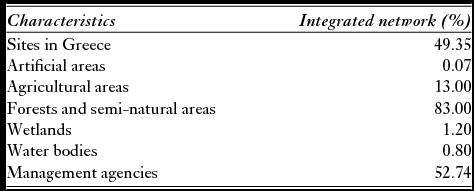
Artificial surfaces (for example discontinuous urban fabric) constitute only 16.58 km2 (0.07% of the integrated network [nQAs = 56]), while they covered 203.33 km2 (0.6% of the Natura 2000 network). Agricultural areas cover 25.1% of the QA network, 18.5% of the Natura 2000 network and 13.0% of the integrated network (nQAs = 311). Forests and semi-natural areas were the dominant land use, covering 70.1% of QAs, 75.1% of Natura 2000 and 83.0% of the integrated network (nQAs = 319). Wetlands constitute only 0.3% of QAs, 2.5% of Natura 2000, and 1.2% of the integrated network (nQAs = 49). Water bodies formed a small percentage of QAs (0.8%), Natura 2000 (3.2%) and the integrated network (0.8%) (nQAs = 42) (Appendix 1, Table S3, see supplementary material at Journals.cambridge.org/ENC).
Only two of the 28 management agencies did not include areas that were even partially quiet. The protected areas managed by the remaining 26 agencies were represented in the integrated network at least partially (QAs cover 0.02–100% of the managed protected areas). Approximately half (53%, 11 098 km2) of the integrated network was under a management authority, a higher proportion than the 32.78% of the Natura 2000 network with management agencies (Table 1).
The basic descriptive characteristics of the integrated network of biodiversity and acoustic value in Greece. There were 765 sites and 26 management agencies within Greece.

Quiet Natura 2000 sites (containing > 30% QA) were recorded at higher altitudes than noisy Natura 2000 sites, (n = 371, Mann-Whitney U test, p < 0.01). Quiet Natura 2000 sites covered significantly larger areas than noisy sites (n = 371, Mann-Whitney U test, p < 0.01).
Biodiversity and the integrated network
For all studied species, the logistic regression models achieved a high predicted probability of occupancy, ranging from 84.3 to 95.9%. The range of Hosmer and Lemeshow and Nagelkerke R2 values (0.26 and 0.39) indicate that the model's estimates fitted the data adequately. The percentage of QAs and existence of forests were significant predictors of the presence of all three mammal species. In each case, however, several other land use types also contributed to the model's goodness of fit. The presence of scrub and/or herbaceous vegetation associations and of open spaces with little or no vegetation were significant predictors of Canis lupus occurrence. The existence of industrial, commercial and transport units negatively affected the presence of Ursus arctos. Artificial non-agricultural vegetated areas were positively, and heterogeneous agricultural areas were negatively associated with the occurrence of Rupicapra rupicapra.
Only 12, out of the 158 habitat types mapped in the Greek Natura 2000 network, were absent from the integrated network, while when the management authority status was taken into account 42 habitat types were absent from Natura 2000 sites in comparison to the 57 habitat types of the integrated network. In the integrated network, only two priority habitat types were missing (Mediterranean salt steppes [Limonietalia] and wooded dunes with Pinus pinea and/or Pinus pinaster), which were also absent from the sites with a management agency (Appendix 1, Table S4, see supplementary material at Journals.cambridge.org/ENC).
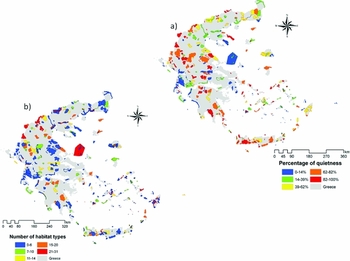
Overall, the proportion of quietness in Natura 2000 sites correlated with site total richness of habitat types (Fig. 2; n = 371, R2 = 0.164, p < 0.05), but not with richness of priority habitat types (n = 371, R2 = 0.028, p > 0.05).
Correlation between quietness and diversity in the Greek Natura 2000 network, expressed as a colour scale depicting: (a) the percentage of quiet areas present in protected areas and (b) site diversity, defined as the richness of habitat types.

Across the 241 sites analysed, the number of recorded activities within the protected sites was significantly, but weakly, negatively correlated to the percentage of the site that was a QA (R2 = 0.032, p < 0.05). The status of the site (whether it was a SPA or SCI) did not affect the proportion of the site that was quiet (n = 371, Kruskal Wallis Test, p > 0.05).
DISCUSSION
Despite the different objectives of the Directives, there is a considerable overlap between QAs in open country, as defined in the END, and protected areas established under the EU Birds and Habitats Directives, providing the opportunity for environmental, cultural, natural and biodiversity values to thrive under an integrated strategy (Waugh et al. Reference Waugh, Durucam, Korre, Hetherington and O'Reilly2003). Quiet protected areas were recorded at higher altitudes and within larger areas than noisy ones. The predominance of quiet over noisy protected areas accords with the EU's designation of natural and pristine areas, confirming that Greece has met the requirements of the Habitats Directive.
Noise mitigation could contribute to biodiversity conservation in a practical and cost-effective way, since many species’ abundances (Swaddle & Page Reference Swaddle and Page2007; Slabbekoorn & Ripmeester Reference Slabbekoorn and Ripmeester2008) and natural habitats (Gontier et al. Reference Gontier, Balfors and Mörtberg2006) seem to be negatively associated with human-induced noise (Bayne et al. Reference Bayne, Habib and Boutin2008). A major tool towards realizing this goal is the identification and preservation of QAs (Barber et al. Reference Barber, Burdett, Reed, Warner, Formicella, Crooks, Theobald and Fristrup2011; King et al. Reference King, Murphy and Rice2011; Votsi et al. Reference Votsi, Drakou, Mazaris, Kallimanis and Pantis2012), as proposed in article 11 of the END. The Birds and Habitats Directives aim to conserve biodiversity through the establishment and management of the Natura 2000 network (Beaufoy Reference Beaufoy1998; Araújo et al. Reference Araújo, Lobo and Moreno2007). We found that, in Greece, QAs and Natura 2000 areas do not fully overlap, but extensive areas are both protected and quiet, potentially constituting noise refuges. Almost 60% of the area covered by Natura 2000 sites is also QA, a considerably greater proportion than the 49% national terrestrial average, implying that the Natura 2000 network was represented more than randomly expected in the QA network. Thus, nature conservation offers an added service, the preservation of QAs. The value of quietness has been recognized (Mace et al. Reference Mace, Bell and Loomis2004), but it has not been the focus of management and designation until the introduction of the END (Maffei et al. Reference Maffei, Iachini, Masullo, Aletta, Sorrentino, Senese and Ruotolo2013), whereas it is still ignored in conservation area selection and site prioritization processes. This ecosystem service has not been fully appreciated in the past, and thus raises the question of how many more other services do we receive without even realizing their existence, while other ecosystem benefits may also have been underestimated or ignored (Stringer & Dougill Reference Stringer and Dougill2013).
The present combination of Natura 2000 and QAs is not the result of a policy process, since the networks we analysed here were designated independently for the implementation of different policies according to different rules and criteria. Our analysis shows that there is an overlap in the results of these policies (of protected areas and QAs). This overlap suggests that it may be possible to combine these policies and develop synergies towards ensuring future policy coherence development, as strongly supported by the EU. If the integration of two policies is to be successful, it must be first established that their implementation is not mutually exclusive. Thus we tried to investigate whether quietness, as defined by the END, was associated with the presence of large mammals in protected areas, taking into consideration the environmental characteristics of the conservation sites, as large mammals are likely to be affected by environmental noise. We found that quietness, along with forested area, contributed significantly to the presence of such flagship species. However, natural and semi-natural areas also seemed to contribute to the presence of large mammals, while anthropogenic land-use types negatively affected occupancy. Large mammals prefer large spaces with limited human interference (Mladenoff et al. Reference Mladenoff, Sickley, Haight and Wydeven1995; Woodroffe & Ginsberg Reference Woodroffe and Ginsberg1998; Mertzanis et al. Reference Mertzanis, Kallimanis, Kanellopoulos, Sgardelis, Tragos and Aravidis2008), while the major factors determining large mammals’ distribution are road density (Thiel Reference Thiel1985; Lin Reference Lin2006), pressure of agricultural land use (Parks & Harcourt Reference Parks and Harcourt2002; Papaioannou & Kati Reference Papaioannou and Kati2007, Benítez-López et al. Reference Benítez-López, Alkemade and Verweij2010), total site area and connectivity (Harrison & Chapin Reference Harrison and Chapin1998), habitat destruction (Breitenmoser Reference Breitenmoser1998), hunting and poaching (Mertzanis et al. Reference Mertzanis, Ioannis, Mavridis, Nikolaou, Riegler, Riegler and Tragos2005, Papaioannou & Kati Reference Papaioannou and Kati2007), and altitude (Kobler & Adamic Reference Kobler and Adamic2000). Most of these factors are correlated with human presence, which is interwoven with anthropogenic activities and consequently human-induced noise. Several studies have recorded the negative effects of noise on large mammals (see for example Gander & Ingold Reference Gander and Ingold1997; Clevenger & Waltho Reference Clevenger and Waltho2005). A possible explanation is that mammals avoid noisy areas due to the consequent effects of human interactions (such as direct mortality, illegal hunting or direct human disturbance), rather than the actual disturbance of noise. We cannot conclude that quietness determines large mammal presence or absence in protected areas, but preference for quiet protected areas could benefit animals’ conservation, a fact inadequately considered previously, with a view to planning integration (Reed & Merenlender Reference Reed and Merenlender2008).
The combined network included 17 of the 19 priority habitat types observed in Greece, and Natura 2000 sites with greater proportion of QAs also supported a greater diversity of habitats. Since QAs by default represent roadless and/or low traffic areas, undisturbed by human activities (2002/49/EC; see also Votsi et al. Reference Votsi, Drakou, Mazaris, Kallimanis and Pantis2012), which play an important role in biodiversity conservation (Crist et al. Reference Crist, Wilmer and Aplet2005; Selva et al. Reference Selva, Kreft, Kati, Schluck, Jonsson, Mihok, Okarma and Ibisch2011), the implementation of the END is not in conflict with the aims of nature conservation policy. It could be combined without compromising biodiversity conservation goals. The END is primarily meant to address the noise exposure levels of dense urban populations, which by definition are not included in protected areas. However, the END makes specific provisions for QAs in open country, which already exist, and could serve as potential noise refuges.
Our results demonstrate that Natura 2000 sites located at higher altitudes supported higher levels of quietness. Sites located at high altitudes could be considered as remote areas and are often preferred in the site selection process (Joppa & Pfaff Reference Joppa and Pfaff2009, Reference Joppa and Pfaff2011). Nevertheless, the Greek Natura 2000 network has a high percentage of agricultural land (Kallimanis et al. Reference Kallimanis, Tsiafouli, Pantis, Mazaris, Matsinos and Sgardelis2008), and various forms of cultivation, livestock and forestry activities operating within the conservation sites (Tsiafouli et al. Reference Tsiafouli, Apostolopoulou, Mazaris, Kallimanis, Drakou and Pantis2013).
Such a landscape level approach has several confounding factors. Noise levels may differ among vegetation types due to sound penetration properties (Cosens & Falls Reference Cosens and Falls1984; Hideki et al. Reference Hideki, Toshiaki and Nobuo2006; Joo et al. Reference Joppa and Pfaff2011). However, since we used the assumption of open space to estimate the buffer zone where the sound pressure level falls below the critical threshold, this might mean that in our analysis we underestimated QAs in densely vegetated protected areas. Moreover, following coarse-scale studies on environmental noise assessments (Öhrström et al. Reference Öhrström, Skånberg, Svensson and Gidlöf-Gunnarsson2006), lack of appropriate data at national scale prevented traffic noise being treated as a seasonal and daily variable. Instead it was treated as though it was a static property of the soundscape. Our results demonstrate that 26 out of the 28 management agencies in Greece encompass QAs to a lesser or greater extent. There is ongoing discussion about possible reduction of the number of such agencies (Drew & Henne Reference Drew and Henne2006). Our analysis highlights the potential role these agencies could play in the implementation of European policies. If these agencies remain, they could include the preservation of QAs in their mandate, and implement the END in a cost-effective way. Any such attempt would require a potential reorganization of basic priorities and some changes at the organizational level of the agencies (such as additional personnel). However, any such structural changes would be minor in comparison to the development of new operational conservation schemes; in addition, the ability of these agencies to offer support to the objectives of alternative legislative acts could also serve as an argument towards their maintenance and governmental support.
The conservation of these protected areas offers additional ecosystem services and could help implement a directive that has not yet been fully implemented in countries like Greece. The spatial overlap of these policies may also apply at a European level, as they are European directives followed by all the EU member states. This approach could be further explored throughout the EU to establish whether quietness is associated with the features of Natura 2000 protected areas. Although EU directives and national laws provide for such a reciprocal integration, the tools necessary to accurately assess their impacts are missing. In Greece, we found that the potential combination of policies would not compromise nature conservation. If environmental policy, during the site selection process, incorporated additional criteria (such as mitigation of environmental noise) in addition to the basic conservation objectives of the Birds and Habitats Directives, directive integration could be successful. The status of quietness within a site could serve as such an additional criterion (Barber et al. Reference Barber, Crooks and Fristrup2009), and is unlikely to conflict with the conservation objectives of the Directives (Birds and Habitats). Conservation policy represents a complex social and political process (Tsing et al. Reference Tsing, Brosius, Zerner, Brosius, Tsing and Zerner2005; Apostolopoulou & Pantis Reference Apostolopoulou and Pantis2009; Tsianou et al. Reference Tsianou, Mazaris, Kallimanis, Deligioridi, Apostolopoulou and Pantis2013) where the selection of candidate sites should be based on environmental, economic, political and cultural ground (Faith & Walker Reference Faith and Walker1996; Adams et al. Reference Adams, Aveling, Brockington, Dickson, Elliott, Hutton, Roe, Vira and Wolmer2004; Apostolopoulou et al. Reference Apostolopoulou, Drakou, Santoro and Pantis2012). According to our findings, quietness constitutes an effective means to evaluate most of these interacting factors and, if incorporated as a goal, could satisfy the basic goals of the conservation policy.
CONCLUSIONS
We have demonstrated how spatial planning may be used to integrate the END into existing nature conservation infrastructure without compromising biodiversity preservation. Other sectoral policies may also be integrated with nature conservation policy, and combining conservation budgets with other policies may reduce expense, especially in the present economic crisis.
ACKNOWLEDGEMENTS
We thank E.G. Drakou and J. Tzanopoulos for their insightful comments and assistance in part of the analysis. The work of N.E.P Votsi was cofinanced by the European Union (European Social Fund) and Greek national funds obtained through the operational programme ‘Education and Lifelong Learning’ of the National Strategic Reference Framework (NSRF) Research Funding Programme: Heracleitus II. Investing in knowledge society through the European Social Fund. The work of A.S. Kallimanis, A.D. Mazaris and J.D. Pantis was partially supported by SCALES (Securing the Conservation of Biodiversity across Administrative Levels and Spatial, Temporal and Ecological Scales; EU FP7 project 226852).