Implications
This study reviews the reported performance results of immunocastrated (IC) pigs in comparison with boars (BO) and barrows (BA). The results depend on the feeding strategy. If feed is restricted, BO grow faster and more efficiently than BA or IC. With ad libitum feeding, BA and IC consume more feed than BA. Feed efficiency of IC is intermediate between BO and BA and growth is the fastest. The killing out percentage is lowest in IC and highest in BA. Meat percentage of IC is intermediate between BA and BO. At this moment, it is not possible to give the optimal feeding strategy for IC.
Introduction
In order to prevent boar taint, most European pig farmers surgically castrate male piglets. However, criticism of this practice has increased. McGlone and Hicks (Reference McGlone and Hicks1993) raised the concern about castration as a painful experience to the piglets, and later Bonneau (Reference Bonneau1998) gave food for thought to European Union decision-makers by listing the advantages and disadvantages of entire male fattening pigs, pointing out that despite the boar taint problem, the use of entire males needs to be reconsidered because of the animal welfare issue of unanaesthetised surgical castration. In the Annex to Directive 98/58/EC (European Union, 2009), it is stated that ‘if castration or docking of tails is practised after the 7th day of life, it shall only be performed under anaesthetic and additional prolonged analgesia by a veterinarian’. Because the European Union thus imposes a ban on the surgical castration of piglets as commonly practiced in the last decades, raising intact boars (BO) or immunocastration may become a common practice. As immunocastration alters performance of the animals (Dunshea et al., Reference Dunshea, Colantoni, Howard, McCauley, Jackson, Long, Lopaticki, Nugent, Simons, Walker and Hennessy2001), it can be expected that immunocastrated (IC) male pigs have different nutrient requirements than BO and barrows (BA). To date, few scientific studies describe the amino acid requirements of IC pigs. This review aims to describe the reported differences in performance parameters between BO, BA and IC and their expected consequences on nutrient requirements. Owing to the absence of studies comparing different immunocastration methods, the potential impact of the choice of immunocastration method is not taken into account.
Performance of IC pigs compared with BA and BO
Performance depends on several factors, as described below. Growth performance is influenced by the biological response to the immunisation. Pigs will develop some antibodies after the first injection but there will not be a prolonged and high level of self-gonadotrophin-releasing hormone (GnRH) antibody production until after the second vaccination, so they may be considered BO until then. Turkstra et al. (Reference Turkstra, van Diepen, Jongbloed, Oonk, van de Wiel and Meloen2002) found that some pigs (early responders) may be affected already by the first injection, but it has to be noted that these authors used a vaccine that contained Freunds's complete adjuvant in the primary vaccination, which might have enabled an early high antibody and physiological response.
Protein deposition rate
Maximum protein deposition (PDmax), expressed in g/day, indicates the amount of protein that is maximally retained in the body at a given moment. This PDmax, together with the daily energy intake, determines the partitioning of energy towards lean gain and fat deposition and consequently the daily gain and feed conversion ratio (FCR). The fraction of energy for growth designated for protein deposition is maximal at low-intake levels (Van Milgen et al., Reference Van Milgen, Quiniou and Noblet2000) and lowest at ad libitum intake. Once energy intake leads to PDmax, this protein deposition will stay at that absolute maximum and a further increase in energy intake will not affect protein deposition. The PDmax depends on genotype and gender (Thompson et al., Reference Thompson, Sun, Kuczek, Schinckel and Stewart1996). According to most authors, PDmax evolves with age (Quiniou et al., Reference Quiniou, Dourmad and Noblet1996a; Van Milgen et al., Reference Van Milgen, Quiniou and Noblet2000). Mohn and de Lange (Reference Mohn and de Lange1998), however, stated a constant PDmax for growing pigs. The PDmax is higher in BO than in BA (Table 1). According to Van Milgen et al. (Reference Van Milgen, Quiniou and Noblet2000), also the evolution of PDmax over time differs between BO and BA. Besides, BO reach PDmax with a lower energy intake than BA, indicating more efficient energy use for protein deposition (Quiniou et al., Reference Quiniou, Dourmad and Noblet1996a).
Protein deposition rates (g/day) of boars and barrows according to several authors

PDmax = maximum protein deposition.
aPDmax100 = upper limit to protein deposition at 100 days of age; PDmax150 = upper limit to protein deposition at 150 days of age.
No studies have described the evolution of PDmax in IC as a function of age.
Theoretically, the evolution should be similar to BO until the second vaccination. If castration leads to a decreased capacity of lean deposition, one would expect a decreased PDmax in IC after the second vaccination. However, based on lean meat growth this is not clear, as will be discussed in the section ‘meat percentage’.
An adequate provision of amino acids per unit of energy is a key factor in protein deposition and overall pig performance. To our knowledge, dose-response studies on amino acid requirements of IC are not reported in scientific literature. Owing to the discontinuous development of IC compared with gilts and BA, extrapolation from the latter requirements is not justified.
Therefore, in order to estimate amino acid requirements of IC, dose-response studies will be necessary and growth curves for IC will need to be determined.
Feed intake (FI)
With ad libitum access to feed, BA consume more feed than BO (Campbell and Taverner, Reference Campbell and Taverner1988; Bonneau et al., Reference Bonneau, Dufour, Chouvet, Roulet, Meadus and Squires1994). In studies carried out by Dunshea et al. (Reference Dunshea, Colantoni, Howard, McCauley, Jackson, Long, Lopaticki, Nugent, Simons, Walker and Hennessy2001) and Zamaratskaia et al. (Reference Zamaratskaia, Andersson, Chen, Andersson, Madej and Lundstrom2008), IC and BA consumed considerably more feed than BO during the last 4 weeks before slaughtering (after the booster vaccination). Studies reporting values of voluntary FI for ad libitum fed pigs during the last weeks of growth (after the second vaccination of IC) all show an increased FI of IC and BA compared with BO (Table 2). In agreement with this, Cronin et al. (Reference Cronin, Dunshea, Butler, McCauley, Barnett and Hemsworth2003) observed that BO spent less time in the feeder than BA or IC pigs during the last 4 weeks before slaughtering. Numerically, FI of ad libitum fed pigs after the second vaccination is higher in IC than BA, although this was not always significantly different.
Performance characteristics of BO, BA and IC in several studies from second vaccination until slaughter, unless otherwise mentioned

BO = boars, BA = barrows, IC = immunocastrates.
Excluding Zamaratskaia et al. (Reference Zamaratskaia, Andersson, Chen, Andersson, Madej and Lundstrom2008) and D'Souza and Mullan (Reference D'Souza and Mullan2003).
aWeight class not mentioned.
b26 to 124 kg.
In wild BO, gonadal hormones affect FI and this effect would still be present in domesticated BO (Weiler et al., Reference Weiler, Claus, Dehnhard and Hofacker1996). This may account for the lower FI of BO as compared with BA. In addition, IC and BA may spend less time engaged in sexual and aggressive behaviour and therefore spend more time feeding (Dunshea et al., Reference Dunshea, Colantoni, Howard, McCauley, Jackson, Long, Lopaticki, Nugent, Simons, Walker and Hennessy2001).
As far as the amino acid content is not limiting, extra FI in (immuno) castrated pigs may be used for growth before the PDmax is reached, but after the PDmax is reached, extra FI will only result in increased fat deposition.
The effect of immunocastration on overall (grower + finisher) FI differs between studies and probably depends on the size of the difference as well in the grower as the finisher period. For example, when comparing two recent studies, overall FI of IC was not significantly different from BA in the study of Fàbrega et al. (Reference Fàbrega, Velarde, Cros, Suárez, Tibau and Soler2010), whereas in the study of Pauly et al. (Reference Pauly, Spring, O'Doherty, Kragten and Bee2009) the FI of IC was lower than BA.
Growth
Differences in growth rate between BA and BO are directly linked to FI (in ad libitum fed pigs) and feed utilisation efficiency. The latter may be a consequence of partitioning of energy between growth and other processes (maintenance and activity) and the partitioning of gain between protein or fat deposition. The latter depends on PDmax, as described in the section ‘protein deposition rate’.
With restricted feeding, BO grow faster than BA, because they use this feed more efficiently (Campbell and Taverner, Reference Campbell and Taverner1988; Hansen and Lewis, Reference Hansen and Lewis1993). BO also grow faster than IC pigs if FI is restricted (Metz et al., Reference Metz, Hohl, Waidelich, Drochner and Claus2002; Turkstra et al., Reference Turkstra, van Diepen, Jongbloed, Oonk, van de Wiel and Meloen2002). After the first vaccination, growth response depends on the reaction of IC to the vaccination.
With ad libitum feed provision, the difference between BO and BA diminishes because of BA's higher FI. In most studies, average daily gain (ADG) was not different between BO and BA in late finishing. In several studies (Xue et al., Reference Xue, Dial, Schuiteman, Kramer, Fisher, Marsh, Morrison and Squires1995; Zeng et al., Reference Zeng, Turkstra, Jongbloed, van Diepen, Meloen, Oonk, Guo and van de Wiel2002; Zamaratskaia et al., Reference Zamaratskaia, Andersson, Chen, Andersson, Madej and Lundstrom2008), ADG between 20 and 110 kg was faster in BA than in BO, but Knudson et al. (Reference Knudson, Hogberg, Merkel, Allen and Magee1985) did not observe differences in body weight gain between BA and BO with ad libitum feeding until 105 kg. ADG of IC is influenced by the biological response to the second injection. With the second injection, the testosterone production diminishes and IC start to eat more and grow faster (Dunshea et al., Reference Dunshea, Colantoni, Howard, McCauley, Jackson, Long, Lopaticki, Nugent, Simons, Walker and Hennessy2001; Cronin et al., Reference Cronin, Dunshea, Butler, McCauley, Barnett and Hemsworth2003; Zamaratskaia et al., Reference Zamaratskaia, Andersson, Chen, Andersson, Madej and Lundstrom2008). In most of these studies, growth rates of IC in late finishing is higher than the growth rate of BO and BA (Table 2).
Interestingly, Falvo et al. (Reference Falvo, Chandrashekar, Arthur, Kuenstler, Hasson, Awoniyi and Schanbacher1986), the first researcher who showed that immunisation against luteinizing-hormone-releasing-hormone, did not observe an effect of the immunisation on growth performance. Again, the overall (grower + finisher) effect of immunocastration differs between studies.
FCR
The FCR is mostly determined by two factors: growth rate and composition of the growth. Lean growth has a lower energetic cost than fat deposition (National Research Council, 1998). Faster growth leads to a lower maintenance energy requirement relative to the energy requirements for gain, which results in a better FCR. If faster growth leads to fatter animals, these two factors counteract one another.
Several authors have noted a better FCR in BO than BA (Bonneau et al., Reference Bonneau, Dufour, Chouvet, Roulet, Meadus and Squires1994; Xue et al., Reference Xue, Dial and Pettigrew1997; Aluwé et al., Reference Aluwé, Millet, Nijs, Tuyttens, Verheyden, De Brabander, De Brabander and Van Oeckel2009), which can be explained by the higher PDmax in BO. Even with restricted feeding, when PDmax is not reached, this effect is visible. According to Campbell and Taverner (Reference Campbell and Taverner1988), the two components of the linear/plateau relationship (the slope and the plateau level) between energy intake and protein deposition are interrelated. Therefore, differences in protein deposition can be observed even at levels where PDmax has not been reached. With the second injection, one would expect the IC to behave physiologically like BA, with an increased FCR because of an increase in fat deposition at the expense of lean meat.
To the contrary, a better FCR in IC after the second vaccination than in BA was observed in several studies (Table 2). This might be due to a higher PDmax of IC in comparison with BA. As far as we know, this has not been determined yet, but Metz and Claus (Reference Metz and Claus2003) showed that growth hormone levels (but not IGF-2) are higher in IC pigs than in BA, even after the second vaccination. Moreover, before the second vaccination, IC will be physiologically closer to BO than to BA. Therefore, body composition and FI pattern at the moment of the second vaccination is likely to differ between BA and IC. This may account for differences after the second vaccination. The fact that it takes 7 to 10 days for IC to become castrated from a hormonal point of view (Claus et al., Reference Claus, Lacorn, Danowski, Pearce and Bauer2007), means that IC might be longer in a boar-like state compared with BA. Indeed, Fàbrega et al. (Reference Fàbrega, Velarde, Cros, Suárez, Tibau and Soler2010) did not observe differences in behaviour the between BO and IC 2 days after the second vaccination. Together with gut fill effects because of the increased FI after second immunisation, this may add to the causes of difference in FCR between BA and IC after the second vaccination.
The full advantage of raising IC will only be attained when the biological effect of vaccination is shown only from the second injection on, without any visible effect from the first injection. According to the findings of Bonneau et al. (Reference Bonneau, Dufour, Chouvet, Roulet, Meadus and Squires1994), immunocastration is preferably performed in the finisher phase, in order to maximise the boar-type growth during the period before the onset of immunocastration: they found that giving the second injection 2 weeks before slaughtering created no noticeable difference in overall FCR between BO and IC, whereas BA performed significantly worse. Fàbrega et al. (Reference Fàbrega, Velarde, Cros, Suárez, Tibau and Soler2010) confirmed this finding with a vaccination 4 weeks before slaughtering, whereas Pauly et al. (Reference Pauly, Spring, O'Doherty, Kragten and Bee2009) observed a significantly worse FCR in IC compared with BO.
In this case, the first immunisation, which is intended to prime the immune system, preferably elicits a low or moderate antibody response without GnRH-neutralising activity (Turkstra et al., Reference Turkstra, van Diepen, Jongbloed, Oonk, van de Wiel and Meloen2002). If the first injection leads to some ‘early responders’, this might lead to different growth characteristics for these animals and more diversity within a group.
Carcass quality of IC pigs compared with BA and BO
Carcass yield
The killing out percentage is lower in BO than in BA, because of the presence of testes and other accessory tissues in BO (Hansen and Lewis, Reference Hansen and Lewis1993; Babol and Squires, Reference Babol and Squires1995). Moreover, BO have heavier kidneys, heads, legs, and intestines, and slightly higher proportions of head, feet and viscera (Hansen and Lewis, Reference Hansen and Lewis1993; Babol and Squires, Reference Babol and Squires1995). Not all studies confirm this difference in dressing percentage (Knudson et al., Reference Knudson, Hogberg, Merkel, Allen and Magee1985) and this inconsistency may be the result of various trimming techniques of the scrotal tissues (Babol and Squires, Reference Babol and Squires1995). Besides, intra-abdominal fat may be higher in BA than in BO.
The weight of testes and bulbo-urethral gland are lower in IC than in BO (Pauly et al., Reference Pauly, Spring, O'Doherty, Kragten and Bee2009; Gispert et al., Reference Gispert, Angels Oliver, Velarde, Suarez, Pérez and Furnols2010). Nevertheless, most studies report a lower carcass yield (Dunshea et al., Reference Dunshea, Colantoni, Howard, McCauley, Jackson, Long, Lopaticki, Nugent, Simons, Walker and Hennessy2001; Zamaratskaia et al., Reference Zamaratskaia, Andersson, Chen, Andersson, Madej and Lundstrom2008; Pauly et al., Reference Pauly, Spring, O'Doherty, Kragten and Bee2009; Gispert et al., Reference Gispert, Angels Oliver, Velarde, Suarez, Pérez and Furnols2010). The authors of these studies attested the lower dressing percentage of IC as compared with BA or BO to increased gut fill and the increased amount of abdominal fat. Gispert et al. (Reference Gispert, Angels Oliver, Velarde, Suarez, Pérez and Furnols2010) state that the faster growth in the finishing phase may explain an increased gut content.
Meat percentage
BO have a higher lean meat percentage than BA (Campbell and Taverner, Reference Campbell and Taverner1988), especially when fed ad libitum (Quiniou et al., Reference Quiniou, Noblet and Dourmad1996b). When the PDmax rate is reached, BA's extra FI leads to extra fat deposition and a lower meat percentage.
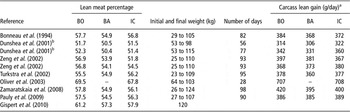
As IC can be considered BO until or shortly after the second injection, an overall higher lean meat percentage is expected in these animals compared with BA and a lower lean meat percentage in comparison with BO. This is confirmed in most studies (Table 3).
Lean meat percentage in BO, BA and IC, with corresponding average lean meat growth

BO = boars, BA = barrows, IC = immunocastrates.
aAverage carcass lean gain (g/day) was calculated as [lean meat content at slaughter (g)] − [lean meat content at start (g)]/[number of days between start and slaughtering]. Lean meat content at slaughter (kg) was obtained by multiplying lean meat percentage and carcass weight. Lean meat content (kg) at start (±20 kg live weight) was estimated at 45% of the live weight (Millet et al., Reference Millet, Raes, Van den Broeck, De Smet and Janssens2005).
bLean meat percentage was calculated based on back fat thickness (indirect method) for estimating fat free lean (National Research Council, 1998).
Back fat thickness in BO is less than in BA (Siers, Reference Siers1975; Knudson et al., Reference Knudson, Hogberg, Merkel, Allen and Magee1985; Hansen and Lewis, Reference Hansen and Lewis1993; Zeng et al., Reference Zeng, Turkstra, Jongbloed, van Diepen, Meloen, Oonk, Guo and van de Wiel2002; D'Souza and Mullan, Reference D'Souza and Mullan2003). Back fat thickness is significantly more in IC than BO (Dunshea et al., Reference Dunshea, Colantoni, Howard, McCauley, Jackson, Long, Lopaticki, Nugent, Simons, Walker and Hennessy2001; Zeng et al., Reference Zeng, Turkstra, Jongbloed, van Diepen, Meloen, Oonk, Guo and van de Wiel2002; D'Souza and Mullan, Reference D'Souza and Mullan2003).
In most studies, the calculated average lean meat gain (LMG) was lower for BA than for BO and IC (Table 3). This difference in LMG indicates that the difference in meat percentage between BO and BA is due to both a lower PDmax and a higher FI in BA, leading to increased fat deposition. LMG between BO and IC is quite similar. The observed difference in meat percentage might be attributed mainly to the excess FI, in animals with a similar capacity to retain protein. Nevertheless, evolution of PDmax over the life of IC as stated under the section ‘protein deposition rate’.
Conclusion
Immunocastration affects performance of pigs. After the second vaccination, IC showed a higher FI than BO. They grow faster than BO and BA and FCR is better than BA, but worse than BO. IC showed a lower carcass yield than BA and BO, whereas meat percentage is intermediate. In order to optimise the production of IC, it will be necessary to determine growth curves and to deduct nutrient requirements with dose-response studies.
Acknowledgement
Thanks to Miriam Levenson for language correction.