INTRODUCTION
Copepods are the most important secondary producers in marine ecosystems. The relationships between marine copepods and microalgae, the major primary producers of the oceans, have been a focus of investigation in the past (Ban et al., Reference Ban, Burns and Castel1997; Ceballos & Ianora, Reference Ceballos and Ianora2003; Ianora et al., Reference Ianora, Poulet and Miralto2003; Lee et al., Reference Lee, Park, Lee and Kang2006). However, past studies on this area have been mainly focused on calanoid copepods, with relatively few studies investigating non-calanoid copepods.
Cyclopoids are the second most abundant group of marine copepods after calanoids and it has been proposed that their feeding habit is different from that of calanoids (Vogt et al., Reference Vogt, Ignoffo, Sullivan, Herndon, Stillman and Kimmerer2013). Vogt et al. (Reference Vogt, Ignoffo, Sullivan, Herndon, Stillman and Kimmerer2013) suggested that cyclopoids should be considered as omnivorous since they feed mainly on microalgae during early development but become carnivorous at a later stage. However, there also exists a different view, that microalgae are the prime food for some cyclopoid copepods (Perbiche-Neves et al., Reference Perbiche-Neves, Serafim-Júnior, Ghidini and Brito2007).
It is hence necessary for further research on feeding habits of cyclopoids to be carried out to help better understand the roles cyclopoids play in energy flow and material flux between primary and secondary producers in marine ecosystems. The cyclopoid copepod, Apocyclops borneoensis (Lindberg, 1954), is a species commonly found in coastal waters of southern China (Zhang & Wu, Reference Zhang and Wu1988). The present study investigated the effects of five microalgae, belonging to Pyrrophyta, Bacillariophyta and Chrysophyta, provided at different concentrations on its survival, development and reproduction.
MATERIALS AND METHODS
Microalgae cultivation
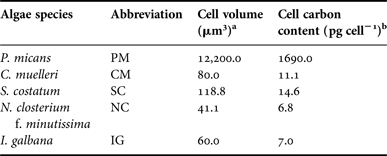
Five common microalgal species were selected for the experiment. They consisted of a dinoflagellate, Prorocentrum micans (Ehrenberg, 1833), three diatoms, Chaetoceros muelleri (Lemmermann, 1898), Skeletonema costatum [(Greville) Cleve, 1873] and Nitzschia closterium f. minutissima (Allen & Nelson, 1910), and a prymnesiod species, Isochrysis galbana (Parke, 1949). The cell volumes and carbon contents of these algae species are shown in Table 1. They were all sourced from the Centre of Marine Bacteria and Phytoplankton, Xiamen University and were cultured using f/2 medium with silicates added for the diatoms (Guillard & Ryther, Reference Guillard and Ryther1962). All cultures were kept at 25 ± 1°C and under a photoperiod of 12 h light:12 h dark with a light intensity of ~ 3000 lx.
Cell volumes and carbon contents of microalgae used for the experiment.

a The cell volume calculation was according to Sun (Reference Sun2004).
b The carbon contents of diatoms and the prymnesiod were calculated based on Strathmann's formula (Strathmann, Reference Strathmann1967) while for the dinoflagellate, the calculations were based on the formula by Menden-Deuer & Lessard (Reference Menden-Deuer and Lessard2000).
Copepod stock culture
The cyclopoid copepod, A. borneoensis, was collected from plankton tows in the coastal water of Xiamen (24°27.00′N 118°4.20′E), China, in April 2011. Upon arrival at the laboratory of Xiamen University, A. borneoensis was isolated from other zooplankton to start the stock culture. The A. borneoensis were fed the algae I. galbana daily and gradually scaled up. The cultures were maintained under a photoperiod of 12 h light:12 h dark with the light density of 3000 lx and temperature was controlled at 28 ± 1°C.
Naupliar and copepodite survival and development experiment
All five algal species, P. micans, S. costatum, C. muelleri, N. closterium f. minutissima and I. galbana, were fed to nauplii and copepodites of A. borneoensis at five concentrations of 0.07, 0.35, 1.70, 8.50 and 17.00 µg C ml−1, and there were three replicates for each treatment. All replicates were kept in a temperature controlled chamber set at 28 ± 1°C with a photoperiod of 12 h light:12 h dark. During the experiment, the culture concentrations of five algae were determined daily and diluted to designated concentrations using 0.45 µm filtered seawater. Only algal cultures at exponential growth phase were used. Throughout the culture, salinity was maintained at 20, pH 7.70–8.25 and dissolved oxygen 6–9 µg C ml−1.
Prior to the experiment, A. borneoensis stock culture were acclimated for 24 h to the experimental condition specified above and fed I. galbana. Following the acclimatization, 30 egg-carrying females were randomly picked from the stock culture and transferred to a Petri dish (diameter: 10 cm) containing 200 ml filtered seawater and with one of the five algae species added at one of five designated concentrations. Overall a total of 25 treatments with three replicates per treatment were set up.
After 24 h of culture, 100 healthy first stage nauplii (N1) produced by the females in each Petri dish were selected under a dissecting microscope, they were then transferred to a new Petri dish containing 500 ml of the same culture medium to continue culture for evaluating the effects of algal species and concentration on survival and development of nauplii and copepodites. Every day, 100% of the culture medium was exchanged with fresh medium. The survival and development of the naupliar and copepodite stages were monitored and recorded every 8 h for each replicate. The development time from N1 to the first copepodite stage (C1) and then from C1 to adult were estimated based on 50% of surviving individuals reached the respective stage for each replicate (Uye, Reference Uye, Boxshall and Schminke1988).
Fecundity experiment
The fecundity of A. borneoensis was estimated based on the number of nauplii produced by females daily under different food conditions. Upon reaching the adult stage, A. borneoensis in each treatment of the experiment outlined above were continuous cultured and monitored daily. Once an individual was found gravid, it was immediately picked up and transferred to a 170 ml bottle filled with 25 ml of the same culture medium to be cultured individually. For each treatment, 15 individually cultured gravid females were set up to serve as replicates.
During the experiment, the female in each 170 ml bottle was removed to a new bottle with new algae added at the same concentration for continuous culture while the number of nauplii produced in the old bottle was counted and recorded. This procedure was repeated for 12 consecutive days for each replicate.
Statistical analysis
Data are presented as the mean ± standard deviation (mean ± SD). All data collected were tested for normality and homogeneity of variance prior to mean comparison procedures and data expressed in percentages were arcsin-transformed prior to analysis. Survival, development and nauplii production data were analysed using one-way ANOVA. When significant differences (P < 0.05) were found, Tukey's multiple comparison test was performed to determine specific differences among treatments. All statistical analyses were conducted using the statistical software SPSS, Version 17.0 (SPSS Inc., Michigan Avenue, Chicago, IL, USA).
RESULTS
Effects of algal species
NAUPLIAR AND COPEPODITE SURVIVAL
The survival of the naupliar stage of A. borneoensis was significantly affected by algal species fed to them (Figure 1). Of the five algal concentrations tested, except the highest concentration of 17.00 µg C ml−1, under a same concentration as the other four algal concentrations, naupliar survival was significantly lower when fed the dinoflagellate P. micans than fed other four algae species (P < 0.05) while no significant difference was detected among the other four algae species (P > 0.05). At the highest concentration of 17.00 µg C ml−1, naupliar survival was significantly lower when fed P. micans, S. costatum and N. closterium f. minutissima than when fed C. muelleri and I. galbana (Figure 1).
Naupliar survival of A. borneoensis. Vertical bars indicate SD. Same lowercase letters indicate no significant difference between different algal treatments fed at the same concentration while same capital letters indicate no significant difference of the same algal species provided at different concentrations.

For the survival of the copepodites, when different algae were fed at lower concentrations of 0.07 and 0.35 µg C ml−1, the P. micans and S. costatum treatments were significantly lower than the N. closterium f. minutissima, C. muelleri and I. galbana treatments (P < 0.05). However the differences between all algal treatments became insignificant when algae were fed at higher concentrations of ≥8.50 µg C ml−1 (Figure 2).
Copepodite survival of A. borneoensis. Vertical bars indicate SD. Same lowercase letters indicate no significant difference between different algal treatments fed at the same concentration while same capital letters indicate no significant difference of the same algal species provided at different concentrations.

For the survival from N1 to adult, at lower concentrations of 0.07 and 0.35 µg C ml−1, the P. micans treatment recorded the lowest survival, which was significantly lower than all other algae treatments (P < 0.05) while the S. costatum treatment was the second lowest (Figure 3). The survival differences between different algae treatments generally showed a decreasing trend with increasing food concentration, particularly when concentration was ≥8.50 µg C ml−1 (Figure 3).
Survival from N1 to adults of A. borneoensis. Vertical bars indicate SD. Same lowercase letters indicate no significant difference between different algal treatments fed at the same concentration while same capital letters indicate no significant difference of the same algae species provided at different concentrations.

NAUPLIAR AND COPEPODITE DEVELOPMENT
The naupliar developmental duration (i.e. from N1 to C1) of A. borneoensis was significantly different when fed different algae at the same concentration (Figure 4). At each concentration tested, C. muelleri as the diet led to significantly shorter development duration than the other four algae species tested (P < 0.05). In contrast, feeding S. costatum resulted in the longest naupliar development at all concentrations tested, which were also significantly longer than other treatments (P < 0.05) (Figure 4).
Naupliar developmental time of A. borneoensis. Vertical bars indicate SD. Same lowercase letters indicate no significant difference between different algal treatments fed at the same concentration while same capital letters indicate no significant difference of the same algae species provided at different concentrations.

The copepodite developmental duration (C1 to adult) was also significantly affected by algae diets (Figure 5). At each food concentration tested, P. micans and C. muelleri always produced the two fastest development durations, which were significantly shorter than other algae treatments (P < 0.05). Among the three remaining algae treatments, feeding S. costatum and N. closterium f. minutissima generally led to longer copepodite developmental duration than that of the I. galbana treatments (Figure 5).
Copepodite developmental time of A. borneoensis. Vertical bars indicate SD. Same lowercase letters indicate no significant difference between different algal treatments fed at the same concentration while same capital letters indicate no significant difference of the same algae species provided at different concentrations.

For the cumulated development time from N1 to adult, at all concentrations tested, C. muelleri treatment always had the shortest developmental time while the longest time consistently came from the S. costatum treatment (Figure 6).
Overall developmental time from N1 to adult of A. borneoensis. Vertical bars indicate SD. Same lowercase letters indicate no significant difference between different algal treatments fed at the same concentration while same capital letters indicate no significant difference of the same algae species provided at different concentrations.

FECUNDITY
Fecundity of A. borneoensis, measured by daily nauplii production over 12 consecutive days, was significantly different among diet treatments and the results appeared to fluctuate substantially related to food concentration used (Figure 7). In general, in comparison to other treatments, the C. muelleri and I. galbana treatments had the highest numbers of nauplii produced when they were provided at higher concentrations of 1.70, 8.50 and 17.00 µg C ml−1, which in most cases showed significant differences. However, the situation reversed at the lowest food concentration tested at 0.07 µg C ml−1: these two algae produced significantly lower numbers of nauplii than the P. micans and S. costatum treatments (P < 0.05) (Figure 7).
Fecundity of A. borneoensis. Vertical bars indicate SD. Same lowercase letters indicate no significant difference between different algal treatments fed at the same concentration while same capital letters indicate no significant difference of the same algae species provided at different concentrations.

Largely in opposite to the trend found for C. muelleri and I. galbana treatment, the P. micans and S. costatum treatments generally produced the higher numbers of nauplii at low food concentrations of 0.07 and 0.35 µg C ml−1, but significantly lower numbers of nauplii than other treatments at higher food concentrations of 1.70, 8.50 and 17.00 µg C ml−1 (P < 0.05) (Figure 7).
Among five algal species, N. closterium f. minutissima consistently produced the lowest numbers of nauplii at all food concentrations tested except at the concentration of 1.70 µg C ml−1 (Figure 7).
Effects of algal concentration
NAUPLIAR AND COPEPODITE SURVIVAL
Naupliar survival was significantly affected by the food concentration for all five species of algae tested (P < 0.05) (Figure 1). For all five algae species, the survivorships of nauplii were significantly lower when they were provided with the lowest algal concentration of 0.07 µg C ml−1. Naupliar survival showed no further significant increase as food concentration increased beyond 0.35 µg C ml−1 for all algae species although for the dinoflagellate P. micans, no further significant increase was found when food concentration reached 1.70 µg C ml−1 (P > 0.05) (Figure 1).
At the copepodite stage, survival was not significantly affected by food concentration for the C. muelleri and I. galbana treatments (P > 0.05). For the remaining three algae treatments, the copepodite survival was generally significantly lower at lower food concentrations (P < 0.05); however as food concentration increased beyond 8.50 µg C ml−1, no further significant increase in survival was detected (Figure 2).
For the survival from N1 to adult, no significant difference for different food concentrations was detected for the C. muelleri treatment (Figure 3). For the remaining four algae species, survival was generally significantly lower at lower food concentrations; however no further significant increase in survival was detected when algal concentration increased beyond 8.50 µg C ml−1 (Figure 3).
NAUPLIAR AND COPEPODITE DEVELOPMENT
Algal concentration significantly affected duration of the naupliar stage in each of the five species tested (P < 0.05). There appear to be two general patterns of the relationship: (1) the increasing concentration from the lowest level of 0.07 µg C ml−1 led to significantly decreased naupliar duration as seen for the P. micans, C. muelleri and I. galbana treatments (P < 0.05); (2) the development time of nauplii initially decreased with the increasing algal concentration up to 8.50 µg C ml−1, however the trend reverted to significantly increase as concentration further increased to 17.00 µg C ml−1, which suggested that naupliar development was inhibited by such a very high food concentration. The late pattern was found in the S. costatum and N. closterium f. minutissima treatment (Figure 4).
The duration of copepodite stage was also found to be significantly affected by food concentration in all five species of algae tested (P < 0.05). Again, a general trend of faster development with increasing food concentration up to 8.50 µg C ml−1 was evident for all species. Of all other species except N. closterium f. minutissima, further increase in algal concentration to 17.0 µg C ml−1 had no significant effect on the copepodite development, however in the case of N. closterium f. minutissima, the increase of concentration to 17.00 µg C ml−1 led to the opposite effect of significantly inhibited copepodite development (Figure 5).
The cumulative developmental time from N1 to adults very much followed the same patterns found for naupliar development: that is, development was generally significantly enhanced with increased food concentration from 0.07 µg C ml−1 for all algae species. However, for S. costatum and N. closterium f. minutissima, as food concentration further increased to a high level of 17.00 µg C ml−1, inhibiting effects were shown, which were not found in other species (Figure 6).
FECUNDITY
Algal concentrations significantly affected female fecundity in all five algae species tested (Figure 7). With increasing food concentration from the lowest 0.07 µg C ml−1, the fecundity increased significantly for all species. However, in the case of P. micans and I. galbana, the fecundity stabilized at 0.35 and 1.70 µg C ml−1, respectively, with further increases in concentration not leading to significant changes in fecundity. On the other hand, for C. muelleri, S. costatum and N. closterium f. minutissima, the fecundity of A. borneoensis appeared to reverse the initially increasing trend and decreased significantly when food concentration increased, suggesting inhibiting effects of high food concentrations of these three algal species. It was found that for S. costatum, fecundity significantly decreased as concentration increased to 1.70 µg C ml−1 but stabilized thereafter. In the case of N. closterium f. minutissima, signficant decreases in fecundity were detected at 8.50 µg C ml−1 and again at 17.00 µg C ml−1. For C. muelleri, significantly decreased fecundity was detected only at the highest concentration of 17.00 µg C ml−1 (Figure 7).
DISCUSSION
The results of the present study show that the cyclopoid copepod A. borneoensis was able to complete both naupliar and copepodite development as well as successfully produce offspring when fed on any of the five microalgae species tested, which included a dinoflagellate, three diatoms and a prymnesiod species. It suggests that all of these common microalgae could be utilized by A. borneoensis as diets although important biological parameters, including survival, development, and fecundity showed significant differences when A. borneoensis was fed different algae species and at different food concentrations. Among the five species of microalgae, C. muelleri appeared to overall perform the best as the diet for A. borneoensis with I. galbana closely following. These two algae generally produced better survival, faster development and higher fecundity than other species, particularly when fed at optimal concentration of 8.50–17.00 µg C ml−1. The optimal food concentration of P. micans were also found to be 8.50–17.00 µg C ml−1 while for S. costatum and N. closterium f. minutissima, it was at a lower range of 1.70–8.50 µg C ml−1 as higher concentrations appeared to lead to longer development and decreased fecundity.
Although C. muelleri was found overall to be the best diet generating good survival, development and fecundity, inhibiting effects on the fecundity were detected when it was provided at a high concentration of 17.00 µg C ml−1. A possible explanation for this could be that excessive secretions, such as extracellular polymeric substances (Wang et al., Reference Wang, Huang and Cheng2003), by C. muelleri at such a high concentration might generate negative effects on fecundity of A. borneoensis.
Previous research had reported that cyclopoids rely on mechanoreceptors to detect their food, it was hence assumed that they might prefer motile algae species, such as dinoflagellates (Lee et al., Reference Lee, Park, Lee and Kang2006). However, our study showed that the non-mobile diatom C. muelleri as the diet for A. borneoensis generally produced better survival, faster development and higher fecundity than the dinoflagellate P. micans. Clearly, the underlying mechanisms for such an outcome warrant further study.
Several previous studies have also reported that when copepods fed on algae with fatty acid profiles characterized by low ω3/ω6 and 22:6ω3:/20:5ω3 ratio, egg hatching rates were generally low (Jónasdóttir & Kiørboe, Reference Jónasdóttir and Kiørboe1996; Müller-Navarra et al., Reference Müller-Navarra, Brett, Liston and Goldman2000; Shin et al., Reference Shin, Jang, Jang, Ju, Lee and Chang2003). The diatom Phaeodactylum tricornutum was not shown as a good diet for A. borneoensis, which is probably linked to its low ratio of ω3/ω6 and the absence of 22:6ω3 (Li et al., Reference Li, Sun, Li, Zhang and Tao2006a, Reference Li, Sun, Li, Zhang and Pub). Phaeodactylum tricornutum reportedly also shows an absence of 20:4ω3 and contains a relatively low level of 22:5ω3, which could further negatively affect reproduction of copepods (Rousch et al., Reference Rousch, Bingham and Sommerfeld2003).
Our study showed that both development and fecundity of A. borneoensis were inhibited when N. closterium f. minutissima was fed at high concentrations (≥8.50 µg C ml−1). It has been suggested that taxonomically N. closterium f. minutissima is very close to P. tricornutum (Shi et al., Reference Shi, Pan, Wang, Chen, Zhou, Zhu and Qing2008), hence while this needs confirmation, its negative effects on development and reproduction might similarly be attributed to fatty acid deficiencies as reported in P. tricornutum.
It was found that the diatom S. costatum fed at ≥1.70 µg C ml−1 negatively affected fecundity of A. borneoensis and high food concentration of S. costatum at 17.00 µg C ml−1 extended the naupliar duration by 16.8 h when compared with that of 8.50 µg C ml−1. Previous studies have shown that S. costatum as the diet produced severe negative effects on calanoid copepods. For example, Ianora et al. (Reference Ianora, Poulet and Miralto2003) reported that when S. costatum was fed to the calanoid copepod Calanus helgolandicus (Claus, 1863) at 105 cells ml−1 for 15 days, egg hatching rate dramatically decreased with eggs produced on day 9 hardly hatched. Dutz et al. (Reference Dutz, Koski and Jónasdóttir2008) also reported that for another calanoid copepod Temora longicornis (Müller O.F., 1785), feeding S. costatum at >0.5 µg C ml−1 not only led to a hatching rate decreased to less than 30% on day 4 and further down to 0 on day 9; egg production also significantly decreased. Reports have shown that when two unsaturated aldehydes extracted from S. costatum, i.e. 2-trans-4-trans-octadienal and 2-trans-4-trans-heptadienal, reached certain levels, they resulted in abortion, physiological defects, low viability and retarded development in the larval copepod Temora stylifera (Dana, 1849) (d'Ippolito et al., Reference d́Ippolito, Romano, Iadicicco, Miralto, Ianora, Cimino and Fontana2002; Ceballos & Ianora, Reference Ceballos and Ianora2003). Further studies should be conducted to confirm whether these aldehydes were the causes for prolonged naupliar development and decreased fecundity of A. borneoensis found for higher food concentrations treatments of S. costatum in this study.
Murray & Marcus (Reference Murray and Marcus2002) reported that when fed the dinoflagellate P. micans alone, survival and development of the calanoid copepod Centropages hamatus (Lilljeborg, 1853) were excellent, however no eggs was produced. It was suggested that this is probably due to a shortage of one or more essential nutrients for copepod reproduction in the dinoflagellate. However in the present study, feeding P. micans alone did not lead to cessation of reproduction in A. borneoensis. It is worth noting that nauplii survival of A. borneoensis fed P. micans was substantially lower than other algae species, particularly at low concentrations while the survival differences for copepodites survival was not as great. This may be explained by relatively large size and high mobility of P. micans, which made it difficult for nauplii to ingest. It was reported that copepods often selectively ingest algae of preferred sizes and it has been suggested that there may exist a positive correlation between optimal particle size of algae and the size of a copepod (Li et al., Reference Li, Sun, Li, Zhang and Tao2006a, Reference Li, Sun, Li, Zhang and Pub). Equivalent spherical diameter (ESD) of P. micans was ~ 30 µm, which is significantly larger than other algae used in this study. Hence the high ESD and mobility of P. micans probably limited its availability to nauplii of A. borneoensis, particularly at low concentrations, leading to low naupliar survival. When nauplii developed to copepodites, both their body size and foraging ability increased, thus the ingestion of P. micans should become more efficient.
In summary, the present study showed that the cyclopoid copepod, A. borneoensis, was able to complete its life cycle and successfully produce offspring when fed solely on any of the five microalgae species tested, which included a dinoflagellate, diatom and prymnesiod. Such results suggest that the diet spectrum of this cyclopoid species is relatively broad and the feeding habit of late life stages of the species is not necessary carnivorous, as was suggested for other cyclopoids. It was also clearly demonstrated that both quality and quantity of microalgae diets could significantly affect survival, development and fecundity of A. borneoensis although their relationships are complicated.
FINANCIAL SUPPORT
This work was supported by a grant (41276132) from National Natural Science Foundation of China (NSFC).