Implications
By-products obtained from grape juice and wine processing industry that are rich in polyphenolic compounds such as grape seed extract (GSE) can be efficiently utilized in chicken diets as a natural source of antioxidant and immunostimulant compounds. However, the optimum and maximum levels of GSE in broiler diets need to be assessed. This study demonstrated that GSE can be safely included at levels up to 2000 ppm and that the optimum inclusion level is 125 to 250 ppm.
Introduction
With the ongoing intensification of poultry industry, broiler chickens are exposed to several stressors including transportation, vaccination, nutrition/metabolism, disease, overcrowding and environmental stressors. These stressors increase the production of reactive oxygen species (ROS) and disturb the balance between oxidation and antioxidant defense systems inside the chicken’s body, in a condition known as oxidative stress. Excess ROS such as free radicals and non-radicals cause injury to the cellular components (lipid, protein and DNA), and subsequently adversely affect growth performance, decrease immune response, increase lipid peroxidation and lower meat quality (Surai, Reference Surai2002; Panda and Cherian, Reference Panda and Cherian2014). The adverse effect of oxidative stress can be minimized via supplementation of chickens with an adequate supply of antioxidants (Grashorn, Reference Grashorn2007).
Synthetic antioxidants such as BHT, butylated hydroxyanisole and ethoxyquin are commonly used in poultry diets to increase feed stability and meat/egg quality at levels ranging from 50 to 200 ppm (Bartov and Bornstein, Reference Bartov and Bornstein1981; Shahidi et al., Reference Shahidi, Rubin and Wood1987; Hayat et al., Reference Hayat, Cherian, Pasha, Khattak and Jabbar2010). However, their use is debated due to their carcinogenic nature (Thompson and Trush, Reference Thompson and Trush1988; Niki et al., Reference Niki, Yamamoto, Komuro and Sato1991). Vitamin E is also used as a conventional antioxidant in animal feed (Avanzo et al., Reference Avanzo, de Mendonca, Pugine and de Cerqueira Cesar2001), but there are some concerns regarding the use of vitamin E from synthetic sources and limited bioefficacy when high levels of polyunsaturated fatty acids are included in the diet (Allard et al., Reference Allard, Kurian, Aghdassi, Muggli and Royall1997).
In order to meet consumer’s demands, researchers have been looking for alternative natural and safe antioxidants to replace synthetic ones. Polyphenol-rich plant extracts have the potential to be good candidates for this purpose (Surai, Reference Surai2007; Brenes et al., Reference Brenes, Viveros, Chamorro and Arija2016). Grape seed (Vitis vinifera) extracts the by-product of wine and grape juice processing are known to contain polyphenols with high antioxidant capacity. The polyphenolic constituents found in grape seeds are mainly flavonoids, including gallic acid, the monomeric flavan-3-ols catechin, epicatechin, gallocatechin, epigallocatechin and epicatechin 3-O-gallate, and procyanidin dimers, trimers and more highly polymerized procyanidins. (Santos-Buelga and Scalbert, Reference Santos-Buelga and Scalbert2000; Shi et al., Reference Shi, Yu, Pohorly and Kakuda2003).
Most GSE in the market are extracted with organic solvents or hydroalcoholic mixtures (methanol/water, ethanol/water). The extraction solvent has an impact on the phytochemical profile of the resulting extract; a water-based extract should contain principally monomeric flavonoids, dimer and trimer procyanidins, whereas organic extraction solvents tend to extract higher molecular weight procyanidins (Khanal et al., Reference Khanal, Howard and Prior2009). The chemical structure of catechin and procyanidin found in GSE is presented in Supplementary Figures S1a and b.
Dietary GSE has been reported to have positive effects on the growth performance of broilers when included at low levels (Wang et al., Reference Wang, Suo, Gu, Zhang, Fang and Wang2008; Brenes et al., Reference Brenes, Viveros, Goni, Centeno, Saura-Calixto and Arija2010). In a recent review, Brenes et al. (Reference Brenes, Viveros, Chamorro and Arija2016) highlighted the benefits of grape by-products (including seeds) as a source of functional feed or additive in monogastric nutrition. Inclusion of polyphenol-rich, grape by-products in feed has been shown to inhibit lipid peroxidation in meat and have proved to be effective in modifying the intestinal microbiota. In addition, GSE has been found to lower plasma lipid components (El-Damrawy, Reference El-Damrawy2014), enhance antioxidant and immunostimulant status (Bagchi et al., Reference Bagchi, Bagchi, Stohs, Das, Ray, Kuszynski, Joshi and Pruess2000; Katiyar, Reference Katiyar2015), and increase the oxidative stability of chicken and turkey meats (Mitsumoto et al., Reference Mitsumoto, O’Grady, Kerry and Buckley2005; Mielnik et al., Reference Mielnik, Olsen, Vogt, Adeline and Skrede2006). In contrast, its inclusion at very high levels resulted in growth depression (Lau and king, Reference Lau and King2003; Hughes et al., Reference Hughes, Brooker and Smyl2005; Viveros et al., Reference Viveros, Chamorro, Pizarro, Arija, Centeno and Brenes2011).
This study was conducted to investigate the hypothesis that dietary GSE has the potential to improve the antioxidant status of broiler chickens, and subsequently the performance parameters and humoral immune response. In order to assess the antioxidant capacity of this feed supplement, the levels of glutathione-reduced in liver tissue and malondialdehyde in thigh muscle were measured. The serum lipid profile was also measured to investigate the general health status of the chickens. Dietary BHT was included in one treatment as a synthetic antioxidant to compare its effects with a diet supplemented with GSE.
Material and methods
Tested products
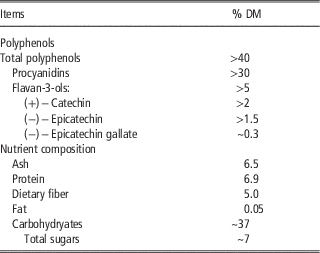
GSE was a spray dried red-brown powder obtained by extraction of grape seeds with water. The total polyphenol content was >40%, of which ~5% were monomeric flavan-3-ols and 30% procyanidins. The composition of the GSE used in this study is described in Table 1. This product was obtained from Plantextrakt GmbH & Co. KG (Vestenbergsgreuth, Germany). BHT (99% purity) was purchased from Multi Vita Animal Nutrition Company, 6th October City, Egypt.
Composition of the grape seed extract used in this study

DM=dry matter.
Experimental birds and management
This study was extended from 0 to 42 days of age. A total of 245 one-day old, unsexed broiler chicks (Ross 308 strain) were obtained from a commercial hatchery. On arrival, they were weighed, banded and randomly distributed into seven dietary treatments; each treatment included five replicate pens (seven chicks were housed in each pen). The average BW difference between pens was <1 g at the start of the trial. The pens were bedded with fresh wood shaving. Chicks were brooded at 33°C in the 1st week and the temperature was then reduced by 2°C every week until 22°C was reached. Lighting was continuous and the relative humidity was 60%. All birds were reared in an open-sided house and kept under similar management conditions. All experimental procedures were in compliance with the regulations of the Faculty of Veterinary Medicine, Zagazig University Institutional Animal Care and Use Committee.
The chicks were vaccinated against Newcastle disease virus (Hitchner B1 strain at day 7 via eye-drop, inactivated oil adjuvant clone 30 strain at day 15 via s.c. injection of 0.25 ml/chick, and LaSota strain at day 17 via eye-drop); Gumboro disease virus (D78 strain, at days 12 and 22 via drinking water); infectious bronchitis virus (H 120 strain at day 7 via eye-drop); avian influenza disease virus (reassortant inactivated H5N1 subtype, Re-1 strain) at day 9 via s.c. injection of 0.3 ml/chick).
Experimental diets
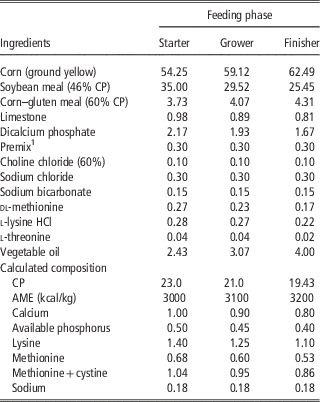
The diets were based on corn–soy–gluten, and were formulated to meet or exceed the nutrient requirements of broiler chickens as set by the National Research Council (NRC, 1994). The feeding programme was divided into three feeding phases: starter (0 to 21 days of age), grower (22 to 35 days of age) and finisher (36 to 42 days of age). The diets were isocaloric, isonitrogenous and provided in mash form. Feed and water were offered ad libitum. No synthetic antimicrobials were included in the experimental diets. There were seven dietary treatments as followings: treatment 1, basal diet (control); treatment 2, basal diet plus 125 ppm BHT; treatments 3, 4, 5, 6 and 7 were fed basal diets plus 125, 250, 500, 1000 and 2000 ppm of GSE, respectively. The dosage of BHT was chosen according to the recommendation of the producing company. The basal diets and their composition are represented in Table 2.
Ingredients and nutrient composition of experimental diets (% as fed)

AME=Apparent metabolizable energy.
1 Supplied the following per kg of diet: vitamin A (12 000 IU), Vitamin D3 (3000 IU), Vitamin E (10 mg), Vitamin K3 (1 mg), Vitamin B1 (1 mg), Vitamin B2 (5 mg), Vitamin B6 (1.5 mg), Pantothenic acid (10 mg), Vitamin B12 (0.01 mg), Niacin (30 mg), Folic acid (1 mg ), Biotin (0.05 mg), Zn (60 mg), Mn (60 mg), Fe (30 mg), Cu (4 mg), I (0.3 mg), Co (0.1 mg) and Se (0.1 mg).
Chemical analysis
Feed ingredients and diets were analyzed for proximate composition according to the standard procedures of the Association of Official Analytical Chemists (1990). The analyzed values of feed ingredients and diets were in agreement with the calculated values.
Measurements
Growth performance parameters
Individual bird weights and pen feed residues were measured at end of each feeding phase to calculate the average BW, average daily gain, average daily feed intake and feed conversion ratio (FCR; feed/gain). Percentage of livability was determined on a weekly basis.
Lipid profile of the blood serum
At the age of 42 days, eight birds were randomly selected from each treatment, and blood samples were collected from the wing veins of the selected birds into test tubes without anti-coagulant and kept in the refrigerator overnight. Serum samples were separated via centrifugation at 3000 r.p.m. for 15 min then stored at −20°C for further analysis. Serum samples were utilized for determination of the lipid profile using commercial kits as following: total lipid (Tietz, Reference Tietz1976), total cholesterol (Young, Reference Young2001), high-density lipoprotein cholesterol (Young, Reference Young2001) and triglycerides (Young et al., Reference Young, Pestaner and Gibberman1975). The low-density and very low-density lipoprotein cholesterols were determined by calculation (Friedewald et al., Reference Friedewald, Levy and Fredrickson1972).
Antioxidant status
At the end of the trial, eight birds per treatment were randomly selected and euthanized. Samples from the liver and right thigh muscle of the selected chickens were taken, washed in a solution of 0.9% NaCl, packed in plastic bags and stored at −20°C until further analysis. Liver homogenates were obtained by dilution of 1 g of liver sample with 9 ml of ice-cold phosphate buffered saline (pH=7.2), then homogenized, and centrifuged at 10 000 r.p.m. for 15 min. The clear supernatants were transferred into vials and used for the assays of glutathione-reduced using a commercial kit according to Beutler et al. (Reference Beutler, Duron and Kelly1963). The method principle is based on the reduction of 5,5 dithiobis (2-nitrobenzoic acid) with glutathione to produce a yellow compound. Absorbance was measured at 405 nm. Meat homogenization and supernatant preparation were processed in a similar manner to liver homogenization. The malondialdehyde level was measured according to the method described by Ohkawa et al. (Reference Ohkawa, Ohishi and Yagi1979) using commercial kit (Bio-Diagnostic kit, Giza, Egypt). A 100 μl aliquot of the meat homogenate was mixed with thiobarbituric acid reagent, incubated at 95°C for 30 min then centrifuged at 10 000 r.p.m. for 3 min. The clear pink supernatant (thiobarbituric acid reactive products) was measured at absorbance level of 534 nm.
Humoral immune response against Newcastle disease virus vaccines
Blood samples were collected from the wing veins of eight chickens per treatment at 21, 28 and 35 days of age. Serum samples were separated and stored at −20°C for further measurements. Newcastle antibody level in serum samples was investigated using an ELISA commercial kit (BioChek B. V., Reeuwijjk, Holland) according to the instructions provided by the manufacturer. Optical density values were recorded at 405 nm using an ELISA reader (Stat Fax 3200, FL, USA). The antibody titer of 1159 or greater following vaccination is considered protective.
Experimental design and statistical analysis
The experimental design was a randomized block design with five replicate pens per treatment. Pen was served as the experimental unit for performance parameters (average daily feed intake and FCR), and bird was served as the experimental unit for other measurements. Arcsin transformation was conducted to calculate percent livability. One-way ANOVA was conducted to determine the effect of the different treatments. Mean testing (LSD) was conducted to determine if significant differences exist among treatments at P<0.05. Contrast testing (control v. BHT; control v. GSE; BHT v. GSE) and polynomial contrasts (linear and quadratic for GSE levels) were also analyzed using Statistix 9 (Analytical Software, 2008).
Results
Growth performance
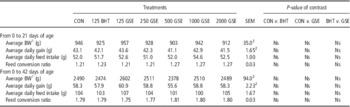
Supplementation of broiler chicken diets with GSE or BHT did not result in significant differences in the measured growth performance parameters during different phases (P>0.05). The best numerical values for the overall performance were observed in broilers fed on diets containing 125 and 250 ppm GSE (Table 3). No significant difference (P>0.05) was observed among treatments in the livability percentage (data not presented).
Effect of dietary grape seed extract (GSE) on the performance of broiler chickens at 21 and 42 days of age

CON=control; BHT=butylated hydroxytoluene; Ns=no significant effect (P>0.05).
Linear and quadratic response because of the level of GSE in the diet was not significant (P>0.05; data not presented).
1 The average initial BW of day old chicks was 40.5±1.65 g.
2 Each value represent the mean of 35 bird.
Serum lipid profile
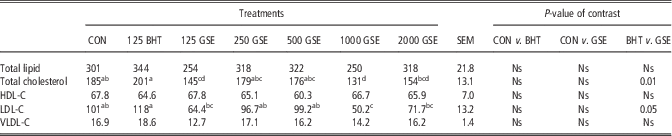
The total lipid, high-density lipoprotein cholesterol and very low-density lipoprotein cholesterol levels were not significantly different (P>0.05) among treatments. Dietary inclusion of GSE resulted in significant decreases in the total cholesterol (P<0.01) and low-density lipoprotein cholesterol (P<0.05) levels by up to 35% and 57%, respectively, compared with inclusion of BHT. Inclusion of GSE did not result in significant differences (P>0.05) in the level of total cholesterol and low-density lipoprotein cholesterol compared with the control. The best values were observed in broilers fed on diets containing 125 and 1000 ppm GSE (Table 4).
Effect of dietary grape seed extract (GSE) on the serum lipid profile of broiler chickens at 42 days of age (mg/dl)

CON=control; BHT=butylated hydroxytoluene; HDL-C=high-density lipoprotein cholesterol; LDL-C=low-density lipoprotein cholesterol; VLDL-C=very low-density lipoprotein cholesterol; Ns=no significant effect (P>0.05).
a,b,c,dMeans in a row with different superscripts differ significantly (P<0.05).
Linear and quadratic response because of the level of GSE in the diet was not significant (P>0.05; data not presented).
Antioxidant status
Supplementation of broiler chicken diet with GSE resulted in a significant (P<0.01) increase in the glutathione-reduced level by up to 60% compared with the control. The level of glutathione-reduced in broilers fed on BHT supplemented diet was not significantly (P>0.05) different from those fed on the GSE or control diets. The highest values were reported in broilers fed on diets containing 125, 250 and 500 ppm GSE. Dietary GSE and BHT supplementation resulted in a significant (P<0.01) decrease in lipid peroxidation marker (malondialdehyde) in the broiler’s meat tissue by levels up to 36.7% and 37.3%, respectively, compared with the control. No significant difference (P>0.05) was observed in the malondialdehyde level between broilers fed on diets supplemented by BHT or GSE. The best results were observed in broilers fed on diets containing 125 ppm BHT followed by those fed on diets containing GSE (Table 5).
Effect of dietary grape seed extract (GSE) on the liver glutathione-reduced and meat malondialdehyde of broiler chickens at 42 days of age

CON=control; BHT=butylated hydroxytoluene; Ns=no significant effect (P>0.05).
a,b,cMeans in a row with different superscripts differ significantly (P<0.05).
Linear and quadratic response because of the level of GSE in the diet was not significant (P>0.05; data not presented).
Humoral immune response
Dietary intake of GSE resulted in significant increases in the specific antibody titer against Newcastle disease virus vaccines by levels up to 57% (at 28 days of age; P<0.01) and 76% (at 35 days of age; P<0.05) compared with the control. Similarly, dietary inclusion of BHT resulted in significant (P<0.05) increases in the antibody levels by 35% and 50% at 28 and 35 days of age, respectively, compared with the control. No significant (P>0.05) differences were observed in the antibody titer among treatments at 21 days of age, and also between BHT and GSE supplemented groups. A quadratic effect was observed for increasing dietary GSE level at 28 and 35 days of age (P<0.01). The best results were reported in broilers fed on diets supplemented by GSE at levels ranging from 125 to 500 ppm (Table 6).
Effect of dietary grape seed extract (GSE) on the antibody titer against Newcastle disease virus vaccine in broiler chicken at 21, 28 and 35 days of age (titer range)

CON=control; BHT=butylated hydroxytoluene; Ns=no significant effect (P>0.05)..
The basal average antibody titer against Newcastle disease virus vaccine of day-old chicks was 2665±175
a,b,cMeans in a row with different superscripts differ significantly (P<0.05).
Linear response because of the level of GSE in the diet was not significant (P>0.05; data not presented).
Quadratic response because of the level of GSE in the diet was highly significant at 28 and 35 days of age (P<0.01; data not presented).
Discussion
Although not many studies have been carried out with grape seed and broilers, some positive results have been observed in the growth performance (Wang et al., Reference Wang, Suo, Gu, Zhang, Fang and Wang2008 utilizing 5 to 80 ppm of GSE). Nevertheless, high dosages may be detrimental to the growth performance (Hughes et al., Reference Hughes, Brooker and Smyl2005/30 000 ppm; Viveros et al., Reference Viveros, Chamorro, Pizarro, Arija, Centeno and Brenes2011/7200 ppm; Chamorro et al., Reference Chamorro, Viveros, Centeno, Romero, Arija and Brenes2013/5000 ppm). Other studies did not observe significant effect (Hughes et al., Reference Hughes, Brooker and Smyl2005/2000 to 10 000 ppm; Brenes et al., Reference Brenes, Viveros, Goni, Centeno, Saura-Calixto and Arija2010/600 to 3200 ppm; Chamorro et al., Reference Chamorro, Viveros, Centeno, Romero, Arija and Brenes2013/25 to 2500 ppm).
The variation in response to inclusion of GSE in different trials could be attributed to the difference in concentration and profile of polyphenols and proanthocyanidins in the tested products. High level of polyphenols could interact with proteins (of either dietary or endogenous origin including digestive enzymes) and form tannin–protein complexes that decrease efficiency of nutrient utilization and depress growth performance (Jansman et al., Reference Jansman, Frohlich and Marquardt1994; Brenes et al., Reference Brenes, Viveros, Goni, Centeno, Sayago-Ayerdi, Arija and Saura-Calixto2008).
The GSE used in this study was obtained through a water-extraction process without the use of additives and contained >40% total polyphenols, of which ~5% were monomeric flavan-3-ols and 30% were procyanidins (Table 1). The extraction solvent has an impact on the phytochemical profile of the resulting extract; a water-based extract should contain principally monomeric flavonoids, dimer and trimer procyanidins, whereas organic extraction solvents will also tend to extract higher molecular weight procyanidins (Khanal et al., Reference Khanal, Howard and Prior2009). Highly polymerized procyanidins are thought to be less bioavailable than their monomeric constituents (Tsang et al., Reference Tsang, Auger, Mullen, Bornet, Rouanet, Crozier and Teissedre2005). Hence, the extraction solvent and the resulting phytochemical composition of the GSE may play a significant role in the biological activity of the extract. The concentration of polyphenols in the current study at the highest level of GSE (2000 ppm) is considered low to produce such growth depression.
The overall percentage livability in this study was very high (98%), with no significant difference among treatments. This could be attributed to the good hygienic conditions in which chickens were reared and the quality of the feed provided. Broilers in this study were fed on the ideal corn–soy–gluten diet which is considered an easily digested diet.
The levels of total cholesterol and low-density lipoprotein were decreased by inclusion of GSE. Similarly, El-Damrawy (Reference El-Damrawy2014) reported a significant decrease in the serum level of low-density lipoprotein due to supplementation of heat-stressed broilers by GSE at levels of 100 and 200 ppm. Condensed tannins and polyphenols have the ability to bind cholesterol and increase their excretion in the excreta (Roy and Schneeman, Reference Roy and Schneeman1981). Chamorro et al. (Reference Chamorro, Viveros, Centeno, Romero, Arija and Brenes2013) did not observe significant differences in the serum triglyceride and cholesterol levels of 3 weeks old broilers due to inclusion of GSE (29.6% extractable polyphenols) at levels ranged from 25 to 5000 ppm. The 3 weeks feeding period applied in the later study may not be long enough for GSE to exert effects on the measured lipid parameters. Similarly, the level of blood cholesterol at 21 days of age is physiologically low when compared with that of 42-day-old chicks (Jin et al., Reference Jin, Ho, Abdullah and Jalaludin1998). In a different study, Vossen et al. (Reference Vossen, Ntawubizi, Raes, Smet, Huyghebaert, Arnouts and De Smet2011) observed that the oxidative status and lipid oxidation of plasma in broilers was not affected by feeding natural antioxidant extracts at doses of 100 and 200 ppm, although some changes in antioxidant enzyme activities (e.g. GSH-Px) were observed.
Supplementation of broiler chicken diets with GSE resulted in a significant increase in the level of glutathione-reduced (the important cellular antioxidant) in liver tissue, which is considered as an indicator of the antioxidant status of birds (Wang et al., Reference Wang, Yang, Wang, Cui, Cai, Li and Wu2010). The antioxidant potential of grape seed polyphenols has been reported to be 20 and 50 times greater than vitamins E and C, respectively (Shi et al., Reference Shi, Yu, Pohorly and Kakuda2003). The obtained results are in agreement with Lopez-Oliva et al. (Reference Lopez-Oliva, Agis-Torres, Goni and Munoz-Martınez2010) who reported a significant increase in the glutathione content of liver and colonic mucosa of rats due to consumption of GSE and grape pomace. Likewise, El-Damrawy (Reference El-Damrawy2014) reported a significant increase in liver glutathione-reduced and a decrease in liver malondialdehyde levels due to supplementation of heat-stressed broilers with 100 or 200 ppm GSE. Similarly, Wang et al. (Reference Wang, Suo, Gu, Zhang, Fang and Wang2008) reported a significant decrease in the plasma malondialdehyde of broiler chicks supplemented by GSE at a level of 12 ppm.
Dietary GSE can delay the lipid peroxidation of thigh meat as indicated by decreased malondialdehyde level in muscle tissue. Brenes et al. (Reference Brenes, Viveros, Goni, Centeno, Saura-Calixto and Arija2010) revealed that polyphenols present in GSE can be absorbed at sufficient levels to enhance the antioxidant status in chicken tissue. Mielnik et al. (Reference Mielnik, Olsen, Vogt, Adeline and Skrede2006) reported a significant decrease in the malondialdehyde level of ground turkey meat after supplementation of the meat before processing by GSE at concentrations ranging from 400 to 1600 ppm. Similar in vitro studies showed the ability of GSE polyphenols to decrease lipid peroxidation in chicken meat (Lau and King, Reference Lau and King2003; Mitsumoto et al., Reference Mitsumoto, O’Grady, Kerry and Buckley2005). Broilers fed on a diet supplemented by BHT also showed a significant decrease in the MDA (malondialdehyde) level. Previous research studies revealed a beneficial effect for BHT alone or in combination with other synthetic antioxidants in enhancing meat quality (Webb et al., Reference Webb, Brunson and Yates1972; Bartov and Bornstein, Reference Bartov and Bornstein1977; Lin et al., Reference Lin, Asghar, Gray, Buckley, Booren, Crackel and Flegal1989).
Supplementation of broiler chicken diets with GSE resulted in a significant increase in the antibody titer against Newcastle disease virus vaccine. Up to the authors’ knowledge, no studies have been published regarding the ability of GSE to enhance the humoral immune response of broiler chickens. The immunostimulatory function of GSE is mainly attributed to its antioxidant and free radical scavenging properties that could increase the integrity and proliferation of B-lymphocytes and its differentiation into antibodies producing plasma cells (Hamilos et al., Reference Hamilos, Zelarney and Mascali1989). Dietary BHT also increased the antibody titers against Newcastle disease virus vaccine. The later finding disagrees with Brugh (Reference Brugh1977), who indicated that BHT prevented the immunological response in chickens exposed to non-virulent Newcastle disease virus. The author attributed the finding to the ability of BHT to dissolve the lipid envelopes of the virus.
In conclusion, GSE can be used as a feed supplement in broiler chickens from 0 to 42 days of age to enhance their antioxidant status, immune response and meat quality. In addition, dietary GSE can replace synthetic antioxidants (e.g. BHT), and be utilized to increase vaccination effectiveness. Levels ranging from 125 to 250 ppm can be considered as the optimum inclusion levels for the GSE used in this study. Future studies may be recommended to investigate the possibility of GSE inclusion as a supplement in the drinking water during periods of stress and vaccinations, and the acceptance rate of broiler chickens to consume GSE supplemented water.
Acknowledgments
The authors gratefully acknowledge Plantextrakt GmbH & Co. KG, Germany for their support.
Supplementary material
To view supplementary material for this article, please visit https://doi.org/10.1017/S1751731116002251