Introduction
Advertising sells many things at the same time to different kinds of consumers, and its manifold levels of significance are widely touted by marketing executives. Less widely acknowledged, however, is that a brand campaign does not simply sell a product to a targeted consumer, but it also sells the idea of advertising itself to potential clients. Hence, a well-designed advertisement that resonates deeply in public culture generates business for the ad agency, irrespective of the revenue generated for their client in resulting sales. This ideology was reinforced by Rajeev Raja, Executive Creative Director at Bates India in Mumbai, as he admired a Coca Cola ad campaign Thanda Matlab Coca Cola (2004),Footnote 1 which had generated ripples in Bombay advertising and had become an example to follow for many of his colleagues:
Thanda matlab Coca Cola has changed the fortunes of [that] agency, and the fortunes of the creative director, who has overnight become a star. And he's the most high-flying creative director overnight because of one campaign. And that agency has completely turned around and suddenly become a big player. The agency starts getting called for pitches. It's happened to us in a way, in a small way. Some work that we've done for Tata-AIG, just one commercial which everyone has loved. Suddenly we start getting calls for pitches. (Interview, 17 January 2005)
Raja refers here to a project for the life insurance company Tata-AIGFootnote 2 that he had supervised the previous year. As creative director, Raja was responsible for developing the overarching message of the advertisement, managing the creative team of Abhinay Deo (director) and Ram Sampat (composer), and selecting the most effective aural and visual possibilities that emerged in the production process. While there is little doubt that authorship in the culture industries is dispersed among many actors, as the executive creative director Raja had primary responsibility for the result. Just before exhibiting the advertisement to me on his office computer, Raja summarised the advertising narrative:
The execution idea is a little boy on his side of the fence, looking up at a little girl in a balcony. He looks at her, she smiles, their eyes meet, and by little, I mean four years old. And suddenly there is a shadow, and her father is standing there. And he looks at this little boy and says, ‘piss off’. And the little boy turns around and goes away. Time lapse.Footnote 3
You see the little boy is five years older. No no, sorry, he just goes away and comes back and he plants a little sapling. So the father again comes out, sees the boy, looks at him planting a sapling and says, ‘good boy, environmental conscious and all that. Nice chap.’ The fellow [boy] gives him [father] an angelic smile. Time lapse.
The boy is five years older, the sapling is five years older. The boy's watering the sapling again. The father's five years older. He comes out, looks at the boy, ‘Good, tending your plant. Very good.’ Time lapse, the boy's fifteen years old now. The sapling is almost a tree. He's still watering. The father comes out, ‘Ok, good boy’. Time lapse.
The boy is eighteen, nineteen. It's a full-grown tree now. The father comes out and says, ‘yeah, fantastic.’ Soon as the father drives away, the guy drops his hose pipe [garden hose], climbs up the tree [Raja laughs], into the girl's balcony. The branches have gone to the girl's balcony, and they hug. And the voiceover is, ‘life inspires us to think ahead, which is why our insurance solutions are also one step ahead. Tata-AIG Life, a new look at life.’ (Interview, 17 January 2005)
Summarised in slightly different terms, the 60-second narrative of Tata-AIG's television advertisement Tree of Love (2004) follows a formula familiar to fans of conventional Hindi cinema. Utilising distinct musical and visual signs that mark four consecutive historical periods (1960s to present), a boy falls in love with the girl next door, is thwarted by the girl's father, then pulls off a zany scheme that involves planting and watering a tree that straddles the fence between their houses. The growth of the tree enables him to climb over to the girl's balcony after many years of labour. In terms of ‘dominant or preferred meanings’ (Hall Reference Hall, Marris and Thornham2000), the commercial is intended to suggest that investment in an insurance annuity programme will allow an individual to achieve his long-term goals with minimal sacrifice through natural principles of organic growth. More specifically, the Tata-AIG multinational partnership would be the best place to turn to in order to ensure an affluent future.
The charm of the advertisement carries the message quite well: the boy is looking ahead, thwarting adversity and always one step ahead of the girl's father. Through diligence one can achieve the object of one's desire. But every multimedia text is polysemic and interacts with a variety of experiences of the world, even as it inserts new interpretations that will later be reframed by future authors. As Goodwin (Reference Goodwin1992) rightly noted, a successful advertisement encourages the viewer to watch multiple times in order to catch minor details, facilitating diverse experiences of the same text within and between individuals. The Tree of Love is a particularly rich object of analysis as the formal and representative devices used by the producers implicate a predominantly nostalgic approach to cultural history and the Indian middle class. Hence, the advertising message carries a political payload, insofar as one subtext of the narrative reinforces a neoliberal ideal that runs counter to the developmentalist narratives of the time periods the advertisement is depicting.
In reframing the past into the context of the present, the advertisement turns the tables on Gandhian austerity ideologies represented in films, newspapers and other media of the time that Tree of Love purports to represent. Thus, as it (literally) goes without saying, in overcoming the adversity represented by the father, the boy is also overcoming the protectionist economic policies of the State to achieve personal wealth. Through the mobilisation of the recognisable visual and aural signs of affluence of different eras, the production values of the advertisement (such as simulated scratches in the film and changes in colour balance) and, most poignantly, shifts in the musical style and extra-musical ‘noise’ in each of its sections that allude to different periods of Indian popular music, this advertisement invokes cultural memory, fashioning the Indian past into the terms of the neoliberal present in order to consume the fruits of an imagined future. Like other nostalgic media texts, Tree of Love sanitises recent Indian history in order to paint a picture of fulfilled aspirations through a particular type of symbolic consumption.
This paper explores the ways in which popular music is mobilised to sell products through advertising, focusing on the production of musical meaning, and the ways that this meaning is constituted through the mobilisation of visual, cultural and historical devices within the context of a very short advertising narrative. As Cook (Reference Cook1994) has noted, a commercial has relatively little time to produce a meaningful narrative, and thus its music does not fit typical formal conventions. In a similar vein, Tagg (Reference Tagg1982, Reference Tagg1987) has argued that any attempt to theorise the significance of music must account for diverse social-historical contexts through which these meanings emerge. Consequently, this paper briefly examines the political-economic context in which Tree of Love was conceived, as well as the social uneasiness about private insurance that its producers hoped to reconcile. In a close multimedia analysis supported by Peircean semiotics, this article argues that the audio and visual components work in tandem with cultural memory and, as such, are complimentary partners in the constitution of meaning. This partnership is particularly notable in the use of aural and visual signs to mark the passage of time, and the ‘progress’ of both the individual and the nation, reframing developmentalist ideological perspectives of earlier media narratives into contemporary terms. Not only is this an advertisement for insurance, it also promotes a neoliberal conception of India in which new conceptions of middle-class wealth, not State intervention, are critical for the development of the nation.
Insurance advertising in India
This advertisement emerges from a complicated political–economic context. From the protectionist policies pursued by the central government after gaining independence in 1947, India has gradually liberalised its economy since the early 1980s, reducing import tariffs, privatising many state-owned industries, and allowing for greater foreign investment in Indian business. Yet the privatisation of the insurance industry has moved at a much slower pace than have other segments of the Indian economy. Insurance, in fact, has been one of the last areas opened for foreign direct investment, and multinational insurance companies that invest in India are still required to have an Indian partner that owns a majority share in the business.
While the number of multinational insurance and finance companies in India has increased substantially, especially after the reforms of the 1990s which liberalised these investment rules, the state-owned Life Insurance Corporation of India (LIC) still maintains a 75 per cent share of the overall business in the life assurance market. It has retained its dominance primarily because consumers believe that a public sector company is less likely to shirk its responsibility to its customers. Insofar as private insurance companies have had to contend with the perception of greater accountability of certain state-run companies, a potential customer needs to be convinced not only of the legitimacy of the company, but that a multinational corporation will not simply abscond with his or her hard-earned cash if the company generates insufficient profit. Indeed, as Raja himself noted in an interview with an online advertising trade magazine,
The existing paradigm was to convey the solidity and long-term stability of the insurance company. This was because the biggest concern for consumers was what if the insurer cannot pay back my money, either at the time of maturity or at the time of death. The life insurance consumer is unwilling to take even an element of risk, and in the case of insurance, the money is usually the consumer's lifelong savings. So the focus of all private insurance players was to establish the heritage and pedigree of the respective brands, and reassure consumers that their money is safe. (Rajeev Raja, quoted in http://www.afaqs.com/news/story.html?sid=9191)
Raja's statement here highlights the inherent risk to the potential customers. How does a company convince someone to invest in their future by making sacrifices in the present, especially if these plans only mature after 15 years of steady, fixed payments? Indeed, this statement suggests that selling an investment package is a thornier proposition than selling something tangible, insofar as life insurance lacks the display value of a new car or television. And the inherent riskiness of insurance is compounded by the perceived instability of private corporations.
Not surprisingly given this cultural history, advertising in the insurance sector has emphasised a dominant message of ‘trust’, especially when many schemes abound that are different incarnations of fraud. The first brand campaign that introduced Tata's 2001 joint venture with the then unknown, but now infamous American International Group (AIG), highlighted this issue of trust through the corporate slogan ‘With you always’. However, once they felt that their brand image had been established, the company changed their strategy in summer 2004, introducing a new brand campaign of print and television advertisements that emphasised innovation, accompanied by the slogan: ‘A New Look at Life’. Tree of Love was the first television commercial in this series. This shift in branding signalled a point at which Tata-AIG executives believed that reassuring the consumer had become less of an issue. Thus, even as the tagline ‘A New Look at Life’ positions Tata-AIG within the insurance marketplace, it also suggests that consumers reconsider their attitudes towards private insurance companies vis à vis the state-run LIC and, perhaps, the riskiness of private vs. public enterprises more generally.Footnote 4
On a different level, the tagline exhorts consumers to examine their own lives, be one step ahead of adversity and anticipate their own future needs. In other words, even as it nostalgically remixes past cultural history, situating it in contemporary terms, the advertisement sells an affluent future. More specifically, it is selling an imagined affluent future (Anderson Reference Anderson1991; Appadurai Reference Appadurai1996), even as it sells an imagined past (Boym Reference Boym2001). Not only is this an imagined future of the aspiring middle-class family, but of the future progress of the neoliberal state. In a series of stages that mimic the growth of the Tree, the resulting branches enable the individual to surpass imposed barriers through the natural laws of capitalism. It is in this cultural context that the Tree of Love melds a conception of household economy with archetypes of Indian popular music, cinema, and commodity consumption through signs that are recognisable to many kinds of audiences.
Musical meaning in multimedia
If the hermeneutic possibilities of a single image are potentially infinite, what are the analytic implications of adding moving images and a soundtrack? In other words, how might we theorise the role(s) of music in multimedia and the sorts of meanings that music elicits? The theoretical canon for this type of analysis resides in cinema studies, but unfortunately such analyses tend to give only the barest nod to the importance of sound/music in the constitution of multimedia. Film scholars have a strong tendency to privilege analysis of the visual component of media, often barely mentioning the music/sound in the background, reinforcing Gorbman's (1987) argument that the soundtrack is largely ‘unheard’ by scholars, if not by audiences. Yet there is a small but growing body of literature on music in media, drawing especially from film music and sound studies (e.g. Gorbman Reference Gorbman1987; Flinn Reference Flinn1992; Chion Reference Chion1994) that provides many great insights into the ways in which soundtracks covertly aid the production of meaning in multimedia contexts. Cook (Reference Cook1994) has pointed out, for example, that there are manifold meanings that might emerge in the nexus of music and image. Moreover, the role of music is frequently naturalised by both producers and audiences. To develop this insight, even as there are patterns of meaning that audiences both bring and take with them (Tagg and Clarida Reference Tagg and Clarida2003), we should also acknowledge the potential contingency of meaning. Indeed, individuals who are physically present when the advertisement is being broadcast may be more or less engaged with different sensory modalities each time they see it, may change the channel, press the mute button, etc. Moreover, the advertisement itself is both a product of-and a response to-the field of advertising as a whole (Huron Reference Huron1989), with meanings constantly shifting in the mediascape in ways that media producers and audiences may not be completely aware of. Hence, as with any cultural text, the interpretations of the advertisement can be as diverse as the histories and experiences of the audiences that encounter it. This plenitude of interpretive possibilities must be accounted for by any multimedia analysis.
One way to address this hermeneutic problem of music, meaning and media is with recourse to the theory of sign relations developed by C.S. Peirce (Reference Peirce1916). Although Peircean theory is undeniably difficult to gloss without distorting or over-simplifying, semiotic analysis is a particularly helpful framework for understanding the ways individuals perceive and generate meaning from non-denotational sources, without necessarily being mediated by language.Footnote 5 In other words, a semiotic framework enables an analyst to begin to address the ways in which music, colour, noise, style or genre can be significant for audiences, without reifying these meanings or resorting to linguistic analogies. The Peircean theory of signs rests upon the notion that the mind utilises and manipulates signs in the process of cognition. As a unit of cognition, he defines the sign as ‘something which stands to somebody for something in some respect or capacity’ (Peirce 1916, p. 2.228). Thus, a sign can be most anything, at any level of perception, from a quality of sound, a passage of music, a song or a musical style, to even the category ‘music’ itself. Moreover, the object represented by the sign can be ‘internal’ (i.e. residing in the mind in the form of memories, beliefs, etc.), or ‘external’ (i.e. existing outside the mind). Thus, because cognition operates through the use of internal and external signs, no sign exists in isolation: signs necessarily co-occur with other signs.
From the perspective of interpretation or experience, it is important to acknowledge that not all potential signs are recognised as signs. In the process of cognition, a potential sign may slip by without being recognised as a sign by one individual, while another individual recognises it as a sign based upon his or her (inter)subjective experience, knowledge or memory. In other words, something that is beyond the experience of the individual and not recognised as a sign by the individual is not a sign. The relative contingency of sign systems operating as a cognitive process provides us with a solution to the hermeneutic problem of multimedia. Insofar as signs such as music or hair style have no denotational content, it would be inaccurate to suggest that a sound or style ‘references’ a particular historical period. On the other hand, suggesting that a musical period is indexed by a sound or style acknowledges the contingency of meaning, suggesting that this association may not occur for all listeners, or may occur with more or less specificity.
In order to retain maximal clarity with theoretical rigour, the analysis below utilises only a portion of Peirce's specialised language: the hierarchical differentiation of signs into icons, indexes and symbols. In Peircean terms, icons are signs based upon a quality or resemblance (‘the sound of the musical passage is iconic of the wind through the trees’). Indexes are signs based upon contiguity, co-occurrence or causality (‘bellbottoms index 1970s fashion’). Symbols are signs based solely on social convention or law (‘the word gato in Spanish designates the same creature as cat in English’). In making these analytic distinctions, this paper demonstrates the ways in which visual and aural signs work together in the process of signification. As such, I argue here that musical meaning is constituted through the interaction signs of all sorts, inside and outside the individual – inside and outside the advertisement itself.
Visual narrative of the Tree of Love
Abhinay Deo, the director of the advertisement, produced the visual narrative with alternating shots between the boy's house and of the father's house, which enables the viewer to measure the boy's actions with the growth of the tree, and the father's (positive) reaction to the boy's action (Table 1). This approach is sustained by four camera angles to enable and encourage this measurement:
• Camera Angle A – the boy from the father's perspective
• Camera Angle B – the father from the boy's perspective
• Camera Angle C – both houses, the wall separating them, marking the tree's progress
• Camera Angle D – the balcony and the girl
Shot-by-shot analysis of Tree of Love, including timing, shot number, camera angle and description.

The advertisement can be subdivided into four distinct sections, each with different representations of filmic eras, different hair and clothing styles, and different periods of music. As a complete package, each section represents a period of Indian history, starting from roughly the early 1970s to the present. But the clip also represents the aging of both the father, the ‘haves’, and the boy next door, the ‘less haves’.Footnote 6 Another sign of progress is the boy's coming of age and ability to acquire the object of his desire (the daughter) through long-range planning, diligence/hard work (watering the tree), and a certain amount of cunning (his disingenuous smiles directed at the father). Thus, the narrative structure of the advertisement follows a pattern that would be recognisable to any fan of Hindi films: low-class boy meets high-class girl, they fall in love, boy has to overcome familial opposition to their union, boy gets girl. For the purposes of the advertiser, the emphasis of the clip is on the diligence and long-term planning of the boy, which enables him to accomplish his goal. This is one of the most important tropes of capitalism: hard work allows individuals to overcome social or material resistance to the acquisition of the object of their desire. This was a common theme in investment-related advertisements that I saw in India while conducting fieldwork in 2003–2005.
Marking time, marking progress
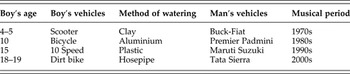
The analyst could focus on any number of signs of the passage of time and progress in this advertisement (Table 2). For example, ivy creeps up the sides of both houses, a floral growth that parallels the tree's growth, although it is not the focus of the narrative. Or, one might examine the aging of the father and the gradual loss of hair and the weight gain that he experiences through each of these periods. Both are natural processes that could suggest an increasing maturity/dignity in and through the passage of time. However, I would suggest that these are supporting semiotic characters in that they show the passage of time without giving us any way of measuring how much time has lapsed. Nor do they index particular periods of Indian history. Hair and clothing fashions are other elements that help to pinpoint the historical periods, but these are notoriously cyclical. Still, both are objects of consumption that are useful to mark time, if not progress.
Representation of progress. Boy's age as suggested by Raja (2005).

The most direct indication of the passage of time is the size of the tree, but measuring the age of a tree might be difficult for the casual viewer. More familiar, however, is the boy's relative age in different segments of the clip (see Figure 1). These approximate ages are probably the best indication of how much time elapses between each section of the advertisement, although they do not necessarily provide us with much information on where we are historically. Indeed, in Raja's earlier summary, the boy's age is the way that he marks the time. For the sake of expediency, we will privilege Raja's accounting of the boy's age, but point out a certain indeterminacy here that is contiguous with a semiotic analysis of the clip: whether the boy is four or five, 18 or 19 is immaterial. The cultural-historical associations made by viewers of the advertisement based upon their personal and interpersonal experience are more important to communicate the boy's age. The toys scattered in the boy's yard in the background of the frames also help us to pinpoint his age. Perhaps most significant of these toys are his methods of conveyance, which parallel the man's car (see Table 2). These vehicles might be considered ‘age appropriate’ markers for each of the age grades that the boy achieves. Even as these vehicles increase in monetary value, they also increase in the speed and distance that they will enable the operator to drive. And, one might add, they also require an increasingly developed road infrastructure for operation.Footnote 7
Age progression: shots 2B, 3B, 4B, 5B. Note the size of the tree, boy's bicycles, and mode of watering.

The boy uses other tools to mediate his interactions with the tree, the fourth character of the advertising narrative. As the sign of organic growth, the tree is the object of the boy's attention and labour. Following biological principles, it grows along with the boy, reflects the fruit of his labour, his foresight, and is the bridge to his object of desire. This is the very idea of savings, the miracle of compound interest in a naturalised law of economy. This might explain how the tree is able to grow so quickly between the fourth and fifth sequences, much to the father's apparent shock. A little effort goes a long way and (literally) pays dividends. Watering the tree is an obvious metaphor for sending in monthly payments to an investment scheme and watching the balance grow. The tree, then, is a transference of bank balance and reflects a sort of economic security. But in order for such efforts to be successful, one must begin watering/investing at a young age. The objects that mediate the boy's watering the tree also progress, beginning with self-contained sources that increase in size as the tree grows, and that are made of a naturalised progression of materials (clay to iron to plastic). These finally reach the garden hose, a cornucopia of excess. If water does indeed flow, like money, then one potential subtext here is that certain practices enable other good practices, which in turn enable wealth to flow more generally.
While the boy's vehicles help to pinpoint his age and the physical development that comes along with it, the father's succession of cars is a sign bursting with interpretative possibilities that connect the individual to the social memory of the nation's progress (Figure 2). That is, even as the boy's vehicles indicate an individual, organic development, the father's cars are one sign of the technological progress of the nation.Footnote 8 Not only are these cars metonymic of a variety of possible social meanings, such as ‘success’, ‘disposable income’, ‘cosmopolitanism’ or ‘conspicuous consumption’, depending upon the viewer's ideological perspective, they also mark technological progress and the history of the Indian nation. The first car, a Buck Fiat of the late 1950s–1960s, is the perfect icon of a Nehruvian ‘planned’ economy. Domestically produced but with an international design familiar across European and post-colonial states, the Fiat has very few frills or creature comforts, is easily repairable with minimal specialised technical knowledge, and the parts are easily and inexpensively available. It is well suited to the always-under-construction state of Indian roads, especially those outside the metropolitan areas. Western travelogues often snidely point to the ubiquitous Fiat and the AmbassadorFootnote 9 as the sign of India's lack of innovation and the fruits of an inhibiting socialist economy. More recently in urban areas, the Fiat, like the ubiquitous Ambassador, has come to index both the rural (as they are seen more often in smaller urban spaces) and the ‘backwardness’ of the socialist mode of production.
National progress: shots 1D, 3D, 4D, 5E. Note the growth of the tree and the father's changing cars. Note also that the Tata-AIG logo is superimposed over the tree (5E), suggesting their organic connection.

Each of the succeeding cars in the father's driveway is similarly embodied with possibilities of meaning. The second car, the Premier Padmini, a Fiat 1100D manufactured by Premier Automobiles, Ltd., still operates widely in Mumbai as taxis. The third car, a Maruti-Suzuki, emerged from an abortive attempt in the early 1970s by the Indian government to nationalise its auto industry by creating a ‘people's car’.Footnote 10 Sanjay Gandhi, son of then Prime Minister Indira Gandhi, was appointed the head of this endeavour, but the state-financed company collapsed after his death in an airplane crash in 1980 without having produced a single car. Out of the rubble emerged a 50–50 joint partnership with the Japanese Suzuki company, which led to the release of the first cars in the early 1980s. From that time, it has become one of India's best-selling inexpensive cars and is an icon of the 1980s and 1990s. The final car, a Tata Sierra (c. 1993) whose the body design is similar to a Ford Bronco or Chevy Blazer, springs from a modern, globalised world. As such, it does not yet have a ‘legacy’ in the same ways as the other cars used in the advertisement. But it also represents the promise of the present: freedom from the fetters of a protectionist economy. Not coincidentally, perhaps, it is the only car that the father is actually depicted as driving.
In terms of the consumer objects visible in the advertisement, the father's cars have the greatest indexical potential on some of the levels that I have described. If the musical periods in the soundtrack are the most powerful aural index of each historical period, then the progression of cars is the most powerful visual index. Indeed, in our discussion of the advertisement when he introduced it to me, Raja equated the cars with the progress of India more generally:
Raja: So you can see how the tree film [Tree of Love] has actually traced the history of India's progress, if you look at the last 30 years. You know, the way our cars have changed, and the first car could well have been my dad's car, it's called a Buck Fiat.
Beaster-Jones: Yeah, I actually rather like those cars. But at the same time, too, with this particular ad, wouldn't you be drawing from what someone might call an ‘Indian sensibility’ of thinking ahead and saving?
Raja: Yeah yeah yeah! Which is why it's working so well because there are so many layers. There is an idea which is different, there is something that every Indian identifies with when he looks at the progress.
The cars represented here are exemplars of forward progression, an idea that ‘every Indian’ can readily identify with. Or, stated a different way, for the vast majority of Indians that have never owned a car, these vehicles can index an imagined India with which they can identify. But, as Raja rightly suggests, there are many layers here. Like any good advertisement, the narrative resonates with many audiences, both those who might valorise saving and security (despising consumption more generally) as well as those who celebrate consumption and the generation of wealth. Hence, the cars, tree and other signs are a past framed within the values of the contested present, a very common device used in film, advertising and music. As such, it is implicated in creating memory as much as reflecting memory.
Aural narrative of the Tree of Love
Even more powerful than the father's cars in reflecting/creating cultural memory is the music Ram Sampat composed for the soundtrack. A prolific composer for ad films, television shows and the occasional Hindi film, Sampat's music in this advertisement masterfully represents a different period of Indian film song in each of its six sections. Each segment is thus a sonic ambassador of its era, encoding an immense amount of information for the audience through the representations of style or genre, a compositional technique frequently used in commercials (Cook Reference Cook1994). Insofar as the music is being used to index particular periods of Indian popular music, the key issue is not whether the music in the advertisement is authentic. Rather, it is more important whether the music of each of the sections could be deemed authentic by a layman who has even a minimal cultural memory of Indian cinema.Footnote 11 Since each of the musical sections is only 16–20 beats long (less than 10 seconds each), definitive stylistic distinctions cannot be sorted out. Nor would it be particularly useful to take a strictly formalist approach to defining the musical styles used in each of the sections. Yet each of the musical periods referenced within the advertisement is distinct and recognisable in its own right, utilising cultural memory to anchor each moment of the narrative in a snippet of history in ways that are arguably more powerful than the amalgam of visual images. Even then, as the analysis below will suggest, the ideology of progress is constant throughout, both in terms of the music and the simulacra enabled by the production values.
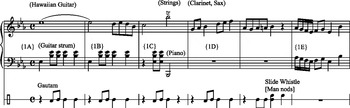
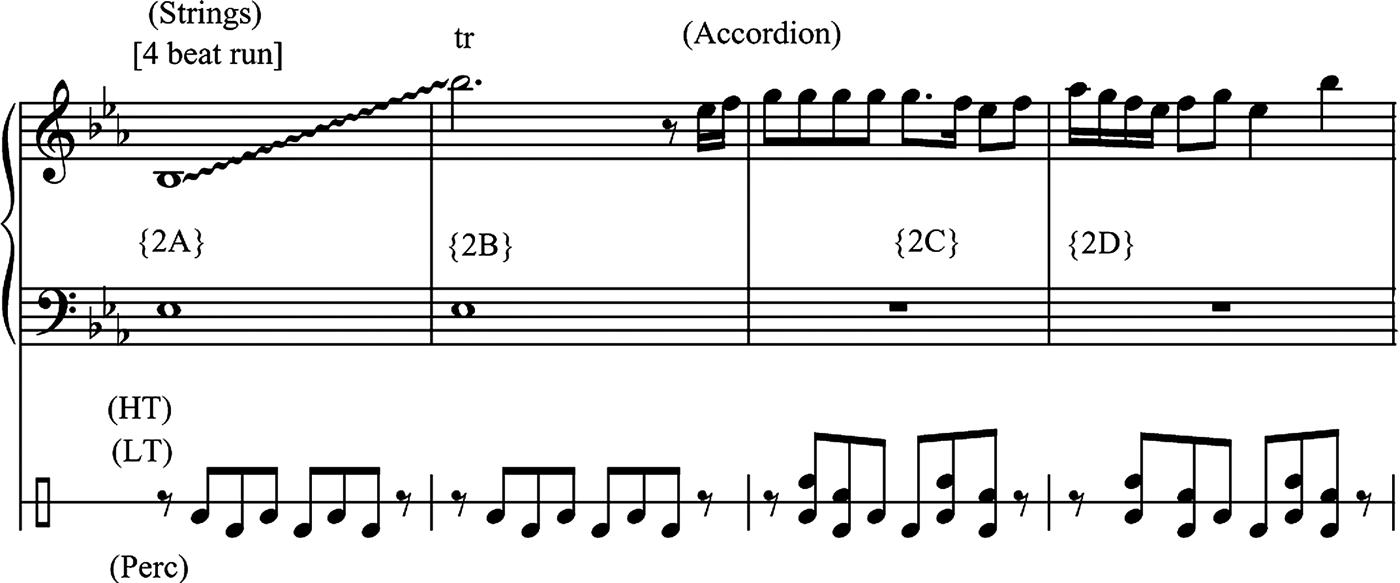
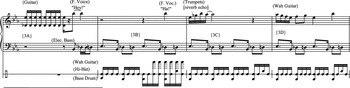
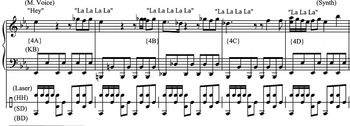
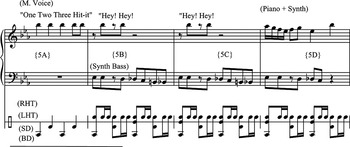
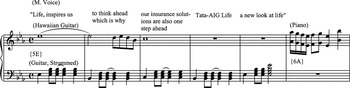
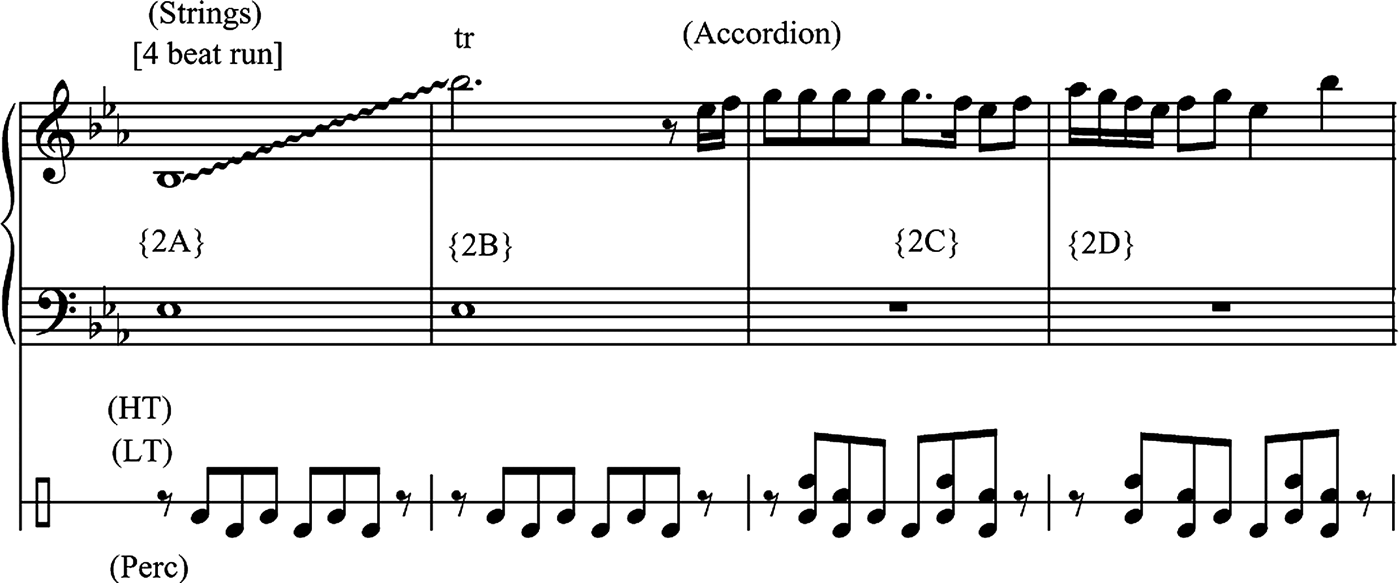
In the musical transcriptions that follow, instruments are noted in parentheses, e.g. (Guitar); spoken or sung text is noted in quotes, e.g. ‘Hey!’; the approximate starting point of each of the shots in the music is correlated with the screenshot labels in the middle of the staff with curly brackets, e.g. {1A}, {5E}; other noteworthy events are in square brackets, e.g. [man nods]. The third staff of each of the musical passages is for percussion. I have tried to notate the relative change in pitches of each of the instruments, noting the instrument and the rhythm that seemed most important here.Footnote 12
In the first section of the commercial, when the boy first sees the girl, the instrumentation is very sparse (Figure 3). With a very open melody, light percussion background and simple rhythms, it begins with a two-bar Hawaiian guitar motif that returns at the end of the advertisement as the boy climbs the tree over to the girl's balcony. Hence, I label this the ‘Love Motif’. Following this is a simple diatonic figure in the middle registers of a saxophone and clarinet that leads into the motif at {1E} that is repeated at the end of each section of the advertisement. Because it is always played during the medium shot showing both houses, the point at which the viewer can measure the growth of the tree, I will call it the ‘Tree Motif’. As I will suggest later, although not strictly speaking a jingle, the Tree Motif becomes representative of the entire advertisement in ways that other melodies have been attached to products or brands in order to be instantly remembered by the audience. In the style of melodramatic television serials of the 1970s–1980s, the music directly reflects the emotive content of the visual narrative as it is played out on screen. This happens in moments of this section: {1C} in the low B-flat played by the piano when he interrupts the boy gazing at the girl and just before {1E} with the slide whistle that is concurrent with the ‘piss off’ head gesture that the father directs at the boy.
Transcription of Section 1.

In the second section, the soundtrack begins with a violin glissando, a musical parallel to the visual transition (Figure 4). In Chion's (1994) terms, this is a suturing of musical sound to the narrative of time passage, an aural icon of time lapse. Following this is a one-bar synthesised accordion figure with a light percussion and tabla background that moves into the Tree Motif {2D}. The gramophone static remains in the background, as does the focus on high frequencies. Like the previous section, this musical passage is intended to evoke the 1950s–1960s period of Indian film music.
Transcription of Section 2.
In the third section, a single bar transition slightly precedes the visual ‘clock wipe’ to mark the passage of time and indicate the new time period (Figure 5). There is no melody in the rest of this section, just a woman's voice, trumpets with analogue effects (reverb, chorus), and electric guitar attached to a wah-wah pedal, which indexes a stylised percussive feel of film songs of the 1970s. The entire section is anchored by a groove carried by an ostinato electric bass figure and acoustic drums. The drum figure resembles what most drummers both inside and outside India would recognise as ‘disco’: bass drum on every beat, 16th note closed high-hat strokes and open high hat on beat four. The ‘Tree Motif’ is played by guitar. The overall texture has become heavier and louder than Sections 1 and 2. As before, the mix emphasises the high and middle frequencies, but it is at this point that we begin to hear the bass. There is a noticeable tape hiss in the background and there is a mix of electric and acoustic instruments.
Transcription of Section 3.

Unlike previously, there is no musical transition to the fourth section (Figure 6), although there is a visual transition (a ‘clock wipe’). A melody here is sung by a male voice augmented by synthesised violins that emphasise minor 3rd and 7th scale degrees. The final motif, played by a synthesiser, remains diatonic. Like the previous section, bass and drums keep a groove that is in the disco style: the electronic (synthesiser) bass playing in octaves that moves briefly out of the tonal centre of Eb and back; electronic (synthesiser) drums with the bass drum on beats 1 and 3, snare drum on 2 and 4, and high-hat on off-beats. Perhaps the most noticeable instrument in this section that indexes the disco style is the ‘laser’ that plays a quick repeated rhythmic figure throughout the section. By this point, there is no hint of the emphasis of the high frequencies in the mix and there is no background noise (e.g. scratches or hiss). Most of the instruments are now electronic instruments.
Transcription of Section 4.

The fifth section begins with a one bar musical transition (a male voice saying ‘one, two, three, hit it’) and there is no melody, simply off-beat ‘Hey!’ for two bars until the Tree Motif (Figure 7). The motif is now played by piano and synthesiser. Synthesised bass has returned to playing an ostinato groove (a descending chromatic line) and electronic drums feature bass drum on beats 1 and 3, snare drum on 2 and 4. Tabla returns to the percussion, playing a simple repeated pattern. The sound mix now emphasises the bass, though the remaining parts are very clear. The texture at this point is very heavy and there is a sensation that the musical section has become louder and faster, though the tempo has not increased.
Transcription of Section 5.

There is neither a musical nor visual transition to the final section as this is a continuous shot from Section 5. There is a return to the Hawaiian guitar of Section 1 playing the simple ‘Love Theme’ as the voiceover reads the text (Figure 8). Strummed guitar follows a simple I-V-vi-V-I progression with all of the guitar accompaniment in root position. There is no percussion. The Tree motif is played by piano in octaves at a slightly increased tempo, and a ‘rushing’ sound accompanies the camera as it pans down from the boy and girl on the balcony to the father below them. Crickets chirp in the background. The texture is crisp and the sound mix is evenly distributed with no emphasis on the bass.
Music of Sections 5E, 6A.

Musical history, musical progress
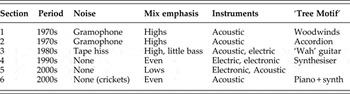
While the ordering of the musical passages alone suggests a certain sense of historical progress, there are other elements within each of the sections of music that are stylistic representatives of particular eras of Hindi film song (Table 3). In the first and second musical sections, for example, the narrative is placed into its historical context through the use of Indian percussion, unison woodwinds, and the sound of the accordion, all of which are trademarks of the music director duo Shanker-Jaikishan, and allude to songs like ‘Awaara Hoon’ (‘I'm a Vagabond’) from the Raj Kapoor film Awaara (1951). While the accordion is especially evocative of 1950s–1960s Hindi film song, it is a counterintuitive allusion insofar as the Raj Kapoor films and song picturisations of that period were unabashedly socialist in message and are in direct opposition to the investment capitalist perspective of this advertisement. Musical style is used as an index of historical period throughout the remainder of the advertisement. Indeed, while the trumpet line, timbre of the electric bass and the use of vocal effects (‘Hey’ and ‘Ha’) in the third section are deeply associated with the music director R.D. Burman in the 1970s and Amitabh Bachchan's ‘Angry Young Man’ period of Hindi films, the use of laser and octave bass in the fourth section index Bappi Lahari's disco period of the 1980s, especially the film Disco Dancer (1982). Finally, in the fifth section, contemporary remixes of film songs are presented through a stylisation of hip hop in the vocal line (‘Hey Hey’), the bass drum, and the chromatic line of synthesised bass. Once again, it is important to stress that the semiotic elements that make up the musical ideas do not refer to specific songs or styles since music has no denotational content, but the relative indeterminacy of indexicality works here to suggest these possible connections. Despite this indeterminacy, those listeners who have some familiarity with the conventions of Hindi film songs would experience a certain pleasure of recognition.
Musical progress in the soundtrack.

As the advertisement moves forward in its temporal representations, so too the emphasis of the soundtrack shifts from the melodic to the rhythmic element of the music, lending to the illusion that the tempo has increased. In addition, the shift from acoustic instruments (woodwinds, percussion), to a mix of electric and acoustic instruments, and then to electronic instruments is also a measure of the progress of time. Through the instrumentation and the stylistic shifts, one could suggest that the musical evolution is reflected as a move toward the electronic, percussive ‘fast life’ and away from the acoustic, melodic ‘slow life’ in a manner that is iconic of increasing Indian modernity, as many of my interlocutors construed it. But this is not the end of the story: the music returns to the original theme, the ‘Love Theme’, albeit with a slight change (the guitar strumming a recognisable chord progression in the background), acoustic instruments and higher production values than its original instantiation.Footnote 13
Although there is a sense of progress in the notes and styles of the music, it is the production values that indicate this more profoundly. In the initial musical passages, background static has been added, alluding to the idea that this music may have been played on a scratched gramophone record. This extra-musical noise works in tandem with the graininess/scratchiness on the film to index a recording originating from the 1970s. With each succeeding musical section, the static lessens: the third section is reminiscent of a tape recording, and the static is gone by the fourth section. In addition, the frequency spectrum gradually increases in each clip. Like recordings of the 1970s and before, the music emphasises higher frequencies and no bass is present in the recording (the Eb of the guitar in the middle staff is only barely audible with headphones). The mix of the third section adds a bit more bass, and the middle instruments are more audible. The fourth and fifth sections add electronic instruments and the bass begins to dominate. There is the appearance of a gradual shift from acoustic instruments to electronic instruments between the first and fourth sections of the music. Working together with the gradual evolution of production values in the video track, the aural allusions further index progress through these ideal types of the extra-musical elements, as much as the melodic, harmonic or rhythmic elements of the music also progress. The use of acoustic instruments, the lack of additional musical effects such as reverb, and the orientation of the sound mix on the higher frequencies all work together to create the illusion that this section actually emerges from the 1960s. Not only will most viewers recognise the deception, but the producers actually intend for the audience to recognise that this is a clever simulacrum as part and parcel of their creation of a historical imaginary. In terms of representing this imaginary, the stylised use of musical periods is quite effective in transmitting the idea through the simulation of musical icons that index the complex of cultural memory, nostalgia and imagination.
Finally, in indexing this neoliberal future, the importance of the music in this advertising message re-emerges. Indeed, insofar as it is a melody that remains constant, yet played by different instruments over different time periods and in different fashions, the Tree Motif is metonymic of an Indian ethos of saving and sacrificing. It does not change, though it is reframed over time. Thus, the ‘Tree Motif’, along with the image of the tree itself, plays a double role: not only does it indicate the relative constants of an identifiably ‘Indian’ system of values as fashions change, but it also serves to index the very message and messengers getting this idea across. That is, in shorter instantiations of this advertisement on radio and television, the musical motif serves as a way of conveying the entire message, and indexing the advertisement more generally. Not surprisingly, this repetition of a short musical phrase is characteristic of Ram Sampat, the music composer for this ad. Indeed, Sampat is acutely aware of the importance of music in branding, noting in January 2010 that:
advertising has evolved to the point where we don't have to stuff a jingle into the brand identity. We are now in the age of the “Brand Sound”. We can now design a sonic palette as a broad template for a brand. This serves as a blueprint that keeps the brand identity intact while letting the sound of the brand evolve along with the brand itself.Footnote 14
The repetition of the Tree Motif here is an excellent example of the manifold uses of music and sound, not only in creating coherence within the narrative of the advertisement, but also in being self-consciously mobilised by the producers for the sake of being a sonic blueprint for later instantiations of the brand, a practice which further reflects neoliberal ideologies.
Conclusion: selling insurance, claiming the past
In his analysis of early American television, George Lipsitz has noted that public culture often reflects the dramatic social-economic transformations and tensions of its time, legitimising new ways of social being for its audiences. For instance, he notes that television shows:
evoked the experiences of the past to lend legitimacy to the dominant ideology of the present. In the process, they served important social and cultural functions, not just in returning profits to investors or by attracting audiences for advertisers, but most significantly as a vehicle for ideological legitimating of a fundamental revolution in economic, social, and cultural life. (Lipsitz Reference Lipsitz1990, p. 42)
Insofar as it has experienced tremendous economic growth following the liberalisation reforms of the 1990s–2000s, coupled with the rapid development of commercial satellite television networks at approximately the same time, urban India has certainly been experiencing a fundamental social-economic revolution. Yet, in drawing a connection between 1940s–1950s American television and contemporary Indian television, it is not my intention to suggest that this is an evolutionary tale. Rather, in the contemporary neoliberal moment, the past is reframed in terms of the hegemonic discourses of the present, in spite of the ironic implications revealed by a dialogic analysis.
Nevertheless, while the bias of Tree of Love is toward the representation of progress of the individual and the nation, some things do not change much over the course of the narrative, suggesting that even in this transformational moment there is still continuity of social values. For example, the cars are consistently red, a colour associated with Lakshmi, the goddess of wealth and prosperity. Moreover, if the tree is an icon of the boy's bank balance, then one subtext of the advertisement is the boy's accumulation of wealth to acquire the girl. That is, in all the drama, the girl is literally left out of the picture. Indeed, one might argue that she is in a state of purdah (concealment from the public) until she is won. Recognising that class formation is not simply a matter of material wealth (Bourdieu Reference Bourdieu1984), we could ask whether the boy maintains his middle-class position throughout the narrative. This is where the objects of consumption on and around the boy tell a tale of their own. His tastes in clothing, vehicles, etc. suggest that he has aspired to and achieved the urban upper-middle-class fantasy over this period of time. His material-symbolic consumption practices have made him worthy of the daughter's love. This is the neoliberal present framing the developmentalist past in its own terms: revolutionary social change is no longer the responsibility of the state, but the middle-class individual charged with changing his own future through today's consumption.
It is important to stress here that the soundtrack of this advertisement is complicit in, if not critical for, the production of the narrative of acquiring wealth through consumption. The music is the site of ironic reference and historical reframing, such that the stylised representations of past eras of popular song and non-musical noise provide a basis for narrative contiguity (Chion Reference Chion1994), each of the styles also bringing with them complex bundles of social-historical associations (Cook Reference Cook1994). Middle-class consumption and achievement of wealth is a common theme of the different eras of Hindi film in the time periods indexed by the music in each section. But insofar as the music covertly draws the attention of the audience to these periods, the original narratives of these periods of film song are reframed as enabling conditions for the neoliberal present, rather than desirable ideologies in their own right. For example, in the Raj Kapoor film Shri 420 (1955), which the song fragment of Section 2 evokes, the middle-class, college-educated hero moves to Bombay from the village, only to learn that there is no honest way to support oneself and has to sell his honour. Consuming a decadent lifestyle of women, gambling and liquor, he comes to realise the error of his ways and rejoins the middle class as an activist to help the noble poor. Similarly, the musical period of Section 3 is associated with the 1970s ideal of the poor but virtuous middle class. This music then transforms into the optimistic disco of Section 4, then to the hip hop and remix-inflected period of Section 5. But as the return to the Love Motif suggests in the final section, Indian values were there all along.
In each musical period represented in the advertisement, this ideology of consumption for the good of the nation underlies the progress of the narrative in time. But this is not simply austerity turned on its head. Instead, the boy has to labour over a long period of time in order to achieve his object. But the fruits of his labour are no longer framed as inherently detrimental to the development of the nation. Instead, the labour and the objects of his consumption propel him and the nation forward. This is an imagined future available to anyone, not just those already situated in wealthy circumstances. This is one of the potential double meanings of the tagline ‘a new look at life’ that we are encouraged to pursue by Tata-AIG: not only a new look at the ways in which the Indian past has led to new conditions of possibility, but a new ideological paradigm in which consumption that generates wealth may, in fact, further the goals of national development better than the mechanisms of the State ever could. Saving is still valorised, but saving for the individual rather than the collective future is the goal.
Finally, returning to the hermeneutic problem addressed earlier in this paper, it is worth reflecting upon the idea that the audience for Tree of Love is not simply the potential consumers of Tata-AIG's services, but also the potential clients of Bates India. These clients need to be convinced of the efficacy of advertising and the buzz that can emerge from a good marketing campaign. In other words, the cleverness of the advertisement targets not only the television viewing audience – who may lose the intended message in the welter of competing messages – but it provides an example of the skill of the marketing company itself. Indeed, in correspondence a year later, Raja noted precisely this result: this one-minute television advertisement had positively changed the fortunes for all who were associated with it, enhancing the reputation both of the advertising agency and production company that had created it.Footnote 15 He went on to suggest that Tree of Love was ‘one of the films that established beyond doubt that he [Abhinay Deo] is one of India's finest ad film makers. Today he's the most sought after film maker in the business’ (email communication, January 2006). Hence, from the perspective of generating business for Bates India and Ramesh Deo productions, Tree of Love was a roaring success, regardless of the impact it had on Tata-AIG's quarterly revenue statements and reassuring customers about the feasibility of investing in private insurance. Truly the idea of brand communication through marketing had been sold.
Acknowledgements
Thanks are due first to Rajeev Raja at Bates India in Mumbai for providing the author with a digital copy of Tree of Love and his comments on early drafts; to Tildy Bayar and Byron Dueck for verifying the accuracy of the transcription; and Carla Bellamy, Fabian Holt, William Mazzarella, Nakul Mehta and Abigail Rosenthal for helpful comments on later drafts.