Introduction
Much progress has been made in the last few years in the development of assisted reproductive techniques (ART) for species conservation (Pope et al., Reference Pope, McRae, Plair, Keller and Dresser1997).
Most wild felid species are classified as rare, vulnerable or endangered because of poaching and habitat loss. In vitro fertilization (IVF), embryo transfer (ET), artificial insemination (AI) and gamete cryopreservation are potentially important ART by which to optimize captive breeding programmes of selected felid species. The domestic cat is often used as a model from which to develop these techniques (Pope, Reference Pope2000; Spindler et al., Reference Spindler, Crichton, Agca, Loskutoff, Crister, Gardner and Wildt2006).
In the last few years, the application of ART in the domestic cat has allowed researchers to obtain 70% of oocytes at metaphase II after in vitro maturation (IVM) (Pope et al., Reference Pope, Gomez and Dresser2006), of which 80% developed to cleaved embryos after IVF and 70–80% after intracytoplasmic sperm injection (ICSI). (Comozzoli et al., Reference Comizzoli, Wildt and Pukazhenthi2006). Following in vitro culture (IVC) only 10% of total cleaved embryos developed to blastocyst after IVF and only 15–20% after ICSI (Wood et al., Reference Wood, Bayers, Jennette and Wildt1995; Wood & Wildt, Reference Wood and Wildt1997; Freistedt et al., Reference Freistedt, Stojkovic and Wolf2001; Comozzoli et al., Reference Comizzoli, Wildt and Pukazhenthi2006). Kittens have been born after the transfer of IVM/IVF-derived embryos (Pope et al., Reference Pope, Gomez and Dresser2000). Despite the relatively rapid development and adoption of in vitro embryo production, in vivo embryo collection remains the most popular technique for the production of embryos.
It has been demonstrated that the domestic cat can also serve as a successful recipient of embryos from closely related small non-domestic cats, as shown by the birth of Indian desert cat and African wildcat kittens after the transfer of IVF-derived embryos in female domestic cats (Pope et al., Reference Pope, McRae, Plair, Keller and Dresser1997). Recently, Gomez et al. (Reference Gomez, Pope, Giraldo, Lyons, Harris, King, Cole, Godke and Dresser2004) produced African wildcat kittens after the transfer of embryos derived by fusion of adult somatic cells from one species with enucleated oocytes of a closely related species (domestic cat).
The sex determination of preimplantation embryos is a valuable method in ART by which to improve safeguard programmes for endangered felid species.
Several methods are available to determine sex at the cellular level. Cytological methods have been used since 1967, when cells from rabbits were scanned for Barr bodies (Edwards & Gardner, Reference Edwards and Gardner1967). Another procedure is ‘in situ’ hybridization, in which chromosome-specific DNA probes are hybridized to nuclei. In the early 1990s, the development of the polymerase chain reaction (PCR) opened up new possibilities for embryo sexing. Sex determination in mammals was first performed on blood cells from several species using the PCR reaction (Aasen & Medrano, Reference Aasen and Medrano1990). Subsequently, several studies were undertaken to determine the sex of ruminant embryos (Peura et al., Reference Peura, Hyttinen, Turunen and Janne1991; Appa Rao et al., Reference Appa Rao, Pawshe and Totey1993; Macháty et al., Reference Macháty, Páldi, Csáki, Varga, Kiss, Bárándi and Vajta1993; Shea, Reference Shea1999; Lopes et al., Reference Lopes, Forell, Oliveira and Rodrigues2001; Park et al., Reference Park, Lee, Choi, Joung, Kim, Chung, Jin and Im2001; Manna et al., Reference Manna, Neglia, Marino, Gasparrini, Palo and Zicarelli2003), and subsequently other authors performed splitting procedures (Leoni et al., Reference Leoni, Ledda, Bogliolo and Naitana2000; Lopes et al., Reference Lopes, Forell, Oliveira and Rodrigues2001). At first, sexing was applied to whole embryos (Appa Rao et al., Reference Appa Rao, Pawshe and Totey1993; Manna et al., Reference Manna, Neglia, Marino, Gasparrini, Palo and Zicarelli2003) and only subsequently on embryo biopsy (Bredbacka et al., Reference Bredbacka, Kankaanpaa and Peippo1995).
The potential of this method has been demonstrated in several species, which include humans (Handyside et al., Reference Handyside, Pattinson, Penketh, Delhanty, Winston and Tuddenham1989), cattles (Herr et al., Reference Herr, Matthaei, Bradley and Reed1990; Peura et al., Reference Peura, Hyttinen, Turunen and Janne1991; Kirkpatrick & Monson, Reference Kirkpatrick and Monson1993; Macha´ty et al., Reference Macháty, Páldi, Csáki, Varga, Kiss, Bárándi and Vajta1993; Collins et al., Reference Collins, Stevens, Jenner and Brownlie1995; Thibier & Nibart, Reference Thibier and Nibart1995), horses (Peippo et al., Reference Peippo, Huhtinen and Kotilainen1995), sheep (Herr et al., Reference Herr, Matthaei, Bradley and Reed1990; Bredbacka & Peippo, Reference Bredbacka and Peippo1992), pigs (Fajfar-Whetstone et al., 1993; Ford & Conley, Reference Ford and Conley1994) and mice (Kunieda et al., Reference Kunieda, Xian, Kobayashi, Imamichi, Moriwaki and Toyoda1992). To date, no sexing method for felida species that uses PCR has been reported in the literature.
PCR allows the amplification of X and Y chromosome-specific sequences in order to determine the sex of embryos in a relatively short time and with high reliability (Macháty et al., Reference Macháty, Páldi, Csáki, Varga, Kiss, Bárándi and Vajta1993; Grifo et al., Reference Grifo, Tang and Krey1997; Bredbacka, Reference Bredbacka1998; Greenlee et al., Reference Greenlee, Krisher and Plotka1998; Shea, Reference Shea1999; Park et al., Reference Park, Lee, Choi, Joung, Kim, Chung, Jin and Im2001).
Several approaches to sex determination involve the co-amplification of a Y-chromosomal sequence, commonly found in mammals. (Manna et al., Reference Manna, Neglia, Marino, Gasparrini, Palo and Zicarelli2003). This approach requires a small amount of DNA, be fast, efficient and accurate, and allows embryos to be transferred immediately into recipient females without the need for further storage.
The aims of this study were firstly to develop a rapid and reliable method for the sex determination of preimplantation cat embryos in domestic cats by the use of nested PCR and in order to identify Y chromosome-linked markers when starting from small amounts of DNA, and then to apply the same method to identify the sex of some wild felids.
To establish the sensitivity of the method we first tested the procedure on autosomal cells by the use of both female and male blood samples of adult cats and blood or hair of male and female wild felids; the technique was then applied to embryos using only a few cells from blastocysts produced in vitro and in vivo.
Materials and Methods
To test the efficiency of nested PCR in order to differentiate female and male sex, blood samples were obtained from domestic cats of known sex. Next, the method was applied to domestic cat embryos produced in vitro and in vivo. Furthermore, blood and hair samples of some wild felids of both sexes were tested with nested PCR.
Blood and hair samples
Blood samples were collected from four male and four female domestic cats in the clinic as controls to verify if the primers chosen were able to differentiate male and female sexes.
In addition, blood and hairs were collected from the following wildcats resident at Naples Zoo: two Panthera pardus (blood of one male and one female); two Panthera leo (hairs of one male and one female); two Puma concolors (hairs of one male and one female); two Panthera onca (blood of one male and one female).
All samples were collected from domestic cats following the owners' agreements. It was possible to get samples from the zoo animals during routine clinical procedures, on the basis of a research agreement between the Veterinary Faculty and Naples Zoo.
In vitro cat embryo production
All chemical products used were purchased from Sigma–Aldrich, Italy.
Oocytes collection and IVM
Ovaries were collected from 20 sexually mature queens at various stages of their reproductive cycle and following routine ovariohysterectomy at local veterinary clinics. During transport, ovarian pairs were stored in Dulbecco's phosphate-buffered saline (D-PBS plus 100 IU/ml penicillin and 100 mg/ml streptomycin) at 34 °C. Within 2 h of excision, ovaries were minced and the oocytes were liberated into 38 °C D-PBS. (Spindler et al., Reference Spindler, Crichton, Agca, Loskutoff, Crister, Gardner and Wildt2006; Herrick, 2007). Each ovary was sliced repeatedly with a scalpel blade to release cumulus–oocyte complexes (COCs) into a 90-mm culture dish containing tissue culture medium (TCM-199) with 25 mM HEPES supplemented with 4 mg/ml bovine serum albumin (BSA). Only COCs that exhibited uniform, dark-pigmented ooplasm and an intact cumulus cell investment were used for further culture (Wood & Wildt, Reference Wood and Wildt1997). We collected COCs immediately after recovery. COCs were cultured separately in 500 μl drops of maturation medium (12–20 COCs/drop) in 4-well dishes for 24 h. The maturation medium consisted of TCM-199 with Earle's salts, supplemented with 0.4% BSA, 2.6 mg/ml pyruvate, 0.075 mg/ml kanamycin, 0.1 IU/ml FSH, 10 IU/ml LH and 1 μg/ml estradiol (Spindler et al., Reference Spindler, Crichton, Agca, Loskutoff, Crister, Gardner and Wildt2006; Herrick, 2007). All cultures were preformed for 32 h at 38 °C in a humidified environment of 5% CO2 in air.
Spermatozoa collection and IVF
Spermatozoa for IVF were collected from adult male cat epididymis following castration at local veterinary clinics. The testes with their epididymies were kept in physiological saline and maintained at room temperature until spermatozoa collection. Each epididymis was separated, removed from its testes and sliced repeatedly with a scalpel blade to release spermatozoa into a 90-mm culture dish containing m-PBS at 37 °C. The released spermatozoa were washed with m-PBS and centrifuged at 1200 rpm for 5 min. The supernatant was removed and the sperm pellet was evaluated. The spermatozoa concentration was adjusted to 4 × 10⁶ spermatozoa/ml in the Fert-TALP (Izquierdo et al., Reference Izquierdo, Villamediana and Paramio1999) and then further diluted with additional Fert-TALP medium supplemented with 0.6% BSA, 2.2 mg/ml sodium pyruvate, 0.075 mg/ml kanamycin and 20 mg/ml heparin to a final concentration of 2 × 10⁶ spermatozoa/ml. After 24 h in vitro maturation, the oocytes were transferred into 500 ml drop that contained the sperm (15–20 COCs/drop) for fertilization and were coincubated for 24 h. After 24 h of coincubation with spermatozoa, cumulus cells surrounding zygotes were removed by vortexing (Herrick et al., Reference Herrick, Bond, Magarey, Bateman, Krisher, Dunford and Swanson2007). The denuded zygotes were cultured in wells containing synthetic oviductal fluid (SOF) that was supplemented with 0.8% BSA, 0.036 mg/ml sodium pyruvate, 0.075 mg/ml kanamycin sulfate, 10 mg/ml non-essential amino acid and 10 mg/ml essential amino acids (AA) and incubated at 38 °C under a 5% CO2, 5% O2 and 90% N2 gas mixture for 7 days. Days 3 and 5 embryos were transferred to fresh SOF + BSA + essential and non-essential AA with 0.8% BSA. On day 7 of in vitro culture (IVC) the number of embryos that developed to the blastocyst stage was determined visually and all embryos were classified into three stages: (1) 2–16 cells; (2) morula (16–50 cells); (3) blastocyst (>50 cells with blastocelic cavity) (Bogliolo et al., Reference Bogliolo, Leoni, Ledda, Naitana, Zedda, Carluccio and Pau2001).
In vivo cat embryo production
Three cyclic non-pregnant cat donors, between 9 and 26 months old, were selected after clinic examination and confirmation of anestrus. These experiments were performed with the owners' agreements.
Mature anestrus females were injected with PMSG (150 IU) and 96 h later with hCG (100 IU). Each superovulated cat stayed with an adult fertile male cat for 24 h to allow mating. For the following 7 days each female cat was fed ad libitum and was put in a quiet, comfortable and familiar environment. At the end of the seventh day each female cat was ovary isterectomized and the uterus was immediately plunged in the PBS solution at 37 °C. Next, the uterus was flushed with SOF and the recovered embryos were evaluated and frozen (Kajta, Reference Kajta1998; Herrick et al., Reference Herrick, Bond, Magarey, Bateman, Krisher, Dunford and Swanson2007).
A total of 37 embryos were obtained: 20 embryos at different development stages were collected in vivo and 18 blastocysts were produced in vitro.
Embryo biopsy
Compacted morulae and blastocysts were biopsied manually with a microblade and according to a simplified protocol (Bredbacka et al., Reference Bredbacka, Kankaanpaa and Peippo1995). The employed slice was a cut from a razor blade (Gilette) and glued onto a glass tube using acrylic glue. The size of the edge was approximately 5 mm. The biopsy was put into a 100–200 ml drop of PBS supplemented with 4 mg/ml polyvinylpyrrolidone (PBS + PVP) in the a 35-mm plastic Petri dish. Blastocysts were biopsied by slight pressure over the embryo, leaving the inner cell mass intact. The biopsy size was about 25% of the total embryonic cell mass. After this biopsy the blade was moved to one side until a biopsy of desired size could be separated from the embryo. To avoid the situation that spermatozoa DNA could contaminate the zona pellucida, and therefore contaminate the assay, the blastomeres were removed by aspiration after microdissection of the zona pellucida and the collected cells were rinsed several times. Each sample was frozen in microdrop container and maintained at −20 °C until the experiments were performed.
Polymerase chain reaction
DNA purification from blood and hairs
DNA was purified from 200 μl whole blood using a QIA-amp Kit (Qiagen). Briefly, 25 μl of proteinase K was added to the samples and incubated at 70 °C for 10 min. After digestion, samples were loaded on a QIA-amp spin column binding specifically the DNA. The membrane was washed three times and the DNA was eluted in 200 μl of distilled water preheated to 70 °C.
DNA purification from embryo biopsy
A magnetic resin system (Promega) was used to capture a consistent amount of DNA. Samples were incubated at 95 °C for 30 min with a lysis buffer, then mixed with an appropriate amount of paramagnetic resin. Samples were incubated at room temperature for 5 min and placed in the magnetic stand for resin separation. After several washes, DNA was eluted in 100 μl of elution buffer.
Nested polymerase chain reaction
Nested PCR amplification of the sex-determining region Y gene (SRY) was used to identify Y chromosome-linked markers for sex determination, using small amounts of DNA only. The SRY box is ubiquitous and highly conserved across mammalian orders. The outer primers used were: SRYA1 (5′-cgtcaaacgacccatgaacgc-3′) and SRYA2 (5′-atagcccgggtatttctctc-3′). The nested primers were: SRYB3 (5′-gaacgcattcatggtgtggtc-3′) and SRYB4 (5′-gcctgtagtctctgtgcctcc-3′) (CEINGE, Naples).
Amplifications were carried out in a programmed thermal cycler (Biometra). The conditions of the first amplification (SRYA1/SRYA2) were: initial denaturation at 95 °C (3 min), followed by 35 cycles at 95 °C (1 min), 60 °C annealing (30 s) and 72 °C extension (1 min), with a final extension at 72 °C for 10 min. The second amplification (SRYB3/SRYB4) was performed under the same conditions.
The first PCR reactions were performed using 1 μl of DNA in a total volume of 50 μl in the presence of: 10 pmol of each oligonucleotide primer, 200 mM dNTP, 5 μl of 10× PCR buffer, 1.5 mM mgCl2 and 1.25 U Taq polymerase. For the nested PCR, 1 μl of each reaction was reamplified in presence of the nested primers.
Another pair of primers, specific to a fragment of β-actin gene, was also amplified and used as the control for the presence of DNA. The interpretation of the PCR assay is valid only if the PCR control band (442 bp) is observed on the gel after amplification. The absence of this band in the sample reveals either a problem of amplification or absence of the cell sampling. Therefore no interpretation can be done in the absence of the control band (442 bp).
The primer sequences for β-actin were: sense 5′-tgactacctcatgaagatcct-3′; antisense: 5′-gaggagcaatgatct- tgat-3′. The conditions for the amplification of β-actin were: initial denaturation was at 95 °C (3 min), followed by 35 cycles at 95 °C (1 min), 65 °C annealing (30 s) and 72 °C extension (1 min), with a final extension at 72 °C for 10 min. After amplification, PCR products were subjected to size separation by agarose gel electrophoresis (18 g/l) and visualized with UV transilluminator.
Results
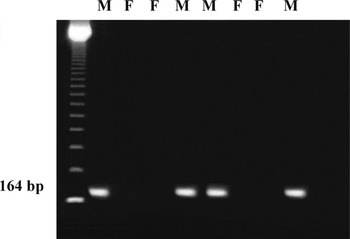
To differentiate male and female sexes in domestic cats, we performed a nested PCR on eight blood samples from eight domestic cats of known sex. Figure 1 shows a band of 164 bp in the male domestic cats (four samples) and no evidence of a band in female samples. Actin was also amplified in each sample to control for the presence of DNA (control for false negatives).
Electrophoretic presentation of nested PCR products amplified from white blood cells from sex-known domestic cats. The 164 bp band was present in males and but not in females. M: male; F: female.

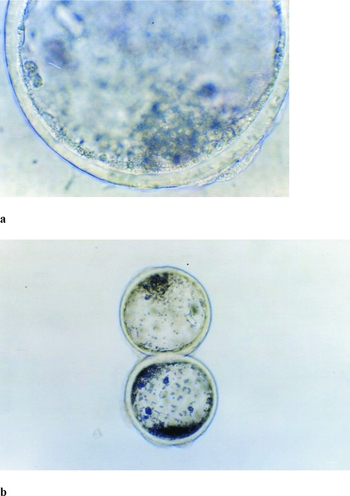
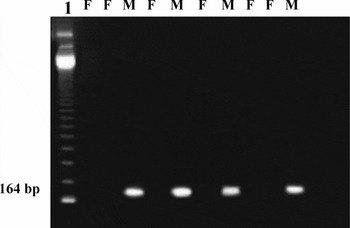
Figure 2 shows blastocysts of domestic cats. Figure 3 reports the results of nested PCR of ten embryos, of which four were males (positive for the presence of a 164 bp band) and six were female (no 164 bp band). A total of 37 embryos was used for the determination of sex. Nested PCR was applied to every sample and the final result was: 21 males and 16 females. Furthermore, the control β-actin was also amplified in each sample, DNA presence (control for false negative).
(a) Feline blastocyst (magnification ×40); (b) two feline blastocysts (magnification ×10).

Electrophoretic representation of nested PCR products amplified from biopsied blastocysts. The 164 bp band was present in males and but not in females. Lane 1: 123 ladder; M: male; F: female.

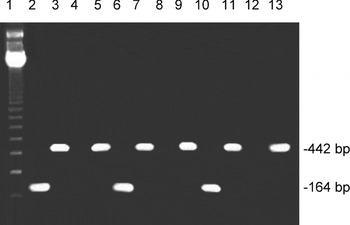
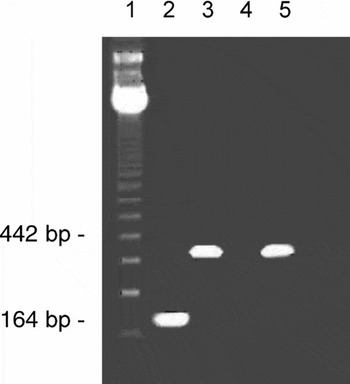
Blood and hair of some wild felids were subjected to nested PCR in order to evaluate the efficiency of the primers that were used in domestic cat to identify the SRY region in the test species. The results are reported in Figs. 4 and 5. The 164 bp bands presented in Fig. 4 correspond to three male wild felids (Panthera pardus, Panthera leo, Puma concolor). The corresponding females presented no 164 bp band. Figure 5 shows the presence of a 164 bp band in the male Panthera onca, while the 164 bp band was absent in the female. Nested PCR was performed on blood from: two Panthera pardus, two Panthera onca; and from hairs of: two Panthera leo and two Puma concolor. The 442 bp band (β-actin) is present in each sample (control for false negatives).
Electrophoretic representation of nested PCR products amplified from blood or hairs of sex-known wild felids. The 164 bp band was present in males and but not in females. The 442 bp band (β-actin) is positive in every sample (control for false negatives). Lane 1: 123 ladder; 2: male (Panthera pardus); 3: male β-actin (Panthera pardus); 4: female (Panthera pardus); 5: female β-actin (Panthera pardus); 6: male (Panthera leo); 7: male β-actin (Panthera leo); 8: female (Panthera leo); 9: female β-actin (Panthera leo); 10: male (Puma concolor); 11: male β-actin (Puma concolor); 12: female (Puma concolor); 13: female β-actin (Puma concolor).

Electrophoretic representation of PCR products amplified from blood of sex-known wild felids (Panthera onca). The 164 bp band was present in males and but not in females. The 442 bp band (β-actin) is positive in every sample (control for false negatives). Lane 1: 123 ladder; 2: male (Panthera onca); 3: male β-actin (Panthera onca); 4: female (Panthera onca); 5: female β-actin (Panthera onca).

Discussion
The primary application of feline sexing is to determine accurately the sex of in vivo- and in vitro-produced cat embryos. It is necessary that the method ensures maximum embryo viability as only minimal DNA is obtained from embryonic cells. In the present study, nested PCR was used to increase the sensitivity of the assay and Y chromosome-specific primers have been used for sex determination of domestic cat blood samples and embryos. The same method was utilized to isolate the SRY sequence in wild felids of both sexes: Panthera pardus, Panthera onca, Panthera leo, Puma concolor, using blood or hair samples.
Advances in domestic cat ART have enabled investigators to use similar techniques in some species of wild felids. Embryo sexing of wild felids is available and contributes to the protection of biodiversity for captive breeding programmes (Pelican et al., Reference Pelican, Wildt, Pukazhenthi and Howard2006).
The most common approach in sexing embryos involves the co-amplification of the Y chromosome-specific sequence, which contains the Y-linked genes (SRY) and an autosomal sequence that acts as a control for the presence of DNA (Peura et al., Reference Peura, Hyttinen, Turunen and Janne1991; Appa Rao et al., Reference Appa Rao, Pawshe and Totey1993; Macháty et al., Reference Macháty, Páldi, Csáki, Varga, Kiss, Bárándi and Vajta1993; Park et al., Reference Park, Lee, Choi, Joung, Kim, Chung, Jin and Im2001; Manna et al., Reference Manna, Neglia, Marino, Gasparrini, Palo and Zicarelli2003).
The method described here uses a primary PCR to amplify the SRY sequence. SRY is expressed ubiquitously and is highly conserved across mammalian orders. Reverse primers were chosen to anneal with conserved regions of SRY in order to differentiate SRY from related autosomic genes. In addition, we checked the sensitivity of primary PCR by nested PCR using SRY-B1 and SRY-B2 primers. The results indicate clearly that nested PCR is highly sensitive and enhances the specificity of the assay. Similar observations were reported with preimplantation embryos from other species (Handyside et al., Reference Handyside, Pattinson, Penketh, Delhanty, Winston and Tuddenham1989; Kunieda et al., Reference Kunieda, Xian, Kobayashi, Imamichi, Moriwaki and Toyoda1992; Ford & Conley, Reference Ford and Conley1994; Collins et al., Reference Collins, Stevens, Jenner and Brownlie1995; Peippo et al., Reference Peippo, Huhtinen and Kotilainen1995; Leoni et al., Reference Leoni, Ledda, Bogliolo and Naitana2000; Chrenek et al., Reference Chrenek, Boulanger, Heyman, Uhrin, Laurincik, Bulla and Renard2001; Mara et al., Reference Mara, Pilichi, Sanna, Accardo, Chessa, Chessa, Dattena, Bomboi and Cappai2004). To date, no sexing method for felida species using PCR has been reported in the literature. Commercial PCR sexing protocols for bovine embryos that involve the use of Y-specific primers report a 90–95% efficiency and a 93–95% accuracy, depending on the biopsy procedure (Thibier & Nibart, Reference Thibier and Nibart1995).
The PCR primers used for the nested PCR reaction were designed to amplify a smaller fragment within the SRY sequence. Using nested primers, no evidence of non-specific nested amplification was observed.
The samples that did not show the amplified male specific product were interpreted as being from female embryos; however false sex determination could occur, as the absence of any amplified product may reflect the absence of embryonic DNA in the sample. To assess this possibility, the detection of autosomal DNA primers (β-actin) was carried out in this study as a control, in addition to the detection of Y-specific sequences. This control facilitated the confirmation of the absence of blastomeres in the reaction mixture and the exclusion of false female results. When using control primers in the reaction, the presence of two bands, the first specific for the sex and the second for autosomal DNA, is interpreted as the embryo being male. When the male-specific band is absent and the autosomal specific band visible, the embryo is considered female. The lack of the two bands indicates the absence of cellular DNA in the sample, excluding false female results. As sex-determined cat embryos were not transferred because of the non-availability of recipient cats, it was not possible to confirm the results directly.
DNA isolated from blood that was collected from both male and female domestic cats and wild felids was used as a template for the PCR, in order to evaluate the reliability of the sexing method. PCR-based sex determination using DNA from blood and hair of wild felids was in complete agreement with phenotypical sex.
The amplification bands indicated that the Y-specific amplification, detected by first primers, was confirmed by nested primers (in nearly all cases); this demonstrated the accuracy of the nested PCR sexing method.
The SRY gene region is conserved in domestic and non-domestic felids and a sensitive and efficient method for sexing cat embryos has been developed using nested PCR. This study is a useful adjunct to the technologies of in vitro maturation and fertilization and embryo transfer and these results may facilitate future studies in embryo sex differentiation, in transgenic animals and in fetal gene expression.
Furthermore, embryo sexing has the advantage over other methods (i.e. sperm sexing) in that it can be applied in in vivo-obtained embryos. This method allows investigators to use fewer embryo cells, ensuring maximum embryo viability and can be effectively applied in wild feline.
These results confirm that the method can be used in feline assisted breeding programmes for the purpose of manipulating the sex ratios of offspring.