Introduction
Human ageing is universal, although the phenomenology of growing old, including trajectories of age-related decline, is influenced by multiple factors, not the least of which are culture and ethnicity. Contemporary developmental theories of ageing have pointed to the role of culture as a pivotal mechanism in human adaptation (Baltes Reference Baltes1997) and it has been highlighted by many scholars as a primary source in first-world countries for extending average life expectancy and enhancing perceived quality of life (Helman Reference Helman2005; Nusselder, Mackenbach and Mackenbach Reference Nusselder, Mackenbach and Mackenbach1996). Ethnicity can also exert deleterious effects on health and wellbeing across the lifespan, particularly in terms of membership in groups that have experienced social oppression and subsequent economic and political disadvantages (Blakely et al. Reference Blakely, Tobias, Robson, Ajwani, Bonne and Woodward2005). The study of trajectories of age-related decline has been an important source of knowledge about the nature and the effects of culture on lifespan development in the later years (Hill Reference Hill2005). Because culture and its effects on the processes of growing old exert a large and complex impact across geographical regions, it is essential that country-specific studies are undertaken to elucidate the differences and similarities in the process of growing old within identifiable ethnic groups.
Examining specific factors that impact the processes of growing old also has important public health implications. In New Zealand, a recent national effort has been initiated within a larger umbrella initiative known as the Positive Ageing Strategy (New Zealand Ministry of Social Policy 2001). One purpose of this national agenda that focuses on its ageing citizens is to optimise the wellbeing of this often under-recognised subset of New Zealand society. The New Zealand Positive Ageing Strategy includes the articulation of governmental policies to facilitate adaptation of older New Zealand citizens within their extant socio-cultural context.
The positive ageing label underscores an evolving scientific literature that emphasises intrapersonal processes and their role in mediating functional loss in age-related decline. Hill (Reference Hill2010) has articulated four component characteristics of positive ageing; namely the ability to (a) mobilise one's latent resources, (b) engage in psychological flexibility, (c) utilise an affirmative decision-making style, and (d) generate an optimistic response even in the presence of objective age-related decline. Unlike more common terms including ‘successful’ or ‘healthy’ ageing that focus on objective indices of physical and cognitive health for maintaining functioning and wellbeing in old age, positive ageing highlights capacities to alter one's subjective state and thus make it possible to find wellbeing even when health and functioning are in decline. Culturally embedded supports that can function to facilitate adjustment to these realities are the constructivist underpinnings of the positive ageing label (Gergen and Gergen Reference Gergen, Gergen, Goodheart and Worell2005). From within a positive ageing paradigm it can be hypothesised that cultural factors including family and community supports as well as cultural traditions and values (e.g. finding a sense of meaning within traditional cultural practices) are essential for late-life optimal adjustment.
The overarching goal of the current report is to characterise the process of ageing among New Zealanders in an attempt to identify features of this population that can be recruited to enhance positive ageing among citizens within this country. What follows is a general description of the New Zealand context with specific emphasis on its bicultural structure, an overview of the New Zealand Health, Work and Retirement Study (HWR), a detailed description of the study sample as well as preliminary findings from the first wave of data that have emerged from this sample. Data from the HWR are interpreted within the policy framework of the New Zealand Positive Ageing Strategy. Another goal of this paper is to describe how the findings from this study can inform New Zealand public policy with the goal of enhancing the wellbeing of its indigenous citizens, the Māori.
The New Zealand context
A guiding principle that undergirds New Zealand society is termed ‘biculturalism’. Biculturalism is a modern derivative of the Treaty of Waitangi which was signed by Māori and New Zealand colonists in 1840 and is widely considered to be a cornerstone of New Zealand sovereignty (Orange Reference Orange1992). Essentially, biculturalism refers to a partnership between the Māori and non-Māori of New Zealand which facilitates Māori participation in all levels of New Zealand governance and social policy (Belich Reference Belich1996).
Within the issue noted above, it is important to examine how the context of biculturalism has manifested itself in relation to health and wellbeing consequences between older non-Māori and Māori New Zealanders. One goal of this descriptive exploration is to facilitate the development of appropriate governmental programmes and interventions to address the unique needs of both groups. Independent of biculturalism and the imperative nature of addressing Māori in education and research in New Zealand, there are also health needs among Māori that drive a focus on health and wellbeing among older Māori. Essentially, Māori lag far behind non-Māori on all indicators of health and wellbeing and there is a nine-year lower life expectancy of Māori compared to non-Māori (New Zealand Ministry of Health 2004). To date, no large-scale longitudinal study exists in New Zealand that focuses on the health issues of older Māori. An elucidation of factors that lead to enhanced health and wellbeing among New Zealand Māori is needed. The impetus for this study comes from an awareness of the lack of specific information about health and wellbeing among older New Zealanders, and the role of socio-cultural factors in impacting the health of both Māori and other groups of adults living into their later years. This issue has become a visible priority for the New Zealand government and the subsequent creation of the Positive Ageing Strategy. This paper provides additional dimensions to this policy, including conceptual underpinnings of identifiable cultural factors and their role in health and wellbeing of New Zealand citizens. A goal of this report is not only to elucidate this mechanism, but to propose strategies for ameliorating processes which are hypothesised to exert both positive and negative effects on all groups in New Zealand.
Background to the study
The New Zealand Government's Positive Ageing Strategy emphasises the ongoing community participation and independence of older people. Part of this strategy is to ‘empower older people to make choices that enable them to live a satisfying life and lead a healthy lifestyle’ and to ‘provide opportunities for older people to participate in and contribute to family, whanau [Māori language term for extended family] and community’ (New Zealand Ministry of Social Policy 2001: 6). The strategy also highlights the importance of continuing economic involvement and choice of workforce participation in contributing to the health of older adults. Policies designed to address these strategies seek to empower and support people in leading productive lives in society as they age. A key determinant that enables participation and independence for older adults is good health. The HWR was designed as a prospective study with two waves of data collection two years apart (2006 and 2008). The focus of the study was on the determinants of health in older adults (55–70 years old) in the general New Zealand population as they moved from work into retirement and older age. In 2007, the study was extended to include two additional waves of data collection (2010 and 2012) and the scope broadened to include a wider age group (50–80 years). Since 2008, it has been known as the New Zealand Longitudinal Study of Ageing and the aims include alignment with international longitudinal studies of ageing including the Health and Retirement Study (Heeringa and Connor Reference Heeringa and Connor1995), English Longitudinal Study of Ageing (Taylor et al. Reference Taylor, Conway, Calderwood, Lessof, Cheshire, Cox and Scholes2007), and the Survey of Health Ageing and Retirement in Europe (Börsch-Supan, Hank and Jürges Reference Börsch-Supan, Hank and Jürges2005) with the inclusion of increasing face to face interview data collection methods.
This longitudinal study includes a special focus on the needs of older Māori as a sub-group of the national cohort and has relevance to policy, outcomes and new knowledge for Māori health. This paper reports on findings from the representative population sample of the first wave of data collection for the HWR. The focus of this initial analysis is on ethnic differences in physical and mental health, and the factors that contribute to these differences in physical and mental health in early old age.
Methods
Participants
The first data collection wave was conducted in 2006. The population of interest was New Zealanders aged 55–70 who are generally in the later stages of work life or early stages of retirement (there is no legal age of retirement in New Zealand, although a universal superannuation scheme provides a pension from age 65). There are approximately 609,000 New Zealanders aged 55–70, with 47,400 of those identifying as Māori (New Zealand Ministry of Social Policy 2001). The New Zealand Electoral Roll was the source for sample selection. Registration on the roll is mandatory for all citizens eligible to vote in government elections and in 2007, 96 per cent of all eligible New Zealanders were registered.
Equal probability random sampling procedures were used to select two independent samples to represent the general population (which includes Māori; N=5,264) and the Māori-only population (N=7,781). Māori were over-sampled for this study using the self-report Māori descent indicator on the general electoral roll to maximise participant recruitment and provide sufficient numbers for statistical analysis in later data collection waves. The rationale for using the Māori descent indicator was based on problems of categorising Māori identity. It has been established by Durie et al. (Reference Durie, Fitzgerald, Kingi, McKinley and Stevenson2002) that people of Māori descent do not always agree with census categorisations, and often prefer to align themselves with a range of different groups. The use of the electoral roll was a way to invite those who have made a specific identification, as being of Māori descent, to participate in this study. Analysis of 2006 New Zealand census data (Statistics New Zealand 2007) shows that older Māori (40–79 years) are slightly more inclined to report Māori descent than younger Māori (10–39 years).
In total 13,045, 55–70-year olds were surveyed. The total response rate (after exclusions, e.g. unable to be contacted, deceased or institutionalised) was 53 per cent (N=6,662). Specifically, the general sub-sample return rate was 62 per cent and the Māori sub-sample return rate was 48 per cent. These response rates are consistent with previous health-related postal surveys undertaken by the authors and colleagues which have elicited response rates of between 55 and 60 per cent for general population samples and between 40 and 44 per cent for Māori (Baken and Stephens Reference Baken and Stephens2005; Paddison Reference Paddison2004; Towers et al. Reference Towers, Alpass, Stephens, Davey, Fitzgerald, Stevenson and Pennington2006). Participants who responded at later contact points in the data collection process were generally in poorer health and were less trusting of others. For the general sub-sample, late responders were likely to be younger than early responders, and for the Māori sub-sample, late responders were less physically active and had fewer qualifications than early responders.
Of the 6,662 participants, 3,117 (47%) identified their primary ethnicity as Māori and 3,545 (53%) were classified as non-Māori. Of this latter group, 3,085 were of European descent, 52 identified as Pacific Islander, 83 as Asian and 164 as other (161 missing for ethnicity). Age was well distributed with a mean of 60.93 (standard deviation=4.70; N=6,402).
Representativeness of the sample
The HWR general and Māori samples generally represent their respective reference New Zealand populations (seeTowers and Noone Reference Towers and Noone2008). Both samples have a slight sex imbalance with more females (general sample 52.8%; Māori sample 55.6%) than their target populations (51 and 52.4%, respectively). However, the proportion in each age group was representative of the 55–70-year-old general and Māori populations in the New Zealand 2006 Census of Population and Dwellings (Statistics New Zealand 2006), with just slightly more older Māori (aged 65–70) in the HWR study (26%) than in the 2006 Census data (24%). Contrasts in labour-force participation between the two HWR samples and the 50–69-year-old general population in the 2006 census suggest that the transition from full-time work to retirement is bridged by part-time employment for many of the HWR participants. There were higher proportions of white-collar and professional workers, and higher income levels and standards of living in the HWR samples compared to the older age group in the 2006 census. A higher proportion of both the general and Māori sample (the latter in particular) also lacked any formal educational qualifications.
Measures
The measures used in this study were included in a postal questionnaire designed to assess individual factors related to retirement, wellbeing and independence. The following measures were chosen for this analysis to assess health and factors that are known to impact on health. Health was assessed using the SF36 Health Survey (Ware, Kosinski and Dewey Reference Ware, Kosinski and Dewey2000), a widely used, reliable and validated measure of generic health status. The SF36 has eight sub-scales (physical function, role limitations for physical and emotional problems, pain, general health perception, general mental health, energy/vitality and social functioning). Each sub-scale was standardised using New Zealand norms for older adults aged 55–70 (Stephens et al. forthcoming). These sub-scales were then combined using principle components (orthogonally rotated) derived coefficients from the United States general population (Ware, Kosinski and Dewey Reference Ware, Kosinski and Dewey2000) to form two components assessing physical and mental health with lower scores implying poorer health. Means and standard deviations for the unweighted sample are reported in Table 2.
The Economic Living Standards Index – Short Form (ELSI-SF; Jensen et al. Reference Jensen, Spittal, Crichton, Sathiyandra and Krishnan2002) was developed in New Zealand to measure levels of consumption, social activity and asset ownership, rather than the economic resources that enable them. The scale assesses restrictions in ownership of assets (eight items), restrictions in social participation (six items), the extent to which respondents economise (eight items), and a self-rated indicator of standard of living (three items). The ELSI-SF scores on each of the items were combined to form a continuous variable ranging from 0 to 31 (higher scores reflect higher economic living standards) and as an ordinal variable with seven levels from severe hardship to very good (seeJensen et al. Reference Jensen, Spittal, Crichton, Sathiyandra and Krishnan2002 for a complete description). For the continuous variable, Jensen et al. reported a Cronbach's alpha of 0.88.
Perceived social support was assessed using the Social Provisions Scale. Cutrona and Russel (Reference Cutrona, Russel, Jones and Perlman1987) describe the development of this scale to assess the six relational provisions: Attachment, Social Integration, Reassurance of Worth, Reliable Alliance, Guidance, and Opportunity for Nurturance. Respondents rate the extent to which each of four statements (two positive and two negative) describe how their social relationships are currently supplying each of the provisions using four-point scales (from completely true to not at all true). The scores are summed (after reversing the negative scores) for each social provision (0–16) and a total social support score is also formed by summing the six individual provision scores (0–96). Cutrona and Russel report alpha coefficients for the total scale score from 0.85 to 0.92 across a variety of populations. Cronbach's alpha for the present sample was 0.89.
The total job satisfaction scale is a 15-item scale developed by Warr, Cook and Wall (Reference Warr, Cook and Wall1979) and reflects the degree respondents report satisfaction with both the intrinsic and extrinsic features of their job. Thus, the scale items assess the respondent's level of satisfaction with both intrinsic and extrinsic aspects of their occupation (e.g. physical work conditions, autonomy, colleagues, responsibility level, remuneration). Scores on each of the items are combined to form a continuous variable ranging from 15 to 105. Higher scores on the scale represent higher levels of total satisfaction. Warr, Cook and Wall (Reference Warr, Cook and Wall1979) report a Cronbach's alpha for the scale of 0.85–0.88, and the alpha for the present sample was 0.92.
Retirement adjustment is a four-item measure developed by Taylor and Shore (Reference Taylor and Shore1995). This scale measures respondents' beliefs about their ability to make the retirement transition successfully. Thus, the scale items assess levels of confidence, and conversely, anxiety and depression, associated with thoughts of retirement for respondents. Scores on each item are combined to form a continuous variable ranging from 4 to 22. Higher scores on the scale reflect higher levels of anticipated adjustment to retirement (e.g. more confidence in one's ability to make the transition). Taylor and Shore (Reference Taylor and Shore1995) report a Cronbach's alpha for the scale of 0.86, and the alpha for the present sample was 0.89.
Participants were categorised as having no qualifications, some qualifications or tertiary qualifications. For the regression equations, a dummy variable was used: comparing those with no qualifications (0) to those with secondary and tertiary qualifications (1). Age was assessed as a continuous variable of years based on year of birth. Gender was female (0) or male (1). Retirement status was two categories: not retired (working full-time) (0) or retired (including semi-retired) (1). Marital status was also assessed as a dichotomy: single, divorced or widowed (0) or married or partnered (1). Ethnicity was measured as Māori (0) or non-Māori (1) according to self-identification by participants.
Health behaviours
Participants were categorised as smokers or non-smokers. Physical activity levels were based on the number of days per week spent in moderate or vigorous activity. The dichotomous variable divided those who reported that they engaged in at least 30 minutes of moderate and/or 15 minutes vigorous activity for five or more days per week from those who reported less. This cut-off was based on the public guidelines for healthy activity provided to New Zealanders (Sport and Recreation New Zealand (SPARC) 2003) and is consistent with current public guidelines in North America (Haskell et al. Reference Haskell, Lee, Pate, Powell, Blair, Franklin, Macera, Heath, Thompson and Bauman2007) and the United Kingdom (United Kingdom Department of Health 1996).
Procedures
The postal survey used multiple contact points to maximise participation (Dillman Reference Dillman2000).
1. A brief pre-notice letter was sent to inform potential participants about their selection and the questionnaire study.
2. One week later, the questionnaire, a detailed information sheet and a free-post return envelope were sent.
3. At three weeks, a reminder postcard was sent to the whole sample.
4. At six weeks, a replacement questionnaire was sent to all non-respondents.
5. At 11 weeks, a final postcard was sent to all non-respondents.
These procedures were approved by the Massey University Human Ethics Committee.
Results
Characteristics of the sample
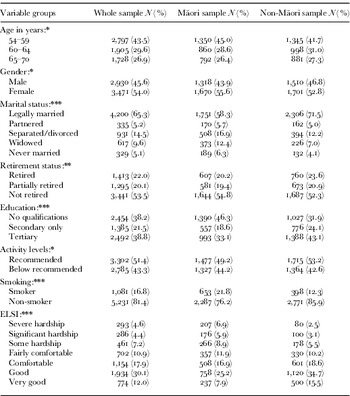
Table 1 shows the percentages of participants at each level of age, gender, marital status, retirement status, education, smoking, physical activity levels, and ELSI categories for the whole sample and for the Māori and non-Māori groups.
Percentages of those in groups of each nominal variable for whole sample, Māori sample and non-Māori sample

Note: ELSI: Economic Living Standards Index.
Significance levels: Significant differences (χ2) between Māori and non-Māori groups at * p<0.05, ** p<0.01, *** p<0.001.
Pearson chi-square tests were applied to test the significance of any association between these variables and ethnicity. Significant differences between Māori and non-Māori participants were found for gender, marital status, retirement status, education, physical activity levels, smoking and economic living standards.
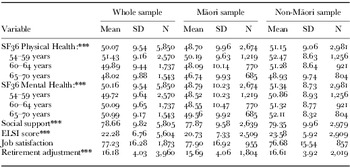
Table 2 shows means and standard deviations for the continuous variables for three different groups: whole sample, non-Māori and Māori. ANOVA showed that there were significant differences between Māori and non-Māori mean scores for physical health, mental health, social support, ELSI and retirement adjustment. There was no difference for job satisfaction.
Mean and standard deviations (SD) across selected study variables

Note: SF36: SF36 Health Survey. ELSI: Economic Living Standards Index. ANOVA showed significant differences between Māori and non-Māori mean scores for: physical health (F=110.28); mental health (F=115.70); social support (F=34.63); ELSI (F=278.09); and retirement adjustment (F=50.41).
Significance level: *** p<0.001.
Relationships between the variables
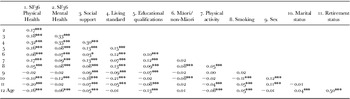
To test relationships between the variables in the population, the whole sample was weighted for ethnicity. A post-stratified weighting variable according to primary ethnicity was applied to the present analyses based on the population estimates from the 2006 census (Statistics New Zealand 2007) for the 55–70-year-old age group. Table 3 shows the patterns of significant zero-order relationships between the variables in this sample. For these comparisons, the following dummy variables were used: retirement was collapsed to retired and partially retired compared to working full time; education compared those with no educational qualifications with all others; marital status compared those who were married or partnered with all others. Retirement adjustment and job satisfaction were not included in these analyses because each applied to only part of the sample. The strongest patterns of relationships in this set for the whole sample were between health, living standards and social support.
Bivariate correlations among study variables

Note: SF36: SF36 Health Survey. N=6,662 with pairwise deletion of missing cases and weighted by ethnicity.
Significance levels: * p<0.05, *** p<0.001 two-tailed.
Predicting mental and physical health differences
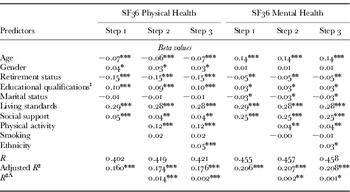
Given the multiple relationships between the variables, two hierarchical regression equations were run to determine the contribution of demographic variables, health behaviours, and the additional contribution of ethnicity, to physical and mental health. The criterion variables were either SF36 Physical Health summary scores or SF36 Mental Health summary scores and the predictor variables at each step were identical (results are summarised in Table 4). Missing data were deleted listwise across the ten variables leaving 4,904 cases for analysis. To meet the assumptions of multiple regression, 370 multivariate outliers were deleted (Physical Health equation N=4,534) and 380 from the Mental Health equation (N=4,524).
Hierarchical multiple regression of SF36 Physical Health summary scores (N=4,534) and SF36 Mental Health summary scores (N=4,524) on age, gender, retirement status, physical activity, smoking, wealth, living standards, education and ethnicity (Māori/non-Māori)

Note: SF36: SF36 Health Survey. 1. Reference group: no qualifications.
Significance levels: * p<0.05, ** p<0.01, *** p<0.001.
When SF36 Physical Health was the criterion, the demographic and social variables entered at the first step were: age, gender, retirement status, marital status, living standards, educational qualifications, and social support. Marital status did not contribute, but the other variables together significantly predicted 16 per cent of the variance in physical health. Beta values (see Table 4) show that younger age, being male, working full-time, having higher living standards, educational qualifications, and more social support were related to better health.
At the second step, the health-related behaviour variables were entered. Smoking was not significant, but physical activity accounted for an additional 1 per cent of the variance in physical health. Engaging in more than 2.5 hours a week of moderate or vigorous exercise was related to better health. At the third step, ethnicity explained an additional 0.2 per cent of the variance in physical health. On average, after taking into account the social and lifestyle variables, non-Māori reported better health. The total variance in physical health explained by this model was 18 per cent.
When SF36 Mental Health was the criterion, gender was not significant, but the other demographic and social variables (age, retirement status, marital status, living standards, educational qualifications, and social support) together significantly predicted 21 per cent of the variance in mental health. Beta values in Table 4 show that all significant variables were related in the same direction as for physical health, and those who were partnered were likely to report better mental health. At the second step, only physical activity again accounted for an additional 0.2 per cent of the variance in mental health. At the third step, ethnicity explained only an additional 0.1 per cent of the variance in mental health. The total variance explained in mental health by this model was 21 per cent.
Discussion
The variables in this study that fit within a cultural-context prediction model specific to a New Zealand sample and that predicted both physical and mental health among older New Zealanders were (a) economic living standards, (b) social support, and (c) retirement status. Among these, economic living standards accounted for the largest percentage of the explanatory variance in health and the impact of this predictor was magnified by the remaining two factors. Those who have poor living standards also had poorer social support and experienced lower perceived physical and mental health. These structural socio-cultural factors, rather than individual difference variables, exerted the greatest impact on perceived health and wellbeing.
A potential limitation of these findings comes from the low response rate. A 53 per cent (on average) response rate is good for a postal survey and attests to the efficacy of the method. However, with nearly 50 per cent of the randomly selected target population missing, some bias must be found in the results. Characteristics of participants who provided later returns following several reminders suggest that those who did not respond would be more likely to be in poorer health and less trusting of others, possibly younger and less physically active, and with fewer educational qualifications, and therefore lower literacy rates, particularly among Māori. Comparisons of the sample with census data also suggest that missing representatives were more likely to be men and have fewer educational qualifications. While not necessarily representative, the lack of males with poorer health, poorer health behaviours, and lower socio-economic status does not obviate the validity of the relationships between socio-economic status and the other socio-cultural factors with health. This relationship has been shown despite loss of variance across these factors. Thus, this finding provides impetus for examining more closely the efficacy of specific social and entitlement programmes and how these have operated to impact the health of older New Zealanders, particularly in relation to Māori who have reported poor access to these services. The present results also provide data to guide social policies with respect to augmenting access to these programme offerings.
Another primary finding was between older Māori and non-Māori citizens in light of their physical and mental health. The data were clear that older Māori adults are more often divorced or widowed, have less education, are less physically active, and more likely to be an active smoker. These features are coupled with the higher likelihood of Māori to report significant or severe economic hardship. These findings support those of Blakely et al. (Reference Blakely, Fawcett, Hunt and Wilson2006) who concluded from a study of 45–74-year-olds that the contribution of socioeconomic position to ethnic disparities in mortality in New Zealand was substantially greater than that of smoking. The data also indicated that even when all of these variables were statistically accounted for, ethnicity explained additional variance in both physical and mental health. This finding provides another line of evidence in support of additional factors related directly to minority ethnic status as an explanation for poor health and wellbeing among the Māori in relation to the majority population residing in New Zealand. There is agreement in the contemporary literature that inequalities in resources such as income, education and housing are the primary cause of health inequalities, but there are additional factors that contribute to ethnic health inequalities (New Zealand Ministry of Health 2002; Sporle Reference Sporle, Pearce and Ellison-Loschman2002). Suggested reasons for these additional disparities include the effects of colonisation and land confiscation, structural and inter-personal racism, and unequal access to quality health services (Blakely et al. Reference Blakely, Tobias, Robson, Ajwani, Bonne and Woodward2005). The mounting evidence in this area suggests that a social policy focus should be on socio-economic inequalities between groups of older people, and that ongoing consideration of ethnicity in regard to access to health resources such as health care should be included.
The factors assessed in the Māori group in this study are indicative of a population that, across the course of recent history, has experienced both low control and lack of autonomy stemming from the distal effects of colonisation. This issue may manifest itself in a set of health parameters that have not only a socio-contextual effect, but could also have a biological effect. Marmot (Reference Marmot2006) has argued that low social position is associated with indicators of raised cortisol levels which then impact wellbeing, especially when this complex occurs in the presence of maladaptive behaviours. As the New Zealand population ages, the health disparities between Māori and non-Māori will have increasingly marked effects on population health and must be addressed, particularly in light of the Treaty of Waitangi, whose mandate is to ensure equality between Māori and non-Māori regarding access to government health care and economic programmes. A limitation of the information provided by the present results is the cross-sectional nature of the data. This initial report is an important first step in introducing the overarching theoretical and methodological framework for the HWR. It is our view that these initial findings provide compelling evidence for the role of culture on health behaviours that exert a substantial impact on longevity. We anticipate that an elucidation of the role that these culturally-influenced behaviours play on patterns of longevity among the Māori will be evident from more in-depth results from face-to-face interviews across time as part of emerging data from this study.
It is no surprise that the aggregated results of this study indicate that age is associated with a decrease in physical health. After all, there is a well-known continual decline of physical wellbeing with advanced age (Arking Reference Arking2006). The relationship between age and mental health, however, was reversed, indicating that mental health of older New Zealanders improves with age. While this finding may seem surprising, it is consistent with other longitudinal ageing studies (Chandola et al. Reference Chandola, Ferrie, Sacker and Marmot2007). This seeming ‘paradox of ageing’ can be explained by Socioemotional Selectivity Theory, which states that in late life, individuals become increasingly aware of a limited time horizon, resulting in an increased focus on goals and activities that are emotionally meaningful and satisfying (Löckenhoff and Carstensen Reference Löckenhoff and Carstensen2004). Results may also reflect that New Zealand has factors in place (such as universal superannuation and a reasonably high overall quality of life) for older individuals to feel increasingly satisfied with their lives despite declining physical health.
As a theoretical construct that is evolving in the 21st century, the positive ageing label provides a guiding framework for optimal adjustment to old age. Adjustment in this regard focuses on the preservation of wellbeing through psychological flexibility and the capacity to access latent resources to adjust to the inevitabilities of age-related physical decline (Hill Reference Hill2005, Reference Hill2010). From a social policy perspective, New Zealand, like many Western countries in the 21st century, is defining policies of positive ageing to help citizens access essential goods, services, and supports to facilitate not only longevity, but wellbeing in late life (World Health Organisation 2002). Such policies have also recently come under sustained critique (e.g. Asquith Reference Asquith2009) for their support of neoliberal discourses which focus on individual responsibility at the expense of care for those in need, and particularly for their impact on the lives of indigenous people (Ranzijn Reference Ranzijn2010). Policies based on positive approaches to wellbeing which emphasise resilience and coping may avoid penalising older people who are in poor circumstances and compromised health by taking into account the importance of social and structural contributions to their wellbeing. The results of this study support the importance of such an approach and turn our attention towards the needs of those who have been disadvantaged across the lifecourse through access to fewer resources and membership in historically marginalised cultural groups. Future analyses will examine how economic, socio-cultural, and intra-personal resources facilitate adaptation in the presence of physical decline among this sample of New Zealanders over time.