




No CrossRef data available.
Cues that Matter: How Political Ads Prime Racial Attitudes During Campaigns
Published online by Cambridge University Press: 03 March 2004
Abstract
Recent evidence suggests that elites can capitalize on preexisting linkages between issues and social groups to alter the criteria citizens use to make political decisions. In particular, studies have shown that subtle racial cues in campaign communications may activate racial attitudes, thereby altering the foundations of mass political decision making. However, the precise psychological mechanism by which such attitudes are activated has not been empirically demonstrated, and the range of implicit cues powerful enough to produce this effect is still unknown. In an experiment, we tested whether subtle racial cues embedded in political advertisements prime racial attitudes as predictors of candidate preference by making them more accessible in memory. Results show that a wide range of implicit race cues can prime racial attitudes and that cognitive accessibility mediates the effect. Furthermore, counter-stereotypic cues—especially those implying blacks are deserving of government resources—dampen racial priming, suggesting that the meaning drawn from the visual/narrative pairing in an advertisement, and not simply the presence of black images, triggers the effect.
Information
- Type
- Research Article
- Information
- Copyright
- © 2002 by the American Political Science Association
The public expression of racist attitudes has dramatically declined over the last several decades (Schuman et al. 1997). Racial issues have also been approached rather obliquely in most federal and state election campaigns since 1968 (Mendelberg 2001). Still, there are indications that contemporary mainstream media reinforce negative stereotypes about minorities (Coltrane and Messineo 2000; Entman 1990, 1992; Entman and Rojecki 2000; Gray 1995). For example, crime news coverage often employs racial imagery, reinforcing linkages between blacks and violence (Dixon and Linz 2000; Gilliam and Iyengar 2000; Peffley, Shields, and Williams 1996). Reporting about poverty and social welfare has also become racialized, even though African Americans remain a minority of those in poverty or on government assistance (Gilens 1999; Mendelberg 2001).
The racial “coding” of crime and welfare in the minds of many Americans leads to the possibility that invoking these concepts, even without explicitly referring to race, can activate racial thinking (Gilens 1996, 1998; Jamieson 1992; Mendelberg 1997, 2001; Valentino 1999). Some have argued that elites foster and reinforce these connections to gain a strategic political advantage. For example, Edsall and Edsall (1991) argue that Ronald Reagan nurtured the linkages among “special interests,” “big government,” and particular minority groups during the 1980s. The result, they claim, was that Americans perceived unpopular groups such as trade unionists, blacks, Hispanics, feminists, and homosexuals, to be united in making unreasonable demands for rights and resources they did not deserve (p. 203). These requests for “special preferences” were repeatedly juxtaposed against the interests of “ordinary” Americans. According to this argument, opinions about certain policies and programs became linked to attitudes about minority groups, thereby creating a powerful tool for strategic communicators to exploit during campaigns.
Coded language, understood by large segments of the public, affords elites the opportunity and incentive to activate racial thinking without explicitly “playing the race card.” Obvious examples are the 1988 “Willie Horton” appeal and its next of kin, the “Turnstile” ad that invoked the same issue (Massachusetts' prison furlough program under Governor Dukakis) without mentioning Horton specifically. The Horton ad paired nonracial narratives with racial imagery to produce an “implicitly” racial message (Jamieson 1992), and news about the ad primed racial attitudes in opinions about various policies (Mendelberg 1997).
Mendelberg (2001) has outlined a theoretical approach for understanding the impact of racialized campaign messages. This argument has four components. First, white Americans are torn between the “norm of equality” and resentment toward blacks for their perceived failure to abide by the American creed of individualism and hard work. Second, racial priming works because certain cues make racial schemas more accessible in memory so that they are automatically employed during subsequent political decision making. Third, becoming aware of the racial content of a message would lead most people to reject it because they would not want to violate the norm of equality. Therefore, fourth, racial appeals are effective only if they are not recognized as such by the audience. Mendelberg argues that “implicit” (i.e., visual but not verbal) cues rather than “explicit” (i.e., visual plus verbal) ones are likely to meet this fourth requirement. Experimental and survey data support her claim that implicitly racial messages can powerfully prime racial attitudes during campaigns.
Underlying Mendelberg's approach is the assumption that racial attitudes are still a potent force in American politics, a claim supported by research linking such attitudes to opposition to racially redistributive policies (e.g., Bobo and Kluegel 1997; Bobo, Kluegel, and Smith 1997; Sears 1988; Kinder and Sanders 1996) and to ideological transformations in general (Carmines and Stimson 1989). But the precise nature and extent of the role of racial attitudes in mass political preferences are still hotly debated (Sears, Sidanius, and Bobo 2000). Some argue that a fundamental change in the politics of race in America has taken place over the last four decades, such that most Americans now evaluate policies and candidates according to their resonance with basic nonracial values such as individualism (Sniderman and Hagen 1985; Sniderman and Piazza 1993), egalitarianism, and the ideal size of government (Hurwitz and Peffley 1998; Sniderman and Carmines 1997). If so, one might predict that standard political appeals involving government spending or taxation activate more global values, and not attitudes about race in particular, even if racial cues are present. Or, finally, exposure to political messages might simply activate existing predispositions, such as party identification, bringing candidate preferences into line with these attachments (Campbell et al. 1960; Finkel 1993).
We find Mendelberg's theoretical approach convincing, and her findings persuasive, but additional conceptual clarity and more precise testing of the fundamental assumptions of the model are necessary to understand fully the nature and extent of racial priming in modern American politics. We explore three related questions here. First, do subtle racial cues in standard political appeals actually prime racial attitudes? Much of the research demonstrating race priming via political advertisements focuses on the issue of crime or welfare spending (Gilens 1999; Jamieson 1992; Mendelberg 1997, 2001), indicating some of the ways racial attitudes can be brought to bear on political judgments. We further explore the race priming effect by testing the impact of racial cues embedded within appeals involving references to wasteful government spending and taxation, not crime or welfare.
Second which types of cues most powerfully prime racial attitudes? Current research draws a distinction between “implicit” and “explicit” racial messages, with the Horton ad exemplifying the former because the narrator never uttered a noun such as “black” or “race” (Mendelberg 2000). We agree that explicit and implicit racial appeals should have different effects, but also suspect that variation among implicit cues is important. The set of racial cues that one might consider to be “implicit” might vary widely along several dimensions. Some advertisements make only oblique narrative references to racialized issues, such as crime, welfare, or government spending, without presenting images of blacks or other minorities at all. For example, an advertisement run by Bob Dole's campaign in 1996 criticized Bill Clinton for sponsoring several “wasteful spending proposals” such as “midnight basketball” and “alpine slides in Puerto Rico,” but contained no visual images of blacks.1
With this type of appeal, one could presume that it was racialized only by observing its effects.
For reasons we delineate below, we do not make a directional prediction with regard to whether group comparisons or one-sided negative depictions of blacks will produce the largest effects.
Third, what is the psychological mechanism underlying racial priming? Previous work has assumed that cognitive accessibility moderates media-based priming effects (e.g., Iyengar and Kinder 1987; Kinder and Sanders 1996; Mendelberg 2001; Price and Tewksbury 1997; Valentino 1999). In other words, ideas and considerations that have been activated recently or often, those at the “top-of-the-head,” are more likely to be used automatically in subsequent decision-making tasks (Taylor and Fiske 1978). No study to date, however, has demonstrated that news or political advertising primes concepts in memory via this automatic process.3
Fazio and Williams (1986) show that more accessible attitudes have a larger impact on preferences for the 1984 presidential candidates, but they do not manipulate the accessibility of these attitudes.
Additional evidence about the psychological mechanism underlying race priming can be gathered by examining whether the effect is always triggered by images of blacks or if it depends upon whether the ad resonates with negative stereotypes in particular. It has been suggested that exposure to stereotype-discrepant information boosts attention to the stimulus, so that the information can be explained and either incorporated into the existing cognitive structure or rejected entirely (Brewer, Dull, and Lui 1981; Hastie 1981). If racial priming takes place automatically, the added thought stimulated by a stereotype-inconsistent cue might reduce priming (Mendelberg 2001).4
Mendelberg (2001) also examines the effects of counter-stereotypic images on racial priming. However, she examines only the effects of negative portrayals of whites rather than positive portrayals of African Americans. As described more fully below, we test both scenarios.
To summarize, we predict that racial cues embedded in standard political appeals prime racial attitudes during campaigns. This effect should manifest itself as an increase in the impact of racial attitudes on candidate preference. Since racial cues activate primarily racial attitudes, the power of nonracial global values such as egalitarianism and individualism, or predispositions such as party identification, should not be affected as strongly. Second, we attempt to determine which types of implicit cues—those in which the narrative alone invokes racialized issues, those wherein a comparison of racial group access to valued resources is visually presented (with whites apparently disadvantaged), or those that visually imply that blacks are undeserving—most powerfully prime attitudes toward blacks. Third, we investigate whether racial priming is mediated by the cognitive accessibility of racial considerations in memory. We expect racially counter-stereotypical cues to undermine priming, ostensibly by stimulating conscious processing of the racial content of the message.
Determining the scope of racial priming, and the mechanism by which it occurs, is important for several reasons. First, if such a phenomenon exists, it suggests that racial attitudes continue to exert a powerful influence on American politics and, at least to some extent, this role is dependent on elite communication strategies. Furthermore, it would indicate that racial attitudes can be activated by basic appeals about government spending, not just issues that touch directly on negative stereotypes about blacks (e.g., welfare and crime). In other words, such findings would undermine the current perception among most whites that the power of racism in American politics has largely disappeared (Schuman et al. 1997).
Second, implicit racial priming is inherently manipulative, as it encourages voters to evaluate candidates based on criteria they would likely ignore if they were aware of the intent of the appeal. Finally, implicitly racial messages may heighten social group conflicts not only by propagating negative stereotypes about racial minorities, but by reinforcing their political relevance. If we are ever to resolve the “American dilemma” (Mrydal 1944), therefore, we must understand whether and how elite communication strategies activate racial considerations in contemporary American politics. If implicit racial priming is rare or relatively weak in its effects, then our continued focus on the phenomenon would be at best a waste of intellectual energy. At worst, it might distract us from the damage that obvious and blatant racism produces.
METHODS AND PROCEDURES
Experiments are now widely accepted as a valid method for studying political communication processes and effects such as agenda setting, priming, and framing (e.g., Iyengar and Kinder 1987; Nelson and Kinder, 1996; Nelson, Clawson, and Oxley 1997; Miller and Krosnick 2000; Iyengar 1991; Mendelberg 1997, 2001; Domke, McCoy, and Torres 1999; Valentino 1999). The method's greatest strength is its ability to isolate the causal impact of communication factors on political attitudes and behavior. The direct manipulation of media content, coupled with random assignment of subjects to treatment and control conditions, produces strong inferences about specific elements of a message that alter citizens' decision-making criteria. This methodology is especially useful for studying the psychological processes underlying media effects. We therefore employ an experiment to test our hypotheses about the extent and nature of implicit racial priming.
Several experimental studies of media-based priming rely on undergraduate student samples [(Miller and Krosnick 2000; Mendelberg 1997; Nelson, Clawson, and Oxley 1997); but see Iyengar and Kinder (1987); Iyengar (1991); and Mendelberg (2000) for examples of experiments employing adult samples]. The use of such samples raises concerns about the generalizability of results, since undergraduates usually have limited personal experience with the political process and therefore may be especially vulnerable to persuasive campaign communication. Therefore nonstudent adult subjects are desirable in studying the impact of political advertising on candidate evaluations.
Most racial priming studies focus exclusively on white Americans. One justification for the decision to restrict such analyses to whites is the particular interest in the impact of white racial attitudes on race-relevant policy opinion. The concept of symbolic racism (Kinder and Sears 1981; Sears 1988), in particular, was designed solely with white Americans in mind. Subsequent studies that utilize this concept, or its next-of-kin racial resentment, analyze exclusively nonblack respondents (Kinder and Sanders 1996; Mendelberg 1997, 2001). In keeping with this practice, we too focus on nonblacks, though we do so reluctantly. We believe that the theory of implicit communication applies to blacks as well as whites, though individual differences will certainly moderate the size of the effect (Lau 1988; Devine 1989). Indeed, when we run our analyses with blacks included, our results are essentially identical. We do not, unfortunately, have enough African American respondents to test adequately the theory on different racial groups separately. Ultimately, however, the theory of racial priming must be extended to include and understand the reactions of all audience members.
Our study was conducted in a computer lab at the Marsh Center for Journalistic Performance at the University of Michigan, with a total of 346 adult, nonstudent subjects in late June through early July of 2000.5
After excluding black subjects, our sample size drops to 293.
Women also made up about half of our sample, and conservatives represented about 30%. There were no significant differences across cells of the design in the proportions of these sociodemographic and partisan variables. Therefore, differences we observe between conditions can be attributed to the stimuli.
Respondents were told they would receive $15 for watching several television advertisements and answering questions about “current events.” As subjects entered the lab they were randomly assigned to one of several advertising conditions, which are described below, and then escorted to a computer terminal. To minimize interviewer biases, subjects interacted solely with the computer throughout the interview. Once the subjects completed a demographic questionnaire, the computer instructed them to don a pair of headphones and watch a series of television advertisements. Each subject viewed three advertisements. The control group viewed three common product commercials.7
These were Duralast Batteries, Staples Office Supplies, and Wallside Windows, in that order. In the treatment conditions, those who viewed the political spot did not see the Staples commercial.
We treat political and racial attitudes as independent variables in our analyses. Technically, then, we should have placed all these items in the pretest. Unfortunately, we would then run the risk of priming respondents to think about race and politics before exposure to the advertisement, thereby confounding the potential effects of the cues we manipulated. We decided, therefore, to place these measures in the posttest. We were concerned that what we describe as “priming” effects (where candidate evaluations are brought into line with attitudes about race) might in fact be “projection” effects (where attitudes about race are brought into line with candidate evaluations). Given that racial attitudes and other political predispositions are acquired at an early age and stable throughout the life span, we felt that this was unlikely. This is also the standard procedure in many priming studies (Iyengar and Kinder 1987; Mendelberg 1997; 2001; Valentino 1999). Mean levels of racial and political predispositions did not change substantially as a function of exposure.
Since we expose subjects to fictitious ads sponsored by an actual candidate, we provided an extensive debriefing interview to ensure that no one left with the mistaken impression that the advertisement they saw was authentic.
THE EXPERIMENTAL MANIPULATION
One limitation of many experimental media effects studies is the absence of realistic stimuli. Producing and manipulating realistic political advertisements is technically challenging and resource intensive. As a result, most priming studies utilize news coverage, which is plentiful and easy to edit, as stimulus material (Gilliam and Iyengar 2000; Iyengar and Kinder 1987; Mendelberg 1997, 2001; Miller and Krosnick 2000; Nelson, Clawson, and Oxley 1997). Since political advertisements and campaign news coverage are likely to differ in terms of the source's perceived credibility and motivation, we decided that it was critical to manipulate particular racial cues embedded in standard political appeals. The only way to achieve this kind of control is to construct the advertisements from the ground up. We first produced a narrative focusing on general government spending, taxes, and funding for health care. We chose George W. Bush as the sponsoring candidate because Republicans are typically viewed as most competent on economic and spending issues (Petrocik 1996). Furthermore, the Republican Party has targeted government spending on “wasteful” programs that benefited particular groups in society (Edsall and Edsall 1991). The narrative plays into these assumptions intentionally.10
We do not assume that only George W. Bush or only Republican candidates in general are capable of or motivated to prime racial attitudes. Either party may have incentives, depending on the circumstances, to activate racial or other group dimensions.
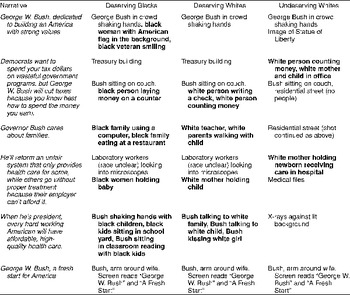
A complete description of the experimental treatments used in the first part of the study is presented in Table 1. After invoking Bush's “dedication to an America with strong values,” the male narrator contrasts Bush with Democrats who would “spend your tax dollars on wasteful government programs.” Bush, the narrator continues, pledges to cut taxes because “you know best how to spend the money you earn.” The second half of the narrative focuses on health care, with the claim that Bush will reform an “unfair system that only provides health care for some, while others go without proper treatment because their employer can't afford it.” The narrator closes the 30-sec spot with the refrain, “George W. Bush, a fresh start for America.”

By itself, the advertisement's narrative carries no obvious racial significance. Only if the language of wasteful government, unfair allocation of government resources, and taxation carries racial connotations for some viewers could this appeal prime attitudes about blacks. In the neutral visuals condition, presented in Table 1, we insert racially neutral visuals such as the Statue of Liberty, the Treasury building, and residential neighborhoods (devoid of people) over this narrative. When health care is invoked, racially ambiguous images of the medical profession appear.11
The individuals shown are wearing full-body lab coats and masks that obscure racial characteristics.
In the second and third versions of the ad, visual racial cues are substituted for some of the neutral symbolism overlaying the basic narrative. In what we call the race comparison condition, an image of a black person counting money is followed by that of a black woman and child in an office setting. At this point, the narrator says, “Democrats want to spend your tax dollars on wasteful government programs.” As the narrator notes that Bush supports tax cuts “because you know best how to spend the money you earn,” white images appear. Further, as the narrator highlights Bush's intention to “reform an unfair system that only provides health care for some … ,” an image of a black mother and child in a hospital bed are on screen. When the narrator refers to other Americans going without proper medical treatment “because their employer can't afford it,” a white mother and child appear. The other visuals in the ad remain identical to those in the neutral version. Finally, in what we refer to as the undeserving blacks condition, the white images in the racial comparison cell are removed, so that only black images with negative connotations remain. These three versions of the ad all carry implicit racial cues: the first simply refers to issues that might carry racial significance; the second visually highlights racial comparisons, with the implication that whites are receiving fewer resources than blacks; and the third visually depicts blacks as undeserving.
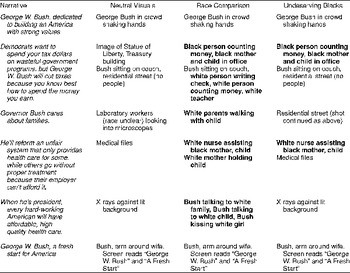
To test the impact of stereotype-inconsistent cues, three additional versions of the ad are constructed by rearranging the timing of the visual race cues. Transcriptions of these versions are detailed in Table 2. First, we attempt to produce positive connotations about blacks by inserting images of blacks at the point when the narrator claims, “You know best how to spend the money you earn.” Blacks are also shown when the narrator mentions that Bush “cares about families” and when he states that under Bush “every hardworking American will receive affordable, high-quality health care.” We call this condition the deserving blacks condition, it provides a direct, counter-stereotypical comparison to the cell involving blacks as undeserving beneficiaries of government spending. The final two versions of the ad depict whites as either deserving (labeled deserving whites, in column 3) or undeserving (labeled undeserving whites, in column 4) beneficiaries of government spending. These additional cells create a comparison between stereotype consistent versus inconsistent cues that target either whites or blacks.

RESULTS
Our first hypothesis predicts racially coded appeals will boost the explanatory power of racial attitudes on candidate evaluations. To test this, we estimate the impact of racial attitudes on vote choice across the conditions of the design. The dependent variable ranges from 0 to 1, with higher values indicating greater support for Bush relative to Gore. We examine three measures of racial attitudes: racial resentment, laissez-faire racism, and perceived influence of blacks. Though they are composed of different survey items, these indicators are conceptually interrelated. The racial resentment scale is based on the contention that “blacks do not try hard enough to overcome the difficulties they face and that they take what they have not earned” (Kinder and Sanders 1996, 106).12
See the Appendix for exact question wordings. Cronbach's α for the racial resentment scale was 0.78.
See the Appendix for exact question wordings. Cronbach's α for the laissez-faire racism scale was 0.79.
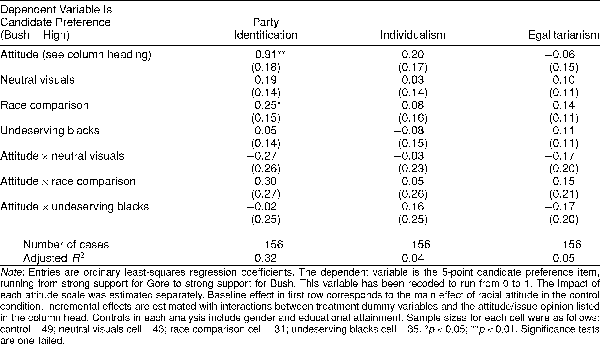
Table 3 displays the results of our first test. Each column represents a separate OLS regression equation where the candidate preference scale is regressed upon a given racial attitude or issue opinion measure (listed in the column head), dummy variables for each treatment condition (with the control group as the excluded category), and interactions between the racial attitude measure and each dummy variable to capture the slope shift associated with exposure to each ad. With this specification, we can compare the baseline effect of racial attitudes with the impact of those same attitudes in the presence of various primes. To guard against the possibility that differences in the distribution of sociodemographic or political variables across cells of the design might account for differences we observe, controls for global ideology, gender, and education are included.14
There are no significant differences in the distributions of these variables across cells, and excluding these controls does not alter the direction or magnitude of the results.

Our hypotheses hinge most directly on the direction and magnitude of coefficients B1, B5, B6 and B7. Tables 3 and 4 present all the coefficients in the model except for the controls.15
Results for the full model are available upon request from the first author.
Entries in the first row in Table 3 are estimates of the baseline effect of each racial attitude/issue measure on the candidate preference scale. The intercept shifts associated with exposure to each advertising condition are located in the second, third, and fourth rows. All of these coefficients, across all attitudinal dimensions, are negative. This means that for those very low in racial resentment or other forms of racial conservatism, seeing any of our ads boosts support for Gore. These main effects make sense intuitively, since subjects these subjects are perhaps prone to vote for Gore to begin with. However, these coefficients are rarely statistically significant. More important for our hypothesis are the slope shifts between the control group and each treatment group, presented in rows 5 through 7. To calculate the overall effect of a given attitude among those exposed to a particular ad, one must combine the baseline effect in the first row with the slope shift represented by the interaction coefficient of interest in that same column.
Reading down the rows in the first column, we see that racial resentment has little effect on support for Bush among those subjects who did not view a political advertisement. The interaction in the fourth row indicates that, among those who saw an ad with neutral visual cues, the impact of racial resentment is boosted. The resulting association between this racial attitude and preference for Bush over Gore in this condition is 0.42 (0.01 + 0.41). In the fifth row, we see that the priming effect of the race comparison cues is substantively similar to that of the neutral version (0.35). Neither of these slope shifts is statistically significant, but their direction is consistent with the first hypothesis. Finally, in the undeserving blacks condition, the impact of racial resentment reaches its zenith, at 0.62 (0.01 + 0.61). This statistically significant shift indicates a large substantive effect: In the presence of the undeserving blacks cue, moving from the lowest to the highest level of racial resentment produces a shift across more than half of the entire candidate preference scale running from Gore to Bush.
The basic pattern of results is strongly replicated when our attention shifts to other measures of racial attitudes. The impacts of laissez-faire racism and blacks have too much influence are statistically indistinguishable from 0 in the control group but grow large and positive for respondents who see ads containing implicit racial primes. The racial comparison condition strongly primes both of these attitude dimensions. Across all three measures, however, the race priming effect is largest in the undeserving blacks condition.
The last two columns in Table 3 examine whether implicit race cues prime racialized policy opinions as predictors of candidate preference. Opposition to affirmative action is statistically unrelated to candidate preference among those who saw no political advertisement. All three versions of the advertisement, however, produce a positive relationship between these variables, and the difference reaches statistical significance for the neutral visuals and undeserving blacks conditions. The same basic pattern is replicated for opposition to welfare spending for the poor. In other words, the impact of the race comparison cues is somewhat weak as a prime for opinions about these racialized policies, while the undeserving blacks condition produces a large effect.
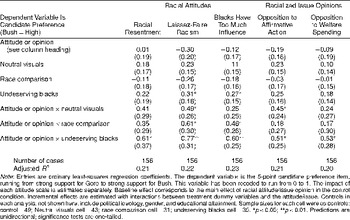
These results confirm our suspicion about the power of subtle racial cues. However, it is possible that some other set of predispositions or values is actually activated by these appeals and that our indicators of racial attitudes simply covary with those other dimensions. Next, therefore, we focus on partisanship and global values such as individualism and egalitarianism. If our ads prime these dimensions, the pattern of relationships between them and candidate preference should be similar to that observed for racial attitudes across the cells of the design. The evidence presented in Table 4, however, suggests that this is not the case. The results for party identification are presented in the first column. In the first row, we see that party identification is a powerful predictor of candidate preference in the baseline condition. Exposure to racial cues, however, does nothing to boost this relationship.16
Party identification is measured in the standard way, drawn directly from the National Election Studies, and collapsed to form a 7-point scale running from strong Democrat to strong Republican.

These ads may also activate nonracial values such as individualism and egalitarianism.17
These concepts are measured with standard National Election Study items. For question wording, see the Appendix.
We could have tested these alternatives with a saturated model containing all condition dummies, each attitude dimension, and interactions between condition dummies and attitudinal measures. This would have produced a large and unwieldy model to present. We therefore tested each of these dimensions separately, assuming that the absence of changes in the bivariate relationship indicates an absence of priming. It is difficult to imagine how these nonracial attitudes could be primed in the omnibus model if effects are absent using the bivariate setup.
THE PSYCHOLOGICAL MEDIATOR OF RACIAL PRIMING: ACCESSIBILITY OR IMPORTANCE?
The results presented thus far suggest that a variety of implicit racial cues, embedded in appeals about nonracial issues, can serve as racial primes, especially those implying that blacks are undeserving recipients of government spending. However, we still know little about the particular psychological process underlying these effects. The theory proposed by Mendelberg (2001) identifies accessibility as the mediator: racial attitudes are made more accessible in memory such that they are automatically employed in subsequent decisions. We tested for accessibility affects in the standard way, using a lexical task identical to the one employed by Nelson, Clawson, and Oxley (1997), who in turn draws on a technique developed by Fazio (1990). Immediately after viewing the ads, subjects were told that they would need to discriminate between words and nonsense letter strings flashed on the computer screen by pressing keys marked on the keyboard.19
We choose to measure accessibility immediately after the stimulus for all subjects. Other studies, including those by Nelson et al. (1997) and Miller and Krosnick (2001), do not measure accessibility and importance for every subject, because of the concern that the accessibility task might signal what the experimenters deem important, thereby creating a demand that might affect importance ratings appearing later in the questionnaire. We find this implausible in the current study, because the judgment made (word versus nonsense string) is unrelated to racial attitudes, the advertising stimuli, or politics in general. Still, if such demands exist, this test is a conservative one because they should depress differences between control and treatment groups.
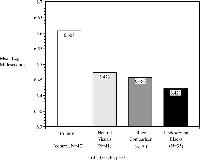
Figure 1 suggests that racial cues increased the accessibility of racial schemas in memory. Compared to the control group, each of the three advertising conditions records faster response times to race relevant words (neutral visuals, t = 2.17, p < 0.05; racial comparison visuals, t = 2.12, p < 0.05; undeserving blacks visuals, t = 3.01, p < 0.01). An analysis of variance reveals the significance of the overall trend (F = 3.36, 3 df, p < 0.01). These results corroborate the previous evidence that racial cues prime viewers' attitudes about blacks, but they also illuminate the psychological mechanism: the accessibility of those attitudes in memory. The narrative alone did much of the work, but adding visual racial cues boosted the accessibility of these attitudes even further. Finally, to control for individual differences in reading speed, the response time to filler words was subtracted from the response time to race-relevant words. The pattern of results across the cells is unchanged for this relative response time measure, with the undeserving blacks and racial comparison conditions producing the fastest scores (F = 2.91, 3 df, p < 0.05).

The Impact of Exposure to Advertising Race Cues on Response Time to Race-Relevant Word Probes Note: Bars represent mean log milleseconds of response time for race-relevant word probes. Race-relevant word probes included “white,” “black,” “drug,” “lazy,” and “crime.” The analysis of variance used to estimate the significance of differences between conditions included controls for education,gender, and ideology.
Extending the work of Nelson, Clawson, and Oxley (1997) and Miller and Krosnick (2001), we hypothesize that these ads may alter the level of importance viewers assign to group representation in candidate evaluations. Their results suggest that this difference in importance, and not simply the increased accessibility of racial schemas in memory, could drive the slope shifts displayed in Table 3. We examine this possibility by asking respondents to rate the importance of various criteria in their own voting calculus. One item read, “When you evaluate a candidate for president, how important are the groups in society the candidate cares about?” Racial cues might boost the mean score on this item if the importance of group representation mediates the impact of the appeal. There is some evidence that this occurs. The importance of group concerns is slightly higher in the neutral and racial comparison cells (5.23 and 5.13, respectively, on a 1–7 scale) than in the control (4.82), though neither of these differences reaches statistical significance. However, the mean importance of groups in the undeserving blacks condition is even higher (5.71), and this difference is significant (t = 2.46, p < 0.01). The overall trend, however, falls short of statistical significance (F = 1.44, 3 df, p = 0.23). In sum, the undeserving blacks condition seems to boost the importance of groups as a voting criterion, while the neutral and racial comparison cues do not.
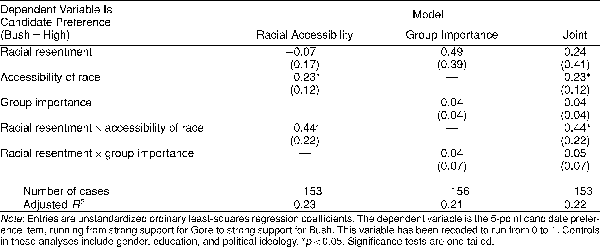
These results suggest that exposure to implicit racial cues, especially the undeserving blacks cues, makes racial attitudes more accessible and makes group concerns more important in the voting calculus. Therefore, we need another test to determine whether accessibility or importance ratings actually mediates the racial priming effect. According to the technique employed by Miller and Krosnick (2000), accessibility will be determined to mediate priming if the interaction between accessibility and racial resentment is positive and statistically significant. In our study, this would mean that racial resentment would be boosted as a predictor of candidate evaluations primarily among those for whom race is accessible in memory. The alternative hypothesis is that citizens employ a more intentioned psychological process when evaluating candidates, such that racial resentment plays a larger role among those who decide that “the groups in society that the candidate cares about” is an important vote criterion. The results of these analyses appear in Table 5.

In the first column in the table, we estimate the effects of accessibility, racial resentment, and the interaction between the two on candidate evaluations.20
The constant and controls for ideology, gender, and education are not presented here.
Results are substantively equivalent and remain statistically significant when the full linear measure is employed.
Note that this effect is pooled across all the cells of the design. The three-way interaction, accessibility × racial attitudes × exposure to ad, would test the hypothesis that accessibility would mediate priming differentially, depending on the salience of race in the ad. This is possible, but not predicted by the theory of implicit communication.
We also ran these analyses for the other two racial attitude measures (laissez-faire racism and “blacks have too much influence”). The results are almost-identical in direction and magnitude.
To this point, the analyses focus on stimuli that conform to racial stereotypes. Blacks are depicted as undeserving beneficiaries of, and whites are shown bearing the tax burden for, “wasteful government programs.” In the second set of experimental conditions, we compare the power of stereotype consistent versus inconsistent cues as racial primes. Remember from Table 2 that we create a “deserving blacks” condition that implies that blacks are hardworking Americans supporting unidentified “others.” Next we replace images of blacks in the undeserving blacks condition with whites, thereby producing an “undeserving whites” condition. Finally, we create a condition that places whites in a positive light, without any images of blacks, as a baseline against which to compare the undeserving whites cell. These additional three cells contain a total of 135 subjects beyond those analyzed above.
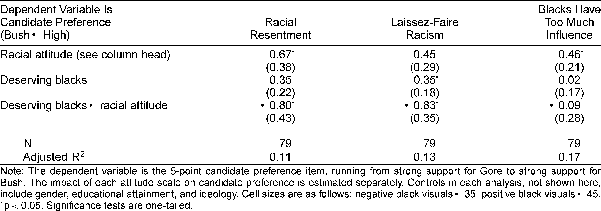
The prediction is that stereotype inconsistent cues might lead to more intentioned thought, thereby suppressing racial priming effects. Table 6 replicates the basic analyses from Table 3, with regard to the strength of racial attitudes as predictors of candidate preference when the black stereotype is violated. In the first row we import the previous results from the undeserving blacks condition. Recall that this cell produced powerful race priming effects, as indicated by the positive relationship between all three racial attitude measures and the vote. When the black racial cues are stereotype-inconsistent, however, the relationship between racial attitudes and the vote disappears, as indicated by the large negative interaction term in the third row. Violating racial stereotypes with positive images of blacks dramatically undermines racial priming. The presence of black images alone, therefore, does not prime negative racial attitudes. The effect emerges only when the pairing of the visuals with the narrative subtly reinforces negative stereotypes in the mind of the viewer.

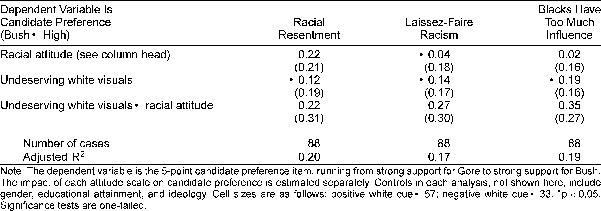
Table 7 compares the impact of white stereotype-consistent versus inconsistent cues, and a somewhat different pattern emerges. First, none of the coefficients in the deserving white condition is very large, suggesting that this cue did not produce a strong relationship between racial attitudes and candidate preference. However, cues implying that whites are the undeserving beneficiaries of government spending boost the impact of racial attitudes on the vote. Only the increase in the impact of the blacks have too much influence item even approaches statistical significance (p = 0.09, one-tailed), but the overall pattern implies that violating positive stereotypes of whites is not the same as violating negative stereotypes of blacks in terms of racial priming.24
These findings also allay our concern that the lexical task, and not simply our ads, primed respondents to think about race in the visually neutral condition. If such a task were powerful enough to racialize the neutral stimulus, we would expect that it might also racialize the versions of the ads with positive or negative depictions of whites. This does not happen. The impact of racial attitudes is not significantly different in the control condition compared to the positive or negative white conditions. The absence of visual race cues in the neutral cell must permit viewers to “fill in” the stereotypical group, blacks.

Violating the negative black stereotype did not make racial considerations more accessible in memory relative to the control group (mean difference= 0.04 log msec, p = 0.87). Violating the white stereotype did produce slightly faster response times to race relevant words, but the difference was not statistically significant (mean difference = 0.30 log msec, p = 0.19). On the other hand, the deserving blacks condition boosted the self-reported importance of group considerations in the vote calculus relative to the control (mean difference = 0.65 on a 1–7 scale, p = 0.03). The undeserving whites condition also significantly boosted the importance of group considerations compared to the control (mean difference = 0.91, p = 0.01). This pattern suggests that counter-stereotypical cues do not make racial attitudes more accessible but, instead, may induce conscious processing of the racial content of the message, thereby increasing the self-reported importance of groups. We speculate about the explanation for this last set of results in the discussion.
DISCUSSION
We set out to explore how standard political appeals alter the criteria citizens use to select candidates. Three major findings emerge. First, our evidence is consistent with Edsall and Edsall's (1991) claim that the language of government spending and taxation has become racially “coded,” such that its invocation in political appeals primes racial considerations even in the absence of racial imagery. More powerful effects emerge, however, when the imagery in political ads links blacks to the narrator's comments about undeserving groups. Ads that visually compare the interests of whites and blacks are slightly less powerful racial primes. Furthermore, none of the cues we manipulate prime individualism, egalitarianism, or partisan identification. We also find that racial priming is mediated by the accessibility of race in memory, not the self-reported importance of group representation. Finally, counter-stereotypic black cues suppress racial priming, while violating positive stereotypes of whites has, if anything, a positive racial priming effect.
Though the differences are small, the particular effects of the racial comparison versus the undeserving black cues conditions warrant further attention. One somewhat subtle pattern emerges from the finding that racial comparison cues primed racial attitudes that tapped the notion of resource competition in society (laissez-faire racism and “blacks have too much influence”) more powerfully than they primed direct resentment toward blacks or opinions about affirmative action or welfare. The undeserving blacks cues, however, powerfully primed all three racial attitude dimensions, as well as opinions about redistributive policies such as affirmative action and welfare. This pattern suggests that raising negative attributions about blacks, without referring to implications for whites, is a powerful political strategy. Highlighting resource competition is a somewhat weaker priming agent. Why might this be the case? Two explanations seem plausible. First, the salience of the racial stimulus in the comparison condition may have been diluted by the presence of white images. On the other hand, the salience of the racial stimulus in that condition may have been so high that subjects became conscious of it and consequently suppressed racial criteria in evaluating candidates. Given that the salience of the racial stimulus and the specific problem that it raised are confounded in these two conditions, we must reserve judgment with regard to which explanation is correct.
Interesting differences in priming effects appear when racial stereotypes are violated in different ways. Although neither the black nor the white counter-stereotypic cells significantly boosted the accessibility of race compared to the control group, both significantly raised the self-reported importance of group representation as a voting criterion. However, violating black stereotypes produces far weaker associations between racial attitudes and candidate evaluations than conforming to them did. Finally, violating the white stereotype slightly boosted the impact of racial attitudes compared to reinforcing the white stereotype. This pattern suggests that violating stereotypes may trigger increased attention and conscious processing of the stimulus, but the result for racial priming depends on the group involved. When the violated stereotype involves blacks, white respondents who wish to avoid race-based decision making suppress race as a criterion in their vote, even as they claim that group representation is important. When the white stereotype is violated, however, racial criteria are not suppressed because there is no obvious way that responding one way or another could be considered racist. Ironically, then, the increased importance of groups slightly boosts the association between racial attitudes and candidate evaluations in that instance.
The above speculation about the overall pattern of findings presented here is consistent with research demonstrating that priming is more powerful when subjects do not attend closely to the stimulus (Lombardi, Higgins, and Bargh 1987; Strack et al. 1993). Research on social categorization and group stereotyping also suggests that these processes operate mostly below the level of conscious awareness (Banaji and Hardin 1996; Bargh and Pietromonaco 1982). Mendelberg (2001) finds support for this as well, though she draws a dichotomous distinction between “implicit” appeals whose narratives do not mention racial groups and “explicit” ones that do. We think that it would be more useful to think of the underlying racial salience dimension as continuous: As the salience of race increases, the power of racial priming grows, until some point at which each viewer becomes conscious of the prime and begins to suppress race as a criterion. Our present findings merely provide a hint of evidence to support this claim: Some implicit cues seem more powerful than others in priming racial attitudes.
Our central finding, that subtle racial cues in political advertising can prime racial attitudes, should encourage investigations of racial priming effects beyond the classic instances of the 1988 Willie Horton ads, the Helms “White Hands” ad, and other racial appeals. It seems reasonable to expect that candidates will attempt to infuse particular group cues into the political debate, to shape the criteria that citizens use when evaluating candidates. If, as many suggest, attitudes about groups help voters organize the political world (Campbell et al. 1960; Converse 1964; Conover 1984), then priming those attitudes should comprise an effective communication strategy for candidates when they expect a large proportion of the “activated” group to vote for them.
Our results are consistent with Mendelberg's (2001), but we do not agree with all of her conclusions. Highly salient, or explicit, racial appeals may be less effective than more subtle or implicit ones, because some voters might intentionally avoid racial criteria when they become aware of them. Similarly, stereotype-inconsistent cues may also suppress priming by making people spend time thinking about how to reconcile the new information with prior beliefs. However, this does not necessarily mean that a different candidate will be preferred. Sensitizing people to the racial content of an appeal may undermine its persuasive impact, or it may lead to a more involved set of rationalizations to justify support for a prior choice. Individuals might suppress the expression of racial conservatism while leaving their candidate preference unchanged, thereby reducing the correlation between racial attitudes and vote choice. Further research on the behavioral consequences of long-term exposure to racial cues, varied across a wide range of perceptual salience, is needed.
These results leave several questions unanswered. First, further exploration is needed to determine the message characteristics that drive automatic, versus intentioned, priming effects. Prior work has found little evidence that accessibility mediates the impact of media exposure. Why do we get such strong and consistent results in this regard? One speculation is that the stimuli and the judgment tasks used in previous studies demand more conscious thought, thereby overwhelming subtler, automatic effects. Nelson, Clawson, and Oxley (1997), for example, had subjects view news stories about a Ku Klux Klan rally, framed in terms of either free speech or public order. The dependent variable in their analysis was tolerance for racist groups. Perhaps these stimuli, and the judgments they were designed to affect, required more careful consideration than was present in the political appeals and judgments we are concerned with in this paper. When either the priming stimulus or the target decision requires a great deal of conscious attention, we expect racial priming to be diminished. In the case of exposure to 30-sec advertisements and candidate preference formation, however, racial priming may exhibit quite pervasive effects.
Our results are based on a disproportionately educated and Democratic sample compared to the nation as a whole. We are somewhat reluctant, therefore, to generalize our findings to all citizens. However, studies employing entirely different samples have discovered similar effects (Mendelberg 2001; Reeves 1997; Valentino 1999). Further, by exposing a largely Democratic audience to a Republican message, ours is probably a conservative test of the theory, because priming may be more powerful when the party of the sponsor matches the partisan leanings of the viewer (Ansolabehere and Iyengar 1995). Nevertheless, studies that vary source characteristics and test racial priming hypotheses across a wider demographic and partisan range are warranted.
CONCLUSION
The evidence provided here, in combination with recent theoretical and empirical advances, suggests that a broadening of the debate about race in American politics is necessary. Far from being a spent force, the impact of race and racism in America can emerge from some of the most common political messages that mainstream candidates rely upon as their stock-in-trade. But this force is not overwhelming and constant, nor is it beyond the power of elites and masses to control. When campaigns emphasize policies that have been linked previously to blacks, they boost the impact of racial attitudes on candidate evaluations. When they reinforce negative stereotypes, the impact of racial attitudes grows. But when they violate those stereotypes by presenting blacks in a favorable light, or present images of nonstereotyped groups in these negative roles, that impact declines. When citizens are aware of the racial cues in a particular message, they seem to suppress racial thinking.
Unfortunately, the potential remedies for race priming we can offer—violating negative stereotypes, avoiding overemphasis on racialized issues—are meager, short-term fixes for a larger problem. By priming group attitudes, candidates take advantage of the ways citizens store political information in memory and attempt to simplify decision making. How, then, might one control some of the more pernicious effects of implicit racial priming during campaigns? A start would be to reduce elite incentives to prime racial attitudes in the first place, by breaking down invalid linkages between groups and social problems from which stereotypes spring. For example, the public's misperception of the proportion of welfare recipients who are African American could perhaps be remedied if news organizations took a proactive stance against perpetuating these inaccurate, negative stereotypes (Gilens 1999). Subsequently, invoking welfare issues, even coupled with images of blacks, might not pack the same punch when it comes to priming racial attitudes. The more general version of this plea is as controversial in some circles as it is commonsensical in others: We must engage in honest public discussion of the ways in which race, gender, and other group cleavages affect policymaking, election outcomes, and day-to-day living conditions in America. To begin this dialogue, we must recognize that implicit racial cues have been, and continue to be, cues that matter.
References
Ansolabehere Stephen
Iyengar Shanto
1995
Going Negative: How Political Advertisements Shrink and Polarize the Electorate
New York
Free Press
Banaji Mahzarin R.
Hardin Curtis
1996
Automatic Stereotyping
Psychological Science
7
May
136 41Google Scholar
Bargh John A.
Pietromonaco Paula
1982
Automatic Information Processing and Social Perception: The Influence of Trait Information Presented Outside of Conscious Awareness on Impression Formation
Journal of Personality and Social Psychology
43
September
437 49Google Scholar
Blair Irene V.
Banaji Mahzarin R.
1996
Automatic and Controlled Processes in Stereotype Priming
Journal of Personality and Social Psychology
70
June
1142 63Google Scholar
Bobo Lawrence
2000
Race and Beliefs About Affirmative Action: Assessing the Effects of Interests, Group Threat, Ideology, and Racism
Racialized Politics
David O. Sears
Sidanius Jim
Lawrence Bobo
Chicago
University of Chicago Press
137 64
Bobo Lawrence
Kluegel James R.
1997
Status, Ideology, and Dimensions of Whites' Racial Beliefs and Attitudes: Progress and Stagnation
Racial Attitudes in the 1990's: Continuity and Change
Steven A. Tuch
Jack K. Martin
Westport, CT
Praeger
93
120
Bobo Lawrence
Kluegel James R.
Smith Ryan A.
1997
Laissez-Faire Racism: The Crystallization of a Kinder, Gentler, Antiblack Ideology
Racial Attitudes in the 1990's: Continuity and Change
Steven A. Tuch
Jack K. Martin
Westport, CT
Praeger
15
41
Brewer Marilyn B.
Dull Valerie
Lui Layton
1981
Perceptions of the Elderly: Stereotypes as Prototypes
Journal of Personality & Social Psychology
41
October
656
70Google Scholar
Campbell Angus
Converse Philip E.
Miller Warren E.
Stokes Donald E.
1960
The American Voter
Chicago
University of Chicago Press
Carmines Edward G.
Stimson James A.
1989
Issue Evolution: Race and the Transformation of American Politics
Princeton, NJ
Princeton University Press
Coltrane Scott
Messineo Melinda
2000
The Perpetuation of Subtle Prejudice: Race and Gender Imagery in the 1990's Television Advertising
Sex Roles
42
March
363 89Google Scholar
Conover Pamela
1984
The Influence of Group Identifications on Political Perception and Evaluation
Journal of Politics
46
August
760 85Google Scholar
Converse Philip E.
1964
The Nature of Belief Systems in Mass Publics
Ideology and Discontent
David Apter
New York
Free Press
206 61
Devine Patricia
1989
Stereotypes and Prejudice: Their Automatic and Controlled Components
Journal of Personality and Social Psychology
56
January
5
18Google Scholar
Dixon Travis L.
Linz Daniel
2000
Overrepresentation and Underrepresentation of African Americans and Latinos as Lawbreakers on Television News
Journal of Communication
50
2
131 54Google Scholar
Domke David
McCoy Kelley
Torres Marcos
1999
News Media, Racial Perceptions, and Political Cognition
Communication Research
26
October
570
607Google Scholar
Edsall Thomas B.
Edsall Mary D.
1991
Chain Reaction: The Impact of Race, Rights, and Taxes on American Politics
New York
Norton
Entman Robert M.
1990
Modern Racism and the Images of Blacks in Local Television News
Critical Studies in Mass Communication
7
4
332 46Google Scholar
Entman Robert M.
1992
Blacks in the News: Television, Modern Racism, and Cultural Change
Journalism Quarterly
69
Summer
341 62Google Scholar
Entman Robert M.
Rojecki Andrew
2000
The Black Image in the White Mind: Media and Race in America
Chicago
University of Chicago Press
Fazio Russell H.
Williams Carol J.
1986
Attitude Accessibility as a Moderator of the Attitude-Perception and Attitude-Behavior Relations: An Investigation of the 1984 Presidential Election
Journal of Personality and Social Psychology
51
September
505 14Google Scholar
Fazio Russell H.
1990
A Practical Guide to the Use of Response Latency in Social Psychological Research
Review of Personality and Social Psychology, Vol. 11. Research Methods in Personality and Social Psychology
C. Hendrick
Margaret S. Clark
Newbury Park, CA
Sage
74 97
Finkel Steven E.
1993
Reexamining the ‘Minimal Effects’ Model in Recent Presidential Campaigns
Journal of Politics
55
February
1
21Google Scholar
Gaertner Samuel L.
Dovidio John F.
1986
The Aversive Form of Racism
Prejudice, Discrimination, and Racism
John F. Dovidio
Samuel L. Gaertner
Orlando, FL
Academic Press
61 89
Gilens Martin
1996
‘Race Coding’ and White Opposition to Welfare
American Political Science Review
90
3
593
604Google Scholar
Gilens Martin
1998
Racial Attitudes and Race-Neutral Social Policies: White Opposition to Welfare and the Politics of Racial Inequality
Perception & Prejudice
Jon Hurwitz
Mark Peffley
New Haven, CT
Yale University Press
171
201
Gilens Martin
1999
Why Americans Hate Welfare
Chicago
University of Chicago Press
Gilliam Franklin D. Jr.
Iyengar Shanto
2000
Prime Suspects: The Influence of Local Television News on the Viewing Public
American Journal of Political Science
44
July
560 73Google Scholar
Gray Herman
1995
Watching Race: Television and the Struggle for “Blackness”
Minneapolis
University of Minnesota Press
Hastie Reid
1981
Schematic Principles in Human Memory
Social Cognition: The Ontario Symposium
Vol. 1
E. Tory Higgins
C. Peter Herman
Mark P. Zanna
Hillsdale, NJ
Erlbaum
39
88
Hurwitz Jon
Peffley Mark
1998
Perception and Prejudice: Race and Politics in the United States
New Haven, CT
Yale University Press
Iyengar Shanto
1991
Is Anyone Responsible?
Chicago
University of Chicago Press
Iyengar Shanto
Kinder Donald R.
1987
News that Matters: Television and American Public Opinion
Chicago
University of Chicago Press
Jamieson Kathleen Hall
1992
Dirty Politics: Deception, Distraction, and Democracy
New York
Oxford University Press
Kinder Donald R.
Sanders Lynn
1996
Divided by Color: Racial Politics and Democratic Ideals
Chicago
University of Chicago Press
Kinder Donald R.
Sears David
1981
Prejudice and Politics: Symbolic Racism versus Racial Threats to the Good Life
Journal of Personality and Social Psychology
40
March
414 32Google Scholar
Lau Richard
1989
Individual and contextual influences on group identification
Social Psychology Quarterly
52
September
220 31Google Scholar
Lombardi Wendy J.
Higgins E. Tory
Bargh John A.
1987
The Role of Conscious in Priming Effects on Categorization: Assimilation versus Contrast as a function of Awareness of the Priming Task
Personality and Social Psychology Bulletin
13
September
411 29Google Scholar
Mendelberg Tali
1997
Executing Hortons: Racial Crime in the 1988 Presidential Campaign
Public Opinion Quarterly
61
Spring
134 57Google Scholar
Mendelberg Tali
2001
The Race Card: Campaign Strategy, Implicit Messages, and the Norm of Equality
Princeton, NJ
Princeton University Press
Miller Joanne
Krosnick Jon A.
2000
News Media Impact on the Ingredients of Presidential Evaluations: Politically Knowledgeable Citizens are Guided by Trusted Sources
American Journal of Political Science
44
April
301 15Google Scholar
Myrdal Gunnar
1944
An American Dilemma: The Negro Problem and Modern Democracy
New York
Harper & Row
Nelson Thomas
Kinder Donald R.
1996
Issue Frames and Group-Centrism in American Public Opinion
Journal of Politics
58
November
1055 78Google Scholar
Nelson Thomas
Clawson Rosalee
Oxley Zoe
1997
Media Framing of a Civil Liberties Conflict and Its Effect on Tolerance
American Political Science Review
91
September
567 83Google Scholar
Peffley Mark
Shields Todd
Williams Bruce
1996
The Intersection of Race and Crime in Television News Stories: An Experimental Study
Political Communication
13
July/September
309 27Google Scholar
Petrocik John R.
1996
Issue Ownership in Presidential Elections, with a 1980 Case Study
American Journal of Political Science
40
August
825 50Google Scholar
Price Vincent
Tewksbury David
1997
News Values and Public Opinion: A Theoretical Account of Media Priming and Framing
Progress In Communication Sciences, Vol. 13
G. A. Barnett
F. J. Boster
Greenwich, CT
Ablex
173
212
Reeves Keith
1997
Voting Hopes or Fears?: White Voters, Black Candidates, and Racial Politics in America
Oxford
Oxford University Press
Schuman Howard
Steeh Charlotte
Bobo Lawrence
Krysan Maria
1997
Racial Attitudes in America
Cambridge, MA
Harvard University Press
Sears David O.
1988
Symbolic Racism
Eliminating Racism: Profiles in Controversy
Phyllis A. Katz
Dalmas A. Taylor
New York
Plenum Press
53
84
Sears David O.
Sidanius Jim
Bobo Lawrence
2000
Racialized Politics: The Debate About Racism in America
Chicago
University of Chicago Press
Sniderman Paul M.
Carmines Edward G.
1997
Reaching Beyond Race
Cambridge, MA
Harvard University Press
Sniderman Paul M.
Hagen Michael G.
1985
Race and Inequality: A Study in American Values
Chatham, NJ
Chatham House
Sniderman Paul M.
Piazza Thomas
1993
The Scar of Race
Cambridge, MA
Harvard University Press
Strack Fritz
Schwarz Norbert
Blass Herbert
Kubler Almut
Wanke Michaela
1993
Awareness of the Influence as a Determination of Assimilation Versus Contrast
European Journal of Social Psychology
23
January/February
53
62Google Scholar
Taylor Shelley E.
Fiske Susan
1978
Salience, Attention, and Attribution: Top of the Head Phenomena
Advances in Experimental Social Psychology
Leonard Berkowitz
New York
Academic Press
249 88
Valentino Nicholas A.
1999
Crime News and the Priming of Racial Attitudes During Evaluations of the President
Public Opinion Quarterly
63
Fall
293
320Google Scholar
Transcripts of Implicit Race Cue Advertising Manipulation
Transcripts of Counter-Stereotypic Advertising Manipulation
Predicting Candidate Preference with Racial Attitudes and Racialized Issue Opinions, by Condition
The Impact of Partisan Identification and Global Values on Candidate Preference, by Condition
Note: Bars represent mean log milleseconds of response time for race-relevant word probes. Race-relevant word probes included “white,” “black,” “drug,” “lazy,” and “crime.” The analysis of variance used to estimate the significance of differences between conditions included controls for education,gender, and ideology.
Accessibility Versus Importance as Mediators of Priming Effects of Ads on Candidate Preference
Violating Negative Black Stereotypes and the Effect of Racial Attitudes on Candidate Preference
Violating Positive White Stereotypes and the Effect of Racial Attitudes on Candidate Preference
 You have Access
- 461
- Cited by
Comments
No Comments have been published for this article.