Introduction
Comorbid anxiety disorders significantly add to the burden of depression in terms of impact on quality of life, physical disability, increased health care utilization, and even mortality (e.g. Schoevers et al., Reference Schoevers, Van, Koppelmans, Kool and Dekker2008). Moreover, comorbid anxiety disorders negatively impact on treatment outcome of depression (e.g. Andreescu et al., Reference Andreescu2007; Greenlee et al., Reference Greenlee, Karp, Dew, Houck, Andreescu and Reynolds2010; Roca et al., Reference Roca2011). Knowledge of determinants of comorbid anxiety disorders in depression may guide development of more specific interventions. Nonetheless, the literature on “anxiety in depression” is difficult to interpret as studies on depressed patients with a high level of anxiety symptoms and depressed patients with concurrent anxiety disorders are often grouped together. Recently, we have shown that, in a sample of patients with depression, comorbid anxious distress or as comorbid anxiety disorders, identify completely different patients, where, for example, depressed older persons who report high levels of (somatic) anxiety symptoms are of a different group than patients suffering from comorbid PD (van der Veen et al., Reference van der Veen, Comijs, van Zelst, Schoevers and Oude Voshaar2014). Determinants of anxious distress and of comorbid anxiety disorders should therefore be examined separately.
Although, a number of studies examined risk factors for anxiety and depression (for a review see Vink et al., Reference Vink2008), to our knowledge, only four studies have explored determinants of comorbid anxiety disorders in late-life depression (Allgulander and Lavori, Reference Allgulander and Lavori1993; Lenze, Reference Lenze2000; Bartels et al., Reference Bartels2002; Cairney et al., Reference Cairney, Corna, Veldhuizen, Herrmann and Streiner2008). These studies found that comorbid anxiety disorders are associated with both, a higher level of psychological and somatic distress (Lenze, Reference Lenze2000; Cairney et al., Reference Cairney, Corna, Veldhuizen, Herrmann and Streiner2008), a higher frequency of completed suicide (Allgulander and Lavori, Reference Allgulander and Lavori1993) and suicidal ideation (Lenze, Reference Lenze2000; Bartels et al., Reference Bartels2002), as well as poorer social functioning (Lenze, Reference Lenze2000). Nonetheless, these determinants were not consistently found in each of the studies. Furthermore, personality characteristics as well as early and recent life-events are common risk factors for late-life anxiety and depressive disorders, but have not been studied as determinants of comorbid anxiety disorders in late-life depression (Vink et al., Reference Vink2008). Besides, these characteristics are important moderators for treatment outcome in old age psychiatry (Newton-Howes et al., Reference Newton-Howes, Tyrer and Johnson2006; Veerbeek et al., Reference Veerbeek, Oude Voshaar and Pot2014). Results from randomized controlled trials suggest that especially cluster C personality disorder negatively impact on antidepressant treatment outcome (e.g. Morse et al., Reference Morse, Pilkonis, Houck, Frank and Reynolds2005), whereas epidemiological studies point to neuroticism as a predisposing and perpetuating factor in late-life depression (Steunenberg et al., Reference Steunenberg, Braam, Beekman, Deeg and Kerkhof2009). Therefore, we hypothesise an association between personality characteristics and comorbid anxiety disorders in late-life depression.
The aim of this study was to examine personality characteristics as well as early and recent life-events as possible determinants of comorbid anxiety disorders in late-life depression, taking previously examined determinants of higher levels of psychological, social, and somatic distress into account. Since pure anxiety disorders are rare in later life (Flint, Reference Flint2005; Kessler et al., Reference Kessler, Berglund, Demler, Jin, Merikangas and Walters2005; Lenze et al., Reference Lenze2005) and many treatment studies on late-life anxiety lump different anxiety disorder together, we first explored determinants of “any concurrent anxiety disorder”, where after we explored further differentiation between the different concurrent anxiety disorders.
Methods
Study design and participants
This cross-sectional study is based on baseline data from the Netherlands Study of Depression in Older persons (NESDO), is a multi-site naturalistic cohort study that includes 378 depressed and 132 non-depressed participants aged 60–93 years (see Comijs et al., Reference Comijs2011). Persons with a clinical diagnosis of dementia or who were suspect for dementia, or a Mini Mental State Examination-score (MMSE, Folstein et al., Reference Folstein, Folstein and McHugh1975) under 18 (out of 30 points), and insufficient command of the Dutch language were excluded.
Psychiatric diagnoses were assessed with the CIDI (CIDI – version 2.1 World Health Organization (WHO), 1997) according to DSM-IV-R criteria.
For the present paper, we first selected those patients who met the criteria for a major depressive episode within the past six months (n = 359, 95%), therefore we excluded 19 patients who met the criteria for a minor depression of dysthymia only. Patients were classified as positive for a comorbid anxiety disorder if there was an anxiety disorder in the past six months, including SP, GAD, PD with and without AGO) and finally AGO. Rules concerning the hierarchical diagnostic structure of the DSM, where GAD cannot be diagnosed in the presence of MDD were not followed to make meaningful comparison possible. To avoid contamination of depressed patients with a recently remitted anxiety disorder, we excluded a further nine patients who had an anxiety disorder in the past 12 months, but not anymore in the past six months.
Possible determinants of comorbid anxiety disorders
We characterized our population by age, gender, and level of education (total educated years) as demographic characteristics. All other determinants were assessed with questionnaires (or tests) that have proven adequate psychometric properties among Dutch older persons.
Psychological functioning
The severity of depressive symptoms was assessed with the 28-item self-report version of the Inventory of Depressive Symptomatology (IDS-SR, Rush et al., Reference Rush, Gullion, Basco, Jarrett and Trivedi1996). Thoughts of death or suicide during the past month were derived from CIDI questions. Participants were divided in three groups: (1) no thoughts of death or suicide; (2) thoughts of death but no thoughts of suicide; (3) thoughts, plans or attempts of suicide.
Physical health
The presence of chronic diseases was assessed by means of a self-report questionnaire applied by interviewer. First, screening questions were asked and in case of a positive answer, more detailed predefined questions were asked. Based on a validated algorithm, the presence of cardiac disease, peripheral atherosclerosis, stroke, diabetes mellitus, COPD, arthritis, cancer, or any other chronic disease was assessed (Kriegsman et al., Reference Kriegsman, Penninx, van Eijk, Boeke and Deeg1996). Compared to general practitioner information, the accuracy of self-reports of these diseases was shown to be adequate and independent of cognitive impairment (Kriegsman et al., Reference Kriegsman, Penninx, van Eijk, Boeke and Deeg1996). Gait speed, a proxy for physical frailty (Peel et al., Reference Peel, Kuys and Klein2012), and best implemented using a short distance (Abellan van Kan et al., Reference Abbelan van Kan2009), was assessed by a six meter walk test (Cesari et al., Reference Cesari2005).
Social functioning
Social functioning was indexed by having a stable relationship (yes/no) as well as the level of loneliness with the 11-item Loneliness and Affiliation scale (de Jong-Gierveld et al., 1985).
Early life-events (childhood trauma)
Childhood trauma, including emotional neglect as well as psychological, physical, and sexual abuse before the age of 16, was assessed using a structured inventory previously used in the Mental Health Survey and Incidence Study (de Graaf et al., Reference de Graaf, Bijl, Ten Have, Beekman and Vollebergh2004) and the Netherlands Study of Depression and Anxiety (Penninx et al., Reference Penninx2008). A childhood abuse index was constructed ranging from 0 to 8, with higher scores indicating a higher frequency of childhood abuse (see Comijs et al., Reference Comijs, van Exel, van der Mast, Paauw, Oude Voshaar and Stek2013).
Recent life-events
The occurrence of recent stressful life-events was assessed using the List of Threatening Experiences (LTE; Brugha et al., Reference Brugha, Bebbington, Tennant and Hurry1985). These events reflect the presence of life stressors during the past year, such as serious illness and injury, death of close friend or relative, unemployment, major financial loss, and loss of important relationships. The LTE has good test–retest reliability, high agreement between participant and informant ratings, and good agreement with interview-based ratings (Brugha and Cragg, Reference Brugha and Cragg1990). We dichotomized the number of life-events in the past year as none versus one or more life-events.
Personality
We assessed the big five personality domains, i.e. neuroticism, extraversion, conscientiousness, agreeableness, and openness to experience, with the 60-item NEO-Five Factor Inventory (NEO-FFI, Costa and McCrae, Reference Costa and McCrae1995). The psychometric properties of the Dutch version of the NEO-FFI are generally good (Hoekstra et al., Reference Hoekstra, Ormel and De Fruyt1996). The internal consistencies of all domains range from acceptable to good, and are comparable to those of the American version. In addition, mastery was assessed with a short mastery scale (Pearlin and Schooler, Reference Pearlin and Schooler1978).
Analyses
Differences between depressed participants with or without a comorbid anxiety disorder were analysed by independent t-tests or χ 2 statistics.
Multivariate logistic regression analyses were performed to assess the association between previously identified determinants of comorbid anxiety disorders. Age, sex and level of education were entered in each regression model with the presence (yes/no) of any comorbid anxiety disorder as the dependent variable. Subsequently, indicators of psychological functioning (depression severity, presence of suicidal ideation or intention), physical functioning (number of chronic somatic disease and gait speed) and social functioning (partner status, loneliness) were added using a forward stepwise procedure. In order to explore specific results for the different anxiety disorders, all analyses were repeated with the specific anxiety disorder as the dependent variable. In these analyses, depressed patients with a comorbid anxiety disorder other than the dependent variable were excluded.
Subsequently, recent life-events, early traumatisation, the big five personality characteristics, and level of mastery were added in separate models. These models will be adjusted for the determinants found to be significantly associated with comorbid anxiety disorders in any of the previous models described above. In these models, we also examined whether the presence of recent life-events interacted with the severity of childhood traumatisation or any of the personality traits, as theoretically, characterological vulnerable people may be more stress-responsive and thereby having a higher chance of a comorbid anxiety disorder.
Results
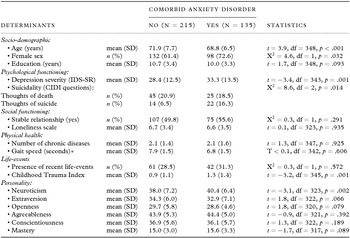
The mean (standard deviation) age of the 350 patients was 70.7 (7.4) years old; 230 (65.7%) were female. See Table 1 for further characteristics of the study population, stratified by the presence of any comorbid anxiety disorder.
Characteristics of study population stratified by presence of any comorbid anxiety disorder

* Analyses based on log-transformed values, which are back transformed for interpretation
A total of 135 (38.6%) patients suffered from any comorbid anxiety disorder. The most frequent comorbid anxiety disorder was SP (n = 62, 17.7%), followed by PD with and without AGO (n = 52, 14.9%), AGO (n = 36, 10.3%) and finally GAD (n = 33, 9.4%). Figures of the individual anxiety disorder do not add up to 38.6%, as 40 patients had two anxiety disorders and four patients had three anxiety disorders.
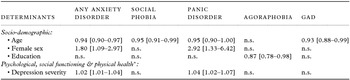
As shown in Table 2, having a comorbid anxiety disorder was associated with a lower age and being female. Nonetheless, the determinants differed across the individual anxiety disorders. Of the determinants indicative of poor psychological and social functioning and physical health, only the severity of depressive symptoms reached significance in two of the models, i.e. as determinant of any comorbid anxiety disorder and as determinant of comorbid PD.
Determinants of comorbid anxiety disorders in multivariate logistic regression analysis

* Since suicidality, partner status, loneliness, number of somatic diseases, and gait speed did not reach significance in any of the models, these variables are not presented in the table.
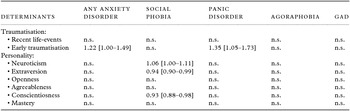
Subsequently, we examined in separate logistic regression models (all adjusted for age, sex, level of education, and severity of depression) whether recent and early life-events as well as each personality trait was associated with any comorbid anxiety disorder as well as with each comorbid anxiety disorder separately (see Table 3). Recent life-events were not associated with any anxiety disorder. Early traumatisation was solely associated with PD. Personality traits were not associated with comorbid anxiety disorders in general, but neuroticism, extraversion and conscientiousness were associated with SP, specifically. The presence of recent life-events did neither interact with early traumatisation, nor with any of the personality traits.
Life-events, early traumatisation and personality*

* Adjusted for age, sex, level of education and severity of depressive symptoms (see Table 2).
Discussion
In line with previous studies, we found that 38.6% of depressed older patients had a comorbid anxiety disorder (Beekman et al., Reference Beekman, de Beurs, van Balkom, Deeg, van Dyck and van Tilburg2000; Lenze, Reference Lenze2000; Ritchie et al., Reference Ritchie2004; Cairney et al., Reference Cairney, Corna, Veldhuizen, Herrmann and Streiner2008). Important determinants of comorbid anxiety disorders include age, sex, depressive symptom severity, and early traumatization. Nonetheless, determinants differ across the individual comorbid anxiety disorders and some determinants are even masked by lumping all anxiety disorders together, like level of education and the personality traits neuroticism, extraversion and conscientiousness. These findings point to the importance of acknowledging the individual comorbid anxiety disorders.
Prevalence
Previously reported prevalence rates of comorbid anxiety disorders in late-life depression ranges from 23% to 47.5% (Beekman et al., Reference Beekman, de Beurs, van Balkom, Deeg, van Dyck and van Tilburg2000; Lenze, Reference Lenze2000; Ritchie et al., Reference Ritchie2004; Cairney et al., Reference Cairney, Corna, Veldhuizen, Herrmann and Streiner2008), which may be explained by several methodological differences. First of all, the heterogeneity in the type of anxiety disorders included is a relevant matter. Some studies have included post-traumatic stress disorder (Lenze, Reference Lenze2000) or obsessive-compulsive disorder (Beekman et al., Reference Beekman, de Beurs, van Balkom, Deeg, van Dyck and van Tilburg2000; Ritchie et al., Reference Ritchie2004a), which are not classified as anxiety disorders anymore in the DSM-5, whereas also studies differ on the inclusion (or not) of specific phobia and GAD (Beekman et al., Reference Beekman, de Beurs, van Balkom, Deeg, van Dyck and van Tilburg2000; Lenze, Reference Lenze2000; Ritchie et al., Reference Ritchie2004). Nonetheless, the distribution of individual anxiety disorders as reported in previous studies is comparable to ours, with the highest prevalence rates for comorbid SP, followed by PD with or without AGO, AGO solely and finally GAD (Lenze, Reference Lenze2000). Widely discrepant prevalence rates of GAD can be explained by the minimal duration of these symptoms of one month, based on DSM-III criteria (Beekman et al., Reference Beekman, de Beurs, van Balkom, Deeg, van Dyck and van Tilburg2000) versus six months when applying DSM-IV criteria (Lenze, Reference Lenze2000; Ritchie et al., Reference Ritchie2004; Cairney et al., Reference Cairney, Corna, Veldhuizen, Herrmann and Streiner2008). Second, studies use different diagnostic assessment instruments (e.g. the CIDI, Cairney et al., Reference Cairney, Corna, Veldhuizen, Herrmann and Streiner2008), the Structured Clinical Interview for DSM-IV Axis I Disorders (SCID, Lenze, Reference Lenze2000), the Mini International Neuropsychiatric Interview (MINI, Ritchie et al., Reference Ritchie2004) or the Diagnostic Interview Schedule (DIS, Beekman et al., Reference Beekman, de Beurs, van Balkom, Deeg, van Dyck and van Tilburg2000)) and have applied different time-windows (1- (Ritchie et al., Reference Ritchie2004); 6- (Beekman et al., Reference Beekman, de Beurs, van Balkom, Deeg, van Dyck and van Tilburg2000); or 12-month diagnoses (Cairney et al., Reference Cairney, Corna, Veldhuizen, Herrmann and Streiner2008)).
Determinants
The impact of age was a generic effect across individual anxiety disorders; with younger patients having a higher likelihood of suffering from comorbid anxiety disorders. This is in line with findings of the National Comorbidity Survey-Replication showing a general decline of comorbid mood-anxiety disorders with age (55 years and older) (Byers et al., Reference Byers, Yaffe, Covinsky, Friedman and Bruce2010) as well as with a general decrease in anxiety disorders in older compared to younger patients (Kessler et al., Reference Kessler, Berglund, Demler, Jin, Merikangas and Walters2005). These findings stress the need to examine determinants of comorbid anxiety by age groups.
Although female sex, severity of depressive illness and early traumatisation were determinants of having any comorbid anxiety disorder, having a comorbid PD primarily drove these effects. In adult samples, females have 2–2.5 times the risk of developing a PD (see Sheikh et al., Reference Sheikh, Leskin and Klein2002) and are more likely to develop more severe and chronic forms of PD (Yonkers et al., Reference Yonkers, Bruce, Dyck and Keller2003). Furthermore, females have a higher risk of being traumatised in early life (Dong et al., Reference Dong, Anda, Dube, Giles and Felitti2003). Early traumatisation (childhood adversity) predisposes to developing a major depressive disorder as well as PD (Young et al., Reference Young, Abelson, Curtis and Nesse1997; Goodwin et al., Reference Goodwin, Fergusson and Horwood1999), and in case of these disorders, early traumatisation is associated with a higher severity (Kim et al., Reference Kim2013).
Besides these general issues that may explain our finding, there might be a diagnostic issue. In DSM-5, the depressive disorder specifier “with anxious distress” focuses on somatic anxiety symptoms. The anxious distress specifier is assumed to identify a more severe form of depression and can be assumed to have considerable overlap with the major depressive disorder with comorbid PD, since somatic anxiety symptoms are the core symptoms of PD. Therefore, we may not be looking at “pure” comorbidity, but merely a heterogeneous group where some have a comorbid PD and some have an anxious depression as a specific subtype of depression (van der Veen et al., Reference van der Veen, Comijs, van Zelst, Schoevers and Oude Voshaar2014).
None of the personality traits was associated with “any comorbid anxiety disorder”. When examined for the individual anxiety disorder separately, SP appeared to be associated with a higher level of neuroticism, lower level of extraversion and a lower level of conscientiousness. Avoidant personality disorder can be seen as a more severe and chronic form of SP (Chambless et al., Reference Chambless, Fydrich and Rodebaugh2008; Lampe and Sunderland, Reference Lampe and Sunderland2013). Interestingly, avoidant personality disorder is also associated with a higher level of neuroticism as well as with a lower level of extraversion (Samuel and Widiger, Reference Samuel and Widiger2008). Low levels of extraversion typically are most marked in depression and SP (i.e. Saulsman and Page, Reference Saulsman and Page2004). Our findings follow the same trend but leave the significantly lower score on conscientiousness unexplained.
In addition to the determinants we found, the absence of some determinants may also be relevant. First of all, recent life-events were neither associated with a comorbid anxiety disorder, nor interacted with any of the personality traits in explaining the presence of a comorbid anxiety disorder. Previously, life-events were found to be associated with anxiety symptoms in late-life depression, but this accounted for only 3% of variance when corrected for depression severity (Flint and Rifat, Reference Flint and Rifat2002).
Second, we did not find an independent effect of suicidality with comorbid anxiety disorder, which has been frequently reported in the literature on anxious depression in younger patients (e.g. Sareen et al., Reference Sareen2005; Goes et al., Reference Goes2011). This effect in younger and middle-aged adults have been assumed to be driven by having a comorbid PD (Johnson, Reference Johnson, Weissman and Klerman1990; Allgulander and Lavori, Reference Allgulander and Lavori1993; Andrade et al., Reference Andrade, Eaton and Chilcoat1994). In old age, Bartels (Bartels et al., Reference Bartels2002) also found that comorbid anxiety disorders were a significant correlate of suicidal and death ideation after controlling for depressive symptom severity. We also found that having a comorbid anxiety disorder was associated with more thoughts of suicide. When corrected for depression severity, however, this association lost significance, conform earlier findings of Lenze, who only found this association with GAD (Lenze, Reference Lenze2000).
Finally, comorbid GAD as well as AGO were hardly associated with specific determinants. Although speculative, it might be that in later life it is much more difficult to distinguish between worrying in GAD and rumination in depression as well as depressive avoidance due to a lack of motivation and anxious avoidance due to anticipatory anxiety (Mohlman et al., Reference Mohlman2011).
Methodological considerations
The strengths of our study are the large number of older persons suffering from depression and high quality of data collection. Moreover, depressed persons were recruited from both mental healthcare institutes and general practices in order to include persons with late-life depression in various developmental and severity stages (see Comijs et al., Reference Comijs2011). Nonetheless, some limitations should also be acknowledged for proper interpretation. First, the cross-sectional study design precludes causal interpretations of the findings. Second, we measured personality traits and depression at the same time. Although, personality traits are stable, the presence of depression is known to amplify the personality profile of people prone to depression (Costa et al., Reference Costa, Bagby, Herbst and McCrae2005). After recovery of depression, however, the overall shape of the profile does not change (Costa et al., Reference Costa, Bagby, Herbst and McCrae2005). Furthermore, the relationship between change in personality and change in depressive symptoms is at most moderate (Santor et al., Reference Santor, Bagby and Joffe1997; Ormel et al., Reference Ormel, Oldehinkel and Vollebergh2004; Costa et al., Reference Costa, Bagby, Herbst and McCrae2005; Spinhoven et al., 2014).
Implications/interpretation/conclusion
Since high anxiety levels in late-life depression have frequently been associated with negative treatment outcome, determinants of increased anxiety levels are of importance for guiding treatment development and refinement. Except one study, all outcome studies on late-life anxious depression, however, are based on (different) anxiety specifiers. An initial meta-analysis including trials published up to August 2006 did not find any impact on treatment outcome of increased anxiety symptoms in late-life depression (Nelson et al., Reference Nelson, Delucchi and Schneider2009). More recent studies, however, all point to negative effects of pre-treatment anxiety levels on treatment outcome in terms of a delayed or reduced response as well as a higher chance of relapse (Dew et al., Reference Dew1997; Flint and Rifat, Reference Flint and Rifat1997; Andreescu et al., Reference Andreescu2007; Saghafi et al., Reference Saghafi2007; Greenlee et al., Reference Greenlee, Karp, Dew, Houck, Andreescu and Reynolds2010). The only two studies examining the impact of comorbid anxiety disorders in late-life depression showed a delayed response (Mulsant et al., Reference Mulsant, Reynolds, Shear, Sweet and Miller1996; Hegel et al., Reference Hegel2005). These differential findings stress the need to include formal anxiety disorders as well as (different) anxiety specifiers when examining treatment outcome in late-life anxious depression.
Conflict of interest
None.
Description of authors’ roles
Van der Veen and Oude Voshaar formulated the research questions, analyzed the data and wrote the paper. Comijs, as principal investigator of the NESDO study was responsible for the study design, data collection, and co-authored the paper. Van Zelst and Schoevers offered their expert opinion on mood and anxiety disorders in late-life and co-authored the paper.