

1. INTRODUCTION
In the unitary model of the family, household decisions are analyzed under the hypothesis that the household is a single decision unit that maximizes the welfare of its members. This unitary family is a black-box where individual consumption decisions and resource allocation processes are not taken into account. In this framework, the head of the household makes all the relevant decisions, including child and spouse consumption, as if decisions were optimal for the welfare of all household members. However, the welfare consequences caused by unequal intrahousehold distribution may be relatively large particularly in developing countries, where the household endowment of resources is often meager.
How resources are allocated within the family is also relevant when the interest is to properly evaluate the impact of a policy or other exogenous events on individual welfare and to design public interventions aiming at favoring a more equal distribution within the household, such as those targeted to females or children in need. Rosenzweig (Reference Rosenzweig1986) and several recent empirical tests [Kusago and Barham (Reference Kusago and Barham2001), Mangyo (Reference Mangyo2008), Alam (Reference Alam2012), Dunbar et al. (Reference Dunbar, Lewbel and Pendakur2013), Bargain et al. (Reference Bargain, Donni and Kwenda2014), de Brauw et al. (Reference de Brauw, Gilligan, Hoddinott and Roy2014), Vijaya et al. (Reference Vijaya, Lahoti and Swaminathan2014), and Wang (Reference Wang2014)] have highlighted the weakness of treating the household as an individual decision maker when studying microeconomic behavior in developing countries, where highly variable socioeconomic conditions and culture may strongly influence intrahousehold inequality. For instance, the impact of cash transfers on poverty among children depends on the different response of each household in terms of the intrahousehold re-allocation of resources [Alderman et al. (Reference Alderman, Chiappori, Haddad, Hoddinott and Kanbur1995), Duflo (Reference Duflo2000), and Jacoby (Reference Jacoby2002)], especially considering that the identity of the recipient of a cash transfer does matter in terms of outcomes [Lundberg et al. (Reference Lundberg, Pollak and Wales1997), Duflo (Reference Duflo2003), Ward-Batts (Reference Ward-Batts2008), Bobonis (Reference Bobonis2009), and Attanasio and Lechene (Reference Attanasio and Lechene2014)].
One way to study the intrahousehold distribution of resources is to model family behavior in a collective setting, as introduced by Chiappori (Reference Chiappori1988, Reference Chiappori1992), to identify the rule governing the distribution of resources and intrahousehold inequality. The collective approach enables the identification of the structure of preferences and welfare functions of each household member. Most applications of the collective household theory estimate the sharing rule between husband and wife or treated children as public goods for their parents [Blundell et al. (Reference Blundell, Chiappori and Meghir2005) and Cherchye et al. (Reference Cherchye, De Rock and Vermeulen2012)]. Children as bargaining agents were introduced by Bourguignon (Reference Bourguignon1999), who shows how to derive the sharing rule both between parents and parents and children.
The present work follows this approach to describe how resources are allocated among members of Albanian families, placing special emphasis on the consequences of family splitting due to parental and spousal migration. It uses a collective consumption model based on a complete demand system with price variation and individual Engel effects similar to Arias et al. (Reference Arias, Atella, Castagnini, Perali, Dagum and Ferrari2004), Menon et al. (Reference Menon, Perali and Piccoli2017a), and Caiumi and Perali (Reference Caiumi and Perali2014), but extended to estimate the rule governing the distribution of resources between adults (female and male) and children.
In a similar way, Dunbar et al. (Reference Dunbar, Lewbel and Pendakur2013) implement a collective consumption model, although not based on a complete demand system, in a development setting. They extended the model of Browning et al. (Reference Browning, Bourguignon, Chiappori and Lechene1994) studying how resources are allocated both between parents and between parents and children in Malawi. Their main findings are that resource allocation varies by family size and structure and standard poverty indices understate the incidence of child poverty. Similar results have been obtained by Bargain et al. (Reference Bargain, Donni and Kwenda2014), using a different identification strategy, in the context of Cote d’Ivoire.
A proper implementation of collective models requires the sharing rule to be correctly identified. While intrahousehold allocation is not (fully) observable, it can be recovered using specific identifying assumptions based on observable household data about the exclusive or assignable consumption of at least one good, such as men’s, women’s, and children’s clothing [Browning et al. (Reference Browning, Bourguignon, Chiappori and Lechene1994), Menon and Perali (Reference Menon and Perali2012), and Chiappori and Meghir (Reference Chiappori and Meghir2015)]. Our identification strategy is based on this individual-specific consumption information and the observation of suitable distribution factors, exogenous variables that modify the intrahousehold distribution of resources but do not affect consumption choices. Unlike most other studies, exogenous price variation is exploited by constructing (pseudo) unit values using the technique first introduced by Lewbel (Reference Lewbel1989) and applied by Atella et al. (Reference Atella, Menon, Perali, Ferrari and Dagum2004), Arias et al. (Reference Arias, Atella, Castagnini, Perali, Dagum and Ferrari2004), Menon et al. (Reference Menon, Perali and Piccoli2017a), and Caiumi and Perali (Reference Caiumi and Perali2014). Further, our empirical strategy can be used to analyze the impact of specific factors on the share of resources for each household member. An endogenous binary variable model estimated by maximum likelihood is used to evaluate the impact of a family split due to international migration on the rule governing the allocation of resources in Albania.
Albania is a particularly interesting setting to study the governance of household resources within the family and describe how it changes when one of the parents migrates. At the end of the Second World War, Albania was a traditional rural society with patriarchal family values and patrilineal kinship system. In mountain and rural areas, the social and economic structure was governed by the Kanun code, a set of traditional and unwritten laws, based on patriarchy handed down from generation to generation since the Middle Ages [Gjonca et al. (Reference Gjonca, Aassve and Mencarini2008) and Vullnetari (Reference Vullnetari2012)]. This set of laws gave males unquestioned authority within the household. For instance, daughters could not inherit, unless there were no sons. In this case, the daughter needed to become a burrnesha (sworn virgin) dressing and behaving like a man including in smoking and drinking habits, and, therefore, giving up on forming a family. In the Kanun, the “blood of a woman is not comparable to that of a man,” and she was considered as a “jar made just to bear.” During the isolationist communist regime, the educational policies targeted on females tried to dilute the patriarchal values of Albanian households, not entirely successfully. The family maintained a central position in the society archetype of Albania and patriarchal values resurfaced after the fall of the regime in the 1990s and the consequent increase in economic uncertainty. The country partially returned to a traditional family structure with the risk of relegating women – and indirectly childrenFootnote 1 – to a marginal role, becoming more and more vulnerable to suffering severe poverty and malnutrition especially among northern communities.
In Albania, large migration flows out of the country represented an additional challenge to the family model after 1990, especially in rural areas where poverty is more rooted. The household structure has changed deeply since migration strongly affected family stability and role equilibria exposing the most vulnerable family members left behind to the risk of chronic poverty. In the Albanian tradition, especially at times of historical and political upheaval, temporary migration was a normal practice. For example, the pre-communist migration was a consequence of the Ottoman occupation and gave rise to stable small Albanian communities in the South of Italy. The massive migration that took place after 1990 was dominated by young males leaving a socially relevant portion of female spouses and children behind [Giannelli and Mangiavacchi (Reference Giannelli and Mangiavacchi2010) and Mendola and Carletto (Reference Mendola and Carletto2012)]. King and Vullnetari (Reference King and Vullnetari2012) and Vullnetari (Reference Vullnetari2012) study how Albanian women participate in the migratory process suggesting that they are often the most important pillar for supporting the family migration strategy, when remaining behind, through their participation in the labor market, providing domestic work and as caregiver for children and the parents of male migrants. However, women are often left out of the decision-making process. The absence of fathers changes the distribution of duties and responsibilities, with implications for children’s development. In our sample, when the father migrates, the administrative headship shifts to the mother in 48.8% of families as compared to 6.0% of nonmigrant families, while an elderly male takes the headship in 26.0% of the sub-sample of families left behind.
This scenario reveals a double-sided research question. On the one hand, we aim to understand whether and how mothers can manage household resources after the father’s departure. On the other hand, we aim at verifying whether the shift of the decision power to the hands of an elderly male poses a risk of returning toward traditional values with the consequent increase in discrimination against women and associated lower investment in child development. To address these issues, we implement the collective approach to the modeling of household decision making and link it with a recent stream of research on the welfare of family members left behind focusing on spouses [Amuedo-Dorantes and Pozo (Reference Amuedo-Dorantes and Pozo2006), Lokshin and Glinskaya (Reference Lokshin and Glinskaya2009), and Cortes (Reference Cortes2015)], children [Giannelli and Mangiavacchi (Reference Giannelli and Mangiavacchi2010), Antman (Reference Antman2011), Antman (Reference Antman2012), and Chen (Reference Chen2013)], or the elderly [Antman (Reference Antman2010)]. This literature argues that the change in family composition due to migration leads to a shift in decision-making power, possibly affecting individual well being. However, none of these studies deals directly with transmission mechanisms behind the empirical evidence or models the intrahousehold allocation of resources explicitly. Chen (Reference Chen2013) proposes a noncooperative model of household decision making, finding that when the father migrates without his family, children spend more time in household production, while mothers spend less time in both household production and income-generating activities. Antman (Reference Antman2015) studies the relationship between international migration and children’s gender discrimination in Mexico focusing on the spousal control of resources. She found empirical evidence that a greater share of resources is spent on girls compared to boys when the father has emigrated and the mother has greater decision power. Unlike these studies, the consequences of migration are studied by explicitly taking into account individual and intrahousehold distribution issues.
To pursue this strategy, our study faces an additional empirical issue. The decision to migrate abroad is likely to be endogenous to the intrahousehold allocation of resources. In the literature, international migration has been considered endogenous with respect to many family outcomes such as consumption, labor supply, and children’s education. Antman (Reference Antman2015) and Chen (Reference Chen2013) link intrahousehold gender discrimination among children with father migration. Antman (Reference Antman2015) treats migration as endogenous with respect to household expenditure for girls and boys. Chen (Reference Chen2013) adopts a panel approach to deal with possible unobservable factors influencing both the decision to migrate and time use allocation. To the best of our knowledge, our paper is the first dealing with the potential endogeneity arising between the decision to migrate and the sharing rule. Indeed, the share of resources allocated to each household member can be influenced by a change in household composition due to migration choices. However, the sharing rule depends on the intrahousehold decision-making process, which in turn is also determined by family values and culture. These unobservable factors may influence the decision to migrate as well, thus posing an identification problem. This issue is addressed by means of a post estimation strategy, applying an endogenous binary variable model to the predicted shares of resources of males, females, and children, and using as exclusion restrictions proxies for the migrant network [Mckenzie and Rapoport (Reference Mckenzie and Rapoport2007)], the historic propensity to leave behind family and community social capital [Putnam et al. (Reference Putnam, Leonardi and Nanetti1994)].
Our main results suggest that Albanian women are willing to sacrifice part of their resource share in favor of their children, especially to daughters. This results in an average resource share of 26.3%, compared to 35.1% of men and 38.6% of children. This suggests that women in Albania are suffering severe discrimination in the allocation of resources within the household. When the control of family resources shifts to the mother, she allocates substantially more resources to the children – especially when the proportion of female children is larger – often at the expense of her own resource share. This is in line with previous studies on the impact of policy interventions aiming at increasing the relative income of women [Duflo (Reference Duflo2000, Reference Duflo2003)]. No evidence is found of a significant change in the distribution of resources when the control of resources shifts to older males. In general, our results show that, if appropriate policies are adopted, there is scope to significantly improve the equitable distribution of resources and power within the household while relaxing the excessive burden of migration on mothers.
The paper is organized as follows. Section 2 presents the collective model of consumption choices and specifies both the functional structure of the sharing rule and the complete collective demand system. Section 3 deals with the empirical issues faced in the application and the strategy proposed to address them. Section 4 describes the data used and the sample selection. Results are discussed in Section 5, placing special emphasis on the factors influencing the distribution of resources and the implications of international migration on the family members left behind. Section 6 gives our conclusive remarks.
2. THE COLLECTIVE CONSUMPTION FRAMEWORK
Our collective model of consumption assumes that the family decision-making process, conducted in a deterministic environment, leads to Pareto-efficient outcomes provided that individual utility functions are well behaved and the budget sets are convex. These assumptions of the collective approach are common to all cooperative models and are necessary to implement the second fundamental welfare theorem leading to the decentralized decision program [Chiappori (Reference Chiappori1992)].
Market goods are assumed to be consumed privately by each household member.Footnote 2 Consumption of private goods can either be assigned or nonassigned to a specific member of the household. Goods like food items are traditionally nonassignable because consumption surveys do not record individual consumption of food. On the other hand, clothing is a common example of a private good whose consumption can be exclusively assigned to a specific member of the family. This individual-specific information, commonly available in household surveys, is exploited to develop our identification strategy.
The household comprises two adults – one male and one female – and a child indexed as k = 1, 2, 3. The family purchases N nonassignable goods ck j for j = 1, . . .N and n assignable goods qk i , for i = 1, . . ., n.Footnote 3 Each privately consumed good qk i can be assigned to a specific family member, while for the nonassignable goods only consumption at the household level can be observed, so that cj = c 1 j + c 2 j + cj 3. The associated vectors of market prices for assignable and nonassignable goods are p q k and pc , respectively. Note that market prices of nonassignable goods are not specific to each household member: they are observed at the household level.Footnote 4 The set of demographic characteristics d = (d 1, d 2, d 3, d 123) describes observable heterogeneity comprising the subset of characteristics specific to each individual k and the subset of household characteristics common to the family d 123.
The family decision problem can be decentralized in two stages. In the first stage, household members decide how to share total household expenditure y assigning to each of them a given amount ϕ k of the household resources so that y = ϕ1 + ϕ2 + ϕ3. The function ϕ k represents the sharing rule and must be strictly positive (ϕ k > 0). Then, in the second stage, each member chooses his/her own optimal consumption bundle maximizing the utility function given the budget constraint.
In the decentralized program, each family member maximizes his/her own utility function
 $$\begin{eqnarray*}
\max _{\mathbf {c}^{k},\mathbf {q}^{k}}\quad & u^{k}(\mathbf {c}^{k},\mathbf {q}^{k};\mathbf {d})
\end{eqnarray*}$$
subject to his/her own budget constraint
 $$\begin{equation*}
\mathbf {p}_{\mathbf {c}}^{\prime }\mathbf {c}^{k}+\mathbf {p}_{\mathbf {q}^{k}}^{\prime }\mathbf {q}^{k}=\phi _{k},
\end{equation*}$$
where in line with the caring assumption, individual utility functions may also be affected by characteristics of the other household members. The solution to this problem yields the following individual Marshallian demand functions:
 $$\begin{eqnarray*}
\mathbf {\mathbf {\hat{q}}}^{k} & = & \mathbf {q}^{k}\left(\mathbf {p_{c}},\mathbf {p}_{\mathbf {q}^{k}},\phi _{k},\mathbf {d}\right),\\
\mathbf {\mathbf {\hat{c}}}^{k} & = & \mathbf {c}^{k}\left(\mathbf {p_{c}},\mathbf {p}_{\mathbf {q}^{k}},\phi _{k},\mathbf {d}\right),
\end{eqnarray*}$$
where optimal consumption of the nonassignable good is observed at the household level as a function of the sharing rule, prices, and demographic attributes.
The aggregate collective Marshallian demand system at the household level is
 $$\begin{eqnarray*}
\mathbf {\mathbf {\hat{q}}}\left(\mathbf {p_{c}},\mathbf {p}_{\mathbf {q}^{1}},\mathbf {p}_{\mathbf {q}^{2}},\mathbf {p}_{\mathbf {q}^{3}},y,\mathbf {d}\right) & = & \mathbf {q}^{1}\left(\mathbf {p_{c}},\mathbf {p}_{\mathbf {q}^{1}},\phi _{1},\mathbf {d}\right)+\mathbf {q}^{2}\left(\mathbf {p_{c}},\mathbf {p}_{\mathbf {q}^{2}},\phi _{2},\mathbf {d}\right)\\
&&+\,\mathbf {q}^{3}\left(\mathbf {p_{c}},\mathbf {p}_{\mathbf {q}^{3}},\phi _{3},\mathbf {d}\right),\\
\mathbf {\mathbf {\hat{c}}}\left(\mathbf {p_{c}},\mathbf {p}_{\mathbf {q}^{1}},\mathbf {p}_{\mathbf {q}^{2}},\mathbf {p}_{\mathbf {q}^{3}},y,\mathbf {d}\right) & = & \mathbf {c}^{1}\left(\mathbf {p_{c}},\mathbf {p}_{\mathbf {q}^{1}},\phi _{1},\mathbf {d}\right)+\mathbf {c}^{2}\left(\mathbf {p_{c}},\mathbf {p}_{\mathbf {q}^{2}},\phi _{2},\mathbf {d}\right)\\
&&+\,\mathbf {c}^{3}\left(\mathbf {p_{c}},\mathbf {p}_{\mathbf {q}^{3}},\phi _{3},\mathbf {d}\right).
\end{eqnarray*}$$
2.1. The Collective Demand System
Extending Menon et al. (Reference Menon, Perali and Piccoli2017a), the Quadratic Almost Ideal Demand System (QUAIDS) [Banks et al. (Reference Banks, Blundell and Lewbel1997)] is now derived for a collective model including three household members. Let the extended PIGLOG individual expenditure function be
 $$\begin{eqnarray*}
\ln y_{k}\left(u_{k},\mathbf {p}\right) & = & \ln A_{k}\left(\mathbf {p}\right)+\frac{\varphi (u_{k})B_{k}\left(\mathbf {p}\right)}{1-\varphi (u_{k})\lambda _{k}\left(\mathbf {p}\right)}=\ln A_{k}\left(\mathbf {p}\right)+\frac{B_{k}\left(\mathbf {p}\right)}{\varphi (u_{k})^{-1}-\lambda _{k}\left(\mathbf {p}\right)},
\end{eqnarray*}$$
where φ(u k )−1 is decreasing in utility. In line with the tradition of the Almost Ideal demand systems, the differentiable and concave price aggregators have the following functional forms:
 $$\begin{equation*}
\ln A_{k}(\mathbf {p})=\frac{1}{2}\left(\alpha _{0}+\sum _{i}\alpha _{i}\ln p_{i}+\frac{1}{2}\sum _{i}\sum _{j}\gamma _{ij}\ln p_{i}\ln p_{j}\right),
\end{equation*}$$
and
 $$\begin{equation*}
B_{k}(\mathbf {p})=\beta _{0}\prod _{i}p_{i}^{\beta _{i}^{k}}.
\end{equation*}$$
λ k (p) is a differentiable function of prices specified as λ k (p) = ∑ i λ k i ln pi .
The translog term Ak (p) can be interpreted as the level of subsistence expenditure of individual k when u k = 0. It is a portion of household subsistence expenditure. It is assumed that each member has equal access to household subsistence expenditure as if each member faced the same individual shadow prices and thus define ln Ak (p) = G − 1ln A(p), where G is the number of groups of individuals in the family, in our case an adult male, an adult female and a child.Footnote 5 The price aggregators Bk (p) and λ k (p) are associated with individual utility variation, in the expenditure definition, and with individual incomes in the budget share equation. It is the variation in individual incomes that enables the identification of individual-specific parameters (β k i , λ i k ).
By Shephard’s lemma, the individual budget share of good i is given by the following Hicksian demand:
 $$\begin{eqnarray}
w_{i}^{k} & = & \frac{\partial \ln y_{k}\left(u_{k},\mathbf {p}\right)}{\partial \ln p_{i}}=\frac{\partial \ln A_{k}\left(\mathbf {p}\right)}{\partial p_{i}} \nonumber\\
&&+\,\frac{\left[\frac{\partial \ln B_{k}\left(\mathbf {p}\right)}{\partial \ln p_{i}}\left(\varphi \left(u_{k}\right)^{-1}-\lambda _{k}\left(\mathbf {p}\right)\right)+B_{k}\left(\mathbf {p}\right)\frac{\partial \lambda _{k}\left(\mathbf {p}\right)}{\partial \ln p_{i}}\right]}{\left(\varphi \left(u_{k}\right)^{-1}-\lambda _{k}\left(\mathbf {p}\right)\right)^{2}}.
\end{eqnarray}$$
The inversion of the individual expenditure function gives the value of
 $$\begin{equation*}
\varphi \left(u_{k}\right)^{-1}-\lambda _{k}\left(\mathbf {p}\right)=B_{k}\left(\mathbf {p}\right)/\left(\ln y_{k}\left(u_{k},\mathbf {p}\right)-\ln A_{k}\left(\mathbf {p}\right)\right),
\end{equation*}$$
that substituted into equation (1) yields the individual budget share of good i
 $$\begin{eqnarray*}
w_{i}^{k} & = & \frac{\partial \ln A_{k}\left(\mathbf {p}\right)}{\partial \ln p_{i}}+\beta _{i}^{k}\left(\ln y_{k}-\ln A_{k}\left(\mathbf {p}\right)\right)+\lambda _{i}^{k}\frac{\left(\ln y_{k}-\ln A_{k}\left(\mathbf {p}\right)\right)^{2}}{B_{k}\left(\mathbf {p}\right)}.
\end{eqnarray*}$$
Because in our case individual quantities are not known, decentralized budget shares as derived above cannot be estimated. Therefore, the budget share of good i is aggregated at the household level as
 $$\begin{eqnarray}
w_{i} & = & \alpha _{i}+\sum _{j}\gamma _{ij}\ln p_{j}+\beta _{i}^{1}\left(\ln y_{1}-\ln A_{1}\left(\mathbf {p}\right)\right) \nonumber\\
&&+\, \lambda _{i}^{1}\frac{\left(\ln y_{1}-\ln A_{1}\left(\mathbf {p}\right)\right)^{2}}{B_{1}\left(\mathbf {p}\right)}\nonumber \\
&& +\, \beta _{i}^{2}\left(\ln y_{2}-\ln A_{2}\left(\mathbf {p}\right)\right)+\lambda _{i}^{2}\frac{\left(\ln y_{2}-\ln A_{2}\left(\mathbf {p}\right)\right)^{2}}{B_{2}\left(\mathbf {p}\right)}\nonumber \\
&& +\, \beta _{i}^{3}\left(\ln y_{3}-\ln A_{3}\left(\mathbf {p}\right)\right)+\lambda _{i}^{3}\frac{\left(\ln y_{3}-\ln A_{3}\left(\mathbf {p}\right)\right)^{2}}{B_{3}\left(\mathbf {p}\right)}.
\end{eqnarray}$$
Observed heterogeneity is introduced using a translating household technology ti (d) that modifies the demand system (2) so that demographic characteristics interact additively with income in a theoretically plausible way [Gorman (Reference Gorman, Artis and Nobay1976), Lewbel (Reference Lewbel1985), Perali (Reference Perali2003)]. Thus, the demographically modified collective share equation (2) becomes
 $$\begin{eqnarray}
w_{i} & = & \alpha _{i}+t_{i}(\mathbf {d})+\sum _{j}\gamma _{ij}\ln p_{j}\nonumber \\
&&+\, \beta _{i}^{1}\left(\ln y_{1}^{*}-\ln A_{1}\left(\mathbf {p}\right)\right)+\lambda _{i}^{1}\frac{\left(\ln y_{1}^{*}-\ln A_{1}\left(\mathbf {p}\right)\right)^{2}}{B_{1}\left(\mathbf {p}\right)}\nonumber \\
&& +\, \beta _{i}^{2}\left(\ln y_{2}^{*}-\ln A_{2}\left(\mathbf {p}\right)\right)+\lambda _{i}^{2}\frac{\left(\ln y_{2}^{*}-\ln A_{2}\left(\mathbf {p}\right)\right)^{2}}{B_{2}\left(\mathbf {p}\right)}\nonumber \\
&& +\, \beta _{i}^{3}\left(\ln y_{3}^{*}-\ln A_{3}\left(\mathbf {p}\right)\right)+\lambda _{i}^{3}\frac{\left(\ln y_{3}^{*}-\ln A_{3}\left(\mathbf {p}\right)\right)^{2}}{B_{3}\left(\mathbf {p}\right)},
\end{eqnarray}$$
where ln y*1, ln y*2, and ln y*3 are the log individual expenditures modified by a translating household technology as
 $$\begin{eqnarray*}
\ln y_{k}^{*}= \ln y_{k}-\sum \nolimits _{i}t_{i}(\mathbf {d})\ln p_{i},
\end{eqnarray*}$$
where for empirical convenience the translating demographic functions ti (d) are specified as ti (d) = ∑ r τ ir ln dr for r = 1, . . ., R. The system of budget shares (3) is used to estimate both individual income parameters β1 i , β2 i , β3 i , λ i 1, λ2 i , and λ3 i , and the intercept α i , the price parameters γ ji , and the parameters of the scaling function ti (d), which are estimated at the household level.
2.2. The Sharing Rule
In system (3), the individual total expenditure y
k
is assumed to be observed. However, the data used in this study does not collect this information and the available solution is to work with partial information, that is expenditure on exclusive or assignable goods. If individual expenditure is deduced from exclusive and assignable consumption only, it is by definition measured with some error. To overcome this issue, we introduce a correction term mk
(z) that captures the “transfers” of resources from one member to the others according to specific variables z, called distribution factors, that are assumed to affect the intrahousehold decision rule but not tastes. Thus, the sharing rule ϕ
k
(yk
, z) can be specified as a function of observed assignable expenditure y
k
and a vector of distribution factors z. In analogy with Barten’s scaling (Reference Barten, Hart, Mills and Whitaker1964)), y
k
is scaled by function
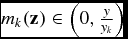 $m_{k}(\mathbf {z})\in \left(0,\frac{y}{y_{k}}\right)$
as ϕ
k
(yk
, z) = yk
· mk
(z), such that in logarithms it becomes additively separable
 $$\begin{equation*}
\ln \phi _{k}(y,\mathbf {z})=\ln y_{k}+\ln m_{k}(\mathbf {z}).
\end{equation*}$$
This property makes the estimation of the sharing rule independent of income as shown in Menon and Perali (Reference Menon and Perali2012) and Dunbar et al. (Reference Dunbar, Lewbel and Pendakur2013), and empirically validated in Menon et al. (Reference Menon, Pendakur and Perali2012).
The portion of income of each member, y
k
, can be recovered from observed expenditures on exclusive or assignable goods. Observed individual income y
k
is determined on the basis of the ratio of the expenditure in exclusive goods, σ
k
. Assuming that each member’s expenditure is defined as the expenditure on his exclusive good p′
c
c
k
plus 1/3 the expenditure in ordinary goods p′
q
q
Footnote
6
. This is equivalent to write ln y
k
= σ
k
ln y, where σ
k
is the resource share defined as
 $\sigma _{k}=\frac{1}{y}\left(\mathbf {p}_{\mathbf {c}}^{\prime }\mathbf {c}^{k}+\frac{1}{3}\mathbf {p}_{\mathbf {q}}^{\prime }\mathbf {q}\right)$
meaning that ln y = ∑
k
ln y
k
= ∑
k
σ
k
ln y because ∑
k
σ
k
= 1. To make families with groups of different sizes comparable, for example, families with a different number of children, the σ
k
is computed re-scaling individual expenditure to per-capita expenditure for males, females, and children. Let g
k
be the number of family members belonging to each category k and g be household size, the individual observed resource is
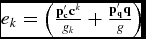 $e_{k}=\left(\frac{\mathbf {p}_{\mathbf {c}}^{\prime }\mathbf {c}^{k}}{g_{k}}+\frac{\mathbf {p}_{\mathbf {q}}^{\prime }\mathbf {q}}{g}\right)$
, and the individual resource share is σ
k
= e
k
/∑
k
e
k
.Footnote
7
The sharing rules can thus be written as a function of household income, distribution factors and the ratio of expenditure in exclusive goods, i.e.
 $$\begin{eqnarray*}
\ln \phi _{1}(y,\mathbf {z}) & = & \sigma _{1}\ln y+\ln m_{1}(\mathbf {z}),\\
\ln \phi _{2}(y,\mathbf {z}) & = & \sigma _{2}\ln y+\ln m_{2}(\mathbf {z}),\\
\ln \phi _{3}(y,\mathbf {z}) & = & \sigma _{3}\ln y+\ln m_{3}(\mathbf {z}).
\end{eqnarray*}$$
Because by definition ln ϕ1(y, z) + ln ϕ2(y, z) + ln ϕ3(y, z) = ln y, the following constraint on ln mk (z) must hold:
 $$\begin{equation}
\ln m_{1}(\mathbf {z})+\ln m_{2}(\mathbf {z})+\ln m_{3}(\mathbf {z})=0.
\end{equation}$$
The income modifying function m
k
behaves as a scaling index that describes the transfers between household members. When the scaling function is less than 1, the expenditure transfer goes from, say, k = 1 to k = 2 and k = 3. The direction of the transfer is inverted for m
k
> 1. Therefore, the scaling function
 ${\normalcolor m_{k}}$
explains both the amount and direction of the allocation of resources between household members. It also clarifies that the amount of resources allocated to member k, that is ϕ
k
, differs from the observable amount of individual spending y
k
.
In the empirical specification, the mk (z) function is a Cobb–Douglas, so that the logarithmic specification is linear
 $$\begin{equation}
\ln m_{k}(\mathbf {z})=\sum _{l=1}^{L}\phi _{k}^{l}\ln z_{l}\;\forall k=1,2,3,
\end{equation}$$
where L is the dimension of vector z. Note that this specification drives the restriction ∑ k ϕ l k = 0 for all l = 1, . . ., L.
Summarizing, the introduction of the sharing rule through the m k (z) scaling function modifies system (3) by replacing ln y* k with ln ϕ* k , defined as
 $$\begin{equation*}
\ln \phi _{k}^{*}(y,\mathbf {z})=\ln y_{k}+\ln m_{k}(\mathbf {z})-\sum \nolimits _{i}t_{i}(\mathbf {d})\ln p_{i},
\end{equation*}$$
and results in
 $$\begin{eqnarray}
w_{i} & = & \alpha _{i}+t_{i}(\mathbf {d})+\sum _{j}\gamma _{ij}\ln p_{j}\nonumber \\
&& +\, \beta _{i}^{1}\left(\ln \text{$\phi $}_{1}^{*}-\ln A_{1}\left(\mathbf {p}\right)\right)+\lambda _{i}^{1}\frac{\left(\ln \phi _{1}^{*}-\ln A_{1}\left(\mathbf {p}\right)\right)^{2}}{B_{1}\left(\mathbf {p}\right)}\nonumber \\
&& +\, \beta _{i}^{2}\left(\ln \phi _{2}^{*}-\ln A_{2}\left(\mathbf {p}\right)\right)+\lambda _{i}^{2}\frac{\left(\ln \phi _{2}^{*}-\ln A_{2}\left(\mathbf {p}\right)\right)^{2}}{B_{2}\left(\mathbf {p}\right)}\nonumber \\
&& +\, \beta _{i}^{3}\left(\ln \phi _{3}^{*}-\ln A_{3}\left(\mathbf {p}\right)\right)+\lambda _{i}^{3}\frac{\left(\ln \phi _{3}^{*}-\ln A_{3}\left(\mathbf {p}\right)\right)^{2}}{B_{3}\left(\mathbf {p}\right)}.
\end{eqnarray}$$
3. EMPIRICAL ESTIMATION AND POST-ESTIMATION STRATEGIES
This section discusses empirical issues related to the estimation of demand systems – such as the infrequency of purchases, the construction of household-specific prices, the potential endogeneity of total household expenditure – and the post-estimation strategy applied to infer the impact of parental migration on the intrahousehold distribution of resources.
3.1. Infrequency of Purchases
Cross-section household expenditure data often involve positive as well as zero purchases. The behavioral information contained in the observations with zero expenditure has significant econometric as well as economic implications. It is the manifestation of a choice that needs to be explained. In many cases, the household deliberately chooses not to consume particular goods given their budget constraint. In other cases, the realization of zero expenditure can be explained by the short duration of the recall period of the survey design.
In our sample of Albanian families, for example, alcohol and tobacco expenditure is censored in nonnegligible proportion. Assuming that the decision-making process generating the corner solutions is based on disposable income, prices, and preferences, a type-III tobit model [Maddala (Reference Maddala1983), Amemiya (Reference Amemiya1985)] is implemented in a system-wide setting using a Heckman two-steps estimator [Heckman (Reference Heckman1979)]. The sample selection bias is corrected by the inverse Mill’s ratio that is the ratio between the predicted normal density and cumulative probability function estimated in the first stage probit regression. This study adopts a generalized Heckman two-step estimator for a censored system of equations in line with Shonkwiler and Yen (Reference Shonkwiler and Yen1999), Perali and Chavas (Reference Perali and Chavas2000), and Arias et al. (Reference Arias, Atella, Castagnini, Perali, Dagum and Ferrari2004).
Consider the following limited dependent variables system of i = 1, .., M equations:
 $$\begin{eqnarray}
x_{i}^{\ast } & =& x(g_{i},\theta _{i})+\epsilon _{i},\quad h_{i}^{\ast }=s_{i}^{\prime }\tau _{i}+\upsilon _{i}, \nonumber\\
h_{i} & = & \left\lbrace \begin{array}{l}1\quad \text{if }h_{i}^{\ast }>0\\
0\quad \text{if }h_{i}^{\ast }\le 0 \end{array},\right.\quad x_{i}=h_{i}x_{i}^{\ast },
\end{eqnarray}$$
where x(g i , θ i ) represents the observed censored continuous variable of interest, h i are the indicator variables, x* i and h* i are the latent variables, g i and s i are vectors of exogenous variables, θ i and τ i are parameters, and, ε i and υ i are bi-variate normal error terms. System (7) can be summarized as
 $$\begin{equation}
x_{i}=\Psi (s_{i}^{\prime }\tau _{i})x(g_{i},\theta _{i})+\eta _{i}\psi (s_{i}^{\prime }\tau _{i})+\xi _{i},
\end{equation}$$
where Ψ and ψ are univariate normal standard cumulative distribution and probability density functions, respectively. The element ξ i = x i − E[x i |g i ] belongs to the vector ξ ~ MVN(0, Ω).
3.2. Household-Specific Prices
Because of the lack of quantity information (except for food consumption) that would allow the direct derivation of unit values from expenditure information, household-specific pseudo unit values are computed using the procedure adopted by Atella et al. (Reference Atella, Menon, Perali, Ferrari and Dagum2004), Hoderlein and Mihaleva (Reference Hoderlein and Mihaleva2008), and McLaren and Yang (Reference McLaren and Yang2014), based on theory results developed by Lewbel (Reference Lewbel1989). Even when monthly price indices are available for each commodity present in the expenditure survey at a relatively small territorial level, such aggregate price indices do not have sufficient variation to identify all parameters and to provide plausible estimates.Footnote 8 Lewbel’s method consists in reproducing the cross-sectional price variability using the variability of the budget shares at the highest level of disaggregation available. In summary, pseudo unit values are estimated by means of
 $$\begin{equation*}
\hat{p}_{i}=\left(\frac{1}{k_{i}^{\ast }}\prod \limits _{j=1}^{J}w_{ij}^{-w_{ij}}\right)ex_{i},
\end{equation*}$$
where ex i is expenditure on the ith good, w ij is the sub-category budget share,Footnote 9 and k* i is a scaling factor defined as
 $$\begin{equation*}
k_{i}^{\ast }=\prod \limits _{j=1}^{J}\bar{w}_{ij}^{-\bar{w}_{ij}}
\end{equation*}$$
with
 $\bar{w}_{ij}$
being the average sub-category budget share.
3.3. Endogeneity of Total Expenditure
Demand system estimations are often exposed to potential endogeneity of total expenditure. The main cause is measurement error, either due to the infrequency of purchases or to recall errors. Although the potential endogeneity attributable to the infrequency of purchases is already treated, recall errors are still possible. Thus, total expenditure is instrumented using wealth indicators. Instead of the standard IV methods, which in nonlinear models is biased and inconsistent [Terza et al. (Reference Terza, Basu and Rathouz2008)], the control function approach is used. Similarly to the Hausman endogeneity test, it consists in estimating an augmented regression formed by including the predicted residuals from the first-stage OLS regression of the endogenous variable on all co-variates of the main regression plus the instruments.
Defining s a vector composed by prices of goods p, demographic variables d, and a set of instruments such as wealth indicators discussed in Section 4, the first stage regression is
 $$\begin{equation}
\ln y=\mathbf {s}\pi +\omega ,
\end{equation}$$
where ω is a spherical error term, whose prediction,
 $\hat{\omega }=\ln y-\mathbf {s}\hat{\pi }$
, is used in the demand system as specified below.
3.4. Specification of the Empirical Model
The system can be estimated by means of a two-step procedure. The vector of parameters τ
i
of the Heckman correction is estimated using a Maximum Likelihood probit estimator to obtain the predicted cumulative and probability density functions
 $\hat{\Psi }(s_{i}^{\prime }\hat{\tau _{i}})$
and
 $\hat{\psi }(s_{i}^{\prime }\hat{\tau _{i}})$
. Then the predicted residuals
 $\hat{\omega }$
of the endogenous regressor (total expenditure, ln y) are obtained by OLS estimation of the endogenous variable on all co-variates and the instruments. Finally, estimates of θ
i
, η
i
, and ζ
i
are obtained by Full Information Maximum Likelihood of the demand system in (6), modified as
 $$\begin{eqnarray}
w_{i} & = & \hat{\Psi }_{i}[\alpha _{i}+t_{i}(\mathbf {d})+\sum \nolimits _{j}\gamma _{ji}\ln \hat{p}_{j}+\beta _{i}^{1}\left(\ln \phi _{1}^{\star }-\ln A_{1}(\hat{\mathbf {p}})\right)\nonumber \\
&&+\,\frac{\lambda _{i}^{1}}{B_{1}(\hat{\mathbf {p}})}\left(\ln \phi _{1}^{\star }-\ln A_{1}(\mathbf {\hat{p}})\right)^{2}\nonumber \\
&&+\, \beta _{i}^{2}\left(\ln \phi {}_{2}^{\star }-\ln A_{2}(\mathbf {\hat{p}})\right)+\frac{\lambda _{i}^{2}}{B_{2}(\mathbf {\hat{p}})}\left(\ln \phi _{2}^{\star }-\ln A_{2}(\hat{\mathbf {p}})\right)^{2} \nonumber\\
&&+\, \beta _{i}^{3}\left(\ln \phi {}_{3}^{\star }-\ln A_{3}(\mathbf {\hat{p}})\right)+\frac{\lambda _{i}^{3}}{B_{3}(\mathbf {\hat{p}})}\left(\ln \phi _{3}^{\star }-\ln A_{3}(\mathbf {\hat{p}})\right)^{2}]+\eta _{i}\hat{\psi _{i}}\nonumber \\
&&+\,\zeta _{i}\hat{\omega }+\xi _{i}.
\end{eqnarray}$$
System (10) is estimated imposing standard regularity conditions for QUAIDS estimation: adding-up (
 $\sum \nolimits _{i}\alpha _{i}=1$
), homogeneity (
 $\sum \nolimits _{i}\tau _{ir}=0$
,
 $\sum \nolimits _{i}\gamma _{ij}=\sum \nolimits _{j}\gamma _{ij}=0$
and
 $\sum \nolimits _{i}\beta _{i}^{k}=\sum \nolimits _{i}\lambda _{i}^{k}=0$
for each k = 1, 2, 3), and symmetry (γ
ij
= γ
ji
, ∀i ≠ j) .
3.5. Post-Estimation Strategy
Turning to the objective of verifying whether and how migration of one parent influences the distribution of resources within the household, this section describes the post-estimation strategy employed. To be a legitimate policy analysis, in the context of a structural collective consumption model, the variable of interest must be (a) a proper distribution factor and (b) exogenous. Being left behind by a migrant parent violates both (a) and (b). Being left behind is likely to modify consumption behavior because at least one household member is no longer consuming. Further, both the distribution of household resources and the decision to migrate might be determined by a common set of unobservable characteristics, such as family values and culture. To deal with these aspects, a post-estimation analysis on the predicted sharing rule is proposed. Because the variable of interest is binary, the analysis is conducted using an endogenous binary variable model [Cameron and Trivedi (Reference Cameron and Trivedi2005), Sections 16.7, 2.3, and 25.7, and Wooldridge (Reference Wooldridge2010), Section 21] estimated by maximum likelihood. Compared to treatment effects models for observational data, this model is robust to violations to the unconfoundedness assumption (or conditional independence assumption) where some unobservable factors may influence both the treatment and the outcome. The model is also more flexible than the linear IV models in the specification of the outcome equation, because the set of regressors in the selection equation can be different from the explanatory variables of the outcome equation. Still, to help identification, the explanatory variables for the treatment equation must include at least one exclusion restriction where an exogenous variable is significantly correlated with the endogenous variable but not with the outcome.
The model can be specified as
 $$\begin{eqnarray}
o_{j} & = & \mathbf {v}_{j}\vartheta +\delta t_{j}+\nu _{j}, \nonumber\\
t_{j} & = & \left\lbrace \begin{array}{l}1\quad \text{if }\mathbf {k}_{j}\kappa +\mu _{j}>0\\
0\quad \textrm {otherwise}, \end{array}\right.
\end{eqnarray}$$
where o j is the outcome variable for the jth observation corresponding in our context to the predicted share of resources assigned to each household member, v j are the exogenous co-variates used to model outcome, t j is the endogenous binary variable – the treatment – and k j are the exogenous co-variates used to model the endogenous binary variable. ν j and μ j are bi-variate normal error terms. k j may overlap with vj , but is assumed that at least one component in k j is an independent source of variation in t j , uncorrelated with the outcome. When there are no interaction terms between the endogenous variable and other outcome co-variates, parameter δ corresponds to the Average Treatment Effect (ATE) and to the Average Treatment Effect on the Treated (ATET). When there are reasons to think that the endogenous variable may change some parameters of the outcome equation, then interactions of the endogenous variable with those co-variates may be added. In this case, the ATE and ATET need to be computed after the estimation of the model.
4. DATA AND SAMPLE SELECTION
The collective QUAIDS is estimated using household data drawn from the World Bank Living Standard Measurement Survey collected in Albania in 2002.Footnote 10 It is a rich data set containing information on household consumption, socio-economic conditions, and income sources. The survey records detailed individual information on education, labor market participation, health, and migration history.
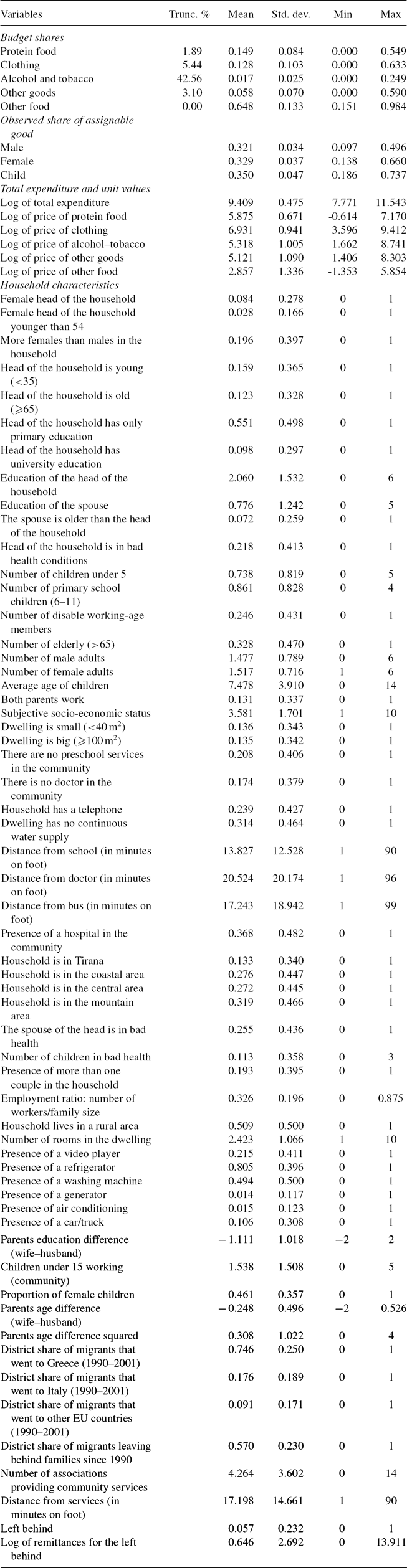
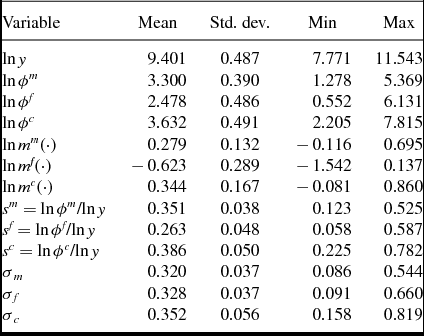
We select households with at least a child younger than 15, an adult male and an adult female (2,260 obs.) and exclude a few observations with missing variables (36 observations). The original sample covers 3,599 households, falling, after selection, to 2,224 families. Table 1 provides descriptive statistics for the variables described below.
Descriptive statistics (2,225 obs.)

The estimation of the demand system is conducted over five categories of goods: protein food, other food,Footnote 11 clothing, alcohol and tobacco, and other goods.Footnote 12 The other goods category includes expenditure on education, leisure, personal care, banking, and other nonspecified services and goods. Unit values are observed for protein food and other food, while for the remaining categories pseudo unit values computed following Lewbel’s procedure described in Section 3 are used. Exclusive consumption goods available in the data set are clothing and footwear for males, females, and children, and expenditure in education, which can be assigned to each household member category. Durable goods are excluded from the system.Footnote 13
The set of demographic variables d includesFootnote 14 head of household characteristics such as gender, age below 35, having tertiary education; health status with dummies indicating whether the head, the spouse or any child are in bad health defined as a chronic illness or disability lasting for more than three months. To account for enlarged families, a dummy indicating the presence of more than one couple within the household is used. Economic status is captured by a family labor supply variable that relates the number of working members to family size, and an indicator for those dwellings that have no continuous water supply. Finally, a variable indicating residence in a rural area is included.
The set of variables selected as distribution factors z traditionally used in the literature includes patents education difference (husband–wife normalized by the average education of the spouses), parents age difference (wife–husband normalized by the average age) and its square, and the proportion of female children. We also include a community level dummy indicating whether a relevant percentage of children under the age of 15 work (either with their parents or in the market). This is a question put to the community administrator asking whether in the community there are children that work even for a short period during the year. Possible answers include none, very few, less than half, half, more than half, most children. The dummy is equal to 1 for all answers except none and very few. Similarly to Dunbar et al. (Reference Dunbar, Lewbel and Pendakur2013), to instrument household total expenditure, a set of wealth indicators is used: ownership of video player, refrigerator, washing machine, generator, air conditioning, and car/truck. Even though other wealth indicators were available, only the nonredundant ones were selected.
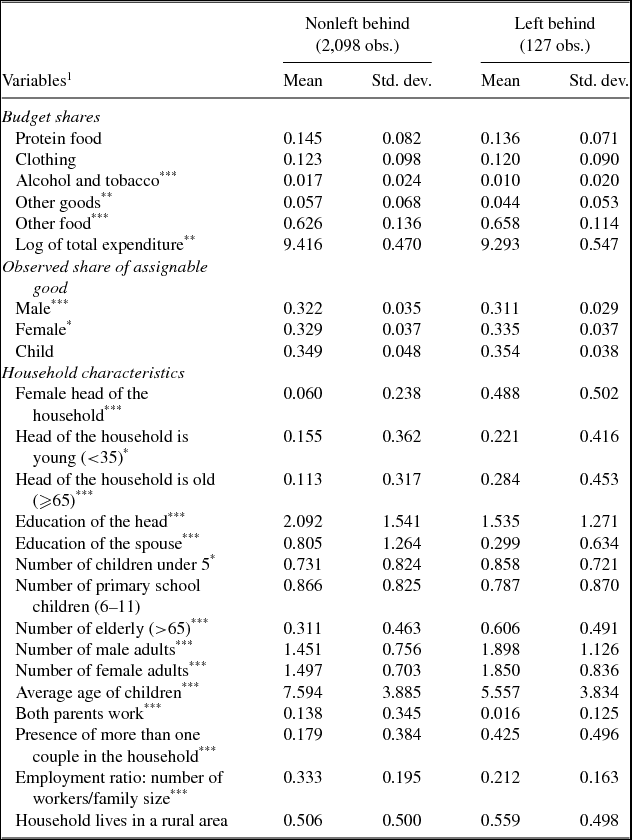
As discussed in Section 3, the left behind status of a family is not suitable to be used as a distribution factor, which should not influence consumption demand. Indeed, looking at Table 2, which reports test for mean differences in selected variables for the sub-samples of left behind families and the rest of the sample, Alcohol and tobacco, Other goods, Other foods, and Total expenditure have all statistically significant different means. This rules out using the left behind variable as a distribution factor and for analyzing its impact on intrahousehold distribution of resources it is necessary to perform a post-estimation analysis. At the same time, the decision of migrating is likely to be co-determined by unobservable factors that are likely to affect also intrahousehold distribution of resources, posing a clear endogeneity issue. As expected, as shown in Table 2, several other relevant characteristics are different in the two sub-samples. Intrahousehold distribution of resources is slightly different, but less than expected and is significantly different at 5% only for males. Instead, as expected, family composition is radically different, as well as the characteristics of the head (proportion of female head, age, and education), as well as family size, and work status. In particular, in left behind household, the head is more likely to be female, young (<35), and old (⩾65); the head and the spouse have lower education; children are younger, there are more elderly, female, and male adults, and the probability of multiple couples in the household is larger. Finally, the number of members working is significantly lower. This evidence alone would be sufficient to justify an instrumental variable approach to obtain unbiased estimates of the impact of migration on intrahousehold distribution of resources. As described in Section 3, the present work adopts an endogenous binary variable approach, to properly account for the binary nature of the endogenous variable.
Sample averages of key variables by left behind status

Note: 1. Asterisks denote t-test results on the difference of the means: ***p < 0.01; **p < 0.05; *p < 0.1.
The endogenous binary variable model requires two sets of regressors: one explaining the sharing rule and one explaining father’s migration, and the latter should include at least one proper instrument (exclusion restriction) for the migration decision. The main variable of interest in the outcome equations is being left behind, indicating that one of the parents has been abroad for at least three months at the date of interviewFootnote 15 , which is also interacted with the proportion of female children and a dummy indicating that the head of the household is a woman who is not elderly. The regressors included in both the treatment and outcome equations are the presence of more than one couple in the household, the average distance from services (bus, school, and doctor) in minutes on foot, and area of residence (coastal, central, and mountain). In relation to the exclusion restrictions, several variables proposed by the literature have been tested as exogenous explanatory factors for the migration decision: the distance from ports, credit market variables, and the district share of families speaking Italian, Greek, or English in 1990 [Cattaneo (Reference Cattaneo2012), Mendola and Carletto (Reference Mendola and Carletto2012)]. However, none of them were a valid instrument for our model. A strong explanatory power have been obtained using variables related with migrants network. The distribution of countries of destination has been constructed for each of the 36 districts in Albania in the period 1990–2001, distinguishing rural and urban areas. Then, the district-level share of all migrants that went to each of the top three destinations has been used as a proxy for the strength of migrants network in the year of the survey. It is also included the historical district share of migrants who left behind a family member using the average value in the post-communist period 1990–2001, in line with Mckenzie and Rapoport (Reference Mckenzie and Rapoport2007). For both variables, the same exogenous data source is used: the Albanian Living Standard Measurement Survey 2005. While the first can be considered a good instrument for international migration in general, the latter is more specific to our variable of interest. Indeed, migrants who leave behind their family members are only one part of the migration flow, and the motivations behind this kind of migration may varied. The period 1990–2001 is before the year of the survey and covers the three main peaks of outflows: 1991–92, immediately after the fall of communism; 1997, when the corrupt system of pyramid savings schemes collapsed, bankrupting a large number of Albanian households; and 1999, when the country was destabilized by the Kosovo crisis [King et al. (Reference King, Piracha and Vullnetari2010)]. The chosen time span also accounts for regularization schemes which let Albanians acquire a legal status between 1990 and 2001 in the main destination countries [in Italy since 1995 and in Greece since 1998]. However, even after controlling for a migrant network at district level, there may still be community level heterogeneity possibly explaining the decision to leave. As suggested by Putnam et al. (Reference Putnam, Leonardi and Nanetti1994) and a number of subsequent works, an effective instrument could be a community index of social capital, which in our case is the number of associations providing community services (such as village committees, political groups, parent associations, and so on).Footnote 16 Given the very poor public services at the community level, the presence of informal and voluntary associations providing additional services and opportunities may reduce the need to migrate ceteris paribus.
The other co-variates explaining the outcomes include all the distribution factors z plus a set of relevant household characteristics such as a young head of the household, living in a rural settlement, education level of the head and the spouse, and family composition variables, such as the average age of children, number of children under 5, number of children of primary education age (6–11), number of disabled working-age members, number of elderly (>65), number of male and female adults.Footnote 17 Remittances sent by the migrant parent (in logarithm) are also included. On average, the relative importance of remittances compared to total household expenditure is 2.7% (Table 1), although the conditional mean is about 46.6% , indicating that most families left behind are in need and the amount received is substantial for family sustenance (for almost 20% of families left behind remittances represent at least 80% of consumption).
5. RESULTS
This section presents the results of the estimation of model (10) along with the corresponding individual elasticities and sharing rule results. The description follows with the post-estimation analysis of the predicted relative sharing rule used to assess the impact of being left behind by a migrant family member on the intrahousehold distribution of resources.Footnote 18
5.1. Demand System Estimation
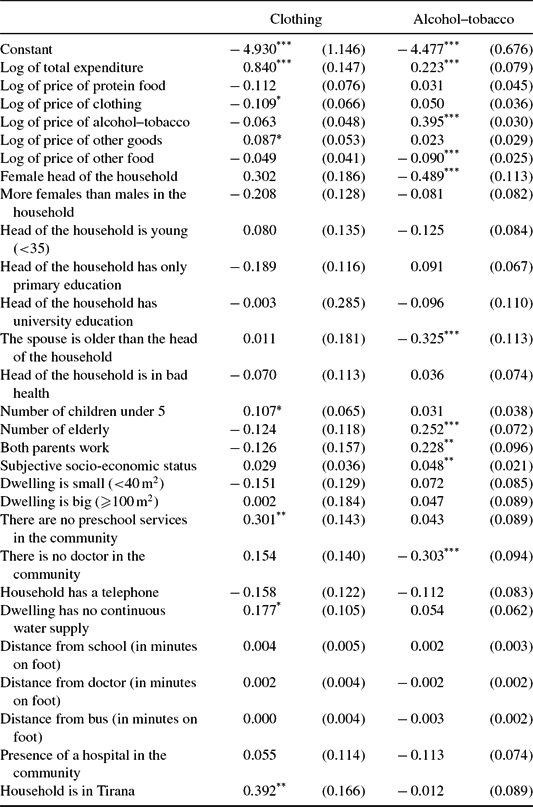
Table 3 shows the estimates of the first-stage probit regressions for clothing and alcohol and tobacco. Relevant variables in explaining positive clothing consumption are total expenditure, its price, the price of other goods, number of children under 5, the absence of preschool in the community, and living in Tirana, all with a positive sign. Those explaining positive alcohol and tobacco consumption include total expenditure and its price, both with a positive effect, while the price of other food, the head of the household being a female or young, or the spouse being older than the head all reduce the probability of consumption. The number of elderly, having both parents working and the subjective well-being indicator increase the probability of drinking or smoking, while the lack of a doctor or a hospital in the community reduce the probability of consumption. In the demand system, estimation the magnitude of selection parameters η for both clothing and alcohol and tobacco, significant at 5 and 10%, respectively, suggests that sample selection bias might be more serious for clothing although the proportion of zeros is much smaller (about 5.5 vs. 42.5% of alcohol and tobacco).
Probit estimates for the sample selection bias correction

Note: Standard errors in parenthesis.
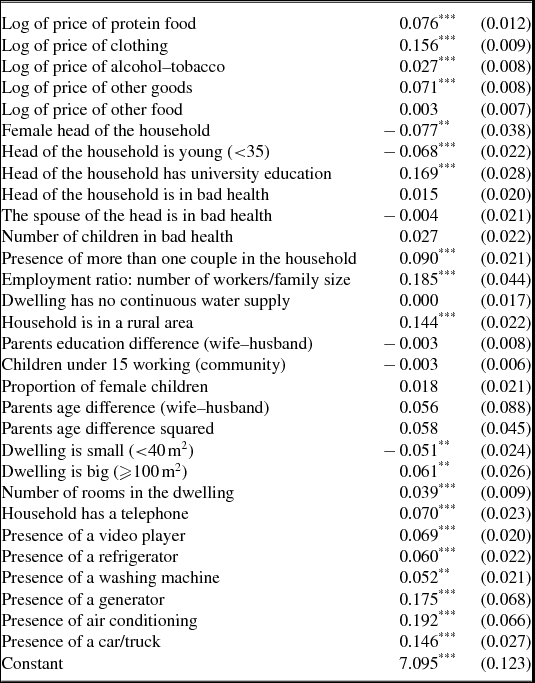
The first-stage IV regression for household total expenditure shown in Table 4 indicates that all wealth assets chosen as instruments are significant at least at 5%. This evidence together with a partial R 2 of 0.104, and an F statistic for the excluded instruments of 25.32 indicate that the chosen instruments are sufficiently strong.Footnote 19 Anderson’s under-identification test is strongly rejected, with a χ2 of 230.19. Nevertheless, the coefficients ζ i of the predicted residuals in the demand system estimation are never significant, revealing that endogeneity of total expenditure might not be a severe issue in our sample.
First stage OLS regression of total expenditure

Note: Standard errors in parenthesis.
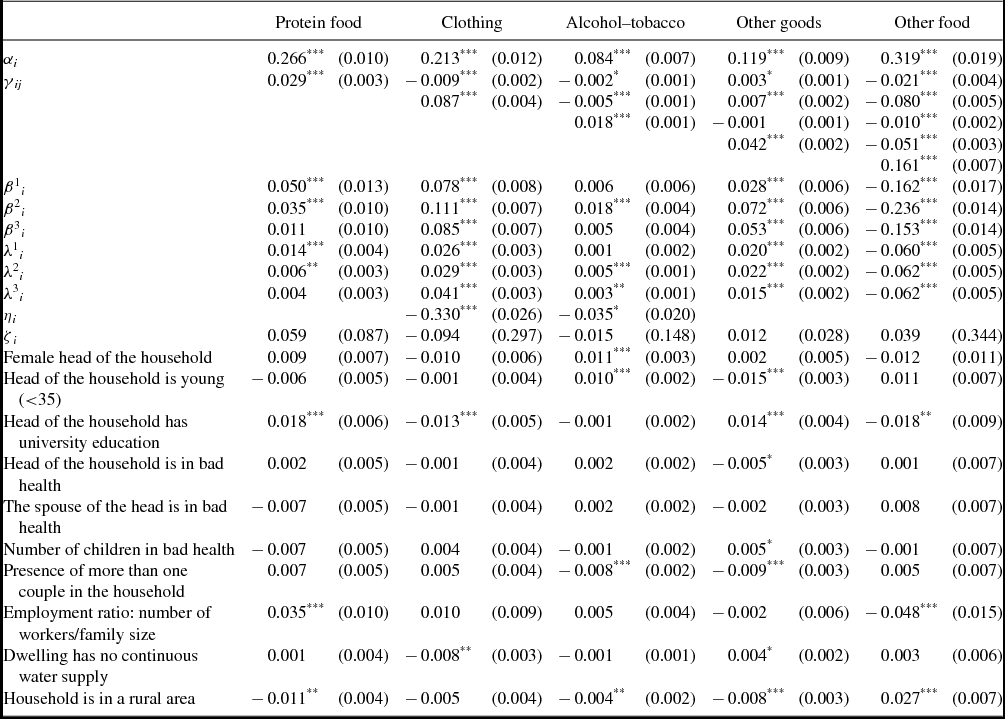
Table 5 presents the estimates of the collective QUAIDS demand system. The parameters of the sharing rule are estimated jointly with the demand system, but are shown separately in Table 7. Most income and price parameters are significantly different from zero and with the expected sign. In general, demographic effects are not large, though several are significantly different from zero. Head of the household characteristics are important in determining consumption choices. For example, when the head of the household is a woman or young, the alcohol and tobacco share increases, while tertiary education increases the consumption of meat and other goods (including education and cultural expenditure) and decreases clothing and food shares. The presence of more than one couple, typically grandparents, reduces both alcohol–tobacco and other goods consumption. Also, the ratio between the number of workers and family size has a significant impact, increasing protein food consumption and reducing other food consumption. Living in a rural area reduces consumption in all categories except other food.
Parameters and demographic variables of the collective demand system

Note: Standard errors in parenthesis.
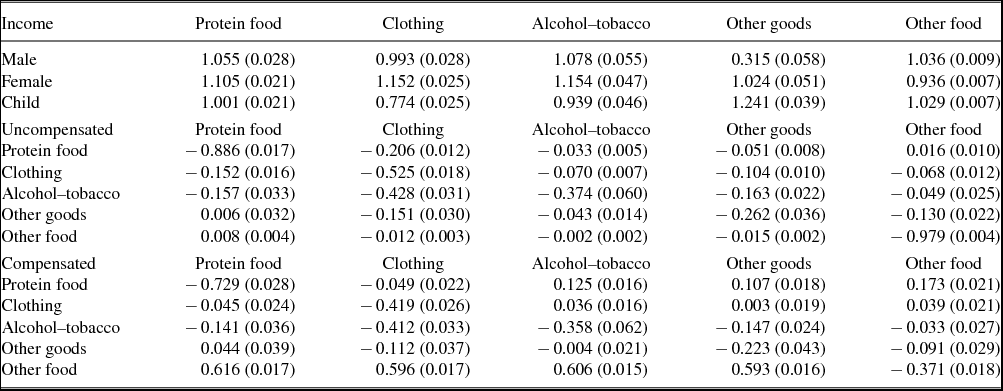
Table 6 shows individual-specific income elasticities for males, females, and children, and household price elasticities along with the associated standard errors. Signs are consistent with the theory. Individual Engel effects are important because they enable the prediction of how changes in the sharing rule may affect household consumption decisions. Men reveal near unity elasticities for all categories but other goods, which is inelastic. Females show larger elasticities for protein food, clothing, and alcohol–tobacco, while other goods have a unity elasticity, other food is slightly inelastic. Children reveal a rather different pattern, with unit elasticity for protein food and other food, small elasticities for clothing and alcohol and tobacco, and a large elasticity for other goods. This pattern is as expected because other goods includes cultural, educational, and recreational expenditure as the most relevant items, which are important for children but less so for adults, especially males. The comparison of uncompensated and compensated price elasticities in the middle and at the bottom of Table 6 reveals that the size of the income term of the Slutsky matrix evaluated at the means is relatively small with the notable exception of protein and other food. As required by consumption theory, all diagonal terms are negative. The own price effect of protein food is relatively more elastic, while that of alcohol and tobacco and other foods are quite inelastic. The cross-effects of the compensated price elasticities show generally significant complementary relations of alcohol with protein food, clothing, and other goods, while protein food and other food tend to be substitutes for the other categories.
Income and price elasticities

Note: Standard deviation in parenthesis.
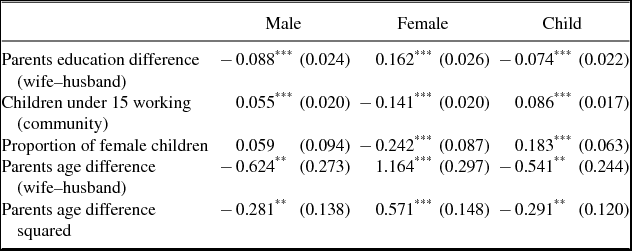
The estimates of the parameters of the sharing function mk (z) are shown in Table 7. The effect of a difference in the educational levels of men and women has the expected effect, increasing the bargaining power of women who are more educated than their husbands. The difference in age between the parents, and its square, has a similar effect. Living in a community where a relevant share of children work has a positive impact on men and children resource shares and negative on females. This might indicate that children have more bargaining power as possible sources of revenue [Basu (Reference Basu2006)], but it might also indicate simply that the type of work is agricultural, and the prevailing culture patriarchal, and hence susceptible to gender discrimination. As to the concern about the discrimination of female children within the household, our results indicate that the proportion of female children improves the child sharing rule, even though this happens at the expense of female adults rather than males.
Sharing rule parameters in mk (z)

Note: Standard errors in parenthesis.
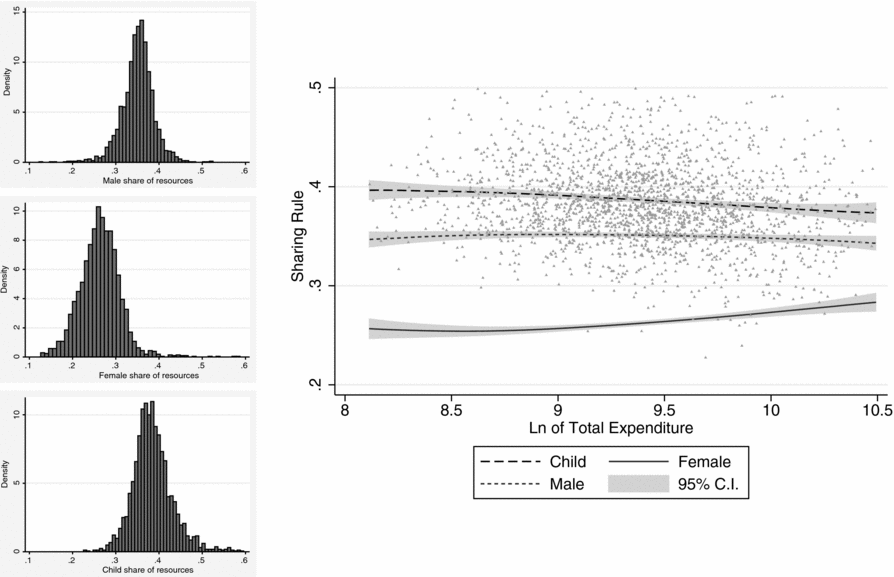
The predicted sharing rules, presented in Table 8 and Figure 1, show how resources are distributed among household members. In Albania, on average, male members control about 35.1% of the household resource pool mainly at the expense of female members who remain with 26.3% of resources. Children have 38.6% of resources. These average figures show that the distribution of resources within the family is quite unequal. The bargaining power of Albanian women is much weaker than men’s. The right panel of Figure 1 shows that the gap in the share of resources tends to reduce with household expenditure, but remaining substantially far from an equal distribution even for rich households. This evidence is in line with the Albanian patriarchal family model that excludes women from the household decision-making process.
Densities and distribution of the predicted shares of resources.

Estimated resource share: descriptive statistics

These results are strong signals of a critical situation for Albanian mothers. Moreover, women have an even lower resource share in favor of children whenever at risk, a situation that may occur when child labor is particularly widespread and when the majority of children are female. In the next subsection, we seek further insights on these issues by implementing a post-estimation analysis on the sharing rule, concentrating on the effects of migration on the share of resources for left behind family members, a critical situation that could not be modeled as a distribution factor. Prior to that, however, we present the results of a robustness analysis aimed at assessing the stability of the estimates of intrahousehold distribution of resources with respect to several model assumptions and specifications changes.
5.2. Robustness Analysis
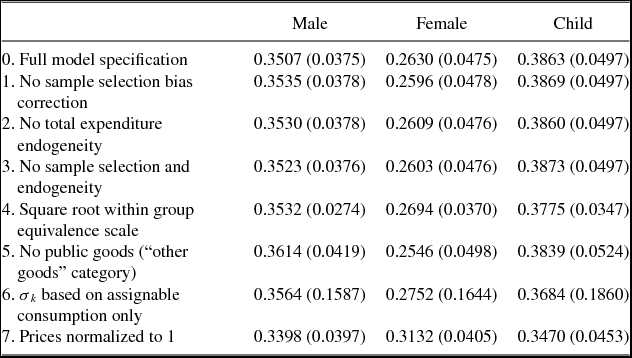
The results reported in the previous subsection account for a series of empirical concerns that may bias the estimated coefficient, such as endogeneity of total expenditure and infrequency of purchases. To verify whether these corrections are important for the estimation of the distribution of resources within the household, we present the results of alternative estimations without such corrections. In addition, because the sharing rule depends heavily on the observed share of expenditure, we also present the results of alternative definitions of σ k that account for the possibility of within-group economies of scale and do not assume equal sharing of nonassignable goods. Finally, because the “other goods” category include expenditure in items that might be considered partially public, we also present the results for a demand system that excludes this category. The statistics of the predicted share of resources for males, female, and children (mean and standard deviation) for each of the robustness analyses are presented in Table 9.
Estimated resource share: robustness analysis

In particular, the first row of the table (labeled “0.”) reports the share of resources from the main estimation and the subsequent rows the results from the following alternatives:
-
1. The sample selection bias correction was not applied to budget share equations (10), but total expenditure is still assumed to be possibly endogenous. This estimation would highlight whether in our sample correcting for infrequency of purchases is relevant for estimating the distribution of resources within the household.
-
2. Total expenditure was assumed to be exogenous, thus avoiding the inclusion of the residual of the first-stage regression (9) in the budget shares equation, but still correcting for infrequency of purchases.
-
3. Both sample selection bias and total expenditure endogeneity corrections were not applied. This corresponds to directly estimating the collective demand system in equation (6).
-
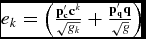
4. Economies of scale have been allowed within family groups (i.e. among males, females, and children separately). The main model assumes that resources are distributed equally within groups, because there is no information on assignable consumption for individuals with the same characteristics. By using a square root scale for the computation of the observed individual expenditure
 $e_{k}=\left(\frac{\mathbf {p}_{\mathbf {c}}^{\prime }\mathbf {c}^{k}}{\sqrt{g_{k}}}+\frac{\mathbf {p}_{\mathbf {q}}^{\prime }\mathbf {q}}{\sqrt{g}}\right)$
and the corresponding share σ
k
= e
k
/∑
k
e
k
, we try to assess whether the estimation of intrahousehold resources distribution is robust to different assumptions about within-group economies of scale.
-
5. The “other goods” category has been excluded from the demand system. Being an heterogeneous category, it includes items that may be safely considered private, such as education and personal care, and others that may more likely be partially public goods, as leisure, banking, and nonspecified goods and services. Because the proposed model assumes that all goods are privately consumed, with this alternative specification we aim at testing the robustness of our results to small violations of such assumption.
-
6. σ k has been computed using only assignable consumption expenditure information. Although the assumption of equal sharing of nonassignable consumption has been proven to be neutral for the estimation of the sharing function [Menon and Perali (Reference Menon and Perali2012)], as a robustness check we also estimated the collective demand system under the assumption that nonassignable consumption is distributed in the same way as assignable consumption rather than in equal proportions, that is
$e_{k}=\frac{\mathbf {p}_{\mathbf {c}}^{\prime }\mathbf {c}^{k}}{g_{k}}$
and σ
k
= e
k
/∑
k
e
k
. -
7. All prices have been normalized to 1. Because price information is not available for all consumption categories, pseudo unit values have been created for nonfood items [Lewbel (Reference Lewbel1989)]. An alternative strategy could have been to normalize all prices to 1, that is reduce the demand system to a system of Engel curves, where no coefficient associated with price information is estimated and much of the structure of the QUAIDS is removed. This implies significant changes to equation (10), which reduces to
with ln ϕ* k (y, z) = ln yk + ln mk (z).
$$\begin{eqnarray*}
w_{i} &=& \hat{\Psi }_{i}[\alpha _{i}+t_{i}(\mathbf {d})+\beta _{i}^{1}\left(\ln \phi _{1}^{\star }\right)+\lambda _{i}^{1}\left(\ln \phi _{1}^{\star }\right)^{2}+\beta _{i}^{2}\left(\ln \phi {}_{2}^{\star }\right)+\lambda _{i}^{2}\left(\ln \phi _{2}^{\star }\right)^{2}\\
&&+\,\beta _{i}^{3}\left(\ln \phi {}_{3}^{\star }\right)+\lambda _{i}^{3}\left(\ln \phi _{3}^{\star }\right)^{2}]+\eta _{i}\hat{\psi _{i}}+\zeta _{i}\hat{\omega }+\xi _{i},
\end{eqnarray*}$$


Notably, as shown in Table 9, all these estimations produce a nearly identical intrahousehold distribution of resources as the main model except the last one, implying a sound robustness of our results. In particular, robustness 1–3 indicate that in our sample, selection bias and total expenditure endogeneity are not important for the determination of intrahousehold allocation of resources. Estimation 4 provides evidence that the assumption of equal sharing within household member categories is neutral to the estimation of intrahousehold distribution of resources. Excluding public goods (estimation 5) produce again very similar results, slightly increasing intrahousehold inequality but in the same direction of the main model. This suggests that not properly accounting for public goods might produce an slight underestimation of intrahousehold inequality in our sample. Robustness 6, which bases the calculation of σ k uniquely on assignable expenditure, has the drawback of producing several zeros in the σ k that must be dropped from estimation (1,191 obs.). Despite of having different samples in size and composition, this estimation produces an almost identical distribution of resources within the household, providing empirical evidence to the theoretical result about the neutrality of assuming equal sharing of nonassignable expenditure. Finally, we expected more important deviations with the last specification (robustness 7), where all prices are normalized to 1. This is a rather strong simplification of the main model and reduces the demand system to an Engel curves system that loses a significant portion of structure and theoretical restrictions. Despite the radical changes to the model, the predicted intrahousehold inequality goes in the same “direction” of discriminating women as in the main model. The difference in the intrahousehold distribution of resources with respect to the main model, however, is somewhat larger than the other robustness checks.
5.3. The Impact of Migration on the Intrahousehold Distribution of Resources
When a parent migrates abroad, the distribution of resources within the household may substantially change. It frees part of the home resources that become available for other members of the household and may bring new resources by sending remittances. In our sample, about 98% of migrants send remittances to the left behind household. Among those sending remittances, the primary declared objective is to buy food or goods of necessity (57% of households), to invest in construction (12%), and to cover medical expenses (12%). The declared objective is child support only for 3% of households, while remittances are never used for educational purposes.Footnote 20 The remainder is more or less evenly distributed across purchasing a durable good, paying for a wedding or funeral, charity, investment in the household enterprise, and other uses.
Most migrant fathers leave behind their spouses and children with other adult males in the household and send them remittances. The resources freed by the migrant member plus the remittances sent are likely to be reallocated between the remaining adult males, adult females, and children. We expect two kinds of behavioral reactions to the migratory event: the wife may take over the control of household resources and decide on the reallocation, probably favoring children. Alternatively, in the patriarchal tradition, the control of resources may shift to the older remaining males, which would probably keep a distribution of resources similar to the pre-migration state.Footnote 21 The two scenarios can be analyzed using the information on household headship reported in the survey. Only 49% of migrant-sending families have female headship, suggesting that the migrant’s spouse is taking control over resources. In both cases, we expect that the male share of resources falls, since there is one adult male less in the household, and that the beneficiary of redistribution are the children since (a) women are naturally more caring toward children or (b) older males may have stronger traditional values that tend to discriminate women. We intend to disentangle these aspects by controlling for the presence of the elderly and women registered as the head of the household.
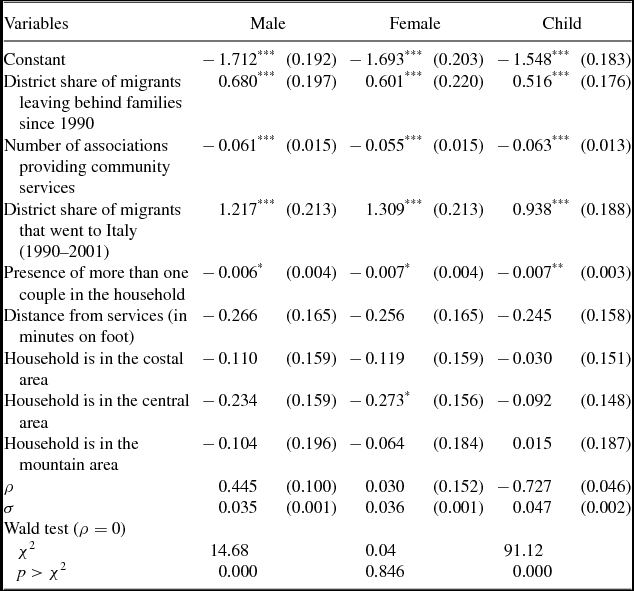
The endogenous binary model described in Section 3 is estimated by Full Information Maximum Likelihood (Tables 10 and 11) using only significant exclusion restrictions, which implies keeping the district share of migrants to Italy and excluding the shares of migrants to Greece and other EU countries.Footnote 22
Endogenous binary variable model – first stage (being left behind)

Note: Robust standard errors in parentheses. ***p < 0.01, **p < 0.05, *p < 0.1.
Endogenous binary variable model – outcome (resource shares)

Note: Robust standard errors in parentheses. ***p < 0.01, **p < 0.05, *p < 0.1.
1. ATE and ATET stand for Average Treatment Effect and Average Treatment Effect on the Treated, respectively.
Although the proposed model is nonlinear and estimated by maximum likelihood, to check the effectiveness of the exclusion restrictions, a series of tests treating the model as a linear IV have been performed. The F test of joint significance of the instruments is 11.65 with a partial R 2 of 0.0196. The null hypothesis of weak instruments can be rejected since the F test is larger than the critical value with a 10% OLS relative bias tolerance [Stock and Yogo (Reference Stock and Yogo2005)]. The Wald tests performed on the endogenous binary variable specifications reject the null hypothesis of no correlation between the treatment and outcome error terms for male’s and child’s equations (see Table 10).
Table 10 shows the treatment equations of the post-estimation analysis of the share of resources for each family member. The coefficients of the exclusion restrictions, the district share of families with migrants leaving behind the wives and/or children in the period 1990–2001, the number of associations providing community services present in the community, and the district share of migrants that went to Italy in the period 1990–2001, are all significant at 1%. Thus, networks seem to play an important role in migration to Italy, where well-established Albanian communities can be found and the migration periods are longer than Greece. The treatment equations include controls for the presence of other couples in the household (significant at 10% in all equations), the area of residence, and the distance from community services.
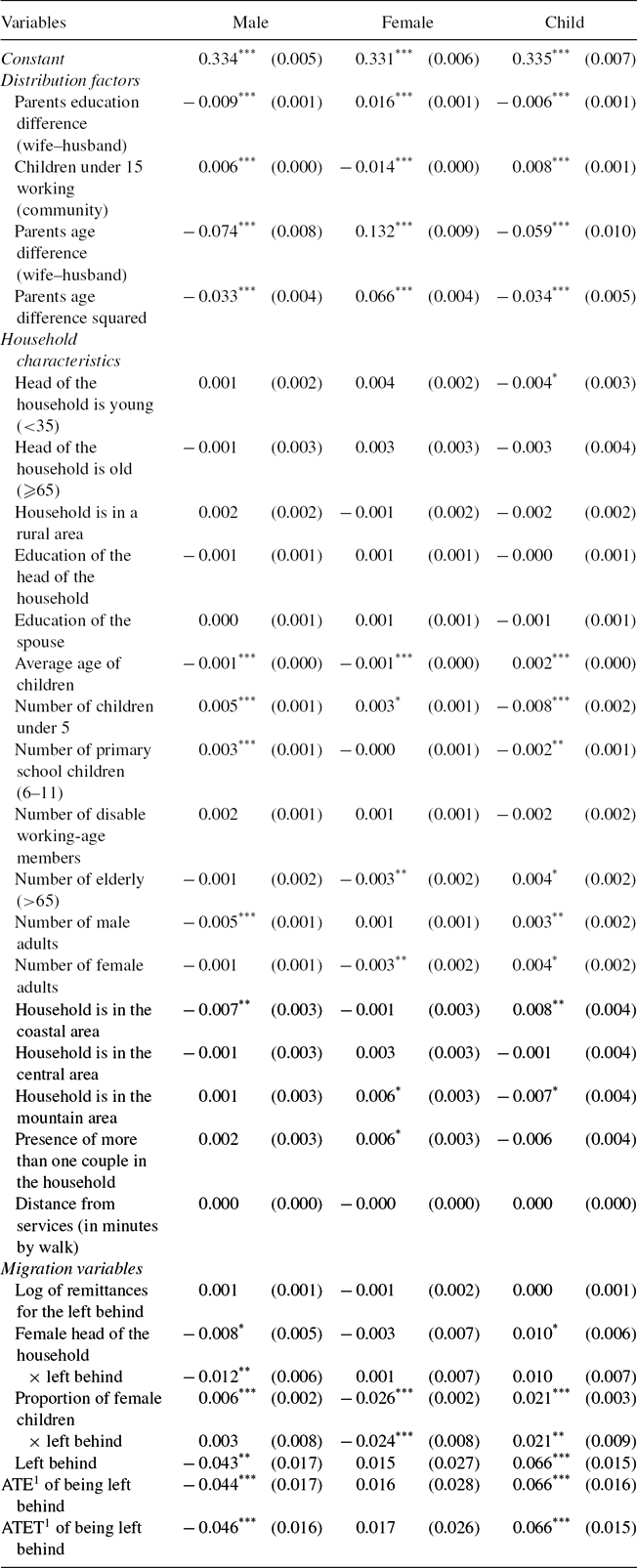
Tables 11 shows the outcome equations. Here the share of resources of each household member is regressed on a set of relevant variables, including the distribution factors used in the collective demand system estimation, a set of household characteristics and a set of variables related to the migration of a household member. The last two lines of the tables give the ATE and ATET of being left behind. The results show that having a migrant parent reduces a male adult’s share of resources by 4.6 percentage points and improves that of children by 6.6 percentage points, while the ATET on a woman’s share of resources is not significantly different from zero.Footnote 23 These findings may be due to two different factors suggested by the literature. The first follows the Basu and Van (Reference Basu and Van1998) hypothesis that children, in this case, making up for the loss of labor of the migrant member, increase their bargaining power. An alternative explanation could be that the mother decides to allocate the share of resources of the migrant husband to the children. This would reinforce the vision that when the bargaining power is shifted to women they dedicate more resources to children, especially girls as suggested in previous studies [Duflo (Reference Duflo2000), Duflo (Reference Duflo2003), Attanasio and Lechene (Reference Attanasio and Lechene2014), Antman (Reference Antman2015)].
As to the specific parameters of each equation, being left behind has a negative and significant impact on male resource share. Oddly, the more female children there are, the greater is the share of resources of adult males, but only in families that are not left behind. However, if the head of the household is a woman, the reduction in the share of resources to males is significant but smaller for left behind families. As expected, the distribution factors significantly affect the resource share of males, and with the same sign of the collective demand system estimation. Geographical variables are not relevant, except for living in a coastal area, which moderately reduces the male share of resources. Family composition, as expected, is also important. The share of resources of males is smaller when there are more male adults and when children are older.
Inspection of the results referring to female resource share shows that having a larger proportion of female children reduces the woman’s share both for left behind and not by a similar magnitude. On the other hand, a household headed by a woman does not increase the share of resources to women, left behind or not. When children are older, the share falls but the number of young children increases women’s share. Although an elderly head of the household does not allocate less resources to women, the number of elderly has a negative impact. As expected, the share reduces with the number of female adults.
Children’s share of resources substantially increase when left behind and in nonleft behind households headed by a woman. A higher proportion of female children always increases the share of resources devoted to children [in line with Duflo (Reference Duflo2000, Reference Duflo2003) and Antman (Reference Antman2015)]. It is worth noting that this increase always happens at the expense of the woman’s share. Again the distribution factors act with the same sign and significance as in the demand system estimation. Living in a coastal area significantly increases the share of resources, while living in the mountain area reduces it. The average age of children plays a significant role in increasing the children’s share of resources, probably because older children are able to help more in household and farm duties, allowing them to increase their bargaining power. Family composition is important, with the expected signs and significance.
One of the strongest concerns in relation to the migration of fathers is the possibility that the headship of the household shifts to elderly members following traditional patriarchal household patterns, to the detriment of women and children [Giannelli and Mangiavacchi (Reference Giannelli and Mangiavacchi2010), Antman (Reference Antman2011), and Antman (Reference Antman2012)]. However, the results show no significant impacts of elderly headship on the distribution of resources within the household, while an increased number of elderly tends to shift resources from women to children.
The overall picture has clearly defined traits. Children in Albania are effectively protected from the risks associated with male migration both by their mothers or by elder household members taking control of resources. When a variable has a positive impact on the share of resources assigned to children, in most cases it has a negative impact on a woman’s share, and a nonsignificant or positive impact on a man’s share. Our evidence shows that when the father is absent, the mother is willing to give the resources freed by the migrant to children, in particular when there are more females. Again, it is worth noting that women do not keep resources left by the migrant husband for themselves, as being left behind in the female equation is never significant.
6. CONCLUDING REMARKS
This study applies the collective consumption framework to the measurement of distribution of resources within Albanian households, placing special emphasis on the impact of international migration of one parent and on possible discrimination arising from an unequal distribution of resources. The analysis is conducted on households with children, observed by the Albanian Living Standard Measurement Survey in 2002.
Albanian households have been deeply affected by the transition to a market economy from a regime that reduced the intensity of the previous patriarchal tradition. One of the social effects of transition was the restoration of traditional and strongly patriarchal values with customs and laws at the village level and the risk of relegating women to a marginal role, especially in rural areas. At the same time, the household structure changed deeply due to sustained migration flows affecting family stability. In order to improve our understanding of these delicate economic and social issues, our study provides detailed information about the distribution of household resources between genders and generations and its relation to migration. To achieve this objective, we identify a sharing rule for the adult male and female component and a sharing rule for children along with their individual Engel effects using a collective complete demand system. We also analyze the impact of being left behind by a migrant parent on the resource share of each household member by means of an endogenous binary variable model.
Our results suggest that when a father migrates abroad leaving the family at home, and the control of family resources shifts to the mother, substantially more resources are allocated to children, especially when the proportion of female children is larger and at the expense of the woman’s resource share. We also find no evidence of a significant change in the distribution of resources when the control of resources shifts to older males. Irrespectively of the left-behind status, the woman’s share of resources is substantially lower than an equal distribution.
The presence of intrahousehold inequality affecting women and the study of its determinants suggest some policy intervention aimed at promoting gender parity, such as incentives for female education and work participation. These policies would improve the relative bargaining position of women in relation to men, reducing the risk of female discrimination within the household, and indirectly favor households investment on children.
CONFLICT OF INTEREST
The authors declare that they have no conflict of interest.