

A Theoretical and Policy Dilemma
Politics and policy-making processes governing rivers that cross two or more countries are conventionally categorised under the rubric of international politics and policy institutions. Under this rubric, national governments that represent sovereign states are considered the only legitimate actors and their decisions and actions are assumed to represent their citizens and communities. Each state plays political games at two levels – domestic and international – as popularised by Robert Putnam (Reference Putnam1988) in his article on the entanglements of domestic and international politics. In this analytical view, “central decision-makers” (Putnam Reference Putnam1988: 460) in the entanglement of both domestic and international politics are state leaders with the unitary assumption about the sovereignty of the state. Citizens and local communities, therefore, have neither legitimacy nor political authority to participate and act in international politics. This raises both a theoretical puzzle and a policy dilemma in cases such as international river basin governance, where local users and local appropriators of river resources play central roles in the successes and failures of that governance. This policy dilemma is a non-traditional global public policy dilemma because a traditional approach, such as diplomacy or international treaty-making mechanisms, is not sufficient to provide a solution to the dilemma. How, then, can local communities, their livelihood issues, and their interests be represented directly in the international institutions that are designed to govern international rivers?
The legal and policy frameworks of international river basin institutions such as the Mekong River Commission assume that member states represent and act on behalf of local communities. The framework is consistent with the dominant theories of international relations that treat states as unitary sovereign actors with the assumption that they represent local citizens and their interests in the international institutions. In this paper, I posit that the linkages between local communities and international-layer institutions are not fully established by connecting only national-layer issues and interests of member states to international institutions. Local citizens and communities have to participate independently of riparian states in governance processes of international rivers. Therefore, theorising governance of international river basins in particular, and global environmental governance in general, has to move beyond the ‘two-level game’ approach. This article provides a diagnosis of the international environmental governance problems in the Mekong River Basin by examining the linkage problems between local livelihood issues and an international institution, the Mekong River Commission (MRC).
The literature addressing international environmental policy and governance presents empirical evidence to show increasing influence of local communities and non-state actors on international environmental governance (Auer Reference Auer2000; Princen and Finger Reference Princen and Finger1994; Wapner Reference Wapner1996). However, there is a lack of generally accepted theoretical language to advance analytical frameworks and methods to investigate the role of non-state actors, and how citizens and their livelihood issues at the local level are represented at the international level (Auer Reference Auer2000: 155; Fonseca Reference Fonseca1999). Even the most explicit literature, calling for the problems of local roots of international development and governance to be taken into consideration, tends to focus on explaining the impact of top-down international policies on national governments of respective sovereign states (Hooghe et al. 1996; Marks 1993). More importantly for the policy world, there is a lack of recognition of the direct role of local citizens and communities in the practices of international environmental governance. How international river basin development institutions represent local citizens' livelihood issues and interests has not been widely studied, even though the relevance of local resource appropriators and users in the implementation processes is “the most obvious” in the river basin context (Hirsch Reference Hirsch1999: 2). One of the earliest independent studies of the Mekong River Basin recognised the central role of farmers and local livelihoods in international river basin development planning (Gaitskell Reference Gaitskell1973: 24). This present article analyses how local livelihood issues are treated on the one hand by states and international institutions and, on the other, by local communities and non-government organisations in the Mekong area. The aim is to identify the sources of governance problems and possibilities in linking local actors and their livelihood issues to international river basin development planning.
Although there have been some independent assessments of institutional evolution and national policy issues in the Mekong River Basin (Browder and Ortolano Reference Browder and Ortolano2000; Hirsch and Cheong Reference Hirsch and Cheong1996; Molle Reference Molle2005; Torell et al. Reference Torell, Salamanca and Ahmed2001), there has not been a systematic assessment of how local communities' livelihood issues are represented to institutions at the international level, particularly to the MRC. This article investigates what the local livelihood issues are and what the sources of contention between the state and local citizens are in this local-international linkage problem. Two questions guide this assessment: First, how did the current institutional arrangement for the Mekong River Basin evolve at the international level? And, second, what are the critical development issues at the local layer in the Mekong River Basin? The article will first briefly discuss the evolution of the Mekong River Basin development planning at the international level, before moving on to assesses the policy landscape of development challenges. The methodology applied to investigate critical development issues in the Mekong River Basin are then considered, and four development issues that demonstrate the problems of contention between state leaders and local communities that affect development planning are identified. Finally, it will be argued that because local livelihood issues and local communities' livelihood freedomFootnote 1 shape the successes and failures of governing development processes in the Mekong River Basin, it is crucial that local citizens and communities play a direct decision-making role in the national and international development planning. To do so, the development planning processes and institutional frameworks have to move beyond the two-level game approach.
The Origin of Mekong Development Plans
Among 263 river basins in the world that cross borders of two or more countries, the Mekong River Basin is the third richest in the world in terms of its biodiversity, after the Amazon and Congo rivers. The Mekong, being the world's twelfth longest river, captures a basin area of 795,000 km2 (Table 1). More than 65,000,000 people living in the river basin directly depend on the Mekong River and its tributaries for food, water, transport, and many other aspects of their livelihoods. The river flows through different cultural, geographical, jurisdictional, and political borders from the Tibetan Plateau to the coast of Vietnam, ultimately reaching the South China Sea (or geographically, the Southeast Asian Sea). The Mekong River flows over 4,500 km through the Yunnan Province of China, Myanmar (Burma), Lao People's Democratic Republic (Lao PDR), Thailand, Cambodia, and Vietnam.
Mekong River Basin catchment area by riparian countries. (Source: Adapted from MRC 2003b).

The institutional development of the Lower Mekong River Basin was never isolated from the historical context of world events. Since the first French missionary arrived in 1624, in what later became French Indochina (Schaaf and Fifield Reference Schaaf and Fifield1963, 80), historical events and basin-wide institutional initiatives were mainly the result of relationships between internal and external forces that continue to shape the course of human actions along the Mekong River. The colonial powers, mainly the French and British, left legacies of considerable influence on the evolution of the social and economic institutions in Southeast Asia and the Lower Mekong River Basin (Schaaf and Fifield Reference Schaaf and Fifield1963: 24). Although Thailand, then known as Siam, was not colonised by either the French in the east or the British in the west, it was not able to escape the influence of Western colonialism, especially in its economic dimensions (Osborne Reference Osborne2000: 130–131; Schaaf and Fifield Reference Schaaf and Fifield1963: 24–25).
The earliest recorded international cooperation concerning commercial use of the Mekong River can be traced back to the Treaty of Friendship, Commerce, and Navigation between France and Siam (Thailand) signed on August 15, 1856 (Jacobs Reference Jacobs2002: 109; Menon Reference Menon1970: 68; Thai Ministry of Foreign Affairs 2004, Article 17).Footnote 2 However, the first international effort for the cooperative use of the Mekong River was made in 1926 when France and Siam signed the Convention between French Indochina and Siam Concerning the Relations between the Two Countries, 1926 (Jacobs Reference Jacobs2002: 109; Menon Reference Menon1970: 77; Schaaf and Fifield Reference Schaaf and Fifield1963: 82). The convention aimed to improve the river communication system and agreed to establish the Permanent Franco-Siamese High Commission to draw up regulations for navigation.
However, significant international cooperation among lower Mekong countries, namely Lao PDR, Thailand, Cambodia, and Vietnam, did not begin until after the end of World War Two. With the worldwide wave of decolonisation and the emergence of independent states after the war, France was forced to accept the independence of its Indochina colonies. Meanwhile, the establishment of the United Nations (UN) was perceived by many independent state leaders as a global and institutional assurance of their sovereignty and independence under the UN Charter; thus many countries became members of the UN, including the riparian countries in the Lower Mekong Basin, once they gained independence from the colonial powers.
The policy birthplace of the Mekong River Basin development plans articulated at the international level was the UN. A series of five studies conducted by UN-affiliated agencies and later by the United States of America upon the request of the four lower basin countries between 1952 and 1958 were significant information-gathering studies at the international level for development planning. Among those studies, the 1957 study conducted by four appointed consultants of the UN Economic Commission for Asia and the Far East (ECAFE) and titled Development of Water Resources in the Lower Mekong Basin was presented to the thirteenth session of ECAFE in Bangkok in 1957 (ECAFE 1957: iii; Schaaf and Fifield Reference Schaaf and Fifield1963: 86; Sewell and White Reference Sewell and White1966: 20). The survey reiterated the 1956 U.S. Bureau of Reclamation's Reconnaissance Study of the Lower Mekong Basin report by calling for further data collection and issuing recommendations similar to those of the Reconnaissance Study. The 1957 ECAFE study was, however, the first to articulate basin-wide planning and the need for international cooperation in the Mekong by explicitly recommending that:
“…a comprehensive plan for the optimum development of water resources should cover an entire basin, including tributaries. While planning for water resources development of tributaries is the primary concern of individual countries, such planning needs proper co-ordination. For this purpose, it is necessary to establish an international channel or clearing house for exchange of information and plans and the coordination of projects.” (ECAFE 1957: 64)
After the 1957 ECAFE study was reported, a meeting of expert representatives from four riparian countries – Cambodia, Lao PDR (Laos before 1975), South Vietnam, and Thailand – was held in Bangkok in May 1957 to consider follow-up actions and to establish a Coordination Committee for further work (Schaaf and Fifield Reference Schaaf and Fifield1963: 90; Sewell and White Reference Sewell and White1966: 20). The Mekong Committee, officially named the Committee for the Coordination of Investigations of the Lower Mekong Basin, therefore, became the first international organisation to coordinate development planning in the Lower Mekong Basin.
The Birth of the Mekong River Commission
The establishment of the Mekong Committee by the recommendation of ECAFE, now known as the UN Economic and Social Commission for Asia and the Pacific (ESCAP), was the forerunner of the current MRC. The MRC has developed through three stages of institutional evolution. The first stage began with the Mekong Committee in 1957, which was the first transnational governing body in Southeast Asia, and thus a pioneer in regional cooperation (see Browder Reference Browder1998, chapters 2 and 3, for 1957–1995 evolution of MRC). The second stage was ushered in in 1975 by the end of the American-Vietnam war with the victory of North Vietnam over South Vietnam. Parallel Communist victories in Cambodia and Lao PDR then almost led to the end of the Mekong Committee as the three communist states refused to participate in the functions of the committee. Meanwhile, Vietnam invaded Cambodia and ousted the Khmer Rouge by installing a pro-Vietnamese government in Cambodia. As regional Cold War tensions intensified, the Mekong Committee's mission was in jeopardy. However, with diplomatic negotiations initiated by the UN, the Mekong Committee was transformed into the Interim Mekong Committee (IMC) composed of Lao PDR, South Vietnam, and Thailand in 1978. The 1978 IMC Statute called for the reactivation of the Mekong Committee if and when Cambodia were to re-join in the future.
The third stage of institutional evolution emerged when the Cold War was winding down and political tensions among riparian countries in Southeast Asia were easing. This geopolitical shift opened up new prospects for cooperation in the Mekong region. As the rivals in the Cambodian civil war signed a peace agreement in Paris in 1991, Cambodia prepared to re-enter the Mekong regime. The negotiation initiated by the UN to reconstruct the Mekong regime took place in various stages. This time, all parties agreed that (re-)establishment of a Mekong regime was important for regional cooperation and stability. However, Thailand proposed the total dismantling of the previous two regimes – the Mekong Committee and the Interim Mekong Committee – and initiated establishment of a new Mekong regime.
The series of negotiations brokered by the UN led to a political agreement that the lower four riparian countries – Cambodia, Lao PDR, Thailand, and Vietnam – would establish a new cooperative regime. The meeting in Kuala Lumpur, Malaysia, in December 1992 was one of the significant events in the Mekong negotiation process because it resulted in a political commitment by the governments of the four countries to reach an agreement on a new constitutional framework for the Mekong regime (Browder Reference Browder1998: 114). This agreement led to intense negotiations among the countries, and finally resulted in the establishment of the Mekong River Commission (MRC) during a meeting in 1995 in Thailand.
The MRC was established on 5 April 1995, with the signing of the Agreement on the Cooperation for the Sustainable Development of the Mekong River Basin (known as the Mekong Agreement). The Mekong Agreement is the constitutional document for the current MRC legal and policy regime. It contains six chapters with 42 articles. Out of the concerned countries, only Cambodia, Lao PDR, Thailand, and Vietnam signed the agreement. With the final stage of institutional establishment, the MRC replaced the Interim Mekong Committee established in 1978 and the Mekong Committee. China and Myanmar did not join the MRC, as these countries did not see significant benefits in participating.
The entrenched state-centric history of the Mekong River Basin development plans represent only a part of the history of human-environment interactions which, on a local scale has also involved extensive and intensive processes in the Mekong River Basin itself. However, state-centric policy thinking and policy making along the Mekong continue to dominate basin-wide development plans. Even though state-centric mechanisms of development planning are helpful in defining problems at the international level, they are not sufficient in addressing the practical issues that are tied directly to local livelihoods and local communities' livelihood freedom.
Challenges of Development Planning
The Mekong River Basin was one of the first river basins in the world where the UN was directly involved in developing programs for basin-wide social and economic development of riparian countries in the early 1950s (Hanna Reference Hanna1968: 9). Even at this early stage of planning, in addition to four riparian countries, 21 other countries, 12 international agencies, and several private organisations prepared plans for a development of the Mekong River Basin by the year 1966. The UN Secretary General, U Thant, in a Columbia Broadcasting System (CBS) radio broadcast on 14 March 1965 praised the Mekong project as “one of the most important and one of the most significant actions ever undertaken by the United Nations” (CBS 1965).
This important effort of the UN in the Mekong River Basin between the early 1950s and the late 1960s created a policy environment for the emergence of the Mekong River Basin development concept. More importantly, the emergence of the international Mekong Committee was facilitated by the persistent interest of the UN and four lower riparian countries. This historic effort at the international level was the crucial foundation for the emergence of the Mekong River Commission, which was established to coordinate development challenges among four lower riparian countries.
Availability and Quality of Information as a Primary Challenge
The most common theme of early studies and expert reports on the Mekong River Basin was the lack of data on the physical attributes of the Mekong and scientific knowledge about the Mekong River Basin. They were the two most important resources needed for comprehensive river basin development planning. The Wheeler Mission summed up the crucial role of scientific knowledge and reliable data in its report as follows:
“One of the great handicaps in river programs in under-developed areas is the lack of adequate and reliable data….The ICA [U.S, Bureau of Reclamation study team] and ECAFE teams previously reported the lack of adequate and reliable basic data and the shortage of technical personnel in these countries. These reports emphasize the need of prompt initiation of a systematic and uniform program of continuous collection of basic data. Had these recommendations been carried out, it would have enabled this Mission to formulate a more advanced program towards the comprehensive development of the Lower Mekong Basin.” (UN/TAA 1958: 7)
It is important to note that development planning in the Mekong was viewed through two lenses. First, it was viewed centrally as a technical problem that required hard science and data about the biogeophysical systems of the Mekong River. Second, it was framed within the institutional context of nation-state and international relations.
Challenges for the Mekong River Commission
The MRC's stated objective is “to cooperate in all fields of sustainable development, utilization, management, and conservation of the water and related resources of Mekong River Basin” (MRC Secretariat). In order to achieve this objective and to implement the Mekong Agreement, the MRC launched three major programs that called for the active participation of national and local communities. First, in accordance with Articles 5 and 6 of the Mekong Agreement that mandate water utilisation and ecological protection, the MRC inaugurated the Water Utilization Program (WUP) in 1999. The World Bank's Global Environmental Facility (GEF) finances the WUP for institutional and capacity-building activities among the MRC member states. The 1999 MRC annual report maintains that the WUP would be “a major test-case for the potential for regional cooperation on the development and use of the Mekong River Basin resources. Its implementation will also be a major test-case on the effectiveness and relevance of the Mekong River Commission itself” (MRC 1999). Therefore, the success or failure of the WUP would test the MRC's institutional capacity to solve collective-action problems among its members. However, collective-action problems constitute only one of many scales of problems in the Mekong River Basin (Lebel et al. Reference Lebel, Garden and Imamura2005; Ostrom Reference Ostrom2010).
Second, along with the WUP, the MRC began to launch Basin Development Planning (BDP) in 2000. BDP is envisioned as both a general planning tool and as a process that will be used by the Joint Committee composed of four ministers from member countries under the MRC as a blueprint for identifying and prioritising programs and projects at the basin-wide level in order to realise the sustainable development of the Mekong region (MRC 1999). The Secretariat office is responsible for assisting the Joint Committee with technical and administrative work to accomplish BDP.
The third major program that was implemented is the MRC Environmental Program (MRC-EP). MRC-EP is designed to provide scientific data and technical advice to the MRC so that entity can carry out programs and projects based on hard science. MRC-EP, therefore, is the key program that addresses the environmental consequences of other MRC programs such as dam projects, irrigation, and water utilisation programs. While the study of physical and ecological attributes of the Mekong has been substantially improved since the Wheeler Mission report of 1958, the study of socioeconomic and institutional parameters, especially those about local communities, has lagged far behind in the international planning and action of the MRC. BDP and MRC-EP are two logical programs to integrate scientific data concerning the physical attributes of the Mekong with humanities based studies of the societal attributes of the local communities in the Mekong for international development planning. As Sir Arthur Gaitskell (Reference Gaitskell1973: 22–24) articulated, the success of such integration of social and natural science is dependent on how well local livelihood issues are integrated into international development planning. Therefore, even if all riparian countries, including upstream China and Myanmar, join the MRC and participate actively in governance at the international level, the MRC still faces the problem of local-international linkage in development planning (Magee 2006).Footnote 3
A Lack of Anticipating Consequences of Development
The implications of resource-based development in the Mekong River Basin are complex and multifaceted. A number of factors govern the challenges that the MRC is facing, including: (1) different levels of development within and between Mekong Basin countries, which leads to marginalisation of the rural poor; (2) diverse cultural-, social-, and national-level political structures among Mekong Basin countries, which leads to skewed access to resources; (3) the inherent nature of river basin resource development, which produces externalities and create spillover effects in social, spatial, temporal, and environmental arenas across several boundaries; (4) dominant patterns of development thinking and planning that puts economic growth before livelihood freedom, equal access to opportunities, and sustainability in most countries' macroeconomic policy and mainstream development agenda; (5) a lack of a Southeast Asian theoretical perspective in policy regimes of member countries so that the various riparian states in the region assume that what was good for the ‘Western, developed’ world must be equally good for them; (6) the rise of non-state actors (for profit and not-for-profit) in changing the landscapes of institutional infrastructures in their favour in the Mekong River Basin; and (7) donor-dependent thinking among national policy makers and subsequent donor-driven planning for development.
The MRC, by design an international interstate organisation, lacks capacity and a ‘contextual fit’ to meet the challenges embedded in these factors and to govern river basin development. The institutional structure and the working programs within the Mekong River Commission demonstrate that it does not view its position as a regional supranational authority or local-empowerment body. The MRC serves as a coordinating body among national governments of perceived sovereign states for transnational governance of the Mekong. Whether the MRC will be able to coordinate its member countries to address these development challenges depends on how successful it is in creating governance space for local communities to exercise their livelihood freedom, and whether it succeeds in linking livelihood issues of local communities to national and international planning. These challenges raise questions about the expectations donors and observers have of the MRC. In fact, it is unrealistic to expect that the MRC alone will be able to confront the challenges meaningfully. If the MRC, or other international institutions in the Mekong region, cannot be expected to handle the challenges, what are the sources of problems? To address this question, we must understand the dynamics of local communities and their livelihood issues relating to the Mekong River.
Local Livelihood Issues
Since the end of the Cold War era in the region, with the signing of UN-initiated peace agreement in 1992 in Cambodia, two prominent national development issues have dominated the landscape of the Mekong River Basin development planning at the international scale. The first is hydropower development plans within riparian countries. The second is the navigational uses of the river for transportation of goods and services. In this study, I investigated local livelihood issues and the role of local communities relating to hydropower development plans. To study and understand dynamics of local livelihood issues and to analyse the challenges of linking local livelihood issues to international development policy planning in the Mekong, I conducted field research and interviews in the villages directly affected by two hydroelectric dams: (1) the Pak Mun Dam in north-eastern Thailand; and (2) the Nam Theun 2 (NT2) Dam in Lao PDR (Baker Reference Baker2000; Missingham Reference Missingham2003). I spent a total of 11 months – three months in summer 2000 and eight months from October 2002 to May 2003 – conducting field research in Lao PDR and Thailand based at the Regional Center for Social Sciences and Sustainable Development (RCSD) in Chiang Mai University. The two hydroelectric dams were selected for study because of the direct consequences they imposed on the livelihoods of villagers who were involuntarily relocated by the projects. These types of national development projects require working directly with local communities. In addition, the hydroelectric dams on international rivers are obvious cases in which one would expect to see the linking of local livelihood issues to international development planning, because upstream and downstream dams threaten the major food sources – fishing and farming – in the communities in all riparian countries in the Mekong. As Gaitskell (Reference Gaitskell1973: 24) put it in his study of the alternative choices in the development of the Mekong, “the successful implementation of projects is critically dependent upon the people in the locality.” Even though Gaitskell was writing in the era when the centralisation of development projects under unitary state control was popular and almost considered a panacea, incorporating and inviting local participation in the international development planning of such projects as hydroelectric dams is still relevant and perhaps the most significant challenge of Mekong development planning.
Field research methods included: (1) archival research and interpretation of archival materials and key legal and policy documents; (2) open-ended interviews and observing participants at the workshops and meetings of the stakeholders at the three institutional levels; and (3) semi-structured and structured interviews with actors and experts across three institutional levels. Archival research was crucial in identifying long-term livelihood issues and policy contentions on those issues. It was also helpful to identify key actors who were involved in shaping the issues. Through open-ended interviews, I verified the validity of issues uncovered in the archive. Open-ended interviews also provided contextual background to how issues developed and how actors raised them in policy-decision frameworks.
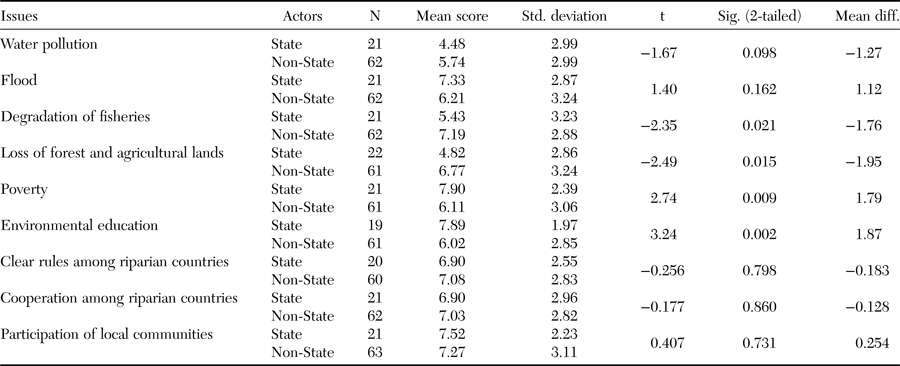
I investigated the issues that actors perceived as important and critical policy issues in the Mekong River Basin. Based on archival research of newspapers, policy documents, meeting minutes, and open-ended interviews with key actors, nine key policy issues crucial for local livelihood were identified (Table 2). These nine issues were frequently reported in local newspapers in regard to policy debate about the development of the Mekong River in Cambodia, Thailand, and Lao PDR. These issues were also frequently reported in Bangkok Post and The Nation newspapers in Thailand concerning Pak Mun Dam and NT2 Dam. The archive of official policy documents and the meeting minutes of NGOs also frequently described these nine issues as challenging policy areas in the Mekong River Basin. Subsequently, the same nine issues were then listed in one question of the structured interview sheet, which contained a total of fourteen questions.Footnote 4
Policy issues in the Mekong River Basin as perceived by state and non-state actors. (Note: N = number of participants rating the issue. Participants were categorised as state or non-state actors based on whom they represented, which was determined from their answers to one of the interview questions. In another question, participants were asked to score the level of importance, 1 = least important to 10 = most important, of issues that the Mekong governance faced at the time of interview in late 2003 and early 2004. Both questions were worded the same in two questionnaires (one for NT2 Dam participants and another for Pak Mun Dam participants) that asked about general issues that the Mekong River Basin governance processes have to deal with. N values, therefore, are combined results from two case studies).

Field Interviews and Data Analysis
While I identified issues, I also identified key actors for interviewing. Some participants who were not prominently reported in archival records but played crucial roles in local communities and government decision processes were recommended by scholars who had been studying in the region for decades. During my first research trip in 2000, I was able to build a network of scholars who engaged in research related to dams and navigation issues in the Mekong, who then assisted and advised me in identifying key actors at three levels for my interviews. Although I was able to identify key actors in the dam industries, the World Bank, NGOs, and local and national government offices from reading archival documents, I needed to conduct fieldwork in the villages to identify key actors in local communities. For these interviews, I spent a total of one month in 17 villages in Nakai Plateau in central Lao PDR where NT2 Dam is located and three months with villagers in the Pak Mun Dam area in north-eastern Thailand.Footnote 5
The interviewees are grouped into state and non-state actors. States are direct participants and official members of the international development planning in the Mekong under the guidance of each riparian national government. Local communities and non-governmental organisations are not officially allowed to participate in international development planning or the decision-making processes in the Mekong. The comparison of how each of these two main actors view the nine policy issues inform the source of contention on the issues of how local livelihood issues are linked to or connected with international development planning. For the purpose of comparing how state and non-state actors view the governance issues that the Mekong River Basin as a whole is facing, I compared the means of these two groups and use a t-test to determine statistical significance. The outcomes of the t-test are reported in Table 2. The outputs of the t-test were then cross-checked with the language used in policy debates about the development issues reported in the media, meeting minutes, official policy documents, and my open-ended interview notes, which describe development issues that are viewed differently by state and non-state actors.Footnote 6
Understanding Contentious Development Issues
There are four policy/governance issues that state and non-state actors view differently in terms of how important it is that they be resolved in governance processes or development planning in the Mekong River Basin. These four issues are: (1) degradation of fisheries due to dam construction; (2) loss of forest and land from dam construction; (3) definition of the ‘poverty’ of the population; and (4) environmental education within communities. These four issues are the sources of policy contentions between state and villagers. They are also the sources of violent and non-violent protests that occurred from 1989 to 2003 in the Pak Mun Dam case in Thailand (Baker Reference Baker2000; Missingham Reference Missingham2003). The contention is a depository of factors that explain why these local livelihood issues are not considered in international development planning and why international planning without local participation will face significant hurdles to achieve stated goals in the future.
Degradation of Fisheries
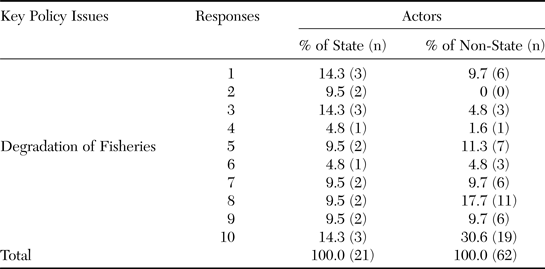
Fish and rice are to people in the Mekong River Basin, like meat and potatoes are to U.S. citizens. They are culturally and nutritiously important items for local livelihoods. Degradation of fisheries is the issue that cannot be lightly considered in development planning. My research found that on the issue of degradation of fisheries, the significance level of probability of the t score is 0.021 (<.05), indicating less than 5% of respondents support the null hypothesis to suggest that the mean value between state and non-state actors is nearly the same. The remaining 95% of respondents' scores, therefore, seem to support that the mean difference between state and non-state actors is statistically significant, to say that state and non-state actors view the issue of degradation of fisheries differently. This significance is also reflected in differences in distribution of respondents as shown in Table 3 on the fisheries issue. Table 3 shows that 58% of non-state actors scored 8, 9, and 10, whereas only 33% of state actors scored the issue that high. In policy terms, this suggests that the issue of degradation of fisheries will be weighted differently between state officials and local communities. The majority of urban dwellers and elitist state leaders in the region view the life of fishers and farmers as backward, poor, uneducated, and uninterested in national development. Fishers and famers view their livelihood activities not only as economic activity but also as social and cultural spaces in which communal bonds and festivities are embedded. These views lead to conflict between state and non-state actors on the issue of degradation of fisheries relating to measurement in the benefit-cost analysis of development projects such as dam construction.
Responses to the issues of degradation of fisheries: state and non-state actors compared. (Note: Responses are scored from 1, least important; to 10, most important).

For villagers, fisheries are one of the most important sources of their livelihoods. For states, traditional economic practices such as fisheries are incompatible with modern development goals that require hydroelectric power and irrigation systems to feed fruit orchards and rice farming for export. Similarly, since states in Southeast Asia engaged in export-oriented economic policies beginning in the early 1980s, national production of goods and services have responded better to the needs of buyers from abroad than to the needs of the local population. For instance, 95% of total electricity production from NT2 Dam is for export to Thailand, and only 5% is for local consumption. While Lao PDR will receive revenue from the sale of electricity, how much of it will go to, or even be beneficial to, local communities is not guaranteed.
Poverty
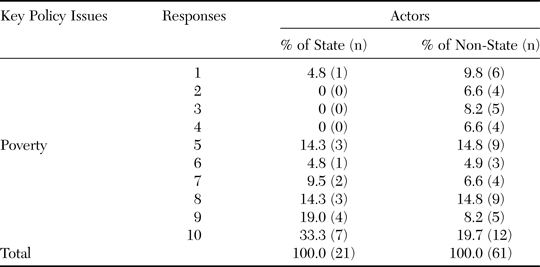
The issue of poverty can also be interpreted statistically. The significance level of the poverty issue is 0.009 (<.05), indicating less than 5% of the sample cases seem to support that the means of state actors and non-state are the same. This suggests that the ways in which the state actors and non-state actors view the poverty issue in the context of development planning in the Mekong River Basin are different. Many of the state-initiated development projects such as dam construction in the Mekong River Basin are debated in terms of ‘poverty reduction’ policies and programs. Framing of development projects around poverty reduction issues is preferred by the state and developers because they want to present their projects as helping the poor when seek external funding from international financing institutions such as Asian Development Bank. This is the case even when a project is purely commercial, like the NT2 Dam, which is being developed by a consortium of multinational corporations and the Lao PDR government to sell electricity to Thailand. As Table 4 shows, 66.6% of state actors scored poverty issues as important (8, 9, 10) while 42.7% of non-state actors scored the same. Poverty reduction programs are supported and promoted by the Asian Development Bank and the World Bank through loans.
Responses to the issue of poverty: state and non-state actors compared. (Note: Responses are scored from 1, least important; to 10, most important).

It is important to consider how people who are viewed as ‘poor’ by bank officials and state leaders view the issue of poverty in such poverty-reduction policies and programs. The difference in the mean test suggests the states' development policies imposed on rural villagers may be at odds with the needs and desires of the villagers who see the issues of poverty differently from the state. This is a relevant issue in the Mekong River Basin, as some of the high-level MRC officials expressed during the interviews how the issue of poverty dominates riparian states in terms of development thinking. Former Chief Executive Officer Joern Kristensen of the MRC summed up this issue in the MRC's State of the Basin Report 2003:
“Although exploitation of the basin's resources could be of tremendous benefit to the peoples of the Mekong Basin, who are among the poorest in the world, it could also cause tremendous hardship if it is not properly planned, managed and monitored.” (MRC 2003, Preface)
The problem of the states' and citizens' different definitions of poverty is rooted in how elitist state leaders and rural populations in the region view what they want to do with their livelihoods and how they plan to develop their livelihoods. For the majority of ‘Western-educated’ or textbook-trained leaders and urbanites, going to eat at Pizza Hut, McDonald's, or Starbucks and enjoying amenities that symbolise ‘development’ in the West are assumed to be good for their societies. Some village elites and wealthy people also seem to agree with how states define poverty and development and don't think about alternative definitions by applying self-driven education. What this means is that development planning that will benefit everyone must go through rigorous and honest participation of all concerned stakeholders at multiple scales and contexts. A project's space, context, and scale are defined on the basis of ‘thinking like the state’ and ‘acting like the state’, thus leading to a two-level game approach in the region.
Environmental Knowledge
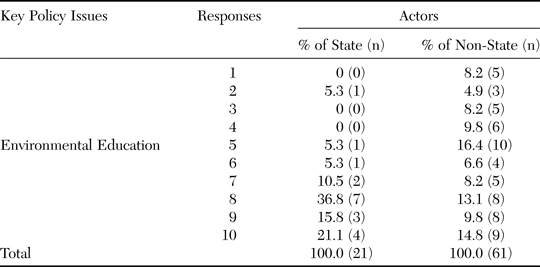
The issue of environmental education among local populations is the third policy issue that state and non-state actors view differently, as suggested by the t-test, with the significance level of 0.009 (<.05), which rejects the null hypothesis. Very often the ways in which non-state actors view the level of environmental education of villagers is different from the ways in which government officials view it. Government officials often view the environmental education of local populations as a problem in implementing development projects, whereas non-state actors view it as less of a problem. Table 5 shows the distribution of responses between state and non-state actors on the issue of environmental education. Similar to the poverty issue, the state actors (73.7% scoring 8, 9, and 10) compared to non-state actors (38.2% scoring 8, 9, 10) think environmental education of local populations is a problem in environmental governance and an obstacle to promotion of sustainable development of the Mekong River Basin.
Responses to the issue of environmental education: state and non-state actors compared. (Note: Responses are scored from 1, least important; to 10, most important).

During interviews with government officials in both Lao PDR and Thailand, the rural populations, especially poor villagers and farmers, were often described as backward and uneducated people who needed to be developed by the state. Surprisingly, Thai government officials were more negative about the education of villagers in northeast Thailand compared to their counterparts in Lao PDR. In general, they have more formal education and live in a politically open society compared to their Lao PDR peers. One would expect those in Thailand to have a more informed and balanced view of poverty and the poor than in Lao PDR. Perhaps the communist philosophy of the Lao PDR government, which considers itself a representative of poor and rural villagers, played an important role in the way in which government officials viewed villagers. This is not to convey that the Lao PDR government officials' view is right and Thai government officials' view is wrong. It is, however, important to understand the sources of contentions between state and non-state actors.
The Lao PDR government officials' perception of education of the rural villagers is almost counter-productive in that they blind themselves by refusing to see the need for educating rural villagers. As a consequence, they may fail to devote adequate resources for rural education. Thai government officials' perception that villagers need to be educated more about their environment is perhaps factually correct in some cases, but government officials use this as a reason to deny villagers the right to participate in decision-making processes about their own livelihoods. This is problematic for policy implementation. Therefore, it is necessary to understand how governments of the countries in the Lower Mekong Basin think about and perceive the environmental education of their rural populations. While government leaders view this education through the lens of general education based on official degrees and certificates, villagers view environmental education through the lens of their tacit knowledge based on livelihood activities. For instance, in central and upland Lao PDR, local and international NGOs that promote education programs for rural children face the problems of parents' lack of interest in formal textbook education. Parents think their children's lives will be better if they learn how to extract foods and commodities from forests. In other words, rural parents desire education that is directly relevant and related to the maintenance and development of their livelihoods. This could be fertile social ground on which development planning in the region could be conceived. However, dominant patterns of ‘thinking like the state’ hinder a mental switch to think of it as fertile ground for national development. On top of that, development policies conceived through locally untested theories that what is good for industrialised societies will be equally good for village communities in the Mekong River Basin also hinder the appreciation of local communities' livelihoods and depository of knowledge associated with local livelihoods.
Loss of Forest and Agricultural Lands
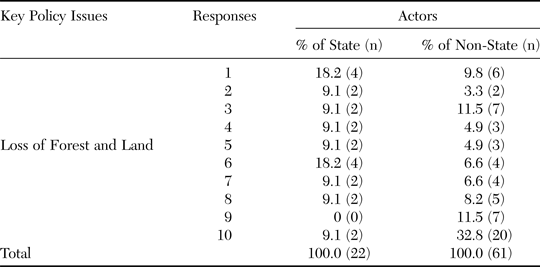
The loss of forest and agricultural land due to development projects such as dam construction is the fourth issue where state and non-state actors have differences in opinions, as suggested by the t-test, with the significance of 0.015 (<.05). The mean difference is −1.95, the widest among all issues listed in Table 2. The perceptions of government officials and non-state actors, especially villagers, on the complex issues of loss of forest and land go beyond the loss of trees and space. Table 6 shows that 52.5% of non-state actors viewed the loss of forest and land as an important policy issue, while only 18.2% of state officials viewed the same, with both groups scoring 8, 9, and 10. The remaining 30% of participants scored importance as less than 8. Based on my interviews and observations of village life during nine months of field research, I determined that for villagers, their forest is not just trees, land, and space. Their cultural, communal, and emotional attachments to land and the worship of certain forests were getting very little (or no) consideration in the decision making at the state level. Government officials often think that compensation packages containing the market price of land and equivalent of lost income due to these projects should satisfy villagers. This type of assumption made by government officials and consulting firms that calculate costs and benefits of dam projects is a major source of the governance problem.
Responses to the issue of loss of forest and agricultural land: state and non-state actors compared. (Note: Responses are scored from 1, least important; to 10, most important).

The conventional approach proposed in response to deforestation in Thailand and Lao PDR is to designate an area of forest near each village community as a protected forest. For instance, nearly 20,000 ha of forest surrounding the NT2 dam in central Laos were designated as a community forest after the construction of the NT2 dam and inundation of former forests and villages. The Village Forestry Associations (VFAs) are established to manage the designated community forests. However, VFAs are run by lower-rank officials of the state's bureaucracy with technical inputs from NGOs. Local people's direct ownership and management are not present in the arrangement. These types of responses show that state leaders and bureaucrats tend to view tacit knowledge and local experts as incongruent with state development planning.
Finally, the five remaining issues listed in Table 2 – water pollution, flood, clear rules among riparian countries, cooperation among riparian countries, and participation of local communities – are also equally important issues, and state and non-state actors appear to see their importance similarly, as suggested by the t-test and significance levels that indicate the null hypothesis should not be rejected. These five issues are the main focus of current MRC projects within the three major programs discussed briefly in the preceding section. They are also central components of national development planning in each riparian member state.
Conclusion
Since the formation of the UN Mekong Committee, the problem of the Mekong River Basin development at the international scale has been defined by outsiders and not necessarily by the riparian states and communities themselves. The long-standing institutional framework that facilitates outsiders in shaping the meaning of projects for development has been a two-level game framework in which riparian states are considered central decision makers and actors. This trend continues at the convenience of the consequences for local livelihood development issues discussed above. At the national level, riparian states in the Mekong River Basin operate with a narrow vision within national borders. Consequently, national interests defined only by the elites continue to dictate the fate of development. Under both international and domestic frameworks, local communities and citizens have neither legitimacy nor political authority to define the problem and meaning of development, both of which have direct consequences for their livelihoods.
After a half-century of international institutionalisation of development in the Mekong River Basin within a two-level game framework, we can observe that the most developed country in the lower Mekong region, Thailand remains ranked at 103rd, and Vietnam, Lao PDR, and Cambodia ranked respectively at 127th, 138th, and 138th out of 169 countries according to the 2013 UNDP Human Development Index ranking (UNDP 2013: 203). Two upper riparian countries, China and Myanmar, are ranked at 101st and 149th respectively. If we examine poverty distribution in the national data of these countries closely, the majority of poor people live in the Mekong River Basin. These figures highlight the fact that if development planning is to follow the old institutional path and continue to perceive the problem defined as that of basin-wide development within the two-level game approach, a familiar result will be repeated in the future.
It is inevitable if the success of development in the Mekong River Basin is to be achieved for the population it targets, the role of local communities in decision making and implementation of projects must be recognised and integrated into international institutional mechanisms. More important, if the communities and states along the Mekong and its tributaries plan to pursue basin-wide sustainable development, the participation and action of local appropriators and users of the Mekong River plays a crucial role. Understanding and recognising local livelihood issues as such requires moving beyond traditional two-level game approach in which states presumably control local issues and international bodies command national politics of the Mekong.
Acknowledgements
The author acknowledges the funding from National Bureau of Asian Research, and the Woodrow Wilson International Center for Scholars as an NARP Fellow in 2010–2012. The initial field research was made possible by a research grant from the Vincent and Elinor Ostrom Workshop in Political Theory and Policy Analysis at Indiana University, Bloomington, IN, USA. The author also thanks anonymous reviewers of TRaNS for insightful comments.