Among children with asthma, comorbid anxiety occurs at an increased rate compared to children without asthma, with approximately one in five children with asthma also experiencing an anxiety disorder (Dudeney, Sharpe, Jaffe, Jones, & Hunt, Reference Dudeney, Sharpe, Jaffe, Jones and Hunt2017). Anxiety plays a role in the prognosis, severity, and control of asthma in children, and elevated anxiety symptoms are positively related to asthma severity in children (Richardson et al., Reference Richardson, Lozano, Russo, McCauley, Bush and Katon2006). Anxiety in children with asthma is also associated with poorer control of asthma symptoms (Lehrer, Feldman, Giardino, Song, & Schmaling, Reference Lehrer, Feldman, Giardino, Song and Schmaling2002), decreased emotional and physical functioning (McCauley, Katon, Russo, Richardson, & Lozano, Reference McCauley, Katon, Russo, Richardson and Lozano2007), greater use of health services (ten Brinke, Ouwerkerk, Bel, & Spinhoven, Reference ten Brinke, Ouwerkerk, Bel and Spinhoven2001), and a greater risk of being a smoker as an adolescent (Bush et al., Reference Bush, Richardson, Katon, Russo, Lozano, McCauley and Oliver2007).
Despite the high levels of comorbid anxiety with asthma and its serious consequences, there are very few evidence-based treatments for this population. In contrast, there is a vast amount of evidence to support the application of cognitive-behavioural therapy (CBT) for healthy children with anxiety disorders (James, James, Cowdrey, Soler, & Choke, Reference James, James, Cowdrey, Soler and Choke2015). CBT may be particularly effective for children with asthma and anxiety if it can directly target the factors that underpin the comorbidity. One model developed by Park, Sawyer, and Glaun (Reference Park, Sawyer and Glaun1996) highlights the cognitive and behavioural factors believed to explain the relationship between asthma and panic disorder. In this model, children with asthma are thought to misinterpret sensations of breathlessness that are normal and experience them as signifying imminent physical threat. Children with asthma, therefore, overestimate threat in situations in which they experience asthma-like symptoms, and a vicious cycle develops in which children engage in avoidance (e.g., missing school or activities) or safety behaviours (e.g., overusing medication or seeking reassurance). These behaviours then exacerbate and/or maintain anxiety and asthma symptoms. Addressing children's interpretations of their symptoms, in addition to other treatment-interfering representations (e.g., decreased self-efficacy to manage their asthma) or other anxiety-related biases, may improve both anxiety and asthma symptoms in children.
A literature search reveals a paucity of studies investigating the application of CBT to individuals with asthma and anxiety, and most are based on adult populations with asthma and comorbid panic disorder. These studies have involved interventions involving asthma education, relaxation exercises, behavioural techniques, and cognitive coping skills, and have reported a significant decrease in anxiety and asthma symptoms and an increase in quality of life (Feldman et al., Reference Feldman, Matte, Interian, Lehrer, Lu, Scheckner and Shim2016; Grover, Kumaraiah, Prasadrao, & D'Souza, Reference Grover, Kumaraiah, Prasadrao and D'Souza2002; Put, van den Bergh, Lemaigre, Demedts, & Verleden, Reference Put, van den Bergh, Lemaigre, Demedts and Verleden2003; Ross, Davis, & Macdonald, Reference Ross, Davis and Macdonald2005).
For children with asthma, the most recent systematic review of psychological interventions for children with asthma concluded, on the basis of 12 low-quality trials, that evidence for the efficacy of psychosocial interventions in childhood asthma is lacking (Yorke, Fleming, & Schuldham, Reference Yorke, Fleming and Shuldham2005). Further, there are only three uncontrolled trials that have examined the question of whether CBT is effective for children with asthma who also present with an anxiety disorder, which have shown mixed outcomes (Marriage & Henderson, Reference Marriage and Henderson2012; Papneja & Manassis, Reference Papneja and Manassis2006; Park, Sawyer, & Glaun, Reference Park, Sawyer and Glaun1996). One study involved a retrospective file review of cases of childhood asthma where a recent worsening in function had been reported but where respiratory testing did not confirm a worsening in condition (Park et al., Reference Park, Sawyer and Glaun1996). Twenty-three cases of children aged 10–12 years old were identified, and the researchers determined that these children had developed an increasing fear associated with their asthma with an increasing awareness of its potential life-threatening nature. The researchers used a CBT model based on panic disorder to treat these children and found that treatment resulted in fewer hospitalisations. This study, while preliminary, is encouraging for the potential application of CBT that specifically targets asthma-related fears.
In a second study, Papneja and Manassis (Reference Papneja and Manassis2006) compared the treatment response to CBT of 36 children with asthma and anxiety to that of 36 children with anxiety disorders alone (children were aged 8–12 years). The results of this study suggested that although both groups improved significantly, children with asthma improved significantly less compared to children with anxiety alone in terms of anxiety symptoms and anxiety diagnostic severity. The researchers did not fully describe the treatment they used, but one potential reason for this finding is there was no indication that CBT was adapted to account for the asthma status of the children in the study. If the role of specific fears related to asthma was not taken into account, it is likely that the treatment may not have been optimal.
A more recent study investigated the effect of nurse-delivered CBT on anxiety and asthma-related quality of life in 10 children (aged 7–16 years) with asthma and anxiety (Marriage & Henderson, Reference Marriage and Henderson2012). The treatment was adapted to account for the child's asthma status and included breathing and relaxation exercises, and basic cognitive restructuring. Children reported fewer anxiety symptoms and higher quality of life at posttreatment and at 3-month follow up. However, the study did not include diagnostic measures of child anxiety, and so it is unknown whether the intervention achieved clinically meaningful change for anxiety.
Caring for a child with asthma places a significant burden on parents, and research shows that parenting stress, anxiety, and depression is higher in children with asthma compared to healthy children (Easter, Sharpe, & Hunt, Reference Easter, Sharpe and Hunt2015; Hullman et al., Reference Hullmann, Wolfe-Christensen, Ryan, Fedele, Rambo, Chaney and Mullins2010), which in turn has been shown to adversely affect child asthma outcomes (Kaugars, Klinnert, & Bender, Reference Kaugars, Klinnert and Bender2004; Tibosch, Verhaak, & Merkus, Reference Tibosch, Verhaak and Merkus2011). In addition, parenting behaviours have been found to be associated with anxiety in children with asthma (Sicouri et al., Reference Sicouri, Sharpe, Hudson, Dudeney, Jaffe, Selvadurai and Hunt2017a). Including parents in treatment for children with asthma and anxiety may therefore be worthwhile to improve treatment outcomes and help to alleviate caregiver stress; however, previous studies have not included parents, with the exception of one study (Papneja & Manassis, Reference Papneja and Manassis2006), but they did not measure parent outcomes.
Apart from Park and colleagues’ (Reference Park, Sawyer and Glaun1996) cognitive model, which explains the relationship between asthma and panic disorder, we are yet to understand why children with asthma experience a higher rate of anxiety disorders. Understanding the nature of the relationship between asthma and anxiety is particularly important, as research shows that children with asthma experience a spread of anxiety disorders, which is similar to what is seen in a healthy youth population (Dudeney et al., Reference Dudeney, Sharpe, Jaffe, Jones and Hunt2017). Other possible mechnisms that underlie the relationship between asthma and anxiety in children may be the experience of living with a chronic illness, which could then lead to anxiety (Goodwin, Bandiera, Steinberg, Ortega, & Feldman, Reference Goodwin, Bandiera, Steinberg, Ortega and Feldman2012), perhaps as a result of a catastrophic thinking style or avoidance, such that the relationship is transdiagnostic in nature. Alternatively, a third factor may be influencing the relationship between asthma and anxiety disorders in children, such as parenting behaviours or parental psychopathology. Understanding and targeting these factors as part of treatment is vital in order to effectively treat this population.
The aim of the current study was to evaluate the efficacy of a pilot CBT group intervention designed to address limitations in previous studies by tailoring treatment to account for children's asthma, including a diagnostic measure of child anxiety and measuring parent outcomes. In addition, we aimed to complement previous studies by describing the children who took part in treatment in more detail. By doing so, we aimed to better understand the nature of the relationship between asthma and anxiety disorders in children. The hypotheses were that a CBT intervention would lead to: (1) a reduction in child clinical anxiety; (2) an improvement in asthma-related quality of life and asthma control; and (3) an improvement in parent quality of life associated with caring for a child's asthma.
Method
Participants
The participants were drawn from a larger project investigating the relationship between asthma and anxiety (Sicouri et al., Reference Sicouri, Sharpe, Hudson, Dudeney, Jaffe, Selvadurai and Hunt2017b). Children were eligible if they met DSM-IV diagnostic criteria for an anxiety disorder; had an asthma diagnosis from a respiratory paediatrician, their asthma was well controlled and monitored by optimal and stable respiratory medications, aged between 8 and 13 years, and were fluent in English. Exclusion criteria included any condition that would hinder participation in group treatment (e.g., developmental disorders) and if the child was receiving current psychological treatment. No children met diagnostic criteria for a mood disorder.
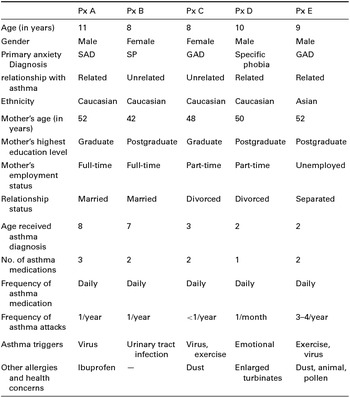
The children were recruited from the Sydney Children's Hospital, Randwick. Out of 29 eligible participants who took part in the larger project, six participants accepted the offer of treatment and five completed the treatment. One participant dropped out of treatment after the first session due to a scheduling conflict. The remaining 23 participants declined the offer of treatment for the following reasons: scheduling conflicts or too busy (n = 12), lack of interest (n = 4), or because of the travel time to get to treatment (n = 7). Five participants completed the treatment, and three of these participants reported anxiety that was related to their asthma (Cases 1, 4 and 5); a child whose anxiety developed as a result of his asthma, a child whose anxiety symptoms were a primary trigger for his asthma symptoms, and a child who had anxiety about her asthma (demographic and diagnostic information for the three participants is shown in Table 1). Two cases reported anxiety unrelated to their asthma (Cases 2 and 3). The five cases are described in more detail below.
Key Demographic and Diagnostic Information

Note: Px = Participant. The mother was the primary caregiver and took part in the treatment in all cases.
Participant A: David, 11 years old
David had a primary diagnosis of separation anxiety disorder (SAD) and a secondary diagnosis of specific phobia (SP; heights). David's separation fears from his parents arose in the context of hospitalisation due to a virus-induced asthma flare-up. Prior to this, he had never experienced or received treatment for anxiety symptoms. David missed a lot of school due to his asthma, which was triggered by viruses, and had been hospitalised on four occasions. David's mother reported that she experienced significant anxiety in relation to David's asthma. His parents were married and David was their only child. David's treatment goals were to learn skills to manage his fears around separating from his parents.
Participant B: Rachel, 8 years old
Rachel had a primary diagnosis of social phobia (SP) and secondary generalised anxiety disorder (GAD). Her primary fears were speaking or reading out aloud, or speaking to unfamiliar people, as well as worries about school work. Rachel was diagnosed with asthma when she was 7 years old, and her asthma was well controlled. Her mother reported that Rachel's anxiety was independent of her asthma. Rachel's goal for treatment was to be able to read out aloud and to speak to unfamiliar people.
Participant C: Claudia, 8 years-old
Claudia had a primary diagnosis of GAD, and three comorbid anxiety disorders (SP, SAD, and SP). Claudia's anxiety developed in the context of changes in her family structure and living arrangements (parental divorce and father's remarriage). Claudia was diagnosed with asthma when she was 3 years old. Her asthma was well controlled and reportedly independent of her anxiety. Her mother had a prior diagnosis of depression. Claudia lived with her mother and older sister.
Participant D: Connor, 10 years old
Connor had a primary diagnosis of SP that the ceiling would fall in in large enclosed spaces (e.g., cinema, basketball court, school hall). He experienced panic-like symptoms, but did not meet full diagnostic criteria for panic disorder. His anxious symptoms would trigger the onset of his asthma symptoms. His asthma and anxiety symptoms were thus intimately related. He missed on average one day of school every fortnight due to his asthma and/or anxiety and avoided a number of activities. His mother reported that she was often unsure about whether his symptoms were asthma or anxiety-related. Connor was an only child and his mother was divorced. Connor's treatment goals were to reduce the impact of his anxiety on his asthma symptoms and become less fearful of the ceiling falling down in large enclosed spaces.
Participant E: Nina, 9 years old
Nina experienced GAD in relation to a range of things, including her asthma and its impact on her quality of life. She also had a diagnosis of SAD. She avoided exercise completely as exercise was a trigger for her asthma symptoms, and she feared it would result in an asthma attack. She experienced anticipatory anxiety about the onset of her asthma symptoms and had a tendency to catastrophise any symptoms perceived to be related to her asthma; however, her asthma was well controlled with medication. She also suffered from a dust allergy and hayfever. She lived with her mother, who was divorced, and her older sister. Nina's treatment goals were to learn skills to manage her anxiety and participate in exercise.
Primary Outcome Measures
Anxiety Disorders Interview Schedule for DSM-IV: Child and Parent Version (ADIS: C/P; Silverman & Albano, Reference Albano1996)
The ADIS: C/P is a semi-structured clinical interview that provides a DSM-IV diagnosis and has strong evidence supporting reliability for child and adolescent disorders (Silverman, Saavedra, & Pina, Reference Silverman, Saavedra and Pina2001). Diagnoses are rated on a clinician severity rating (CSR) using a 9-point scale (0 = not at all disturbing/disabling; 8 = very severely disturbing/disabling; a rating under 4 is subclinical), based on child report, parent report and therapist's combined interpretation. The structured interview was conducted face to face by registered psychologists who had been trained to conduct diagnostic interviews. All of the pretreatment diagnostic interviews were audiotaped and coded again by a different registered psychologist trained in scoring the ADIS. Interrater reliability was excellent (χ = 1.0 for the presence of an anxiety diagnosis and 0.98 for the primary diagnosis). Disagreements were resolved by consensus. Assessments were conducted under the supervision of a senior clinical psychologist (CH) and taken at pre- and posttreatment.
Paediatric Asthma Quality of Life Questionnaire (PAQLQ; Juniper et al., Reference Juniper, Guyatt, Feeny, Ferrie, Griffith and Townsend1996a)
The PAQLQ is a 23-item, interviewer-administered scale assessing areas of daily function (physical, emotional, social) that children with asthma (aged 7–17 years old) report as most troublesome, and good evidence supporting reliability and validity have been reported (Juniper et al., Reference Juniper, Guyatt, Feeny, Ferrie, Griffith and Townsend1996a). Scores are averaged to obtain an overall score ranging from 1–7, with lower scores indicating a poorer quality of life.
Secondary Outcome Measures
Asthma Treatment Assessment Questionnaire (ATAQ; Skinner et al., Reference Skinner, Diette, Algatt-Bergstrom, Nguyen, Clark, Markson and Wu2004)
The ATAQ is a parent-completed measure that measures asthma symptom control in children and adolescents aged 7–17 years. Scores range from 0–7, with higher scores indicating poorer symptom control. The ATAQ has evidence of good internal consistency and has been validated against objective measures of physical health, asthma symptoms, and health-care utilisation (Skinner et al., Reference Skinner, Diette, Algatt-Bergstrom, Nguyen, Clark, Markson and Wu2004).
Pediatric Asthma Caregivers Quality of Life questionnaire (PACQLQ; Juniper et al., Reference Juniper, Guyatt, Feeny, Ferrie, Griffith and Townsend1996b)
The PACQLQ a 13-item questionnaire that measures problems that are most troublesome for parents of children (aged 7–17 years) with asthma. Scores are averaged to obtain an overall score ranging from 1–7, with lower scores indicating poorer caregiver quality of life. The PACQLQ has evidence supporting good reliability and validity (Juniper et al., Reference Juniper, Guyatt, Feeny, Ferrie, Griffith and Townsend1996b).
Treatment satisfaction questionnaire
Parents completed a treatment satisfaction questionnaire designed specifically for the study. A total score was calculated based on eight questions, with higher scores indicating higher levels of satisfaction. An overall program rating was also provided on a Likert scale ranging from 1 (very poor) to 5 (excellent).
Treatment
The treatment comprised of eight 1-hour weekly sessions. It was adapted from a standard group CBT treatment for children with anxiety to account for the child's asthma status based on a cognitive behavioural model of asthma and anxiety (Park et al., Reference Park, Sawyer and Glaun1996). Components of treatment included psychoeducation about asthma and anxiety, discriminating between asthma and anxiety symptoms, cognitive challenging, graded exposure, planning and pacing, relaxation techniques, and problem solving. The asthma-related content was developed in consultation with a respiratory paediatrician (AJ). Treatment was delivered by two clinical psychologist trainees supervised by a senior clinical psychologist (CH) at the Psychology Clinic at the University of Sydney.
Procedure
Eligible participants who accepted the offer of treatment completed baseline questionnaire measures in the week prior to starting treatment. For each of the subsequent weeks, children and their mothers attended the treatment. Treatment handbooks were given to participants (a child and parent version), which included information covered in each session and exercises to complete between sessions. Child and parent sessions were conducted separately, with a meeting together for the final 10 minutes. The group facilitators followed a standardised protocol designed to complement the handbooks. In the week following the end of treatment (posttreatment), parents and children completed an assessment that included completing the diagnostic interview and questionnaire measures. Three months following the program, parents and children completed the questionnaire measures only (3-month follow-up).
Clinical Significance of Treatment for Asthma Measures
A clinically significant improvement for the PAQLQ and PACQLQ was defined as a change score greater than 0.5 in accordance with the measurement guidelines for this measure (see Juniper et al., Reference Juniper, Guyatt, Feeny, Ferrie, Griffith and Townsend1996a, Reference Juniper, Guyatt, Feeny, Ferrie, Griffith and Townsend1996b). Clinical significance of treatment response for the ATAQ was analysed by determining whether change in scores represented a return to normal functioning, where posttreatment scores were closer to the mean of the normal population than to the mean of the dysfunctional population (Jacobson & Truaz, Reference Jacobson and Truax1991). The Reliable Change Index (RCI) was calculated by dividing the difference between pre-and posttreatment scores on each variable by the standard error of measurement. If the RCI exceeds 1.96, the change is considered statistically reliable (Jacobson & Truax, Reference Jacobson and Truax1991). Participants were considered ‘recovered’, ‘improved’ (but not recovered), or ‘unchanged’ according to the method posited by Hageman and Arrindell (Reference Hageman and Arrindell1999). Means and standard deviations required for calculation of the RCI and clinical cut off scores were taken from the literature.
Results
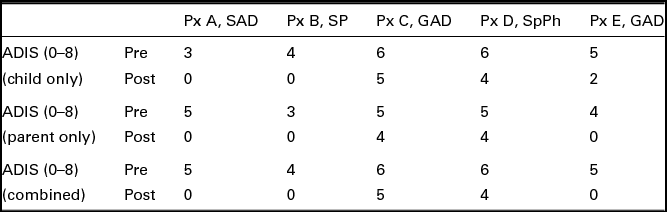
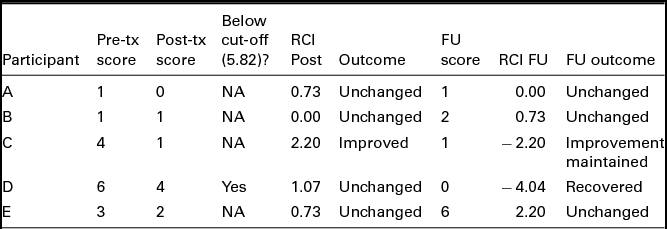
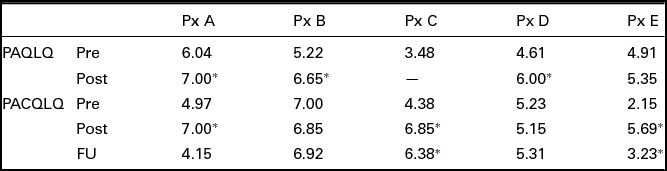
Although each of the five cases had different needs and problems, all were able to benefit from the intervention. Tables 2, 3, and 4 demonstrate the changes in different indices at pretreatment, posttreatment and follow-up (where relevant).
Pre- and Post-ADIS Severity Ratings for Primary Diagnosis Only

Note: *Indicates clinically significant change (>0.5); Px = Participant; SAD = Separation anxiety disorder; SP = Social phobia; GAD = Generalised anxiety disorder; SpPh = Specific phobia; PAQLQ = Pediatric Asthma Quality of Life.
ATAQ Scores at Pretreatment, Posttreatment and Follow-Up

Note: Pre-tx = Pretreatment; Post-tx = Posttreatment; FU = Follow-up; RCI = Reliable Change Index.
Asthma-Related Quality of Life Scores for Children and Parents at Pretreatment, Posttreatment and Follow-Up

Note: *Indicates clinically significant change (>0.5); PAQLQ = Pediatric Asthma Quality of Life; PAQCLQ — C = Pediatric Asthma Caregivers Quality of Life; Px = Participant.
Child Anxiety
Table 2 displays the results of pre- and posttreatment anxiety diagnoses information for child report, parent report and combined report. Three of the five children no longer met diagnostic criteria for any anxiety disorder posttreatment (Participants A, B, and E). Of the two children who did meet diagnostic criteria for an anxiety disorder posttreatment (Participants C and D), both reported lower severity scores on their primary diagnoses and Participant C did meet clinical cutoff for one of their cormorbid diagnoses, social phobia.
Asthma Outcomes
Tables 3 and 4 show ATAQ and asthma-related quality of life scores respectively. Participant C reported an improvement in asthma symptom control (ATAQ) posttreatment and this was maintained at follow-up. Participant D reported a recovery at follow-up. Three children reported a significant improvement in asthma-related quality of life posttreatment (Participants A, B, and D).
Caregiver Quality of Life
Table 4 displays pre-, post-, and follow-up treatment scores for caregiver quality of life associated with caring for a child with asthma. Three of the five parents reported an improvement in quality of life posttreatment (Participants A, C, and E), with two parents maintaining this improvement at follow-up (Participants C and E).
Program Attendance and Satisfaction
All participants completed six or more sessions of treatment (M = 6.6 sessions). Participants rated the program as either good or excellent and the average satisfaction score was 17.3 (out of 24).
Discussion
The current study examined the effectiveness of a pilot CBT intervention tailored for children with asthma and anxiety. The program consisted of an eight 1-hour group treatment sessions, and the outcomes of five children with asthma and anxiety are presented using a case-series design. The current findings provide preliminary evidence for the effectiveness of CBT for reducing anxiety and improving asthma-related outcomes in these children and add to the small literature on the effectiveness of CBT for treating anxiety in children with asthma.
Results showed that three of the five participants no longer met diagnostic criteria for an anxiety disorder posttreatment (Participants A, B, and E) and two participants reported lower clinical severity scores for their primary diagnoses (Participants D and C). These results provide preliminaty evidence for the efficacy of a CBT intervention for improving clinical anxiety, which supports previous research showing improvements in anxiety symptoms or severity in the context of childhood asthma following CBT treatment (Marriage & Henderson, Reference Marriage and Henderson2012; Papneja & Manassis, Reference Papneja and Manassis2006).
Three of the five participants reported improvements in asthma-related quality of life (Participants A, B, and D) and two participants reported improvements in asthma symptom control (Participants C and D). These findings show that although CBT was largely not effective in improving asthma symptom control, it was for two of the participants (whose asthma symptom control did not improve) still possible to improve quality of life. This is an important finding as it suggests that addressing anxiety can reduce the impact of a physical condition such as asthma on a broader level of wellbeing, despite no change in the child's asthma status or severity. The improvement in quality of life is consistent with the finding by previous research for children with asthma and no clinical anxiety (Marriage & Henderson, Reference Marriage and Henderson2012).
Improvements in caregiver quality of life for three of the mothers of children with asthma and anxiety (Participants A, C, and E) suggests that CBT also provided parents with positive benefits. Given that parents are centrally involved in their child's ongoing asthma management, this result tentatively suggests the need to include parents in any intervention to improve outcomes for children with asthma and comorbid anxiety. Inclusion of parents in the present study may also partially account for the low attrition rate in comparison to other treatment studies (Marriage & Henderson, Reference Marriage and Henderson2012). Future research could investigate the role of parental involvement further by comparing treatment outcomes for an intervention with and without parents, or assessing the relationship between parent and child outcomes using a multiple regression analysis.
The treatment was tailored for children with anxiety to account for their asthma status; however, it appeared to be effective whether or not the child's anxiety and asthma symptoms were related. Two participants (Participants B and C) experienced anxiety that was relatively independent of their asthma, and one responded effectively to treatment across the primary outcome measures (Participant B) whereas the other did not (Participant C).
Participant D's anxiety symptoms often triggered his asthma symptoms, which resulted in an exacerbation of his asthma and anxiety symptoms, which was consistent with a cognitive model of asthma and anxiety purported by Park et al. (Reference Papneja and Manassis2006). Therefore, addressing the relationship between asthma and anxiety as part of the treatment was perhaps important for him to distinguish between his asthma and anxiety symptoms and reduce the likelihood of emotional triggering of this asthma. Posttreatment, he reported a lower severity score for his anxiety diagnosis, higher asthma-related quality of life, and asthma-symptom control, which indicated that addressing his anxiety was associated with an improvement in his asthma outcomes, most likely because they were related.
Participant A's separation fears developed in the context of hospitalisation for his asthma and he showed a mostly positive response to treatment. He no longer met diagnostic criteria for any anxiety disorder posttreatment and quality of life significantly improved, but there was no change in his level of asthma control. In part, this may reflect Participant A's low pretreatment scores for this measure. It may also reflect the fact that Participant A's asthma symptoms were not a daily concern as his asthma was triggered by viral illness, which meant that his symptoms were intermittent and seasonal, and importantly not a concern during the treatment period.
Participant E no longer met criteria for anxiety disorder posttreatment, but there were no improvements for her asthma outcomes. Given she had a primary diagnosis of GAD, which included worries about asthma, it is possible that her anxiety symptoms were not making her asthma symptoms worse, and so the resolution of her anxiety did not result in an improvement in asthma-related outcomes.
Participant C showed the poorest response to treatment, and continued to meet diagnostic criteria for three anxiety disorders posttreatment (four at baseline). There may be a number of reasons for this. First, treatment may have been too short in duration to achieve widespread changes, given her high number of anxiety comorbidities. Second, Participant C was experiencing anxiety in the context of significant changes to her family home environment that was not explicitly addressed as part of the treatment program.
Our results demonstrate that the nature of the relationship between anxiety disorders in children with asthma can vary significantly between individuals, which supports research showing that a range of anxiety disorders are comorbid with childhood asthma (Dudeney et al., Reference Dudeney, Sharpe, Jaffe, Jones and Hunt2017). CBT appeared to be effective across different anxiety disorders comorbid with asthma, perhaps by addressing common mechanisms underlying the different anxiety disorders and their relationship with asthma. This result is consistent with research in the child anxiety literature showing the efficacy of transdiagnostic CBT treatments (Ewing, Monsen, Thompson, Cartwright-Hatton, & Field, Reference Ewing, Monsen, Thompson, Cartwright-Hatton and Field2015).
Several limitations apply to the results of this study. First, there were only a small number of participants in this study and a large number of eligible participants declined to take part, which may mean the sample was positive biased to those who wanted to improve. It is imperative to investigate the reasons why families do not want to engage in psychological management of their child's anxiety disorder in the context of their asthma despite the disabling effect of having both conditions. Second, there was no control group, and there has not been a single randomised controlled trial for the treatment of anxiety disorders in the context of asthma. Research could aim to implement large randomised controlled trials to determine whether CBT is an effective intervention for treatment of child anxiety disorders comorbid with asthma and ascertain whether the improvements in outcomes in the current study were not attributable due to the effects of time alone. Third, the participants were from a relatively homogenous population; predominantly Caucasian and mothers who were highly educated. Thus, the extent to which the findings generalise to other populations remains unknown.
In conclusion, the current study provides some preliminary proof-of-concept evidence that anxiety and asthma-related quality of life might be improved by a tailored CBT intervention for children and their parents. It is the first CBT-focused intervention that adapted anxiety treatment to account for the child's asthma status, included diagnostic status as an outcome, included parents in treatment, and included parent outcomes. It is possible that similar interventions could be administered by a range of health professionals involved in caring for children with asthma to manage anxiety in these children; however, further research is needed before the efficacy of CBT can be confirmed, with a larger sample size and the treatment compared with a waitlist or active intervention control group.
Acknowledgments
This research received no specific grant from any funding agency, commercial or not-for-profit sectors. We would like to thank the Sydney Children's Hospital, Randwick for assisting us with recruitment. We would also like to thank Dr Isabella Choi for her work in adapting the CBT manual for children with asthma and anxiety.
Conflicts of Interest
None.