Introduction
While previous outcome studies have typically examined the clinical course and outcome of schizophrenia according to the presence or intensity of positive psychotic symptoms (Lieberman et al. Reference Lieberman, Jody, Geisler, Alvir, Loebel, Szymanski, Woerner and Borenstein1993; Eaton et al. Reference Eaton, Thara, Federman and Tien1998; Ho et al. Reference Ho, Andreasen, Flaum, Nopoulos and Miller2000; Malla et al. Reference Malla, Norman, Schmitz, Manchanda, Bechard-Evans, Takhar and Haricharan2006), modern therapeutic goals have been extended to address outcomes that are meaningful to patients, carers and clinicians, with growing emphasis on full functional recovery (FFR) (Andreasen et al. Reference Andreasen, Carpenter, Kane, Lasser, Marder and Weinberger2005) [i.e. a return to former, or even improved, social and vocational functioning (Kane et al. Reference Kane, Leucht, Carpenter and Docherty2003)].
The need to widen the scope of outcome measurement in psychosis was recently addressed in the consensus definition of symptomatic remission by including negative symptoms in the criterion set (Andreasen et al. Reference Andreasen, Carpenter, Kane, Lasser, Marder and Weinberger2005), which are known to be strongly associated with functional outcomes (Cassidy et al. Reference Cassidy, Norman, Manchanda, Schmitz and Malla2010). According to Andreasen and colleagues (Reference Andreasen, Carpenter, Kane, Lasser, Marder and Weinberger2005), remission is a necessary step toward full recovery. Conversely, it has been argued that interventions aimed at early functional and vocational recovery have the potential to ameliorate or even prevent chronic psychotic symptoms and disability (Killackey et al. Reference Killackey, Jackson and McGorry2008), which suggests a bidirectional relationship between symptomatic and functional recovery.
A few studies have investigated the longitudinal relationship between symptomatic remission and functional outcome in first-episode psychosis (FEP) samples (Wunderink et al. Reference Wunderink, Nienhuis, Sytema and Wiersma2007; Boden et al. Reference Boden, Sundstrom, Lindstrom and Lindstrom2009; Cassidy et al. Reference Cassidy, Norman, Manchanda, Schmitz and Malla2010). However, they only included patients who were initially responsive to treatment (Wunderink et al. Reference Wunderink, Nienhuis, Sytema and Wiersma2007), examined the cross-sectional association between symptomatic remission and functioning (Boden et al. Reference Boden, Sundstrom, Lindstrom and Lindstrom2009), or included follow-up periods that did not extend beyond the critical period (Wunderink et al. Reference Wunderink, Nienhuis, Sytema and Wiersma2007; Boden et al. Reference Boden, Sundstrom, Lindstrom and Lindstrom2009; Cassidy et al. Reference Cassidy, Norman, Manchanda, Schmitz and Malla2010) (i.e. the first 5 years after the onset of psychosis), after which the level of disability sustained, or recovery achieved, is thought to endure into the long term (Birchwood et al. Reference Birchwood, Todd and Jackson1998; Crumlish et al. Reference Crumlish, Whitty, Clarke, Browne, Kamali, Gervin, McTigue, Kinsella, Waddington, Larkin and O'Callaghan2009). In addition, it is important to elucidate the relative contribution of symptomatic versus functional recovery to long-term functioning, in contrast to focusing solely on the predicting value of symptomatic remission. No study has examined the longitudinal interrelationships between symptomatic remission and FFR in the early course of psychosis.
In the present study, we recruited a representative cohort of FEP patients presenting at a specialized FEP service and followed them up over a 7.5 year period. We sought to: (1) characterize the subgroup of FEP patients who achieve FFR 7.5 years after the index episode; (2) investigate the relationships between symptom remission and FFR over time; (3) test two different models of the relationship between symptom remission and FFR over time (the Symptom Remission model, i.e. symptom remission predicts both short-term and long-term symptomatic remission and FFR versus the Functional Recovery model, i.e. remission predicts early FFR, which predict long-term recovery and remission of negative symptoms).
Method
Design and setting
The study participants were drawn from the Early Psychosis Prevention and Intervention Centre (EPPIC) long-term follow-up study, a longitudinal 7.5-year study of epidemiologically representative FEP patients consecutively admitted into EPPIC. The EPPIC programme is a youth-orientated, specialist mental health service, which provides 18-month comprehensive, community-based treatment for FEP patients originating from a geographically defined catchment area in metropolitan Melbourne, Australia with a population of approximately 800 000. The EPPIC long-term follow-up study rationale, methods and recruitment strategy have been described elsewhere (Henry et al. Reference Henry, Harris, Amminger, Yuen, Harrigan, Lambert, Conus, Schwartz, Prosser, Farrelly, Purcell, Herrman, Jackson and PD.2007, Reference Henry, Amminger, Harris, Yuen, Harrigan, Prosser, Schwartz, Farrelly, Herrman, Jackson and McGorry2010).
Sample and procedure
Patients were recruited from consecutive admissions to the EPPIC programme between April 1993 and July 1997. Inclusion criteria were the following: (1) age 15 to 30 years; (2) a DSM-III-R (APA, 1987) and, from 1995, a DSM-IV (APA, 1994) diagnosis of a psychotic disorder (schizophrenia, schizophreniform disorder, schizoaffective disorder, delusional disorder, brief reactive psychosis/brief psychosis or psychosis not otherwise specified); (3) informed consent for research participation; (4) living in the defined catchment of EPPIC; (5) adequate English language comprehension; (6) experiencing the first treated episode of psychosis with <6 months of prior neuroleptic medication. Exclusion criteria included diagnosis of affective psychosis (i.e. bipolar psychotic disorder and major depressive disorder with psychotic features), primary organic mental syndrome, intellectual disability, drug- and/or alcohol-induced psychosis and epilepsy.
Assessments were conducted at multiple time points including: within the first few days following entry into treatment (index presentation; T1); at the time of first symptom stabilization (a median of 8 weeks after index presentation; T2); 6 months after clinical stabilization [a mean 8.1 months (s.d.=1.7) after index presentation; T3]; 12 months after clinical stabilization [a mean 14.3 months (s.d.=1.8) after entry into treatment; T4]; 7.5 years after index presentation; T5). Inter-rater reliability was established between three interviewers on 12 participants, employing a balanced incomplete block design. High intraclass correlation coefficients indicated excellent inter-reliability [‘–0.97’ for Brief Psychiatric Rating Scale (BPRS) total score; ‘0.94’ for Quality of Life Scale (QLS); ‘0.91’ for Schedule for the Assessment of Negative Symptoms (SANS) total score; ‘0.92’ for Social and Occupational Functioning Assessment Scale (SOFAS)]. Very good to excellent inter-rater reliability was also found for baseline measures including DSM diagnosis (κ=0.92) and the onset and duration of symptoms (mean κ=0.79). Raters were blind to diagnostic information and clinical ratings from previous assessments. The study was approved by relevant institutional human research ethics committees.
Measures
Clinical measures
At baseline, the Royal Park Multidiagnostic Instrument for Psychosis (RPMIP; McGorry et al. Reference McGorry, Copolov and Singh1990) was used to evaluate illness duration, psychiatric diagnosis and other clinical and sociodemographic variables. The RPMIP is a comprehensive and valid measure developed for the acute psychotic episode using serial interviews and multiple information sources. A variety of sources of information were obtained by interviewing patients and close relatives and then integrated to produce an accurate record of the onset, evolution and duration of the illness. Onset of psychosis was defined as the emergence of the first sustained positive psychotic symptom at threshold level, dated as precisely as possible to the nearest day, week or month. Onset was further classified as acute (symptoms fully developed from a clearly non-symptomatic state within 1 week) or insidious (symptoms developed over ⩾2–4 weeks or the beginning of the episode was difficult to determine with accuracy). In addition to being analysed as a continuous variable, duration of untreated psychosis (DUP) was divided into four time points (28 days, 60 days, 90 days and 1 year) in order to accurately identify a clinically meaningful cut-off point. Selection of cut-off points was informed by previous research findings (Crumlish et al. Reference Crumlish, Whitty, Clarke, Browne, Kamali, Gervin, McTigue, Kinsella, Waddington, Larkin and O'Callaghan2009; Alvarez-Jimenez et al. Reference Alvarez-Jimenez, Gleeson, Henry, Harrigan, Harris, Amminger, Killackey, Yung, Herrman, Jackson and McGorry2011). The onset of prodrome was defined as the earliest deviation from the patient's pre-morbid personality, behaviour or level of functioning prior to the onset of psychotic symptoms. The duration of prodrome was the period of time (days) between the onset of the prodrome and the onset of psychotic symptoms. Duration of untreated illness (DUI) was the sum of the duration of prodrome and DUP. DUI was further divided into three time points (6 months, 12 months and 2 years) in accordance with previously published longitudinal data (Crumlish et al. Reference Crumlish, Whitty, Clarke, Browne, Kamali, Gervin, McTigue, Kinsella, Waddington, Larkin and O'Callaghan2009). Time to treatment response (TTR) of positive symptoms was defined as the number of days between the onset of pharmacological treatment and first treatment response or stabilization. Duration of hospital admission was defined as the number of days of psychiatric hospitalization during the index episode.
Information derived from the RPMIP was used to ascertain the presence of poor pre-morbid work/social functioning and pre-morbid social isolation or withdrawal prior to presentation and poor insight.
Sociodemographic variables
Baseline sociodemographic and psychosocial variables evaluated consisted of gender, age, vocational status (employed or studying versus not employed), marital status, living arrangements (family housing versus living independently), level of education (tertiary education versus primary/secondary education), parents' country of birth (both parents born in Australia versus one or two immigrant parents), parental loss (having both parents alive versus death of or loss of contact with one or both parents) and family history of psychiatric illness.
Psychopathology and symptomatic remission criteria
At T3–T5 psychopathology was assessed via the 18-item BPRS (Lukoff et al. Reference Lukoff, Liberman and Nuechterlein1986), which provides severity ratings across a broad range of psychotic and psychiatric symptoms, and the SANS (Andreasen, Reference Andreasen1984), a scale specifically developed to assess negative symptoms. A positive symptom subscale (range of possible scores 0–24) was derived from the BPRS, including items measuring conceptual disorganization, hallucinations, unusual thought content and suspiciousness. With the exception of the 6-month duration component, the symptomatic remission criteria put forward by Andreasen and colleagues (Reference Andreasen, Carpenter, Kane, Lasser, Marder and Weinberger2005) was used to assess symptomatic recovery. Thus, remission of positive symptoms was defined as scores no greater than 3 (mild) concurrently on the following six BPRS items: unusual thought content; hallucinatory behaviour; conceptual disorganization; grandiosity; suspiciousness; mannerisms/posturing. Remission on negative symptoms was defined as a score of ⩽2 (mild) on the following four SANS global items: affective flattening; anhedonia–asociality; avolition–apathy; alogia. Andreasen and colleagues (Reference Andreasen, Carpenter, Kane, Lasser, Marder and Weinberger2005) suggested employing both positive and negative symptoms simultaneously.
Functional and vocational status
Functional and vocational outcomes were assessed at T4 and T5. In line with previously published definitions of full recovery (Robinson et al. Reference Robinson, Woerner, McMeniman, Mendelowitz and Bilder2004), FFR comprised four components derived from ratings on the QLS (Heinrichs et al. Reference Heinrichs, Hanlon and Carpenter1984). All components had to be fulfilled to meet criteria. The first component was appropriate interpersonal relationships with people outside the family (QLS item 4; social activity score ⩾4). The second and third components were, respectively, adequate vocational functioning defined as paid employment, attending school or, if a homemaker, performing that role efficiently (QLS item 9; occupational role functioning score ⩾4) and adequate accomplishment, defined as success in fulfilling the particular role that the person has chosen to attempt (QLS item 10; level of accomplishment score ⩾4). The fourth component was regular participation in basic living tasks (QLS item 19; commonplace activities score ⩾4). Additionally, functional status was measured at T4 via the SOFAS (Goldman et al. Reference Goldman, Skodol and Lave1992).
Treatment variables
Pharmacological treatment was assessed by means of the WHO (1992) Life Chart Schedule (LCS). The LCS longitudinally measures four domains (residency, employment, course of illness and service/treatment utilization) via a semi-structured interview. For the purposes of this study the LCS was rated for the 2 years prior to the last assessment point. Antipsychotic treatment was classified as either ‘never’ or ‘sometimes/most of the time’ for this period. A service and treatment questionnaire (Henry et al. Reference Henry, Harris, Amminger, Yuen, Harrigan, Lambert, Conus, Schwartz, Prosser, Farrelly, Purcell, Herrman, Jackson and PD.2007) was additionally administered to record current medication type, compliance and dosage at 7.5-year follow-up. Relevant treatment information was gathered from the patient, informant and medical records.
Statistical analysis
Data screening was conducted to determine the presence of outliers, non-normality, heterogeneity of variance and heteroscedasticity. When data deviated from the normal curve, logarithmic transformations were conducted. Sample representativeness was assessed using logistic regression to compare the study sample with the non-completer group (i.e. participants who could not be interviewed at endpoint; n=98) on a range of baseline demographic and clinical characteristics.
The primary analysis focused on the relationship between symptomatic remission and FFR over the 7.5 years follow-up of the study. A two-stage analysis procedure was implemented. First, a series of univariate logistic regression models were fitted to assess the unadjusted associations between baseline variables, symptom remission and FFR at 14-month follow-up and FFR at 7.5 years. The relevance of each predictor was assessed via the effect size of the association [odds ratio (OR)] and the Nagelkerke's pseudo R 2 statistic, which attempts to approximate the R 2 statistic in linear regression (Nagelkerle, Reference Nagelkerle1991). Subsequently, both symptomatic remission and functional recovery at 14-month follow-up were entered into a multivariate logistic regression model to examine their relative contribution to FFR at 7.5 years. The association between FFR at 14-month and 7.5-year follow-up was next examined in an adjusted multivariate logistic regression model controlling for covariates known to be associated with functioning. The same sequence of analysis was conducted to explore the association between symptomatic remission and FFR over the first 14 months of treatment.
Univariate logistic regression was applied to assess the unadjusted associations between baseline variables and symptomatic remission at 8-month follow-up. Those predictors associated with symptom remission at an a priori specified probability value of 0.10 were retained for subsequent analyses. Next, all possible multi-level logistic regression models for multiple predictor variables were fitted and ranked by Mallows' Cp statistic (a measure of goodness of fit of the model). The significant predictors resulting from the analysis were force-entered into a multi-level logistic regression model before the inclusion of a range of potential confounders. All models were validated graphically and analytically.
Second, multi-level logistic regression and path analysis were employed to examine the hypothesized relationships between FFR and symptom remission over time. Path analysis encompasses the use of path models that mathematically represent the direction of influence on the variables of interest. Constructed models are tested for fit against the data. To quantify the overall fit of the hypothesized models to the empirical data, the maximum likelihood method, which generates a χ2 goodness-of-fit statistic, is employed. For any proposed model a lower, non-significant (p⩾0.05) χ2 value indicates minimum significant differences between the hypothesized model data and the empirical data. Model fit was further examined by using three additional indices of goodness of fit, the Comparative Fit Index (CFI), the root mean square error of approximation (RMSEA) and the Tucker–Lewis Index (TLI). Good-to-excellent model fit is indicated if the following criteria are met: χ2 difference test ⩾0.05, CFI >0.95, RMSEA <0.05 and TLI >0.95 (Kline, Reference Kline1998). Hypothesized models were compared via the Akaike's Information Criterion (AIC) and the Bayesian Information Criteria (BIC). These measures of goodness of fit are used to rank and select competing hypothesized models, with the one having the lowest AIC and BIC being preferred (Kline, Reference Kline1998).
Descriptive and regression analyses were conducted using the Statistical Package for Social Sciences (SPSS) for Windows, version 18.0 (SPSS Inc., USA). For path analyses the AMOS 8.0 SEM software was employed.
Results
Follow-up and characteristics of the sample
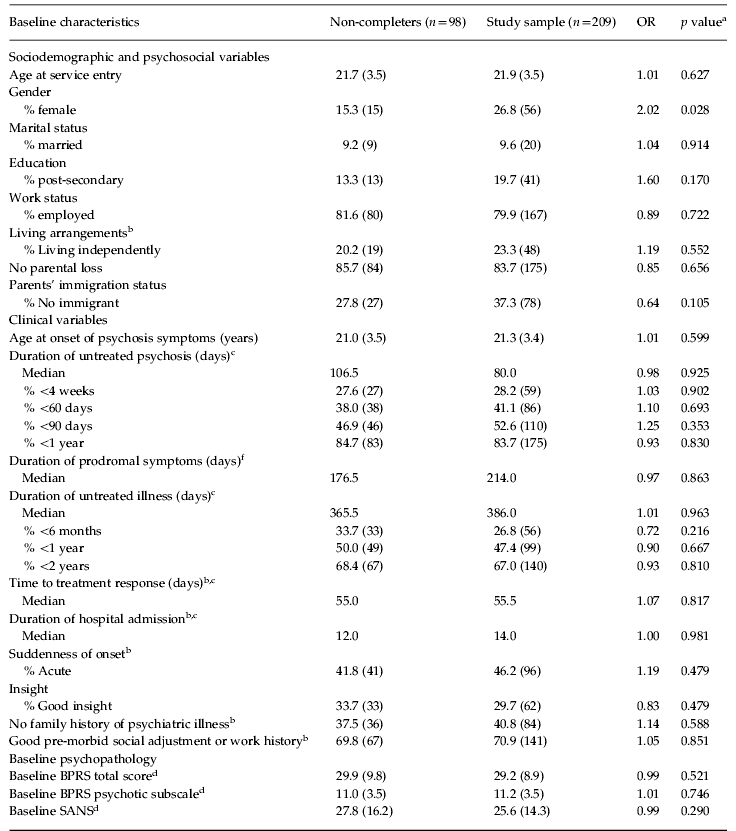
Altogether, 307 patients agreed to participate in the study at baseline and reliable information on functional and vocational recovery was available for 209 participants from the 7.5-year follow-up interviews. Loss to follow-up (n=98) was due to refusal to be interviewed (n=58; 18.9%), previous refusal of all further follow-up (n=3; 1.0%), deceased (n=17; 5.5%) or failure to locate the participant for interview (n=20; 6.5%). With the exception of gender variable, with males being more likely to be lost to follow-up, results from the analyses examining the representativeness of the sample showed no significant differences on baseline demographic and clinical characteristics between completers and non-completers (Table 1).
Comparison of study sample and non-completer groups (total n=307) on baseline demographic and clinical variables with means (s.d.) or percentages (n)

OR, Odds ratio; BPRS, Brief Psychiatric Rating Scale; SANS, Schedule for the Assessment of Negative Symptoms.
a Based on univariate logistic regression.
b Subject numbers vary between n=284 and n=306 for these variables.
c Log-transformed due to positive skewness but untransformed data are presented here.
d Subject numbers vary between n=236 and n=296 for these variables.
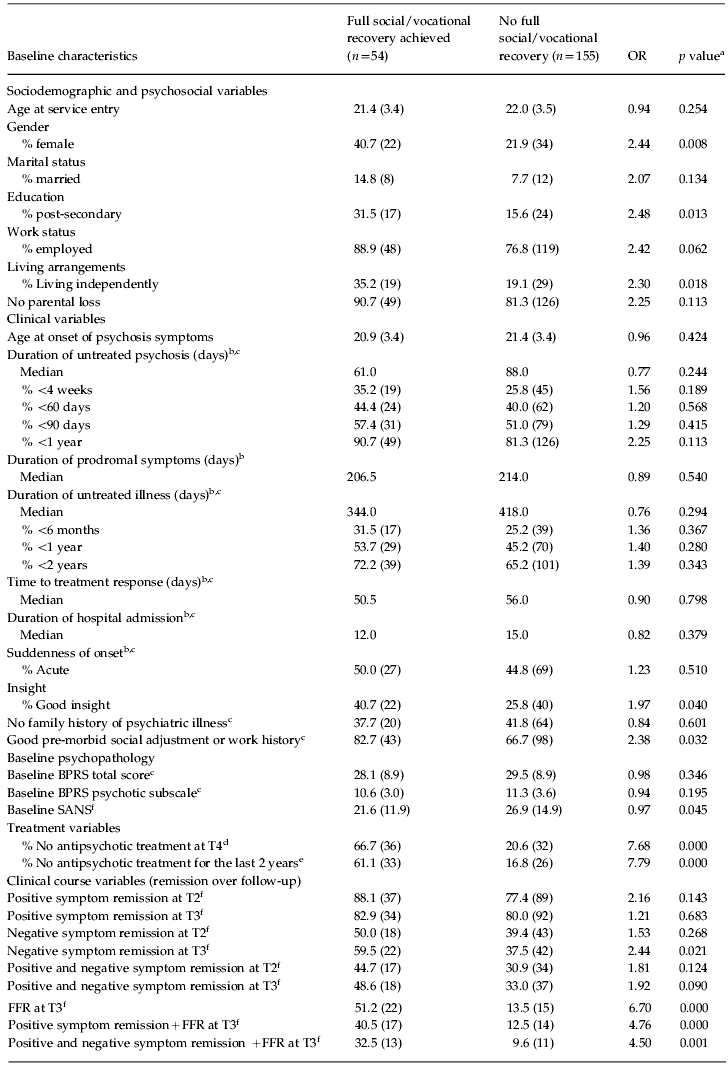
Of the 209 included participants, 54 (26%) met criteria for FFR and demonstrated high levels of functioning (mean SOFAS score=78.2, s.d.=10.3) at 7.5-year follow-up.
Baseline and follow-up predictors of FFR at 7.5 years
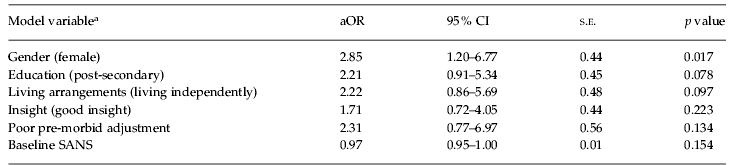
As depicted in Table 2, statistically significant associations were found between FFR at 7.5-year follow-up and six of the baseline candidate predictors. However, with the exception of gender, none of the baseline predictors remained significant after controlling for potential confounders known to be associated with functioning (Table 3). Follow-up predictors yielded considerably larger effect sizes compared with baseline variables. Specifically, social and vocational recovery at 14-month follow-up showed the largest effect size (OR 6.70, p<0.01), accounting for nearly 20% of the variance of FFR at 7.5-year follow-up (pseudo R 2=0.19). The combination of FFR plus symptom remission (either positive symptoms only or positive and negative symptoms concurrently) at 14-month follow-up did not show better predictive performance than FFR alone (OR 4.76, p<0.01, pseudo R 2=0.12; OR 4.50, p<0.01, pseudo R 2=0.09, respectively), indicating that symptomatic remission did not improve the prediction of FFR. In addition, while those subjects who reached remission on negative symptoms at 14-month were 2.4 times as likely to achieve FFR at 7.5 years as those with ongoing negative symptoms, remission on positive symptoms at different time points did not significantly predict FFR at endpoint.
Baseline psychosocial and clinical predictors of full social/vocational recovery in first episode psychosis patients (n=209) at 7.5 years follow-up with means (s.d.) or percentages (n)

OR, Odds ratio; BPRS, Brief Psychiatric Rating Scale; SANS, Schedule for the Assessment of Negative Symptoms; FFR, full functional recovery.
a Based on univariate logistic regression.
b Log-transformed due to positive skewness but untransformed data are presented here.
c Subject numbers vary between n=195 and n=208 for these variables.
d As measured by the treatment questionnaire.
e As measured by the WHO Life Chart Schedule (WHO 1992).
f Subject numbers vary between n=145 and n=161 for these variables.
Adjusted associations between candidate predictors and full social/vocational recovery in first-episode psychosis patients (n=209) at 7.5 years follow-upFootnote a

aOR, Adjusted odds ratio; SANS, Schedule for the Assessment of Negative Symptoms.
a Covariates included age of onset, gender, baseline negative symptoms, work status, education and pre-morbid adjustment.
Subject numbers vary between n=145 and n=155 for multivariate analysis.
Subsequently, FFR and remission on negative symptoms at 14-month follow-up were force-entered into a logistic regression model to evaluate their relative contribution to FFR at 7.5-year follow-up. This allowed an analysis of whether remission of negative symptoms alone or FFR alone still contributed to the prediction of FFR at 7.5 when both criteria were met and taken into account. In the multivariate model, FFR at 14-month remained unchanged and significant (OR 6.56, p<0.01), whereas remission on negative symptoms at 1-year was no longer significantly associated with FFR at 7.5 years (OR 1.14, p=0.77). Multi-level logistic regression analyses were next performed to explore whether FFR at 14-month predicted FFR at 7.5 years in the presence of the following baseline covariates: age of onset; gender; work status; educational level; living arrangements; level of negative symptoms; pre-morbid adjustment. The covariates were selected on the basis of their significant univariate association with FFR (see Table 2) and their well-known influence on functional recovery (Malla & Payne, Reference Malla and Payne2005). In the adjusted model, FFR at 14-month remained significantly associated with FFR at 7.5-year follow-up (OR 5.39, p<0.01), whereas none of the covariates was significant. The explained variance was only marginally improved in the model including control variables (pseudo R 2=0.25 v. pseudo R 2=0.19).
Symptomatic remission and FFR at 14-month follow-up
The relationship between symptomatic remission at 8 months and FFR at 14-month follow-up was next examined. Whereas remission of positive symptoms alone was not a significant predictor of FFR at 14-month follow-up (OR 2.91, 95% confidence interval (CI) 0.81–10.36, p=0.09, pseudo R 2=0.03), remission of negative symptoms increased the likelihood of FFR at 14-month follow-up 3.2-fold (CI 1.39–7.49, p<0.01, pseudo R 2=0.08). The joint remission of positive and negative symptoms was superior in predictive power (OR 4.45, 95% CI 1.91–10.38, p<0.01, pseudo R 2=0.13) to either alone.
Baseline predictors of concurrent positive and negative symptom remission at 8 months were subsequently explored. Univariate logistic regression models showed significant associations between symptom remission at 8-month follow-up and five of the baseline predictors (gender, married status, DUP <28 days, DUI <6 months, TTR and poor insight). Multivariate models identified three factors that were significant predictors of symptomatic remission at 8 months: DUP <28 days (OR 2.83; 95% CI 1.28–6.25; p<0.01); TTR (OR 0.41; 95% CI 0.17–1.00; p=0.05); married status (OR 8.53; 95% CI 2.45–29.69; p<0.01) [pseudo R 2=0.21, F=24.30, degrees of freedom (df)=3, p<0.01]. Each of the significant predictors was then force-entered into a multi-level logistic regression model before the introduction of potential confounders, including suddenness of onset, pre-morbid adjustment, age of onset and gender. In the adjusted model, DUP <28 days (OR 3.25; 95% CI 1.19–8.82; p=0.02), TTR (OR 0.37; 95% CI 0.14–0.96; p=0.04), married status (OR 7.73; 95% CI 2.02–29.62; p<0.01) remained significant, whereas none of the covariates predicted symptomatic remission. The adjusted model predictive performance (pseudo R 2=0.24) was similar to that of the best model obtained in the multivariate analysis (pseudo R 2=0.21), which indicated little additional predictive value for the control variables.
Multivariate relationship between FFR and remission on negative symptoms over time
Next, we examined whether FFR at 14-month follow-up predicted negative symptom remission at endpoint. Univariate regression models showed that both FFR and remission of negative symptoms at 14-month follow-up predicted remission of negative symptoms at 7.5-year follow-up (OR 3.07; 95% CI 1.36–6.94; p<0.01; OR 2.21; 95% CI 1.10–4.44; p=0.02, respectively). FFR and remission of negative symptoms at 14-month follow-up were then force-entered into a logistic regression model to investigate their relative contribution to remission of negative symptoms at 7.5-year follow-up. In the multivariate model, FFR at 14-month follow-up proved to be a significant predictor of remission of negative symptoms at 7.5 years (OR 2.60; 95% CI 1.04–6.52; p=0.04) while remission of negative symptoms at 14-month follow-up was no longer significantly associated with remission of negative symptoms at 7.5 years when the simultaneous FFR was taken into account (OR 1.65; 95% CI 0.75–3.59; p=0.20).
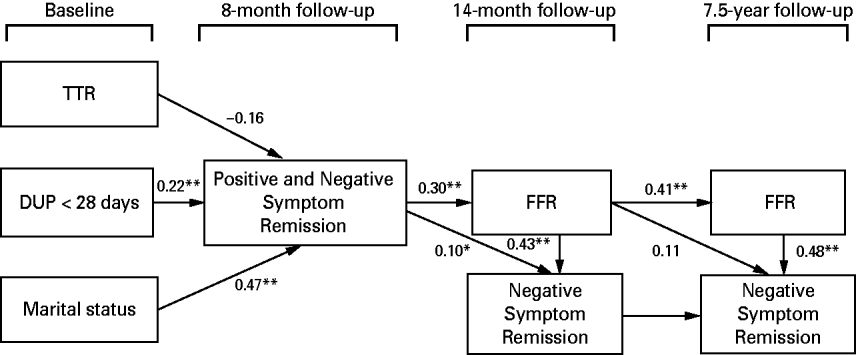
Finally, path analysis was applied to test the hypothesis that functional recovery at 14-month follow-up would foster both remission in negative symptoms and functional recovery at endpoint. Two different models were hypothesized and tested. In hypothesized model 1 (Fig. 1; Symptom Remission Model), symptom remission at 8-month follow-up was predicted to facilitate functional recovery at 14-month follow-up. In addition, remission on negative symptoms at 14-month follow-up would predict further functional recovery and negative symptoms remission at 7.5-year follow-up. In hypothesized model 2 (Fig. 2; Functional Recovery Model) while symptom remission at 8-month follow-up would facilitate functional recovery at 14-month follow-up, achieving functional recovery by 14 months would predict both remission in negative symptoms and FFR at 7.5-year follow-up. In line with results from the multivariate analysis, DUP <4 weeks, more rapid response to antipsychotic treatment and married status were hypothesized to predict symptom remission at 6-month follow-up in both models. The symptom remission model provided a good fit for the data, as suggested by a non-significant χ2 (χ2=24.41, df=18, p=0.14) and the CFI, RMSEA and TLI indices (0.95, 0.04 and 0.90, respectively). Conversely, the functional recovery model provided an excellent fit for the data (χ2=18.98, df=19, p=0.45, CFI=1.00, RMSEA=0.00, TLI=1.00). Comparative goodness of fit measures showed the functional recovery model was superior in predictive performance to the symptom remission model (AIC=68.98, BIC=71.24 v. AIC=76.41, BIC=78.76, respectively).
Symptom Remission Model. Performance of the model: χ2=24.41; degrees of freedom=18; p=0.14; Comparative Fit Index=0.95; root mean square error of approximation=0.04; Tucker–Lewis Index=0.90; Akaike's Information Criterion=76.41; Bayesian Information Criteria=78.76 (* p<0.05, ** p<0.01). TTR, time to first treatment response; DUP=duration of untreated psychosis; FFR, full functional recovery.

Functional Recovery Model. Performance of the model: χ2=18.98; degrees of freedom=19; p=0.45; Comparative Fit Index=1.00; root mean square error of approximation=0.00; Tucker–Lewis Index=1.00; Akaike's Information Criterion=68.98; Bayesian Information Criteria=71.24. (* p<0.05, ** p<0.01). TTR, time to first treatment response; DUP, duration of untreated psychosis; FFR, full functional recovery.

Discussion
The results of this study demonstrated an interrelationship between symptomatic remission and functional and vocational recovery over a 7.5-year follow-up period. While remission of both positive and negative symptoms at 8-month follow-up facilitated recovery at 14-month follow-up, symptomatic remission after 8 or 14 months of treatment had only limited value for the prediction of FFR at long-term follow-up. Conversely, FFR at 14 months emerged as a strong predictor of both FFR and remission of negative symptoms at 7.5-year follow-up, the associations remaining strong and significant even after controlling for potential confounders. Results from path analysis provided support to the hypothesis that early functional and vocational recovery may play a pivotal role in preventing the development of chronic negative symptoms and disability.
Symptom remission and FFR over 7.5 years
Our finding that remission of both positive and negative symptoms predicted functional and vocational recovery after 14 months of treatment better than either alone paralleled those of Cassidy et al. (Reference Cassidy, Norman, Manchanda, Schmitz and Malla2010), who found that negative symptoms were critical in the prediction of functional outcomes at 2-year follow-up. This is not surprising, given the considerable overlap between dimensions of negative symptomatology such as avolition and anhedonia with vocational and social recovery (Cassidy et al. Reference Cassidy, Norman, Manchanda, Schmitz and Malla2010). These results support the importance of including negative symptoms in remission criteria in FEP (Andreasen et al. Reference Andreasen, Carpenter, Kane, Lasser, Marder and Weinberger2005; Cassidy et al. Reference Cassidy, Norman, Manchanda, Schmitz and Malla2010), against the common trend to employ remission criteria based solely on positive symptoms (Lieberman et al. Reference Lieberman, Jody, Geisler, Alvir, Loebel, Szymanski, Woerner and Borenstein1993; Ho et al. Reference Ho, Andreasen, Flaum, Nopoulos and Miller2000; Malla et al. Reference Malla, Norman, Schmitz, Manchanda, Bechard-Evans, Takhar and Haricharan2006).
Conversely, symptom remission variables at either 8-month or 14-month follow-up had limited predictive value of FFR at 7.5 years follow-up. Whereas remission of negative symptoms significantly predicted long-term FFR, the association was no longer statistically significant when accounting for functional recovery at 14-month follow-up. On the contrary, functional recovery at 14-month follow-up strongly predicted FFR at 7.5 years follow-up even after controlling for baseline prognostic variables. Interestingly, the effect size of the association was somewhat less strong when symptomatic remission and functional recovery at 14 months were considered concurrently. As depicted in Table 2, 31% of those who achieved FFR both at 14 months and 7.5 year follow-up failed to meet remission criteria at 14 months. Moreover, only 14% of those who attained symptomatic remission at 8 months and failed to achieve functional recovery at 14 months went on to fully recover at 7.5 years. Taken together these results suggest that while symptomatic remission facilitated early functional and vocational recovery, the latter played a critical role in attaining and maintaining long-term FFR even if remission was not initially achieved. Likewise, if initial symptomatic remission was not translated into early functional gains, long-term full recovery was unlikely to occur.
FFR and negative symptoms over 7.5 years
Results from path and multivariate analysis suggested an interrelationship between negative symptoms and FFR. First, in line with previous longitudinal studies (Malla & Payne, Reference Malla and Payne2005; Cassidy et al. Reference Cassidy, Norman, Manchanda, Schmitz and Malla2010), remission of negative symptoms at 8-month and 14-month follow-up were found to be predictive of FFR and remission of negative symptoms at 7.5-year follow-up. However, when functional recovery and remission of negative symptoms at 14 months were considered together, only the former significantly predicted further recovery or remission of negative symptoms even when adjusted for known prognostic indicators. This constitutes a key finding of the study – achieving functional recovery after 14 months of treatment may exert a protective effect on the development of chronic negative symptoms and disability.
Early functional and vocational recovery is likely to further engagement in work and intimate relationships, purpose in life and positive emotions about the present and the future, which are key components of a novel concept of recovery (Seligman et al. Reference Seligman, Rashid and Parks2006). There is evidence that positive emotions are associated with lowered sensitivity to stress (Geschwind et al. Reference Geschwind, Peeters, Jacobs, Delespaul, Derom, Thiery, van Os and Wichers2010) and contribute to resilience in periods of vulnerability (Fredrickson et al. Reference Fredrickson, Tugade, Waugh and Larkin2003) by means of increased personal resources, such as social support and purpose in life (Fredrickson et al. Reference Fredrickson, Cohn, Coffey, Pek and Finkel2008). Moreover, engagement in work and intimate relationships and purpose in life are strongly correlated with lower levels of stress and depression (Seligman et al. Reference Seligman, Rashid and Parks2006) and reduced risk of cognitive decline (Boyle et al. Reference Boyle, Buchman, Barnes and Bennett2010), respectively. Therefore, early vocational and social recovery may reinforce each other, leading to a positive spiral of well-being (Fredrickson & Joiner, Reference Fredrickson and Joiner2002) and buffering against potentially harmful negative emotional responses to stressful life experiences (Kok & Fredrickson, Reference Kok and Fredrickson2010).
Conversely, failing to achieve early functional recovery is likely to severely disrupt the development period in which vocational milestones (i.e. the completion of education and starting work) and intimate relationships occur (Killackey et al. Reference Killackey, Jackson and McGorry2008). Thus, it can be argued that the vocational and social skills not attained during this period of development may lead to a loss of protective factors such as work and social support, which may affect long-term outcomes (Alvarez-Jimenez et al. Reference Alvarez-Jimenez, Gleeson, Henry, Harrigan, Harris, Amminger, Killackey, Yung, Herrman, Jackson and McGorry2011). Moreover, those who fail to achieve early recovery are likely to gain access to disability payments, which have been demonstrated to pose a significant barrier to further vocational recovery (Rosenheck et al. Reference Rosenheck, Leslie, Keefe, McEvoy, Swartz, Perkins, Stroup, Hsiao and Lieberman2006). This could generate a downward spiral, in which social disadvantage, social withdrawal, narrowed thinking and lack of volition perpetuate each other.
Limitations
This study has some limitations. First, of the 307 participants initially recruited into the study, 98 could not be assessed at 7.5 year follow-up. That said, our attrition rate is relatively low considering the cohort size and length of follow-up and is similar to that of FEP studies with comparable follow-up periods (Bertelsen et al. Reference Bertelsen, Jeppesen, Petersen, Thorup, Ohlenschlaeger, le Quach, Christensen, Krarup, Jorgensen and Nordentoft2008; Crumlish et al. Reference Crumlish, Whitty, Clarke, Browne, Kamali, Gervin, McTigue, Kinsella, Waddington, Larkin and O'Callaghan2009). With the exception of the gender variable, analyses found no evidence of selection bias due to attrition over the follow-up period. Additionally, the main analyses were corrected for the effect of gender. Second, interim assessments (8- and 14-month follow-up) were relatively proximate to baseline. Long-term follow-up studies have shown that a subgroup of patients may remit after 2 years of follow-up or even later (Harrow et al. Reference Harrow, Sands, Silverstein and Goldberg1997). This may have concealed significant associations between symptomatic remission and long-term recovery. However, the high proportion of patients who achieve early symptomatic remission (Loebel et al. Reference Loebel, Lieberman, Alvir, Mayerhoff, Geisler and Szymanski1992; Cassidy et al. Reference Cassidy, Norman, Manchanda, Schmitz and Malla2010) and the finding that long-term FFR was unlikely if symptom resolution did not lead to early functional gains supports the validity of our findings. Third, it could be argued that recovery at 14-month follow-up was best accounted for by pre-existing positive prognostic factors. Accordingly, the association between functional recovery at 14 months and at 7.5-year follow-up was corrected for the influence of both a wide range of known baseline prognostic indicators and concurrent symptomatic remission. In addition, functional recovery after 14 months of treatment was a better predictor of long-term remission of negative symptoms and functional recovery than was remission of negative symptoms. Thus, the predictive power of early functional recovery was unlikely to be an epiphenomenon. Finally, because the study did not include regular assessments, we were unable to ascertain the effect of duration of remission or recovery in long-term outcomes.
Clinical implications and future research
This study showed that shorter DUP predicted full symptomatic remission, which, in turn, significantly facilitated early functional and vocational recovery. However, if symptom resolution was not translated into early functional gains, long-term FFR was unlikely to be achieved. In contrast, nearly 60% of those who met recovery criteria at 14 months went on to attain FFR at 7.5 years, irrespective of whether symptomatic remission criteria were simultaneously met. This highlights the importance of not relying solely on early pharmacological treatment and symptomatic remission and the need for interventions that specifically address psychosocial recovery. Further, these findings may encourage treating teams to work with FEP patients to achieve vocational/functional recovery within 14 months of treatment, given that this may be a point after which functional gains are likely to endure into the long term. An interesting additional finding was that 61% of those who achieved full recovery at 7.5-year follow-up were not taking antipsychotic medication in the preceding 2 years. Further research should make efforts to identify clinical predictors and/or criteria for FEP patients who do not need continuous antipsychotic medication to achieve and maintain recovery in the long term.
In conclusion, our results supported the hypothesis that promoting early functional recovery may exert a protective effect against further development of disability and chronic negative symptoms in FEP patients. Future research should focus on the identification of the specific psychological and biological factors that contribute to, or result from, early functional and vocational recovery. The basis for these protective factors may help design interventions which specifically target psychological and biological processes known to determine the course and outcome of psychosis.
Acknowledgements
This study was supported by a series of grants from the Australian National Health and Medical Research Council (grant number 350241) and the Victorian Health Promotion Foundation (grant number 91–0084C), together with generous funding from the Colonial Foundation to Orygen Youth Health Research Centre. The sponsors did not participate in the design or conduct of this study; in the collection, management, analysis, or interpretation of data; in the writing of the manuscript; or in the preparation, review, approval, or decision to submit this manuscript for publication. The authors particularly wish to thank all of the young people and family members who took part in the study, and the dedicated research team who conducted the interviews.
Declaration of Interest
None.