Cigarette smoking is the leading preventable cause of death and disease in the United States and an estimated 35 million smokers attempt to quit smoking each year (Centers for Disease Control, 2013; Fiore et al., Reference Fiore, Jaén, Baker, Bailey, Benowitz and Curry2008). Several effective interventions are available to facilitate quitting including nicotine replacement therapies, bupropion, varenicline, and behavioural counselling (Fiore et al., Reference Fiore, Jaén, Baker, Bailey, Benowitz and Curry2008). Many smokers, however, resume smoking within weeks or months of initiating treatment (Fiore et al., Reference Fiore, Jaén, Baker, Bailey, Benowitz and Curry2008; Ockene et al., Reference Ockene, Emmons, Mermelstein, Perkins, Bonollo and Voorhees2000). Thus, identifying factors that maximize treatment efficacy is important for increasing rates of smoking cessation.
Smokers’ beliefs about a particular treatment may be an important factor that contributes to their treatment response. According to expectancy theory, the decision to engage in a behaviour (e.g., use smoking cessation medication) is guided in part by an individual's beliefs about the expected outcomes of that behaviour (Ajzen, Reference Ajzen1991; Bandura, Reference Bandura1977; Kirsch, Reference Kirsch1985). These expectancies, such as perceiving desired therapeutic effects, side effects, etc., influence not only the decision to take a particular course of action such as medication adherence but also the actual medication effects an individual may experience (Kirsch, Reference Kirsch1997). In clinical trials, this is important as positive expectancies may enhance the benefits attributed to the experience of receiving treatment rather than the direct, active components of treatment (‘placebo effects’; Finniss & Benedetti, Reference Finniss and Benedetti2005) which may mediate outcomes in placebo-controlled studies.
Many smokers have negative treatment expectancies, consider pharmacological and behavioural interventions to be ineffective (Etter & Perneger, Reference Etter and Perneger2001; Hammond et al., Reference Hammond, McDonald, Fong and Borland2004; Shiffman et al., Reference Shiffman, Ferguson, Rohay and Gitchell2008; Vogt et al., Reference Vogt, Hall and Marteau2008), and may overestimate health risks of approved pharmacotherapies (Bansal et al., Reference Bansal, Cummings, Hyland and Giovino2004; Cummings et al., Reference Cummings, Hyland, Giovino, Hastrup, Bauer and Bansal2004; Etter & Perneger, Reference Etter and Perneger2001; Ferguson et al., Reference Ferguson, Gitchell, Shiffman, Sembower, Rohay and Allen2011; Shiffman et al., Reference Shiffman, Ferguson, Rohay and Gitchell2008; Vogt et al., Reference Vogt, Hall and Marteau2008). For example, negative treatment expectancies predict simultaneously less benefit and more side effects of nicotine replacement (Robinson et al., Reference Robinson, Lam, Carter, Wetter and Cinciripini2012; Tate et al., Reference Tate, Stanton, Green, Schmitz, Le and Marshall1994). On the other hand, relative to smokers with negative treatment expectancies, those who maintain more positive expectancies for smoking pharmacological and behavioural interventions report stronger concurrent intentions to quit smoking, better treatment adherence, and greater intentions to utilize these smoking cessation interventions for future quit attempts (Etter & Perneger, Reference Etter and Perneger2001; Fucito et al., Reference Fucito, Toll, Salovey and O’Malley2009; Juliano & Brandon, Reference Juliano and Brandon2004; Vogt et al., Reference Vogt, Hall and Marteau2008; Reference Vogt, Hall and Marteau2010; Zbikowski et al., Reference Zbikowski, Jack, McClure, Deprey, Javitz and McAfee2011).
To our knowledge, there is only one published study examining the role of smoking cessation treatment expectancies on actual smoking behaviour. In this open-label bupropion trial, more positive beliefs and attitudes about bupropion assessed one week into treatment increased the likelihood of achieving continuous abstinence at the end of treatment among completers (Fucito et al., Reference Fucito, Toll, Salovey and O’Malley2009). While this prospective finding on the role of expectancies to future outcomes may have implications for smoking cessation treatment trials, there were limitations, including that expectancy was not assessed before bupropion was initiated and the trial was open-label without a placebo control. Therefore, double-blind trials examining experimental treatments may provide particularly robust tests of expectancy effects in both active and placebo treatment groups and external influences, i.e., advertisement claims and experiences of others would be minimized.
The current investigation examined smokers’ treatment expectancies before and during treatment as a predictor of quit rates in a randomized, placebo-controlled clinical trial of the opioid receptor antagonist naltrexone in combination with the nicotine patch and behavioural counselling (King et al., Reference King, Cao, O’Malley, Kranzler, Cai and deWit2012). Naltrexone is under investigation for smoking cessation particularly as an adjunct to nicotine patch therapy (King et al., Reference King, de Wit, Riley, Cao, Niaura and Hatsukami2006; Reference King, Cao, O’Malley, Kranzler, Cai and deWit2012; Krishnan-Sarin et al., Reference Krishnan-Sarin, Meandzija and O’Malley2003; O’Malley et al., Reference O’Malley, Cooney, Krishnan-Sarin, Dubin, McKee and Cooney2006). We endeavoured to test the potential role of expectancies in the context of this placebo-controlled medication trial, controlling for perceptions of treatment assignment. In particular, we tested whether positive medication expectancies had a main effect on smoking cessation success in both the placebo and naltrexone groups, or a differential effect by randomization.
Method
Participants
The data for this secondary analysis paper were culled from a double blind, randomized controlled trial of naltrexone (50 mg/day) for smoking cessation (King et al., Reference King, Cao, O’Malley, Kranzler, Cai and deWit2012). In a prior report of the main outcomes in this study, naltrexone was found to significantly increase smoking quit rates (38.5% vs. 32.5%) and decrease the number of cigarettes smoked and the amount of weight gained at the end of treatment at 12 weeks compared to placebo (King et al., Reference King, Cao, O’Malley, Kranzler, Cai and deWit2012). Eligibility criteria included being between the ages of 18 and 65, smoking 10–40 cigarettes daily for at least two years, having a body mass index of 19–38, having a breath carbon monoxide level of at least 10 ppm, and having a Nicalert® reading greater than 500 ng/ml of the nicotine metabolite cotinine, indicating regular moderate-to-heavy smoking. Study candidates were also excluded if they had a past-year history of a major medical/psychiatric disorder or substance dependence other than nicotine, a lifetime diagnosis of opioid abuse or dependence, current use of opioid or psychotropic medications, elevated hepatic transaminase concentrations (>2.5 times normal range), an inability to read or write English, and being pregnant or nursing.
The 315 participants (168 women, 147 men) were racially diverse (181 Caucasian, 110 African American, 24 Other), had a mean age of 41.93 (SD = 11.26) years, smoked an average of 19.65 (SD = 5.88) cigarettes per day for a mean of 24.10 (SD = 11.64) years, had 4.36 (SD = 7.45) prior quit attempts with 65.9% reporting prior use of bupropion and 75.6% reporting prior use of nicotine replacement therapy, and had a mean Fagerström Test for Nicotine Dependence (FTND) score of 5.24 (SD = 1.86; range = 1–10) indicative of moderate tobacco dependence. The groups did not differ on these baseline characteristics. Eligible candidates signed the informed consent form approved by The University of Chicago Institutional Review Board during initial screening.
Procedures
Participants were randomly assigned to receive either 50 mg naltrexone hydrochloride or placebo, stratified by gender. The tablets were initiated one week prior to the quit date and maintained at 50 mg daily dose for 12 weeks after the quit date. All participants also received nicotine transdermal patch therapy (Nicoderm CQ®, GlaxoSmithKline) and smoking cessation behavioural counselling, both of which ended four weeks after the quit date. Nicotine patch was initiated on the quit date with the following dose schedule: (1) two weeks at 21 mg/day, (2) one week at 14 mg/day, and (3) one week at 7 mg/day. Counselling was primarily cognitive-behavioural (Courage to Quit™) and delivered individually by a master- or doctoral-level clinician (for details, see King et al., Reference King, Sánchez-Johnsen, Van Orman, Cao and Matthews2008; Reference King, Cao, O’Malley, Kranzler, Cai and deWit2012). Each of the 10 study visits over the course of the 12-week treatment trial included questionnaires, interviews, breath tests, weight, and medication disbursement.
During screening as part of informed consent, participants were informed that naltrexone is an experimental medication for use in smoking cessation. They were also made aware that naltrexone is approved in the treatment of alcohol and opioid dependencies. They were told that the possible mechanisms of the drug on smoking are not currently known but that naltrexone temporarily blocks opioid receptors related to the rewarding effects of some substances and therefore, may affect similar experiences related to smoking. They were also told that 50% would receive naltrexone and the most common side effects are mild nausea, fatigue, and headache, which occur in a minority (5%–10%) of persons taking the medication and often dissipate within a few days. Finally, participants were made aware that persons in the placebo condition also often reported these symptoms as they may relate to usual bodily symptoms that vary across individuals or could be related to nicotine withdrawal during a quit attempt.
Measures
Naltrexone expectancies
At pre-treatment baseline (Week 2), participants were asked the extent to which they agreed with a statement using a 5-point Likert scale (1 = strongly disagree, 5 = strongly agree): “I believe that the study drug will be the key factor in helping me stop smoking or will make a significant change in my smoking.” This item was repeated at Week 4 in the trial and worded in the past tense at that interval. Baseline expectancies were used to examine the role of expectancies prior to initiation of treatment on outcomes, and the change in expectancy from baseline to Week 4 was used to examine how changes in expectancies during early treatment affect outcomes (Week 12). The rationale for this measure was that while there are currently no validated measures of expectancies for naltrexone as a smoking cessation aid, single and two-item measures about medication beliefs in the aforementioned, bupropion study did show good predictive validity for smoking cessation outcomes.
Outcomes
The Timeline Followback Interview (TLFB), a highly reliable and valid calendar-based instrument (Sobell & Sobell, Reference Sobell, Sobell, Litten and Allen1992), was given at each visit and used to determine the estimated number of cigarettes smoked per day since the last visit. Data from the TLFB were used to compute two main outcomes: (1) continuous abstinence (no smoking, not even a puff of a cigarette since the quit date, verified by carbon monoxide breath test reading of <10 ppm) at Weeks 4 and 12; and (2) time to first cigarette (number of days to the first cigarette from the quit date). Dropout participants were conservatively classified as relapsed, and complete abstainers were coded as 84 days (end of treatment) in time to first cigarette analyses. Smoking urges were assessed weekly by the Questionnaire on Smoking Urges-Brief (Cox et al., Reference Cox, Tiffany and Christen2001), as well as adverse effects of naltrexone (nausea, headache, tired, etc.) rated ‘mild’ or ‘severe’ using a scale designed for the study. Adherence was measured by computing the proportion of dispensed pills that participants reported taking. Finally, guess/estimation of which treatment cell the participant thought s/he was randomized to was assessed at Weeks 1 and 4 by indicating ‘yes’, ‘no’, or ‘I don't know’.
Statistical Analyses
All analyses were conducted using SPSS version 19. T-tests and chi-squared analyses were conducted to compare treatment groups on demographic and smoking variables and expectancy ratings. To examine the predictive role of baseline medication expectancy to outcomes, logistic regression was conducted on quit status (continuous abstinence) at Weeks 4 and 12, and Cox regression survival curves were conducted on time to first cigarette using a hazard ratio. Finally, linear regression analyses were conducted to examine expectancy effects to pill adherence, smoking urge, and medication side effects; simple slope analyses were conducted for post-hoc probing of significant interactions (Holmbeck, Reference Holmbeck2002). All models controlled for perceptions of treatment assignment at Week 1. We also evaluated the change in expectancies from baseline to Week 4 as predictors of smoking cessation outcomes through the end of treatment (i.e., Week 12 quit rates, medication adherence). Multinomial logistic regression was used to test the predictive role of treatment expectancies to perceptions of treatment assignment.
Results
Naltrexone Expectancies
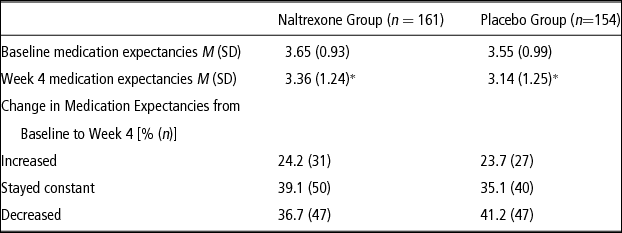
As displayed in Table 1, participants reported moderate baseline medication expectancies, and neither baseline nor change in medication expectancy differed between the groups. Medication expectancies were positively correlated with higher nicotine dependence (r(306) = 0.13, p = 0.03) and readiness to quit smoking scores (r(305) = 0.12, p = 0.04). Adding nicotine dependence scores or readiness to quit smoking scores to the statistical models examining medication expectancy to smoking cessation outcomes did not change the results. Therefore, they were not included as covariates in the analyses.
Medication expectancies by treatment group

Note. Week 4 data and change in medication expectancies data from baseline to Week 4 limited to the sub-sample of participants who completed treatment through Week 4 (n = 239).
*Significant change in mean medication expectancies from baseline to Week 4 for both treatment groups; p < 0.05.
Smoking Outcomes
There was a significant interaction of baseline medication expectancies and treatment group on quit rates at Week 4, controlling for Week 1 perceptions of treatment assignment (χ 2(1) = 9.92, p = 0.002) (see Table 2): more positive expectancies were associated with higher quit rates in the naltrexone group (OR = 1.51 [95% CI = 1.05, 2.17], p = 0.03) but were associated with lower quit rates in the placebo group (OR = 0.66 [95% CI = 0.46, 0.95], p = 0.03). A significant interaction was also found for latency to first cigarette (χ 2(1) = 4.23, p = 0.04), with a tendency for medication expectancies to be associated with latency to smoke in the naltrexone group (Hazard Ratio = 0.85 [95% CI = 0.70, 1.04], p = 0.11) but not the placebo group (HR = 0.98 [95% CI = 0.85, 1.13], p = 0.77). Baseline medication expectancies had no significant effects on Week 12 quit rates (main effect: χ 2(1) = 0.96, p = 0.33; interaction: χ 2(1) = 1.55, p = 0.21; see Table 2). Likewise, the change in expectancies was not associated with Week 12 quit rates (main effect: χ 2(1) = 0.47, p = 0.49; interaction: χ 2(1) = 0.07, p = 0.79).
Smoking outcomes by treatment group and baseline treatment expectancies (N = 315)

Note. **p < 0.01; *p < 0.05.
Treatment Group: naltrexone versus placebo main effects (advantage of naltrexone); Baseline Medication Expectancies: main effect of expectancies regardless of actual medication group assignment; Treatment Group × Baseline Expectancies: interaction of medication group assignment and baseline naltrexone expectancies.
Medication Adherence
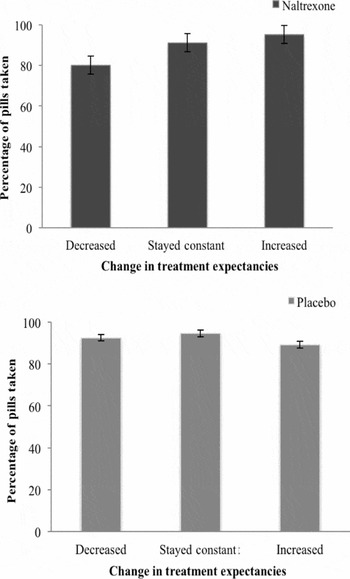
Medication adherence rates were high in this study, with an average of 90% of all dispensed pills reported taken through the 12 weeks of treatment. While there were no effects of baseline medication expectancies on medication adherence (main effect: b = −0.96, t(225) = −0.48, p = 0.63; interaction: b = 2.54, t(225) = 0.90, p = 0.37), the change in medication expectancies interacted significantly with treatment group (b = −7.00, t(209) = −3.40, p = 0.001; R 2 = 0.11, F(4, 204) = 6.49, p < 0.001), with higher medication expectancies at Week 4 predicting better medication adherence in the naltrexone group (b = −7.20, t(111) = −4.21, p < 0.001) but not the placebo group (b = −0.06, t(98) = −0.06, p = 0.96). To examine this finding further, we analyzed adherence rates by expectancy change status (i.e., decreased, stayed constant, increased) and treatment group, and found that in participants whose medication expectancies increased or stayed constant during treatment (Tukey HSD; ps < 0.05), medication adherence rates were higher than in those who had decreases in medication expectancy (see Figure 1).Footnote 1
Medication adherence by expectancy change and treatment group.
Note. Treatment Group × Expectancy Change: interaction of medication group assignment and change in naltrexone expectancies from baseline to Week 4.

Urge to Smoke and Medication Side Effects
Neither baseline expectancies nor the change in expectancies were associated with participants’ self-reported ratings of urge to smoke or medication side effects (all p's > 0.10).
Perceptions of Treatment Assignment
Perceptions of treatment assignment at Week 1 significantly predicted treatment perceptions at Week 4 (χ 2(4) = 57.47, p < 0.001). Greater positive medication expectancies at baseline were associated with an increased likelihood of perceiving having received naltrexone versus placebo in the first month of treatment (Week 1: OR = 1.29 [95% CI = 0.93, 1.78], p = 0.13; Week 4: OR = 1.65 [95% CI = 1.17, 2.32], p = 0.004). Perceptions of treatment assignment were not associated with the likelihood of achieving or maintaining smoking abstinence quit rates at Week 4 or 12, or secondary smoking cessation outcomes of urge to smoke ratings, or medication side effects (all p's > 0.10). Participants in the naltrexone group were more likely than participants in the placebo group to perceive that they had received naltrexone (69.6% vs. 46.0%, respectively; χ 2(2) = 16.60, p < 0.001).
Discussion
This study was the first to our knowledge to examine the role of medication expectancies to smoking cessation treatment outcomes in a placebo-controlled, double-blinded clinical trial and how changes in smokers’ treatment expectancies with treatment exposure influence smoking cessation outcomes. Consistent with the hypotheses that expectancies increase the efficacy of an active intervention, participants in the naltrexone group who endorsed more positive medication expectancies at the start of treatment had better quit rates during early treatment, but this was not observed for those receiving placebo. Furthermore, participants who received naltrexone and whose medication expectancies remained constant or increased over time reported better overall pill adherence than those naltrexone-treated participants whose medication expectancies decreased over time. In addition, positive medication expectancies before treatment facilitated the perception that one had received naltrexone over placebo.
The findings support the hypothesis that smoking treatment expectancies may improve outcomes by increasing treatment exposure and are not specifically due to non-specific treatment effects (e.g., regression to the mean, attention and support from a healthcare provider, treatment setting characteristics). Smokers may be more likely to take a novel pharmacologic treatment if they anticipate it will facilitate smoking cessation success. Greater pharmacologic treatment exposure, in turn, may increase the therapeutic effects of the drug. In particular, we may speculate in the current study that better adherence increased the likelihood of having regular competitive antagonism of mu opioid receptors that for the smoker may produce reduction of urges when exposed to salient cues (Hutchison et al., Reference Hutchison, Monti, Rohsenow, Swift, Colby and Gnys1999) or those related to negative affect (Walsh et al., Reference Walsh, Epstein, Munisamy and King2008) and/or concomitant alcohol use (King et al., Reference King, Cao, Vanier and Wilcox2009; O’Malley et al., Reference O’Malley, Krishnan-Sarin, McKee, Leeman, Cooney and Meandzija2009). We hypothesize that these pharmacological benefits may then help to maintain smokers’ positive expectancies and overall commitment to treatment and quitting smoking, as suggested by our results.
These results support prior studies on the role of positive beliefs and attitudes to future intentions to quit smoking and use adjunctive pharmacotherapy (Etter & Perneger, Reference Etter and Perneger2001; Juliano & Brandon, Reference Juliano and Brandon2004), and the association of positive bupropion expectancies after one week of treatment to better smoking cessation outcomes at 6 weeks (Fucito et al., Reference Fucito, Toll, Salovey and O’Malley2009). Moreover, the findings add to our understanding of perceptions of treatment assignment in smoking cessation clinical trials (Schnoll et al., Reference Schnoll, Epstein, Audrain, Niaura, Hawk and Shields2008; Thomas et al., Reference Thomas, Guo, Lynam, Powell, Okuyemi and Bronars2008). Smokers’ treatment perceptions may be the result of self-fulfilling treatment expectancies that are formed prior to actual treatment exposure.
There are clinical implications of these results with regard to treatment planning and conducting clinical trial research with smokers. Smokers’ treatment expectancies should be assessed prior to and during treatment. In addition, attempting to maintain or improve their medication expectancies may be an important component in the delivery, evaluation, and targeting of smoking cessation treatments. Smokers’ beliefs about smoking pharmacotherapies are modifiable (Mooney et al., Reference Mooney, Leventhal and Hatsukami2006) and emphasizing the benefits/effectiveness of smoking pharmacotherapies may enhance smokers’ expectancies and intentions to use these interventions (Fucito & Juliano, Reference Fucito and Juliano2007; Vogt & Marteau, Reference Vogt and Marteau2012). Nevertheless, it remains to be determined whether maintaining or increasing smokers’ treatment expectancies actually improves smoking cessation success in standard treatment and not as part of a well-controlled intervention trial. This is an important avenue to pursue, given that medication information and adherence motivational counselling is appealing on multiple levels as it is less costly than new drug development and relatively easy to implement.
This investigation had advantages including testing a large, diverse sample of smokers, examining expectancy within the context of a randomized trial, and assessing pre-treatment expectancies as well as the change in expectancies after the first month of treatment. However, study limitations should also be noted. First, smokers’ expectancies were assessed by a single-item Likert scale designed for this study, therefore, more detailed information on sub-components of positive expectancies were not assessed. However, there are no standardized scales of smoking medication expectancies with novel pharmaceutical approaches and prior studies have demonstrated the validity of very brief measures for this purpose with smokers (Fucito et al., Reference Fucito, Toll, Salovey and O’Malley2009). Second, expectancies were not directly manipulated, so although baseline expectancies predicted several outcomes, interpretations of causality of this finding are limited. Third, examination of treatment expectancies over time was limited to the 76% of the sample still enrolled in treatment at Week 4. The likelihood of being enrolled at Week 4, however, did not vary by treatment group or baseline expectancies. As the case with many clinical trials, participants who withdrew from the study were assumed to have relapsed, and continuing with data collection in participants who withdrew from the study may impart ethical dilemmas.
In sum, smokers’ treatment expectancies appear to be an important predictor and modifier of treatment response. These findings have implications for the delivery and evaluation of smoking cessation interventions. Smokers are often misinformed about smoking cessation medications and maintain low expectations that they will be helpful (Etter & Perneger, Reference Etter and Perneger2001; Shiffman et al., Reference Shiffman, Ferguson, Rohay and Gitchell2008; Vogt et al., Reference Vogt, Hall and Marteau2008) which may then reduce the effectiveness of these treatments. Behavioural counselling designed to increase smokers’ overall expectancies for smoking cessation treatment may facilitate quitting success by enhancing the efficacy of these interventions. Future studies should further examine the potential role of smokers’ treatment expectancies in smoking cessation outcomes as well as potential mechanisms by which these effects may occur. Moreover, behavioural interventions targeting and increasing smokers’ pharmacotherapy expectancies warrant further investigation.
Acknowledgements
The authors thank Lingjiao Zhang, MS, for biostatistical and administrative assistance.
Financial Support
This research was supported in part by National Institutes of Health grants R01-DA016834 (AK), K23-AA020000 (LF), as well as grants to the University of Chicago Institute for Translational Medicine ULI-RR024999, and University of Chicago Comprehensive Cancer P30-CA14599.
Conflict of Interest
AK has consulted for Lundbeck and the US Food and Drug Administration. BT has received investigator-initiated funding from Pfizer. All other authors report no financial conflicts of interest.
Ethical Standards
The University of Chicago Institutional Review Board approved all study procedures. All participants completed written informed consent prior to participation.
Contribution of Authorship
LF, BT, and AK designed the study, and AK provided supervision and oversight for data collection. LF and CR completed literature searches and summaries of previous work. LF completed statistical analyses with assistance from CR. LF completed the first draft of the manuscript. All authors contributed to and have approved the final manuscript.