INTRODUCTION
To minimize stress and risk of fatal impact on cetaceans during handling, it would be valuable to be able to monitor stress levels. Heart rate, respiration rate and behaviour of small cetaceans may be subject to drastic changes during stressful situations (Moberg, Reference Moberg1987; St Aubin & Dierauf, Reference St Aubin, Dierauf, Dierauf and Gulland2001). It is, thus, important to recognize how stress affects these parameters, to be able to use them as stress indicators during handling. Monitoring stress indicators may help to improve current handling methods, identify stressful states of cetaceans and end handling procedures before they become fatal to the animals. In addition to ethical reasons, stress levels should be kept low in order to sustain the validity of scientific results.
The effect of stressors varies among species and individuals. Natural stress factors include social status and interactions during the breeding season (Conner & Smolker, Reference Conner and Smolker1995; Cowan & Curry, Reference Cowan and Curry2002; Waples & Gales, Reference Waples and Gales2002). Anthropogenic activities such as live by-catch in fisheries, boating and noise pollution may also cause acute or chronic stress to marine mammals. As stress mainly affects and causes changes to the endocrine, immune and neurological systems (Moberg, Reference Moberg1987; Morton et al., Reference Morton, Anderson, Foggin, Kock and Tiran1995; St Aubin & Dierauf, Reference St Aubin, Dierauf, Dierauf and Gulland2001), it may result in physiological and/or behavioural changes leading to loss of fitness, reduced reproductive success or even increased mortality (Sapolsky, Reference Sapolsky1990; Fair & Becker, Reference Fair and Becker2000; St Aubin & Dierauf, Reference St Aubin, Dierauf, Dierauf and Gulland2001; Waples & Gales, Reference Waples and Gales2002).
Behavioural responses
Behavioural responses to a stressor usually are the most common and easily observed. The animal may vocalize or display stereotypic behaviour (Moberg, Reference Moberg1987; St Aubin & Dierauf, Reference St Aubin, Dierauf, Dierauf and Gulland2001; Norman et al., Reference Norman, Hobbs, Foster, Schroeder and Townsend2004) but several factors including location, age, sex and experience possibly have an effect on an animal's stress response (Kastelein et al., Reference Kastelein, Rippe, Vaughan, Schooneman, Verboom and de Haan2000; St Aubin & Dierauf, Reference St Aubin, Dierauf, Dierauf and Gulland2001). Stress responses to tagging may include struggling if the animal tries to escape, although often little or no response is observed. These behaviours are difficult to measure quantitatively and it is uncertain to what extent the behaviours affect the animal's well being. Hence, it is difficult to determine from behavioural actions alone, whether a stressor is harmful to the animal or not (Moberg, Reference Moberg1987).
Nervous system responses
When the body responds to stress or danger, the sympathetic nervous system reacts by diverting resources from somatic tissues to the autonomic nervous system, increasing the heart rate, and stimulating the secretion of epinephrine and norepinephrine from the adrenal gland. This response is known as the fight-or-flight reaction (Moberg, Reference Moberg1987; Eckert et al., Reference Eckert, Randall, Augustine, Eckert, Randall and Augustine1988). Because of the specific response performed by the autonomic nervous system, some researchers have used heart rate as a clinical measure of stress (Moberg, Reference Moberg1987). Heart rate is easy to obtain and causes minimal additional stress to the animal. However, heart rate in marine mammals may be difficult to interpret, due to their much larger oscillations in heart rate compared to terrestrial animals. Bradycardia is a well-documented response to diving in marine mammals, where the heart rate decreases to save oxygen for the vital organs, and, thereby, extends the aerobic dive time (Eckert et al., Reference Eckert, Randall, Augustine, Eckert, Randall and Augustine1988; Elsner, Reference Elsner, Reynolds and Rommel1999). Studies found the heart rates of harbour seals (Phoca vitulina) decrease from 105–135 beats per minute (bpm) while at the surface to 30–55 bpm during dives (Fedak et al., Reference Fedak, Pullen and Kanwisher1987). For bottlenose dolphins (Tursiops truncatus) the surface heart rates were 85–130 bpm and dive heart rates 24–30 bpm (Noren et al., Reference Noren, Cuccurullo and Williams2004). In a captive female harbour porpoise (Phocoena phocoena) the heart rate decreased from 160–180 bpm at the surface to 60–80 bpm during shallow dives (<4 m) (Lockyer et al., Reference Lockyer, Amundin, Desportes, Goodson and Larsen2001; Teilmann et al., Reference Teilmann, Tougaard, Miller, Kirketerp, Hansen and Labberté2006).
Endocrine responses
Many stressors lead to secretion of glucocorticoids (cortisol and corticosterone). In marine mammals, high cortisol levels are a common measure of stress (Thomson & Geraci, Reference Thomson and Geraci1986; Orlov et al., Reference Orlov, Mukhlya and Kuz'min1991; Koopman et al., Reference Koopman, Westgate, Read and Gaskin1995; Morton et al., Reference Morton, Anderson, Foggin, Kock and Tiran1995; St Aubin et al., Reference St Aubin, Ridgway, Wells and Rhinehart1996; Waples & Gales, Reference Waples and Gales2002; Desportes et al., Reference Desportes, Buholzer, Anderson-Hansen, Blanchet, Acquarone, Shephard, Brando, Vossen and Siebert2007). However, not all kinds of stress increase cortisol level in the blood (Moberg, Reference Moberg1987) and diurnal changes in the concentration have been shown for Indo-Pacific bottlenose dolphins (Tursiops aduncus, Suzuki et al., Reference Suzuki, Uchida, Ueda, Tobayama, Katsumata, Yoshioka and Aida2003) and killer whales (Orcinus orca, Suzuki et al., Reference Suzuki, Uchida, Ueda, Tobayama, Katsumata, Yoshioka and Aida2003). Also, long-term monitoring of serum cortisol levels in four harbour porpoises shows high individual variations (Desportes et al., Reference Desportes, Buholzer, Anderson-Hansen, Blanchet, Acquarone, Shephard, Brando, Vossen and Siebert2007). One-time cortisol measurements should, thus, be interpreted with some care in relation to stress, especially as baseline concentrations in wild animals are difficult to obtain. Moreover, cortisol cannot serve as a real-time stress indicator, since blood cortisol measurements can only be done in a laboratory. Scientists, therefore, rely on behavioural observations such as trembling or muscle spasms, combined with respiration and heart rate monitoring, to determine the well being of an animal during handling.
Aim
Equipping cetaceans with electronic tags is a widely used technique to obtain information on movement and behaviour. The capture, handling, and tagging procedures are likely to be stressful experiences for naïve animals, and it is important to determine the stress levels to reduce them. During satellite tagging of harbour porpoises in Danish waters (Teilmann et al., Reference Teilmann, Larsen and Desportes2007), respiration rates, heart rates and cortisol levels were analysed in order to monitor the effects of handling.
MATERIALS AND METHODS
Capture and handling
Data for this study were based on video recordings, heart rate measurements and blood samples taken during handling and satellite tagging of harbour porpoises (Teilmann et al., Reference Teilmann, Larsen and Desportes2007). Forty-five harbour porpoises were unintentionally trapped in pound nets along the coasts of Kattegat and the Danish straits during the period from 7 April 1997 to 2 September 2003. The porpoises could swim freely in the net without being entangled. A national network of pound-net fishermen was established prior to the study. When one or more porpoises were trapped in a net, the net entrance was closed and a tagging team contacted. Typically the team arrived within 3–8 hours of the animals being discovered by a fisherman. The net was then pulled to the surface and the porpoise lifted onboard the fishing boat and placed on a stretcher lying on top of two foam pads. Measurements included determination of sex, standard length, weight, girth and blubber thickness. Sexual maturation of porpoises was estimated from length (Lockyer & Kinze, Reference Lockyer, Kinze, Haug, Desportes, Vikingsson and Witting2003) and the mammary slits were examined for milk. Samples included blood from the dorsal side of the tail fluke (for haematology and chemistry including hormone levels), eye swabs (for microbiology) and biopsies taken at the pin holes made for the satellite tag. Expiration on agar, cytology slides and genital swabs were taken for cytology and bacteriology. During the whole tagging procedure, the porpoise was covered with wet towels and sponged with seawater to keep it moist and cool. The behaviour was observed continuously and after 25–45 minutes the porpoise was released.
Heart and respiration rate monitoring
After the porpoise had been placed on the foam pads, a heart rate monitor was fitted around the body behind the pectoral fins. The monitor consisted of a Polar transmitter on an elastic belt and a Polar Vantage NV wrist monitor (Polar Electro Oy, Finland, www.polar.fi). The transmitter and monitor were removed just prior to porpoise release and data were downloaded via an infrared connection to a computer for further analyses. The heart rate monitor recorded every heartbeat (R-R mode) or average heart rate every 5 seconds. Observing the wrist monitor made it possible to closely follow the heart rate during handling. If a porpoise exhibited exceptionally high (>200 bpm) or low (<50 bpm) heart rates for an extended period of time (~15 seconds) or held its breath for >30 seconds, water was poured over the head to stimulate respiration. If this was not sufficient to stabilize heart rate and respiration, the porpoise was lowered into the water in the stretcher. This always stabilized the heart rate to within 50–200 bpm and when respiration rates were more than 4 respirations per minute (rpm) the porpoise was brought back onto the foam pads. Heart rate and respiration rate data could not be monitored or recorded properly during periods when porpoises were lowered into the water and these data were, therefore, excluded from the analyses.
Cortisol measurements
Blood for determination of serum cortisol concentrations was taken into S-Monovetten ® KE (Sarstedt) and centrifuged at 2500 U/min for 15 minutes. Analyses were performed at the Veterinary Analytical Laboratory in Geesthacht, Germany, with X-Counter (Wallace, Lisle, Ireland). The minimum detectable level was 2 μg/l with an intra-assay CV of 3–5% and an inter-assay CV of 4–6%. Identical results were found whether non-specific binding was considered or not.
Tag attachment
Porpoises that were >100 cm in length and considered in good condition (not emaciated and without injuries) were equipped with a satellite transmitter. Zylocain 5% salve was used as local anaesthesia on the dorsal fin prior to attachment of the transmitter. After veterinarian advice salve was preferred in comparison to injections due to the fibrous tissue of the dorsal fin that prevents spreading of anaesthetic. Several tag types and designs were used (for details see Teilmann et al., Reference Teilmann, Dietz, Larsen, Desportes, Geertsen, Andersen, Aastrup, Hansen and Buholzer2004, Reference Teilmann, Larsen and Desportes2007). The transmitters were attached to the dorsal fin with three POM pins (polyoxymethylen, 5 mm in diameter), lined with polyester tubing, as used in medical surgery to facilitate better healing of the wound (Sulzer Vascutek, Renfrewshire, Scotland). Holes were bored using a 5 mm stainless steel cork borer (sharpened on the outside) driven by a slow-speed 9.2 V rechargeable drill. Pins were disinfected using Betadine, Aureomycin or Fucidin, and fastened with nylon or iron nuts, loose enough to allow water flow between the transmitter and the skin and avoid pressure necrosis. The transmitters varied in size, but weighed between 95–240 g in air and 10–20 g in water. The back of the transmitters, as well as the backing plate (reinforced rubber) holding the washers and nuts on the opposite side of the fin, were lined with 3 mm closed-cell neoprene for skin protection.
Freeze branding procedure
Freeze branding is a highly durable marking method, which can remain readable for five years or more (Irvine et al., Reference Irvine, Wells and Scott1982). A porpoise freeze branded during the present study was observed with a clearly visible number after four years (Jonas Teilmann, personal communication). Freeze branding bronze numbers (7 × 4.5 cm) were cooled for approximately 5 minutes in liquid nitrogen (–196Co) until boiling stopped. The number was pressed firmly against the skin on the upper side of the animal, just in front of the dorsal fin, for 10 seconds on each side. The brand was instantly sponged with seawater to stop the freezing process.
Data handling and statistical analyses
Based on the time-coded video recordings, durations and times of different events (e.g. respiration, weight measurement, blood sampling, hole boring, tag attachment and freeze branding) were noted in relation to the onset of the heart rate recordings. This provided a time stamp for each event in relation to heart rate.
Mean heart and respiration rates were calculated for each individual and used as input data in further statistical analyses. To test the effect of handling, heart rate and respiration data were divided into a baseline period (the period prior to the events) and the event period (period including blood sampling, weighing, hole boring, tag attachment and freeze branding). Given that we work with wild animals, we could not obtain true unstressed baseline heart and respiration rates; the ‘baseline period’ was chosen in order to evaluate the additional stress effects of the events. However, as the blood samples were always taken prior to the tagging and freeze branding an effect on cortisol level for these two procedures was not measured.
Prior to analyses, data were tested for normality by the Shapiro–Wilk test and equality of variance by the F-test. In all cases data were normally distributed. Therefore, parametric tests (paired t-tests, t-tests, two-way analyses of variance (two-way ANOVA), analyses of covariance (ANCOVA) and linear regression analyses) were applied to investigate for differences in the data. A standard level of significance of 0.05 was chosen and statistical analyses were carried out using SAS (Version 8e) or Excel for Windows, 2003:
• Differences in heart rates between baseline and event periods for all animals combined were tested using a paired t-test. For each individual porpoise, differences between baseline and event periods were tested using a t-test.
• Differences in respiration rates for each individual were tested using a t-test. Furthermore, mean respiration rate by individual, were tested by a two-way ANOVA with the factors maturity stage and baseline/event period including the interaction term.
• Average heart and respiration rates in relation to cortisol concentrations included data from the beginning of the handling until the end of the blood sampling. Relationships were tested using linear regression.
• A relationship between cortisol concentration and handling time until the end of blood sampling was tested using linear regression.
• Cortisol levels from the porpoises were tested by an ANCOVA including the factor sex and the covariates body length and month of the year. The significance of the factors and covariates was judged by the significance of the type-III sum of squares.
RESULTS AND DISCUSSION
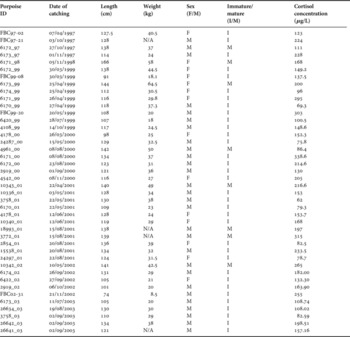
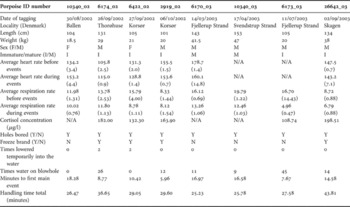
Forty-five wild harbour porpoises were caught and handled. Of these, serum cortisol was measured in 42 (Table 1). Video recordings of the handling procedure were made (244 minutes) for eight porpoises (Table 2). All video-recorded animals were equipped with satellite transmitters, four were subsequently freeze branded and five had blood samples taken. Heart rates were measured from six of the video-recorded porpoises and respiration rates from eight.
List of forty-two harbour porpoises where cortisol level was measured in the blood. Date, length, weight, sex and maturity are indicated. The porpoises were caught alive in the Danish pound net fishery, brought onboard a fishing vessel and blood sampled.

N/A, not available.
Statistics of eight harbour porpoises satellite-tagged in Danish waters from 30 August 2001 to 2 September 2003. Average heart rates are given as heart beats per minute. Average respiration rates are given as respirations per minute. Times for the ‘Minutes to first main event’ and ‘Handling time total (minutes)’are based on time from start of video recording or when the porpoise handling started until end of video recording/porpoise released.

Standard errors are given in parentheses; N/A, not available.
Graphic examples of porpoise responses to sampling and tagging procedures
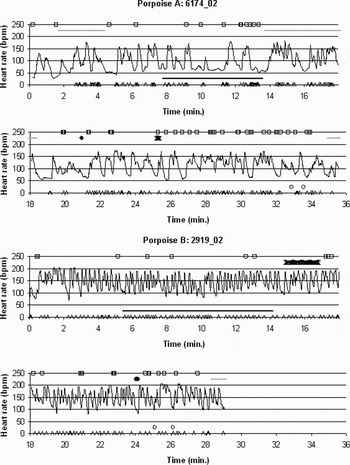
Graphic examples of two tagging procedures that illustrate the high individual variation in heart and breathing rates are given in Figure 1. Porpoise 6174_02 had a variable heart rate, especially during the first 13 minutes of the handling procedure (Figure 1A). During this period, the heart rate oscillated between 30 and 180 bpm. These oscillations were uneven with periods of very low heart rates for up to one minute. During these periods, respirations occurred rarely. Therefore, the animal was lowered temporarily into water twice until heart rate and respiration were more stable. The porpoise did not seem to react to hole boring or freeze branding. Porpoise 2919_02 had a regular heart rate during the whole procedure (oscillations between 70 and 200 bpm) (Figure 1B). No effect from the hole-boring procedure was visible from the heart rate of 2919_02. The heart rate increased during the first freeze branding (>200 bpm) for about 30 seconds but there was no obvious response to the second freeze branding.
Heart rate of two harbour porpoises (A) 6174_02, male, 131 cm; and (B) 2919_02, male, 101 cm measured during the tagging procedures. Heart rate (thin black trend line), respiration (triangle), water poured over blowhole (square), blood sampling (black solid line), weighing (dot), submersion periods (grey solid line), hole boring (x) and freeze branding (ring) are indicated by symbols.

Respiration-rate data
The results indicated a 31.5% overall decrease in respiration rate during the event period (t-test: 4 rpm, P = 0.016). Lockyer et al. (Reference Lockyer, Amundin, Desportes, Goodson and Larsen2001) found a decrease in respiration rate in captive, but free-swimming, harbour porpoises when these were exposed to deterrent alarms, proposing that a general response to stress is lowering breathing rate. When analysing the individuals separately, only two porpoises (6170_03 and 10340_03) reduced their respiration rate significantly (t-test: 3 rpm, P = 0.029; 7 rpm, P <0.005, respectively). When analysing the mean respiration rate, the interaction factor (maturity stage and period) was not significant. Generally, immature porpoises had a significantly lower respiration rate (43.6%) than mature porpoises (P = 0.008, immature porpoises: N = 6, mean = 9 rpm; mature porpoises: N = 2, mean = 16 rpm), which may be due to immature individuals being more stressed and exhibiting a greater response. Moreover, odontocetes have only 5–7 pairs of ribs attached to the sternum (Berta & Sumich, Reference Berta, Sumich, Berta and Sumich1999). The gravity and lack of sternum support creates pressure on the lungs making deep breathing difficult, especially for large animals. As breathing becomes shallower due to the pressure, the breathing rate may increase in order for the porpoise to obtain enough oxygen. The size of the animal and the respiration rate may, therefore, be correlated. Handling animals while they remain in water would reduce pressure from gravity and might, therefore, reduce stress. However, handling, tagging and blood sampling animals while they are in the water are very difficult unless the animal has been trained for these procedures.
Heart rate data
The heart rate data revealed no significant change between baseline and event periods when testing all animals together. However, results from porpoise 10340_02 and 6174_02 showed a significantly higher event heart rate than baseline heart rates (19 bpm; P = 0.001 and 9 bpm; P <0.005, respectively) while porpoise 26642_03 showed a significantly lower event heart rate (4 bpm; P <0.005). The contradictory responses from the individuals above do not allow for general conclusions on how heart rate relates to stress but underline the highly individual response. However, as heart rate is easily monitored it may still indicate when the animal should be returned to the water. During the present study, this was done whenever the heart rate reached very low (<50 bpm) or very high (>200 bpm) levels for minutes at a time. Very high heart rates often coincided with overheating of the flukes while very low heart rates often were related to cramp-like bending of the body.
Cortisol data
Cortisol data in combination with heart rate data were available from four animals (Table 2). No significant relationships were found between cortisol levels and both heart rate and respiration rate. Moreover, no relation between cortisol level and time from the animal was taken out of the water until blood sampling was completed. Neither the factor nor covariates affected the cortisol level significantly (P >0.5). The insignificant results may be a result of the cortisol levels having already reached a maximum due to the stress of being captured. This would prevent a further elevation in the concentration and, thus, an insignificant result.
Most of the forty-two animals were tagged during the afternoon. Therefore, diurnal variations in cortisol concentrations were not anticipated to influence our results. The average cortisol value of the forty-two wild porpoises was 165 μg/l (range = 62–339 μg/l). These highly variable concentrations show that animals may respond very differently to the same treatments, but due to the nature of the experiment, baseline values for the cortisol concentrations are unknown. During a tagging study by Koopman et al. (Reference Koopman, Westgate, Read and Gaskin1995), thirty-one wild harbour porpoises (thirteen females and eighteen males) were fitted with either electronic tags (eight porpoises) or plastic roto-tags (23 porpoises). Blood samples showed lower cortisol concentrations in both the roto tagged porpoises (average: 81 μg/l) and those with electronic tags (average 114 μg/l), than the porpoises tagged during the present study. As almost all porpoises in the present study were blood sampled before tag attachment, this could not have affected the cortisol concentration. A study carried out on two captive porpoises in Denmark (Desportes et al., Reference Desportes, Buholzer, Anderson-Hansen, Blanchet, Acquarone, Shephard, Brando, Vossen and Siebert2007) found that the mean cortisol values were significantly lower when blood samples were taken while the animal remained in the water during voluntary husbandry sessions (17 μg/l & 20 μg/l) than when the porpoises were handled on land (65 μg/l & 72 μg/l respectively). This clearly shows that the cortisol is a good indicator of stress. The poolside samples may be close to the unstressed situation and were the lowest levels observed of all studies. The tagged animals, also exposed to both capture and gravity compared to the animals sampled at poolside, show the highest cortisol levels. Keeping animals in water rather than in air during treatments may, thus, reduce stress also during tagging of wild animals.
Behavioural reactions
Both porpoise 10340_02 and 6173_03 were wiggling during hole-boring. No consistent picture in the parameters measured (heart rate, respiration rate and cortisol level) could be found during hole-boring for these animals and they did not differ from the rest of the animals. The behavioural response may have been a result of an escape reaction (Moberg, Reference Moberg1987; Waples & Gales, Reference Waples and Gales2002). The rest of the porpoises were relatively calm during the tagging procedure.
A way to evaluate the long-term effect of stress during handling is to monitor the behaviour after release. Otani et al. (Reference Otani, Naito, Kawamura, Kawasaki and Kato1998) found no change in swimming behaviour or respiration frequency, after two captive harbour porpoises had instruments attached to their dorsal fins. A detailed study on the effect of tagging (similar procedure as in the present study) carried out on botos (Inia geoffrensis) indicates that the tags had no long-term effect on survival or reproduction on the animals (Martin et al., Reference Martin, da Silva and Rothery2006). However, Martin et al. (Reference Martin, da Silva and Rothery2006) note that botos are much more susceptible to handling than tucuxis (Sotalia fluviatilis), a sympatric delphinid. Therefore, the effect of tagging may differ between species. Geertsen et al. (Reference Geertsen, Teilmann, Kastelein, Vlemmix and Miller2004) studied a satellite-tagged captive porpoise before, during and after tagging for 80 days. Geertsen et al. (Reference Geertsen, Teilmann, Kastelein, Vlemmix and Miller2004) found no significant change in behaviour, except for the first day when the animal was diving deeper, rolling slower at the surface and logging at the surface more often than before tagging. This alternation in behaviour may, however, be confounded by the sedation with Valium before tagging.
Conclusion
This study found no general effects on respiration and heart rates in porpoises during satellite tagging, blood sampling and freeze branding. This could be due to the animals being already stressed to the limit (Wilson & McMahon, Reference Wilson and McMahon2006), but it rather covers a high individual variation in response to handling and treatments. The highly variable cortisol levels also indicate this. In general, however, all animals had considerably higher cortisol levels compared to captive porpoises voluntarily giving blood at poolside (Desportes et al., Reference Desportes, Buholzer, Anderson-Hansen, Blanchet, Acquarone, Shephard, Brando, Vossen and Siebert2007).
This study provides insight into the physiology and behaviour of naïve porpoises during handling and tagging, but since porpoises responded very differently to handling no general guidelines on how to reduce stress can be given. The most important factors to reduce stress are probably experience and well-planned procedures. This limits the risk of problems and enables quick response to problematic situations. Based on subjective judgement and experience it is recommended to avoid apnoea for more than a minute and very low (<50 bpm) or high (>200 bpm) heart rate, since this is often correlated with behaviours such as shaking, bending, apnoea, overheating of fins and fluke, lack of response, superficial breathing or foam around the blowhole, all serious signs of stress. Pouring water over the head or lowering the harbour porpoise into the water triggers breathing, reducing heart rate extremes and, thereby, should improve the general condition of the animal. It is recommended to test if animals that are kept in the water during handling and tagging have a lower cortisol level and express fewer stress symptoms than animals treated out of the water.
ACKNOWLEDGEMENTS
We would like to thank the pound net fishermen and all the people participating in the field for excellent cooperation. Polar Electro Oy kindly sponsored the heart rate measuring equipment. The study was approved by the Danish Institute for Fisheries Research and Danish Forest and Nature Agency, and carried out under permissions from the Danish Forest and Nature Agency (SN 343/SN-0008) and Ministry of Justice (1995-101-62). Cortisol measurements were partly funded by the German Federal Environmental Agency (FE 299 65 221/01).