Introduction
Debates among archaeologists have led to a dialogue that has been increasingly critical of the appropriateness of analogical reasoning in archaeology, especially in relation to the ethnographic observations undertaken by ethnoarchaeologists.Footnote 1 While most archaeologists accept the belief that archaeological interpretation is based on the knowledge of how contemporary societies function, ethnoarchaeology – as a field of inquiry initiated to build a knowledge of contemporary lifeways specifically for archaeological interpretation – has been charged with uncritically adhering to evolutionary and racist assumptions that see contemporary ‘premodern’ indigenous and peasant societies as in some way equivocal to the truly premodern (i.e. ancient) societies that archaeologists hope to understand. In effect, ethnoarchaeological research seems to deny the coevalness of contemporary peoples or the importance of historical contingencies in its search for cross-cultural and trans-temporal processes that enable analogical inference (e.g. Gosselain Reference Gosselain2016). Offered here, in the model of the traditional ethnoarchaeological cautionary tale, is a discussion of how ethnographic observations made in 19th-century Palestine were used to understand ancient biblical society. While most archaeologists would expect ethnoarchaeology to have little in common (theoretically or otherwise) with 19th-century missionaries, similarities in the objectives and logic of ethnoarchaeology and travelogues bring into focus some of the underlying challenges confronting the use of ethnographic analogy.
In effect, we use missionary travelogues as a soft target because the elaborate logics of the Bible lands literature are easily critiqued, but force a critical and admittedly uncomfortable reflection on some questionable tendencies in archaeology's own use of analogical inference. The writings of 19th-century missionaries show that analogical reasoning from ethnographic knowledge is a widespread strategy used by so-called ‘modern’ scholars to address their interpretive myopia when trying to understand ancient lifeways. At the same time, it brings into focus problematic relations between three participants in analogical inference: the ancients seeking to be known, an ‘other’ who is the source of analogical knowledge for an understanding of ancients, and the interpreter who possesses the interpretive deficiency that makes analogy necessary. One of the interesting secondary conclusions that is decipherable, specifically from the unique character of the Bible lands literature, is how analogy has been used to illuminate a past that must be constrained within a particular cosmological vision. In other words, it illustrates the difference between an open-ended ethnographic engagement meant to cast a critical gaze on contingencies of ‘modernist’ cosmological and ideological principles (i.e. standard ethnography) and ethnographic engagements focused on expanding interpretive depth without challenging the veracity of the cosmological vision under which it operates. Indeed, there are awkward parallels between Bible lands scholarship and calls by New Archaeologists to have ethnoarchaeology limit its inquiry to an itemization of middle-range principles that defined behavioural–material correlations.
The conventionally understood history of ethnoarchaeology has generally traced its origin to the fieldwork of J. Walter Fewkes, who first coined the term ‘ethnoarchaeology’ (David and Kramer Reference David and Kramer2001, 6) in the course of interpreting Tusayan archaeological sites in the American South West by speaking with Hopi communities (Fewkes Reference Fewkes1893; Reference Fewkes1896; Reference Fewkes1900). Fewkes embraced the diffusionist outlook of the period and generally thought cultures were naturally conservative and resistant to change. As a result, important parallels could be established between archaeological sites and nearby descendent communities. Yet this view of ethnoarchaeology as born from Fewkes's cultural-historical orientation downplays how archaeologists outside the Anglo-American tradition used ethnographic knowledge to facilitate archaeological interpretations (Marciniak and Yalman 2013; Cunningham, in press, for discussion). It also elides earlier attempts extending back to the Renaissance in which ‘premodern’ peoples informed understandings of the past (Hodgen Reference Hodgen1964), or the perspectives of classic evolutionists such as Edward Tylor and Lewis Henry Morgan who suggested that analogical connections between modern and ancient people reflected their common locations on an evolutionary ladder. Also unrecognized are the contributions of geographers and early anthropologists in the 19th century whose travel literature reflects early efforts at ethnography and ethnology. Some of the works in this genre, in attempting to expand on interpretations of sparse historical data, may have made methodologies that used contemporary populations as analogues for ancient societies seem broadly acceptable.
Of particular interest here are the travel writings of individuals who visited the Near East. In the late 19th century, European and North American travellers to the region (including missionaries) wrote very widely read accounts of ancient biblical practices based on their observations of the behaviours of the residents of contemporary Palestine. The writings of these travellers were part of one of the most popular genre trends of the time, which included some of the best-selling quasi-academic books of the era. There were over five thousand books and articles published on this subject before 1878 and over two thousand authors wrote accounts of their eastern journeys (Ben-Arieh Reference Ben-Arieh2007, 15; Varisco Reference Varisco and Netton2013, 188). The Bible customs book was one particular sub-genre of Near Eastern travel writing in which obscure biblical verses were explained through observations of daily life in the Holy Land.
In what follows, we define ethnoarchaeology and its role in archaeology as a baseline against which we consider Bible customs books. We then analyse three of the most popular (in terms of commercial sales and reprintings) Bible customs books in detail to look at how ethnographic analogy was employed. William M. Thomson (1806–94) was an American missionary whose The land and the book or biblical illustrations drawn from the manners and customs, the scenes and scenery of the Holy Land became one of the best-selling books of the 19th century, nearly reaching the sales figures of Ben-Hur and Uncle Tom's cabin. Reverend Henry J. Van-Lennep's (1815–89) Bible lands. Their modern customs and manners illustrative of Scripture (1875) was not quite as commercially successful but was especially influential in the United States. Palestine and the Bible, the guide that accompanied the Palestine Exhibition put on by the London Society for Promoting Christianity amongst the Jews, written by Samuel Schor (1859–1933), highlights an ‘object-lesson’ approach to educating the Victorian–Edwardian public about the similarities between the ancient and current inhabitants of Palestine (Schor Reference Schor1934).Footnote 2 This was a travelling Bible fair in which community members and performers dressed in 19th-century Bedouin garb and learned about Bedouin practices in order to better understand Scripture (McGeough Reference McGeough2015b, 92–103). While the motivation of the group, the conversion of Jews to Christianity, was not shared by most visitors to this fair, the event offered embodied experiences of the Holy Land within different British communities and this guide continued to be sold as a historical–ethnographic introduction to Biblical times for decades after the fair stopped being performed. These three books and works like them sought to explain biblical verses and customs by direct observations of life in 19th-century Palestine. By the end of the Victorian era, direct historical analogues from local cultures were understood as a legitimate source for biblical exegesis.
Ethnoarchaeological orientations
As already noted, ethnoarchaeology as practised today in the Near East is often seen as having emerged from the work of Walter Fewkes (e.g. Reference Fewkes1900) and other cultural-historical archaeologists (Watson Reference Watson1966; Reference Watson1980), and later embracing the preoccupation with middle-range theory typical of the New Archaeology (Carter Reference Carter and Meyers1997, 280). Near Eastern archaeologists alternatively will situate its origins with the explorations of Edward Robinson (Reference Robinson1841) and Eli Smith (Davis Reference Davis and Master2013, 382; McGeough Reference McGeough2015a, 120), or see some earlier German ethnographers such as George Gatt (Reference Gatt1885) or Gustaf Dalman (London Reference London2000, 2; Saidel Reference Saidel and Ziolkowski2014, 158) as precursors to ethnoarchaeology in that area.Footnote 3 Dalman's (Reference Dalman1964) work has been especially useful for biblical archaeologists in drawing comparisons between ancient and more contemporary populations in the region. Davis (Reference Davis and Master2013, 382–84) has argued that ethnoarchaeology was not embraced by early influential biblical archaeologists, like Petrie or Albright, and any seeming interest by Albright in contemporary ceramics was solely to learn how to not mistake it for ancient pottery. Despite this, ad hoc interpretations of material culture based on observations made about the life of local Palestinians who worked on the excavations were common in site reports until the 1960s. Other than in the works of the occasional scholar, like ceramicist Einer Gjerstad (Davis Reference Davis and Master2013, 383), ethnoarchaeology did not emerge as an important component of Syro-Palestinian archaeology until the processualist movements of the 1970s. The notable exception was in the efforts of numerous (especially German) scholars from the 1920s to the 1960s to understand Iron Age nomadic pastoralism through observations of Bedouin life (Carter Reference Carter and Meyers1997, 282–83). Hence, instead of being connected through a detectable intellectual genealogy, the use of ethnographic analogy among 19th-century Bible scholars and contemporary Syro-Palestinian archaeologists represents the use of a similar logic to address what are understood to be common interpretive problems.Footnote 4
Most archaeologists understand that ethnoarchaeology is ethnographic fieldwork designed to develop ethnographic knowledge that archaeologists can use to interpret the material remains of past human activities (Gould Reference Gould1980; Gould and Watson Reference Gould and Watson1982; Wobst Reference Wobst1978; Wylie Reference Wylie1982; Reference Wylie1985). Analogies from ethnographic settings seem necessary because archaeologists recognize that their upbringing in an industrialized global North and training in post-industrial ‘modern’ educational institutions leaves them at a disadvantage in explaining the rural and/or subsistence-level lifeways frequently represented in the archaeological record. As a result, research programmes with quite divergent theoretical interests historically have adopted some form of ethnographic analysis (e.g. Binford Reference Binford1981; Hodder Reference Hodder1982b; see Arnold Reference Arnold2000; Cunningham Reference Cunningham2003; in press; Lane Reference Lane, Tilley, Keane, Küchler, Rowlands and Spyer2006; cf. Gosselain Reference Gosselain2016 for critiques). Nicholas David (Reference David1992) has noted that ethnoarchaeology's primary service to the wider discipline is to expand the ‘analogical consciousness’ of archaeologists by forcing them to encounter other ways of being in the world. As such, ethnoarchaeology assesses archaeology's interpretive principles through direct engagement with individuals in the global South who do not share the same Eurocentric, middle-class and/or androcentric standpoints that define much of archaeological theorizing (Cunningham and MacEachern Reference Cunningham and MacEachern2016; see Conkey Reference Conkey2007).
Ethnoarchaeological knowledge thus has a very specific place in the logic of archaeological inference. At its most general, ethnoarchaeology expands upon the body of background knowledge that archaeologists use to interpret the past (Cunningham Reference Cunningham2003; Reference Cunningham2009; Reference Cunningham, Chrisomalis and Costopoulos2013; in press). Archaeologists use analogical reasoning when they assume that, based on observed similarities between a source (ethnographic) and a subject (archaeological) context, other elements of these two contexts might also be similar or dissimilar (Wylie Reference Wylie1982; Reference Wylie1985; also Watson Reference Watson and Kramer1979; Reference Watson1980). Similarities in material culture might then be assumed to reflect similarities in the cultural, economic, political or social practices that produced them. The validity of an analogue is established by testing for the presence or absence of other evidence that should be present if the original analogy holds. Ethnoarchaeologists work to identify the causes of material patterning so that archaeologists later can use that knowledge to make interpretations of the material patterns they encounter. However, in the process, ethnoarchaeologists often discover problems in the assumptions archaeologists make about the human behaviours that lead to material patterns, and produce ‘cautionary tales’ that suggest that the models archaeologists use to understand the past are incompatible with contemporary human behaviour.
Within this general understanding of ethnoarchaeology and its role in analogical reasoning, there are a number of specific methodologies in archaeology that show some parallels in Bible lands literature. The first is a widespread practice to use analogies drawn from historical connections between the ethnographic contexts or sources of analogies and the archaeological context that is the subject of inference. Homologous relations were central to the direct historical approach of cultural-historical archaeology, such as that used by Walter Fewkes (e.g. Reference Fewkes1893) and later Patty Jo Watson (e.g. Reference Watson1966), and have become increasingly important as part of post-colonial and indigenous archaeologies. Here, the aim is to identify descendent communities whose cultural connections to the ancient inhabitants of archaeological sites provide insight into material patterns. The second parallel to Bible lands literature is a tendency, first emphasized by the New Archaeology and picked up by later forms of behaviouralism, to see ethnoarchaeology primarily as the pursuit of law-like relations between behaviours and material culture. Lewis Binford and Jeremy Sabloff (Binford Reference Binford1981; Binford and Sabloff Reference Binford and Sabloff1982) were particularly keen to see ethnoarchaeology conduct actualistic research that led the development of middle-range theories that translated the static patterns of the archaeological record into discrete behaviours against which broader social theories could be tested. Middle-range theories were part of an overall episteme that sought to use independencies in paradigmatic knowledge to develop a methodological form of objectivity (Cunningham Reference Cunningham, Chrisomalis and Costopoulos2013; after Wylie Reference Wylie1992). Rather than using ethnographic insights to build or critique the general theory that archaeology used to interpret past social systems, ethnoarchaeologists were charged with observing constant conjunctions between behaviours and material patterns through inductive programmes of fieldwork (Cunningham Reference Cunningham2009).
In addition to these methodological tendencies, ethnoarchaeology and Bible lands travelogues share anxieties around a pair of conceptual issues. First, despite Bible lands travelogues’ distinct theological objectives, both forms of inquiry are rooted in a fundamental distrust in the ability of scholars to directly interpret their subject matter. This shared distrust derives from a common sense of the profound ruptures between their experiences as ‘modern’ scholars and the ‘premodern’ settings they hope to understand. The writers of Bible customs books drew upon a well-established orientalist tradition that the inhabitants of the East were unchanging and monolithic, amplified by theological rationales that made this lack of progress part of a larger divine plan. Ethnoarchaeological work has relied on a not entirely dissimilar set of structuralist propositions. Since the mid-19th century, cultural diversity within the social sciences has tended to be understood through discourses that define societies along binaries of ‘civility–incivility’, ‘modern–traditional’, ‘capitalist–precapitalist’, or ‘developed–underdeveloped’ (Hodgen Reference Hodgen1964; Trigger Reference Trigger1998; for critiques, see Fabian Reference Fabian1983; Ferguson Reference Ferguson2006; Wolf Reference Wolf1982). Critics note that field trips to the global South thus constitute a form of time travel, where researchers from a ‘modern’ (capitalist, developed) global North visit a ‘traditional’ (pre-capitalist, underdeveloped) global South to observe vestigial human behaviours long destroyed by their own more thoroughly developed modernity (see especially Fabian Reference Fabian1983).
A related set of shared conceptual issues is the need for researchers to address relationships between three distinct contexts that frame uses of ethnographic analogy. These contexts are made up of archaeologists, the ancient settings they seek to know, and the ‘source’ population whose otherness makes them appropriate for ethnographic study. How a researcher understands relationships between these three contexts has a significant impact on how analogy is used. For example: (1) how do we conceptualize relations between post-industrial academic archaeologists and the ancient pasts they hope to know? Do archaeologists possess the background knowledge and framing theories suitable to study this specific past, or is there a rupture of some form (‘modernity’) which makes it necessary for the discipline to embrace supplemental forms of ethnographic or ethnoarchaeological work to interpret those material remains? (2) How do we understand relations between coeval ethnographic ‘others’ and the ancient contexts for which they are assumed to possess unique knowledge? Under what conditions might archaeologists then believe that specific communities reflect descendants or analogues that either are or are not positioned to inform archaeologists about sites and/or objects? Finally, (3) how should we understand relations between archaeologists and the contemporary populations that they consult to address interpretive deficiencies in the discipline of archaeology? On what other grounds might a group of ‘others’ be identified and understood as having knowledge specifically relevant to a study of ancient contexts? In archaeology, the common-sense trope introduced above has structured answers to the issues faced in each relation: the ‘modernity’ of archaeology as a discipline makes it difficult to understand ‘premodernity’, therefore they must consult with purposefully selected coeval ‘premoderns’ to interpret an ancient setting. By viewing these issues through a comparison with Bible lands travel literature, we hope to show that there is nothing sensible about the answers archaeologists have derived from this trope (see Johnson Reference Johnson2011 for a wider discussion of common-sense empiricism). The deployment of what equally is analogical ‘common sense’ in the context of Bible travel literature brings into focus the uncomfortable parallels that frame archaeological uses of analogy.
Using 19th-century Palestine to understand Iron Age Israel
Fundamental to the use of 19th-century life as analogous to biblical life was the idea that despite the passage of thousands of years, little had changed in the East over that time, at least in terms of the rhythms of daily practices. Perhaps the boldest assertion of this typical orientalist viewpoint of the region was offered by Samuel Schor. He believed that there was an explicitly theological reason for the timelessness of Palestine: God had, through the enactment of a particular kind of miracle, preserved the land for the edification of later believers (Schor 1934, 1). Others, however, did not need to posit such a direct form of divine intervention. Orientalists had established a scholarly tradition, rich in what seemed to be empirical evidence, that the land was unchanging and static in its development in contrast to the evolutionarily dynamic West, as has been well discussed by Said (Reference Said2003) and others. So, whether caused by divine intervention or a product of the peculiar fixity presumed of oriental cultures, there was little belief in a need to contest this assumption.
For Schor, observation of the 19th-century inhabitants of the land could provide valuable insight because this enactment of biblical life was not done in conscious emulation of the Bible. Schor (1934, 2) explains that ‘they simply live this primitive life because their parents and grandparents for a hundred generations have lived it’. It is the lack of awareness of their own analogous position to Scripture that makes them a source of valuable information about biblical times. They provide, in Schor's logic, objective evidence of the natural ways in which biblical life is practised in the biblical environment yet at the same time these practices have not been purposefully crafted to emulate the Bible. This was what Murre-van den Burg (Reference Murre-van den Burg and Murre-van den Berg2006, 47) has called a ‘romantic primitivism’.
In other instances, this continuity of cultures was conceptualized in almost racial or genealogical forms, most usually from the posited period of the settlement of the land in the Iron Age through to the 19th century C.E. The various ethnic groups identified in the biblical book of Judges were still reflected, according to some of these North American visitors, in the ethnic and tribal divisions that they encountered. Thomson even suggested that some inhabitants of the land were directly descended from biblical figures, such as the descendants of Jael who could still be found north of Nazareth (Murre-van den Burg Reference Murre-van den Burg and Murre-van den Berg2006, 47). Marriage practices, which prevented exogamous unions, were further thought to prevent changes in cultural practices (Varisco Reference Varisco and Netton2013, 193).
That the inhabitants of the land were thought to be vestigial remnants of antiquity is clear throughout the Bible customs books. Van-Lennep's description is evocative (Reference Van-Lennep1875, 806):
A traveler … finally reaches the end of his long and arduous pilgrimage, and is rewarded by the contemplation of the object of his search. But as he gazes upon the dumb witnesses of the past, there stands beside him a living fragment of that same past, a representative of the very men who enacted upon those interesting scenes – a lineal descendant, it may be, of Abraham, or of David, of one of the apostles or protomartyrs. His face and form are perhaps the very photograph of his ancestor; his garb, his manners, the dialect he speaks, are fac-similes of those delineated in Bible story.
Travel to the Holy Land is akin to travelling backwards in time, to a place where the ancient customs of the Bible are still practised.
The stasis proposed for the Orient and other locations in the ideological landscape of the 19th century gave Europeans and Americans a yardstick against which they could measure their modernity. Yet the people inhabiting Palestine were seen as a special case. The reason why Bible customs books could shed light on obscure biblical passages relates to a form of environmental and territorial determinism that assumed that traditions in the Holy Land remained static (Varisco Reference Varisco and Netton2013, 193). Bible lands books thus included detailed descriptions of the flora, fauna and geological features in a way that implicitly sees Ottoman-era ecology to be unchanged from that of biblical times. While in some ways this mimics the kind of documentation of foreign territory that had been established by Napoleon's savants in their exploration of Egypt, there was a theological motive that differed from what was otherwise an Enlightenment-era approach to collecting information about the natural world.
These biblical scholars had directly experienced the land that was the setting of the biblical narratives. Murre-van den Burg (Reference Murre-van den Burg and Murre-van den Berg2006, 51) has explained that the detailed descriptions of environmental features helped prove that ‘Israelite history was grounded in the reality of the geography of the Holy Land’. The accuracy of biblical accounts was seemingly confirmed by observations that geographical descriptions of the regions were accurate or at least plausible given the current knowledge of site identifications. The strong geographic determinism that is implicit in these Bible customs books is mixed with an assuredness that the land itself has remained isolated and uninfluenced by historical change. Given that the history of the region, as understood in the late 19th century, was one of shifting influence from different foreign empires, this political history had to be explained away. Van-Lennep (Reference Van-Lennep1875, 329) explains:
Whatever political changes occur in a country, or even when the population is destroyed or transported, and its place occupied by a foreign race, the customs and practices relating to the cultivation of the soil and to other natural sources of wealth are apt to be adopted, without change or modification … This has been more particularly the case when the conquerors were possessed of a civilization inferior to that attained by the conquered …
He continues (ibid., 330) by explaining that even when the land has been conquered by ‘Arabs or Tartars’, who ‘have reduced the conquered to a state of semi-serfdom’, they eventually relearn and adopt the customs that had been in use since biblical times.
Yet there was more than just this historical confirmation, especially for American Christians. Davis (Reference Davis1996, 47) has shown that Thomson (but by extension the others under discussion here) depicted Jesus as ‘a lover of landscape’. Davis argues that for Americans this was an appealing assertion. At this time, American Protestants felt that they had a special ability to appreciate the natural world and, relatedly, found the Eastern Orthodox sites of early Church significance disagreeable, since these were religious sites mediated through human structures. Thus the appreciation of the Bible's environment was more than just scientific; it was an integral part of the American Protestant experience of Scripture. The experience of the land was articulated as a religious experience, a fundamental part of Protestant and especially evangelical sacred life. Thomson (Reference Thomson1880, 39) is quite clear on this point: ‘God made both the Holy Land and the Sacred Poet, the one for the other. Both were necessary. Neither could realize the divine intention alone. They must be brought together, and act and react upon each other. Both were necessary.’ The Bible and the land are both parts of God's message, as he describes at the outset of his book (ibid., 1):
The land where the Word-Made-Flesh dwelt among men must ever continue to be an important part of Revelation; and Palestine may be fairly regarded as the divinely prepared tablet whereupon God's messages to men have been graven in ever-living characters by the Great Publisher of Glad Tidings.
This was the land where the Bible was ‘devised and first used, and here are found its best illustrations’ (ibid., 1). Thomson (ibid., 3) explains further:
That land [Palestine], we repeat, has had an all-pervading influence upon the costume and character of the Bible. Without the former, the latter, as we now have it, could not have been produced. To ascertain this fact, and to notice by what process of analogy and of contrast the physical and mundane came to signify and illustrate things spiritual and heavenly, may well occupy much of our attention during this pilgrimage through the Holy Land.
Here Thomson argues for prefigurement where spiritual truths are symbolized in the natural and historical world (Frei Reference Frei1974, 153). This older theological approach is related to but more spiritual than the typical environmental determinism that frames other studies of this nature, for the power of this land is more than just economic – that is to say, more than simply related to subsistence practices. The land actually holds a theological power over its inhabitants, impacting them as they move in and out of the region. Thus it was believed that there is a complex relationship between the land, the ancient Hebrews, 19th-century Jews, and 19th-century inhabitants of Palestine.
The importance of land underwrites some of the pervasive anti-Semitism that characterized both the 19th century and the Bible customs books that were produced at that time. Judaism is treated in a variety of ways in different volumes, but usually the contemporary practices are seen as divorced from biblical practices, in part because of Jewish departure from Palestine. Thomson's book especially has anti-Semitic overtones to it, and all of these works follow typical (although not consistently applied) Christian practices of making the Old Testament seem less Jewish and more a prefigurement of Christianity. Schor's interest in converting the Jews to Christianity meant that the issue had to be dealt with in greater complexity, especially as this goal was not strictly advertised to participants in the Palestine Exhibition. Generally, though, the fact that the Jews had left the land and had been transformed by rabbinical Judaism and by the cultures in which they lived meant that they no longer adhered to biblical customs and could not serve as a source for the study of biblical culture, nor could the literature (other than the Bible) or liturgical traditions of that culture (now fully framed as European). According to Van-Lennep (Reference Van-Lennep1875, 339),
Long centuries of oppression have changed the character of this people, once celebrated in the arts of war, and noted for their personal courage, and have made them cowardly and deceitful. Their physical appearance has greatly changed, for they have lived in various climes, everywhere despised, hated and persecuted.
Van-Lennep (ibid., 340–41) continues,
It is not, therefore, to the remnant of God's ancient people that we can look for a correct notion of the ancient Hebrew, his character, or manners. On many points, indeed, connected with their religious practices, the Jewish traditions and the Talmud itself throw much valuable light, of which Biblical scholars have been prompt to avail themselves … But history furnishes us with an instance of the ease with which an entire people may lose all their peculiar characteristics, their religion, and their national traditions, and become completely amalgamated and lost among races of a totally different origin … they [modern Jews] differ little from the people among whom they are scattered, except in their enfeebled appearance, their religious practices, and their marrying only among themselves. The foregoing statements, therefore, clearly show that the light we can obtain from the modern Jews is insufficient to answer our inquiries, and we are thus compelled to seek other means for the gratification of a laudable curiosity.
Those ‘other means’ to which Van-Lennep refers were a type of direct historical approach applied to the local inhabitants and thus rooted in a belief in territorial continuity rather than a cultural or biological linkage to supposed biblical characters. This viewpoint of Palestine as a holy territory outside modernity, rather than the homeland of a dispersed population, was not disputed by 19th- and early 20th-century Jews, despite the rise of Zionism. As Kirschenblatt-Gimblett (Reference Kirschenblatt-Gimblett, Shandler and Wenger1997, 62–64) has shown, many Jews encouraged the perspective that Judaism was a faith and not a racial or ethnic division, that Jews were trustworthy members of whatever nation state they resided within, and were thus as distant from biblical culture as were contemporary Christians. Consequently, Bible customs books generally equate the ancient Jews of the Bible with 19th-century Arabs. The vestigial nature of 19th-century Arab life was thought to have been caused, in part, by the isolation of the Arabian peninsula (Van-Lennep Reference Van-Lennep1875, 349). A belief that Arabs were reluctant to intermarry with other groups suggested that the physical features of ancient times were preserved in that population, a point that Van-Lennep attempts to prove through comparison of Arab physiognomy and ancient Egyptian depictions of ancient Semites (ibid., 352–59). These biological discussions are extended to other groups in the region, with Van-Lennep considering the Copts, Armenians, Turks and other groups as possibly racially vestigial (ibid., 359–74).
What stands out is the way that arguments for specific forms of continuity and discontinuity – and thus the identification of specific groups over others as analogues for biblical histories – are embedded in a combination of Christian theology and 19th-century ideology that shows the complicated assumptions operating at the time. The Bedouin, with all the romantic conceptualizations of a people freed from modernity, had best preserved biblical customs because they were the people who had remained in the land. The Jews who claimed direct historical ties to biblical populations were unacceptable as analogues because they had left the land and subsequently were embedded in occidental nations that were both modernized and morally degraded. In contrast, Bedouin who had remained reflected a static or perhaps degraded level of social evolution, which for many of the missionaries (but not Thomson) justified European or North American colonialism in the region. Murre-van den Burg (Reference Murre-van den Burg and Murre-van den Berg2006, 53) further points to the presumed correlation between Jesus and the American Protestant missionaries, both of whom attempted to teach spiritual truths to those who were still practising ancient ways. Thus the missionaries themselves created a situation where they could imitate the role that they believed Jesus had once played. For the Bible customs books authors, the theological properties of the Holy Land had prevented the inhabitants of that region from participating in global progress. Ethnographic comparators were – luckily for the sake of expediency – found living in the Holy Land in communities described in the Bible where they purportedly continued carrying out biblical practices, regardless of their cultures of origin or religious affiliations.
Here, then, is a different direct historical approach than occurred in the Americas, or even than folk culture approaches in Europe (see contributions to Marciniak and Yalman 2013). It shows some similarities to early Near Eastern ethnoarchaeological explorations of village life (e.g. Kleindienst and Watson Reference Kleindienst and Watson1956; Watson Reference Watson1980), although these have generally been replaced in a more behaviouralist orientation in the region's ethnoarchaeology (London Reference London2000, 3). The issue of which communities may serve as analogues for ancient pasts is usually addressed through discussions of boundary conditions (Stahl Reference Stahl1993, 236) or arguments of relevance (Wylie Reference Wylie1988, 136–37) that assess analogical comparison between a source and subject context. While arguments of relevance in testing schemes tend to be quite sophisticated when assessing specific interpretive questions (see Binford Reference Binford1967), they are nonetheless framed by assumptions made by the theoretical schools in which they are embedded that identify some elements of a sociocultural system as durable or prone to regularity (Trigger Reference Trigger2006). For example, the general comparative method of the late 19th century was overt in considering cultures to cluster in stages of cultural evolution through which more civilized communities passed (e.g. Morgan Reference Morgan1877). Ancient and modern societies at the same stage were thus comparable because they represented the same level of cumulative knowledge and technology, defined along a continuum from savagery to barbarism to civilization. Cultural historians of the subsequent Boasian tradition invoked a similar temporalization of the modern and the traditional, but they were less open to cross-cultural comparison because they believed each culture was unique. Homologous relations between ancient sites and supposed local descendent communities relied on a sense that indigenous societies resisted change despite centuries of colonial violence and thus historical ties provided baselines for archaeological interpretations (Trigger Reference Trigger1980; Reference Trigger1998). Ethnoarchaeology appeared in this period as Tusayan archaeological sites were interpreted in the light of Hopi oral histories (Fewkes Reference Fewkes1893; Reference Fewkes1896; Reference Fewkes1900). The neo-evolutionary approaches of processual archaeology identified common ecological and adaptive criteria as recurrent phenomena, frequently combined with some consideration of a level of social and political complexity (e.g. bands, tribes, chiefdoms and states; see Sahlins and Service 1960) in ways that echoed classical evolutionism (Stahl Reference Stahl1993). Rather than historical continuities, Alaskan Eskimo and Kalahari San mobile hunter-foragers came to inform interpretations of Palaeolithic lifeways despite living in different environments and on different continents (Binford Reference Binford1978; Reference Binford1981; Lee and Devore Reference Lee and Devore1968). Postprocessual archaeology emerged from a series of East African (Hodder Reference Hodder1982a, Reference Hodder1982b) and East Indian (Miller Reference Miller1985) ethnoarchaeological projects dedicated to developing interpretive baselines for a structuralist archaeology. While in some cases European archaeologists felt free to sublimate meaning directly from ancient materialities (e.g. Barrett Reference Barrett1994), the sense that some components of culture such as ideological structures were generally resistant to change made descendent populations near to archaeological sites the best analogical option for an understanding of ancient material patterns.
Forms of geographical determinism – not entirely dissimilar to that used by Bible lands approaches – have thus remained a key part of archaeology's use of analogy. The most overt similarities occur when ad hoc ethnoarchaeological research is conducted in communities near to archaeological sites without a well-reasoned justification for why a particular community offers interpretive insights. All too often, the justification depends on a sense that a nearby community's lack of ‘modernity’ – whether defined by economic (i.e. peasant communities) or cultural (i.e. indigenous) criteria – makes them vestigial. For example, European archaeologists have historically used rural agrarian and nomadic communities to produce interpretive insights for nearby European sites (Luigi Reference Luigi, Marciniak and Yalman2013; Struwe Reference Struwe, Marciniak and Yalman2013); recent developments in archaeological ethnography tend to combine studies of archaeological heritage with ethnographic engagements among adjacent stakeholder communities (e.g. Hamilakis Reference Hamilakis2011); while indigenous and post-colonial approaches focus on how unique and often subaltern standpoints atypical for archaeology (as a colonialist enterprise) expand the discipline's interpretive potential (e.g. Lydon and Rizvi Reference Lydon and Rizvi2010). Research like this is essential in decolonizing archaeology as a discipline and fundamental to the creation of better history (see Wylie Reference Wylie1992; Reference Wylie, Schmidt and Patterson1995). However, when projects that use analogical inferences answer the question ‘which community should I consult?’ by seeking out the closest ‘non-modern’ community to the site, the resulting knowledge risks ignoring both historical dynamism and population mobility in ways that parallel the work of Bible lands scholars. For example, in Alberta, Canada, both academic and CRM archaeologists regularly consult with local indigenous communities, such as Dene, Cree and Blackfoot, as part of their research practice. However, because of well-established understandings of Athapascan migrations, some descendants of the people who likely used late-period sites, such as those associated with the Avonlea points, are likely living in the American South West and identify as Navajo or Apache (discussion in Walde Reference Walde2006). While consultation with indigenous stakeholders to understand traditional land use and heritage concerns is ethically sound practice (and politically expedient for development projects), analogical inference based on such consultation raises the issue of why the biological descendants of some of the sites’ inhabitants are not considered stakeholders while other groups are whose protohistoric-period arrivals in the regiuon likely post-date the Avonlea horizon. Left unexplored, the broader trope of ‘traditional–modern’ seems to justify such ‘other–ancient’ comparisons and it flirts with a territorial determinism that parallels how Bible lands travellers imagined the Ottoman inhabitants of Palestine as similar to biblical personages.
One of the more significant challenges for Bible lands scholars was to use ethnographic information in a way that allowed greater appreciation of biblical histories without undermining the theology that motivated these travels in the first place. Ethnological study provided a means for Europeans to embrace the Bible as a product of a different culture without calling into question the historical accuracy or divine inspiration surrounding the book. For American Protestants especially, literal readings of the Bible had become standard (Murre-van den Burg Reference Murre-van den Burg and Murre-van den Berg2006, 49; Varisco Reference Varisco, Amanat and Bernhardsson2002; Reference Varisco and Netton2013, 188). Direct correlations between biblical verse and 19th-century life and land were important means of supporting these new theologies, especially those literalist theologies that were not consonant with academic biblical criticism. Unlike other orientalist approaches that fetishized cultural difference as problematic, the ethnographic approaches to biblical studies seemed to help ease discomfort with difference (see Murre-van den Burg Reference Murre-van den Burg and Murre-van den Berg2006, 52, on further differences from more standard orientalist scholarship). The Eastern nature of the book was commented on directly by many in the period, including Samuel Schor (Reference Schor1934, 1), who explains,
God's Word is an Eastern Book. It was written in the East, by Easterns and for Easterns. It is therefore obvious that a study of that Land, its life and habits, furniture and dress, language and expressions – in short, everything connected with the Land and the People – will throw a flood of light on many passages of Scripture.
Thus the seeming alien-ness of the biblical lands in fact provided an important exegetical opportunity, to gain an even deeper understanding of the text and its message. What could have been a crisis of cultural difference was transformed into an interpretive and essentially homiletic opportunity. Furthermore, here was an opportunity to gain the kind of direct experience of Scripture that seemed to be otherwise impossible in modernity, yet was deeply desired in the aftermath of the Second Great Awakening (c.1790–1840 C.E.).Footnote 5 The experience of the ‘Eastern-ness’ of the Bible allowed participants to divorce themselves from modernity by immersing themselves in a deeply moving, theological reality present both in the Bible and in travels to Bible lands. As Murre-van den Berg (Reference Murre-van den Burg and Murre-van den Berg2006, 62) has argued about these approaches to the region, it was presumed that ‘[w]ithout the country, the Bible remains a closed book.’
This experiential approach to the Bible was best enacted as it was in church, at the level of the verse rather than of the larger narrative. The scrutiny of German critical scholars using von Rankean positivist methods showed the inconsistencies present in the synthetic biblical narrative. That the Bible contained inherently contradictory information was explained through the identification of different ancient authors and editors, an intellectual approach that threatened literalist approaches. However, at the level of the individual verse, smaller segments of the Bible could be understood and verified using ethnographic analogy and philological investigations without interaction with critical biblical scholarship. Ethnological discussions at the level of the verse meant that specific customs, practices, habits and material culture could be illustrated and proven to have a veristic foundation. There was, then, urgency for an accurate study of the customs of the land (Varisco Reference Varisco and Netton2013, 192) so that Christians could directly experience the testimony of God and the truth of Scripture in the face of wider criticism. Furthermore, because Eastern Orthodox communities controlled the holy sites of the early Church, American Protestants were encouraged instead to put their faith in the land (Davis Reference Davis1996, 46–47), which was accessible to Americans and available for scientific and archaeological survey.
The promise of ethnographic study has long been to provide a moment of critical consciousness that challenges not just specific interpretations, but all forms of background knowledge. Bronislaw Malinowski famously opened Argonauts of the western Pacific by cautioning future ethnographers to leave their preconceptions behind, specifically unilineal and racial ideologies present in anthropology at the time, and instead allow their participation in the ‘imponderability of actual life’ (Malinowski Reference Malinowski1982, 18, emphasis in original) to create new and unexpected insights. Ethnographic research has the potential to unmask and subsequently challenge European interpretive conventions through encounters with those who understand the world on different premises. If this founding principle of anthropology holds, then we might ask, why did ethnographic work not challenge the assumptions of the authors of Bible customs books or even later archaeologists?
The answer lies in the ways that ethnographic work was explicitly framed as the investigation of specific subject matter. The writers of Bible lands travelogues saw their purpose as gaining an understanding of the Bible through direct experience, as opposed to ecclesiastical tradition or, even more problematically, critical biblical scholarship that was starting to undermine traditional understandings of the text. The itemized lists that connected biblical passages to ethnographic accounts reflect the overwhelming sense that Near Eastern societies continued practices that were pristine survivals directly comparable to those recorded in ancient texts. The focus on the minutiae of these connections, which compartmentalized each practice in a relationship with specific biblical passages, ensured that the wider historical context was not the subject of analysis. Thus the relevance of Near Eastern Arabs as analogues for ancient biblical peoples remained insulated from critical scrutiny and orientalizing binaries remained unchallenged.
In these ways, the early ethnographic approach to biblical studies was predicated on a kind of rigorous empiricism that was focused on the minutiae, but not the broader historic contexts, of Palestinian lifeways. These scholars were greatly concerned with accuracy, and conceived of their travels as an experiment meant to assess the validity of specific interpretations of biblical passages. This concern was rooted in a Protestant perspective that suggested that God's message needed to be understood as precisely as possible by seriously investigating the customs, values, languages and cultures of the region. Unlike coeval classic evolutionary approaches in the social sciences in the late 19th century, Bible lands travellers showed a genuine interest in accurately documenting and understanding cultural difference.
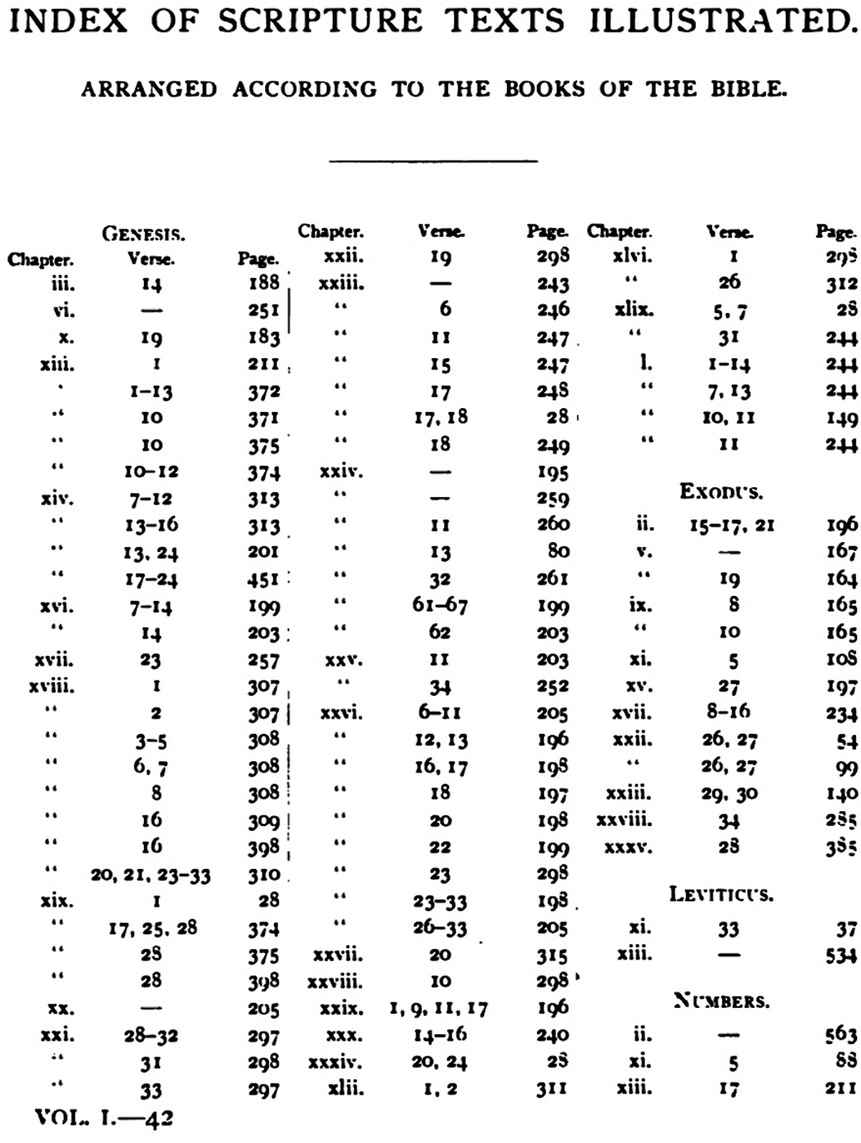
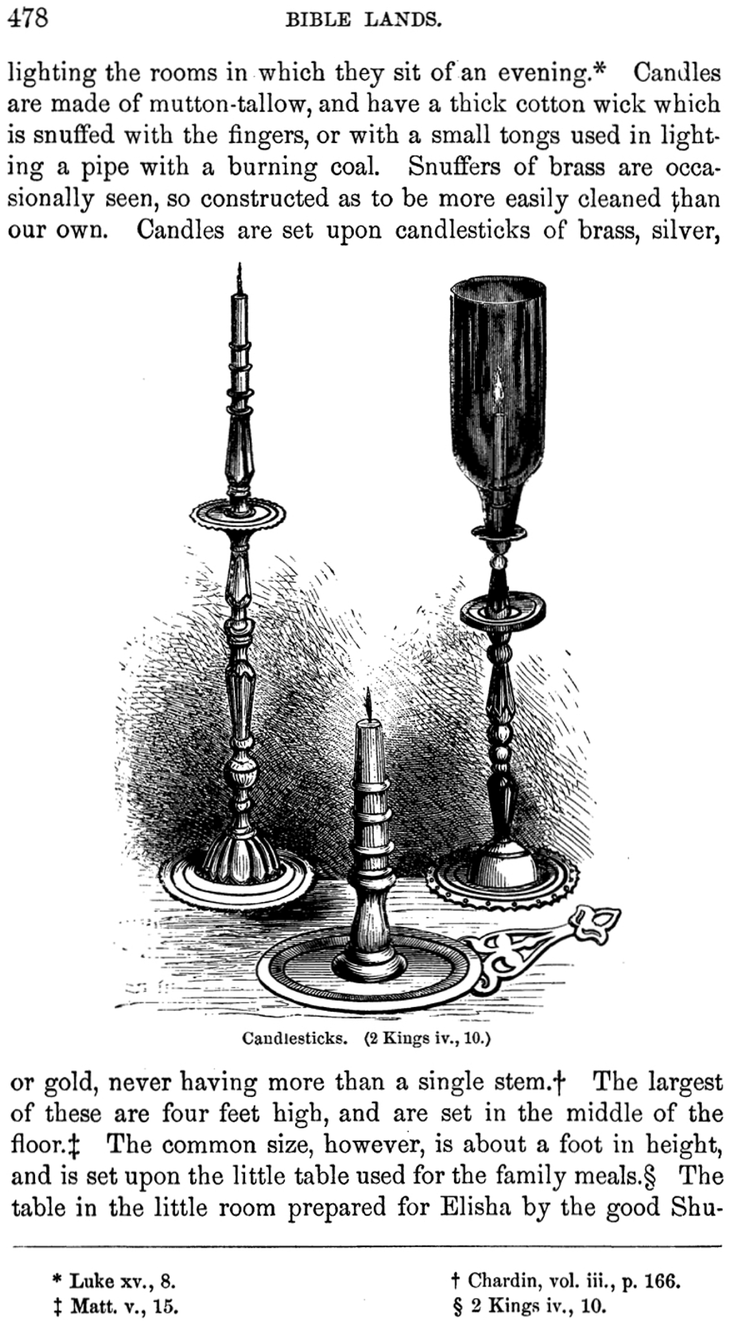
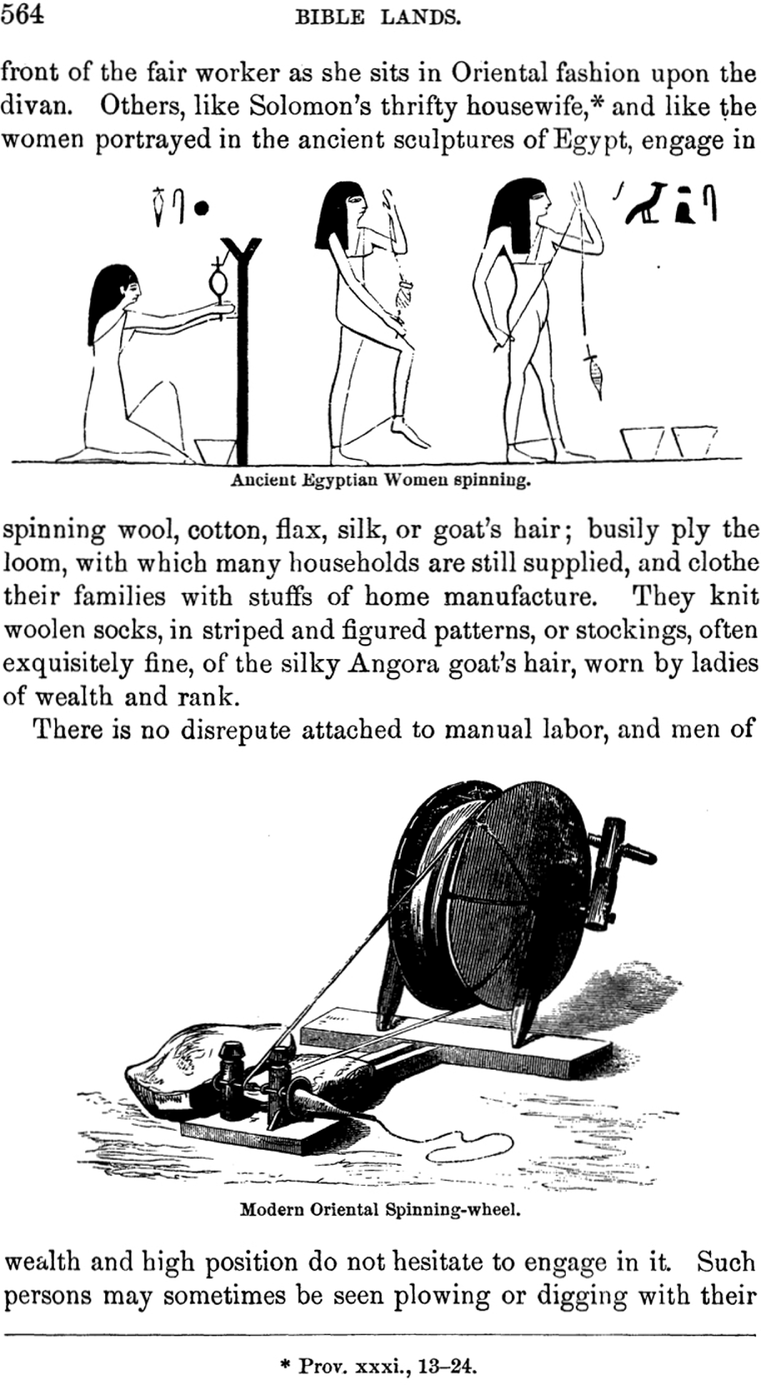
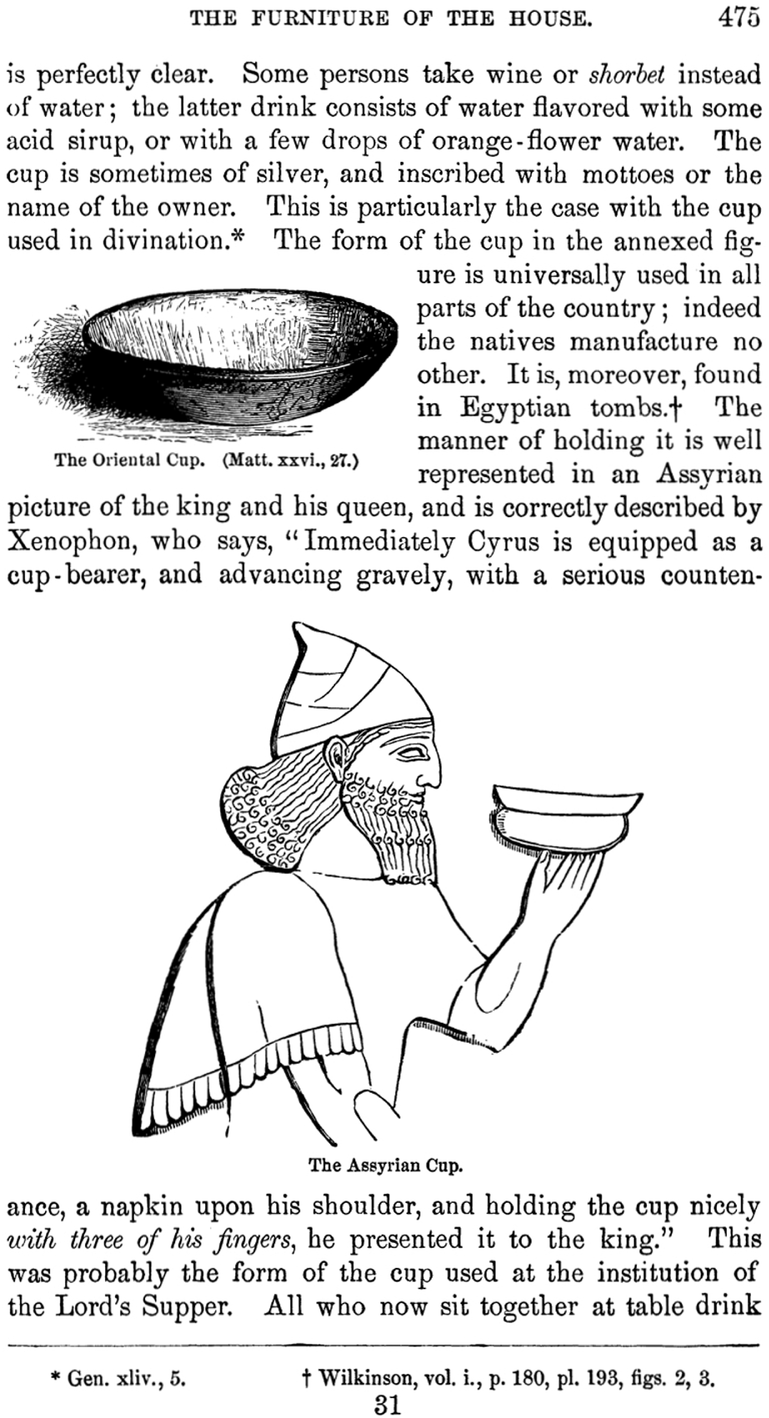
This documentation took the form of specific correlations between observations of daily life and biblical passages that were listed in indices placed at the back of Bible customs books (figure 1). These indices would then allow preachers to add ethnographic insights related to biblical passages into their weekly sermons. These correlations took several forms. For example, according to Van-Lennep (Reference Van-Lennep1875, 407), the patriarchal nature of domesticity among the Bedouins reflected gender roles seen in biblical verse (Genesis 18:6, 27:17) and they were accordingly linked in his index. Other correlations included detailed discussion of the manufacture of mud brick structures and their resistance to rain (ibid., 422 – correlated to Job 12:15), the ingredients for sweet cakes (ibid., 470 – correlated to 1 Kings 17:12–13) and culinary tendencies in the Orient that are frequently mentioned in the Bible such as eating by hand from a communal bowl (ibid., 474 – correlated to several verses, including Ruth 2:14). Images of objects from the 19th century were labelled with biblical verses, thus drawing the connection between the past and present (figure 2). Images of those objects were also juxtaposed with ancient art-historical scenes (figures 3, 4) or imagined reconstructions of the past (figures 5a and 5b) in order to make these points. Sometimes the ethnographic examples allowed for verses that challenged Victorian sensibilities to be reinterpreted. Biblical statements about people being naked were reinterpreted through the lens of the Orient as someone being ‘simply divested of his outer garments’ (ibid., 481).
The index of ‘Scripture texts illustrated’ from Thomson (Reference Thomson1880, 569).

A candlestick from Van-Lennep (1875, 478), labelled with a verse from the Book of Kings.

An ‘oriental cup’ compared with an image from a neo-Assyrian relief (Van-Lennep Reference Van-Lennep1875, 475).
A ‘Modern oriental spinning-wheel’ compared with an image from an Egyptian tomb relief (Van-Lennep Reference Van-Lennep1875, 564).

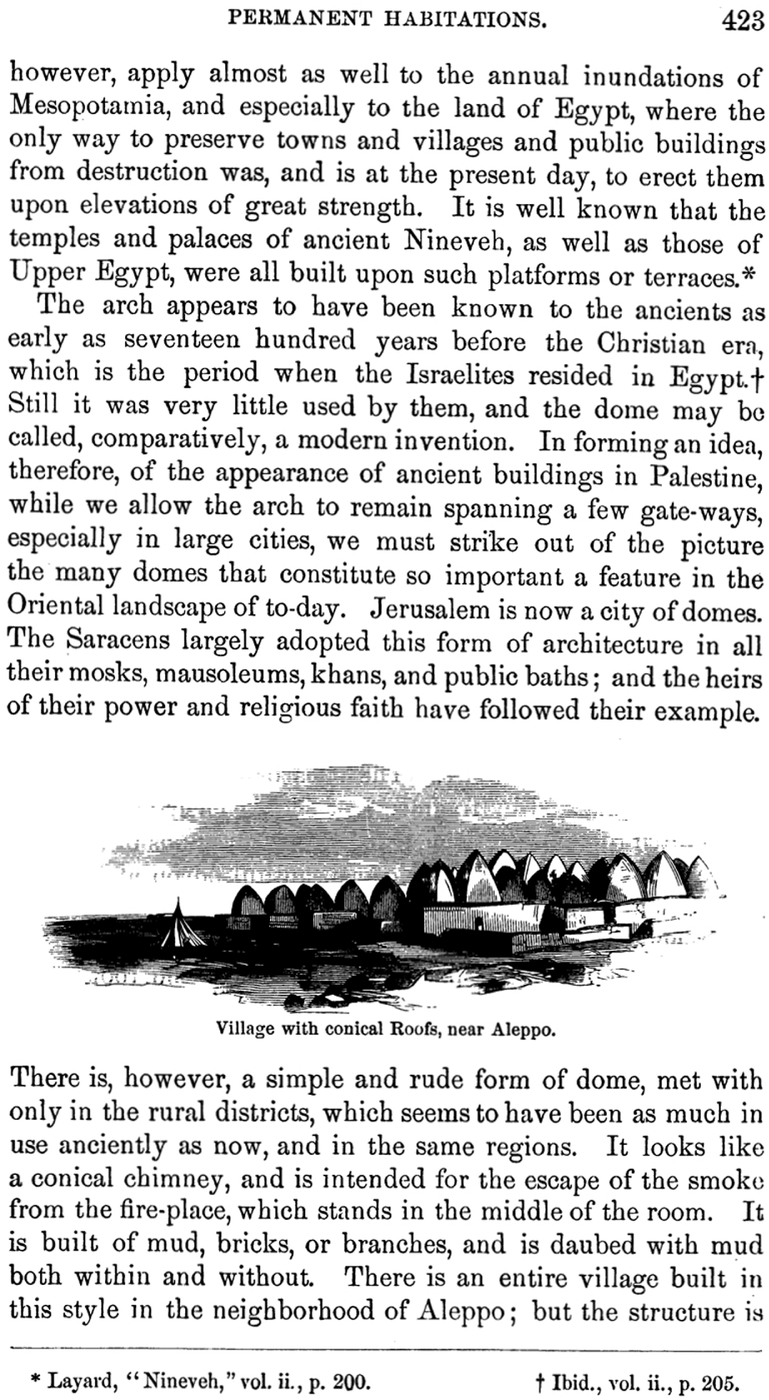
A depiction of houses in Aleppo (Van-Lennep Reference Van-Lennep1875, 423).

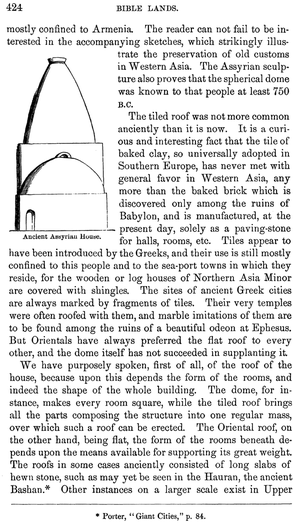
Van-Lennep's reconstruction of an ancient Assyrian house based on observations from his travels, art-historical evidence, and other scholarship on the subject (Van-Lennep Reference Van-Lennep1875, 424).

It was not necessary for the ethnographic examples to consistently parallel ancient biblical life. Van-Lennep's (ibid., 465) description of Arab houses demonstrates that these dwellings differed from those of the ancient Israelites. Likewise, Van-Lennep ponders whether or not coffee – which was an important lubricant for social discourse in the 19th century – has a deeper history rooted in antiquity despite the lack of biblical references to the drink (ibid., 477). There is also a discernible concern with aspects of life that, in the 19th century, seemed impossible to translate from past to present, such as Van-Lennep's preoccupation with local musical scales (ibid., 606) and accurate pronunciations (e.g. ibid., 8). Of course, these textual correlations were supported with illustrations that were fundamental to the veracity of Thomson's and Van-Lennep's books (Varisco Reference Varisco and Netton2013, 191). Related to the earlier illustrated bibles, images from the 19th century were seen as appropriate and realistic snapshots of ancient life. As Murre-van den Burg (Reference Murre-van den Burg and Murre-van den Berg2006, 48) has argued about Thomson's book, these illustrations blurred the boundaries between ancient and modern.
By framing Bible lands analyses as a limited comparison that related specific verses to specific behaviours, biblical travellers effectively sidestepped the broader critical implications of their ethnographic experience. The precise correlations between oriental behaviours and biblical passages offered seeming scientific evidence of the Bible's historicity. Contrary evidence of the vestigial nature of oriental culture, such as the uniqueness of Arab houses or the presence of coffee, was then largely insulated as forms of contamination that did not undermine the broader interpretive project. If anything, these exceptions proved the hypothesis since it was implausible that all elements of 19th-century life remained consonant with biblical times. Theological framing enacted a particular gaze, in which counterfactuals to orthodox Christian understandings of history fell out of focus and specific empirical correlates to biblical passages could be highlighted to both verify and illustrate Bible times.
The encyclopedic view of textual–behavioural relations does have an ethnoarchaeological parallel in the realm of middle-range theory (see Raab and Goodyear Reference Raab and Goodyear1984). Ethnoarchaeologists have differing perspectives on the degree to which the methodology's primary mission should be to identify behavioural material correlations versus offering a more broadly based critique of archaeological theory and practice (e.g. Binford Reference Binford1978; Cunningham Reference Cunningham2009; Schiffer and Skibo Reference Schiffer and Skibo1997). However, the aim to identify constant conjunctions between behaviour and material culture was designed to function in a way not dissimilar to the indices in Bible customs books. Archaeologists would hypothesize that material culture reflected, for example, distinct ethnic communities in a region. They would then consult middle-range knowledge from ethnoarchaeology to identify material patterns that had law-like correlations to ethnicity, and archaeologists would then test their initial hypothesis against this new line of evidence. If followed, this particular objective for ethnoarchaeology, what Binford and Sabloff (Reference Binford and Sabloff1982, 151) identified as ‘(1) nonparticipating, (2) outside, and (3) partitive’, ensured that ethnographic experience would not produce a critical rupture that challenged the broader social theory being tested, which for the New Archaeology was a system-level approach to ecological adaptation whose core assumptions about human subjectivity reified the rationalist logic of American capitalism.
It is perhaps an affirmation of the critical potential of ethnography to unseat even deeply held assumptions that a body of middle-range theory as behaviour–material correlates failed to develop in archaeology. Indeed, rather than correlate tables, ethnoarchaeology tended to produce cautionary tales that highlighted the causal complexity behind material patterns; in particular, the ways material culture was constitutive of social existence (Hodder Reference Hodder1982b) and expressed agentive and mediative qualities as full participants in social action (Latour Reference Latour2007; Gell Reference Gell1998; see Appadurai Reference Appadurai2015). Yet if ethnographic work showed the errors of a correlative agenda, it left ethnoarchaeology without a clear alternative mandate (Cunningham Reference Cunningham, Chrisomalis and Costopoulos2013; Gosselain Reference Gosselain2016). Indeed, ethnoarchaeologists have themselves acknowledged this in a special issue of World archaeology that seeks to reconceptualize ethnoarchaeology's role in the broader discipline (introduced by Lyons and Casey Reference Lyons and Casey2016).
Conclusion
The parallel logic in the uses of analogy from Bible lands literature and ethnoarchaeology thus brings into focus some of the perils of ethnographic research, at least part of which reflects the difficult position that ethnographic work has in contemporary society. In terms of identifying an appropriate subject of study, both Victorian scholars and ethnoarchaeologists tend to rely on some form of territorial determinism. For many ethnoarchaeologists, this is rooted in a cultural-historical derived sense of the conservativism of cultures, which results in deep-time continuities and the appropriateness of historical analogies. Processual archaeology emphasized culture change, but saw that change as a response to ecosystems, such that different populations occupying a similar niche in the past and the present might be expected to have analogical cultural characteristics because of similar rational calculations. For the Victorian scholars of Palestine, explicit statements that God had miraculously preserved the Holy Land to enable future Christians to better understand His message suggests a spiritual justification for a broadly similar geographical determinism.
Likewise, while the Victorian scholars are explicit in stating that God prevented the inhabitants of the Holy Land from participating in progress, ethnoarchaeology has a similarly uncomfortable dependence on treating its subject in binary terms as modern or non-modern. For the Victorian scholars, this is apparent in the identification of Arabs in Palestine as explicitly non-modern in relation to Jews and in the explicit attempt to circumvent Jewish and Eastern ecclesiastical traditions in favour of the study of Ottoman-era inhabitants of Palestine. Both groups of scholars take a view of daily life that seems consistent with that of Braudel and early Annales scholars, where social history is seen as explicitly distinct from history at the political scale. Thus it is of little consequence who rules in Palestine as these matters do not impact the rhythms of daily life over the millennia. The non-modern other is not impacted by political events in the same way that the modern cannot help being. Yet this is not rigid, for both Victorian missionaries and ethnoarchaeologists could identify ‘contamination’ when unexpected behaviours, products or patterns were apparent.
Bible lands literatures depended on a cosmological framing of the 19th-century Near East as a place out of time, and frequently depended on extensive theological arguments to make the territory of the Holy Land transform Ottoman Muslims into vestiges of ancient Jewish lifeways for the purposes of biblical exegesis. Yet the sense of ethnography as a discipline born of a modern West in search of an other to study in order to define its own modernity similarly remains a powerful orienting trope. Ethnoarchaeology's study of others is at least partially defined by this trope, providing a framework through which to understand why archaeologists as ‘moderns’ need to consult premodern ‘others’ to know similarly premodern ancients. The temporalization of contemporary cultural diversity into moderns and premoderns – and rendering others and ancients analogically comparable in the process – has received sustained critique from anthropologists and now shows that it primarily derives from a desire to celebrate the West as modern within in a capitalist eschatology.
Ethnoarchaeology thus likely needs a new orientation, one that rethinks our understanding of relations between archaeologists, others and ancients in a way that eliminates such temporalizations. The significant issue for archaeologists is one of standpoint – archaeologists are generally drawn from a small segment of global cultural diversity, yet they hope to understand the entire sweep of human prehistory. They need a detailed understanding of the contemporary human experience in all its forms to have an analogical baseline suitable for their interpretive ambitions. As Nicholas David (Reference David1992, 352) has suggested, the reason ethnoarchaeologists engage with others is to expand their ‘analogical consciousness’. Hence, rather than needing to bridge a modernist–traditional chasm with the past, or with ethnographic others through some structural definition that slurs global poverty as vestigiality, the aim is simply to engage with communities who possess knowledge that broadens our disciplinary gaze (see Cunningham and MacEachern Reference Cunningham and MacEachern2016).
It should be equally obvious why the rigorous empiricism of both Bible lands scholarship and middle-range-theory approaches is deeply problematic. The seeming factualness of the material record makes claims seem to be more grounded than they really are, allowing empirically based truth claims to be made while masking interpretive leaps and insulating background assumptions from closer analysis. Thus, the broader historical context in which practices–verse indices were created, and from which behavioural–material correlates were to be derived, could go unseen as Protestant travellers and ethnoarchaeologists alike focused on minutiae of daily life. Missionaries were able to ignore, then, both evidence of modernity and Ottoman lifeways for exegetical purposes, while ethnoarchaeologists would push aside evidence of modernity to ensure that their subjects were suitably traditional. The similarities show that such moves are not innocent. Instead, they are ways of using analogy that ensure that ethnographic engagements do not trigger a widespread critical assessment of the assumptions framing the analysis. Indeed, their aim is not to expand analogical consciousness, but to buttress foundational hypotheses and theoretical assertions.
While labelling the unexpected as contamination may not be mistaken in all or even many instances, what this theoretical categorization points to is how both groups’ use of analogy is grounded in claims of scientific empiricism but perhaps lacks the scientific rigour that is claimed. It is not being argued here that such scientific rigour is a desideratum; rather, it is important to note that the authority that claims of science invoke is perhaps unjustified. As has been discussed, concentration on the minutiae of everyday life allowed the Victorian scholars to avoid grappling with more problematic issues in relation to the Bible, allowing them to provide empirical evidence for biblical truth by not having to be concerned with emergent issues in critical biblical scholarship.
The cautionary tale of the analogous uses of analogy in 19th-century Bible customs books and in ethnoarchaeology raises concerns regarding some of the assumptions implicit in the use of ethnography as a means of understanding ancient material culture. Yet the primary takeaway must still be of the value of ethnographic engagements as a consciousness-expanding exercise. Despite a strong behaviouralist orientation in ethnoarchaeology's heyday, fieldwork generally did what Malinowski promised: it uncovered standpoint-based knowledge through engagements with others who saw the world differently. It is exactly this form of engagement that makes ethnoarchaeology a valuable contributor to archaeology's analogical objectives.