1. Introduction
At the time of writing, 11 months after the UK triggered the two-year process of withdrawing from the European Union (EU), it has still not settled on its preferred EU trade arrangement. Different political factions and commentators have picked over options, ranging from remaining part of the European Customs Union (CU) and Single Market (SM) to trading with the EU with no preferences at all, and all points in between (see, for example, Gasiorek et al., Reference Gasiorek, Holmes and Rollo2016; Holmes et al., Reference Holmes, Rollo and Winters2016).
One solution advocated by the Prime Minister (HM Government, 2017b) and the main opposition party was that the UK should leave the CU and SM but conclude a very ambitious trade agreement with the EU. As of February 2018, this was termed ‘Canada plus, plus, plus’, a reference to the EU–Canada Comprehensive Economic and Trade Agreement (CETA), which provides tariff free access for most goods, Mutual Recognition Agreements (MRAs) in some goods sectors, and a limited degree of liberalization. The EU has indicated it could accept a ‘balanced, ambitious and wide-ranging’ trade agreement (European Council, 2017: para. 20). Yet ‘Canada plus, plus, plus’ would be asymmetric: preserving, as far as possible, existing frictionless trade in sectors that rely on it most heavily. Both parties are Members of the World Trade Organisation (WTO) and so any trade agreement between them must also be compatible with WTO rules and practices. For both goods and services, these require that agreements be both wide (covering many – but not necessarily all – sectors) and deep (offering meaningful liberalization of trade). WTO rules also require that MRAs be made conditionally available to all WTO Members. Thus ‘Canada plus, plus, plus’ raises a question that is also more broadly applicable: to what extent do WTO obligations constrain countries from entering into sectorally deep trade agreements?
This paper addresses this issue directly, arguing that a deep but not comprehensive trade agreement would not necessarily violate WTO obligations. These obligations do rule out apparently politically convenient solutions such as selective tariff reductions or granting special market access solely for some companies. However, the rules are drafted and applied in such a way that the depth of the mutual liberalization can vary significantly across sectors: that is, the UK and the EU could design a de facto WTO-consistent trade agreement that went some way towards preserving current trading conditions in a subset of sectors. While the parties may not be able to reach such an agreement, they should not dress political failure up as legal impossibility.
We also consider approaches by which the UK and EU might pursue deep sectoral integration, and how such approaches would preserve, and fall short of, the benefits of the CU and SM. The CU and SM combine to enable the current free circulation of goods within the EU, a degree of integration far exceeding that attainable through any simple tariff-free Free Trade Area (FTA). The CU ensures zero tariffs between Members and a common external tariff, which means that intra-EU border posts are not required either to levy tariffs or to enforce rules of origin. The SM, which underpins the ‘four freedoms’ of movement for goods, capital, services, and labour contributes further through regulatory harmonization, which ensures that goods may be exported without requiring additional certification, that customs procedures are harmonized, and that many services can be traded without hindrance through approaches such as ‘passporting’ for financial services and mutual recognition of professional qualifications.
Approximating this level of market access for selected goods would require agreeing a zero-tariff FTA, and then agreeing to apply identical tariffs on imports from third countries in those sectors so that rules of origin could be very relaxed and customs procedures between the UK and EU very light. The UK and EU would also need to conclude MRAs in these sectors to avoid the need for extra testing of the goods they export to each other. Extending the arrangement to selected services (a clear economic priority for the service-intensive UK economy), would require the UK and EU to get their appropriate regulatory bodies to agree equivalent regulations and certification regimes, design a procedure to keep them equivalent as the regulations developed, and agree a credible and reliable dispute settlement process.
There are caveats, however. First, selective tariff harmonization will not eliminate all border posts and associated delays; absent a full CU and SM, some checks will be needed to verify that goods are covered by the deep agreements and that they comply with tariff and regulatory requirements. Second, to relax or abolish RoOs (i.e. create CU-like conditions in a sector), the UK and EU would need to coordinate their tariffs on the relevant goods and all their significant inputs. Moreover, this applies not just to Most Favoured Nation (MFN) tariffs but to all (existing and new) third-country FTAs and to trade defence instruments as well. Even absent a formal CU, such an arrangement would still constrain the UK's discretion in determining its own trade policy. Third, given that many products have multiple end uses, pursuing a CU for sector A would potentially spill over to sectors B, C, etc. Finally, for both goods and (most) services the conformity of UK production with EU regulations is implicit at present. (It is achieved by proving that the products comply with UK standards, which, in turn, are identical, or deemed equivalent to EU standards.) This will now have to be done explicitly on a sectoral basis in order that the MRA can be signed in the first place, either by agreeing that regulation is equivalent, or, for goods, the more limited approach of agreeing that UK companies would be authorized to certify that products met EU standards, and vice versa.
In the remainder of this paper, we examine these possible approaches to preserving deep sectoral integration for goods and services trade in turn. In both cases, we identify the relevant WTO disciplines on FTAs and mutual recognition, and how they operate in practice.
2. WTO rules and practice on FTAs for goods trade
With the UK having ruled out participation in the CU, the options for a UK–EU trade relationship have narrowed. If the parties wish to continue preferential trade treatment, this will be classified for WTO purposes as an FTA. Any such FTA will have to comply with WTO disciplines on Regional Trade Agreements (RTAs).Footnote 1 RTAs enable countries to grant each other preferential market access. This contravenes the MFN principle, a core WTO commitment whereby Members agree to treat all other Members equally. For trade in goods, Article XXIV of the General Agreement on Tariffs and Trade (GATT) provides an exception to the MFN principle.Footnote 2 It enables RTA Members to grant each other treatment that is more favourable as long as they meet established criteria. Primarily, RTA Members must not raise duties and other restrictive regulations to non-RTA Members (para. 5b), and must eliminate duties and other restrictive regulations on substantially all the trade between them (para. 8b).
The GATT never fully enforced the provisions of Article XXIV. In recent decades, the proliferation of RTAs, and their growing political and economic importance, has continued to erode the appetite of the WTO to do so (see Winters, Reference Winters2015).Footnote 3 The Committee on RTAs, the WTO body which now oversees RTAs, is no longer charged with reviewing the consistency of RTAs with the GATT, but is restricted to requiring Members to provide information to allow one Member to tell whether it will be adversely affected by another's agreements. Further, WTO Members have almost never formally complained about each others’ RTAs through the dispute settlement system. In the handful of disputes that evaluate the WTO legality of RTA provisions, the WTO Appellate Body has, with the exception of Turkey–Textiles (WTO, 1999), never concluded that an RTA does not meet the requirements of Article XXIV. The WTO/GATT has never declared an RTA itself to be GATT non-compliant.
Yet even a rule that is only weakly enforced may reduce the extent of bad behaviour (think of speeding laws). Moreover, the UK has set itself up as the champion of multilateralism and the WTO (HM Government, 2016) and the EU has also sought to remain within the confines of Article XXIV in its FTA negotiations (European Commission, 2013: 4). There is no reason to expect the EU to depart from this past practice in its negotiations with the UK and so we ask what is possible within the confines of WTO law and practice.
2.1 Applicability
There is no dedicated WTO provision pertaining to the situation in which a customs territory, which the EU comprises, is replaced by an FTA. Indeed, replacing a customs territory with a less liberal arrangement goes against Article XXIV's statement of purpose for RTAs, set out in the 4th paragraph: ‘increasing freedom of trade’ by ‘closer integration of the economies of the countries parties to such agreement’.
A UK–EU FTA would uphold the stated purpose of Article XXIV if, rather than comparing the FTA with the current customs territory, MFN status is taken as the baseline, as the EU and UK would revert to this in the absence of a new trade agreement.Footnote 4 The justification for this approach is that an FTA would enable a closer level of integration than would be possible without such an agreement. The Appellate Body has referred explicitly to the Vienna Convention on the Law of Treaties (VCLT) as a source of customary rules of treaty interpretation. VCLT Article 31(1), frequently cited in WTO dispute settlement, states that: ‘a treaty shall be interpreted in good faith in accordance with the ordinary meaning to be given to the terms of the treaty in their context and in the light of its object and purpose’ (VCLT, 1969 [emphasis added]). The employment of MFN status as a comparative baseline conforms with the object and purpose of Article XXIV. Article XXIV sets out a minimum level of liberalization that RTA Members must attain to qualify for an exemption from the MFN obligations established in the GATT Agreement, and thus attain closer integration than countries would attain without an FTA. As long as the EU and UK meet these requirements, they are in compliance with its purpose of ‘increasing freedom of trade’:
In the recent Peru–Agricultural Products dispute, the Appellate Body stated:
In our view, the references in paragraph 4 to facilitating trade and closer integration are not consistent with an interpretation of Article XXIV as a broad defence for measures in FTAs that roll back on Members' rights and obligations under the WTO covered agreements. (WTO, 2015: para. 5.116)
This statement underscores that WTO rights and obligations provide a minimum standard of liberalization that FTAs should preserve.
On this basis, we believe that WTO Members can be persuaded to accept this approach. The WTO has no formal authority to constrain the UK's choice to leave the EU, and it is highly unlikely that WTO Members would protest on the basis that the UK and EU have not achieved closer integration, as meeting this requirement would be impossible.
2.2 Requirements
As stated above, Article XXIV contains two key restrictions on FTAs. Countries can constitute such areas if:
the duties and other regulations of commerce maintained in each of the constituent territories and applicable … to the trade of contracting parties not included in such area … shall not be higher [than] prior to the formation of the free-trade area. (Para. 5(b)).
duties and other restrictive regulations of commerce … are eliminated on substantially all the trade between the constituent territories in products originating in such territories. (Para. 8(b))
Paragraph 5(b) requires that a UK–EU FTA should not result in increased tariffs or other regulatory barriers to third countries. This precludes either party increasing its bound tariff rates. There are very few cases where an FTA has increased the restrictions on imports from non-Members, possibly because the latter could so easily complain. Turkey's raising of external tariffs prompted complaint in the only dispute in which the Appellate Body found a Member not in compliance with Article XXIV, Turkey–Textiles (WTO, 1999). The UK has indicated that it will ‘replicate as far as possible our current position as an EU Member State’ (HM Government, 2017a: para. 9.18). On past precedent, the EU27 would not seek to change its concessions on signing an FTA – at least not upwards. Thus, this condition is unlikely to cause problems.
Paragraph 8(b) has two components – the elimination of duties and other regulations between partners and the coverage of substantially all trade. Again, duties should cause little problem for a UK–EU FTA. The parties currently trade with no duties (tariffs). If cooperation was great enough to negotiate an FTA in the first place, we might assume that there would not be any serious pressure to introduce them in any post-Brexit FTA.
The meaning of the requirement to eliminate ‘regulations of commerce’ has never been clearly established.Footnote 5 In practice, many FTAs make few efforts to reduce restrictive regulations at all (Epps, Reference Epps, Frankel and Lewis2014), and no FTA has the depth of regulatory integration that the SM provides.Footnote 6 If the UK asserts its regulatory independence by leaving the jurisdiction of the Court of Justice of the European Union (CJEU) and restricting the free movement of labour from the EU, the EU will want to pull back from the current high degree of integration. Even with a fair degree of retreat, a UK–EU FTA would more than satisfy current WTO practice to date. Further, as we have argued above, WTO MFN status, rather than the status quo, should act as comparative baseline. (We return to the SM in detail below when we deal with technical standards and their attendant regulations.)
The second element of paragraph 8(b) is its coverage of ‘substantially all the trade’. Years of discussion through GATT and WTO working parties, the Uruguay Round of trade negotiations. and the WTO Committee on Regional Trade Agreements (CRTA) have failed to resolve the definition of ‘substantially all’. Key debates centre on whether the definition should be quantitative (and if so what percentageFootnote 7), qualitative, or on a case-by-case basis, and whether an FTA excluding agriculture can constitute ‘substantially all trade’.Footnote 8 The Appellate Body in Turkey–Textiles decided, albeit in a case about a CU, that the ordinary meaning of the term ‘substantially’ contains qualitative and quantitative elements, with the latter emphasized in relation to duties. It characterized ‘substantially all’ as not the same as ‘all’ but considerably more than some (WTO, 1999: paras. 48–49). Despite formulating these concepts, the Appellate Body refrained from applying them to an assessment of whether Turkey's CU covered ‘substantially all’ trade with the EU as defined by Article 8(b), as the Parties had not appealed the Panel's ‘assumption’ that the EU and Turkey were in compliance (WTO, 1999: para. 60).
Thus examining the practices of WTO Members is instructive. In its FTAs with developed countries, the EU defines ‘substantially all’ as 90% of its trade being tariff-free and at least some coverage of all sectors, even if minimal (Woolcock, Reference Woolcock2007: 5). Given a starting point of zero tariffs on mutual trade and the EU's (and hence the UK's) low MFN tariffs, a UK–EU FTA seems likely to be able to achieve this threshold quite easily.
What paragraph 8(b) does clearly rule out, however, is sectoral deals whereby UK–EU trade in a few specific sectors received better terms than MFN. This principle is made clear in the 2000 dispute Canada–Autos. Canada granted import duty exemption to vehicle manufacturers affiliated with manufacturers in Canada; upon joining an FTA with the US in 1989, it closed the list of eligible manufacturers. The Appellate Body found that Canada was not in compliance with the MFN principle of GATT Article I:1 as it granted an advantage only to some products from some Members (WTO, 2000: paras. 73–84).
Paragraph 8(b) also implies that a UK–EU FTA cannot be constructed piece-meal, starting with narrow coverage and adding sectors as they are negotiated. ‘Substantially all’ must be satisfied from the start; although, once it has been achieved, the initially excluded sectors can be added subsequently.
2.3 Transitional arrangements
Article XXIV contains separate classifications for FTAs and interim agreements leading to, or necessary for, the formation of a FTA. FTAs are defined in paragraph 8 as agreements in which ‘duties and other restrictive regulations of commerce are eliminated’, suggesting that negotiations should be concluded. In practice, however, countries do not declare FTAs under negotiation to be interim agreements, but rather full agreements with transitional periods.Footnote 9
Such transitional periods normally facilitate a move from trading conditions A to trading conditions B over a period of time, where B is known; this is partially managed by clauses in the Uruguay Round ‘Understanding on the Interpretation of Article XXIV’.There is an important difference, however, between this type of transitional period and the increasingly recognized need for a transitional arrangement for UK–EU trade.Footnote 10
In the UK–EU case, a transitional deal is necessary because it is most likely that within the two-year period effectively allowed for negotiating UK exit from the EU, there will not be time to agree, let alone sign and ratify, a comprehensive trade agreement.Footnote 11 That is, the UK and EU will not know precisely what trading conditions B actually are and hence will not be able to submit an FTA text to the WTO. If, however, there is broad political agreement that a trade agreement will eventually be reached, there are two alternatives. Either UK–EU trade reverts to MFN status until it is agreed so that tariffs are increased for a period, only then to be reduced to zero again when agreement is reached. Or the UK and the EU seek a waiver from the WTO membership to continue UK–EU tariff-free trade for a finite period. Waivers are granted on the basis of consensus of WTO Members. While some might see the opportunity for short-run mercantilist gains from insisting that UK–EU trade impose tariffs and then remove them, none can claim that permitting a waiver to avoid this negates their reasonable expectations from a previous agreement. Moreover, many would potentially lose if the UK and EU economies were seriously disrupted. UK and EU diplomats have expressed the intention to work together in the WTO to smooth the path of Brexit (Miles, Reference Miles2017) and this could potentially include seeking a waiver for a forthcoming FTA.Footnote 12
Of course, even a simple goods-only FTA will not be possible unless both sides are willing.Footnote 13 The UK and the EU would need to work together to persuade the rest of the WTO membership to take a sympathetic view of the need for a transitional arrangement while they worked out the details of the FTA and of the fact that a UK–EU FTA will be unwinding trade liberalization rather than extending it. In the subsequent analysis, we assume that a substantial tariff-free FTA can be achieved, and consider how much further the EU and UK can go in maintaining benefits of the CU and SM.
3. Can individual sectors approach CU-like access?
The critical difference between a CU and an FTA is that the former allows goods, once inside the area, to circulate without facing any additional tariffs, as they will have faced the same tariff wherever they entered the CU. The latter cannot do this. If one member of an FTA has a zero tariff on, say, apples, while others have positive tariffs, exporters would seek to send their apples to the first country and serve the others from there. To avoid this ‘trade deflection’, FTAs have rules of origin (RoOs) to determine whether a good has been produced within a member country, in which case it is exempt from tariffs under the FTA agreement, or whether it has been produced outside, in which case it has to pay the tariff of the country of destination.
Applying an RoO is straightforward for simple goods like apples, but most manufactured goods are produced by combining many inputs, some of which may come from third countries. In these cases, the RoOs can be complex, but typically a product needs to contain 60% local value added to be eligible for duty free import into the EU under the European Economic area agreement and we might anticipate the same rule for the UK. Enforcing such RoOs means customs checks between the EU and the UK even in an FTA. These could be minimal if exporters are well known to the customs authorities and their production methods have been inspected in advance. But, even then, there is the cost of periodic inspections and random border checks. Moreover, while such a solution is feasible for large flows – the cost of establishing origin is mainly a fixed cost which can be spread over a large volume of sales – for small and even more so for one-off transactions, such an approach is not realistic and the bureaucratic costs and resulting uncertainty can be proportionately very high – even prohibitive.
This raises the question as to whether, if the UK and the EU agreed to maintain the same external tariff on a specific final good and all the significant inputs into it, that final good could be spared intrusive RoO procedures; that is, whether, for a specific sector, customs-union-like conditions could pertain within an FTA.Footnote 14 Note, however, that this would not address trade frictions associated with regulatory barriers, which we consider in section 4 below.
There is no WTO regulation that precludes two countries from having the same external tariff on a specific good, nor from coordinating to achieve that end. Indeed, providing that, as the UK government intends, the UK adopts the EU's existing external tariffs, the trade partners will have de facto tariff coordination. Moreover, since preferential rules of origin within an FTA are essentially a matter between the partners (despite the fact that they may impose costs on other WTO Members – see, for example, Krueger, Reference Krueger1999), there seems to be no barrier to their agreeing to express and operate those rules in a way that imposes rather little cost on market transactors. Thus, it is, in principle, possible to create customs union-like conditions for specific sectors within an FTA.Footnote 15
On the other hand, this approach implies a good deal of coordination. First, many goods have a large number of inputs; tariffs on all of these would need to be harmonized, including any preferential rates that are offered to developing countries or in FTAs with other countries and any duties arising from trade defence measures. Second, there may be issues about inputs into those inputs: thus, one might exempt tomato ketchup from RoOs if tomato paste faced the same tariff in both partners, but if one member produced tomato paste locally from imported tomatoes, the other partner might wish to know that those tomatoes were facing the same tariffs as it imposed on its imports. Third, inputs such as tomatoes may have uses in other end products, and the tariff chosen for the sake of the sectoral coordination may not be at all appropriate for those other users. That is, because tariffs cannot be varied according to the end-user, the tariff on any good needs to balance the interests of the sector seeking customs-union-like access with those of other sectors. Fourth, the more open two markets are to each other, the more businesses agitate to ensure that they face reasonably equivalent market conditions for non-traded inputs, such as electricity and for labour .This sort of problem besets any agreement to reduce barriers to mutual trade, and was, indeed, one of the pressures towards deeper integration within Europe.Footnote 16 Many such differences are tolerated de facto, but when potential partners are large like the UK, maintaining very open borders may be made conditional on maintaining some sort of equivalence. That is, deep trade integration may be sustainable only with constraints on other areas of policy.Footnote 17
A more fundamental shortcoming is that the requirement that even preferential tariff rates need to be coordinated if customs-union-like conditions are to prevail, effectively requiring the UK and the EU to have FTAs with precisely the same set of third countries and to have pretty much identical conditions for the relevant goods.Footnote 18 This strikes at the notion of an independent UK trade policy. For example, the EU allows Korean exports of goods tariff-free access, and if the UK did not, it would presumably want to impose RoOs to ensure that EU production using high proportions of Korean inputs could not freely enter the UK given the competitive advantage they would reap from cheaper inputs. This, of course, would undermine the customs-union-like conditions in that sector.
Finally, while it would certainly benefit firms to avoid RoO certification, the extent to which this arrangement would actually manage to circumvent border delays is uncertain. Border checks will still be needed for other products transiting between the UK and the EU, and even if a given product does not require RoO certification, border officials still need to verify that it qualifies for customs-union-like treatment, and it may still be subject to queues while other products are checked.
4. Regulations
Tariffs are not the only friction in international trade – meeting regulatory conditions and proving that you have done so are in many cases far greater barriers to commerce (World Economic Forum, 2013). Addressing these was the purpose of the European SM. In this section, we ask whether, as part of an FTA, the UK and the EU could agree to maintain SM-like conditions on specific sectors or whether doing so would violate any WTO non-discrimination rules. Our question is not whether the UK could remain part of the SM on exiting the EU. It is, rather, whether it could have SM-like access in selective sectors.
4.1 Mutual recognition
The EU has harmonized a large proportion – but not all – of its Members’ standards for product safety and public protection. Goods regulated by standards that are not harmonized still circulate freely due to the principle of mutual recognition (European Parliament and Council, 2008). Products from the EU and EEA countries, as well as Turkey, are automatically exempted from national technical regulation. Unless a country can prove that an imported product does not meet its standards on public safety, health, or the environment, it is assumed that standards are equivalent.Footnote 19
Although the principle of mutual recognition applies to non-harmonized Member State legislation, it comprises an essential component of the ‘four freedoms’ of the SM: the right to free movement of goods. It was established in order to ‘complete’ the internal market such that goods would travel as freely within the EU as they would in a national market; all EEA and EU countries are bound by the Mutual Recognition Regulation, which gives effect to the principle.Footnote 20 The extension of this principle to EEA countries, which do not have a CU with the EU, makes clear that the EU does not view CU membership as an essential requirement. Nor does the EU view SM membership as essential, as the example of Turkey establishes. Turkish mutual recognition applies to the goods covered by the CU, but with certain exceptions such as pharmaceuticals (EC–Turkey Association Council, 1996: para. 66; European Commission, 2014: 106). (And, of course, the CU does not cover all goods.) However, Turkey has agreed to align its legislation with the EU acquis in the areas covered by the CU.Footnote 21
These examples suggest the UK could benefit from the mutual recognition principle in the absence of full sectoral coverage and a CU with the EU. However, even if the EU were willing to agree to such an arrangement, mutual recognition for non-harmonized regulation does not equate with broad acceptance of regulatory divergence. On the contrary, divergence is only accepted for products not subject to EU harmonization. The UK would be expected to conform with the acquis in covered sectors, thus compromising its regulatory self-determination.
Less comprehensively, the EU and UK could agree to mutual recognition of goods on a sectoral basis. In general, the EU views the extension of MRAs for regulation to third countries as part of a larger process of harmonization and market integration with the EU. While there is no promise that partner countries will eventually become EU Members, it will only undertake such MRAs in sectors where the regulations and conformity assessment procedures are aligned with the EU's (Correia de Brito et al., Reference Correia de Brito, Kauffmann and Pelkmans2016: 19).
As Members of the SM, the EU and UK currently have standards that are identical or deemed to be perfectly equivalent; indeed, their common history could offer cover for the EU and the UK favouring each other with quick agreements of a sort that other parties have been negotiating for years. More complex will be devising a dispute settlement system that precludes the CJEU having jurisdiction in the UK and creating arrangements that assure consumers and producers that standards and assessments will be mutually acceptable into the indefinite future, so that longer-term investments become possible. Most of that accommodation will have to come from the UK, as a much smaller market, but it might be eased by agreeing a forum or consultation procedure that obliges the EU to discuss future regulation changes with the UK. Clearly, however, a technical regulation MRA that either side could rescind on short notice offers a lot less long-term assurance than a legal requirement enforced by the CJEU, and even if regulations do not change and there are consultation procedures, cooperative outcomes that were achieved under the SM may no longer be sustainable even under a very cooperative Brexit. That is, after Brexit one has to expect that some of the existing harmonization of standards and mutual recognition will unwind.
A third option that better accommodates this unwinding is to negotiate MRAs on conformity assessment procedures. Conformity Assessment Procedures (CAPS) determine that the requirements imposed by technical regulation or standards have been fulfilled. They establish that EU product inspection, testing, and certification can be done in the third country and vice versa. Such MRAs are more modest in ambition; they do not require that equivalence be established, but simply avoid duplication in testing.
However, they do necessitate the Conformity Assessment Body in country A to be knowledgeable of the regulatory requirements of country B, and capable of fulfilling them, and vice versa. This requires a high level of mutual trust. While CAP mutual recognition promises to maintain EU regulatory requirements in foreign products and vice versa, even achieving this more limited goal has proven difficult. For example, negotiations between the US and the EU to grant mutual recognition of pharmaceutical inspections, such that an EU facility could produce a US-approved drug and vice-versa have taken years to conclude. Differences in drug approval procedures were difficult to overcome, and the US was reluctant to concede that EU producers could meet its safety standards. In practice, negotiations have included working toward areas of mutual standardization (US Food and Drug Administration, 2017; Van Norman, Reference Van Norman2016). The EU has succeeded in concluding MRAs in a few sectors with some countries: Australia, Canada, Japan, New Zealand, the US, and Switzerland, though many of these have been problematic or only partially functional in practice (Correia de Brito et al., Reference Correia de Brito, Kauffmann and Pelkmans2016: 80).
The UK and EU have established trust in one another's CAPs already, which gives them a major advantage. The UK is unlikely to object, per se, to assessments of conformity to UK standards being conducted by EU laboratories. Its key offensive interest will be to ensure simple and quick conformity assessments of its exports to the EU, ideally conducted by UK laboratories. This is not something that the EU will offer lightly. In its relations with countries in its eastern and southern neighbourhood, the EU has insisted that ‘Agreements on Conformity Assessment and Acceptance’ of goods into free circulation within the EU:
requires the prior full alignment of the partner country's legal framework with EU legislation and standards and the upgrading of the implementing infrastructure in line with the model of the EU system, in relation to standardization, accreditation, conformity assessment, metrology and market surveillance. (European Commission, 2016)
4.2 Would UK–EU MRAs on goods be compatible with WTO obligations?
As previously confirmed, mutual recognition can establish that rules are equivalent (technical regulation MRAs) or that firms in both countries are capable of undertaking each others’ conformity assessment procedures (CAP MRAs). Both types of agreements must comply with MFN provisions set out in the GATT, the Agreement on Technical Barriers to Trade (TBT Agreement) and the Agreement on the Application of Sanitary and Phytosanitary Measures (SPS Agreement). If the regulations or CAPs covered under the MRA meet established criteria to be classified as ‘technical’, the TBT Agreement will apply; unlike the GATT, it contains articles that deal explicitly with conformity assessment procedures. MRAs concerning food safety and animal and plant health regulations fall under the SPS Agreement. Disputes on MRAs would almost always fall under the more specialized provisions of the TBT or SPS Agreements. However, to make the analysis comprehensive, we first consider the issue of GATT compliance.
GATT compliance
With respect to the GATT, UK–EU sectoral MRAs, either on technical regulations or CAPs, are subject to compliance with its MFN principle, Article I:1.Footnote 22 GATT Article I:1 requires that Member States should provide equality of competitive opportunities for imported products from all WTO Member States. A third party could complain that it was excluded despite having an equivalent ability to achieve a particular standard. Article I:1 does not take into account the policy rationale underlying a measure in dispute, but only its impact on competitive opportunities (see WTO, 2014: para. 5.82). Thus, the exclusion of a petitioning third country from an MRA, regardless of its policy justification, would likely contravene Article I:1 in many cases (see also Zell, Reference Zell2016).
If this were to occur, MRA Members would have recourse to GATT exceptions. This includes Article XXIV, which establishes that regional liberalization is the aim of RTAs (para. 4) and requires RTA Members to remove restrictive regulations of commerce between them (para. 8b). However, the case law establishes a high threshold for applying this exception. The Appellate Body in Turkey–Textiles concluded that Members of a CU could act inconsistently with GATT provisions only if ‘the formation of that customs union would be prevented if it were not allowed to introduce the measure at issue’ (WTO, 1999: para. 58). It applied this criterion in reference to Turkey's introduction of additional trade barriers to third countries. If this same threshold were applied, the UK and EU would be required to establish that the MRAs were necessary for the FTA to be concluded. There are certainly FTAs that achieve tariff reduction with no mutual recognition.
Even if the UK and EU were able to argue that MRAs were necessary, there is another problem: it is unlikely that the Article XXIV exception would be available under the TBT Agreement,Footnote 23 which will act as lex specialis in many MRA disputes. The Appellate Body would want to avoid the asymmetry of providing an exception for regional integration that applied only when a disputed MRA happened not to be adjudicated under the TBT Agreement.
Instead, a party to a closed MRA would need to establish that recognizing third country regulation or conformity assessment would undermine its ability to uphold its desired level of protection in a regulatory area falling under the GATT General Exception, Article XX. This permits trade-restrictive measures that fall under listed public policy objectives, for example human health and conservation of natural resources, if they fulfil additional non-discrimination criteria established in its chapeau.Footnote 24
Since the WTO was established, there have been no Article I:1 disputes on MRAs. However, EC–Tariff Preferences (WTO, 2004a) is instructive in that it dealt with market access conditioned on exporting countries’ achievement of particular public policy goals. As part of its Generalized System of Preferences (GSP) for developing countries, the EU awarded preferential tariffs for developing countries if they met standards on protection of labour rights and the environment, as well as efforts to combat drug production and trafficking. India claimed that the EU was discriminating by providing tariff preferences to Pakistan and not to India. This dispute fell under the 1979 Enabling Clause, which authorizes extending more favourable treatment to developing countries. The Appellate Body analysed whether the EU could provide preferential tariff treatment only to some developing countries and comply with the Enabling Clause's non-discrimination requirement. It considered whether the countries were similarly situated and had similar needs (WTO, 2004b: paras. 154–165). The basis of the Appellate Body's finding of discrimination was that the EC had a closed list of beneficiaries and there were no objective criteria or standards for inclusion on the list (paras. 187–189).
An MRA dispute would differ in factual and legal respects. It would focus on comparability of regulatory bodies and approaches rather than domestic situations more broadly. The market access ‘reward’ would consist not just of lowering tariffs but some ceding of regulatory oversight. The Appellate Body would certainly appreciate that countries require detailed scrutiny before allowing third parties into an MRA. Nonetheless, it is likely that it would require objective and transparent criteria in order to avoid ‘closed list’ MRAs, a requirement applicable as well in the context of the TBT and SPS Agreement provisions examined below
This interpretation is supported by GATT disputes that have focused on equivalence more narrowly. In US–Shrimp, the US required that its trade partners install a device on fishing nets to exclude, and thereby protect, sea turtles. In the context of the GATT Article XX chapeau, the Appellate Body found that the way that the certification was administered was unfair, as trade partners were not notified of whether they had been certified nor were they provided with the rationale or given the opportunity to respond (WTO, 2001: paras. 163, 166, 172).
Yet there is also a burden on complaining countries to establish that they can fulfil the requirements of the regulator. This is made explicit in the TBT and SPS Agreement provisions examined below. A pre-WTO GATT dispute, EEC–Beef from Canada, suggests this would be required under the GATT as well. Canada complained successfully that the EEC had violated the GATT MFN Principle (GATT, 1981: para. 4.2(a)). The EEC specified that an equivalent US product standard met its definition of ‘high quality cut’. It noted only one certifying agency for such meat entering the EEC, which was located in the US. While finding this discriminatory, the GATT Panel also made clear that an important component of its decision was the fact that Canada could certify that the meat it proposed to export ‘met the exact product specifications required for access’.Footnote 25 Canada was required to establish that it could fulfil the requirements to be automatically certified as meeting EEC product standards.
TBT Agreement compliance
The TBT Agreement contains dedicated provisions on technical regulation (Articles 2–4) and conformity assessment (Articles 5–9). The TBT Agreement's MFN provision on regulation, Article 2.1, differs slightly in wording from GATT Article I:1.Footnote 26 The implied obligation is substantively the same: to avoid providing treatment that is more favourable to some trade partners through closed MRAs not available to third parties with equivalent standards. TBT Agreement Articles 2.1 and 2.2 provide grounds to argue that a trade-restrictive measure is justified on the basis that it flows from a legitimate regulatory ‘distinction’ (TBT Article 2.1) or ‘objective’ (TBT Article 2.2). While the TBT Agreement does not contain a General Exception (such as GATT Article XX), it aims to strike a similar balance between avoiding obstacles to trade and allows Members the right to regulate (WTO, 2012b: para. 96).
TBT Article 2.7, a dedicated provision on technical equivalence, provides a qualified obligation to ‘give positive consideration to accepting as equivalent technical regulations of other Members’ but only if they are satisfied that they ‘adequately fulfil the objectives of their own regulations’. Absent any disputes clarifying this requirement, Schroder proposes that regulators should compare the equivalence of: the regulatory goals, the results of the regulation, and the means to achieve the goals (Schroder, Reference Schroder2011: 124).
Article 6 on Recognition of Conformity Assessment Procedures parallels TBT Article 2.7 though applying directly to CAPs. Article 6.1 states that Members shall accept different conformity assessment procedures ‘provided they are satisfied that those procedures offer an assurance of conformity with applicable technical regulations or standards equivalent to their own procedures’. Article 6 recognizes further conditions for acceptance that include negotiation (‘prior consultations’) to ensure confidence and reliability. The obligation is on third parties to ‘offer an assurance of conformity’. Article 6.3 also states that Members ‘are encouraged’ to ‘enter into’ negotiations for CAP MRAs, but such Agreements must provide ‘mutual satisfaction regarding their potential to facilitate trade’.
SPS Agreement compliance
The SPS Agreement places a more precise obligation for cooperation on importing countries. Article 4.1 requires that Members shall accept other Members’ regulations as equivalent if an exporting Member ‘objectively demonstrates’ equivalence. As under the TBT Agreement, the exporter must establish that its measures meet the objective, defined here as ‘appropriate level of protection’ as determined by the importing country – a requirement which is difficult to fulfil. Equivalence differs from mutual recognition in that it does not require bilateral assessment (Schroder, Reference Schroder2011: 142). Article 4.2 also stipulates that ‘Members shall, upon request, enter into consultations’ to recognize multilateral or bilateral equivalence. Article 4 was further clarified by a 2001 ‘Decision on Equivalence’, which requires countries to describe their objectives, desired level of protection, and risk assessment procedures, and provide exporters reasonable access to relevant procedures (WTO, 2004b). Members must do this quickly without disrupting existing imports.
There have been no complaints dealing directly with Article 4 violations. The legal status of the Decision on Equivalence is uncertain, although the Panel in US–Poultry has concluded that it does not bind Member States (WTO, 2010a: paras. 2.5–2.16). Also, despite the exhortations of Article 4.2, establishing equivalence on a bilateral or multilateral basis has proved elusive in practice due to authorities’ attachments to their own national regulatory approaches. For this reason, equivalence agreements are few in number and often narrow in scope (Echols, Reference Echols, van Calster and Prévost2013: 97–99). As in the case of technical regulations, however, the integration of UK and EU SPS measures puts them well ahead of other trade partners with respect to these kinds of obstacles.
Existing MFN obligations on the EU
These MFN obligations also pose a challenge to the EU's existing principle of mutual recognition, available only to a subset of WTO Members. One possible line of defence is that, as a contracting party and customs territory in its own right, the EU is exempt from extending the treatment provided within the EU to third countries on an MFN basis. However, such an argument is undermined by the fact that products from Turkey and the EEA also receive automatic mutual recognition. Bartels (Reference Bartels2005) concludes that the EU principle of mutual recognition contravenes GATT Article I:1. Further, he concludes, that if the EU unjustifiably rejects a request from a third country to recognize the equivalence of its technical regulations or conformity assessment procedures, this would violate the TBT Agreement. In order to bring the EU into conformity with these obligations, Bartels calls for it to make its principle of mutual recognition conditionally available to all WTO Members (Bartels, Reference Bartels2005: 719–720). In this sense, a move to negotiated, sectoral MRAs between the UK and EU actually seems more compatible with MFN obligations than does comprehensive, automatic mutual recognition, as long as these MRAs were in principle open to other WTO Members.
In practice, the EU could maintain the exclusivity of its principle of mutual recognition simply by upholding the existing requirement that countries who wish to benefit must implement the EU acquis. However, the deeper problem that this analysis reveals is the inadequate recognition in the TBT and SPS Agreements that regional integration necessitates a greater level of regulatory harmonization than that available to all WTO Members (see Howse, Reference Howse2015). Instead, countries must resort to defending closed MRAs on the basis that other countries cannot meet their regulatory standards. Yet, in practice, the WTO has not presented any obstacle to regional regulatory integration, simply because there have been no WTO complaints on the principle of mutual recognition as applied by the EU, nor on negotiated sectoral MRAs in the EU, or more broadly. It is unclear whether there is tacit acceptance of the exclusivity of the EU SM, or whether requests for equivalence from third countries will arise imminently, as Bartels (Reference Bartels2005) predicted. From a legal realist perspective, it is difficult to imagine that the WTO dispute settlement bodies would want to undermine the functioning of the SM.
5. Services and GATS Article V
Services trade agreements are governed by GATS Article V, which differs from Article XXIV in that it does not refer to RTAs but rather to ‘Economic Integration Agreements’ (EIAs).Footnote 27 Also, GATS does not distinguish between CUs and FTAs: most services are not subject to tariffs and border measures, rendering the distinction meaningless. The objective of Article V, as implied by paragraph 1, is ‘an agreement liberalizing trade in services’. As it is more or less inevitable that a UK–EU EIA would undo some of the services liberalization achieved previously, it would not meet this minimum threshold, such that the UK and EU would need to establish a different baseline. The obvious way of doing this is to utilize WTO GATS schedules applied to all WTO Member States.
5.1 The degree of liberalization
The legal constraints imposed by the WTO in negotiating a sectoral deal for trade in services are similar to those for goods. GATS Article V operates mutatis mutandis to GATT Article XXIV. Parallel to GATT Article XXIV(5)b (para. 4) prohibits Members from raising barriers to trade in services for non-Parties to the EIA. The Article also, in paragraph 1, requires broad sectoral coverage and non-discrimination; the extent of its reach in both instances hinges around the interpretation of the term ‘substantial’. The basic requirements for compliance with Article V have not been precisely codified by Member States or been subject to interpretation by the Appellate Body.
Substantial sectoral coverage
Rather than GATT Article XXIV's ‘substantially all trade’, Article V requires ‘substantial sectoral coverage’. The footnote to paragraph 1a states that this is constituted by number of sectors (implying that not all sectors need to be covered), volume of trade affected, and modes of supply, and that there should not be a priori exclusion of any of the four modes of supply. The modes are (1) cross-border supply; (2) consumption abroad; (3) commercial presence; and (4) presence of natural persons. Other than in Mode 1, the value of services trade cannot be straightforwardly quantified still less simply added up; this explains the emphasis on liberalization across sectors rather than simply ‘substantially all the trade’ that pertains to goods RTAs. Even so, it is still not clear which elements of trade in services (sectors, trade volumes, modes of supply) require quantitative and which qualitative assessment and, as with goods, precise thresholds have never been established. There is nothing to prevent a very uneven approach to liberalization within the different modes, as long as no Mode is entirely excluded. In most EIAs, there is greater ambition within modes 1 and 2 than in mode 3, and mode 4 commitments are often only marginal (Cottier and Molinuevo, Reference Cottier, Molinuevo, Wolfrum, Stoll and Seibert-Fohr2008: 133–134). Further, even if a sector is listed as liberalized, this still allows the possibility that commitments extend to only one of its sub-sectors (see Wang, Reference Wang2012: 427).
Substantially all discrimination
Within the sectors that are included in the ‘substantial sectoral coverage’, EIA Members must eliminate ‘substantially all discrimination, in the sense of Article XVII’; namely, treating ‘like’ services of EIA Members no less favourably than domestic ones. This can be seen as a vertical requirement: within the covered sectors, there must be depth of liberalization.
The requirement to eliminate ‘substantially all’ discrimination indicates that some subsectors can be exempted. But it is unclear how deep EIA Members must go vis-à-vis existing GATS commitments to non-discrimination. Paragraph 1(b) contains two very different thresholds. It states that EIA Members can eliminate substantially all discrimination by ‘eliminating current discriminatory measures and/or prohibiting new or more discriminatory measures’ [emphasis added]. Eliminating all discriminatory measures suggests near total merging of the domestic market with the foreign market(s): there would be no discriminatory barriers, for example to cross-border sales, consumption abroad, establishing firms, and movement of persons. Simply prohibiting new or measures that are more discriminatory, on the other hand, suggests that a standstill will suffice: that is, avoiding ‘GATS-minus’ outcomes.Footnote 28 Article V prohibits discrimination ‘in the sense of GATS Article XVII’, which applies only to specific commitments identified by WTO Members in their GATS schedules.
The use of the word ‘or’ cannot be ignored. However, it seems difficult to imagine that an EIA that contained only standstills would meet the drafters’ intentions. Paragraph 1 makes clear that EIAs liberalize trade in services; a point echoed by the Panel in Canada–Autos (WTO, 2000: para. 10.271). An interpretation suggested by Cottier and Molinuevo is that the first obligation should apply to sectors in which there are many discriminatory measures and the latter to sectors where there is little discrimination (Cottier and Molinuevo, Reference Cottier, Molinuevo, Wolfrum, Stoll and Seibert-Fohr2008: 136–137). But the message for countries negotiating EIAs is that Article V does not establish a de jure requirement to eliminate all discriminatory barriers.
Another unsettled area concerns market access commitments. WTO Members determine which of their service sectors will be subject to GATS Article XVI commitments to remove six categories of mainly quantitative restrictions on foreign services and capital. The text of Article V does not mention Article XVI, suggesting that it does not apply. However, there is no clear line separating market access from non-discrimination commitments and in practice there are overlaps (see Muller, Reference Muller2016). Also, the WTO Secretariat has considered reduction of market access barriers as contributing to the liberalization achieved by an EIA; see, for example, Factual Presentation of the EU–Korea FTA (WTO, 2012a).
The dispute settlement bodies have enforced the non-discrimination requirement only once, in a Panel finding that was not appealed. The Panel in Canada–Autos concluded that Canada's conditioning of access to an import duty exemption could not be justified under GATS Article V:1 (WTO, 2000: paras. 10.269–10.272). The exemption was awarded within only one sector: vehicles. Within that sector, it was awarded only to a small number of service providers associated with companies that met particular export criteria. Canada argued that the measure could be defended as part of an FTA (NAFTA), but the Panel decided that it failed to meet the requirement of eliminating substantially all discrimination, asserting that Members of an EIA should not discriminate between service suppliers (WTO, 2000: para. 10.270'). Clearly, singling out some service providers for duty exemption within a particular sector in an EIA contravenes GATT Article V. Note that this decision applied only to the sector in question; the Panel did not conclude that NAFTA as a whole contravened GATS Article V.
5.2 GATS and mutual recognition
GATS Article VII addresses MRAs in services; Article VII:2 includes the tentatively worded obligation that a party to an MRA ‘shall afford adequate opportunity for other interested Members to negotiate their accession to such an agreement or arrangement or to negotiate comparable ones with it’. Article VII.3 also provides for non-discrimination ‘in the application of … standards or criteria for the authorization, licensing, or certification of services suppliers’. There have been no disputes to elaborate these provisions and it has been speculated that the lack of disputes is because the ‘burden of persuasion’ for third countries to establish that they should receive better than MFN recognition is perceived to be too high (Marchetti and Mavroidis, Reference Marchetti, Mavroidis, Lianos and Odudu2012: 423).
5.3 Assessing the GATS compliance of a UK–EU EIA
Given the uncertainty about how to interpret the GATS’ legal provisions on EIAs and the absence of any rulings from the Appellate Body, we turn to the actual practice of Members and the Secretariat for guidance. This does not provide definitive guidance regarding how a UK–EU EIA would be viewed, but precedent does carry some weight in WTO proceedings as does, in the case of assessing RTAs and EIAs, the old adage that ‘people who live in glass houses should not throw stones’.
As noted above, the WTO review procedure is now restricted to the Secretariat providing information to Members from which they can draw their own conclusions. The information that the Members seek and the Secretariat provides through this process may be taken as a reasonable guide to what they consider important in making an assessment. Even ignoring the points above, that a sector is covered even if only one sub-sector is included in the liberalization and that ‘eliminating substantially all discrimination’, does not mandate precisely national treatment in all covered sectors; actual practice appears to offer considerable comfort to the notion that an EIA with the depth of integration varying over service sectors would be acceptable to the WTO membership. We base this view mainly on the Secretariat's Factual Presentation of the EU–Korea FTA (WTO, 2012a) but that on the EU–Peru FTA (WTO, 2013) suggests similar criteria.Footnote 29
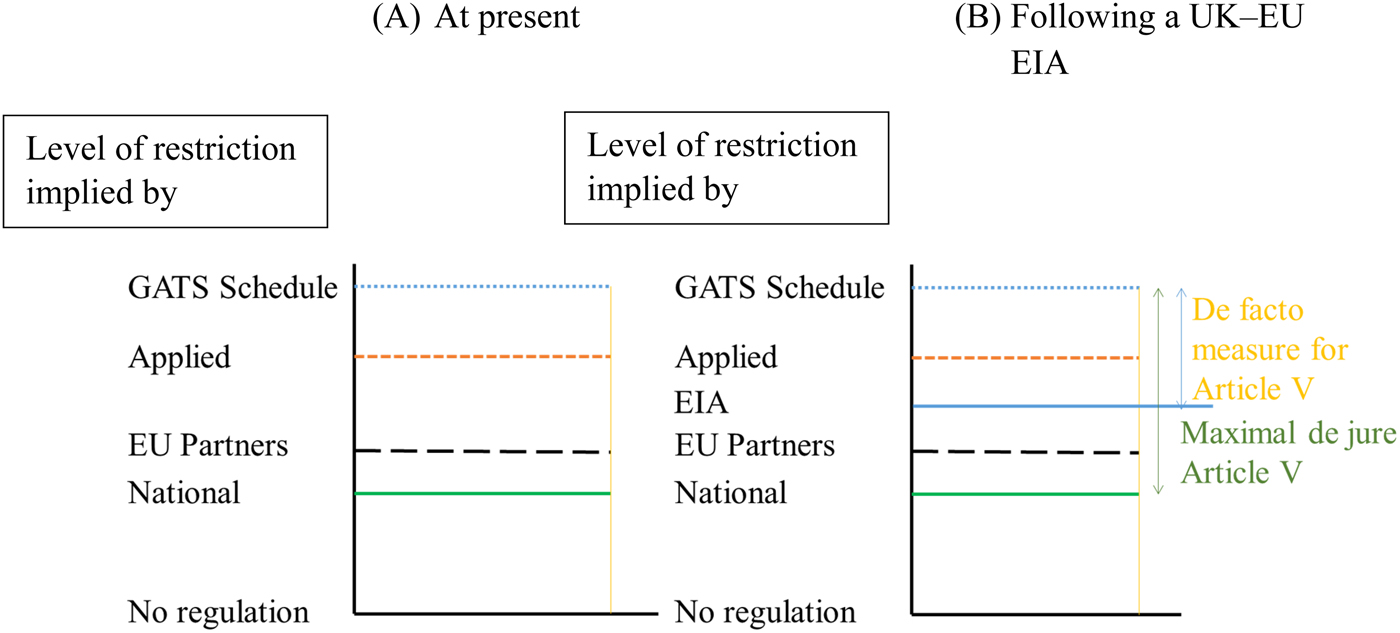
We start by considering schematically a single service sector, such as health provision, banking, or telecoms, and imagining that the degree of restriction can be collapsed into a single scalar measure, which we represent on the vertical axis of Figure 1(A). No country fails to regulate these sectors internally – that is, national suppliers are required to obey some (generally perfectly justifiable) restrictions on their behaviour. We denote this level of restriction as ‘national’ in the figure. At the other end of the scale, a WTO Member must record in its GATS schedule the maximal amount of restriction it will impose on services and service providers from abroad, up to and including infinity (unbound). As Borchert (Reference Borchert2016) has observed, however, there is very considerable binding overhang, such that applied policies towards services imports are typically less restrictive than scheduled commitments. Both of these levels apply on an erga omnes (MFN) basis to all foreign countries. In addition, within the EU, and often as part of the SM, EU Member States afford each other less restrictive regulations than general, which we label ‘EU partners’. This may be the same level as applied to nationals – as, for example, in financial services whereby establishment in one Member State is sufficient to have a ‘passport’ to operate in another – or be more restrictive – as, for example, with the provision of legal services in which several Members States impose residence/nationality requirements (European Commission, 2017). It will never exceed, however, the restriction applied at the MFN applied level.Footnote 30
Levels of restriction in a single services sector
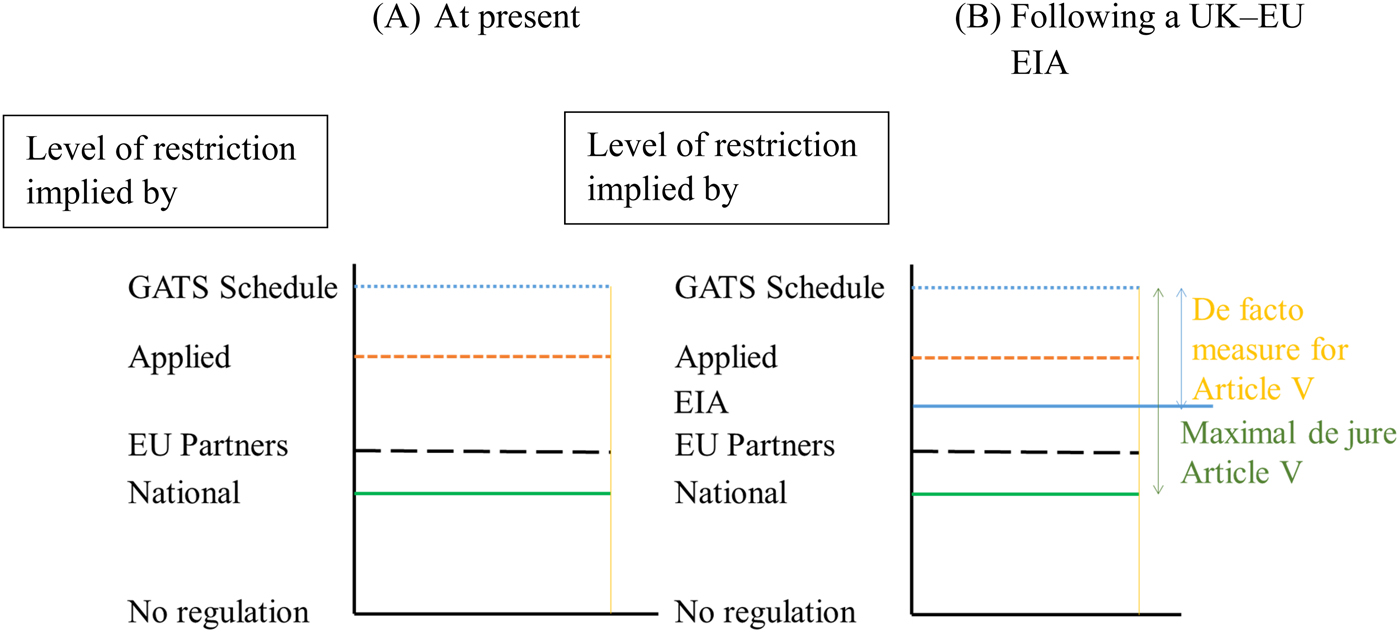
Now suppose that the EU signs an EIA which defines the level of regulatory restriction that will pertain to imports of services from the UK. This might be anything from merely binding the GATS schedule to offering identical conditions to those facing nationals, but if the EIA is to mean anything, it will require that this does not exceed, and in at least some sectors is lower than, the restrictions offered on an applied basis to all WTO Members.Footnote 31 Further, because the SM is so deep – including, for example, the free movement of workers and supranational enforcement via the CJEU – the EU's offer to the EIA partner is almost bound to imply effectively less integration (more restriction) than the SM level in most sectors. Figure 1(B) sketches in a notional EIA agreement on the illustrative service trade.
In assessing the compatibility of the EIA with GATS provisions, Article V(1) might seem to imply that in every covered sector the EIA must deliver liberalization to something like the national level. However, Article V (1) requires the absence of discrimination ‘in the sense of Article XVII’, which arguably covers only a subset of the issues that may be covered by the legal treatment of nationals or even of those covered in the SM. In other words, ‘national treatment’ may entail a level of restriction above what we have termed ‘national’ or even above our ‘EU partners’ level. We do not have to settle this question here, but for concreteness we show the degree of liberalization required of an EIA under the most demanding interpretation, labelling it as ‘maximal de jure Article V’. Clearly, on this basis, the EIA agreement for our illustrative sector would fail the test of eliminating existing discrimination.
In presenting the EU–Korea FTA (WTO, 2012a), however, the Secretariat declares that ‘the EU's commitments cover, at least partly, a large range of services sectors’ (para. 99), and that ‘The list of commitments made by Korea … covers, at least partly, most sectors’ (para. 102). It then notes that ‘The specific commitments by the Parties in the Agreement are based on their GATS commitments … For certain sectors (and sub-sectors) coverage is enlarged, while, for a number of sectors (sub-sectors) already covered, new commitments are made or certain GATS-limitations are withdrawn’ (para. 104) and it ‘compares [the Parties' specific commitments] with their GATS schedules’ (para. 105).Footnote 32 That is, the measure that the Secretariat uses for defining a sector as covered is that the EIA improves upon the GATS scheduled degree of restriction – i.e. that the distance we have labelled as the ‘de facto measure for Article V’ in Figure 1(B) exceeds zero. Given that no challenge has been made to the EU–Korea FTA, we might take it that its standard is acceptable to WTO Members. Moreover, given that in most sectors the EU and UK applied MFN policies are already more liberal than scheduled policies, even an EIA that merely committed to current applied levels would seem to satisfy the de facto standard.
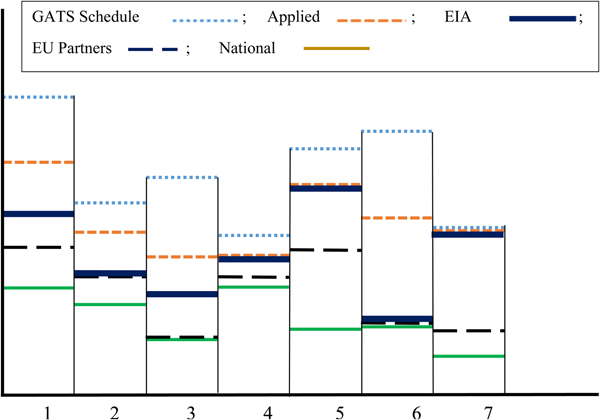
Given that nearly all sectors should meet the standard, there is ample cover for a few – or perhaps more than a few – to offer mutual access at the EU Partner (SM), level without violating the ‘substantially all sectors’ criterion. Figure 2 generalizes Figure 1 to sketch a notional UK–EU EIA in services with seven illustrative sectors, ignoring strictures about every mode of supply having to be included. Sector 1 is identical to that in Figure 1, with differences between all five levels of regulation. Sector 2 is similar, but the UK and EU offer each other essentially the EU Partner level of access via harmonized regulations and mutual recognition. In Sector 3, the EU partners face exactly the same restrictions as nationals, but this is not extended to the EIA, while in sector 4, little integration has been achieved and UK–EU mutual access is bound at applied MFN levels.
A notional UK–EU sectoral services deal
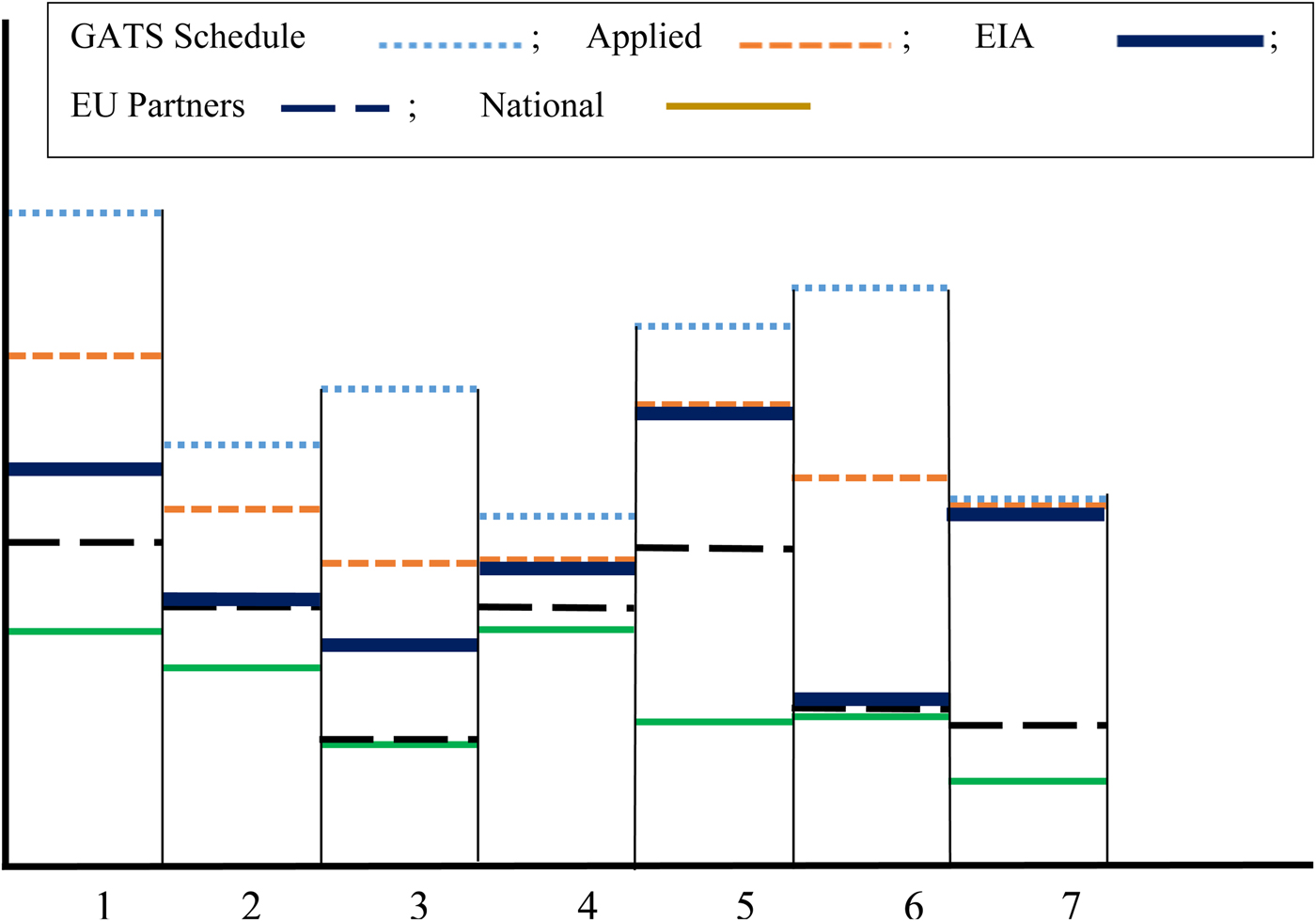
Even sector 4, however, appears to meet the WTO's de facto standard because applied regulation is a little less restrictive than the GATS schedule requires. The latter is also true of sector 5 but here there has been considerable SM liberalization that has not been extended to the UK. In sector 6, both the SM and the EIA offer the same treatment as nationals receive, whereas in sector 7 the key feature is that neither MFN nor the EIA goes any further than the GATS binding. Of all the sectors in Figure 2, only sector 7 would de facto be considered ‘not covered’ in the EIA.
5.4 Connections between EIAs
The EU–Korea FTA appears to offer a strong precedent for a UK–EU EIA that, while comprehensive in coverage, offers significantly different degrees of integration in different sectors. Some of the obligations of this agreement, however, pose a very serious political challenge for the EU. Articles 7.8.1 and 7.14.1 of the EU–Korea agreement state that for cross-border services trade and establishment respectively,
unless otherwise provided for in this Article, each Party shall accord to services and service suppliers of the other Party treatment no less favourable than that it accords to like services and service suppliers of any third country in the context of an economic integration agreement signed after the entry into force of this Agreement.
Hence, whatever preferential arrangements for services the EU includes in other EIAs they must be extended to Korea with the exception (noted under ‘unless… ’) of those that ‘either create an internal market on services and establishmentFootnote 33 or encompass both the right of establishment and the approximation of legislation’ (Annex 7-B).Footnote 34
In sum, either these clauses mean that an agreement between the UK and the EU has to be extended to Korea in these two critical areas of services trade, or that the UK and the EU have to agree that the agreement between them approximates legislation or amounts to an internal market with, inter alia, free movement of persons. These are not impossible goals but they mean that, in the relevant sectors, the UK commits' to a high degree of market integration with the EU.
6. Conclusion
WTO law and practice is perfectly consistent with concluding a UK–EU FTA/EIA that includes very deep integration in a number of sectors. However, it does impose some constraints. With respect to the elimination of tariff barriers, the parties cannot cherry-pick sectors but must maintain comprehensive coverage. This does not prevent coordinating external tariffs, and relaxing RoOs, in key sectors to replicate something like a CU in those sectors. With respect to regulatory cooperation, if the EU and UK maintain some mutual recognition of each other's technical regulation and/or CAPs, there is a risk of violating relevant WTO MFN provisions under certain scenarios. The MFN obligation here is a procedural one: to cooperate with interested parties toward concluding MRAs. Thus far, there has been no appetite among WTO Members to complain about MRAs.
In services, the GATS also requires EIAs to have substantial sectoral coverage, but the requirements for liberalization within covered sectors are very undemanding. An agreement that maintained the current level of (deep) integration in a number of sectors and merely bound MFN applied policies in most others would, de facto, be GATS compatible. Deep services liberalization is mostly achieved via MRAs of the parties’ regulations for the covered sectors; there are MFN requirements for these, but they are weak. A more significant MFN problem in services is that some EU EIAs have MFN clauses that would extend any favourable terms offered to the UK to other partners with no reciprocity. This may constrain EU enthusiasm for deep integration with the UK.
What is possible does not necessarily equate with what is desirable – the latter is for the EU and UK authorities to decide. However, we note that EU integration has strongly increased UK–EU27 trade flows and the development of integrated supply chains, and that physical proximity furthers these advantages. Imposing additional tariff barriers and customs procedures on existing value chains will be costly and disruptive. The agreement we have outlined in this paper is intended to preserve as much as possible of the mutual access that the UK and the EU27 currently offer each other. It needs for the sake of formality to be presented in the WTO relative to the MFN alternative of ‘no deal’. However, the obvious way to try to negotiate it is from the other direction – to take the status quo as the starting point and ask how much change is required to accommodate each side's red lines. This requires agreement in principle that a deep arrangement is sought, and working closely together to design the details to meet that objective.
The first step is to agree the simple tariff-free FTA. It would then be for the UK to decide to what extent it wished to coordinate its MFN and preferential tariffs with the EU. We have argued elsewhere that the UK should initially adopt the EU tariff schedule through a rectification at the WTO (UKTPO, 2016) – but that is a short-term expedient. The decision here is a longer-run one, and in our view it is very finely balanced. If tariff coordination did seem desirable, work would then pass on to coordinating regulations and designing rules of origin and their administration in a way that minimized the customs burden. The latter can occur only once the UK has worked out its general customs regulations and procedures. Of course, these regulations should be as convenient as possible anyway, but we would expect that in the presence of coordinated policies, they could be made significantly easier to manage.
Regarding regulation for goods, conformity assessments and services, it is relatively straightforward to convert existing harmonization into MRAs, as compared to the usual situation in which trade partners have to build trust in divergent regulatory systems. The issue is how to enforce the agreed rules in the UK independently of the CJEU, and how to modify MRAs to reflect changing regulation. The UK as the smaller party would have to accept EU leadership in most standards, a voluntary reduction in regulatory self-determination in exchange for market access.