Introduction
Executive functioning (EF) refers to aspects of complex human behavior that are primarily involved in the control and direction of self-regulating behavior (Cicerone, Levin, Malec, Stuss, & Whyte, Reference Cicerone, Levin, Malec, Stuss and Whyte2006; Levine et al., Reference Levine, Schweizer, O'Connor, Turner, Gillingham, Stuss and Robertson2011; Stuss & Levine, Reference Stuss and Levine2002). EF encompasses not only cognitive skills, such as updating of working memory representations, planning, strategy application, and monitoring, but also more emotionally mediated aspects of control, including self-regulation, inhibition, insight, and motivation, all of which are necessary for goal-directed behavior (Duncan, Emslie, Williams, Johnson, & Freer, Reference Duncan, Emslie, Williams, Johnson and Freer1996; Miyake, Emerson, & Friedman, Reference Miyake, Emerson and Friedman2000; Stuss & Levine, Reference Stuss and Levine2002). The resulting breadth of the EF domain forges its tremendous impact on everyday functioning and correlative importance to human adaptation.
Impairments in EF are typically seen after frontal lobe damage (Stuss & Levine, Reference Stuss and Levine2002). However, EF dysfunction has been observed after a range of etiologies and lesion locations, such as traumatic brain injury (Levine et al., Reference Levine, Schweizer, O'Connor, Turner, Gillingham, Stuss and Robertson2011), stroke and tumors (Zald & Andreotti, Reference Zald and Andreotti2010), aging (Raz, Reference Raz2009), the dementias (Neary et al., Reference Neary, Snowden, Gustafson, Passant, Stuss, Black and Benson1998), and spina bifida (SB) (Burmeister et al., Reference Burmeister, Hannay, Copeland, Fletcher, Boudousquie and Dennis2005).
As executive dysfunction hampers the capacities for changing and adapting behavior in new or altered situations (Norman & Shallice, Reference Norman and Shallice1986), it often constitutes a significant hindrance to the acquisition of independent living skills (Stuss, Reference Stuss2011). Accordingly, effective interventions aimed at improving EF are needed.
Spina bifida myelomeningocele (SBM), accounting for approximately 70% of all SB cases (Charney, Reference Charney1992), is a severe birth defect resulting from a failed closure of the neural tube during fetal development and is associated with several brain abnormalities, including hydrocephalus and Arnold-Chiari malformation (Chiari II) (Barkovich, Reference Barkovich2000). Subsequently, SBM has a pervasive multisystemic impact on physical (Fletcher et al., Reference Fletcher, Copeland, Frederick, Blaser, Kramer, Northrup and Dennis2005; McDonnell & McCann, Reference McDonnell and McCann2000) and cognitive functioning (Dennis & Barnes, Reference Dennis and Barnes2010; Dennis, Landry, Barnes, & Fletcher, Reference Dennis, Landry, Barnes and Fletcher2006; Hampton et al., Reference Hampton, Fletcher, Cirino, Blaser, Kramer, Drake and Dennis2011).
The core cognitive deficits of SBM emerge in infancy and persist throughout life (Dennis et al., Reference Dennis, Landry, Barnes and Fletcher2006). One of the most consistent areas of impairment in SBM is EF (Kelly et al., Reference Kelly, Ammerman, Rausch, Ris, Yeates, Oppenheimer and Enrile2011), interfering with day-to-day living (Burmeister et al., Reference Burmeister, Hannay, Copeland, Fletcher, Boudousquie and Dennis2005; Mahone, Zabel, Levey, Verda, & Kinsman, Reference Mahone, Zabel, Levey, Verda and Kinsman2002; Rose & Holmbeck, Reference Rose and Holmbeck2007) and representing an area of concern in this population (Stubberud & Riemer, Reference Stubberud and Riemer2012; Tuminello, Holmbeck, & Olson, Reference Tuminello, Holmbeck and Olson2011). Fletcher et al. (Reference Fletcher, Brookshire, Landry, Bohan, Davidson, Francis and Morris1996) suggested that the impaired performance on executive tasks in SBM patients is due to injuries in the right posterior region of the brain associated with arousal and activation (Petersen & Posner, Reference Petersen and Posner2012). Failure to behave in a goal-directed manner may result from reduced alertness, a foundational form of attention or processing capacity, from which more complex cognitive functions draw (Coull, Reference Coull1995; Duncan et al., Reference Duncan, Emslie, Williams, Johnson and Freer1996; Greene, Bellgrove, Gill, & Robertson, Reference Greene, Bellgrove, Gill and Robertson2009; Raz & Buhle, Reference Raz and Buhle2006; Robertson & Murre, Reference Robertson and Murre1999; Smith & Nutt, Reference Smith and Nutt1996). Despite the documented presence of executive deficits, there are no published studies that have addressed the treatment of these problems in individuals with SBM. Hence, there is a need to explore the efficacy of cognitive rehabilitation interventions for this patient group.
There have been relatively few validated rehabilitative interventions addressing executive dysfunction (Boelen, Spikman, & Fasotti, Reference Boelen, Spikman and Fasotti2011; Cicerone et al., Reference Cicerone, Dahlberg, Kalmar, Langenbahn, Malec, Bergquist and Morse2000, Reference Cicerone, Dahlberg, Malec, Langenbahn, Felicetti, Kneipp and Catanese2005, Reference Cicerone, Langenbahn, Braden, Malec, Kalmar, Fraas and Ashman2011; Levine, Turner, & Stuss, Reference Levine, Turner and Stuss2008; Rohling, Faust, & Beverly et al. Reference Rohling, Faust, Beverly and Demakis2009). However, increasing evidence supports the effectiveness of group-based compensatory interventions involving problem solving and goal management training that have incorporated “stop-and-think training” (D'Zurilla & Goldfried, Reference D'Zurilla and Goldfried1971; Evans, Reference Evans2005; Levine et al., Reference Levine, Schweizer, O'Connor, Turner, Gillingham, Stuss and Robertson2011; Miotto, Evans, de Lucia, & Scaff, Reference Miotto, Evans, de Lucia and Scaff2009; Rath, Simon, Langenbahn, Sherr, & Diller, Reference Rath, Simon, Langenbahn, Sherr and Diller2003; Spikman, Boelen, Lamberts, Brouwer, & Fasotti, Reference Spikman, Boelen, Lamberts, Brouwer and Fasotti2010; von Cramon, Matthes-von Cramon, & Mai, Reference von Cramon, Matthes-von Cramon and Mai1991; Wilson, Gracey, Evans, & Bateman, Reference Wilson, Gracey, Evans and Bateman2009). One of these, Goal Management Training (GMT), is a promising compensatory intervention that teaches strategies for improving attention and problem solving (Levine et al., Reference Levine, Robertson, Clare, Carter, Hong, Wilson and Stuss2000; Robertson, Reference Robertson1996; Stuss et al., Reference Stuss, Robertson, Craik, Levine, Alexander, Black and Winocur2007).
GMT is based on a theory of sustained attention (Levine et al., Reference Levine, Schweizer, O'Connor, Turner, Gillingham, Stuss and Robertson2011; Robertson & Garavan, Reference Robertson and Garavan2004), and thus attempts to address underlying deficits in sustained attention such as those associated with acquired brain injuries and SBM (Chen et al., Reference Chen, Novakovic-Agopian, Nycum, Song, Turner, Hills and D'Esposito2011; Fletcher et al., Reference Fletcher, Brookshire, Landry, Bohan, Davidson, Francis and Morris1996). Studies have demonstrated that low-level arousal deficits can contribute to high-level executive deficits (Coull, Reference Coull1995; Duncan et al., Reference Duncan, Emslie, Williams, Johnson and Freer1996; Greene et al., Reference Greene, Bellgrove, Gill and Robertson2009; Raz & Buhle, Reference Raz and Buhle2006; Robertson & Murre, Reference Robertson and Murre1999; Smith & Nutt, Reference Smith and Nutt1996). As attention and arousal have a significant role in facilitating experience-dependent plasticity underpinning neurorehabilitation (Robertson & Murre, Reference Robertson and Murre1999), in GMT sustained attention and alerting techniques are included in a larger metacognitive intervention to enhance EF (Levine et al., Reference Levine, Schweizer, O'Connor, Turner, Gillingham, Stuss and Robertson2011).
A key mechanism in experience-dependent plasticity is the capacity to allocate processing resources selectively to a particular stimulus (Blake, Heiser, Caywood, & Merzenich, Reference Blake, Heiser, Caywood and Merzenich2006; Recanzone, Schreiner, & Merzenich, Reference Recanzone, Schreiner and Merzenich1993). This form of attention, however, is dependent on adequate levels of arousal (Coull, Reference Coull1995; Smith & Nutt, Reference Smith and Nutt1996). Studies have demonstrated that arousal can be manipulated by both external and internal alerts; hence, one can improve sustained attention by voluntarily increasing arousal (Robertson, Mattingley, Rorden, & Driver, Reference Robertson, Mattingley, Rorden and Driver1998; Robertson, Tegner, Tham, Lo, & Nimmo-Smith, Reference Robertson, Tegner, Tham, Lo and Nimmo-Smith1995). This type of training has been addressed for patients with executive dysfunction in combination with a metacognitive strategy with which the temporary arousal could be linked and, hence, invoked periodically to produce enduring effects (Fish et al., Reference Fish, Evans, Nimmo, Martin, Kersel, Bateman and Manly2007; Manly, Hawkins, Evans, Woldt, & Robertson, Reference Manly, Hawkins, Evans, Woldt and Robertson2002). GMT promotes internalization of such prompts through training of a self-cueing process to aid in sustaining attentional control. In fact, a central procedure of GMT is to stop ongoing behavior periodically to monitor and adjust goals, an activity supporting the maintenance of goal-related information essential to managing the sequence of stages needed to accomplish the goal. In light of this framework, the role of attentional control, and especially sustained attention and inhibitory control, in supporting processes collectively referred to as executive, is crucial (Andres, Reference Andres2003; Aron, Reference Aron2007; Logan, Cowan, & Davis, Reference Logan, Cowan and Davis1984; O'Connor, Robertson, & Levine, Reference O'Connor, Robertson and Levine2011; Stuss & Alexander, Reference Stuss and Alexander2007).
In everyday life, responses contiguous with features of performance contexts may oppose and displace higher order goals when the sustained attention system does not function optimally (Manly, Robertson, Galloway, & Hawkins, Reference Manly, Robertson, Galloway and Hawkins1999; Reason, Reference Reason1990; Robertson, Manly, Andrade, Baddeley, & Yiend, Reference Robertson, Manly, Andrade, Baddeley and Yiend1997). GMT attempts to prevent goal failure by raising awareness of attentional errors through the use of participants’ real-life attention deficits, in-session practice on laboratory tasks of attention supplemented with periodic alertness cueing, in-session practice of complex real-life tasks, and homework assignments (Levine et al., Reference Levine, Schweizer, O'Connor, Turner, Gillingham, Stuss and Robertson2011). There is also an emphasis on mindfulness-based attention strategies (Kabat-Zinn, Reference Kabat-Zinn1990).
GMT and its modified versions have been shown beneficial in treating EF deficits across several groups, including acquired brain injury (Chen et al., Reference Chen, Novakovic-Agopian, Nycum, Song, Turner, Hills and D'Esposito2011; Fish et al., Reference Fish, Evans, Nimmo, Martin, Kersel, Bateman and Manly2007; Grant, Ponsford, & Bennett, Reference Grant, Ponsford and Bennett2012; Levine et al., Reference Levine, Robertson, Clare, Carter, Hong, Wilson and Stuss2000, Reference Levine, Schweizer, O'Connor, Turner, Gillingham, Stuss and Robertson2011; McPherson, Kayes, & Weatherall, Reference McPherson, Kayes and Weatherall2009; Novakovic-Agopian et al., Reference Novakovic-Agopian, Chen, Rome, Abrams, Castelli, Rossi and D'Esposito2011), normal aging (Levine et al., Reference Levine, Stuss, Winocur, Binns, Fahy, Mandic and Robertson2007; van Hooren et al., Reference van Hooren, Valentijn, Bosma, Ponds, van Boxtel, Levine and Jolles2007), addiction (Alfonso, Caracuel, Delgado-Pastor, & Verdejo-Garcia, Reference Alfonso, Caracuel, Delgado-Pastor and Verdejo-Garcia2011), intensive care unit survivors (Jackson et al., Reference Jackson, Ely, Morey, Anderson, Siebert, Denne and Hoenig2011), and in case studies of patients with focal cerebellar damage (Schweizer et al., Reference Schweizer, Levine, Rewilak, O'Connor, Turner, Alexander and Stuss2008), encephalitis (Levine et al., Reference Levine, Robertson, Clare, Carter, Hong, Wilson and Stuss2000), craniopharyngioma (Metzler-Baddeley & Jones, Reference Metzler-Baddeley and Jones2010), and schizophrenia (Levaux et al., Reference Levaux, Laroi, Malmedier, Offerlin-Meyer, Danion and Van der Linden2012).
When GMT is effective, it is assumed to be a result of underlying alterations in brain networks supporting sustained attention (Chen et al., Reference Chen, Novakovic-Agopian, Nycum, Song, Turner, Hills and D'Esposito2011). Reliable goal-directed behavior requires the capacity to sustain attention over time. Targeting attentional control may therefore lead to improvements in functioning that generalize to broader domains of goal-directed functioning. In fact, GMT is associated with reduced attentional lapses, increased behavioral consistency and improved performance on neuropsychological measures of attention and executive functions, including sustained attention and inhibition (Alfonso et al., Reference Alfonso, Caracuel, Delgado-Pastor and Verdejo-Garcia2011; Levine et al., Reference Levine, Schweizer, O'Connor, Turner, Gillingham, Stuss and Robertson2011; Novakovic-Agopian et al., Reference Novakovic-Agopian, Chen, Rome, Abrams, Castelli, Rossi and D'Esposito2011). Significant effects in support of GMT were also found for performance on analogues of real-life tasks requiring complex attentional skills (Levine et al., Reference Levine, Robertson, Clare, Carter, Hong, Wilson and Stuss2000, Reference Levine, Stuss, Winocur, Binns, Fahy, Mandic and Robertson2007; Novakovic-Agopian et al., Reference Novakovic-Agopian, Chen, Rome, Abrams, Castelli, Rossi and D'Esposito2011) and in surveys of real-life executive deficits (Levine et al., Reference Levine, Stuss, Winocur, Binns, Fahy, Mandic and Robertson2007; van Hooren et al., Reference van Hooren, Valentijn, Bosma, Ponds, van Boxtel, Levine and Jolles2007).
The present study is a randomized controlled trial (RCT) with one treatment group (GMT) and one wait-list control group (WL), and using a repeated-measures design across three time points (baseline, post-intervention, and 6-month follow-up). Experimental participants were assigned to 21 hr of GMT. The neuropsychological test measures included directly assessed attentional control processes targeted by GMT, as well as behaviors supported by sustained attention and inhibitory control and in turn affected by GMT, albeit not specifically trained. In exploring generalization (Burgess, Alderman, Evans, Emslie, & Wilson, Reference Burgess, Alderman, Evans, Emslie and Wilson1998; Burgess, Veitch, de Lacy Costello, & Shallice, Reference Burgess, Veitch, de Lacy Costello and Shallice2000; Manchester, Priestley, & Jackson, Reference Manchester, Priestley and Jackson2004; Wilson et al., Reference Wilson, Gracey, Evans and Bateman2009; Wilson, Reference Wilson2008) a functional “real-life” measure was also included. Additional data, from questionnaires of cognitive functioning, mental health, quality of life, and coping, will be reported elsewhere.
The main objectives of this study were to determine the efficacy of GMT as a group-based treatment program for patients with SBM and EF deficits. The current study addresses several areas with a lack of research knowledge. First, we believe that no studies have investigated the effect of cognitive rehabilitation of EF in patients with SBM. Our particular interest was in examining the effect of an intervention targeting processes of attentional control, specifically sustained attention and inhibition. Second, the evidence related to long-term effects of GMT is weak. In fact, only two group-based GMT studies (Levine et al., Reference Levine, Schweizer, O'Connor, Turner, Gillingham, Stuss and Robertson2011; Novakovic-Agopian et al., Reference Novakovic-Agopian, Chen, Rome, Abrams, Castelli, Rossi and D'Esposito2011) have reported follow-up analyses more than three months post-intervention. No GMT studies other than the current one have evaluated treatment effects at 6-month follow-up. Finally, we are unaware of studies applying GMT over extended time periods. Earlier GMT studies have conducted trials with weekly sessions (e.g., Levine et al., Reference Levine, Schweizer, O'Connor, Turner, Gillingham, Stuss and Robertson2011; van Hooren et al., Reference van Hooren, Valentijn, Bosma, Ponds, van Boxtel, Levine and Jolles2007). However, as SBM is a rare disorder, participants had to be recruited from throughout Norway, necessitating coverage of the GMT modules during three 3-day inpatient intervention periods across a 3-month period. To examine the feasibility of this treatment-delivery method, we planned to monitor treatment compliance, as measured by completed GMT modules. We hypothesized post-intervention changes in scores to reflect improved sustained attention and inhibitory control: on Conners’ Continuous Performance Test II (CPT-II; Conners, Reference Conners2000), reduction in omission and commission errors and increase in reaction time; on D-KEFS Tower Test (Delis, Kaplan, & Kramer, Reference Delis, Kaplan and Kramer2001), increase in mean time to first move and total achievement score, and reduction in rule violations; on D-KEFS Trail Making Test and Color-Word Interference Test (Delis et al., Reference Delis, Kaplan and Kramer2001), reduction in errors. On the task chosen to measure generalization, the Hotel Task (Manly et al., Reference Manly, Hawkins, Evans, Woldt and Robertson2002), it was hypothesized that both time deviation scores would decrease following treatment and that the total number of tasks attempted would increase. Additionally, as patients were taught to use compensatory strategies autonomously, the long-term presence of treatment effects at follow-up was considered as even more important.
Methods
Participants and Procedures
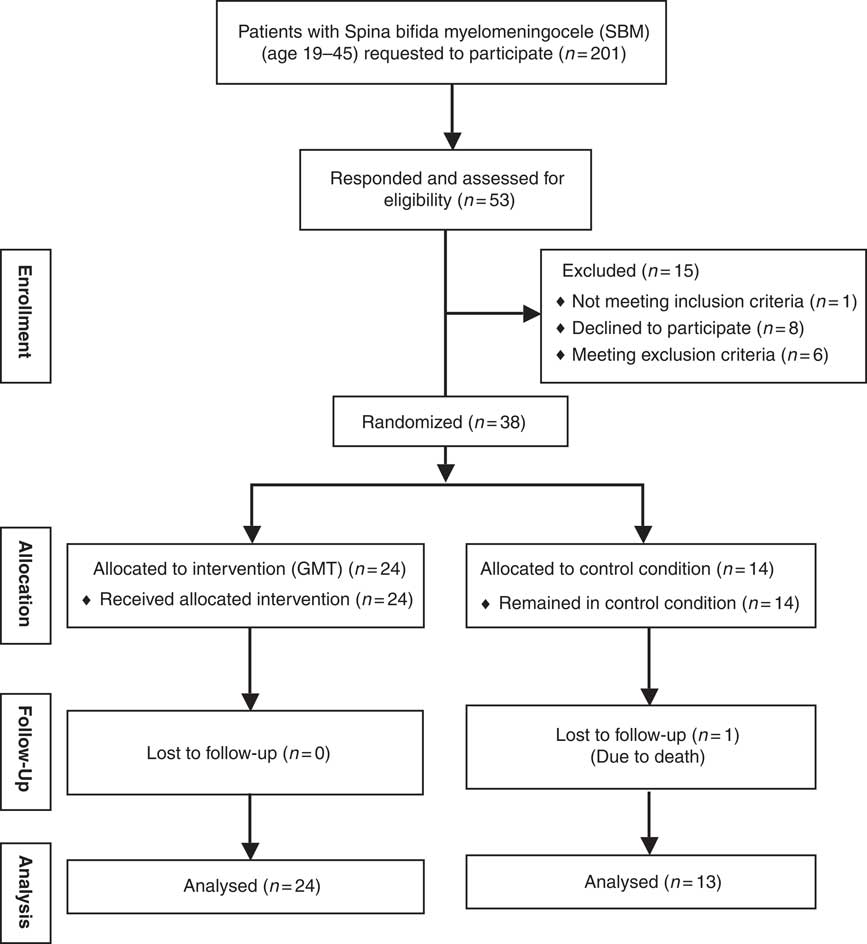
Figure 1 depicts the flowchart of study participants. All patients diagnosed with SBM (19–45 years) and registered in 2010 at TRS national resource center for rare disorders, Sunnaas Rehabilitation Hospital (Norway), were requested to participate (n = 201). The information letter specifically solicited participants with subjective complaints of executive dysfunction such as impaired planning, attention, multitasking, decision-making, and organization. Accompanying the letter was a self-report questionnaire, the Behavior Rating Inventory of Executive Function-Adult Version (BRIEF-A; Gioia, Isquith, Guy, & Kenworthy, Reference Gioia, Isquith, Guy and Kenworthy2000), which respondents were asked to complete and return. In addition to the reported difficulties from the information letter, inclusion of patients was also based upon an elevated score (T > 60) on at least one of the subscales constituting BRIEF-A. Criteria for exclusion, based on review of medical records and baseline measures, included impaired essential linguistic, perceptual, or motor function that would interfere with the capacity to participate in training. Additionally, patients with Axis I psychiatric disorders or IQ below 70 were excluded. Six subjects met exclusion criteria; four had IQ below 70, and two had Axis I disorders. Eight subjects who met inclusion criteria could not participate due to somatic illness and/or hospitalization, or educational requirements. A final sample of 38 subjects (58% female) ages 19–45 (M = 32; SD = 8.3) were included in the study (see Figure 1 for Consort diagram) (Schulz, Altman, & Moher, Reference Schulz, Altman and Moher2010).
Consort diagram.
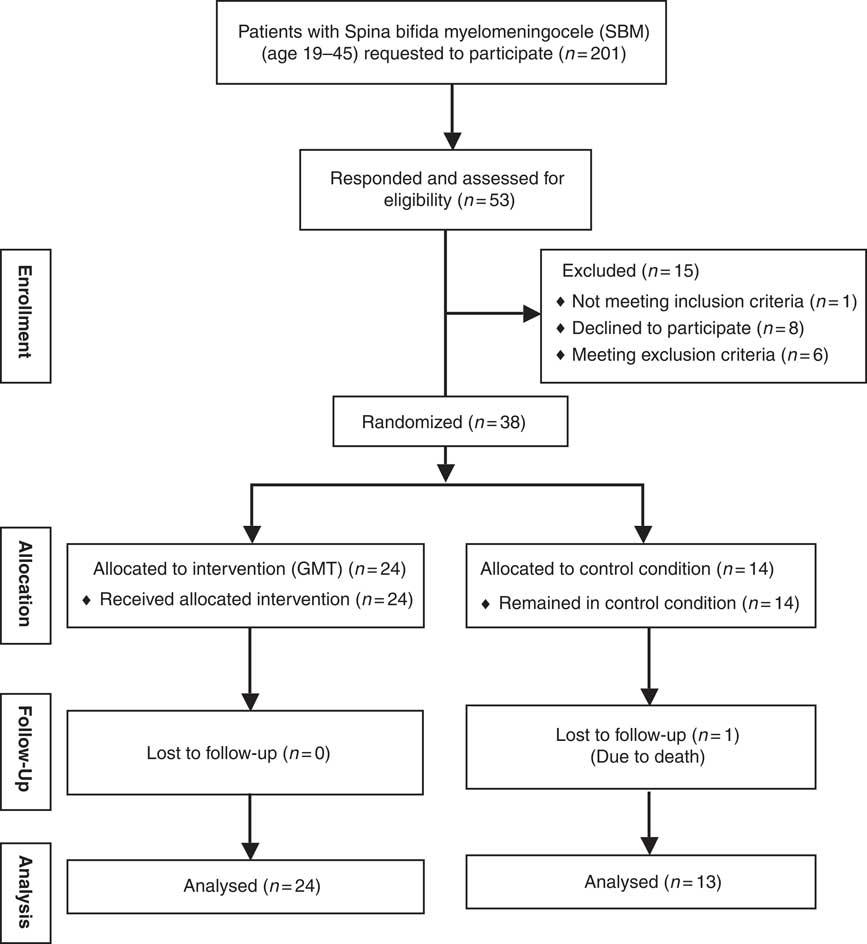
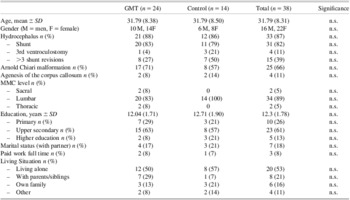
Table 1 displays the sample demographic and medical characteristics. The study was approved by the Regional Ethic Committee for Medical Research Ethics (2009/2188b), South-Eastern Norway. All patients gave informed consent for participation. The research was completed in accordance with the Helsinki Declaration.
Demographic and medical characteristics of both groups

Note. Percentage totals may not add to 100% due to rounding. Differences between groups were tested with Chi-square for dichotomous variables and T-tests for continuous variables.
GMT = Goal Management Training; MMC = myelomeningocele. n.s. = not significant.
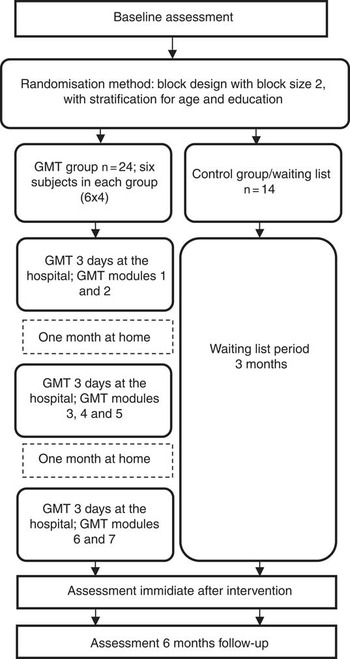
Figure 2 illustrates the randomization, assessment, and intervention/waiting list procedure. The randomization method was block design with block size 2, with stratification for age (above/below 33 years) and education (above/below 12 years). An unequal randomization ratio of 2:1 was used to ensure maximum use of the available intervention and to gain experience of GMT (Dumville, Hahn, Miles, & Torgerson, Reference Dumville, Hahn, Miles and Torgerson2006). The investigator responsible for randomization was not involved in the training procedures. The participants were informed about randomization outcome, and, if assigned to the WL group, told that they would receive GMT one year later. GMT consists of seven modules, with a minimum of 3 hr being necessary to complete each module (see Figure 2). A clinical neuropsychologist and a nurse/social worker conducted the training. None of the participants received any other intervention during the study period.
Randomization, assessment, and intervention/waiting list procedure.

GMT was administered following a manualized protocol, also used by Levine and colleagues (2011), consisting of PowerPoint slides and participant workbooks. The GMT materials were translated into Norwegian, and back-translated to English by an independent translator, whose mother tongue was English and who had no previous knowledge of the materials.
Intervention
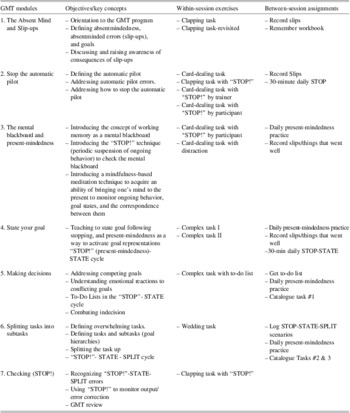
Training involved discussions and exercises intended to increase awareness of different features of goal management. Specifically, participants were trained to use strategies such as stopping and orienting to relevant information, partitioning goals into subgoals, encoding and retaining goals, monitoring performance (Levine et al., Reference Levine, Schweizer, O'Connor, Turner, Gillingham, Stuss and Robertson2011), and mindfulness training (Kabat-Zinn, Reference Kabat-Zinn1990). Complex training tasks used involved multitasking exercises (e.g., do five different tasks within a 4-min allotment; sorting cards, put dates of birth in order, connect the dots, word search in a grid, and spot differences between two pictures). Throughout the intervention, discussion of patients’ real-life executive problems was encouraged, and application of GMT strategies to these difficulties and to the complex training tasks was reviewed. Assignments between sessions included monitoring, recording of absentminded slips and activities that went well, along with present-mindedness practice (see Table 2).
Outline of the modules and objectives in GMT

GMT = Goal Management Training.
Baseline Instruments
In characterizing the cognitive functioning of the sample, the participants completed all subtests of the Wechsler Abbreviated Scale of Intelligence (Wechsler, Reference Wechsler1999), letter-number sequencing and digit span from the Wechsler Adult Intelligence Scale III (Wechsler, Reference Wechsler1997), the Brief Visuospatial Memory Test Revised (Benedict, Reference Benedict1997), and the California Verbal Learning Test II (Delis, Kaplan, Kramer, & Ober, Reference Delis, Kaplan, Kramer and Ober2000). The BRIEF-A (Gioia et al., Reference Gioia, Isquith, Guy and Kenworthy2000) was used as an inclusion instrument.
Outcome Measures
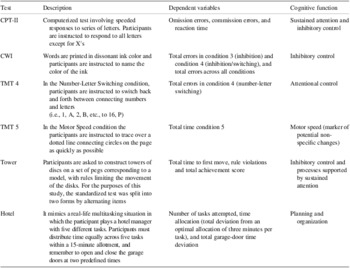
The neuropsychological outcome measures included CPT-II (Conners, Reference Conners2000), and D-KEFS subtests: Color-Word Interference Test (CWI), Trail Making Test (TMT), and Tower Test (Delis et al., Reference Delis, Kaplan and Kramer2001) (Table 3). Participants’ performance in a cognitive domain commonly affected by SBM, but not targeted by the intervention (i.e., motor speed), was assessed as a marker of potential non-specific changes. In exploring generalization, the Hotel Task (Manly et al., Reference Manly, Hawkins, Evans, Woldt and Robertson2002) was used. The Hotel Task has been demonstrated to have acceptable ecological validity, and it has proven to be sensitive in the detection of frontal dysfunction in various conditions (Roca et al., Reference Roca, Parr, Thompson, Woolgar, Torralva, Antoun and Duncan2010, Reference Roca, Torralva, Meli, Fiol, Calcagno, Carpintiero and Correale2008; Torralva, Gleichgerrcht, Lischinsky, Roca, & Manes, Reference Torralva, Gleichgerrcht, Lischinsky, Roca and Manes2012), even in the absence of deficits on standard cognitive tests (Gleichgerrcht, Torralva, Roca, & Manes, Reference Gleichgerrcht, Torralva, Roca and Manes2010).
Description of outcome measures, dependent variables, and cognitive functions assessed

Note. CPT-II = Conners Continuous Performance Test II; CWI = Color-Word Interference Test; TMT 4 = Trail Making Test condition 4; TMT 5 = Trail Making Test condition 5; Tower = Tower Test; Hotel = Hotel Task.
Feasibility of treatment-delivery method
Participants’ attendance was registered after each module.
Statistical Analyses
Data analyses were conducted using SPSS version 19.0 for Windows. Frequency distributions, means, and standard deviations (SD) were calculated for the demographic, medical, and neuropsychological performance variables. Differences between groups were analyzed using Chi-square for dichotomous variables and t-tests for continuous variables. A general linear model with repeated measures analysis of variance (RM ANOVA) was used to examine differential group treatment effects. Data were analyzed using a 2 × 3 mixed-design with Group (GMT, WL) as a between-subjects factor, and Session (baseline, post-intervention, follow-up) as a within-subjects factor, using a multivariate approach to avoid the more stringent univariate model assumptions. T tests were used to explore change scores (baseline to session 2, and baseline to session 3) within each group. Experiment-wise error was not corrected since measures were thought to reflect separate processes at different levels of ecological validity (Levine et al., Reference Levine, Schweizer, O'Connor, Turner, Gillingham, Stuss and Robertson2011). The strength of experimental effects was interpreted with effect size statistics, including partial eta-squared for ANOVA results and eta-squared (η2) for t-tests. According to Cohen (Cohen, Reference Cohen1988), thresholds for interpreting η2 are less than .06 (small), .06 to .14 (medium), and greater than .14 (large). All tests were conducted with an alpha level of P < .05.
Results
As seen in Figure 1, a total of 37 individuals with SBM were included in the 6-month follow-up analysis, with one person lost to follow-up due to death. Demographic and medical characteristics are summarized in Table 1, and neuropsychological data in Table 4. All subjects were Caucasian. Most of the participants had brain abnormalities (hydrocephalus, Chiari-II or agenesis of corpus callosum) and a lumbar-level lesion. The majority of participants were female, had finished upper secondary school, and lived alone. A minority reported being with a partner, and very few were employed full-time. No significant differences in demographic or medical characteristics were found at baseline (Table 1).
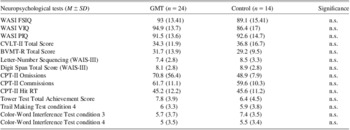
Standardized neuropsychological scores at baseline

Note. All scores reported are standardized scores. Higher neuropsychological scores represent better performance, except for scores in CPT-II where T scores between 40 and 60 are in the normal range. Differences between groups were tested with two-tailed results of t tests.
WASI FSIQ = Wechsler Abbreviated Scale of Intelligence Full Scale Intelligence Quotient (M = 100, SD = 15); WASI VIQ = Wechsler Abbreviated Scale of Intelligence Verbal Intelligence Quotient (M = 100, SD = 15); WASI PIQ = Wechsler Abbreviated Scale of Intelligence Performance Intelligence Quotient (M = 100, SD = 15); CVLT-II = California Verbal Learning Test II (M = 50, SD = 10); BVMT-R = Brief Visuospatial Memory Test Revised (M = 50, SD = 10); WAIS-III = Wechsler Adult Intelligence Scale III (M = 10, SD = 3); CPT-II = Conners Continuous Performance Test II (M = 50, SD = 10); RT = reaction time; Subtests from D-KEFS (M = 10, SD = 3); n.s., not significant.
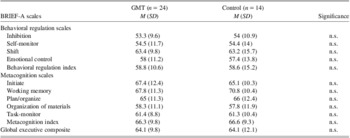
Tables 4 and 5 demonstrate that treatment and control groups had comparable cognitive functioning (Table 4) and self-reported executive functioning (Table 5) at pre-treatment baseline assessment. Overall, both groups displayed impaired executive functioning relative to the standardization samples.
Norm-referenced scale means for BRIEF-A self report

Note. Scores listed are T scores (M = 50, SD = 10), with higher scores indicating greater impairment. Differences between groups were tested with two-tailed results of t tests.
n.s., not significant.
Feasibility of Treatment-Delivery Method
All study participants completed the seven GMT modules.
Effects of Treatment
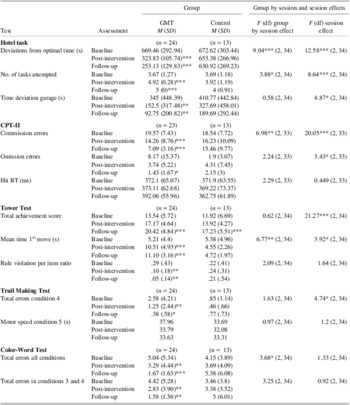
Table 6 provides mean scores on cognitive outcome data by session for intervention and control groups, with session- and group-by-time effects. An examination of the pattern of scores across time and between groups revealed that the GMT group had greater gains over time than the control group. In addition, within the GMT group there were statistically significant improvements on all targeted outcome variables. Of note, effect-size estimates indicated overall large training effects (>.14) (Cohen, Reference Cohen1988). In the WL group, no significant changes were detected except for a significant retest effect on the Tower total achievement score.
Mean scores on outcome data by session for intervention group (GMT) and wait list control (WL) with session and group by time effects

Note. All scores reported are raw scores. Time is reported in seconds (Hotel Task, Trail Making Test) and milliseconds (CPT-II). Significant effects in comparison to baseline *P < .05; **P < .01; ***P < .001. All F-tests use the Wilks’ lambda statistic *P < .05; **P < .01; ***P < .001. N's are provided as data were missing for certain measures.
S = seconds; ms = milliseconds; CPT-II = Conners’ Continuous Performance Test II.
Performance on CPT-II showed a significant reduction in responses given to non-target items across sessions that held at follow-up. The GMT group also demonstrated significantly less failures in responding to target letters at follow-up compared to baseline. Of interest, there was an increase in hit reaction time from baseline to 6-month follow-up that approached significance. In the Tower Test, both groups showed a significantly increased total achievement score across sessions. However, there was a significant increase in mean time used on the first move, and reduction on rule violations per item across sessions for the GMT group that held at follow-up. Furthermore, in both TMT and CWI, there was a significant reduction in errors across sessions that held at follow-up for the GMT group. These findings were evident in condition 4 in TMT and across all conditions (1–4) in CWI, in addition to conditions 3 and 4, in CWI. No significant differences in pre–post change were seen between the two groups for motor speed (TMT condition 5). In the Hotel Task (HT), there was a significant reduction in deviation from optimal time used on each subtask, an increase in number of tasks attempted, and a reduction in time deviation on the closing and opening of the garage door across sessions for the GMT that held at follow-up. In subsequent post hoc analyses, a linear regression analysis was used to derive a standardized residual score for each variable in CPT-II and HT, to represent change. These residuals were then correlated. Significant correlations (Pearson) were found between reduction in garage time deviation (HT) and reduction of commissions (CPT-II) (r = .6; n = 23; P < .002), and between reduction of total time deviation (HT) and reduction of omissions (CPT-II) (r = .55; n = 23; P < .006).
Discussion
The main aim of this RCT was to evaluate the efficacy of GMT using inpatient intervention periods for patients with SBM and executive difficulties, with a 6-month follow-up. In terms of efficacy, participants showed significant differential improvement, compared to WL subjects, on neuropsychological measures of attentional control, including sustained attention and inhibitory control. These results were in line with the hypothesized cognitive targets of the intervention. GMT also was associated with improved performance on a desktop model of a “real-life” multitasking situation, suggesting generalization of intervention effects to functional performance in complex real-life settings. These findings suggest that strategies addressing the ability to plan activities and to structure intentions did improve after training. Participants appeared able to maintain all training gains at 6-month follow-up. Even though this sample was relatively small, effect size estimates indicated overall large training effects. Additionally, all 24 treatment subjects successfully completed GMT, suggesting that a treatment-delivery method with extended treatment periods is feasible for patients with SBM.
Attentional Control
GMT aims to promote a mindful approach to enhance EF by strengthening sustained attention to maintain awareness of goal states and output monitoring (Levine et al., Reference Levine, Robertson, Clare, Carter, Hong, Wilson and Stuss2000). Both sustained attention and inhibitory control are considered to be central elements of attentional control (Andres, Reference Andres2003; Aron, Reference Aron2007; Miyake, Friedman, et al., Reference Miyake, Friedman, Emerson, Witzki, Howerter and Wager2000; Robertson & Garavan, Reference Robertson and Garavan2004), and both are crucial in explaining behavioral flexibility and goal-directed behavior in a dynamic environment. In the current study, there were significant effects specific to the GMT group with a reduction in errors on measures of sustained attention and inhibition (i.e., TMT, CWI, CPT-II). The robustness and specificity of these findings were consistent with the theoretical assumption that GMT targets basic aspects of attentional control. Further supporting the hypothesized targets of training, no changes were found on a control measure of basic motor speed. The GMT group showed a significant reduction in commission errors (CPT-II) across sessions, perhaps reflecting increased ability to inhibit a habitual response. Levine and colleagues (2011) also found a reduction in commission errors on the Sustained Attention to Response Task following GMT. In Reason's (Reference Reason1990) studies of everyday behavior, habit intrusions were especially common when people were distracted or absentminded. This type of cue-dependent behavior or failure to maintain attentional control is more prominent in various clinical groups than control groups, and is related to reports of everyday lapses in goal-directed activity (Fish et al., Reference Fish, Evans, Nimmo, Martin, Kersel, Bateman and Manly2007; Manly et al., Reference Manly, Robertson, Galloway and Hawkins1999; Robertson et al., Reference Robertson, Manly, Andrade, Baddeley and Yiend1997; Shallice & Burgess, Reference Shallice and Burgess1991).
Furthermore, there was a significant increase in the time before first move across sessions on the Tower Test following training. The major emphasis in GMT is to “Stop and Think” before acting. This would seem to correlate with the capacity for response inhibition observed in the Tower Test, indicating that subjects in the GMT group are slowing down (i.e., stopping) for the sake of greater reflection and accuracy. Indeed, this proposition is supported by our finding that the GMT group also demonstrated a significant reduction in rule violations on Tower compared to the control group. There was also a trend for an increase in reaction time for the GMT group on the CPT-II from baseline to 6-month follow-up. On the basis of these findings and the reduction of errors in other neuropsychological measures of executive functioning, it can be argued that the GMT group showed improved inhibitory control following training.
A model from experimental psychology (“horse-race model”) facilitates an interpretation of the performance on tasks of inhibition in the present study. This model asserts that the stopping and reaction processes compete for the first finishing time (Logan et al., Reference Logan, Cowan and Davis1984). If stopping processes finish before the reaction processes, the response is inhibited. Otherwise, the response escapes from inhibitory control. Thus, the extra time taken to respond observed on our study when two dimensions are incongruent can be attributed to the disabling of the incorrect response.
Omission errors occur when the subject fails to maintain an ongoing response, possibly reflecting attentional drift and reduced top-down control leading to pre-empted responses (O'Connell et al., Reference O'Connell, Dockree, Bellgrove, Turin, Ward, Foxe and Robertson2009). Further supporting the training effect on sustained attention and inhibition was the reduction of omission errors in the GMT group, a significant effect only in the baseline–follow-up comparison. The appearance of this effect only after 6 months suggests that participants may have internalized strategy use for attentional control in the months following the intervention. Similar findings have also been found in a another GMT study (Levine et al., Reference Levine, Schweizer, O'Connor, Turner, Gillingham, Stuss and Robertson2011), supporting our results.
The desired goal of cognitive rehabilitation is that individuals will exhibit learned approaches to task completion and application of strategies in situations with similar task demands. Because outcome measures were chosen specifically to detect the learning of expected theory-bound behaviors, there was naturally an overlap between test demands. Therefore, although the measures used were not specifically practiced as part of GMT, it was expected, and seemed borne out, that participants were able to transfer use of strategies to these situations.
Generalization
In a similar vein, a major concern for any rehabilitation study is generalization to situations and activities not specifically addressed by the intervention, yet appropriate for application of learning strategy use (Wilson et al., Reference Wilson, Gracey, Evans and Bateman2009; Wilson, Reference Wilson2008). GMT is designed to promote generalization to everyday functioning. As such, the most optimal transfer of training is to the daily life of participants. However, the nature of neuropsychological tests is that they assess cognitive domains rather than the functional capabilities required in the execution of daily activities (Burgess et al., Reference Burgess, Alderman, Evans, Emslie and Wilson1998, Reference Burgess, Alderman, Forbes, Costello, Coates, Dawson and Channon2006; Manchester et al., Reference Manchester, Priestley and Jackson2004). Nevertheless, in the present study, GMT effects were found on basic cognitive domains necessary for complex behavior in daily life (Aron, Reference Aron2007; O'Connor et al., Reference O'Connor, Robertson and Levine2011; Stuss & Alexander, Reference Stuss and Alexander2007).
A test that is relevant to the concept of generalization is the Hotel Task (Manly et al., Reference Manly, Hawkins, Evans, Woldt and Robertson2002), included as an outcome measure to examine executive functioning in a complex real-life simulation context (Shallice & Burgess, Reference Shallice and Burgess1991). Successful performance of the Hotel Task requires individuals to develop a task-performance plan, monitor ongoing behavior, and keep track of time. In the present study, improved attentional control (specifically sustained attention and inhibitory control) was associated with improved performance on a “real-life” multitasking situation, supporting the proposal that targeting attentional control may lead to improvements in functioning that generalize to broader domains of executive functioning. Although more conjectural, the post hoc analyses suggest that attentional control may have a specific impact in decisions about time allocation and estimation when one is faced with multiple tasks to perform. Previous group studies using GMT techniques have demonstrated positive effects on real-life analogue tasks, consistent with our findings (Levine et al., Reference Levine, Robertson, Clare, Carter, Hong, Wilson and Stuss2000, Reference Levine, Stuss, Winocur, Binns, Fahy, Mandic and Robertson2007; Miotto et al., Reference Miotto, Evans, de Lucia and Scaff2009; Novakovic-Agopian et al., Reference Novakovic-Agopian, Chen, Rome, Abrams, Castelli, Rossi and D'Esposito2011). Yet, in contrast to the positive results found in our study, Levine and colleagues (2011), using this same “real-life” simulation task, found that patients with frontal lobe dysfunction who were treated with GMT distributed their time less consistently across tasks at post-training as compared to baseline. It is possible that the longer period of intervention in our study contributed to more opportunities to exercise and practice GMT techniques in everyday life.
The findings from this study also add support to studies (e.g., Levine et al., Reference Levine, Robertson, Clare, Carter, Hong, Wilson and Stuss2000., Reference Levine, Schweizer, O'Connor, Turner, Gillingham, Stuss and Robertson2011; Miotto et al., Reference Miotto, Evans, de Lucia and Scaff2009; Novakovic-Agopian et al., Reference Novakovic-Agopian, Chen, Rome, Abrams, Castelli, Rossi and D'Esposito2011; Rath et al., Reference Rath, Simon, Langenbahn, Sherr and Diller2003; Spikman et al., Reference Spikman, Boelen, Lamberts, Brouwer and Fasotti2010; von Cramon et al., Reference von Cramon, Matthes-von Cramon and Mai1991) that have incorporated problem solving and goal management training in ameliorating executive deficits. We were able to extend this evidence by demonstrating that effects can also be achieved when using inpatient intervention periods for patients with SBM, with effects lasting at least 6 months post-treatment.
Although the content of GMT has evolved considerably since it was initially conceived (Robertson, Reference Robertson1996), stopping to attend to goal hierarchies is fundamental to the protocol and precedes the remaining problem solving elements. Whereas the problem solving stages are similar to components of problem solving therapy (Miotto et al., Reference Miotto, Evans, de Lucia and Scaff2009; Rath et al., Reference Rath, Simon, Langenbahn, Sherr and Diller2003; von Cramon et al., Reference von Cramon, Matthes-von Cramon and Mai1991), GMT is less focused on making decisions about how to solve a problem and more focused on suspension of ongoing behavior to determine which problems should be solved. Indeed, the element of sustained attention runs continuously through GMT, and is reinforced through mindfulness training.
Limitations and Future Directions
A limitation of the current study was that the persons who carried out the assessments post-treatment were not blind to group membership. It is also important to note that the inclusion criteria for this study included self-reported executive functioning deficits rather than objective test performance as these tests are of limited utility in the assessment of real-life executive deficits of interest in this study. Furthermore, non-specific effects such as professional attention or group dynamics of the intervention cannot be ruled out as contributing to the results without having an active control group. Also, the present findings need to be cross-validated in a larger and more representative SBM sample considering the relatively small sample size. Finally, additional outcome measures are recommended to explore what the nature of the improvement of executive functioning in “real-world” activities that the intervention promotes.
Conclusions
This is the first study published on cognitive rehabilitation of executive dysfunction in patients with SBM. The study reports the successful use of a focused executive-rehabilitation program in SBM patients with executive dysfunction, given that GMT led to significant treatment effects on domain-specific neuropsychological measures as well as a functional measure, with effects lasting at least 6 months post-treatment. These data show that executive deficits can be ameliorated even in patients with congenital brain dysfunction.
Acknowledgments
This work was supported by The South-Eastern Norway Regional Health Authority (grant number 2011041). The authors thank all patients, caregivers, and staff, especially Astri Andersen, Lisbeth Brøndberg, Gunnar Riemer, Lena Haugen, Karen Grimsrud, Brede Dammann, Pål-Erik Plaum, Helene Barder, Per Frydenborg, and Solveig Skou who helped to carry out the study. We also thank Marianne Løvstad and Jan Egil Nordvik for the discussions concerning this study. The authors report no conflict of interest.