In March 2006, Albert Snyder attended the funeral of his son, U.S. Marine Lance Corporal Matthew A. Snyder, who died in the line of duty in Iraq. His experience that day was made yet more painful by Westboro Baptist Church members’ decision to picket the funeral, expressing their disapproval of society’s tolerance for homosexuality and of the Catholic Church in which Lance Corporal Snyder had been raised. As Westboro Baptist Church members have done at more than 600 military funerals, they displayed placards bearing messages, including “God Hates the USA/Thank God for 9/11”, “Pope in Hell”, “Priests Rape Boys”, “God Hates Hags”, and “Thank God for dead soldiers.” Albert Snyder later filed suit against Westboro Baptist Church and its leader, Fred Phelps, and a jury awarded him millions of dollars in damages for intentional infliction of emotional distress. However, in 2011, the U.S. Supreme Court (SCOTUS) overturned that decision, emphasizing that the First Amendment’s right to free expression extends even to speech that is outrageous, offensive, and hurtful.Footnote 1
In February 2012, the feminist punk band Pussy Riot attempted to perform a protest song, entitled “Punk Prayer–Virgin Mary, Drive Putin Away,” from the altar of Moscow’s Christ the Saviour Cathedral. Styled as a prayer to the Virgin Mary, the song includes both substantial religious content and explicit attacks on the Russian Orthodox Patriarch. Its performance was meant to protest both the Putin regime’s policies and the Orthodox Church hierarchy’s support for that regime. The band members were quickly escorted from the cathedral by security, and were subsequently convicted of hooliganism in a Russian court. However, in 2018, the European Court of Human Rights (ECtHR) determined that this conviction had violated the freedom of expression guaranteed by Article 10 of the European Convention on Human Rights (ECHR).Footnote 2
These two cases raise a wide range of normative and empirical questions regarding when constitutional courts should protect, and when they actually do protect, religious and anti-religious expression. In a democratic society, courts clearly should extend freedom of expression to religious speech by a wide range of actors. Religious majorities and minorities alike should have the freedom to express their faiths, but should such freedom extend even to speech that is profoundly offensive and hurtful to others? Does it matter whether the targets of anti-religious expression are themselves powerful religious leaders or relatively powerless minorities? And regardless of the best normative answers to these questions, how should we expect actually existing constitutional courts to resolve these questions in practice?
In this paper, we draw on a new collection of global data regarding free-expression decisions to assess who benefits from the judicial protection of rights. In particular, we examine all decisions issued by two of the world’s leading constitutional (or quasi-constitutional) courts resolving free-expression claims in a religious context. We identified all decisions from SCOTUS and ECtHR resolving a First Amendment or Article 10 free-expression claim advanced on behalf of persons engaged in religious or anti-religious expression, including political advocacy rooted in religious or anti-religious sentiment.
We focus on religious and anti-religious speech decisions because this body of decisions represents a central site of twenty-first century free-expression conflict (whose contemporary judicial resolution is hence substantively important), and because the decisions have long featured a wide variety of claimants across multiple jurisdictions (hence, enabling the analysis we conduct herein).
Before turning to our data, we draw on a variety of existing literature regarding the political foundations of judicial power, the role of courts vis-à-vis religion, and the judicial protection of free speech to develop competing expectations regarding who benefits from the judicial protection of rights in general and of religious and anti-religious speech in particular. First, in the field of normative constitutional theory, one long-standing line of argument suggests that a principal function of independent courts operating in democratic societies is to protect the rights of relatively powerless minority groups whose interests are not well-represented in elected lawmaking institutions. Second, in the field of empirical judicial decision-making research, a longstanding line of argument suggests that, in practice, independent courts tend to “follow the election returns” (i.e., issue decisions in line with majority sentiment). Third, in the comparative literature on judicial empowerment, one prominent line of argument suggests that independent courts are often empowered by political, economic, and legal elites seeking to entrench their own interests that are threatened by democratic politics. In the context of religious conflict in particular, these judicial empowerment accounts have noted that secularist elites sometimes use courts to fend off the demands of religious political movements. Finally, in the comparative literature on free expression, scholars have long shown that apex courts vary across jurisdictions with respect to their willingness to find free speech outweighed by other important societal values in particular contexts. While some courts follow communitarian or egalitarian logics that counsel suppression of false or hateful speech, others lean more heavily toward a marketplace-of-ideas logic derived from John Stuart Mill and Oliver Wendell Holmes Jr. Courts that follow the latter, libertarian logic are likely to extend free expression to both popular and unpopular ideas advanced by both dominant and disfavored groups.
Drawing on these four sets of theories, we consider how four hypothetical courts, each an ideal type deciding case outcomes in line with a single overriding principle, would address disputes involving religious and anti-religious speech. In the next section, we detail these four competing sets of theoretical expectations regarding the relative willingness of constitutional courts to defend free-expression claims advanced by religious minorities, religious majorities, and secular elites. After laying out the four sets of observable implications, we describe our data and methods for evaluating the consistency of SCOTUS and ECtHR case outcomes with the four expected patterns. Next, we detail our findings. The overall pattern is one of similarity across courts, particularly with regard to their support for minority rights. The SCOTUS doctrine appears marginally more consistent with a libertarian theory than that of the ECtHR, and the ECtHR doctrine is marginally more consistent with a secularist court theory than SCOTUS, but neither court appears to be following a particular doctrinaire approach to harmful extremes, and both are producing rights doctrines that disproportionately benefit national minorities.
Observable Implications of Theory
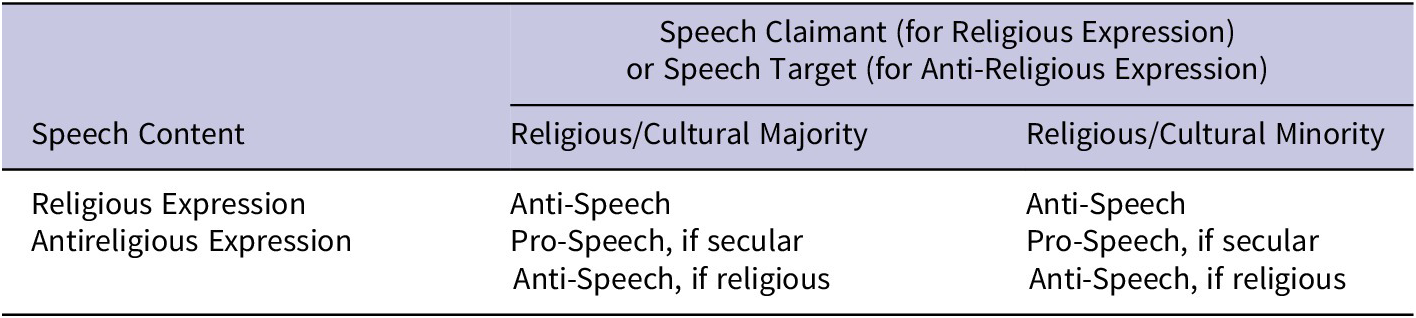
How do constitutional courts respond to free-expression claims advanced by differently situated claimants in the context of religious conflict? We have drawn on a variety of existing literature to derive four predicted patterns (Tables 1–4).
Predicted Protection of Religious and Anti-Religious Speech by Minority-Rights Court

Predicted Protection of Religious and Anti-Religious Speech by Majoritarian Court

Predicted Protection of Religious and Anti-Religious Speech by Secularist Court

Predicted Protection of Religious and Anti-Religious Speech by Libertarian Court

First, a long line of normative constitutional theory suggests that independent courts should use their powers of judicial review principally to protect the rights of racial, religious, and other minority groups whose interests are not well-represented in the polity’s legislative and executive institutions. In U.S. constitutional theory, this emphasis on safeguarding minority rights within a majoritarian system dates at least to James Madison’s Federalist No. 10, and, in fact, has a variety of influential pre-constitutional roots as well. For SCOTUS, this minority-protection principle found its most influential expression in Justice Stone’s footnote 4 in U.S. v. Carolene Products (1938),Footnote 3 and for several decades in the mid-twentieth century, this footnote was a central guiding principle of constitutional law (Casper Reference Casper1976). As Lee Epstein and Eric Posner note, the “conventional historical account” of religious freedom jurisprudence posits that for several decades following Sherbert v. Verner (1963), “the Free Exercise clause was largely used to protect religious minorities–Christian or otherwise–who were burdened by general laws that advanced secular or mainstream Christian values (or both).” Writ large, these holdings reflected “the notion that the Court’s job is to protect vulnerable minorities from indifferent or hostile majorities” (Epstein and Posner Reference Epstein and Posner2021, 316–17).
In 1980, John Hart Ely developed this minority-rights jurisprudence into a full-fledged normative theory of the Court’s role (Ely Reference Ely1980; see also Choper Reference Choper1980; Gardbaum Reference Gardbaum2020). More generally, the need for (judicial or other institutional) protection of minority rights follows from deliberative theories of democracy (Benhabib Reference Benhabib1996; Habermas Reference Habermas1996; Benhabib Reference Benhabib2002; Wheatley Reference Wheatley2003; Zurn Reference Zurn2007). In a deliberative model, democracy is more than preference aggregation and majority rule, and requires free and equal participation of citizens in the political process. Judicial review in such a democracy may be expected to serve as a mechanism to remove barriers to representation and participation in the public sphere by disfavored groups. In many contexts, robust judicial protection of free expression should fit hand in hand with the goal of protecting minority rights. However, in the hate-speech context, a court operating on minority-rights principles may sometimes rule in favor of state censorship of speech that has the effect of silencing minority voices (Waldron Reference Waldron2012).
To the extent that constitutional courts adhere to this normative vision, we would expect them to rule in favor of claims advanced by religious minorities seeking to express their faith or engage in political advocacy motivated by that faith. In the U.S. context, paradigm examples include the mid-twentieth century Jehovah’s Witnesses cases that helped shape Justice Stone’s famous footnote (Peters Reference Peters2000). We would not expect courts to rule in favor of similar claims by religious majorities whose interests should already be well-represented in elected lawmaking institutions, and hence require no added layer of judicial protection. With regard to anti-religious speech, when a member of a religious minority or person with no religious affiliation criticizes the society’s majority religion, we would expect a minority-rights court to weigh in on the side of free expression. Conversely, when a religious majority criticizes a minority faith, we would not expect support for free expression. Where a member of a religious minority criticizes another minority religious faith, the expectations for a minority-rights court are less clear. This predicted pattern is depicted in Table 1.
In sharp contrast with the previous set of expectations, a long line of empirical literature on the political foundations of judicial power suggests we should generally expect courts to support the interests of existing power holders rather than those of the relatively powerless. Here, we draw on two distinct strains in this literature to derive two additional sets of expectations regarding the judicial protection of religious and anti-religious speech. Some literature on the political foundations of judicial power emphasizes courts’ majoritarian character, while other works emphasize courts’ tendency to align with political, economic, and cultural elites. In Tables 2 and 3, we draw on these accounts in depicting predicted patterns of case outcomes that differ on some dimensions from those in Table 1.
The U.S.-based regime politics literature suggests that SCOTUS often follows the election returns. In other words, given the justices’ selection by presidents and senators subject to popular election, they generally share the ideological preferences of their country’s governing majority coalition (Dahl Reference Dahl1957; Gillman Reference Gillman2002; Stohler Reference Stohler2019). It may seem that majorities are not in need of judicial protection, but one of the central claims of regime theory is that that impression is wrong (i.e., governing majorities regularly make use of courts to achieve policies they have not been able to achieve via legislative and executive institutions; Graber Reference Graber1993; Whittington Reference Whittington2005). On this account, we should not realistically expect courts to protect minority rights in any systematic or sustained way, except perhaps for minority-rights claims that have garnered majoritarian support (Klarman Reference Klarman1996). The selection of ECtHR judges operates quite differently from SCOTUS justices. Nonetheless, we can draw a broad expectation from regime theories that individuals able to secure a nomination from national politicians to serve on this international court will be aligned ideologically with the dominant sociocultural group in their home state.Footnote 4
In the context of religious speech disputes, we assume that a majoritarian court would be concerned primarily with the interests of national religious/cultural majorities.Footnote 5 In the U.S. context, for example, if SCOTUS operates as a majoritarian court, we would expect it to defend religious expression by white mainline Protestants throughout U.S. history, as it did for the ordained Baptist minister engaged in street-corner preaching in Kunz v. New York (1951).Footnote 6 We would also expect SCOTUS to defend anti-religious expression directed by national majorities against minority faiths, as with cases involving anti-Semitic or Islamaphobic speech. In contrast, we would not expect a majoritarian court to be protective of anti-religious expression directed at the society’s majority religion nor religious expression advanced by minorities. For example, if the ECtHR operates as a majoritarian court, we would expect it to defend neither Islamist speech directed against French Catholics nor Islamic religious expression. As with the minority-rights account, this theory provides no clear expectations for the judicial resolution of free-expression claims involving minority speech directed against other minorities. The predicted pattern is depicted in Table 2.
In the comparative literature on judicial empowerment, a number of scholars have argued that judicial institutions are often empowered by political, economic, and legal elites whose interests appear threatened by emerging democratic majorities (Ginsburg Reference Ginsburg2003; Hirschl Reference Hirschl2004; Ginsburg and Versteeg Reference Ginsburg and Versteeg2014; Harvey Reference Harvey2015). In the context of religious conflict in particular, Ran Hirschl (Reference Hirschl2010) showed that secularist elites sometimes use courts to fend off the demands of religious political movements. Hirschl’s analysis focused principally on the role of courts in checking aspiring theocratic movements, but he also notes the “secularizing tendency” of constitutional jurisprudence in a variety of non-theocratic polities. Indeed, on Hirschl’s account, constitutional law is almost inherently a secularizing force, as its “very structure, predisposition, epistemology, and contemporary practice … make it a more hospitable domain for secularist worldviews and policy preferences than for religious ideology and social order, or for rule-of-God-based perceptions of the good” (Hirschl Reference Hirschl2010, 82; see generally 72–82). Along these lines, he describes an “important antireligious impulse embedded in the constitutional jurisprudence of even the most accommodating, multicultural polities” in Canada and South Africa, and notes that West European constitutional courts “have advanced, by and large, a secularist or irreligious approach” to questions of public religious expression (Hirschl Reference Hirschl2010, 163, 177).
In Table 3, we depict our expectations for a court that took this secularizing or irreligious tendency as its core purpose, deciding cases based on a preference to limit the role and status of religion in the public sphere. On this account, we should not expect courts to rule in favor of religious expression claims advanced by religious minorities or majorities. For example, in Leyla Şahin v. Turkey (2005), which Hirschl calls “arguably the most significant European case to date dealing with the issue of religious attire,” the ECtHR rejected free expression and religious freedom claims filed by a Muslim medical student who was prohibited from wearing a headscarf while attending class (Hirschl Reference Hirschl2010, 168). The Court’s Grand Chamber acknowledged that Şahin’s rights had been infringed upon, but found the restriction a necessary means to protect the rights of others and “preserve the secular nature of educational institutions.”Footnote 7 Secularist courts might, however, protect religious defamation or blasphemy directed against either majority or minority religious doctrines. Where such anti-religious speech is rooted in secularist traditions, such as laïcité, as with the well-known religious irreverence that has long appeared in the French magazine Charlie Hebdo, we would expect secularist courts to defend free expression.Footnote 8 Where anti-religious speech is rooted in competing religious traditions, we would not expect such judicial protection.
Finally, the comparative free-expression literature makes clear that apex courts vary across jurisdictions with respect to their willingness to find free speech outweighed by other important societal values in particular contexts. Some courts appear more inclined than others to follow a Millian or Holmesian marketplace-of-ideas logic that counsels judicial protection of even false and hateful speech. Indeed, the comparative free-expression literature paints the United States as an outlier from the rest of the democratic world, with SCOTUS firmly committed to a libertarian vision of free expression that extends more broadly than that of constitutional courts elsewhere (Schauer Reference Schauer and Ignatieff2005b). Much of this literature has focused on hate speech, where the scholarly consensus is that most constitutional courts allow significantly greater degrees of state regulation than does SCOTUS (Feldman Reference Feldman and Loveland1998; Errera Reference Errera and Nolte2005; Schauer Reference Schauer and Nolte2005a; Schauer Reference Schauer and Ignatieff2005b; Bangstad Reference Bangstad2012; Parekh Reference Parekh, Herz and Molnar2012; Rosenfeld Reference Rosenfeld, Herz and Molnar2012; Suk Reference Suk, Herz and Molnar2012; Waldron Reference Waldron2012; Bangstad Reference Bangstad2014). Compare, for example, the U.S. Supreme Court’s protection of racist and anti-Semitic speech in Brandenburg v. Ohio (1969) with the Canadian Supreme Court’s unwillingness to extend such protection in R. v. Keegstra (1990).Footnote 9
As such, an ideal type libertarian court would be expected to offer constitutional protection to the widest possible range of religious and anti-religious speech, including religious expression advanced by both religious majorities and minorities, religiously motivated political advocacy from both groups, and anti-religious expression targeting both groups as well. For example, in cases such as Snyder v. Phelps (2011),Footnote 10 which involved both religious expression by a white Christian extremist group and anti-religious expression directed against Catholics, where you place the case in this two-by-two table makes no difference, because a libertarian court would be expected to rule in favor of free-expression claims in all four cells. This predicted pattern is depicted in Table 4.
In the remainder of this paper, we examine the case law of SCOTUS and the ECtHR for consistency with each of these four predicted patterns. The four patterns are not mutually exclusive (i.e., some judicial decisions are consistent with more than one theory of how courts operate in this space). For example, a holding that protects secular anti-religious speech would be consistent with both secularist and libertarian accounts. Consequently, the empirical analysis to follow references some cases more than once.
Data and Methods
To assess the consistency of SCOTUS and ECtHR case outcomes with each predicted pattern, we first draw on data from the Global Free Speech Repository to identify all relevant judgments issued by SCOTUS and the ECtHR.Footnote 11 We focus on these courts because they are two of the world’s leading constitutional (or quasi-constitutional) courts, each having developed a broadly influential body of constitutional free-expression jurisprudence. Each court has issued hundreds of constitutional free-expression decisions, and in both cases, the most notable such decisions have been regularly cited abroad. Whatever stance these courts adopt toward religious and anti-religious expression is likely to directly impact the rights of hundreds of millions of residents of the U.S. and Europe, and indirectly influence the development of free speech rights elsewhere.
Of course, the ECtHR is an international human rights court rather than a domestic constitutional court. It is charged with hearing complaints of violations of the ECHR filed against any of the forty-seven member states of the Council of Europe.Footnote 12 The international legal character of the ECHR differs from a domestic Bill of Rights, and we acknowledge that the analogy between the ECtHR and a domestic constitutional court is neither complete nor uncontested (Alkema Reference Alkema2000; Wildhaber Reference Wildhaber2002). Nonetheless, the ECtHR now operates in practice very much like such a court, albeit one that hears complaints from forty-seven states (Shapiro Reference Shapiro, Shapiro and Sweet2002).
For our purposes, the key implication of its international character is that the ECtHR hears free-expression complaints from states with a diverse array of religious traditions. Europe is home to a continent-wide Christian majority, but also some national-level Muslim majorities (e.g., in Turkey). National-level Christian majorities also diverge, depending on whether the dominant tradition is Catholic, Protestant, or Orthodox (e.g., in Ireland, United Kingdom, and Greece, respectively). In the analysis to follow, all references to religious actors as minorities or majorities are based on these national-level characteristics. In other words, if a case involves speech by a Muslim in Turkey, we treat the claimant as a member of the Turkish majority, not a European minority. This approach is consistent with the ECHR’s design as a supplement to, rather than replacement for, national human rights regimes. In light of this design, the ECtHR’s practice is to consider cases with regard to the national context in which they arise.Footnote 13 Likewide, we characterize religious actors at the national level for U.S. cases. The U.S. Court also hears petitions from a diverse array of religious claimants, and although national minorities sometimes represent majorities or pluralities at the subnational level, that is a rare occurrence and one not reflected in our SCOTUS sample.
This paper focuses on formal judgments deciding the merits of a First Amendment or Article 10 free-expression claim, and we make no argument regarding the broader universe of free-expression disputes from which this subset of judgments arises. For most of the period relevant to our analysis, SCOTUS had almost complete control over its own docket, with the justices’ discretion guided by Court rules directing that the cases most likely to be heard are those that raise substantial and unresolved questions of federal law. The ECtHR’s docket control has shifted over time. Prior to November 1998, its docket was assembled by the non-judicial European Commission of Human Rights, which was charged with determining admissibility of all applications and (if admissible) either addressing the merits itself or referring the application to the ECtHR. Effective November 1, 1998, Protocol 11 eliminated the intermediate body and authorized the Court to field applications directly. Under ECHR Article 35, the Court must accept all applications that meet technical admissibility criteria and are not manifestly ill-founded, incompatible with the Convention, or an abuse of the rights therein, and where the applicant has suffered a significant disadvantage.Footnote 14 However, in practice, the ECtHR, like SCOTUS, filters out the vast majority of complaints prior to the formal judgment stage. In recent years, SCOTUS has issued merits opinions on roughly one percent of cert petitions, while the ECtHR has issued judgments on five to six percent of applications.Footnote 15
With regard to religious expression, we look at a category of disputes that lies at the nexus of two constitutional rights: freedom of speech and of religion. Our substantive interest is in the judicial treatment of free-expression claims, so our dataset does not include religious freedom disputes that lack a free-expression dimension. In some instances, this decision rule leaves us with a truncated set of judicial responses to a particular substantive question, depending on whether the particular responses are framed by the deciding courts as speech and/or religion issues. For example, our dataset includes the Leyla Şahin case noted above, as well as S.A.S. v. France (2014), which upheld a French ban on the wearing of Islamic headscarves in public, but does not include a similar such judgment in Ebrahimian v. France (2015).Footnote 16 In Leyla Şahin and S.A.S., but not Ebrahimian, the Strasbourg Court rejected an Article 10 free-expression claim, as well as an Article 9 freedom-of-religion claim. Likewise, our dataset includes a number of U.S. free-expression cases involving proselytizing by Jehovah’s Witnesses, but does not include Cantwell v. Connecticut (1940),Footnote 17 a case with similar facts that the Supreme Court resolved exclusively on religious freedom grounds.
From within this universe of substantive free-expression holdings, we identified all judgments issued through calendar year 2019 involving either religious or anti-religious speech. Religious speech is defined as a speech act that consists in significant part of religious expression, including verbal or nonverbal expressions of faith, evangelism or proselytizing, teaching or discussion of religious affairs, and political advocacy rooted in religious traditions. Anti-religious speech is defined as a speech act that consists in significant part of anti-religious expression, including blasphemy, religious defamation, religious hate speech, and any other expression that criticizes, mocks, or insults one or more religious institutions, adherents, beliefs, or leaders from outside the targeted faith tradition, as well as political advocacy rooted in anti-religious sentiment.
The sample frame begins with the date of each court’s inception (1789 for SCOTUS; 1959 for ECtHR), but in both cases covers a significantly shorter timespan in practice.Footnote 18 We identified a total of fifty-eight relevant judgments from SCOTUS and sixty-eight from the ECtHR. The full list is shown in the Appendix. Two of those judgments (one from each court) addressed more than one speech act, reaching different conclusions in response to the different fact patterns they raised. For these cases, we have coded and counted each holding separately for our analysis, producing a total of 128 distinct holdings.Footnote 19
For most cases, their inclusion in the sample was clear and straightforward. Both courts have issued multiple judgments involving overt religious expression, political advocacy by religious actors who viewed the work as compelled by God or scripture, unambiguous expressions of religious hatred, or anti-religious political advocacy. Cases in this last category generally include speech that seeks to marginalize or denigrate one or more religious groups in the public sphere or undermine the role of religion generally (e.g., advocating stringent secularism). The Appendix provides examples that illustrate the core of each category.
However, a number of cases required difficult judgment calls. In particular, no sharp line separates political advocacy rooted in religious or anti-religious sentiment (included in our sample) from non-religious political advocacy (excluded). In drawing this line, we selected all cases in which the Court’s summary of the relevant speech act noted any substantial religious content or background factual context clearly indicating a religious or anti-religious nexus for the political advocacy.Footnote 20 For example, if the Court’s opinion identifies the speech claimant as a religious leader advocating political ideas clearly associated with a religious tradition, we include the case even if minimal detail is provided regarding the content of the speech act itself. As such, our sample includes cases involving Quakers engaged in anti-war speech, African-American Christians engaged in civil rights speech, and conservative Christians engaged in anti-abortion speech.
The class of cases of interest is defined not by doctrinal categories, but by the actors involved and the ideas they express. As such, our sample includes some judgments not conventionally understood as religious speech cases. For example, New York Times v. Sullivan is generally (and correctly) described as involving civil rights advocacy and alleged libel of public officials, but the named claimants included several African-American ministers in addition to the New York Times, and the expressive content of the newspaper advertisement reprinted in full in an appendix to the Court’s opinion, was clearly rooted in African-American Christian traditions.Footnote 21 Likewise, Morse v. Frederick (2007) is conventionally understood as a student speech case, but the speech act at issue (banner reading “BONG HiTS 4 JESUS”) was irreverent and potentially offensive to devout Christians.Footnote 22
We make no claim that the relevant parties, litigators, or judges thought of these cases as religious speech cases. Either way, they are relevant to our question of interest, which is who benefits from the judicial protection of religious and anti-religious speech. Sullivan demonstrates that the Court’s First Amendment doctrine sometimes leads to the protection of religiously motivated civil rights advocacy, and Morse demonstrates that the doctrine sometimes leads to the nonprotection of irreverent references to Christian figures. As such, both cases (and others alike) should be counted on the relevant side of the balance.
Once our sample was identified, we deployed what has sometimes been characterized as medium-N qualitative analysis (Goertz Reference Goertz2017, 217-43; Kapiszewski Reference Kapiszewski2012; Keck Reference Keckforthcoming). One goal of such analysis is to examine a set of cases large enough to identify patterns across cases, but small enough to provide some contextual detail within cases. We focused on a core set of characteristics across all cases that allow for us to identify whether an outcome is consistent with the expectations for each ideal type court. Although case studies of a smaller set of judgments would enable a more detailed and contextualized analysis of individual outcomes and doctrinal developments, the medium-N approach enables us to accumulate within-case evidence across a broader range of cases.
For all cases in the sample, we coded the judicial outcome as either favoring or restricting free expression (as noted, for two cases with split outcomes, we separately coded two distinct holdings). To code several additional dimensions relevant to our analysis, we subdivided the sample by classifying the speech acts as religious expression, anti-religious expression, or both.Footnote 23 In our analysis, we separately assess the consistency of religious-speech decisions and anti-religious-speech decisions with each of our four theoretically derived sets of expectations. For cases involving religious expression (including religiously motivated political advocacy), we identified the speech claimants as religious majorities or minorities, defined at the national level. If the documentary record identified the claimants as members of a religious/cultural minority in the United States (for SCOTUS) or relevant European nation (for ECtHR), we coded them as such. If not, we coded them as members of the religious/cultural majority.
Again, these coding judgments were straightforward in most instances. Where the question is a closer call, we have provided sufficient contextual detail for the reader to evaluate our judgments. In the United States, for example, we have coded white Catholics as religious minorities prior to John F. Kennedy’s 1960 election as President and part of the country’s Christian majority after that date. Likewise, we coded white evangelicals as religious minorities prior to Ronald Reagan’s 1980 election but part of the religious majority since.Footnote 24 In contrast, we code white Christian extremists, such as members of the Westboro Baptist Church in Kansas, as religious minorities throughout, on the grounds that they have adopted religious views far outside the mainstream. For the United States, the full list of religious/cultural minorities in our sample is Jehovah’s Witnesses, African-American Christians, white Catholics (before 1960), white Christian extremists, Hari Krishnas, Quakers, and members of the Church of Summum.Footnote 25
For European states, we used demographic data from the Central Intelligence Agency World Factbook (Central Intelligence Agency 2021) to determine national religious majorities for each state represented in our sample. Where one Christian tradition dominates, we treated that tradition as the majority and others as minorities (e.g., Catholic majority and Protestant minority in Ireland). Where a country features a Christian majority but no majority denomination (e.g., Germany), we treated all Christians as members of the majority. Likewise, where a Christian speaker’s denomination is unknown, we coded them as part of the country’s Christian majority. The national minorities present in our sample are Muslims (in all states, except Turkey, Bosnia-Herzegovina, and Azerbaijan, where they were coded as national majorities), Jehovah’s Witnesses, Pentecostals (in Greece), unspecified Protestants (in Catholic Ireland and Orthodox Bulgaria), Christians (in Turkey), Jews (in all contexts), and members of the Raëlien Movement. For cases involving anti-religious expression, we applied these same procedures to identify the majority/minority status of the targets of the speech act. We also coded the source of the anti-religious speech as either an alternative faith tradition or secularist skepticism, critique, or hostility toward religion.
We coded ten of 128 holdings in the sample (five each from SCOTUS and ECtHR) as both religious and anti-religious expression.Footnote 26 These ten holdings reflect two distinct situations. In eight cases, a religious speech act included explicit denunciation of institutions, adherents, beliefs, or leaders associated with other faiths. For example, we coded the speech act in Snyder v. Phelps as both religious expression by the extremist Westboro Baptist Church and anti-religious speech directed against Catholics. In two other cases, a speech act consisted of both expression within a religious tradition and critique of the same tradition from a secular perspective. For example, we coded the speech act in the Pussy Riot case as both religious speech by the band members (whose protest song was explicitly styled as a prayer to the Virgin Mary) and anti-religious speech directed against the Orthodox Church (whose cathedral they had unlawfully commandeered to perform the song). For all ten cases involving both religious and anti-religious expression, we coded the majority/minority status of both speakers and targets, as well as the religious/secularist character of the anti-religious component.
Data Analysis
We assessed what share of the sample is consistent with the observable implications derived from each of the four theories. In other words, we assessed how much SCOTUS and ECtHR case law fits with each set of theoretically derived expectations, which, again, are not meant to be mutually inconsistent with one another.
Are SCOTUS and ECtHR Operating as Minority-Rights Courts?
Tables 5A and B list all cases in the sample that are consistent with the expectations for a minority-rights court. Table 5A includes thirty-six cases, representing sixty percent of the SCOTUS sample. Table 5B includes forty cases, representing fifty-eight percent of the ECtHR sample.
Supreme Court of the United States Religious and Anti-Religious Speech Decisions Consistent with Minority-Rights Court (n = 36)

Note: Snyder v. Phelps appears in both rows because the case represents an instance of both minority religious and anti-religious expressions against the majority. As a single holding, the case is counted only once in the total reported in the table’s header.
European Court of Human Rights Religious and Anti-Religious Speech Decisions Consistent with Minority-Rights Court (n = 40)

Note: Three cases (Paturel, Giniewski, and Ollinger) appear in both rows because they represent instances of both minority religious and anti-religious expressions against the majority. As single holdings, they are counted only once each in the total reported in the table’s header.
Beginning with the empirical heart of this theory, recall from Table 1 that a minority-rights court would be expected to offer robust protection to religious expression claims filed by or on behalf of religious/cultural minorities. The upper-right cells of Tables 5A and B list all judgments in which either of the courts has done so. The lists are long, indicating that both courts have done so regularly and repeatedly. Indeed, more than half of SCOTUS decisions involving religious or anti-religious speech are judgments in favor of minority religious expression. For the ECtHR, the corresponding share is twenty percent.
Remarkably, SCOTUS has issued fully sixteen separate judgments in favor of religious expression claims advanced by Jehovah’s Witnesses. This list includes well-known landmarks, such as West Virginia Board of Education v. Barnette (1943),Footnote 27 but also a wide range of lesser-known cases. These decisions took place from 1938 to 2002, although most are from the 1940s. For example, in Murdock v. Pennsylvania (1943), the Court held that requiring individuals engaged in door-to-door religious proselytizing to purchase a license violated the First Amendment. In doing so, the Court noted that “spreading one’s religious beliefs or preaching the Gospel through distribution of religious literature and through personal visitations is an age-old type of evangelism with as high a claim to constitutional protection as the more orthodox types.” In the Court’s view, the fact that Jehovah’s Witnesses sold religious materials rather than soliciting donations did not transform their activity into purely commercial speech subject to taxation by the state.Footnote 28
A second significant group of U.S. cases was brought by African-American ministers and others, drawing on their faith traditions to advocate for civil rights during the 1960s. For example, in Edwards v. South Carolina (1963), the Court overturned the conviction of 187 African-American students arrested during a protest on the South Carolina Statehouse grounds. After being ordered by police to disperse, the students listened to a “religious harangue” and sang religious and patriotic songs. They were arrested and convicted of breaching the peace, but SCOTUS reversed these convictions on First Amendment grounds.Footnote 29 Seven cases fit this description, plus one additional case involving an African-American Christian outside the civil rights context.Footnote 30
SCOTUS has also issued six decisions protecting religious expression by white Christian extremists, whom we coded as religious minorities. For example, in Dawson v. Delaware (1992), the Court ruled in favor of a First Amendment claim brought by a convicted murderer who objected to the introduction at his capital sentencing hearing of the fact that he had “Aryan Brotherhood” tattooed on his hand and had described himself as “one of Satan’s disciples.”Footnote 31 Three years later, the Court held in Capitol Square Review Board v. Pinette (1995) that a local government’s refusal to erect a Christian cross donated by the Ku Klux Klan violated the First Amendment.Footnote 32
We coded post-1980 white evangelicals in the United States as part of the religious majority, but as noted, they often identify as a minority group facing prejudice and discrimination at the hands of the country’s secular institutions. SCOTUS has issued six decisions protecting the religious expression of such groups, so if we were to code based on this self-perception, the upper-right cell in Table 5A would be even larger.
For its part, the ECtHR has ruled in favor of religious expression claims advanced by minorities on 14 occasions. These judgments involved claims brought by Muslims in France, Greece, and Russia; Jews in France and Austria; Jehovah’s Witnesses in France, Greece, and Georgia; and other Christian minorities in Bulgaria, Greece, and Turkey. For example, in Kokkinakis v. Greece (1993), the Court considered a complaint filed by a Jehovah’s Witness who had been arrested more than sixty times for violating Greece’s criminal ban on proselytism. As interpreted by the Greek courts, this ban did not cover “purely spiritual teaching,” but did prohibit “any determined, importunate attempt to entice disciples away from the dominant religion by means that are unlawful or morally reprehensible.”Footnote 33 By a vote of six to three, the ECtHR Chamber found a violation of ECHR Articles 9 and 10 when Mr. Kokkinakis was convicted for visiting a private home and engaging the occupant in a discussion of her faith. In another case from Greece 5 years later, the Court heard a complaint from three Pentecostal Christians who objected to the proselytism ban. The applicants, all officers in the Greek air force, had been convicted by Greek courts for proselytizing three subordinate airmen and several civilians. The ECtHR Grand Chamber found no violation of Article 9 or 10 with regard to their efforts to proselytize within the military, but did find a violation with regard to their proselytizing of civilians.Footnote 34 In judgments such as these, the ECtHR, like SCOTUS, has regularly indicated its commitment to protecting the religious expression of relatively powerless minorities.
The top left cells in Tables 5A and B include cases consistent with the expectation that a minority-protecting court will not protect religious speech by claimants from the majority religious tradition. For SCOTUS, this cell includes just two cases, separated by more than a century. Davis v. Massachusetts (1897) and Christian Legal Society v. Martinez (2010) are the only instances in which the SCOTUS declined to protect majority Christian speech.Footnote 35 For the ECtHR, this cell includes four cases involving Muslim majority speakers and six involving Christian majorities. Of note, for the latter group, all six involve the same claimant. Klaus Günter Annen regularly campaigns against abortion, euthanasia, and stem cell research, both in person and online, and the German courts have sanctioned him on multiple occasions for defamation and invasion of privacy of abortion providers and others. He has repeatedly petitioned the ECtHR for relief, mostly without success. The ECtHR protected his speech once, in a case referenced below, but in the six cases that appear in Table 5B, the Court sided with the German authorities’ efforts to put limits on Annen’s inflammatory public speech.Footnote 36
With regard to anti-religious speech, we would expect a minority-rights court to rule in favor of speech claims from religious minorities (or speakers without any known religious affiliation) targeting majorities and rule against claims from religious majorities (or speakers without any known religious affiliation) targeting minorities. We have no expectation for claims from religious minorities targeting other minorities. As indicated in the bottom rows of the two Tables 5, SCOTUS has occasionally issued decisions in line with these expectations, and ECtHR has done so more often.
On three occasions, SCOTUS has defended minority expression targeting religious majorities. This list includes the Snyder case highlighted in the introduction, arising from the Westboro Baptist Church’s practice of picketing military funerals with homophobic and anti-Catholic signs. In ruling for the speech claimants, the Court noted that “[w]hile these messages may fall short of refined social or political commentary, the issues they highlight—the political and moral conduct of the United States and its citizens, the fate of our Nation, homosexuality in the military, and scandals involving the Catholic clergy—are matters of public import.”Footnote 37 We coded Phelps’s speech act as both religious and anti-religious speech, because of its explicit denunciations of Catholicism together with prayers to God and religiously motivated political advocacy. We coded post-1960 Catholics as part of the Christian majority in the United States, so we treat this case as judicial protection of minority speech targeting majorities.
Despite well-known anti-speech holdings in cases such as Otto-Preminger v. Austria (1994) and Wingrove v. The United Kingdom (1996),Footnote 38 the ECtHR is usually willing to protect speech targeting national religious majorities. Indeed, the ECtHR has done so in thirteen separate judgments, listed in the lower-left cell of Table 5B. For example, Giniewski v. France (2006) involved a Jewish historian who responded to a Papal encyclical with an article in a Paris newspaper contending that “scriptural anti-Judaism … prepared the ground in which the idea and implementation of Auschwitz took seed.”Footnote 39 The French courts held him liable for publicly defaming the Christian community, but the ECtHR then held this judgment to be a violation of Article 10. In doing so, the Strasbourg Court emphasized the importance of free and open debate regarding the causes of acts amounting to crimes against humanity. The Court noted that the speech act was not gratuitously offensive because the applicant’s article challenged the Pope’s arguments rather than Christian belief or adherents as a whole. The ECtHR concluded that Giniewski’s conviction was not required by a pressing social need, and hence was not necessary in a democratic society.
Also in line with expectations for a minority-rights court, the ECtHR has on six occasions ruled against free-speech protection for majority speech-targeting religious minorities. For example, the Court considered anti-Semitic speech in Balsyte-Lideikiene v. Lithuania (2008). Here, the applicant was the publisher of a Lithuanian calendar that insulted persons of Polish, Russian, and Jewish origin, and repeatedly referred to Jews as perpetrators of war crimes and genocide against Lithuanians. The Lithuanian courts concluded that the calendar promoted hatred against those groups, and the ECtHR then deferred to the domestic courts’ conclusion that confiscation was necessary to protect the reputation and rights of others.Footnote 40
The Court issued a similar judgment in relation to anti-Islamic speech in E.S. v. Austria (2018). In this case, the applicant was convicted for disparaging religious doctrine during seminars entitled “Basic Information on Islam” at the right-wing Freedom Party Education Institute. Particularly objectionable were the applicant’s statements suggesting that the Prophet Mohammed had pedophilic tendencies. The ECtHR emphasized that the domestic authorities had a wide margin of appreciation, because they were in a better position to evaluate which statements were likely to disturb the religious peace in their country. The ECtHR considered that the domestic courts had carefully balanced the applicant’s freedom of expression with “the rights of others to have their religious feelings protected and to have religious peace preserved in Austrian society,” and concluded that the applicant’s conviction was proportionate to the legitimate aim pursued. Hence, there had been no violation of Article 10.Footnote 41
In sum, nearly three-fifths of the holdings in our sample from both SCOTUS and the ECtHR are consistent with the predicted behavior of an apex court dedicated to protecting minority rights.
Are the SCOTUS and ECtHR Operating as Majoritarian Courts?
In Tables 6A and B, we list all cases consistent with expectations drawn from the majoritarian court theory. The tables include fifty-four holdings, representing thirty-nine and forty-five percent of the SCOTUS and ECtHR samples, respectively. As indicated in the upper-left cell of Table 6A, the SCOTUS has extended judicial protection to majority religious expression on ten occasions. Four cases involved evangelical Christians seeking equal access to public school or public university facilities, with the relevant educational administrators attempting to respect the boundary between church and state (also enshrined in the First Amendment) by declining to authorize the use of school facilities for religious purposes.Footnote 42 In each case, evangelical organizations successfully argued that the government could not constitutionally deny access to those facilities on account of the religious nature of the organizations’ expression.Footnote 43 A fifth case involved members of an evangelical sect, Jews for Jesus, seeking to proselytize in an airport terminal.Footnote 44 Two other cases involved Catholic and/or evangelical claimants engaged in anti-abortion speech deeply rooted in their faith traditions.Footnote 45 An eighth case involved a Vietnam-era anti-war demonstration during which protesters sang “We Shall Overcome,” and a ninth case involved a small evangelical church seeking to advertise its worship services via inexpensive signage.Footnote 46
Supreme Court of the United States Religious and Anti-Religious Speech Decisions Consistent with Majoritarian Court (n = 23)

Note: Kunz v. New York appears in both rows because the case represents an instance of both majority religious expression and anti-religious expression directed against a minority. As a single holding, the case is counted only once in the total reported in the table’s header.
European Court of Human Rights Religious and Anti-Religious Speech Decisions Consistent with Majoritarian Court (n = 31)

In sum, nine of ten SCOTUS holdings we have characterized as protecting majority religious expression were initiated by white Catholics and/or evangelicals, and only one was brought by white, mainline Protestants.Footnote 47 For much of U.S. history, mainline Protestants represented the dominant religious group, with all others best understood as relatively powerless minorities. As noted, however, by the late twentieth century, it made more sense to think of white Catholics and evangelicals as part of the country’s dominant Christian majority, and we coded them as such. From the perspective we adopted in Table 6A, cases such as Widmar v. Vincent (1981) and Good News Club v. Milford (2001) are best understood as judicial decisions protecting majoritarian religious expression against secularist state restrictions.Footnote 48 However, from an alternate angle, almost all of the Court’s decisions protecting religious expression have involved minority claimants.
As indicated in the upper-left cell of Table 6B, the ECtHR has ruled even more often than SCOTUS in favor of free expression claims advanced by national religious majorities. Fifteen of nineteen cases in which the ECtHR has done so involved judicial support for majoritarian religious expression by Turkish Muslims against secularist state restrictions. This pattern runs counter to our expectations for a secularist court. Although the Leyla Şahin judgment, upholding a Turkish ban on Muslim headscarves, is often highlighted as a prominent example of European courts siding with secularist governments seeking to restrict public religious expression, the Strasbourg Court has repeatedly ruled in favor of religious expression claims from Muslims in Turkey. Most cases involve expression that can be classified as both religious speech and anti-secularist political advocacy. For example, in Gündüz v. Turkey (2003), a leader of an Islamic sect was convicted for inciting religious hatred after a television appearance in which he criticized Turkish secularism and democracy and advocated the establishment of Sharia law. The ECtHR recognized that some of the applicant’s comments demonstrated “an intransigent attitude towards and profound dissatisfaction with contemporary institutions in Turkey,” and that others endorsed a system of Sharia with features that were incompatible with the ECHR’s values, thereby prompting consideration of whether they should enjoy protection under Article 10. However, the Court concluded that, in the context of a spirited debate on live television, none of the comments crossed the line into incitement of religious hatred or violence. As such, his conviction was not necessary in a democratic society and violated Article 10.Footnote 49
The Strasbourg Court has also ruled in favor of Article 10 claims filed by Christian majorities in four cases, one each from Austria, Italy, Germany, and Russia. As noted, Annen v. Germany (2015) is one of seven cases in our sample involving the same claimant, and the judgment listed in Table 6B is the only one of the seven in which the ECtHR ruled in favor of the German anti-abortion campaigner.Footnote 50 The other cases where the ECtHR protected majority Christian speech all involve speech that reveals tensions between speakers and their own co-religionists. For example, in Mariya Alekhina and Others v. Russia (2018), the Court found that Russian authorities violated Article 10 when convicting members of the feminist punk band Pussy Riot of hooliganism. Mariya Alekhina is one of two ECtHR cases in our sample where the speech act incorporates both religious and secularist anti-religious speech.Footnote 51 As noted in the introduction, Pussy Riot performed their “Punk Prayer” in a Moscow Cathedral as an act of protest against both the Putin government and the Orthodox Church. The song combines religious content and explicit attacks on the Russian Orthodox Patriarch. The ECtHR held that the Russian courts failed to provide sufficient reasons for the infringement of the applicants’ rights, noting that although offensive to many people, the performance did not amount to incitement to religious hatred (para. 225).
The upper right cells in Tables 6A and B contain cases where the courts have ruled against religious expression claims by religious minorities, again in line with our expectations for a majoritarian court. These cells contain substantially fewer cases than the corresponding cells in Tables 5A and B, indicating that both courts protect minority religious expression more often than not.
The most well-known SCOTUS decisions declining to protect minority religious expression are Minersville v. Gobitis (1940) and Jones v. Opelika (1942), each involving Jehovah’s Witnesses, but these holdings were widely criticized and quickly reversed.Footnote 52 The Court rejected claims brought by Jehovah’s Witness in two other cases as well, but as Table 5A shows, these four judgments represent the exception rather than the rule.Footnote 53 More recently, other minority religions have been occasionally on the losing end of Supreme Court decisions. In the late twentieth century, the SCOTUS ruled twice against Hari Krishnas seeking to proselytize in public spaces, holding either that the desired location was not a public forum or that the regulation was a valid time, place, or manner restriction.Footnote 54 In the early twenty-first century, the Court ruled against a small religious sect seeking to erect a stone monument to the “Seven Aphorisms of SUMMUM” in a public park. On the Court’s reading, the government’s decision to place some religious monuments but not others in a public park represented an act of government speech not subject to First Amendment scrutiny.Footnote 55 The Court also issued a split decision in Virginia v. Black (2003), rejecting the First Amendment claims of two of three white Christian extremists who had been convicted of cross burning.Footnote 56
Turning to the ECtHR, anti-speech holdings in response to claims by religious minorities are again rare, with only five appearing in our sample. One such holding was part of the Court’s split decision in Larissis v. Greece ANTI (1998). Relevant here is the holding that Greece did not violate the claimant’s free expression rights when sanctioning him for proselytizing his military subordinates. In Murphy v. Ireland (2003), the Court found no violation of Article 10 when a general ban on religious advertising prevented the broadcasting of a radio advertisement for an event about the “historical evidence of the resurrection.” The advertisement at issue had been submitted to a local station by a pastor associated with a Protestant faith center in Dublin.Footnote 57 In Mouvement Raëlien Suisse v. Switzerland (2012), the Court again accepted state restrictions on religious advertising, rejecting an Article 10 claim filed by the Raëlien Movement, an organization dedicated to establishing good relations with extraterrestrials. The movement’s doctrines include detailed beliefs regarding the origins of life on earth, the proper structure of government, sexuality, immortality, and human cloning.Footnote 58 Because of the movement’s open advocacy of human cloning and alleged advocacy of pedophilia, local authorities in one Swiss municipality denied the movement a permit to hang posters proclaiming their beliefs. Authorities in a second town denied a permit for a poster proclaiming that “God does not exist.” By a vote of nine to eight, an ECtHR Grand Chamber held that states have a wider margin of appreciation when regulating both advertising and religious speech compared with political speech, and the Swiss authorities’ refusal to allow the posters fell within this margin (paras. 61, 76).
With regard to anti-religious expression, we expect majoritarian courts to uphold suppression of speech directed at religious majorities, but protect speech directed by such majorities against religious minorities. Both courts have acted in accordance with these expectations to some degree. SCOTUS has issued four pro-speech holdings in cases involving majority speech targeting minority religions, and the ECtHR has issued two. For example, both courts have, on occasion, protected anti-Semitic speech. Regarding speech that targets religious majorities, the ECtHR has upheld state suppression on five occasions, and SCOTUS has done so just once. The list is relatively short, but two of the ECtHR holdings are well-known judgments. In Otto-Preminger-Institut v. Austria (1994), the Court identified a tension between Article 10’s right to free expression and Article 9’s guarantee of “respect for the religious feelings of believers.” This case was prompted by state seizure of a film to prevent its planned screening. Directed by Werner Schroeter, “Das Liebeskonzil” (“Council in Heaven”) was a satirical work portraying God as old, infirm, and ineffective, Jesus Christ as a “mummy’s boy” of low intelligence, and the Virgin Mary as an unprincipled wanton. These characters enlisted the assistance of the Devil to punish mankind for its immorality by spreading sexually transmitted diseases.Footnote 59 The Austrian authorities determined that seizure was necessary to protect the rights of believers and ensure religious peace in the region. The Strasbourg Court deferred to this judgment, noting that national authorities, not international judges, are best positioned to assess the need for such measures in light of local circumstances. Two years later, the Court reinforced this approach in Wingrove v. United Kingdom (1996), again accepting that prior restraints can be justified to protect religious believers from offense and adopting a deferential standard to determine whether such restrictions were necessary in a particular situation.Footnote 60 These judgments contrast sharply with Burstyn v. Wilson (1952), in which SCOTUS struck down a New York licensing law that permitted censorship of sacrilegious films.Footnote 61
In sum, roughly two-fifths of cases in our sample from each of the two courts are consistent with predicted behavior for a majoritarian court.
Are SCOTUS and ECtHR Operating as Secularist Courts?
Table 7A and B list all cases consistent with expectations for a secularist court. The tables include sixteen holdings from SCOTUS, representing twenty-seven percent of the sample, and twenty-seven from the ECtHR, representing thirty-nine percent. As noted previously, Table 3 shows that a secularist court should not be expected to defend public religious expression from either majorities or minorities. As such, the top rows of Table 7A and B list all cases in which the courts have ruled against a claim for constitutional protection of religious expression.
Supreme Court of the United States Religious and Anti-Religious Speech Decisions Consistent with Secularist Court (n = 16)

Note: Virginia v. Black appears in both rows because the case represents an instance of both minority religious and anti-religious expressions against a minority. As a single holding, the case is counted only once in the total reported in the table’s header.
European Court of Human Rights Religious and Anti-Religious Speech Decisions Consistent with Secularist Court (n = 27)

The upper-left cells of the secularist court tables include the same content as the minority-rights court tables, and the upper-right cells include the same as the majoritarian court tables. As such, we make only a few brief observations here. The top row of Table 7A lists eleven cases, the most well-known of which was famously reversed 3 years after issue.Footnote 62 Only three of these eleven antispeech holdings were issued in the twenty-first century, one involving majority expression (from the Christian Legal Society at the University of California) and two minority (from the Church of Summum and white Christian extremists). As indicated in Table 7B, the ECtHR has issued marginally more such holdings (fifteen versus eleven), and has continued to issue these types of holdings in recent years. Perhaps most notably, the Strasbourg Court has upheld secularist limits on Muslim face coverings in both Turkey (where Muslims represent a majority) and France (where Muslims are a minority).Footnote 63 In S.A.S. v. France (2014), a Muslim woman who wished to wear a niqab and burqa claimed that a French law prohibiting the concealment of one’s face in public violated both the freedom of expression under Article 10 and freedom to manifest religious beliefs under Article 9. The Grand Chamber held fifteen to two that there had been no violation, emphasizing that in the absence of a European consensus on the issue, states retained a wide margin of appreciation to develop rules regarding the limits of religious pluralism.Footnote 64 The fifteen holdings in the top row of Table 7B stand as evidence consistent with Hirschl’s argument that European courts regularly side with secularist governments seeking to restrict public religious expression. However, as noted previously, there are more cases in which the Strasbourg Court has ruled in favor of religious expression.
With regard to anti-religious expression, our expectations are that a secularist court will defend religious defamation, blasphemy, and the like when they are rooted in secularist traditions, such as French laïcité, but not when such religious insults are rooted in competing religious traditions. All twelve cases in the bottom row of Table 7B and five of six cases in the bottom row of Table 7A fall in the former category (i.e., instances in which the relevant court extended Article 10 or First Amendment protection to secular anti-religious speech).Footnote 65 Virginia v. Black ANTI is the only case in our sample that falls in the latter category (i.e., the only one exhibiting the expected judicial deference to state restrictions on religious anti-religious speech).Footnote 66
In sum, more than one-quarter of SCOTUS decisions and more than one-third of ECtHR decisions in our sample are consistent with the predicted behavior of a secularist court.
Are SCOTUS and ECtHR Operating as Libertarian Courts?
Table 8A and B list all cases in our sample consistent with expectations for a libertarian court. Table 4 shows that these expectations are for judicial protection of both religious and anti-religious expression, regardless whether they are voiced by or targeted at religious minorities or majorities. As such, Table 8A and B list all decisions in which either court ruled in favor of the free expression claim, including forty-seven holdings from SCOTUS, representing eighty percent of the sample, and forty-three from the ECtHR, representing sixty-two percent.
Supreme Court of the United States Religious and Anti-Religious Speech Decisions Consistent with Libertarian Court (n = 47)

Note: Five cases (BlackPRO, Brandenburg, Kunz, Snyder, and Terminiello) appear in both rows because they represent instances of both religious and anti-religious expressions. As single holdings, they are counted only once each in the total reported in the table’s header.
European Court of Human Rights Religious and Anti-Religious Speech Decisions Consistent with Libertarian Court (n = 43)

Note: Five cases (Ollinger, Giniewski, Paturel, Alekhina, and Vallauri) appear in both rows because they represent instances of both religious and anti-religious expressions. As single holdings, they are counted once each in the total reported in the table’s header.
As noted previously, SCOTUS has regularly ruled in favor of minority religious expression (thirty-two cases in upper-right cell of Table 8A) and has sometimes done so for majority religious expression (ten cases in upper-left cell). For example, with regard to religiously motivated political advocacy, the Court has defended both Christian anti-abortion and Quaker anti-war advocacy.Footnote 67
Also in line with expectations for a libertarian court, SCOTUS has defended anti-religious expression targeting both majority and minority faiths. For example, in Burstyn v. Wilson (1952), the Court extended First Amendment protection to The Miracle, an Italian film depicting a woman who believes she is seduced by St. Joseph and later gives birth to Christ. In holding the state censorship law unconstitutional, a unanimous Court noted that “the state has no legitimate interest in protecting any or all religions from views distasteful to them which is sufficient to justify prior restraints upon the expression of those views. It is not the business of the government in our nation to suppress real or imagined attacks upon a particular religious doctrine, whether they appear in publications, speeches, or motion pictures.”Footnote 68
In Terminiello v. Chicago (1949), the Court reversed the breach-of-the-peace conviction of a suspended Catholic priest who had delivered an inflammatory speech. In front of a crowd of 800 people, with more than 1000 gathered outside in protest, Arthur Terminiello “condemned the conduct of the crowd outside and vigorously, if not viciously, criticized various political and racial groups whose activities he denounced as inimical to the nation’s welfare.”Footnote 69 His speech included particularly strident anti-Semitic and anti-Communist rhetoric, including a call for “the Communistic Zionistic Jew … to go back where they came from.” Writing for the Court, Justice Douglas emphasized that “[t]he right to speak freely and to promote diversity of ideas and programs is … one of the chief distinctions that sets us apart from totalitarian regimes.” Douglas went so far as to assert that the freedom of speech “may … best serve its high purpose when it induces a condition of unrest, creates dissatisfaction with conditions as they are, or even stirs people to anger.”Footnote 70
These anti-religious speech cases are not as common as those involving religious speech, but SCOTUS has lived up to its libertarian reputation by ruling in favor of the speech claimant in almost all of them. The bottom row of Table 8A lists ten cases ruling in favor of anti-religious speech, and our sample includes only two cases ruling against such speech.
The ECtHR has ruled regularly in favor of majority religious expression, minority religious expression, and anti-religious speech targeting majority faiths. The upper-left, upper-right, and lower-left cells in Table 8B contain at least thirteen cases each. The most notable difference with SCOTUS is that the lower-right cell contains just two cases. In other words, the ECtHR rarely rules in favor of anti-religious expression targeting minority faiths.
The two cases in which the ECtHR did rule in favor of anti-religious expression targeting minority faiths involved anti-Semitic and anti-Islam speech. In Fáber v. Hungary (2012), the Court ruled that Hungarian authorities had violated Article 10 when they detained and fined a right-wing party member. The member had displayed an Arpad-striped flag associated with the Hungarian Arrow Cross regime, which deported and exterminated large numbers of Jews between 1944 and 1945, at a site where those events took place and just meters from a demonstration against racism and hatred.Footnote 71 In Brunet Lecomte & Lyon Magazine v. France (2010), the Court found an Article 10 violation when the French courts held a magazine publisher liable for defamation in connection with an article insinuating that a Muslim professor was associated with terrorism. The ECtHR ruled that the magazine article, published shortly after the September 11, 2001 attacks in the United States, had contributed to a political debate of immediate interest and that these considerations should prevail over the reputational interests of the individual concerned.Footnote 72
In sum, about three-quarters of the SCOTUS holdings and almost two-thirds of the ECtHR holdings in our sample are consistent with our expectations for a libertarian court.
Conclusion
In Table 9, we summarize our results by indicating the share of cases in our sample that appear consistent with each of the four theoretically derived expectations we described at the onset.Footnote 73 The overall pattern is one of similarity across courts, particularly with regard to the minority rights and majoritarian courts theories. The SCOTUS doctrine appears marginally more consistent with a libertarian theory than that of the ECtHR, and the ECtHR doctrine is marginally more consistent with a secularist court theory than that of SCOTUS, although only the libertarian court theory reaches conventional measures of statistical significance.Footnote 74 In sum, one Court that leans libertarian and another Court that leans secularist (in relative terms) are both producing rights doctrines that disproportionately benefit national minorities.
Holdings Consistent with Each Theory

Note: Cells indicate number of holdings, as a share of the total holdings, consistent with each set of theoretically derived expectations, and p-values reported for χ2 tests.
In Table 10, we illustrate this conclusion by summarizing our results from an alternate angle. In our data analysis, we focused only on judgments that were consistent with each set of expectations. For example, when discussing expectations derived from minority-rights theories, we identified cases in which each court ruled in favor of minority religious expression, but not those against minority religious expression. Here, we provide the missing denominators. Again, the benefits of each court’s doctrine for minority religious speech seem clear. SCOTUS rules in favor of both minority and majority religious expression at high rates, and issues substantially more decisions involving the former. In contrast, the ECtHR issues more judgments involving majority than minority religious expression (mostly as a result of frequent applications from Turkish Muslims), but rules in favor of minority claims at a higher rate.
Holdings in Favor of Free Expression by Speech Type

Note: Cells indicate prospeech judgments as a share of the total judgments for each category.
With respect to anti-religious speech, the ECtHR has only twice ruled in favor of speech targeting minority faiths, while protecting antimajority speech more often. For its part, SCOTUS has almost uniformly extended First Amendment protection to anti-religious speech, whether targeting majorities or minorities, but the number of such decisions is small. As shown in the bottom two rows of Table 10, SCOTUS has issued only twelve decisions involving anti-religious speech across its full history, ruling in favor of the speech claim in ten of the twelve.
Normative theories of free expression often turn on predictions (or at least hunches) about the likely pattern of beneficiaries when courts start protecting various types of speech. Critics of broad libertarian approaches sometimes argue that courts will use such theories to defend too much hateful speech (Matsuda, et al. Reference Matsuda, Lawrence, Delgado and Crenshaw1993; Waldron Reference Waldron2012). Supporters of broad libertarian approaches sometimes reply that a more narrowly focused free-speech regime will likely still feature judicial protection of hateful speech targeting minorities while abandoning judicial protection of minority or dissenting speech targeting majorities (Gates Reference Gates1993; Mchangama Reference Mchangama2022). Neither of these concerns is borne out in our data. Widely regarded as the world’s leading example of a libertarian-minded constitutional court, SCOTUS has defended all manner of religious and anti-religious speech acts, but the scale of its efforts on the former front have dwarfed those on the latter. Meanwhile, the ECtHR, perhaps the world’s leading example of a court with a more selective but still robust commitment to free expression, has generally allowed state regulation of speech targeting religious minorities while maintaining a more civil libertarian stance when speech targeting majorities is at issue.
The key lesson of these findings is an empirical one. Our findings suggest that the empowerment of rights-protecting courts is likely to produce substantial downstream benefits for minority claimants, even on a court well-known for its libertarian protection of hate speech and another court well-known for its solicitude toward secularist restrictions on religious expression. These findings stand in tension with some influential elite-focused accounts of judicial empowerment in the existing literature (Hirschl Reference Hirschl2004).
More generally, at least for courts with a robust and regular practice of judicial review, the political beneficiaries of judicial empowerment are unlikely to be confined to those predicted by any single set of theories of how courts work. Dahl (Reference Dahl1957) taught us that the U.S. Supreme Court often operates as a partner with governing political regimes, but Jonathan Casper (Reference Casper1976) showed long ago that this relationship does not preclude the Court from protecting minority rights. The twentieth century Court’s remarkable record of protecting the religious expression of Jehovah’s Witnesses and African-American civil rights advocates may be a result of those groups’ increased support from popular majorities or key political elites, but on our reading, these decisions also resulted, at least in part, from a judicial commitment to defend unpopular expression. This latter commitment also seems the clearest explanation for the U.S. Court’s repeated protection of white Christian extremists across more than 60 years.
Likewise, Hirschl (Reference Hirschl2010) taught us that unelected judges in Europe and elsewhere regularly side with secularist elites against religious majorities in ways that may call into question the legitimacy of judicial power. However, our data indicate that a judicial commitment to secularism may not be driving ECtHR case law as much as this account would lead us to expect. As shown in Table 9, the ECtHR is relatively more secularist than SCOTUS, but only thirty-nine percent of its holdings are consistent with the secularist account. To the extent the ECtHR is driven by a secularist agenda, our data indicate that such an approach, pursued in moderation, need not preclude judicial protection of majority religious expression. Despite some well-known judgments upholding state restrictions on religious apparel, Table 10 makes clear that the Strasbourg Court defends both majority and minority religious expression on a regular basis.
In this light, the key takeaway from our findings is that real-world courts, tasked with resolving complex questions about the scope of constitutional rights in the course of deciding concrete cases, are not likely to conform neatly to any narrow set of theoretical expectations. In particular, the day-to-day practice of judicial review often produces patterns of beneficiaries that differ from those in a handful of well-known judgments. In future work, we hope to explore whether and to what extent these findings hold across courts, across time, and across different areas of rights contestation.
Acknowledgments
The authors are listed alphabetically and contributed equally to the manuscript. The authors thank the participants of the 2020 Annual Meeting of the Law and Society Association for helpful comments on an earlier draft, as well as three anonymous reviewers for thoughtful reviews.
Competing Interests
The authors declare no competing interests exist.
Data Availability Statement
Replication materials for this article are available at the Journal of Law and Courts’ Dataverse archive.
Funding
This paper draws on research that has been supported by the National Science Foundation (SES-1535250), Carnegie Corporation of New York (G-F-56896), the Peter and Sharon Murphy Kissel Fund for the Study of Civil Liberties (based at Syracuse University’s Maxwell School), and the Michael O. Sawyer Chair of Constitutional Law & Politics (also at the Maxwell School).
Supplementary Materials
To view supplementary material for this article, please visit https://doi.org/10.1017/jlc.2022.11.