Introduction
Human knowledge consists to a large extent of representations. We represent sounds in the letters of the alphabet in writing, we draw maps of terrain and transport routes in order to orientate ourselves in the world, and we notate the sounds of music in scores. Typically, a society reproduces valued representational systems like these through formal education. Already from an early age, children growing up in a culture valuing such representational forms of knowledge can be seen to be exploring representational skills, and teachers in preschool and parents may be observed trying to introduce and facilitate their appropriation. Some examples would be ‘mark-making’ as emergent mathematics (Carruthers & Worthington, Reference CARRUTHERS and WORTHINGTON2005) and ‘sign-making’ as a precursor to literacy (Kress, Reference KRESS1997). Representations, among other things, allow us to share experience and knowledge, which is a prerequisite for education. A particular challenge in this context is education in the domain of music, since music is transitory and time-based in nature. For this reason, a fundamental issue in music education is how to make music more tangible and visible in learning situations in extension to listening to and playing music. How is music ‘fixated’ so that teachers and children can speak about and scrutinise, for example, how it is structured? It is of (particular) interest to study how teachers and children communicate about and represent music (e.g. on paper, but not exclusively) from an educational perspective.
Practically anything may work as a representation of anything else (Wells, Reference WELLS and Astington2000). However, in order for a representation to be also functional and understandable to someone else, there has to be some kind of conventionality, iconography or analogy between the representation and what is being represented (e.g. the music). This is further necessary if the representation is to function as an external memory (Säljö, Reference SÄLJÖ2005) for the learner him- or herself at a later point in time. There are thus several reasons why representational knowledge is important to musical communication (for a recent overview of this field of research, see Miell et al. Reference MIELL, MACDONALD and HARGREAVES2005) and hence also to musical education.
In this article, how children represent music and how teachers and children converse about these representations and what they are meant to represent are analysed. What kind of communicative and cognitive challenges (Mauritzson & Säljö, Reference MAURITZSON, SÄLJÖ, Johansson and Pramling Samuelsson2003) children encounter in learning situations and how they ‘reply’ to these challenges are important aspects in children's development within this art form as well as in their development in general. What kinds of insights and what knowing do the children display in their verbal and non-verbal actions?
In an extensive overview, summarising research on early childhood music education (i.e. birth to age 8), Jordan-Decarbo and Nelson (Reference JORDAN-DECARBO, NELSON, Colwell and Richardson2002) draw two conclusions, that ‘few early childhood centers have systematic music instruction’ (233) and that ‘research is needed to investigate the current practices in public schools’ (234) and preschools when it comes to helping children to develop their musical knowledge. The present study can be seen as a small-scale study of the kind that Jordan-Decarbo and Nelson advocate, where teachers in a public preschool try to work with developing children's insights into the representation of music.
This article is structured in the following way. In the first part, a conception of development as dependent on tools will be presented, and the theory supporting certain kinds of tools – external representational systems – will be described. The second, and major, part of the article, will contain the empirical data and analysis. Finally, the findings and the implications for early years practice and research will be discussed.
Theoretical framework
In this section, I will present a sociocultural account of development as contingent upon the opportunities the learner is given to appropriate and use ‘tools’. I will then describe a certain kind of tool, ‘external representations’.
Tools and development
From a sociocultural perspective (Nelson, Reference NELSON1996; Säljö, Reference SÄLJÖ2000, Reference SÄLJÖ2005; Wertsch, Reference WERTSCH2002), development is dependent upon what Vygotsky (Reference VYGOTSKY1978) refers to as ‘tools’. The category of tools refers not only to physical tools such as a ruler, a calculator, and a hammer but also to ‘communicative or intellectual tools’ such as categories, formulas and narratives. The idea is that our knowledge is dependent upon having appropriated (Wertsch, Reference WERTSCH2002) such tools. Communicative and intellectual tools such as language further represent the world for us in distinct ways. In the view of developmental psychologist Katherine Nelson (Reference NELSON1996), human development is contingent upon gaining access to invented representational systems or tools. In a similar vein, Wells (Reference WELLS1999: 70) argues that ‘Knowing, like perceiving, is a mode of action that necessarily involves representing, with different modes of knowing being mediated by different kinds of representational artifacts’. From this perspective, a child's musical development can be perceived in terms of appropriating and being able to use various kinds of tools such as external representations (e.g. notes) and communicative or intellectual tools (e.g. distinctions and categories important in the domain of music).
Communicative tools are appropriated in communicative practices with others. Vygotsky (Reference VYGOTSKY1978: 57) explains this notion by arguing that the development of so-called higher psychological functioning takes place on two ‘levels’:
Every function in the child's cultural development appears twice: first, on the social level, and later, on the individual level; first, between people (interpsychological), and then inside the child (intrapsychological). This applies equally to voluntary attention, to logical memory, and to the formation of concepts.
Through participating in social practices and communication with others, the child will eventually be able to ‘create a room’ for him- or herself, ‘in’ which he or she is able to act. The tools appropriated in collaboration with others will also subsequently be used by the individual in communicating with him- or herself, that is, thinking from a sociocultural point of view (Vygotsky, Reference VYGOTSKY1978). In Vygotsky's view, learning can be said to lead development (Wells, Reference WELLS1999) when it comes to ‘higher mental functions’. Hence, learning, in this perspective, is of importance not only to education but also to development. Like physical tools, communicative/intellectual tools make it possible for us to achieve things we would not have been able to do without such tools. This view also implies that there is no endpoint to human development. People constantly invent new tools that advance the boundaries for what we are able to do. For this reason, development is not only a biological but also, importantly, a culturally contingent process (Nelson, Reference NELSON1996; Säljö, Reference SÄLJÖ2000). In the context of musical development, this reasoning raises questions about how children in early childhood settings gain access to the tools of music and how they employ them in music activities. This is another way of phrasing the overarching interest of the present study.
External representations
External representations of various kinds, such as drawings, texts, and maps, are frequent in the daily life of adults and children in many cultures. While these may differ in ‘graphic features, domain of reference and degree of conventionality,’ Tolchinsky (Reference TOLCHINSKY, Teubal, Dockrell and Tolchinsky2007: 1) argues, ‘external representations share three crucial features’. These three features are: ‘double face, deliberateness’, and ‘endurance’ (2007: 2; italics omitted). The first feature (double face) refers to the fact that external representations are something in themselves (e.g. ink on a sheet of paper) and at the same time ‘they evoke something beyond them’ (loc. cit.). Hence, they represent or symbolise something other than their concrete manifestations. The second feature (intentionality or deliberateness) refers to the fact that ‘[r]epresentations do not stem spontaneously, they are produced by human agents intentionally. Intentionality is always true for production; but, it is not always true for interpretation’ (2007: 2). Hence, in order to produce a representation, something must be intended to stand for something else. However, anything may be understood by a person as representing something even if this was not the intention of the creator. The third feature (endurance) refers to the fact that something that ‘external representations share is that they have physical/material permanence, they are not ephemeral’ (loc. cit.). This feature makes it particularly important for music education, as already mentioned. Tolchinsky (Reference TOLCHINSKY, Teubal, Dockrell and Tolchinsky2007) categorises the three features listed above as ‘functional-communicative tools’. She also points out that external representations can work as ‘epistemic tools’, i.e. ‘tools to think with’ (2007: 2; italics omitted; cf. Vygotsky, Reference VYGOTSKY1978).
In music there is a highly conventionalised notational system – the score. By contrast, the subject of the present study is the invention of external representations by children. There is an important difference between these two kinds of representation in terms of learning. Tolchinsky (Reference TOLCHINSKY, Teubal, Dockrell and Tolchinsky2007) makes a distinction between ‘conventional representations’, such as letters and ‘invented external representations’. She argues that appropriating the first kind of representation differs from creating the latter kind. ‘For conventionalized representations children growing in literate communities have at their disposal examples of the graphic marks on different surfaces – the notational elements – that are part of the systems. Children most probably listen to the ways these forms are named and share many of the communicative situations in which they are used’ (2007: 7).
For invented external representations children must select which aspects of the event or situation they are going to take care of in their representation and, in many cases, the kind of graphic forms – line drawing? written words? graphs? – they are going to use for representing the selected aspects. Thus the interest of examining the external representations that children create in new situations. (loc. cit.)
It is with this latter kind of external representations in the form of invented notations that the present study is concerned.
Previous studies
In this section, I will review previous research on children's invented notations. I will also return to the notion of development as already introduced and relate previous studies to this notion as well as clarifying how the present study relates to previous ones.
Children's invented notations and conceptions of development
The kinds of representation of music children make in the present study are what are sometimes referred to as ‘invented notations’ (e.g. Jordan-Decarbo & Nelson, Reference JORDAN-DECARBO, NELSON, Colwell and Richardson2002; Miller, Reference MILLER2004; Barrett, Reference BARRETT2006). ‘There is considerable interest’, Pound and Harrison (Reference POUND and HARRISON2003: 33f.) write, ‘in trying to stimulate invented notations amongst young children, in order to develop awareness of children's understanding of musical structures and conventions’. There are some studies that particularly refer to children's drawings of music (e.g. Blair, Reference BLAIR2007; Tan & Kelly, Reference TAN and KELLY2004). However, research on children's musical representation has mainly been conducted from the perspective of developmental psychology. An attempt has been made to map the ‘progressive typology’ of children's own notations of music (e.g. Davidson & Scripp, Reference DAVIDSON, SCRIPP and Sloboda1988; Jordan-Decarbo & Nelson, Reference JORDAN-DECARBO, NELSON, Colwell and Richardson2002). This means that the focus has been on the sequentiality of stages the child ‘passes through’ in developing representational knowledge of music. However, the present study differs from these studies not only in the theoretical framework but also in having a ‘pedagogical knowledge interest’. This means that the focus lies on studying communication, i.e. what teachers do in trying to develop children's ability to represent music and how children ‘reply’ to these opportunities for learning. What teachers do (how they direct children's awareness and pose and scaffold challenges) will be analysed, as well as how the children respond to these challenges in ordinary learning activities in a preschool.
In a case study, Bamberger (Reference BAMBERGER, Teubal, Dockrell and Tolchinsky2007) has analysed how one 9-year-old child, using invented notations for tuned bells to represent a tune, goes from what she refers to as ‘path-making’ to ‘map-making’ (cf. Bamberger, Reference BAMBERGER, Miell, MacDonald and Hargreaves2005). While the former is an ‘order of occurrence’ in a tune, the latter means attending to the pitch properties of the bells alone. In my understanding, this developmental trajectory could be seen as transforming a ‘narrative’ (i.e. a sequence of events) representation into a ‘paradigmatic’ (i.e. more abstract and principled ordered) representation (Bruner, Reference BRUNER2006). The distinction Bamberger (Reference BAMBERGER, Teubal, Dockrell and Tolchinsky2007) makes in terms of ‘path-making’ and ‘map-making’ (i.e. ‘narrative’ and ‘paradigmatic’, respectively, according to Bruner and the author) mirrors what she referred to in an earlier work as ‘figural’ and ‘formal’ ways in which learners account for rhythms as well as melodies (Bamberger, Reference BAMBERGER1991). She speaks of the former as ‘a kind of action-language’ (the learner saying, e.g. that it ‘get[s] faster’, they ‘go together’, ‘and then’). She explains the latter as a ‘more static language’ (the learner saying, e.g. that it ‘is a long one’ or ‘it's the same’) (Bamberger, Reference BAMBERGER1991: 27). Hence, the figural way of hearing and representing sounds is in terms of events following one another (phrases), while the formal way builds upon abstracted principles (properties, classification). However, while reconnecting to analogous findings in Piaget, ‘who associates these differences with age and stage of development’, Bamberger (Reference BAMBERGER, Teubal, Dockrell and Tolchinsky2007: 90) argues that ‘experienced musicians make use of both paths and maps and, in fact, move effectively between and within them in order fully to participate (as listeners and performers) in the complexity of a complex piece of music’ (loc. cit.). This suggestion is in line with the concept of development as the appropriation of an increased repertoire of representational tools, as already presented (see also, discussion below).
In a series of studies, Barrett (Reference BARRETT2001, Reference BARRETT, Miell, MacDonald and Hargreaves2005, Reference BARRETT2006) investigated children as notators. In a case study of a 5-year-old boy inventing notations for various musical pieces, Barrett (Reference BARRETT2001) showed the importance of studying not only the representations as such but also of getting children to talk about their representations (a similar case is argued in the domain of visual art by Coates & Coates, Reference COATES and COATES2006). ‘The focus of many of the studies of children's invented notations’, Barrett (Reference BARRETT2001: 35) writes, ‘has been the examination of notations in isolation from children's verbal accounts of the processes and products of notational activity.’ However, getting children to speak about their notations can effectively bring to light what they have attended to in the music and how they understand their own notation. There is a further consequence of previously not having ‘allowed’ children's voices to be heard in this line of research. ‘A danger in viewing the child's work from an adult ‘expert’ viewpoint is a tendency to focus on ‘deficiencies’ rather than the knowledge that the child brings to the task’ (Barrett, Reference BARRETT2001: 35).
Another difference, also shared with the present study, in relation to previous research in this field is that the focus has tended to be on ‘the work of school-aged children who have some history of music instruction’ (loc. cit.). Instead, Barrett studied a preschool child. However, she interviewed the child herself while the present study focuses on teacher–child interaction since it concerns not only children's notations but also the pedagogical milieu of the preschool studied in the form of the roles and strategies of the teachers. The child studied by Barrett (Reference BARRETT2001) used a variety of notational strategies. This kind of finding poses a challenge to the concept of ‘development’ in developmental psychology. ‘This suggests’, Barrett (Reference BARRETT2001: 42f.) argues, ‘a different conception of sophistication, one that embraces the notion of diversity and accommodation to specific contexts and tasks, rather than one in which children move steadily in hierarchical progression towards a single efficient means of recording, abandoning previous strategies on acquiring new strategies’. This view is in line with the comments in the section on ‘tools and development’ in the present paper (see above).
In another study, Barrett (Reference BARRETT2006) reports the case of a 4-year-old girl's ‘invented songs’, ‘an individual and social musico-communicative phenomenon that is most pronounced in the musical behaviours of children aged approximately 18 months to 7 years’ (2006: 202). In her empirical study, Barrett asked children to
‘find a way of putting their music down on paper’ so that they could remember it, or another person would be able to play/sing it. This dual instruction was required as some children responded that they would recall the music without the need for notation. A number of children chose not to notate their work. This was particularly the case with song, both known and invented, with many children commenting that they couldn't notate as they didn't know their letters yet, or how to read. This phenomenon has emerged in other studies and appears to rest in a belief that the notation task in these instances is primarily a linguistic one. (Barrett, Reference BARRETT2006: 208)
Asking children to notate so that others can also see what song it is, it may be added, also offers an opportunity for the teacher to try to make children aware of the conventional status of symbols, i.e. the insight that practically anything can work as a symbol or a representation of anything else, but that in order to function as a communicative tool (Vygotsky, Reference VYGOTSKY1978) it must also be salient to others who do not know in advance what it is supposed to represent (Pramling Samuelsson & Asplund Carlsson, Reference PRAMLING SAMUELSSON, ASPLUND CARLSSON and Werner2007). In addition to this insight concerning representations, the teacher may make children aware of, for example, notation of music as an external memory.
An important developmental aspect of children's representations that is related to the previous point is the realisation that, in order to be understood by someone else, representations cannot be arbitrary. ‘The older children are, the more their signs are likely to focus not just on expressing the things that they want to represent, but to focus also on communication’ (Kress, Reference KRESS1997: 93; cf. Tan & Kelly, Reference TAN and KELLY2004). This includes considering what needs to be made explicit or conventional in order to be understood not only by someone else but also to be remembered by oneself at a later point in time. An analogy to such a development in awareness has been reported in research on children learning to speak. While 1- to 2-year-olds see language as a way of communicating, 3- to 5-year-olds regard it more and more as an object as such that they can speak about (Hagtvet, Reference HAGTVET and Häggström2004). This kind of meta-ability (i.e. speaking about speaking or representing representations) is an important feature in children's development (Mercer & Littleton, Reference MERCER and LITTLETON2007; Pramling, Reference PRAMLING, Olson and Torrance1996).
To conclude this section of the paper, an important observation in these studies is that children tend to ‘move back and forth between notational strategies rather than moving progressively through hierarchically distinct stages where prior strategies are abandoned in favour of newly acquired strategies’ (Barrett, Reference BARRETT, Miell, MacDonald and Hargreaves2005: 130) or tools. This observation is in line with a view of development as the appropriation of an increasing repertoire of representational tools (Säljö, Reference SÄLJÖ2005; Pramling, Reference PRAMLING2006). Children – and humans at large – hence come to appear as a kind of ‘hybrid intellect’ (Nelson, Reference NELSON1996; cf. Säljö, Reference SÄLJÖ2005) in being able to represent the world in a variety of ways and media. Phrased differently, development is not the step-like progression from one kind of ‘single-mindedness’ to another. Rather, development, in this perspective, is increasing one's representational repertoire for conceiving of and acting in the world.
Empirical study: participants and procedures
The empirical material for this analysis is taken from a comprehensive set of data obtained during a 3-year research project on children's learning in the arts, more specifically the domains of music, dance and poetry (for a presentation of the project, see Pramling Samuelsson et al., Reference PRAMLING SAMUELSSON, ASPLUND CARLSSON, OLSSON, PRAMLING and WALLERSTEDT2009). In the project we followed nine work-teams of teachers and their children in preschool and the first years of primary school (children aged 2–8 years). The teachers received in-service training through lectures by, for example, a composer and a dance teacher. Using video-cameras, we documented activities when teachers and children worked on any of the three domains of art studied. These films were viewed and discussed together with the teachers. In this way they received feedback on their own work. Some of the things that we discussed were what difficulties children and teachers appear to face, and what can be developed and how to provide good opportunities for children's learning in the arts. The researchers have lectured on and, together with the teachers, discussed theoretical literature on learning and education. The project has also generated scholarly work on children's learning in the domains of music, poetry and dance (see e.g. Pramling & Asplund Carlsson, Reference PRAMLING and ASPLUND CARLSSON2008; Pramling & Wallerstedt, Reference PRAMLING and WALLERSTEDT2009; Pramling Samuelsson et al., Reference PRAMLING SAMUELSSON, ASPLUND CARLSSON, OLSSON, PRAMLING and WALLERSTEDT2009).
The empirical data for the present study consist of one continuous one-hour sequence (i.e. an entire activity from start to finish) from a preschool. The transcription has been translated from Swedish into English. A brief comment on the terminology (translation) is required. For the present purposes the fact that the term ‘note’ may be used to refer both to a written note and a sounded note is problematic since this distinction comes ‘into play’ in the studied data. Despite this problem, I will use ‘note’ throughout. At times, Swedish terms are used by the children and the teachers that are problematic for some reason, as I will try to illustrate in the analysis. However, a conventional translation risks making certain analytical points lost in the translation into English. For this reason, on such occasions, I will give the original Swedish word and a literal translation, as distinct from a conventional one, within square brackets. Since the video data are rich, the whole sequence will not be analysed. Instead, a few excerpts will be studied more closely. The analytical questions are: what kinds of challenge do children face and how do they respond to those challenges (i.e. what knowledge do children display in their verbal and non-verbal actions)? Four children (Helen, Linnea, Eric and Colin), who are 5 years old, and two of their preschool teachers participate in the activity to be analysed in the present study. The ethical guidelines of the Swedish Research Council have been followed. This means, among other things, that all participation has been voluntary and that the children's caregivers have given their written informed consent to letting the children participate in the study. The preschool is a public one located in a semi-rural area outside a major city. The four children followed in this episode all have Swedish as their first language.
An implication of a sociocultural perspective on learning and development, as presented above, is to analyse processes (Wertsch, Reference WERTSCH1985; cf. Barrett, Reference BARRETT2001; Coates & Coates, Reference COATES and COATES2006) through which individuals appropriate and apply ‘tools’ of various kinds in making sense, and not only the products of development. Hence, one aspect of interest is sense-making as it collaboratively ‘unfolds’ in situ. A rather simple or ‘basic’ analysis will be made in the present study. The empirical data are analysed with the focus on two closely related questions: What challenges do children (and perhaps teachers) face in this activity and how do they ‘respond’ to these challenges?
Results
In this section, the results are presented through an analysis of six empirical excerpts from the activity followed. The excerpts are presented in a temporal as well as in a thematic way. This means that it is possible to follow the activity as it unfolds over time as well as seeing the ‘anchor points’ or ‘milestones’ along the way. Thematically, the excerpts are presented under subheadings. The boundaries between the excerpts are what Bamberger (Reference BAMBERGER1991: 106), in reporting data in a similar way, refers to as ‘structural boundaries’, i.e. ‘each marks what I see as a change of some kind: for example, a change in [the children's] focus of attention, a new intervention, or a new puzzlement’. The subheadings aim to clarify what is ‘at play’ in each excerpt.
When the episode begins, the children and their teachers are sitting in a circle on the floor and talking about a book they have read (The Banana Book by distinguished Swedish children's books author, Lennart Hellsing). The conversation is swiftly focused on ‘notes’ [Swedish ‘toner’, literally ‘tones’]:
Excerpt 1: Distinguishing between representations
1 Teacher: But I don't understand, what notes? What do you mean? Yes, but what?
2 Eric: (goes and fetches a song book from the piano in the room).
3 Teacher: Now you must explain to me.
4 Eric: Here is a note (points at the notes in the book).
5 Teacher: Aha, so those are notes. And that. But here then (points in The Banana Book), what is this then?
6 Eric: It is text.
7 Teacher: Aha, it is text. What is, now I don't quite understand, notes are there (points in the song book) and text is here (points in The Banana Book).
8 Eric: Mm.
9 Teacher: What, but what do we have notes for? Or why do we have notes, I see, what are notes?
10 Eric: Notes are this here (points in the song book).
11 Teacher: Yes, what do notes mean?
12 Teacher 2: What are they good for then?
13 Eric: To play music with.
14 Teacher: Aha, to write music.
15 Teacher 2: To play music.
16 Teacher: To play music, is that what notes are for? Aha.
The teachers ask a lot of developing kinds of questions, such as ‘What do you mean?’; ‘But what do we have notes for?’; ‘What are notes?’; ‘What do notes mean?’ and ‘What are they (notes, referred to as ‘toner’ in Swedish) good for then?’ The teacher also challenges the child further by saying to him ‘Now you must explain to me’. Also evident in this excerpt is how the teacher uses contrast as a principle in making something visible. When ‘notes’ [Swedish: ‘toner’, literally ‘tones’] are compared with ‘text’, the child is made aware of the difference (and perhaps similarities) between these two forms of communication. In this brief sequence, the questions posed by the teachers challenge Eric to go from pointing to being able to formulate a principle: notes are for playing music with. One could argue that, at least at the terminological level, the child here confuses the representation (the written notes) with what it is used to represent (the sounding notes) [at least this could be argued from the original Swedish utterances]. However, the final comment made by the child indicates that this is not confusion at the conceptual level.
The next sequence takes place after the light has been switched off in the room. An overhead projector (OH) is switched on and the drawing placed on the light source is shown as a pattern on the floor. The children can walk on the pattern at the same time as sounding the different signs.
Excerpt 2: Remembering music through representations
17 Teacher: That's what you did. But what's this in the middle here then, what's this then (points to the middle ‘row’ of the paper)? It was something that Linnea did yesterday, so you have to tell the children.
18 Linnea: I don't remember. I remember that it was boom. It was like this boom chicke, eh, and clap clap boom clap clap boom.
19 Teacher: Ye-es, and you know what, and do you know how I remember that then? Because here it was a song that you sang yesterday (points to the first ‘row’ again, blue, blue, black, black, red, green, green).
20 Linnea: Mm.
21 Teacher: What was the song you sang?
22 Linnea: Boom (blue) boom (blue) dang (black) dang (black) ragga (red) gusch (green) gusch (green).
23 Teacher: That's how it was, yes. Let's do it. Shall we try to do it then?
24 Teacher and Linnea: (clap the time and sing): boom boom dang dang ragga gusch gusch (making movements to match). (They sing the song again while Eric tries to follow the signs on the OH with a pointer).
25 Teacher: So now, Linnea, you have written (draws her finger along the symbols).
26 Linnea: Music.
27 Teacher: Mm, but have you written so that we can remember the song boomboom dangdang?
28 Linnea: (Nods her head).
29 Teacher: Excellent.
The teacher helps Linnea to try to remember which song she had drawn the day before. Since Linnea has drawn different colours for different sounds and the same colour and shape for a recurring sound, she is able to reconstruct the song she has drawn even if she does not remember at first. Thus her representation functions outside the situation and time in which it was done. Drawing the same signs for the same sounds and different signs for different sounds illustrates an important insight in Linnea's drawing. The teacher then points out how the visual representation can work as an external memory for Linnea who has made the drawing as well as for others who see it, in saying that ‘but have you written so that we can remember the song boomboom dangdang?’. The words ‘boomboom’ and ‘dangdang’ are not actual words. Rather, they are examples of onomatopoeia (i.e. words mimicking sounds).
The next sequence illustrates how a child (Helen) is clear about what it takes to make the relationship between the visual representation of the music and the music it represents function. In the excerpt // means change of line in Helen's vocalising of the drawing.
Excerpt 3: Vocalising signs
30 Helen: (Has drawn a new OH) Shall I say how mine sounds?
31 Teacher: Yes.
32 Helen: pip pip // la la // how wow // pip pip (moves her hand over the OH from left to right for every sound).
33 Teacher: Wow, now you have to say it again.
34 Helen: pip pip // la la // oh oh // pip pip.
35 Teacher: Are there different rows here? (She points to the OH. The signs are ordered in four rows).
36 Helen: pi pi, no, pip pip // la la // la la, no. pip pip // la la // la la // lo pip pip.
37 Teacher: Ah. Are there any that are the same here? (She points to the OH. The upper row has red symbols, rows two and three have green symbols of a different kind, the fourth row is like the first row.)
38 Helen: Them and them (moves her pen over the first and the fourth row) a little.
39 Teacher: Aha, they, they are a bit similar. Do they sound the same then, perhaps?
40 Helen: Like this pip pip // la la // la la // la lo, no. pip pip // la la // la la // pip pip.
41 Teacher: Aha. So there you said pip pip (points to the first row) and then you said pip pip there too (points to the last row)?
42 Helen: Mm (nods).
43 Teacher: Why do we say pip pip there and pip pip there (points to rows one and four), so we say pip pip and pip pip (points to rows one and four)?
44 Helen: Mm.
45 Teacher: Does it sound the same?
46 Helen: (Nods).
47 Teacher: Mm. And then you have drawn there and you have drawn there (points to rows one and four), is there anything that is similar then to the sounds, do you think, or?
48 Helen: (Nods).
49 Teacher: Or what do you mean?
50 Helen: Because the signs are the same, of course, then it has to be the same voice.
51 Teacher: Aha, so when it is the same sign, then it should be the same voice. Aa, how lucky I am to learn from you, Helen. Wonderful.
When Helen sings her drawing, she relates sign and row to each sound. This is particularly evident when she accidentally sings incorrectly and then immediately retakes so that sign and sound correspond. Her explanation to the teacher of the relationship between the rows (and hence the two kinds of signs she has drawn) and how they sound is also very revealing: ‘Because the signs are the same, of course, then it has to be the same voice’ (sound).
One important function that the teacher's questions activate is that the children are made to see the relevant distinctions and relationships within a domain of knowledge. In this case, they make the children notice musically important aspects. The following excerpt, when children draw music, gives examples of this.
Excerpt 4: Introducing musical distinctions
52 Teacher 2: Is he playing the drum loudly or softly [Swedish: ‘högt’ or ‘lågt’, literally ‘high’ or ‘low’]?
53 Linnea: Loudly [‘högt’, ‘high’]
54 Teachers 1 and 2: Ah.
55 Teacher: And what happens here then, Helen, in your (drawing)? Exciting, a lot of things happen here perhaps?
56 Teacher 2: Is he playing fast or slow, Linnea?
57 Linnea: Fast.
58 Teacher 2: So those notes you have made, are they loud [‘höga’] and fast?
The teachers introduce the distinctions between ‘loud’ and ‘soft’ (‘high’ and ‘low’) and ‘fast’ and ‘slow’. These are two important distinctions (sets of tools) in developing a musical understanding. The following sequence gives additional examples of how the teacher tries to introduce musical distinctions when talking with the children about their representations and their playing.
Excerpt 5: Playing and ambiguous terms
59 Teacher: Mm, do you know what I thought we should do then? Wonder if one could play and perhaps dance to the music (points to the drawing).
60 Linnea: Yees, me and Eric can play on the piano.
61 Teacher: Aha, and use this (the drawing)?
62 Linnea and Eric: Yes.
63 Teacher: Aa, then I got a bit curious.
64 Linnea and Eric: (place their OH on the piano. They start to play).
65 Teacher: If you wanted to play this (points to the OH) note, for example, how does it sound?
66 Eric: (plays a bass note).
67 Teacher: Aha, so.
68 Linnea: And this banana plays these here (points to the OH. Plays).
69 Teacher: Aha, how exciting.
70 Eric: And that sounds (plays a deep bass note loudly).
71 Teacher: Oh. Does it sound loud [‘högt’] or is it low, or soft?
72 Eric: Loud.
73 Teacher: So that is loud?
74 Eric: (points to the OH) and this one sounds (plays a high treble note softly).
75 Teacher: How does it sound over there then? Does it sound loud [‘högt’] or silent or a lot or a little [Swedish: ‘mycket’ or ‘lite’, literally ‘much’ and ‘a little’]?
76 Eric: Here (points to the OH)?
77 Teacher: No, that note that was over there (points)?
78 Eric: A bit plinging.
79 Teacher: It sounds plinging. Aha, a plinging note.
80 Eric: (Points to the OH) and that sounds (plays with both hands rather heavily, many notes at the same time).
81 Teacher: (Points towards the bass section) and those, was it a little or was it a lot?
82 Eric and Linnea: A lot.
83 Teacher: I mean, whoops now I said it wrong. Does it sound loud [‘högt’] or soft?
84 Eric: Loud.
85 Teacher: It sounds loud.
86 Eric: And this sounds (points to the OH and plays a note with each hand).
87 Linnea: (Points to the OH) and it sounds like this (plays a treble note).
88 Teacher: Aha, it sounds like that. Is there any note here then (points to the OH) that sounds soft?
89 Linnea: That one (plays on the treble section), like this.
90 Eric: (Points to the OH) that star.
91 Teacher: Is it soft?
92 Linnea: I made that star. It sounds (plays a bass note).
93 Eric: (takes the same bass note after Linnea.)
94 Linnea: (Nods).
95 Eric: And the whole sounds like this (plays the piano in what appears to be a random manner).
Through her questions, the teacher introduces distinctions such as literally ‘high’ and ‘low’, ‘much/a lot’ and ‘a little’. However, the question of whether it sounds ‘high’ or ‘low’ is particularly difficult in these instances. When the teacher poses this question, Eric has just played a bass note loudly. The problem is that the Swedish words for high and low can refer to either pitch (bass versus treble) or dynamic. Since Eric plays a bass tone (low pitch) high (dynamic-wise), it is difficult to distinguish one sense from the other. Hence, the problem is that several aspects that go by the same name are at play simultaneously. This makes it difficult to distinguish one from the other. Phrased differently, on a terminological level the two are the same but at a conceptual level they are distinct matters.
As has already been discussed, practically anything may work as a representation of anything else. This implies that music can be represented not only by figures on paper (as in the examples above). The following sequence illustrates a fascinating initiative and an impressive insight in a child (Linnea) into the representation of music. Linnea and Colin have invented a new way to represent music.
Excerpt 6: The architecture of music
96 Linnea: (Starts to build with blocks) boom boom.
97 Teacher: Boom and boom, aha. Now I'm getting a bit curious. Aha, what's happening now then, Linnea?
98 Linnea: It is boom (turns around and gets more blocks), shall do chicke chicke.
99 Teacher: Aha, you're going to do chicke chicke? Have you seen, you can do music.
100 Teacher 3: No, what?
101 Teacher: Yes, you see.
102 Teacher 3: With blocks?
103 Teacher: Yes sure.
104 Teacher 3: How do you do that?
105 Teacher: Yes.
106 Colin: I do it, I'll show you.
107 Teacher: You'll show me, okay.
108 Colin: Olé!
109 Teacher: Aha.
110 Colin: And ticke ticke, I mean ticke ticke.
111 Linnea: These ones.
112 Colin: I mean.
113 Linnea: Two ticke ticke. No, boom ticke ticke olé boom ticke olé (moves one of the blocks).
114 Colin: I go.
115 Teacher: You are pleased now? Okay, Colin. Now let's hear what happens here then. What do you think it will be, Helen?
116 Linnea: A lot same kappla (i.e. a kind of flat building blocks/sticks). (To the teacher) I want to take a picture of this. . .
117 Teacher: Yes.
118 Linnea: . . . building.
119 Teacher: Yes, we can do that later.
120 Helen: I too want to build a building.
121 Teacher: Sure, you can too.
122 Helen: I want to take a picture of it.
123 Teacher: Sure. Do you think that you can build music, Helen? I don't know that, if you can build music with notes [says wrong, means blocks], I don't know.
124 Teacher 2: Mm.
125 Teacher: Wonder if it's possible.
126 Linnea: So (lays kappla-sticks in a pile).
127 Teacher: Aha, like that. How does it sound now then, Linnea?
128 Linnea: It sounds boom.
129 Teacher: I think you have to point to each so that, I see badly you know and hear badly as well.
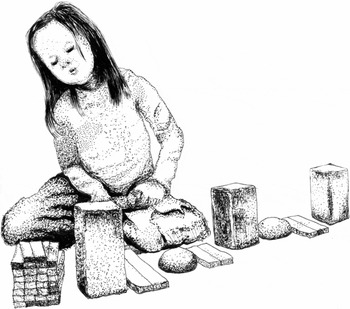
130 Linnea: It's boom (points at a high vertical block) ticke ticke (two kappla-sticks laying in parallel) olé (half a sphere), boom (high vertical block), ticke ticke (two kappla-sticks in parallel), olé (half a sphere), ticke ticke (two kappla-sticks in parallel), boom (high vertical block) and ticke (a pile of parallel kappla-sticks), many ticke.
131 Teacher: And many, how do you know that it should be many ticke ticke there then?
132 Linnea: It is many.
133 Teacher: Aha, because there are many, is that why? Aha.
Linnea and Colin show the teacher how they can represent music in the form of a series of wooden building blocks. A certain block stands for (represents) a certain sound, in total three different sounds in this piece. The sequence of blocks builds a gestalt over the structure of the music. The result is a kind of architecture of music. To have realised that something as intangible and fleeting as music can be represented in the form of a building construction is a very impressive insight in these children.
Linnea ‘playing the wooden blocks’

Throughout this episode, a few excerpts of which have been analysed, the teachers pose challenging questions that make the children ‘go further’ in their exploration and learning. The children display important insights into representing music in their replies and their ways of acting. These excerpts could be read as examples of how a developmental pedagogical practice with young children within the domain of music can look when the teachers are not experts at music.
Discussion
In this section, I will recapitulate and discuss the findings of the empirical study. Then I will return to the issues of sociocultural theory, learning and development, and non-musical-specialist educational practices.
In this small-scale study, the two girls’ invented notations (Barrett, Reference BARRETT2001, Reference BARRETT, Miell, MacDonald and Hargreaves2005, Reference BARRETT2006; cf. Tolchinsky, Reference TOLCHINSKY, Teubal, Dockrell and Tolchinsky2007) were similar in both representing music as geometrical shapes. However, their representations differed by being in the form of shapes (and colours) on paper and as a tactile sequence of building blocks (shapes), respectively. This is how the children in this study managed the rather abstract notion of fixating something as fleeting and intangible as music to paper and objects. This begs the question: what are the teachers doing when trying to develop children's musical knowing in this preschool on this occasion? As seen in the excerpts, they challenge children to try to clarify and explain their understanding. They also work by the principle of contrast (how does one thing differ from another thing that may seem similar in some regard?). Communicating about what and how one does while doing something has been shown to facilitate learning to a considerable degree (cf. Mercer, Reference MERCER1995, Reference MERCER2000; Pramling, Reference PRAMLING, Olson and Torrance1996; Lisboa, Reference LISBOA, Kopiez, Lehmann, Wolther and Wolf2003; Pramling Samuelsson, Reference PRAMLING SAMUELSSON, Einarsdottir and Wagner2006; Mercer & Littleton, Reference MERCER and LITTLETON2007). Talking in this way may pose a particular challenge in the case of music, since it is intangible and invisible (Blair, Reference BLAIR2007; Young & Glover, Reference YOUNG and GLOVER1998). This is also one reason why representing music in other media such as language, drawings or, as in the present case, building blocks, is of some importance to music education. As seen in the excerpts (e.g. excerpt 1; excerpt 2, turn 27; excerpt 3, turns 30, 50; and excerpt 5, turn 75), the representations and the representational system are not only sounded/played but also spoken about (cf. Hagtvet, Reference HAGTVET and Häggström2004). This kind of meta-level talk about what signs mean and so forth is important in gaining an understanding of the tools through which we think, speak about and perceive music (cf. Bamberger, Reference BAMBERGER1991), i.e. developing representational knowledge in the domain of music. The teachers also gave the four children studied an opportunity to appropriate tools for representing music verbally (e.g. high–low, fast–slow). However, some distinctions and concepts used were not entirely clear. The problem of distinguishing between the two different senses of ‘high’ and ‘low’ (as dynamic and pitch) respectively (see excerpt 5) was pointed out in the analysis.
In the introduction, music education was briefly seen in terms of musical communication (Miell et al., Reference MIELL, MACDONALD and HARGREAVES2005). This is particularly emphasised if we have a sociocultural perspective on learning and development. Against this background, why are the children's representations in this study interpreted as musical sounds rather than as nonsense words? Firstly, ‘word’ is a unit of written language, not oral language. This point needs some recognition. Living in a literate culture, we also perceive oral language in terms of writing. Our meta-language is premised on the representational technology of text, as cogently argued by developmental researcher David Olson (Reference OLSON1994). Oral language consists of language sounds and silences, not of words, letters etc. Secondly, at this ‘level’ of communication, the difference between language and music is not necessarily distinct. However, the reason for referring to the children's figures, signs or building blocks as representing music rather than language is because the activity is framed in terms of music, that is, this is the term in which the participating children and teachers speak about what they are doing (as seen in the excerpts). There is one additional reason for labelling the children's representations in terms of music rather than in terms of language. In Thaut's (Reference THAUT, Miell, MacDonald and Hargreaves2005: 172) words, ‘most likely the most important difference between speech and music lies in the lack of semantic or referential meaning in music. Musical sounds and sound patterns communicate themselves in an abstract fashion. They do not intrinsically denote or refer to extramusical events, objects, concepts, or cognitions.’ A further implication of this reasoning is that nonsense-words (which as such are not actual words) may be understood as music rather than language.
It is reasonable to assume that realising that sounds can be represented in other media (e.g. objects and visual shapes) is a key insight in learning music notation – leading to the discovery of principles and patterns (regularities and variation) of sounds and music – as well as literacy. Lest we forget, music notation (visuospatial representation) is a means of or a tool for fixating and hence for being able to inspect and remember the music. Like all tools, notation in music education should ‘serve the music’. While the heart of music education needs to be the music itself, notational tools, paradoxical as this may sound (!), could help the learner ‘get at’ the music (cf. Bamberger, Reference BAMBERGER1991).
One recurrent observation is that the children use onomatopoeia to mimic sounding qualities (cf. Pramling & Wallerstedt, Reference PRAMLING and WALLERSTEDT2009). This implies that the teacher is faced with trying to help the child to clarify what aspect of the music s/he intends to call attention to. For example, the child's use of ‘plinging’ (excerpt 5, turn 78) in accounting for a sound is perhaps his way of making sense of and communicating about the timbre. But since this issue is not followed up in the subsequent talk between the child and his teacher, we cannot know for sure. It is important for the teacher to get children to clarify what they mean (what musical dimension they are referring to; Barrett, Reference BARRETT2001) to be able to develop the child's understanding of music further.
Another observation in the same excerpt was that the musically indistinct terms of literally ‘much/a lot’ and ‘a little’ were used. This raises the issue of whether teachers in the early years have access to the conceptual tools of music theory. As it turns out in this particular case, the teacher corrects herself by subsequently using ‘soft’, though not consistently. The problem with terms such as ‘much’ and ‘a little’ is not that they are incorrect in a strict sense, but that they are indistinct and therefore do not help the child clarify and distinguish what s/he hears. Hence, the important thing is not necessarily to have access to the ‘correct’ concepts but to have functional (distinct) ones.
‘Through their participation in musical experiences in which invented notation is used, children are developing a ‘database’ of representational strategies’, Barrett (Reference BARRETT, Miell, MacDonald and Hargreaves2005: 125) argues. The preschool milieu studied in this article, particularly the verbal interaction with their teacher, appears to provide children with a creative incentive for developing such a repertoire. An important feature of development from the perspective taken in this study (Nelson, Reference NELSON1996; Säljö, Reference SÄLJÖ2000, Reference SÄLJÖ2005; Vygotsky, Reference VYGOTSKY1978) is to appropriate a wider repertoire of representational tools and ways of representing the world (in this case, music). As suggested by sociocultural theory, we need to rethink development from a ‘natural unfolding’ to a socio-historically contingent (experience based) process, particularly dependent on the tools (representational systems) the learner is given the opportunity to appropriate. If development is perceived in these terms, the emphasis is put on the issue of the educational opportunities provided for children in, for example, preschools and schools. Do children gain access to useful tools for representing and perceiving music and hence develop their musical knowing, and if so, how? More research into this issue is especially needed in ‘ordinary’ preschools and schools, i.e. preschools and schools without a particular music profile and where the teachers are not experts at music, i.e. the kinds of preschools and schools the majority of children attend. Hence, if musical skills should not only be exclusive for children who get to attend certain institutional arrangements, more research into non-specialist music education is needed.
Studying music education in non-musical-specialist schools and preschools allows us to see what difficulties or challenges children as well as teachers face when trying to develop children's knowledge in this domain of knowing. It also helps us to see what would be functional, practice-relevant in-service training to provide for teachers. The present study is but one small illustration, hinting at this important issue, much more research is needed. And if we adopt a Vygotskian perspective, as I have intimated, learning is not only of importance in studying education but also for considering development. From a sociocultural perspective, development of ‘higher psychological functions’ (e.g. voluntary remembering and representational skills) cannot be studied in the absence of the learning opportunities provided for children and how they respond to those opportunities.
Acknowledgements
The research reported here has been funded by the Swedish Research Council. I wish to thank Anna-Karin Engberg for making the drawing of Linnea ‘playing the wooden blocks’. I also wish to thank Bengt Olsson and Cecilia Wallerstedt, both at the Academy of Music and Drama at the University of Gothenburg, for reading and commenting on an earlier draft. Finally, I would like to extend my gratitude to the two anonymous reviewers who made a number of helpful suggestions.