Traumatic injury is the leading cause of death during the first 4 decades of life, accounts for 9.6 percent of global mortality (1;Reference Lozano, Naghavi and Foreman2), and causes the biggest loss of disability-adjusted life-years compared with any other disease (Reference Murray, Vos and Lozano3). Traumatic injury disproportionately affects younger individuals and, as a consequence, accounts for the highest amount of lost productive years of life (Reference Kotagal, Agarwal-Harding and Mock4). While the direct medical costs of traumatic injury are substantial, its economic burden is particularly high for employers. To illustrate, in the United States, the total cost of fatal unintentional injury was estimated at approximately USD84 billion, of which the largest share was due to lost productivity (i.e., approximately USD83 billion) (Reference Kotagal, Agarwal-Harding and Mock4). In the Netherlands, the total cost of trauma (intentional and unintentional) was estimated to be EUR6 billion, of which EUR2.6 billion were direct medical costs and EUR3.4 billion were lost productivity costs (Reference den Hertog, Stam and Valkenberg5).
During the past 3 decades, an improved organization of acute trauma care has led to a 15 percent to 25 percent decrease in mortality (Reference Lansink and Leenen6–Reference Haas, Jurkovich and Wang8). As further improvements in survival rates are likely to be relatively small, the focus of trauma care has moved from reducing mortality to improving quality of life and outcome (Reference Celso, Tepas and Langland-Orban9). A possible means for improving trauma patients’ health-related quality of life (HR-QOL) and outcome may be the optimization of their rehabilitation process. We, therefore, developed the Transmural Trauma Care Model (TTCM), which aims to improve the organization, content, and quality of the trauma patients’ rehabilitation process. The TTCM consists of a continuous feedback loop, in which a multidisciplinary hospital-based team supervises a network of primary care physical therapists in the treatment of trauma patients (Reference Wiertsema, van Dongen and Geleijn10). Effectiveness analyses showed that, among trauma patients with at least one fracture, the TTCM resulted in better patient outcomes, such as disease-specific HR-QOL, pain, and functional status, compared with regular care (Wiertsema et al., unpublished data).
As healthcare resources are restricted, trauma systems should not only be effective in improving patient outcomes, but also provide “good value for money.” The latter is assessed in an economic evaluation, which provides insight into a treatment's additional cost per additional unit of health gained (Reference Drummond, Sculpher, Torrance, O'Brien and Stoddart11). Up until now, relatively few economic evaluations evaluated the cost-effectiveness of trauma systems (Reference Seguin, Garber, Coyle and Hebert12–Reference MacKenzie, Weir and Rivara14), and those aimed at the rehabilitation phase in particular. Therefore, the current economic evaluation aimed to assess the cost-effectiveness of the TTCM for generic HR-QOL from a societal perspective compared with regular care. In a secondary analysis, the intervention's cost-effectiveness for disease-specific HR-QOL, pain, functional status, and perceived recovery was assessed.
Methods
The study protocol has been published elsewhere (Reference Wiertsema, van Dongen and Geleijn10). A summary is given below.
Design
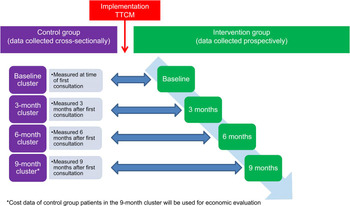
The economic evaluation was conducted alongside a before-and-after study with a convenience control group measured only afterward. This clinical trial was conducted at the outpatient clinic of a level-1 trauma center (Amsterdam UMC, location VUmc, Amsterdam, the Netherlands) (Reference Higgins and Green15). In contrast to a true controlled-before-and-after study, only the intervention group was prospectively followed, while control group data were collected cross-sectionally. That is, the trial's control group consisted of four independent clusters of patients who either had their first consultation at the outpatient clinic 0, 3, 6, or 9 months ago. After implementation of the TTCM, one cluster of intervention group patients was prospectively followed and measured directly after their first consultation at the outpatient clinic (i.e., baseline), and after 3, 6, and 9 months (Figure 1). To capture all costs flowing from the intervention under study, the analytic time frame of an economic evaluation typically needs to be longer than that of an effectiveness study (Reference van Dongen, van Wier and Tompa16). Therefore, in the present economic evaluation, only the 9-month control cluster was compared with the intervention group. The 9-month control cluster will be further referred to as the control group.
Study design of the modified controlled before and after study.

The medical ethics committee of the VUmc decided that the Dutch Medical Research Involving Human Subjects Act (WMO) was not applicable to the present study (registered under number 2013.454). All participants gave informed consent. The trial is registered at the Dutch Trial Register (NTR5474).
Participants
Surgically as well as conservatively treated trauma patients were included. Eligible trauma patients had at least one traumatic fracture, were aged ≥18 years, rehabilitated in the primary care setting, and were able to fill out online questionnaires in Dutch. Patients were excluded if they met any of the following criteria: traumatic brain injury, pathological (nontraumatic) fractures, cognitive limitations, rehabilitation in a tertiary care facility, or living outside the catchment area of the VUmc.
Control group patients were identified from the central trauma registry of the trauma region “North West Netherlands” and were contacted by phone by one of the investigators. They received further information about the study, after which the principle investigator verified the in- and exclusion criteria and patients were assigned to their specific cluster (based on the time elapsed since their first consultation). Eligible patients who were willing to participate received an email containing a link to the online questionnaire. Patients who did not respond within one week received a maximum of two reminder emails. If the patient did not reply to both emails, one of the coordinating investigators contacted the patient by phone.
Intervention group patients were identified during their first consultation at the outpatient clinic. During this consultation, patients were informed about the study by one of the investigators and in- and exclusion criteria were verified. In the week following the first consultation, patients who were willing and eligible to participate, received an email containing a link to the first online questionnaire. Subsequently, patients were prospectively followed and received additional online questionnaires at 3-, 6-, and 9-month follow-up. Patients who did not respond within 1 week, received a maximum of two reminder emails. If the patient did not reply to both emails, one of the coordinating investigators contacted the patient by phone.
Intervention Conditions
Pre- and in-hospital trauma care remained unchanged and was the same for the intervention group and the control group.
The TTCM
Patients in the intervention group received care according to the TTCM (Reference Wiertsema, van Dongen and Geleijn10). The TTCM combined the following components:
A multidisciplinary team consisting of a trauma surgeon and a highly-specialized hospital-based trauma physical therapist at the outpatient clinic for trauma patients
The trauma surgeon acted as the chief consultant, the physical therapist assessed physical function and acted as case manager throughout the rehabilitation process. During a shared decision-making process, the surgeon, physical therapist, and patient determined whether and when physical therapy in primary care was required.
Coordination and individual goal setting for each patient by this hospital-based team in combination with treatment according to customized protocols
The hospital-based team coordinated the patients’ rehabilitation process by repeatedly defining individual goals with the patient during the rehabilitation period. For the purpose of the TTCM, ten rehabilitation protocols were developed for the most common fractures (e.g., hip fractures, tibial plateau fractures).
A network of forty specialized primary care physical therapists
This so called “VUmc trauma rehabilitation network” consisted of forty physical therapists covering the region of Amsterdam (www.traumarevalidatie.nl) (17). The forty primary care physical therapists participating in the trauma network were trained and educated during a 2-day course led by trauma surgeons and hospital-based physical therapists, specialized in trauma care.
E-health support for transmural communication between the hospital-based trauma physical therapist and the primary care physical therapist
The hospital-based physical therapist and the primary care physical therapist communicated repeatedly throughout the rehabilitation process using secured email (especially developed for healthcare professionals).
Regular Care
Patients in the control group received regular postclinical care during which the trauma surgeon acted as the chief consultant and performed the postclinical consultations, unaccompanied by any allied health care professionals. The trauma surgeon decided whether and when physical therapy in primary care was needed. During a patients’ rehabilitation, there was no regular contact between the surgeon and the primary care physical therapist.
Outcome Measures
Various demographic and trauma-related characteristics were assessed for all patients (e.g., age, gender, medical history, Injury Severity Score [ISS], time between trauma and first outpatient consultation [TTO]). These characteristics were collected using online questionnaires, supplemented by data derived from electronic patient records.
The primary outcome was generic HR-QOL. Secondary outcomes included disease-specific HR-QOL, pain, functional status, and perceived recovery. In the intervention group, outcome measures were assessed at 0, 3, 6, and 9 months after patients’ first consultation at the outpatient clinic. In the control group, outcome measures were solely assessed at 9 months after the patients’ first consultation at the outpatient clinic.
Generic HR-QOL was measured using the EQ-5D-3L (Reference Lamers, Stalmeier, McDonnell, Krabbe and van Busschbach18). Using the Dutch tariff, the participants’ EQ-5D-3L health states were converted into a utility score, anchored at 0 (dead) and 1 (optimal health). As control group participants were only measured once, we were not able to estimate quality-adjusted life-years and include them as an outcome measure in the current economic evaluation. Nonetheless, generic HR-QOL can still be regarded as a preference-based measure, as utility values were based on the preferences of the Dutch population.
Disease-specific HR-QOL was measured using four disease-specific function scales, appropriate to the patients’ specific injury type. The Quick Dash score was filled out by patients with fractures of the upper extremity (Reference Hudak, Amadio and Bombardier19;Reference Veehof, Sleegers, van Veldhoven, Schuurman and van Meeteren20). The Lower Extremity Functional Scale (LEFS) was used in patients with hip fractures or other lower extremity fractures (Reference Binkley, Stratford, Lott and Riddle21;Reference Hoogeboom, de Bie, den Broeder and van den Ende22). The Roland Morris Disability Score (RMDS) was filled out by patients with vertebral fractures (Reference Roland and Morris23;Reference Brouwer, Kuijer and Dijkstra24). The Groningen Activity Restriction Scale (GARS) was used in multi trauma patients (Reference Kempen, Miedema, Ormel and Molenaar25). An overall disease-specific HR-QOL score was calculated by converting the overall scores of the four above-mentioned questionnaires to a scale from 0–100, with higher scores representing more functional problems.
Pain was measured using an 11-point numeric pain rating scale (NPRS), ranging from 0 (no pain) to 10 (worst possible pain) (Reference Von Korff, Jensen and Karoly26).
Functional status was measured using the Patient Specific Function Scale (PSFS) (Reference Chatman, Hyams and Neel27;Reference Beurskens, de Vet and Koke28). Patients had to identify three important activities that they are having difficulty with and were requested to rate their current level of difficulty associated with each activity on an 0–100 mm visual analogue scale (VAS) ranging from 0 (“able to perform activity at same level as before injury or problem”) to 100 (“unable to perform activity”). Only the activity that was first mentioned by the patient was used in the economic evaluation.
Perceived recovery was measured using the Global Perceived Effect (GPE) scale. Patients were asked to rate how much their condition has improved or deteriorated since their trauma on a seven-item scale (Reference Kamper, Ostelo and Knol29). Success of treatment was achieved when a patient reported to being “completely recovered” or “much improved.”
Cost Measures
Costs were measured from a societal perspective, including intervention, health care, absenteeism, presenteeism, and unpaid productivity costs. Intervention costs included all costs related to the additional time investments of the hospital-based trauma physical therapist (estimated at 15 minutes per outpatient clinic consultation) and the specialized primary care physical therapist (estimated at 5 minutes per outpatient clinic consultation), as well as the cost of hosting and maintaining the transmural communication system. The costs associated with the TTCM's development (e.g., training costs) were excluded, as these costs will become negligible after implementing the intervention broadly (Reference Frick30;Reference Tan, Bouwmans, Rutten and Hakkaart-van Roijen31). All other cost categories were assessed using online cost questionnaires, supplemented by hospital records if available (e.g., for imaging procedures). To cover the complete duration of follow-up, recall periods of the online questionnaires varied between treatment groups and measurement points. For the intervention group, 3-month recall periods were used at baseline, 3, 6, and 9 months follow-up and costs were added together to get an estimate of the total costs during the 9-month follow-up period. For the control group, a recall period of 9 months was used at 9-month follow-up.
Healthcare use included the use of primary care (e.g., consultations at the general practitioner or physical therapist) and secondary care (e.g., consultations at the outpatient clinic for trauma patients, hospitalization) as well as the use of medication. Dutch standard costs were used to value healthcare costs (Reference Tan, Bouwmans, Rutten and Hakkaart-van Roijen31). Medication use was valued using the G-standard of the Dutch Society of Pharmacy (32).
Absenteeism was assessed using the “PROductivity and DISease Questionnaire” (PRODISQ). Patients were asked to report their total number of sick leave days (Reference Koopmanschap33). Absenteeism was valued using age- and gender-specific price weights (Reference Tan, Bouwmans, Rutten and Hakkaart-van Roijen31).
Presenteeism was defined as reduced productivity while at work and was assessed using the World Health Organization Health and Work Performance Questionnaire (Reference Kessler, Ames and Hymel34). Presenteeism was valued using age- and gender-specific price weights (Reference Tan, Bouwmans, Rutten and Hakkaart-van Roijen31).
Unpaid productivity losses were assessed by asking patients for how many hours per week they were unable to perform unpaid activities, such as domestic work, school, and voluntary work. A recommended Dutch shadow price was used to value unpaid productivity. The Dutch shadow price was calculated in accordance with the opportunity good method and was estimated to be EUR12.50 per hour in 2009 (Reference Tan, Bouwmans, Rutten and Hakkaart-van Roijen31).
All costs were presented in Euros and converted to the same reference year (i.e., 2014) using consumer price indices. Discounting of costs was not necessary due to the 9-month follow-up period (Reference Drummond, Sculpher, Torrance, O'Brien and Stoddart11).
Data Analysis
Descriptive Statistics
Descriptive statistics were used to compare baseline characteristics between intervention and control group participants.
Handling Missing Data
Missing data were imputed using Multiple Imputation by Chained Equations (Reference Azur, Stuart, Frangakis and Leaf35). Two imputation models were constructed, including one for the intervention group and one for the control group. Both imputation models included variables related to the “missingness” of data, variables that predicted the outcomes, and all available midpoint and follow-up cost and effect measure values (Reference Azur, Stuart, Frangakis and Leaf35). Ten complete data sets were created in order for the loss-of-efficiency to be below 5 percent (Reference White, Royston and Wood36). Imputed datasets were analysed separately as specified below, after which pooled estimates were calculated using Rubin's rules (Reference White, Royston and Wood36).
Economic Evaluation
Cost-effectiveness analyses were performed according to the intention-to-treat principle. Cost and effect differences were estimated using seemingly unrelated regression analyses to correct for their possible correlation. Cost and effect differences were corrected for confounders. Confounding was checked by adding the potential confounding variable to the crude models, and was subsequently considered to be present if the regression coefficient changed by 10 percent or more. To deal with the highly skewed nature of cost data, 95 percent confidence intervals around the differences in costs were estimated using the bias corrected and accelerated bootstrap method, with 5,000 replications. Incremental cost-effectiveness ratios (ICERs) were calculated by dividing the differences in costs by those in effects. To graphically illustrate the uncertainty surrounding the ICERs, bootstrapped incremental cost-effect pairs were plotted on cost-effectiveness planes (Reference Black37).
A summary measure of the joint uncertainty of costs and effects was presented using cost-effectiveness acceptability curves (CEACs), which indicate the probability of an intervention being cost-effective in comparison with the control condition for a range of willingness-to-pay values (i.e., the maximum amount of money decision makers are willing to pay to gain one extra unit of effect) (Reference Fenwick, O'Brien and Briggs38). Two one-way structural sensitivity analyses were performed to test the robustness of the results: (i) applying the healthcare perspective (i.e., only costs accruing to the Dutch healthcare system were included), and (ii) excluding presenteeism costs (Reference Drummond, Sculpher, Torrance, O'Brien and Stoddart11). All analyses were performed in STATA, using a level of significance of p < .05.
Results
Study Participants
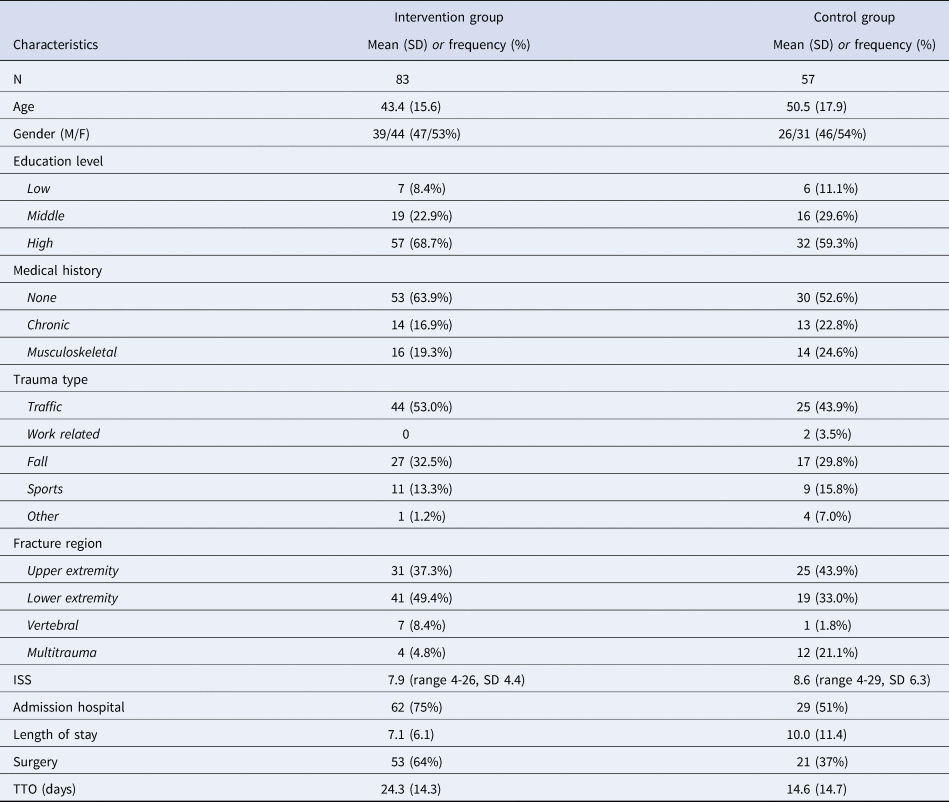
Eighty-three trauma patients were enrolled in the intervention group and 57 in the control group (Supplementary Figure 1). Most baseline characteristics were similar among intervention and control group patients. However, patients in the intervention group were slightly younger, were more frequently admitted to a hospital, received surgery more frequently, and had a longer time between trauma and their first outpatient consultation than their control group counterparts (Table 1). A total of 107 patients (76 percent) had complete effect data at 9 months follow-up (i.e., 52 intervention group patients and 55 control group patients) and 62 patients (44 percent) had complete cost data on all measurement points (i.e., seventeen intervention group patients and forty-five control group patients).
Baseline Characteristics (Patient- and Trauma Related)

M/F, male/female; SD, standard deviation; TTO, time between trauma and first outpatient consultation.
Effectiveness
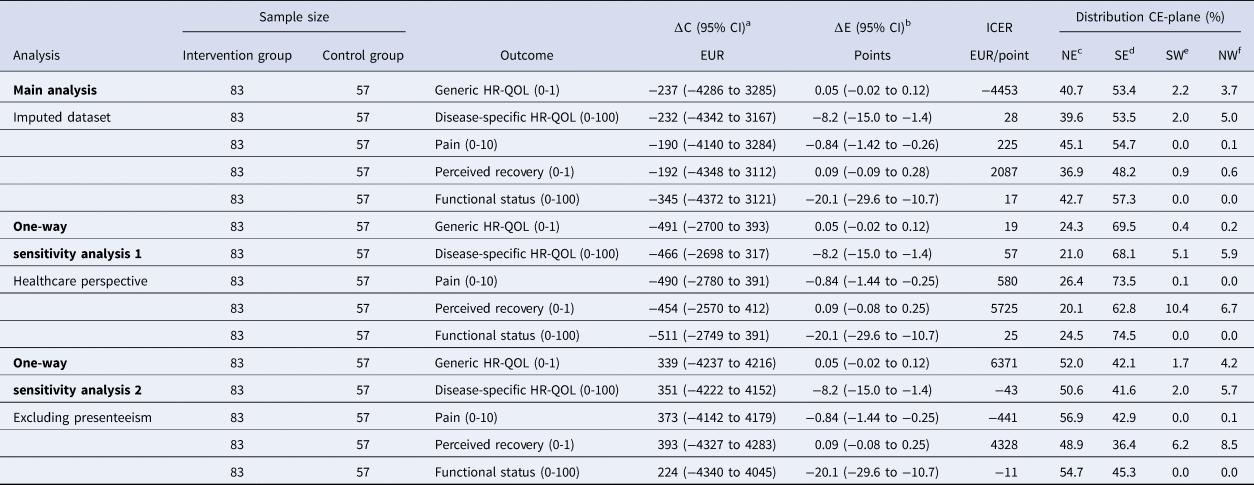
At 9 months, there was no statistically significant difference in the primary outcome generic HR-QOL between the intervention group and control group. As for the secondary outcomes, mean between-group differences were statistically significantly in favor of the intervention group for disease-specific HR-QOL, pain, and functional status, but not for perceived recovery (Table 2).
Differences in Pooled Mean Costs and Effects (95% CI), ICERs, and the Distribution of Incremental Cost-Effect Pairs around the Quadrants of the CE Planes

CE, cost-effectiveness; CI, confidence interval; EUR, Euro; HR-QOL, health-related quality of life; ICER, incremental cost-effectiveness ratio; TTO, time between trauma and first outpatient consultation.
Note. Please note that the mean cost differences differ across outcomes. This is due to the use of Seemingly Unrelated Regression analyses, in which cost and effect differences are corrected from their possible correlation.
aCost differences were corrected for medical history, surgery, paid work (yes/no), and number of working hours/week.
bEffect differences were corrected for age, medical history, TTO (Generic HR-QOL); age, medical history, TTO, fracture region, admission hospital, surgery (Disease-specific HR-QOL); none (Pain); medical history, TTO (Perceived recovery) and TTO, surgery (Functional status).
cRefers to the northeast quadrant of the CE-plane, indicating that the intervention is more effective and more costly than usual care.
dRefers to the southeast quadrant of the CE-plane, indicating that the intervention is more effective and less costly than usual care.
eRefers to the southwest quadrant of the CE-plane, indicating that the intervention is less effective and less costly than usual care.
fRefers to the northwest quadrant of the CE-plane, indicating that the intervention is less effective and more costly than usual care.
Costs
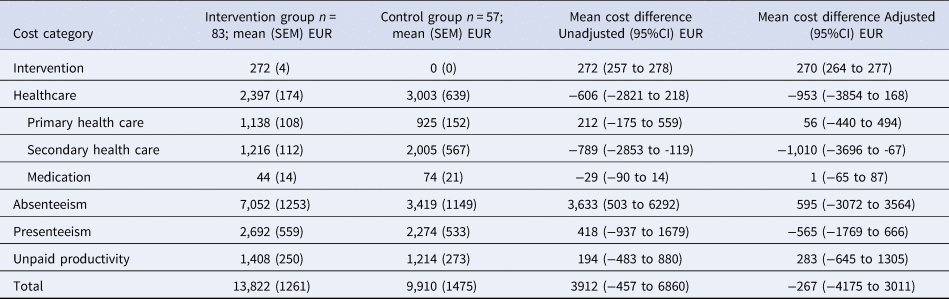
On average, the cost of the TTCM was EUR272 (SEM = EUR4) per patient. Secondary healthcare, presenteeism, and total societal costs were lower in the intervention group than in the control group, while primary healthcare, medication, absenteeism, and unpaid productivity costs were higher in the intervention group than in the control group. Of them, only the difference in secondary healthcare costs was statistically significant (Table 3).
Mean Costs per Participant inI and Control Groups and Mean Cost Differences between Groups during the 9-Month Follow-up Period

CI, confidence interval; EUR, Euro; SEM, standard error of the mean.
Economic Evaluation
Primary Outcome. Generic HR-QOL
The main analysis results for generic HR-QOL indicated that the TTCM dominated regular care (i.e., less costly and more effective) (Table 2). The CEAC in Supplementary Figure 2 indicates that the TTCM has a 0.58 probability of being cost-effective compared with usual care if decision makers are not willing to pay anything per utility gained, increasing to a maximum of 0.90 at a willingness-to-pay of EUR55,000/utility gained.
Secondary Outcomes. Disease-Specific HR-QOL, Pain, Perceived Recovery, and Functional Status
The main analysis results for disease-specific HR-QOL indicated that the TTCM dominated regular care (i.e., less costly and more effective) (Table 2). Please note that a lower score in disease-specific HR-QOL indicates an improvement. The CEAC in Supplementary Figure 2 indicates that the TTCM has a 0.55 probability of being cost-effective compared with regular care if decision makers are not willing to pay anything per one-point improvement in disease-specific HR-QOL, increasing to 0.95 at a willingness-to-pay of EUR700/point improvement.
The main analysis results for pain indicated that the TTCM dominated regular care (i.e., less costly and more effective) (Table 2). Please note that a lower pain score indicates an improvement. The CEAC in Supplementary Figure 2 indicates that the TTCM has a 0.54 probability of being cost-effective compared with regular care if decision makers are not willing to pay anything per one-point improvement in pain, increasing to 0.95 at a willingness-to-pay of EUR3500/point improvement.
The main analysis results for perceived recovery indicated that the TTCM dominated regular care (i.e., less costly and more effective) (Table 2). The CEAC in Supplementary Figure 2 indicates that the TTCM has a 0.54 probability of being cost-effective compared with regular care if decision makers are not willing to pay anything per recovered patient, increasing to a maximum of 0.85 at a willingness-to-pay of EUR50,000/recovered patient.
The main analysis results for functional status indicated that the TTCM dominated regular care (i.e., less costly and more effective) (Table 2). Please note that a lower score in functional status indicates an improvement The CEAC in Supplementary Figure 2 indicates that the TTCM has a 0.57 probability of being cost-effective compared with regular care if decision makers are not willing to pay anything per point improvement in functional status, increasing to 0.95 at a willingness-to-pay of EUR125/point improvement.
One-Way Sensitivity Analyses
When the healthcare perspective was applied, the mean difference in total costs was larger than in the main analysis (e.g., EUR-491 versus EUR-237 for general HR-QOL), and still in favor of the intervention group. This resulted in higher probabilities of the TTCM being cost-effective compared with the main analysis (Table 2). When excluding presenteeism costs, total costs were higher in the intervention group than in the control group. This finding was in contrast to the main analysis, and resulted in lower probabilities of the TTCM being cost-effective (Table 2).
Discussion
Traumatic injury is the most important cause of long-term functional limitations in adults younger than 45 years (Reference Holbrook, Anderson, Sieber, Browner and Hoyt39) and poses a substantial economic burden to society (Reference Willenberg, Curtis and Taylor40). As healthcare resources are restricted, trauma systems should not only be effective in improving patient outcomes, but also provide “good value for money”. Therefore, the current economic evaluation aimed to assess the cost-effectiveness of the TTCM for generic HR-QOL from a societal perspective compared with regular care. In a secondary analysis, the intervention's cost-effectiveness for disease-specific HR-QOL, pain, functional status, and perceived recovery was assessed.
Main Findings
Results indicated that the TTCM statistically significantly improved disease-specific HR-QOL, pain, and functional status compared with regular care. Between-group differences in generic HR-QOL, perceived recovery, and total costs were in favor of the intervention group as well, but not statistically significantly so. On average, the TTCM dominated regular care for all outcomes. CEACs indicated that if decision makers are not willing to pay anything per unit of effect gained, the TTCM has a 0.54–0.58 probability of being cost-effective compared with usual practice. For all outcomes, this probability increased to relatively high levels with increasing values of willingness-to-pay (e.g., to 0.95 at a willingness-to-pay of EUR700/point improvement on a NRS). However, as it is unknown what decision makers are currently willing-to-pay per unit of effect gained, strong conclusions cannot be made about the cost-effectiveness of the TTCM. Nonetheless, decision makers need to understand the role that rehabilitation, job retraining, and injury prevention play in dealing with the tremendous economic impact of traumatic injury to society and they can use the present results to consider whether the TTCM provides “good value for money” at an acceptable probability of cost-effectiveness.
Comparison with the Literature
Even though extensive research has been done on the quality and organization of pre- and in-hospital trauma care, relatively few economic evaluations have evaluated the cost-effectiveness of regionalized trauma systems (Reference Seguin, Garber, Coyle and Hebert12–Reference MacKenzie, Weir and Rivara14), and those aimed at the rehabilitation phase in particular. A recent study assessed the cost-effectiveness of several care pathways for inpatient rehabilitation in severe trauma patients (Reference Wu, Faux, Harris and Poulos41). All participants were treated in a specialized trauma hospital, but the group that rehabilitated in an in-hospital rehabilitation center, had a significantly shorter length of stay (LOS) compared with the group that rehabilitated in an external rehabilitation center. However, this was a retrospective cohort study that solely used LOS as a proxy for resource consumption and, therefore, cannot be considered as a full economic evaluation. Furthermore, a Dutch study evaluated an integrated inpatient “Fast Track” rehabilitation service for multi trauma patients.
No significant effect differences were observed between the intervention and control group and results of the scheduled economic evaluation have not yet been published (Reference Bouman, Hemmen and Evers42). Another study evaluated the cost-effectiveness of three inpatient rehabilitation modalities (i.e., physically orientated, geriatrically orientated, and routine treatment) in patients with hip fractures. Considering total costs 1 year after trauma, physically orientated rehabilitation showed to be more cost-effective than routine treatment. Although it was a robust study, the results were not generalizable to other trauma patients (Reference Lahtinen, Leppilahti and Vahanikkila43). To the best of our knowledge, the present study is the first to evaluate the cost-effectiveness of a transmural care model for the postclinical rehabilitation of trauma patients.
Strengths and Weaknesses of the Study
Important strengths of this study are the fact that it was the first to evaluate the cost-effectiveness of a new multidisciplinary transmural rehabilitation model for trauma patients, its use of a control group and its pragmatic design (i.e., daily practice is resembled as much as possible). Also, the study population covers a broad range in trauma patients (ISS ranging from 4 to 43). This is an important strength, as the majority of studies assessing HR-QOL, functional outcomes and costs after trauma, included only major trauma patients with an ISS > 16 (Reference Holbrook, Anderson, Sieber, Browner and Hoyt39;Reference Gabbe, Sutherland, Hart and Cameron44;Reference Holtslag, Post, Lindeman and Van der Werken45) or trauma patients with specific injuries (e.g., hip fractures or vertebral fractures) (Reference Lindsay, Burge and Strauss46). As our study population represents the whole spectrum from mild to severely injured trauma patients, the results are likely to be generalizable to the total trauma patient population (except patients with traumatic brain injury, which were excluded in this study). However, future research is necessary to explore whether specific trauma patient subgroups respond in a different way on the TTCM.
The study also had some limitations. First, a controlled-before-and-after design, with a convenience control group measured only afterward, was regarded as the most optimal research design within the available resources and within the possibilities of clinical practice. However, such nonrandomized study designs are inherently susceptible to many types of bias, such as selection bias, recall bias, regression to the mean, the Hawthorne effect, and repeat testing bias (Reference Ho, Phelan and Mizubuti47). Most likely in the present study is the occurrence of selection bias, meaning that the control group and intervention group are likely to differ in known and unknown etiological factors. As a consequence, it is not possible to rule out the possibility that the current findings are biased by baseline differences in group characteristics, and those that we were not able to measure due to the current study design in particular (Reference Higgins and Green15). Even though we were able to correct for some of them in our analyses, a randomized controlled design or an observational design with a propensity score matched control group would have likely produced more valid results. Among others, this is evidenced by the fact that after correcting the total cost difference for medical history, surgery, paid work, and working hours it changed from being positive to negative, albeit not statistically significant in both cases.
Another potential form of bias is the possible influence of recall bias due to the use of retrospective questionnaires with varying recall periods. The assumption is that a longer recall period increases the change of recall bias due to difficulties in recollecting facts and events after an elongated period of time. As control group patients were asked to remember their resource use during the last 9 months instead of during the past 3 months (which was the case for the intervention group), one might argue that the costs of the control group have a higher probability of being underestimated than those of the intervention group. However, as total societal costs were higher in the control group than in the intervention group, it seems unlikely that the use of retrospective questionnaires severely biased our results.
A second shortcoming of the present study was the inability to include quality-adjusted life-years in the current economic evaluation, because utilities of the control group were only measured at one single time point.
A third shortcoming is the relatively short time horizon of the clinical trial. Short time horizons are common in trial-based economic evaluations, as longer follow-ups are typically not feasible within a trial setting. One should bear in mind, however, that an intervention's cost-effectiveness observed within a trial may be substantially different from its longer-term cost-effectiveness. To deal with this limitation, the intervention's longer-term cost-effectiveness can be estimated using modelling techniques (Reference Petrou and Gray48).
Finally, and inherent to all economic evaluations, is the fact that the current results may not be generalizable to other countries due to differences in healthcare systems across countries. Also, despite extensive efforts to limit the amount of missing data, 56 percent of all participants had some missing cost data and 24 percent had some missing effect data. Although missing data are generally unavoidable in clinical studies and economic evaluations in particular, and multiple imputation techniques were used for filling in missing values, a complete dataset would have produced more valid and reliable results.
Implications for Practice and Further Research
Decision makers can use the present results to consider whether the TTCM provides “good value for money” at an acceptable probability of cost-effectiveness. Implementation of the TTCM in other level-1 trauma centers could be considered in the future, although a multicenter controlled trial would be required to confirm the present results.
In conclusion, the TTCM may be cost-effective compared with regular care, depending on the decision-makers willingness to pay and the probability of cost-effectiveness that they perceive as acceptable. However, a multicenter, and ideally randomized controlled trial, would be preferred to fortify the results of this pragmatic study.
Supplementary material
The supplementary material for this article can be found at https://doi.org/10.1017/S0266462319000436
Conflicts of interest
The authors declare that they have no competing interests with the potential to bias the work. Dr. Ostelo reports grants from The Netherlands Organisation for Scientific Research, grants from The Netherlands Organisation for Health Research and Development, grants from SIA-RAAK PRO, grants from European Centre for Chiropractic Research Excellence (ECCRE), grants from EUROSPINE, grants from FRIESLAND Zorgverzekeraar, grants from Scientific College Physiotherapy (WCF) of the Royal Dutch Association for Physiotherapy (KNGF), grants from CZ Health Care Insurance, grants from The European Chiropractic Union (ECU), outside the submitted work.