INTRODUCTION
The Mediterranean region, as the centre of origin of settled agriculture, has been cultivated for millennia and is diverse ecologically, climatically, culturally and economically (Ryan et al., Reference Ryan, De Pauw, Gomez, Mrabet, Peterson, Unger and Payne2006). The typical Mediterranean climate has a cool winter season that permits cereal and legume cropping, and a dry hot summer, when cropping is normally only possible with irrigation (Kassam, Reference Kassam1981). The Mediterranean cropping system has traditionally centred on rainfed cereals (Cooper et al., Reference Cooper, Gregory, Tully and Harris1987), mainly with wheat (Triticum aestivum and T. durum) and barley (Hordeum vulgare), grown in rotation with fallow or food legumes, i.e. chickpea (Cicer arietinum) and lentil (Lens culinaris), and forage legumes such as vetch (Vicia sativa) and medic (Medicago spp.). In some cases, the cereal is grown as a continuous crop.
Characteristic of the Mediterranean-type climate, there is considerable inter-annual and within-season variability. Mean annual rainfall is relatively low, i.e. 200–600 mm. Crop production is generally constrained by lack of moisture; in most years, there is some terminal drought. Nevertheless, crop production is generally dictated by seasonal rainfall of dryland zones (Keatinge et al., Reference Keatinge, Chapanian and Saxena1988), which is dominant over fertility status and rotations (Pala et al., Reference Pala, Matar and Mazid1996). With the infrequent rains in Mediterranean systems, the soil's capacity to store moisture for the crop is a key factor (Cooper and Gregory, Reference Cooper and Gregory1987). Rainfed cropping dominates most cereal-producing countries of the Middle East.
With increasing land-use pressure, there has been an inexorable trend towards cropping diversification and intensification, involving the elimination of fallow and monocultures, which is of questionable sustainability (Harris, Reference Harris1995). Similarly, as animal production, mainly sheep, is integrated with the cereal production system and the demand for animal feed is a major issue, forage legume production has become important. Given the many benefits of crop rotations, especially for sustainable yields, disease control, better soil properties and water-use efficiency (Karlen, Reference Karlen1994), growing legumes or other crops instead of fallow is considered an attractive proposition (Harris, Reference Harris1995).
Within such a Mediterranean cropping system, legumes, notably vetch as an annual forage (Christiansen et al., Reference Christiansen, Bounejmate, Bahhady, Thomson, Mawlawi and Singh2000; Jones and Singh, Reference Jones and Singh2000a) and as a source of nitrogen (N) benefit the following cereal crop through symbiotic N fixation (Keatinge et al., Reference Keatinge, Chapanian and Saxena1988). Particular emphasis has been focused on vetch in association with barley, a crop that is adapted to semi-arid conditions in the Mediterranean zone (Yau et al., Reference Yau, Bounejmate, Ryan, Baalbaki, Nassar and Maccaroun2003), as an alternative to barley monoculture (Jones and Singh, Reference Jones and Singh2000b).
While globally the trend in crop production has been towards conservation systems involving shallow tillage, minimum tillage and no-till as a replacement for conventional ploughing or deep tillage, this development has been recent in the Mediterranean area. What little research that has been done indicated no advantage of no-till over conventional tillage (Lopez-Bellido et al., Reference Lopez-Bellido, Lopez-Bellido, Castillo and Lopez-Bellido2000). Zero-till systems were shown to be more economical due to lower input costs (Pala et al., Reference Pala, Harris, Ryan, Makboul and Dozom2000). However, at a relatively drier site in northern Syria, Jones (Reference Jones2000) concluded that zero-tillage was unlikely to be adopted in barley–vetch rotations.
Another development that impinges upon the cropping system is related to management of the cereal straw. While straw was valued as grazing for sheep in traditional Middle Eastern agriculture (Cooper et al., Reference Cooper, Gregory, Tully and Harris1987), the need to clear fields for irrigated summer crops underlined the drive to dispose of surplus straw. Other considerations are that cereal residues should be returned to the soil in the interest of carbon sequestration (Lal, Reference Lal2002) and that conservation tillage or no-till direct drilling could accommodate sowing a crop in standing cereal stubble.
Thus, in view of the need to accommodate a forage crop such as a vetch in cereal rotations, along with the need to effectively dispose of cereals residues in the field under shallow-conservation-type tillage, we established a multi-year dryland cropping system trial in northern Syria to assess the agronomic sustainability of such an integrated tillage and residue management system in a barley–vetch rotation.
MATERIALS AND METHODS
Experimental site
The experiment was conducted at ICARDA's main station, Tel Hadya, near Aleppo in northern Syria (latitude 36°11′N, longitude 36°56′, elevation 248 m asl). The dominant soil at the station was classified as a fine, thermion, Calcixerollic Xerochrept (Ryan et al., Reference Ryan, Masri, Garabet, Diekmann and Habib1997) and is generally representative of typical red Mediterranean soils. The soil at the site is deep (1–2 m), well structured and highly productive when provided with adequate soil moisture.
Treatments and experimental design
This dryland cereal-based trial, begun in November 1996, involved a two-course rotation: barley, vetch (for hay), with both the barley and vetch phases present each year. The experimental design was a split-split-plot in randomized complete blocks with two replications. Tillage treatments were randomly assigned to main plots. The ‘deep’ tillage, which is conventional for the region, was done with a mouldboard plough after cereals to a depth of 30 cm, and with a ‘ducksfoot’ cultivator after the legumes (12 cm); the ‘shallow’ system involved the ducksfoot (12 cm) every year. The crop rotations were randomly assigned to the subplots and the straw management treatments were assigned to the sub-subplots.
The cereal straw management involved: (i) burning all straw and stubble, (ii) removing the straw and incorporating the stubble cut to 10–15 cm, and (iii) incorporating both straw and stubble (estimated at 1.2 times the grain yield and chopped 5–10 cm long). Superimposed on the latter treatment (Trt 3), the compost treatments involved applying 10 t ha−1 of compost as dry matter (DM) once every two (Trt 4) or four years (Trt 5) prior to tillage. The compost material was prepared by piling up mounds consisting of about 75% straw and plant residues, 20% sheep manure and 5% soil from the station. The nutrient content of the compost was about 1% N and 0.23% phosphorus (P). All plots were 25 × 25 m, with two replications for each of the tillage, rotation and straw management treatments.
Crop management
An Amazone drill (row spacing, 12.5 cm) was used for planting the barley and vetch. Prior to planting in November at the onset of winter rains, fertilizers were applied. For vetch, which was sown at 80 kg ha−1, 13 kg P ha−1 was broadcast and incorporated. For the barley (Deiralla), which was sown at 100 kg ha−1, 22 kg P ha−1 as triple superphosphate and 20 kg N ha−1 as diammonium phosphate were applied. In late winter, 40 kg N ha−1 was applied as a top-dressing for barley. The herbicide Weedex (1.5 l ha−1) was used to control broad-leaved weeds in the barley and was sprayed in late winter (mid-February) depending on the year. The herbicide Grasp (1.0 l ha−1) was used for grasses in barley and sprayed in early spring (early to mid-March).
Measurements
Vetch was harvested for hay at about the 50% flowering stage, usually in early to mid-April depending on weather conditions, and barley was harvested in early to mid-May. Despite the rainfall variability, harvestable yields were obtained each year, (except 1999 when the crop was inadvertently sprayed with herbicide). In all cases, a representative part of the respective plots was harvested to obtain yield components.
For barley, harvesting was done with one run of a Hege plot combine (1.4 m) across the 18 m plots. For harvest index, two rows of 1 m, 12.5 cm apart (0.25 m2), were sampled by hand-harvesting. For vetch, yield components were assessed based on hand-harvesting at ground level, using three samples of 50 × 100 cm in each plot. All samples harvested from the vetch plots were weighed fresh and then oven-dried at 70 °C to obtain the final dry weight.
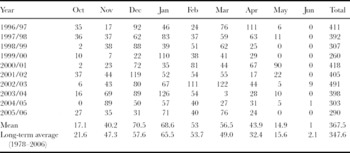
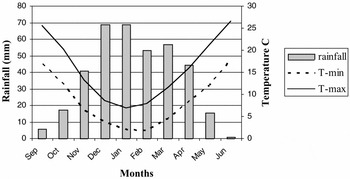
During the trial, seasonal rainfall and maximum and minimum temperatures were measured daily at a nearly meteorological station. Rainfall typically varied around the long-term average (340 mm), with four years below average (1999, 2000, 2005, 2006) and the others above average (Table 1). However, mean maximum seasonal temperatures were relatively constant at about 31 °C and mean lowest temperatures at about 3 °C. Despite annual variation, the patterns of seasonal rainfall and temperature distribution were similar, as illustrated in mean distribution over all years (Figure 1).
Monthly and total precipitation (mm) during the experimental period, Tel Hadya, Aleppo, Syria.

Monthly mean rainfall, and minimum (T-min) and maximum (T-max) temperatures during the experimental period at Tel Hadya, Aleppo, Syria (1997–2006).

Statistical analysis
All yield parameters were assessed for statistical significance using analysis of variance (ANOVA). For an individual rotation, annual as well as combined analysis of data over years was carried out to assess the main effects of tillage and compost and their interactions on grain, straw, and total biomass yields of barley, and vetch DM and grain. The analysis of crop rotation main effect and its interactions with tillage and compost were carried out for barley yields and forage DM.
For annual analysis of data on a given variable, the ANOVA of the standard split-split-plot design was done to test significance of the main factors and their interactions, and both means and precision were estimated. For combining the data over years, we partitioned the total variation for the variable into a number of strata consisting of plot totals for evaluation of tillage, compost and rotation treatments over all years, and into strata of plot × year totals for interactions of those factors with years (Patterson, Reference Patterson1964).
In a rotation experiment, an interaction of a treatment factor with year, which may indicate cumulative effect of the factor with time, is assessed as the interaction of the factor with the cycles of rotation. Therefore, the years were expressed in terms of rotations cycles and series of phases. For example, in the two-course barley–vetch rotation with both phases (barley, vetch) each year, years 1 and 2 form one rotation cycle, years 3 and 4 a second cycle, and so on; each of the two phases in the first year form a series representing odd or even years (Jones and Singh, Reference Jones and Singh1995).
Using this representation of years, ANOVA was performed to evaluate the main effects of the treatment factors and their interactions, and interactions with years expressed as series and cycles. We used the ANOVA directive of GenStat to perform various computations (Payne, Reference Payne2000). The associated BLOCKSTRUCTURE described the plot total strata formed by the split-split-plot design and plot × year total strata formed by the design, and series and cycle within series components of the year.
RESULTS
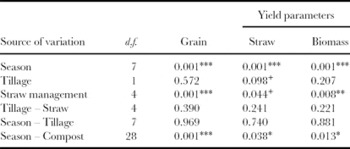
The ANOVA for barley yields (Table 2) showed significant differences between growing seasons. Similarly, the compost treatment had significant influences on all measurements. However, tillage had a significant effect only for straw (p ≤ 0.05). There was a significant compost × season interaction for yield components, but no significant interactions involving tillage. As the main concerns for system sustainability are yield components, only these are considered subsequently.
Analysis of variance with statistical significance of barley yield parameters in a barley-vetch rotation.

+significant at p < 0.10; *significant at p < 0.05; **significant at p < 0.01; ***significant at p < 0.001.
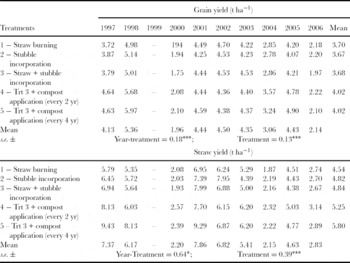
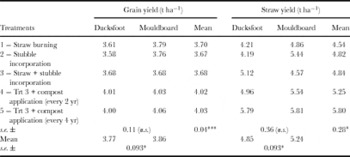
Mean yields (Table 3) of grain and straw reflected the seasonal rainfall to some extent, with lowest grain yields, i.e. 1.96 t ha−1 in 2000 and 2.14 t ha−1 in 2006. However, overall yields were poorly related to seasonal rainfall; for example, yields were also low in 2004 when rainfall was well above average at 400 mm. Deviations from the expected regression are attributed largely to uneven rainfall distribution as well as drought and heat stress at the critical grain-filling stage.
Mean barley grain and straw yields in rotation with vetch with respect to straw management systems.

*significant at p < 0.05; ***significant at p < 0.001.
For overall effects of straw management systems, including compost addition, there were significant differences within years and the mean of years for grain and straw. However, the differences were not expressed in the two low-rainfall years (2000, 2006) when yields were low due to limited rainfall. In the more favourable years (1997, 1998, 2004, 2005), there were little or no significant differences between burning the straw and stubble or incorporating the straw and/or stubble, but the treatment involving stubble and straw incorporation plus application of 10 t ha−1 compost once every two or four years, was significant. In other years, there were no additional effects of added compost. Where compost did increase grain yield, there was no consistent differences between the two- or four-year treatments. For straw yield, the compost applications were consistently higher yielding than the other straw management systems.
When the mean effects of the two tillage systems were compared for barley across the straw management treatments, there were no significant differences between the tillage system for grain yield (Table 4). However, straw yield was significantly (p ≤ 0.05) higher for the mouldboard (5.24 t ha−1) than the ducksfoot (4.85 t ha−1). Regardless of tillage system, the mean of the additional compost treatments was consistently higher than the other straw treatments.
Mean barley grain and straw yields in rotation with vetch with respect to tillage methods and compost applications.

n.s.: not significant; *significant at p ≤ 0.05; **significant at p ≤ 0.01; ***significant at p ≤ 0.001.
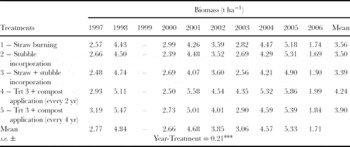
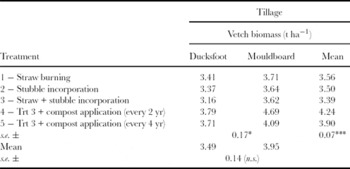
As the alternate crop in the rotation with barley was vetch, mean DM yields of vetch are presented for vetch as a function of the various straw management treatments (Table 5). As with barley, vetch yields showed large seasonal variation, being as low as 1.71 t ha−1 in the low rainfall year (2005/06) and one of the highest (5.33 t ha−1) in 2000/01 when rainfall was well above average at 418 m. The highest yield in 2004/05 was due to optimum distribution of low rainfall (303 mm) coinciding with the vetch-growing period (November–April). Similar to barley, there were significant differences due to the straw management (Table 5), mainly as a result of the additional compost applications; in most years, yields were higher where compost was applied every two years than every four years. In general, the treatments involving straw and/or stubble incorporation or stubble burning had similar effects. As with barley, the tillage system had a small but significant effect (p ≤ 0.05) on mean vetch yields, with the mouldboard plough (3.95 t ha−1) being higher than the ducksfoot (3.49 t ha−1) for DM biomass yield in the barley–vetch rotation (Table 6).
Mean vetch dry biomass yields with respect to compost application in each season in rotation with barley.

***significant at p ≤ 0.001.
Mean vetch dry biomass yields with respect to compost application in each tillage combined over years.

n.s.: not significant; *significant at p ≤ 0.05; ***significant at p ≤ 0.001.
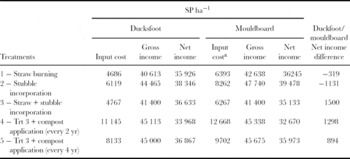
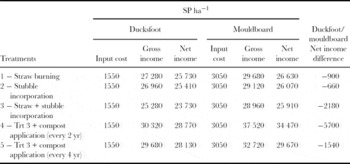
Economic parameters are presented for the two tillage systems in relation to the various treatments for the barley phase (Table 7) and the vetch phase (Table 8). While the input and gross income varied with the treatments in each tillage system, what is of interest is the relative net income from each treatment in relation to tillage system. Thus, in the barley phase, the ducksfoot tillage was less economical than the mouldboard system when the stubble was either burned or incorporated (Table 7). When the vetch phase was considered, the mouldboard plough was always more economical than the ducksfoot cultivator regardless of straw management. The mouldboard plough was economically advantageous when all stubble and straw was incorporated and when compost was applied every two year.
Net return of the treatment combinations with respect to different tillage applications in barley phase of the rotation with vetch.

Currently 1 US$ = 50 SP (Syrian pounds); 1 litre diesel = 7.5 SP (about 15 US cents).
Input costs:
Mouldboard plough: 1200 SP ha−1 (deep tillage) + 550 SP ha−1 (cultivation) + 300 SP ha−1 (roller for seedbed preparation) = total cost, 2050 SP ha−1.
Ducksfoot cultivation: 550 SP ha−1.
Straw collection cost for treatment 2: Straw yield × 700 SP t−1 × 50% collectable.
Barley harvest cost: 5% of grain yield for harvester + 50 SP bag−1 + 20 SP bag−1.
Vetch harvest cost: 1000 SP ha−1.
Output prices:
Barley grain: 11.5 SP kg−1.
Barley straw: 2.0 SP kg−1.
Vetch dry biomass: 8.0 SP kg−1.
Net return of the treatment combinations with respect to different tillage applications in vetch phase of the rotation with barley.

Currently 1 US$ = 50 SP (Syrian pounds); 1 liter diesel = 7.5 SP (about 15 US cents).
Input costs:
Mouldboard plough: 1200 SP ha−1 (deep tillage) + 550 SP ha−1 (cultivation) + 300 SP ha−1 (roller for seedbed preparation) = total cost, 2050 SP ha−1.
Ducksfoot cultivation: 550 SP ha−1.
Straw collection cost for treatment 2: Straw yield × 700 SP t−1 × 50% collectable.
Barley harvest cost: 5% of grain yield for harvester + 50 SP bag−1 + 20 SP bag−1.
Vetch harvest cost: 1000 SP ha−1.
Output prices:
Barley grain: 11.5 SP kg−1.
Barley straw: 2.0 SP kg−1.
Vetch dry biomass: 8.0 SP kg−1.
DISCUSSION
This study showed that over the 10-year trial period a cropping system that integrated forage vetch with barley was a comparatively sustainable one that combined new developments in tillage and surplus straw management. Despite the annual rainfall variability, the rotational system produced acceptable harvests of cereal grain and straw as well as of vetch as forage. Although the relationship of crop yields with annual rainfall was weak in this study, the general broad influence of seasonal precipitation on dryland crops in such a Mediterranean environment cannot be discounted (Keatinge et al., Reference Keatinge, Dennett and Rodgers1986). The positive outcome of this barley–vetch trial coincides with observations of Papastylianou (Reference Papastylianou1993) from drier sites in Cyprus and of Jones and Singh (Reference Jones and Singh2000a; Reference Jones and Singh2000b) in Syria, particularly when the system was adequately fertilized.
Thus, as barley is a critical factor in relation to livestock in Mediterranean agriculture (Cooper et al., Reference Cooper, Gregory, Tully and Harris1987), this study provides further arguments for promoting vetch in barley rotations. Not only are such rotations acceptable in terms of crops yields and associated animal production, but barley–vetch rotations can improve the feed value (protein) of the crop (Jones and Singh, Reference Jones and Singh1995), as well as less tangible benefits in improving soil organic matter (Ryan et al., Reference Ryan, Masri, Diekmann and Pala2003) and, consequently, promoting better soil physical properties such as aggregate stability (Masri and Ryan, Reference Masri and Ryan2006). Efforts to promote vetch in rotation with barley at the farm level as a replacement for fallow instead of monocropping in Syria hold promise (Christiansen et al., Reference Christiansen, Bounejmate, Bahhady, Thomson, Mawlawi and Singh2000).
A unique aspect of the rotation trial was that it compared conventional or deep tillage (30 cm) with shallow or conservation-type tillage, an approach that is gradually gaining momentum in the region (Mrabet, Reference Mrabet2000) in the context of minimum and ‘no till’ systems already being widely adopted elsewhere in the world, notably the USA and Brazil. Despite the fact that the shallow, conservation-type tillage with the ducksfoot cultivator did not produce any higher yields of barley or vetch in the trial, being only marginally less than the conventional system, the result is a positive development as it indicates more energy- and water-conserving tillage without any serious detriment to crop yields of either cereals or legumes.
In essence, based on a tillage timing and equipment with wheat-based systems rotation, Pala et al. (Reference Pala, Harris, Ryan, Makboul and Dozom2000) arrived at the same conclusion, suggesting that conservation systems are more economical than conventional ones, despite the additional chemical weed control costs. Nevertheless, we recognize that in terms of economics, based on the particular costs related to this study, that the ducksfoot cultivation did not perform as well as the conventional mouldboard plough. These results were obviously skewed by the low and subsidized diesel prices in Syria. This negative comparison for the ducksfoot or shallow conservation-type tillage would be unlikely to hold in countries where free-market prices for fuel are the norm. Indeed, this artificial price support for fuel is unlikely to continue in Syria. However, the prospects for such developments in conservation tillage have to be related to the rainfall regime since Jones (Reference Jones2000), based on eight years' work with zero-tillage at a drier (280 mm) site in northern Syria, concluded that there was little evidence to suggest that such conservation systems would be adopted in that zone as there was no yield advantage or increase in soil moisture, and farmers were reluctant to abandon the conventional tillage system with barley.
In addition to the findings regarding tillage, our study showed that in general there was no difference between burning the straw, a practice that is environmentally damaging and prohibited by law in most countries, and soil incorporation of the chopped straw or stubble. Presumably any negative effect of the incorporated straw in reducing available N during the decomposition process was masked by the N added as fertilizer to the cereal phase of the rotation. What was interesting was the positive effect of the added compost on yields. However, there was no consistent difference between the application once every two years and every four years. With cropping intensification, and the need to dispose of cereal straw instead of the traditional sheep grazing in situ, both soil incorporation and use of compost are acceptable options and are compatible with more intensive barley–vetch rotations combined with conservation tillage.