Introduction
Antarctic coastal zones provide habitats in one of the most challenging environments on Earth. Being exposed to very low water temperatures, long periods of darkness, turbulence and sea ice formation, benthic communities have evolved various adaptation and acclimation mechanisms to cope with these particular physical settings. Macroalgae play a key role in shallow benthic ecosystems, providing food, shelter and habitat for a variety of associated organisms such as fish, amphipods and molluscs, as well as being an important source of nutrients when decomposing (Nedzarek & Rakusa-Suscezewski Reference Nedzarek and Rakusa-Suscezewski2004). An example of the importance of seaweeds in the Antarctic is indicated by the littoral biomass of 74 000 tonnes wet weight produced each year in Admiralty Bay on King George Island (62°14′S, 58°40′W), South Shetland Islands (Zielinski Reference Zielinski1990, Oliveira et al. Reference Oliveira, Absher, Pellizzari and Oliveira2009). One of the dominating species in terms of biomass is the rhodophyte Palmaria decipiens (Reinsch) R.W. Ricker (Reference Ricker1987), endemic to the Antarctic region and several sub-Antarctic islands (Iles Kerguelen, Macquarie Island, Campbell Island; Wiencke & Clayton Reference Wiencke and Clayton2002). This algal species may be regarded as a key species in shallow benthic communities (although the alga occurs in greater depths, we here refer to “shallow” as the intertidal zone and water depths down to 15 m), which structures the habitat and is of high nutritional value for a variety of associated organisms such as limpets (e.g. Nacella concinna (Strebel)) or amphipods (e.g. Gondogeneia antarctica Chevreux) and fish (e.g. Notothenia neglecta Nybelin; Iken et al. Reference Iken, Quartino and Wiencke1997, Amsler et al. Reference Amsler, Iken, McClintock and Baker2009).
Species of the order Palmariales belong to one of the most important groups of seaweeds in terms of economic relevance as well. Especially in France and Ireland, but also in Canada and Iceland, the species are cultivated for food, usually using the northern congener species Palmaria palmata (L.) Kuntze (Zemke-White & Ohno Reference Zemke-White and Ohno1999). In total, up to 103 tonnes of dry weight is harvested annually and consumed. In this context it becomes possible that investigations of the nutritional value, physiology and ecology of the Antarctic P. decipiens might indicate its suitability to serve as an additional food source.
In the context of global climate change, the Antarctic and especially the western Antarctic Peninsula, will undergo rapid and drastic changes with rising air and water temperatures with subsequent glacier retreat and increasing freshwater input, as well as changes in precipitation, a decline in air pressure and increasing wind speeds (recently reviewed by Turner et al. Reference Turner, Colwell, Marshall, Lachlan-Cope, Carleton, Jones, Lagun, Reid and Iagovkina2005). There is considerable interest in research activities which are trying to predict future scenarios for Antarctic coastal ecosystems, in which benthic primary producers play an essential role.
So far most of the research on the physiological adaptation mechanisms in Antarctic macroalgae has been conducted at King George Island, South Shetland Islands. A detailed overview of the structure and functions of the Potter Cove ecosystem at King George Island and the possible impacts of global and anthropogenic changes on the system is contained in the synopsis by Wiencke et al. (Reference Wiencke, Ferreyra, Abele and Marenssi2008). Here we review existing knowledge on the abundant Antarctic rhodophyte P. decipiens in the context of physiological adaptation to the abiotic environment and its potential responses to environmental change.
Taxonomy and morphology
Palmaria decipiens is classified in the phylum Rhodophyta and the class Florideophyceae. It belongs to the order Palmariales and the genus Palmaria which comprises nine species (http://www.algaebase.org).
First descriptions of P. decipiens appeared at the end of the 19th and early 20th century as species of various genera (Rhodymenia, Leptosarca, Gracilaria, Leptosomia). In 1987 Ricker integrated all of the described species that mainly differed in colour and shape as morphotypes of the species P. decipiens (Ricker Reference Ricker1987 and references therein). This review focuses on research conducted after the integration of the respective species as P. decipiens, sensu lato.
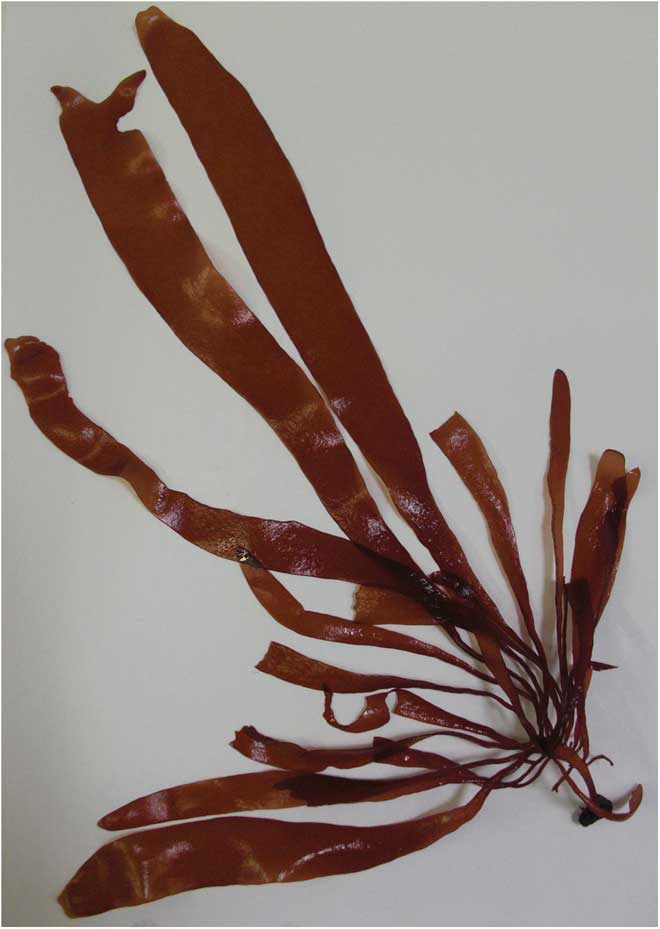
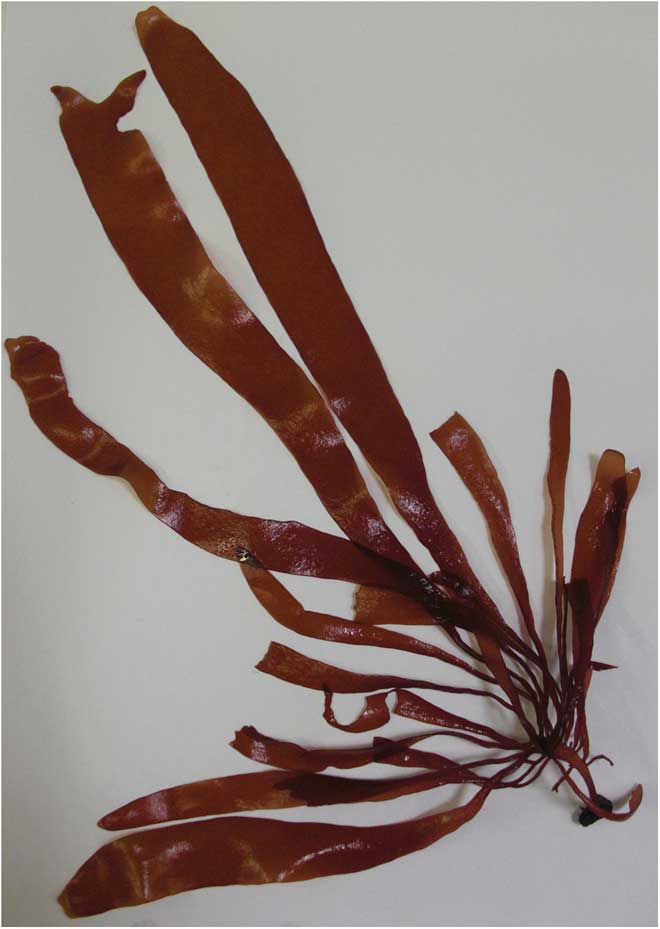
Palmaria decipiens is characterized by a thallus up to 70 cm long, with a reddish to purple colour and a slippery glossy surface (Fig. 1). It is a pseudoperennial macroalga with its major growth period in late winter and spring (i.e. October–December). The first year frond is simple, i.e. an unbranched, lanceolate blade with a width of 8–15 cm arising from the holdfast. Older plants proliferate from the base of the previous year's blade. Generally, blades are attenuated to a terete, narrow stipe from a minute, discoid holdfast. A characteristic feature is the two to three cell thick medulla with nearly isodiametric cells and cruciately divided tetrasporangia embedded in a cortex (Ricker Reference Ricker1987, Wiencke & Clayton Reference Wiencke and Clayton2002).
Photograph of Palmaria decipiens thallus. Each blade represents one thallus.
Life cycle and reproduction
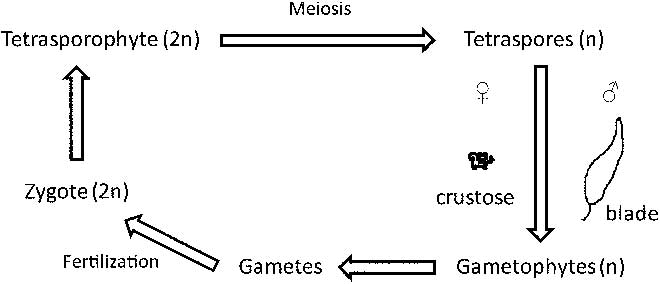
The life cycle and reproduction of Palmariales had been unresolved until the discovery of the microscopic female gametophyte and the lack of carposporophytes in Palmaria palmata, the northern congener species of P. decipiens, by Van der Meer & Todd (Reference Van der Meer and Todd1980). Seven years later, Ricker (Reference Ricker1987) reported the development of the female gametophyte of P. decipiens for the first time. Half of the tetraspores of the alga germinate into spherical, irregularly shaped cell crusts, the female gametophytes bearing colourless, sessile carpogonia, which develop trichogynes shortly after settlement of tetraspores. Male gametophytes are similar in morphology to the tetrasporophytes. Spermatangia have, however, not been observed so far (Wiencke & Clayton Reference Wiencke and Clayton2002). As growth and development of males is much slower than of females, fertilization of females is only possible by mature males of the previous season, indicating a life span for Palmariales of several years (Van der Meer & Todd Reference Van der Meer and Todd1980 for P. palmata, Wiencke Reference Wiencke1990). The fertilized female will be overgrown by sporophytes, which will become mature and release tetraspores after undergoing meiosis (Van der Meer & Todd Reference Van der Meer and Todd1980, see Fig. 2).
Simplified life cycle of Palmaria decipiens (modified after Van den Hoek et al. Reference Van den Hoek, Mann and Jahns1995). Note that spermatia fertilize previous year's female gametes.
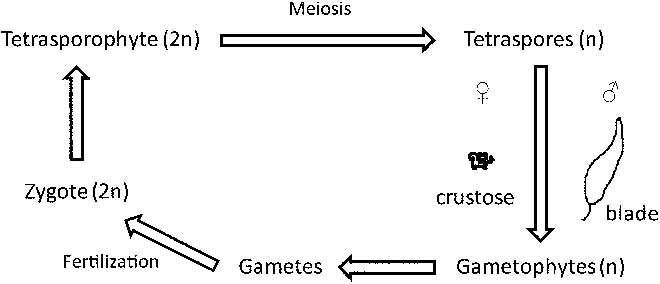
Interestingly, seasonal growth is supposed to be triggered by daylength in P. decipiens (Wiencke Reference Wiencke1990, Wiencke et al. Reference Wiencke, Gómez and Dunton2009). The optimum growth period of the alga coincides with increasing light intensities in spring, which is regarded as an adaptation to the strong seasonality in the light climate in Antarctica. This is classified as a “season anticipation” strategy (sensu Kain Reference Kain1989; Wiencke Reference Wiencke1990, Wiencke et al. Reference Wiencke, Gómez and Dunton2009).
Geographic distribution and habitat
Palmaria decipiens is one of at least 37 rhodophyte species endemic to Antarctica (Wiencke & Clayton Reference Wiencke and Clayton2002, Hommersand et al. Reference Hommersand, Moe, Amsler and Fredericq2009). It occurs in the whole Antarctic region from 77°S in the Ross Sea to a few sub-Antarctic islands (detailed information in Ricker Reference Ricker1987). It inhabits lower intertidal zones as well as depths down to 30 m (Wiencke & Clayton Reference Wiencke and Clayton2002). The northern distribution limit is most probably determined by the 4°C winter isotherm as growth rates are optimal at temperatures ≤ 5°C and almost zero at 10°C (Müller et al. Reference Müller, Laepple, Bartsch and Wiencke2009).
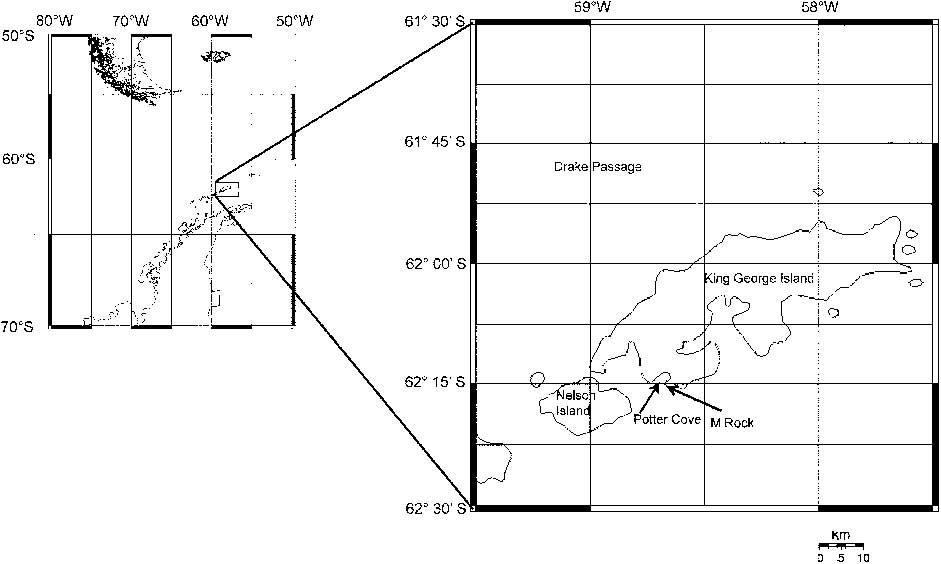
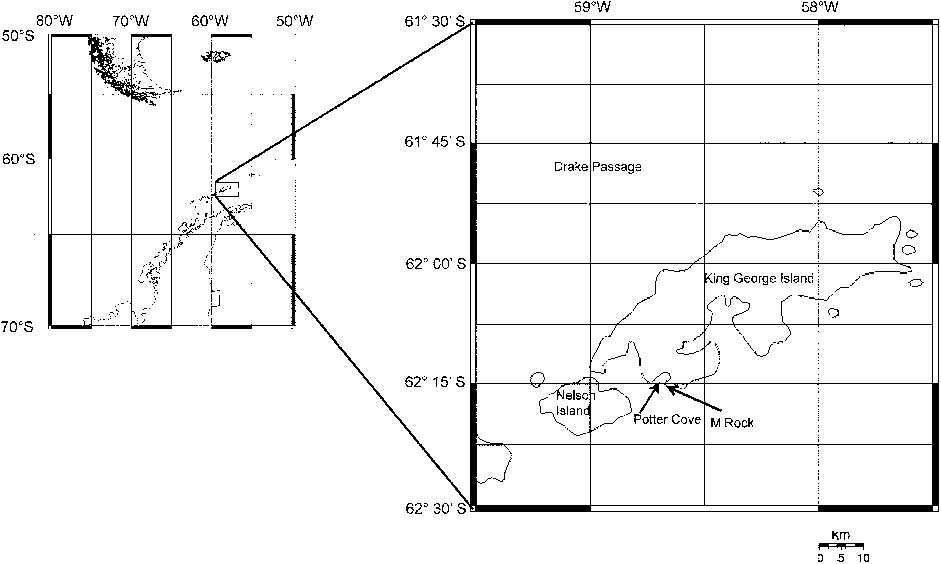
Studies by Klöser et al. (Reference Klöser, Ferreyra, Schloss, Mercuri, Laturnus and Curtosi1993, Reference Klöser, Quartino and Wiencke1996) using video recording in the Potter Cove area on King George Island have shown that P. decipiens is a very common species on hard bottom substrate to 30 m depths. Hard substrate may be found directly underneath the glacier foot on the western side of the bay, at the mouth of the bay, Barton Peninsula and the intertidal platform further outside the bay with its characteristically rising monolith M Rock. In these areas, P. decipiens may form dense stands, especially after community disruption through ice scouring and subsequent exclusion of competing species (Zielinski Reference Zielinski1990, Klöser et al. Reference Klöser, Ferreyra, Schloss, Mercuri, Laturnus and Curtosi1993, see Fig. 3).
Map of King George Island and the Potter Cove area (generated with www.aquarius.org, IfM-GEOMAR, Kiel, Germany).
Physiological responses to environmental conditions
Temperature
Antarctic water temperatures are very stable throughout the year and even surface temperatures usually do not vary strongly during the seasons. This temperature constancy is determined by the particular oceanographic situation of Antarctica: surrounded by the circumpolar current driven by strong westerly winds, water masses within the Polar Front are almost isolated from neighbouring oceans (Rintoul et al. Reference Rintoul, Hughes and Olbers2001). For instance, around King George Island water temperatures range seasonally between -1.8 and +2°C (Klöser et al. Reference Klöser, Ferreyra, Schloss, Mercuri, Laturnus and Curtosi1993, Wiencke et al. Reference Wiencke, Bartsch, Bischoff, Peters and Breeman1994, Wiencke Reference Wiencke1996). In recent years, however, an increase of about 1.5°C has been documented in winter (Schloss et al. Reference Schloss, Ferreyra, González, Atencio, Fuentes, Tosonotto, Mercuri, Sahade, Tatián and Abele2008).
Most endemic Antarctic seaweeds are strongly cold adapted with growth temperatures between 0 and 10°C and an optimum at ≤ 5°C (e.g. Wiencke & Dieck Reference Wiencke and Dieck1989). Their upper survival temperature is usually within the range of 7–18°C (Wiencke et al. Reference Wiencke, Bartsch, Bischoff, Peters and Breeman1994, Bischoff-Bäsmann & Wiencke Reference Bischoff-Bäsmann and Wiencke1996). Generally, Antarctic species such as P. decipiens exhibit the lowest temperature requirements for growth and survival worldwide (Wiencke et al. Reference Wiencke, Bartsch, Bischoff, Peters and Breeman1994). These adaptations can be related to their evolutionary history in combination with the long cold water history of Antarctica that began with the glaciation of East Antarctica 38 m.y.a. and which reached West Antarctica at least 9 m.y.a. (Zacher et al. Reference Zacher, Rautenberger, Hanelt, Wulff and Wiencke2009 and references therein). Overall, water temperature is considered to be the determining factor for macroalgal geographic distribution (Lüning Reference Lüning1990, Wiencke et al. Reference Wiencke, Clayton, Gómez, Iken, Lüder, Amsler, Karsten, Hanelt, Bischof and Dunton2007). The northern distribution limits of Antarctic macroalgae are often determined by winter water temperatures that allow growth and reproduction of the most sensitive early life stages (Wiencke & Dieck Reference Wiencke and Dieck1989). The northernmost location at which P. decipiens occurs, is Macquarie Island (54°S, 158°E), where water temperatures of 5–8°C coincide well with the maximum growth temperature of this species (Wiencke & Dieck Reference Wiencke and Dieck1989).
The first studies on temperature effects on Antarctic macroalgal species, including P. decipiens, were carried out on Signy Island in 1977 by Drew. It was demonstrated that photosynthetic rates, measured as μg C m-2 h-1 towards a maximum at temperatures between 11 and 18°C, with a subsequent sharp decline at higher temperatures. Maximum carbon fixation rates of 6–8 μg C m-2 h-1 were recorded for P. decipiens at the temperature optimum of photosynthesis (Drew Reference Drew1977). These results contrasted the optimum temperatures for growth of the species. Drew argued that this temperature-photosynthesis pattern does not reflect an adaptation towards the low temperatures in the environment. On the other hand, the fact that Antarctic species exhibit similar carbon fixation and photosynthetic rates as temperate algae at higher temperatures points to a considerable low temperature adaptation (Thomas & Wiencke Reference Thomas and Wiencke1991). These latter authors also documented differences in photosynthetic rates with respect to thallus age. Young P. decipiens thalli had rates of oxygen production almost twice as high as older plants and the same applied to rates of dark inorganic carbon fixation. In contrast, light independent carbon fixation rates are higher in older tissues (Thomas & Wiencke Reference Thomas and Wiencke1991).
Interestingly, studies performed on male gametophytes, monitoring growth rates for several weeks, showed that optimal photosynthesis is at 15°C which is considerably above optimum growth temperature and much higher than Antarctic water temperatures (Wiencke & Dieck Reference Wiencke and Dieck1989, Reference Wiencke and Dieck1990, Wiencke Reference Wiencke1990, Wiencke et al. Reference Wiencke, Rahmel, Karsten, Weykam and Kirst1993, Eggert & Wiencke Reference Eggert and Wiencke2000). Nevertheless, especially the intertidal specimens of P. decipiens may endure and survive periods of freezing events and subzero temperatures during low tide conditions.
More recently, studies on the interactive effects of temperature and increasing radiation intensities have been performed to get a more complete picture of the influence of environmental factors on the physiology of P. decipiens (Becker et al. Reference Becker, Graeve and Bischof2010, Reference Becker, Walter and Bischof2009). These studies revealed that photosynthetic performance of subtidal Palmaria specimens was strongly inhibited at 0°C and high radiation conditions in comparison to 8°C and the same radiation conditions (Becker et al. Reference Becker, Walter and Bischof2009). This impairment is thought to be due to slowed down enzymatic reactions at lower temperatures, whereas high light intensities consequently may result in an increase in the generation of reactive oxygen species. Additionally, low temperature might alter membrane fluidity, which subsequently influences turnover rates of proteins, such as the reaction centre D1 protein localized in photosystem II (Aro et al. Reference Aro, Virgin and Andersson1993, Reference Aro, Suorsa, Rokka, Allahverdiyeva, Paakkarinen, Saleem, Battchikova and Rintamaki2005, Becker et al. Reference Becker, Graeve and Bischof2010). Furthermore, mesocosm experiments applying elevated temperatures at ambient radiation intensities showed that specimens from two shore levels (intertidal and subtidal) exhibited decreasing maximum quantum yields of photosynthesis, with the intertidal specimens exposed at 5–10°C being most affected (Becker et al. Reference Becker, Graeve and Bischof2010). Ambient atmospheric radiation intensities in these mesocosm experiments meant an overall photosynthetically active radiation (PAR, 400–700 nm) intensity increase as well as a change in light spectrum compared to in situ conditions for specimens from both shore levels. Hence, in that study it was concluded that even optimum photosynthetic temperatures of 5–10°C cannot compensate for stressful physiological conditions under elevated light intensities (Becker et al. Reference Becker, Graeve and Bischof2010).
Salinity
The distribution of macroalgae was investigated along gradients of the physio-chemical conditions occurring within Potter Cove on King George Island (Klöser et al. Reference Klöser, Ferreyra, Schloss, Mercuri, Laturnus and Curtosi1993). Abiotic parameters such as light, temperature, salinity and sediment input at two different sites were correlated to the macroalgal species present and characteristic community structures were detected (Klöser et al. Reference Klöser, Ferreyra, Schloss, Mercuri, Laturnus and Curtosi1993). One of the stations was close to a glacier, while the other one was closer to the mouth of the bay, so the latter was less affected by ice scouring or changing salinities (Klöser et al. Reference Klöser, Ferreyra, Schloss, Mercuri, Laturnus and Curtosi1993). However, measurable effects of salinity changes on macroalgal community structure were absent. Although it had been reported previously that high densities of Palmaria decipiens might indicate enhanced freshwater input, this finding could not be confirmed in the study in Potter Cove (Klöser et al. Reference Klöser, Ferreyra, Schloss, Mercuri, Laturnus and Curtosi1993 and references therein). Palmaria decipiens seems to be very abundant not only in coastal areas located in close proximity to Fourcade Glacier and especially in new ice-free areas (M.L. Quartino unpublished data), but also in the intertidal zone with pronounced salinity changes and subtidal zones with full marine salinity (Klöser et al. Reference Klöser, Ferreyra, Schloss, Mercuri, Laturnus and Curtosi1993, Quartino et al. Reference Quartino, Zaixso and de Zaixso2005). Thus, this euryhaline species may be regarded as opportunistic in terms of settlement and may outcompete other common dominant species. Particularly in newly opened areas following glacier retreat, which are characterized by intense ice scouring, P. decipiens can build dense stands (Klöser et al. Reference Klöser, Ferreyra, Schloss, Mercuri, Laturnus and Curtosi1993, S. Becker unpublished data).
Generally, under climate change scenarios, an increase in freshwater input due to glacial runoff is expected to cause decreasing salinities in coastal areas. In a short-term experiment by Becker (unpublished data) the effects of changing salinities on P. decipiens from different shore levels were investigated. Specimens from the intertidal as well as the subtidal were exposed to decreasing salinities ranging from 28 to 5 for five days at light intensities of 53 μmol photons m-2 s-1. Photosynthetic performance was measured as chlorophyll fluorescence via a pulse amplitude modulated chlorophyll fluorometer (PAM 2100, Walz, Effeltrich, Germany). Photosynthetic efficiency (Fv/Fm) was nearly unaffected by changing salinities except at 5 Fv/Fm values, at which level values did decrease significantly. Similar responses were observed for specimens from both shore levels. In intertidal specimens a greater tolerance to low salinities is probable since these algae may become fully exposed to air during low tide. If this coincides with rainfall, specimens are exposed to strongly reduced salinities. But subtidal algae inhabiting the hard substrate in close proximity to glaciers also experience freshwater input during melting events in summer seasons. Since stratification is rare in Potter Cove (Klöser et al. Reference Klöser, Ferreyra, Schloss, Mercuri, Laturnus and Curtosi1993) due to vertical mixing by strong winds, common in these high latitudes, a broad level of tolerance is essential to cope with changing salinity.
In respect of the effects of increased freshwater input on the photosynthetic capacity (expressed as the relative maximal electron transport rate, rETRmax) a similar pattern as for Fv/Fm values was found. Relative maximal electron transport rate values of intertidal specimens decreased during the exposure to 60% of the initial value with the strongest impact found at salinities of 5. However, photosynthetic capacity of subtidal specimens was less affected. Relative maximal electron transport rate values decreased over time by only 20% of the initial value. However, algae exposed to salinity of 5 died after the second day of the treatment. Nevertheless, these experiments indicate a strong tolerance towards salinity changes in the habitat. We regard P. decipiens to be a pioneer species, often found in disturbed zones, where a high tolerance towards abiotic changes might be evolutionarily advantageous.
In this context, internal osmolytes may play an important role. It has been shown by Karsten et al. (Reference Karsten, Wiencke and Kirst1990) that P. decipiens exhibits traces of ß-dimethylsulphoniopropionate (DMSP). This low molecular weight compound is known to act as a protectant under low temperatures. For instance, under externally increased salinities the concentration of internal DMSP is also enhanced (Karsten et al. Reference Karsten, Wiencke and Kirst1990, Kirst & Wiencke Reference Kirst and Wiencke1995). Usually, increased amounts are observed at increased light intensities, low temperatures, cell age and population densities. Nevertheless, detailed knowledge about the role of osmolytes is still lacking for P. decipiens and remains an interesting field of research.
Photosynthesis and pigments
Most of the experiments carried out on Palmaria decipiens so far have also considered photosynthetic performance as a marker for physiological fitness of the alga and its ability to cope with the particular Antarctic conditions as well as with a changing environment (e.g. Drew Reference Drew1977, Thomas & Wiencke Reference Thomas and Wiencke1991, Wiencke et al. Reference Wiencke, Rahmel, Karsten, Weykam and Kirst1993, Eggert & Wiencke Reference Eggert and Wiencke2000, Becker et al. Reference Becker, Walter and Bischof2009, Reference Becker, Graeve and Bischof2010). In a study by Weykam & Wiencke (Reference Weykam and Wiencke1996) photosynthetic performance of P. decipiens was observed throughout an annual cycle under fluctuating radiation intensities mimicking Antarctic daylengths. Photosynthetic performance measured via oxygen production was maximal during late winter/early summer conditions (November/December), which was shortly after the observation of maximal growth rates in late winter (October/November, Weykam & Wiencke Reference Weykam and Wiencke1996). As already concluded by Thomas & Wiencke (Reference Thomas and Wiencke1991), the early growth in late winter prepares the alga for an optimal use of favourable light conditions in early summer with freshly grown photosynthetic tissue. Generally, photosynthesis vs irradiance curves (PI curves) recorded during spring (October) and winter (July) conditions showed a higher photosynthetic capacity (Pmax) in spring (Weykam & Wiencke Reference Weykam and Wiencke1996). Photosynthetic and metabolic demands are generally very low for Antarctic endemic species. Palmaria decipiens is able to grow under very low light conditions of only 47 mol m-2 yr-1 and growth has been suggested to be triggered by daylength (Wiencke Reference Wiencke1990, Reference Wiencke1996, Lüder et al. Reference Lüder, Knoetzel and Wiencke2001a). In extreme cases, photosynthetic pigments (in this case chlorophyll a (chl a) and phycobiliproteins) may be totally degraded during winter conditions, as has been shown by Lüder et al. (Reference Lüder, Knoetzel and Wiencke2001a, Reference Lüder, Wiencke and Knoetzel2002). In an experiment simulating six months of darkness by the end of the dark period P. decipiens has lost most of its pigments and thus, its ability to photosynthesize (Lüder et al. Reference Lüder, Wiencke and Knoetzel2002). Within 24 hours of re-illumination, chl a and phycobiliproteins were newly synthesized and within a couple of days photosynthetic performance reached comparable values to pre-darkness conditions and growth was induced. The first pigment to be accumulated after light exposure was chl a, followed by the phycobiliproteins shortly afterwards (Lüder et al. Reference Lüder, Wiencke and Knoetzel2002). These proteins are organized in phycobilisomes and play an important role for shade adapted plants and algae to increase light harvesting efficiency in that range of the radiation spectra which is hardly exploited by chlorophylls. Hence, especially deep growing rhodophytes or those living in regions that are light limited as Antarctica, usually contain high amounts of phycobilisomes. Interestingly, Lüder et al. (Reference Lüder, Knoetzel and Wiencke2001b) discovered a separation of phycobilisomes into two different sized bands by using gel electrophoresis, which showed different ways of degradation during the dark period. These authors demonstrated that the lower subunit disappears completely in darkness and suggested that different physiological functions of the subunits might be an advantage for P. decipiens in the acclimation process to seasonal light conditions (Lüder et al. Reference Lüder, Knoetzel and Wiencke2001b). By modulating its pigment content, P. decipiens is able to adapt quickly to the respective radiation conditions in Antarctica. The alga possesses maximal pigment concentrations during favourable spring light conditions and decreases chl a and the phycobiliprotein content during summer to avoid photodamage through excessive radiation intensities (Lüder et al. Reference Lüder, Knoetzel and Wiencke2001a, Reference Lüder, Knoetzel and Wiencke2001b, Reference Lüder, Wiencke and Knoetzel2002). It is important to note that there are existing photoprotective mechanisms in macroalgae via carotenoids that participate in the dissipation of heat from excessive radiation (e.g. Franklin & Forster Reference Franklin and Forster1997, Fredersdorf & Bischof Reference Fredersdorf and Bischof2007), but these mechanisms mainly apply to Chlorophyta and Phaeophyceae. Studies addressing such mechanisms in P. decipiens are lacking so far.
In accordance with the findings of Lüder et al. (Reference Lüder, Knoetzel and Wiencke2001a, Reference Lüder, Knoetzel and Wiencke2001b, Reference Lüder, Wiencke and Knoetzel2002), Becker et al. (Reference Becker, Graeve and Bischof2010) showed that specimens from different shore levels exhibit particularly different chl a to phycobiliprotein ratios. Subtidal specimens have a higher amount of the antennae pigments phycoerythrin and phycocyanin and are thus well adapted to the lower light intensities compared to those found in the intertidal zone. This indicates that P. decipiens specimens may react flexibly to their given habitat and reveal physiological plasticity.
Photoprotection
Low values for initial saturation of photosynthesis (Ik) coupled with a high initial slope of the PI curve (alpha) are typical for shade adapted plants (Wiencke 1993, Weykam et al. Reference Weykam, Gómez, Wiencke, Iken and Klöser1996, Weykam & Wiencke Reference Weykam and Wiencke1996, Eggert & Wiencke Reference Eggert and Wiencke2000, Becker unpublished data). Although being considered as strongly shade adapted (e.g. Wiencke Reference Wiencke1990, Weykam & Wiencke Reference Weykam and Wiencke1996), P. decipiens is able to cope with high radiation intensities up to 1500 μmol photons m-2 s-1 through down regulation of photosynthetic performance via dynamic photoinhibition (Hanelt et al. Reference Hanelt, Jaramillo, Nultsch, Senger and Westermeier1994). Thus, the alga may withstand even stressful light conditions that might occur during low tide. However, recovery is slower than, for example, in the phaeophyte Adenocystis utricularis (Bory de Saint-Vincent; Hanelt et al. Reference Hanelt, Jaramillo, Nultsch, Senger and Westermeier1994, Reference Hanelt, Melchersmann, Wiencke and Nultsch1997). Dynamic photoinhibition functions as a photoprotective mechanism by which excessive light energy is dissipated as harmless heat (Hanelt et al. Reference Hanelt, Jaramillo, Nultsch, Senger and Westermeier1994 and references therein). Photosynthetic variables (fluorescence and oxygen production) measured at the highest radiation intensities around noon decreased to a minimum and recovered with decreasing intensities until solar irradiances became subsaturating. In their study, Hanelt et al. (Reference Hanelt, Jaramillo, Nultsch, Senger and Westermeier1994) were able to detect a diurnal pattern in dynamic photoinhibition in P. decipiens, which was more pronounced in intertidal specimens than in those from the subtidal.
Lipid content and fatty acid composition
A baseline study by Graeve et al. (Reference Graeve, Kattner, Wiencke and Karsten2002), in which lipid composition was analysed for a number of Antarctic macroalgae provided fatty acid (FA) contents of polar macroalgae. The authors found high amounts of 20:5(n-3), which characterizes marine organisms and also indicates a phylogenetical old lineage (Graeve et al. Reference Graeve, Kattner, Wiencke and Karsten2002). In general, the most abundant FAs of Antarctic rhodophytes including P. decipiens were 16:0, 20:5(n-3), 16:1(n-7) and 20:4(n-6), with an extremely high level of polyunsaturated FAs (Graeve et al. Reference Graeve, Kattner, Wiencke and Karsten2002).
Becker et al. (Reference Becker, Graeve and Bischof2010) showed the ability of the alga to adjust FA composition with changing environmental factors such as temperature and light. In total, 32 different FAs present in P. decipiens were analysed, with 16:0 as the most abundant. However, during the exposure to increased light intensities (in comparison to in situ light intensities) and two different temperatures over three weeks, 18:0 became the most abundant FA. For unsaturated FA Becker et al. (Reference Becker, Graeve and Bischof2010) found an overall increase in concentrations in specimens from the subtidal. In specimens originating from the intertidal zone, an overall decrease in FA content was observed, with an increase of saturated FA over time. The authors argued that this adjustment of FA might indicate that P. decipiens can react to changing temperatures by modulating the FA content and thus, may maintain membrane fluidity (Becker et al. Reference Becker, Graeve and Bischof2010).
Effects of ultraviolet radiation (UV, 280–400 nm)
Ozone depletion was first reported in 1985 over Antarctica (Farman et al. Reference Farman, Gardiner and Shanklin1985) and is severely affecting life in both polar regions. The Atlantic sector of the Antarctic continent between 70°S and 80°S is especially influenced by increasing UV irradiances as a result of ozone depletion. Therefore, a lot of work has been undertaken to understand physiological and biochemical processes that might adapt to changes in UV radiation as well as possible strategies of polar organisms to cope with a changing radiation environment.
UV protective mechanisms
A variety of organisms contain mycosporine-like amino acids (MAAs), low molecular weight, water soluble molecules that absorb in the range of 310–365 nm and are therefore regarded as UV protecting metabolites (Oren & Gunde-Cimerman Reference Oren and Gunde-Cimerman2007).
Mycosporine-like amino acids act as natural UV screening compounds and are found in a variety of organisms and in especially high amounts in red macroalgae (Shick & Dunlap (Reference Shick and Dunlap2002)). Generally, Antarctic red algal species were found to exhibit higher amounts of MAAs than Arctic species, which may be due to the different radiation climates in the two regions (Hoyer et al. Reference Hoyer, Karsten and Wiencke2002). Studies by Hoyer et al. (Reference Hoyer, Karsten and Wiencke2002) have shown that P. decipiens differentially accumulates MAAs in a flexible response to different light regimes. Within their experiments, P. decipiens was exposed to different radiation treatments, comprising PAR only, PAR+UV-A (ultraviolet radiation A, 320–400 nm) and PAR+UV-A+UV-B (ultraviolet radiation B, 280–320 nm). Under the conditions applied, P. decipiens exhibited an increase in total MAA content, with the highest concentrations in samples treated with the full radiation spectrum (Hoyer et al. Reference Hoyer, Karsten and Wiencke2002). Up to seven different MAAs were induced in P. decipiens, particularly shinorine, porphyra-334, palythine and asterina-330 as well as traces of usujirene. The same MAAs were found in the northern congener species P. palmata. The increase in concentrations was most pronounced for porphyra-334 (for structural details see Dunlap & Shick Reference Dunlap and Shick1998, Hoyer et al. Reference Hoyer, Karsten and Wiencke2002).
Overall, the content of MAAs in P. decipiens is flexibly induced in response to changing irradiances. It is also depth-related, as shallow water specimens contain higher amounts of MAAs than subtidal specimens (Hoyer et al. Reference Hoyer, Karsten and Wiencke2002). Concentrations of MAAs differ even among the different tissues of one individual organism, with marginal tissues having four times higher amounts of MAAs than basal tissues. According to Hoyer et al. (Reference Hoyer, Karsten, Sawall and Wiencke2001) this may be due to higher growth activities in basal tissues and thus, differences in cell wall thickness. Additionally, Post & Larkum (Reference Post and Larkum1993) have shown previously that tissue concentration of MAAs in P. decipiens varied according to the season, with highest concentrations in summer. Based on their studies and from a comparison of different Antarctic species, Hoyer et al. (Reference Hoyer, Karsten, Sawall and Wiencke2001, Reference Hoyer, Karsten and Wiencke2002) proposed a classification into different physiological groups: a) species generally lacking MAAs and showing no induction mechanism, these being mostly subtidal species, b) species always maintaining a certain amount of MAAs in varying concentrations depending on the environmental conditions, and c) species always containing high concentrations of MAAs in regard to their high light environment, these being species of intertidal and supralitoral zones. In this classification P. decipiens belongs in group b (Hoyer et al. Reference Hoyer, Karsten, Sawall and Wiencke2001, Reference Hoyer, Karsten and Wiencke2002).
Physiology, ultrastructure and gene expression under UV exposure
Experiments performed by Michler et al. (Reference Michler, Aguilera, Hanelt, Bischof and Wiencke2002) revealed the negative influence of UV radiation on photosynthetic performance and on growth rates of P. decipiens, where P. decipiens grew significantly less under the full light spectra in comparison to PAR only. Although photosynthetic parameters such as Fv/Fm and rETRmax differed only slightly, highest values were measured in treatments without UV radiation (Michler et al. Reference Michler, Aguilera, Hanelt, Bischof and Wiencke2002).
In short-term, unifactorial UV experiments, Poppe et al. (Reference Poppe, Hanelt and Wiencke2002, Reference Poppe, Schmidt, Hanelt and Wiencke2003) investigated ultrastructural changes in P. decipiens occurring during UV exposure. They showed that the ultrastructure of chloroplasts as well as mitochondria changed significantly after exposure to UV radiation for six to eight hours. The thylakoids disrupted and formed translucent vesicles carrying stroma and phycobilisomes inside (Poppe et al. Reference Poppe, Hanelt and Wiencke2002). During continued exposure, these changes disappeared again and cells showed a similar ultrastructure to control specimens. Another study by Poppe et al. (Reference Poppe, Schmidt, Hanelt and Wiencke2003) confirmed that these ultrastructural changes were correlated to exposure time and that the damage in the chloroplast fine structure became apparent in widened thylakoids and the development of vesicle-like formations. Continuing exposure led to thylakoids disruption and the formation of inside-out vesicles. In mitochondria, UV exposure led to swollen and mostly to tubuli of the sacculi type, whereas nuclei, golgi bodies and the endoplasmatic reticulum generally remained unaffected (Poppe et al. Reference Poppe, Schmidt, Hanelt and Wiencke2003). Overall, these changes were reversible even under continued exposure.
Regarding photosynthetic performance and (stress-)reactions, an important factor is the functioning and turnover rate of the D1-protein, which is located in photosystem II (PSII, e.g. Aro et al. Reference Aro, Virgin and Andersson1993, Reference Aro, Suorsa, Rokka, Allahverdiyeva, Paakkarinen, Saleem, Battchikova and Rintamaki2005). Expression of the psbA gene which encodes for the D1-protein and the rbcL gene, encoding for the large subunit of RubisCO which is the key enzyme of carbon dioxide fixation, was studied in detail by Poppe et al. (Reference Poppe, Schmidt, Hanelt and Wiencke2003). Palmaria decipiens was exposed to varying UV radiations that either mimicked normal Antarctic conditions or higher UV intensities that might occur during midday in summer under ozone depleted conditions. They found that under moderate UV intensities both transcripts increased during 16 hours UV exposure and remained high even in darkness, with the most pronounced increase during the first two hours of exposure. During longer exposure to higher intensities, transcripts increased constantly until the end of exposure, whereas transcripts in control specimens exposed to PAR only increased during the first three days and then declined. Transcripts for RubisCO were at a lower level than those of D1 and showed a maximum at the end of exposure (Poppe et al. Reference Poppe, Schmidt, Hanelt and Wiencke2003). Poppe et al. (Reference Poppe, Schmidt, Hanelt and Wiencke2003) argued that this increase might be due to an increased requirement for D1 and RubisCO, as light-dark fluctuations had been observed previously.
Ecological parameters
Biomass and abundance
Palmaria decipiens is predominantly epilithic but also sometimes epiphytic and usually occurs in the lower eulittoral and upper sublittoral down to 15–30 m. The individual recordings down to several hundred metres depths by Zaneveld (Reference Zaneveld1966) in the Ross Sea need confirmation. In the eulittoral the alga can be the dominant canopy species, whereas in the sublittoral it is a common understorey species below the large brown macroalgal stands (Wulff et al. Reference Wulff, Iken, Quartino, Al-Handal, Wiencke and Clayton2009). On King George Island the upper sublittoral is dominated by the phaeophyte Desmarestia menziesii J. Agardh and P. decipiens is commonly competing with Iridaea cordata (Turner) Bory and Curdiea racovitzae Hariot at the same littoral fringe (DeLaca & Lipps Reference DeLaca and Lipps1976, Zielinski Reference Zielinski1981, Heywood & Whitaker Reference Heywood and Whitaker1984, Quartino et al. Reference Quartino, Klöser, Schloss and Wiencke2001). In a detailed study investigating biomass and abundance of macroalgae on King George Island, carried out at an inner site of Potter Cove, P. decipiens was recorded to be one of the most abundant species in terms of density on the rocky surfaces but not the most dominant one in terms of biomass (Quartino et al. Reference Quartino, Klöser, Schloss and Wiencke2001). Individual size of the specimens ranged from small germlings up to large plants with blades of 60 cm. The mean dry biomass found was from 5.57–20.81 g m-2, which is comparable to the biomass estimate found for the competing species I. cordata (Quartino et al. Reference Quartino, Zaixso and de Zaixso2005).
Later studies corroborated the presence of P. decipiens along the rocky surfaces of Potter Cove and surrounding areas (Quartino et al. Reference Quartino, Zaixso and de Zaixso2005, Quartino & de Zaixso Reference Quartino and de Zaixso2008). The recorded frequency (percentage of sample units where the species was present) in the whole area was, however, relatively low (19.37%). This indicates that this species is only present at particular sites and depths. Palmaria decipiens can grow on severely to extremely exposed sites, especially on weakly inclined, not too steep slopes. The species is obviously able to tolerate the steady movements of surge waves but not sudden breakers battering against steep rock faces. In such situations as at M Rock outside Potter Cove the species is principally growing in crevices on the vertical face (Klöser et al. Reference Klöser, Quartino and Wiencke1996). In a new classification system based on abiotic conditions of the respective macroalgal habitat, Quartino et al. (Reference Quartino, Zaixso and de Zaixso2005) proposed P. decipiens to an indicator species for group B. Species of this group prefer boulder substrate at intermediate depths of 6–15 m with low temperatures down to subzero degrees. Regarding radiation and salinity, species belonging to group B settle in intermediate PAR ranges as well as at intermediate to low salinities (> 33.5) with intermediate nitrogen concentrations, which are generally not limiting in Antarctic waters (Quartino et al. Reference Quartino, Zaixso and de Zaixso2005).
In Antarctic coastal waters, ice formation and ice scouring are probably the most structuring factors of macroalgal communities (Quartino et al. Reference Quartino, Zaixso and de Zaixso2005, Wulff et al. Reference Wulff, Iken, Quartino, Al-Handal, Wiencke and Clayton2009 and references therein). In general, assemblages and succession processes are always very distinct and highly dependent on a variety of abiotic and biotic forcings, so that at each moment each patch is in its very own succession state. Floating ice is considered to have the most disturbing impact in intertidal zones and is the main reason for the patchiness of communities (Quartino et al. Reference Quartino, Zaixso and de Zaixso2005). Interestingly, after ice abrasion, P. decipiens increases in biomass and may form characteristic and dense fringes, as reported for Marion Cove on King George Island (Chung et al. Reference Chung, Oh, Lee and Kim1994, Quartino et al. Reference Quartino, Zaixso and de Zaixso2005). A similar phenomenon was observed after the unusually strong winter in 2007 in Potter Cove, which neighbours Marion Cove. After sea ice break up, the intertidal platform of ‘Penon Uño’ was almost pure rock (macroscopically), but a P. decipiens cover developed within days (S. Becker unpublished data).
Climate warming has resulted in glacial retreat especially along the western Antarctic Peninsula (Braun & Gossmann Reference Braun and Gossmann2002). Consequently, new ice-free areas have become available for benthic colonization coinciding with an alteration of the characteristics of the water column. Increased sediment input and salinity changes, and changing ice disturbance patterns are expected in coastal areas. A particular example of this situation is at Potter Cove, where benthic macroalgal communities have been studied and monitored regularly over the last 18 years. In 1993–94, the sublittoral vegetation was documented by subaquatic video transects, providing information of the vertical macroalgal distribution (Klöser et al. Reference Klöser, Quartino and Wiencke1996). The soft bottom habitats of the inner cove were completely devoid of macroalgae and only some individuals were found on few boulders and stones of moraine deposits, which occurred in front of the glacier cliffs (Klöser et al. Reference Klöser, Quartino and Wiencke1996). Over the last years, an apparent melting of the Fourcade Glacier has exposed new ice-free areas, providing substrates for macroalgal colonization. In one of the most turbid new ice-free areas, located close to the glacier, P. decipiens was the only conspicuous species colonizing hard substrata. In this atypical situation P. decipiens appeared growing under very turbid conditions and low light conditions caused by sediment input.
Grazing and habitat
As P. decipiens is usually found in dense stands in shallow subtidal macroalgal communities (Amsler et al. Reference Amsler, Rowley, Laur, Quetin and Ross1995) and often dominates intertidal zones, it has been hypothesized that this rhodophyte plays a vital role in coastal ecosystem functionality forming the base of the food web. Research on grazer-alga interactions in Antarctica has been recently reviewed by Amsler et al. (Reference Amsler, Iken, McClintock and Baker2009). Palmaria decipiens is directly consumed by fish, e.g. Notothenia coriiceps Richardson and starfish Odentaster validus Koehler, an extremely abundant consumer and key stone predator in these waters (Iken et al. Reference Iken, Quartino and Wiencke1997, Amsler et al. Reference Amsler, Iken, McClintock, Amsler, Peters, Hubbard, Furrow and Baker2005). Besides direct consumption by fish and starfish, P. decipiens has also been reported to be grazed by amphipods Gondogeneia antarctica (Amsler et al. Reference Amsler, Iken, McClintock and Baker2009) and Paradexamine fissicauda Chevreux (Amsler et al. unpublished data) along the western Antarctic Peninsula. Palmaria decipiens is the only non-filamentous macroalga tested so far that is consumed by G. antarctica. There is evidence that at least one amphipod species feeds on this particular rhodophyte, but nonetheless only a few amphipods are directly associated with the alga in nature, at least during daylight where most of the sampling is conducted (Huang et al. Reference Huang, Amsler, McClintock, Amsler and Baker2007). An important question for future research would be to see if this pattern changes during night (Charles D. Amsler, personal communication 2009).
Macroalgae may exhibit chemical defences that may be induced as a protective mechanism to prevent excessive grazing activity (Amsler Reference Amsler2008). Although many macroalgae found in western Antarctic waters are known to produce secondary metabolites that aid in their defence against grazing, previous testing on P. decipiens indicated that it is palatable to the species mentioned above (Amsler et al. Reference Amsler, Iken, McClintock, Amsler, Peters, Hubbard, Furrow and Baker2005, Reference Amsler, Iken, McClintock and Baker2009, Huang et al. Reference Huang, McClintock, Amsler, Peters and Baker2006, Aumack et al. Reference Aumack, Amsler, McClintock and Baker2010).
Palmaria decipiens is the exclusive host of Elachista antarctica Skottsberg, which is a filamentous phaeophyte only found growing within, and emerging out of the thallus of P. decipiens (Wiencke & Clayton Reference Wiencke and Clayton2002, Peters et al. Reference Peters, Amsler, Amsler, McClintock, Dunbar and Baker2005). It is surprising that E. antarctica is present only on a palatable species of macroalgae considering that the standing biomass of other unpalatable species is very high. In order to confirm the palatability of P. decipiens, and to understand the relationship between E. antarctica and P. decipiens, feeding assays were conducted with four amphipods commonly associated with P. decipiens: Prostebbingia gracilis Chevreux, Gondogeneia antarctica, Oradarea bidentata K.H. Barnard and Paraphimedia integricauda Chevreux. Two different types of feeding assays were conducted to determine consumption rates (mg algae mg amphipod-1 h-1) of all four amphipod species. In “no choice” feeding assays, one amphipod was isolated with either P. decipiens or E. antarctica for specific periods of time. Preference or “choice” experiments in which an individual amphipod was offered a feeding choice between P. decipiens and E. antarctica were also conducted using all four amphipod species. Gondogeneia antarctica consumed both species but grazed P. decipiens at a faster rate than the epiphyte in both no choice and preference experiments, whereas P. gracilis, O. bidentata and P. integricauda fed on the epiphyte E. antarctica at much faster rates in both types of feeding assays (Bucolo et al. Reference Bucolo, Amsler, McClintock and Baker2011).
Studies by Campana (unpublished data) have shown that the palatability of P. decipiens is not affected by different radiation treatments after five hours of exposure. In her study, the alga was exposed to different radiation climates consisting of PAR alone, PAR+UV-A and PAR+UV-A+UV-B and apparently no differences in the palatability could be detected after exposure to UV radiation (Campana et al. Reference Campana, Quartino, Yousif and Wulff2008 and references therein, Campana et al. Reference Campana, Zacher, Fricke, Molis, Wulff, Quartino and Wiencke2009). However, in recruitment experiments under different radiation treatments, red algal recruitment (including P. decipiens) was negatively affected under UV exposure (Zacher et al. Reference Zacher, Wulff, Molis, Hanelt and Wiencke2007). Nevertheless, grazing reduces biomass and density significantly and is thus one of the major biotic factors in ecosystem structuring. In a two-factorial experiment dealing with the combination of UV radiation and grazing effects, interestingly, Zacher & Campana (Reference Zacher and Campana2008) found that subtidal specimens of P. decipiens were only growing in the presence of grazers, and P. decipiens especially revealed increased densities, while UV radiation overall significantly reduced algal densities regardless of the shore level.
Outlook and future perspectives
Although a lot of effort has been undertaken to study P. decipiens as one important representative species of the Antarctic macroalgal flora, interesting research questions still remain unanswered. For instance, attention should be given to investigating different life history stages of P. decipiens, including not only adult thalli, but also study germlings and spores. It has been shown in Alaria esculenta (L.) Greville (Phaeophyceae) that these early life stages of the alga are more susceptible to abiotic stress factors and are the most fragile link within the life cycle (e.g. Fredersdorf et al. Reference Fredersdorf, Müller, Becker, Wiencke and Bischof2009). For instance, germination as well as algal recruitment and settlement is reduced at increased UV intensities, and community shifts might occur under a changing radiation regime (Zacher et al. Reference Zacher, Wulff, Molis, Hanelt and Wiencke2007, Reference Zacher, Rautenberger, Hanelt, Wulff and Wiencke2009, Campana et al. Reference Campana, Quartino, Yousif and Wulff2008, Zacher & Campana Reference Zacher and Campana2008). If increases in PAR intensities impact these early life history stages to a greater extent than adult thalli, then surely different conclusions on future ecological consequences will be drawn. In addition to physiological monitoring, future investigations should also consider molecular and gene expression patterns for different life history stages of macroalgae.
Although, P. decipiens is able to cope with extensive periods of darkness by reducing its pigment content, it is still not clear how released carbon and nitrogen components will be translocated and processed. Weykam et al. (Reference Weykam, Thomas and Wiencke1997) found that survival in darkness is achieved by consuming floridean starch reservoirs. Additionally, in that study, it was shown that the first newly synthesized carbon is used for high priority growth, and subsequently new pigments are synthesized. The molecular mechanisms behind this pattern remain as yet unclear. Genetic mechanisms and how gene expression is triggered by environmental factors should also urgently be addressed in future research.
In terms of ecosystem function the dynamics of the biota in a changing environment play an important role, since patterns and frequency of grazing may vary under changing light regimes, as shown for example for amphipod grazing on P. decipiens (G.L. Campana unpublished data). In a broader sense, biotic factors such as grazing or inter- or intraspecific competition may influence population structure and individual fitness as well and should be included in our understanding of Antarctic coastal zones. At the level of community structure and grazing influence, changing grazing patterns under changing environmental conditions such as increased UV radiation, rising water turbidity, freshwater input or elevated temperatures need to be addressed with respect to the rapidly changing climate on the western Antarctic Peninsula. To what extent UV radiation influences palatability by changing macroalgal flavour for potential grazers should be addressed in future investigations. Also it needs to be taken into account that grazing might occur during the night or in darkness, so that data available to date might be under- or overestimating grazing rates and grazer influence. Increased input of turbid meltwater will undoubtedly lead to lower light conditions in the sublittoral. An important question to be answered is how the lower depth limit of P. decipiens will be affected by these changes and how this in turn affects the function of coastal Antarctic ecosystems.
Hence, the combined information of molecular techniques, ecophysiology and population ecology will contribute to understanding the response of the highly dynamic shallow benthic communities of Antarctica. The results presented here provide a deeper insight into adaptation and acclimation potential of an abundant Antarctic rhodophyte with a focus on its physiological and to an extent ecological abilities and represents a first step towards a comprehensive understanding of the adaptive capabilities of P. decipiens in the changing Antarctic environment.
Even nowadays Antarctic research is one the most challenging fields of investigation, and is also highly dependent on logistic support, so that research activities are often limited to accessible locations. Nevertheless, it would be of great interest and importance to investigate the key organisms in Antarctic ecosystems in order to understand basic physiological adaptations and predict ecosystem responses in an era of climate change.
Acknowledgements
Parts of the study were funded by the German Research Foundation (DFG Bi 772/7-1,2,3), which is gratefully acknowledged (SB, KB, CW). National Science Foundation awards OPP-0442769 and OPP-0442897 provided funding for PB. Antarctic Research is highly dependent on logistic support, our thanks goes to all logistic partners involved in each project. The constructive comments of the reviewers were also gratefully received.