Introduction
STATE-inflicted violence, including wars and foreign occupations, not only results in deaths, injuries, and the destruction and theft of property, it also leaves a substantial mental imprint on people in the localities where the violence is carried out—an imprint that can last long after the violence and oppression end. The historical memory of violence and oppression can thus result in long-lasting grievances against real and perceived perpetrators and their collective in-groups,Footnote 1 and these sentiments may have substantial political effects. A new and growing research agenda in political science studies the impact of experiences of state-inflicted violence and oppression on later political attitudes and behavior, including hostility to the real and perceived historical perpetrators of violence and oppression,Footnote 2 electoral turnout,Footnote 3 and electoral support for democracy.Footnote 4 Apparently, the experience of state-inflicted violence can have substantial implications for public opinion and national politics even decades after the violence and repression end.
But whether popular sentiments brought on by the historical experiences of state-inflicted violence and repression, including those carried out during foreign occupation, can affect international political factors, such as the level of public support for international organizations, has received much less scholarly attention. The British referendum on EU membership in 2016 is increasingly a subject of research,Footnote 5 and previous scholarship applies standard approaches to studying voter behavior to the different referenda about whether to join and further integrating within supranational entities like the European Union.Footnote 6 Almost no research has concerned itself with the role that historical grievances may have played in the outcomes of these referenda.Footnote 7
This article specifically studies the role played by the experience of foreign-inflicted violence and oppression on support for participation in supranational cooperative entities with former oppressor countries. It does so by studying the effect of violence during the German occupation of Denmark (1940–1945) in World War II on support for entering the European Economic Community (eec, the forerunner of the EU) in the 1972 Danish referendum on membership.
Danish opponents of membership in the eec framed the organization as a German-dominated entity, and in the campaign against Danish membership, these opponents specifically used anti-German rhetoric to make their case. In this article, I argue that this campaign would resonate better in communities where the German occupation forces inflicted more violence on civilians during the war.
In accordance with this argument, analyses of new and detailed data on German-inflicted violence and property destruction against civilians (the so-called “German terror”) in Danish municipalities during the German occupation do indeed suggest that municipalities that experienced more German terror had lower levels of support for entering the eec in the 1972 referendum.
One mechanism behind the effect of previous experiences of German terror on the lack of support for the eec was be higher electoral support for far-left parties in areas that saw more violence. The Danish far-left parties, along with the Danish Communist Party and its socialist successor parties, were the main political opponents of eec membership and were closely associated with the Danish resistance movement during the German occupation—an attribute that was used in the 1972 campaign against membership. The results of this study are robust to controlling for communist electoral support before the German occupation of Denmark, which suggests that the effects are not merely a function of German terror targeting areas with more far-left supporters before the occupation.
Typically, political legacy studies are not able to track the relative persistence of effects over substantial time periods using the same type of dependent variable.Footnote 8 But the frequent Danish eec/EU referenda after 1972 provide an exception. An investigation of these referenda after 1972 suggests that the effect of German terror on opposition to the eec/EU was persistent but declined substantially over time, as Danish left-wing parties changed their organizations and policy stances and became increasingly unable or unwilling to use anti-German rhetoric and allusions to Nazi Germany and the German occupation in their agitation against the EU.
The results of my research suggest that the experience of foreign-inflicted violence can be a substantial brake on public support for international political entities and on cooperation with former oppressor countries, and they also suggest that political parties play a pivotal role in translating historical grievances into resistance toward international cooperation. Furthermore, the results show that the effect of occupation violence on opposition to international collaboration with former occupiers can change substantially within one generation. Consequently, this article expands the existing literature on the legacies of war, violence, and oppression by adding a focus on outcomes directly related to international cooperation and institutions, which have received less attention in this literature. It also expands the literature by providing more precise estimates of whether and how the political effects of violence and oppression might persist and partly decline over time. The article also finds evidence, in line with findings from previous studies on historical grievances and conflicts,Footnote 9 that political parties play an important role in activating historical grievances and might benefit from them in the long run. The insights from this article thus hold implications for future studies of the legacies of violence, historical grievances, and skepticism toward international political integration.
The rest of the article has the following structure. I start by describing the background for the study, including German terror during the occupation of Denmark (1940–1945) and the Danish referendum on eec membership in 1972. Then, I lay out the theory for how German-inflicted violence affects later support for the eec. Next, I present the data and estimation before showing the effects of German-inflicted violence on opposition to Danish eec membership. Last, I investigate the mechanisms behind the results and investigate of the role played by German terror in later Danish eec/EU referenda, followed by a discussion of the results and the conclusion.
German Terror during the Occupation of Denmark
On April 9, 1940, Denmark was invaded and occupied by Nazi Germany. The Danish government initially choose to cooperate with the occupation forces, and a coalition government, with the support of most Danish parties, managed civilian affairs, including policing, in the first three years of the occupation.Footnote 10 During this period, there were substantial economic relations between Denmark and Nazi Germany,Footnote 11 and the Danish government even allowed, after the German invasion of the Soviet Union, for the recruitment of Danish nationals into the Waffen ss. In August 1943, however, the collaboration between the Danish political system and the occupation forces broke down, and German military and security forces, including its secret police organizations, the Gestapo and the sd (the ss's intelligence organization), which had previously had a very limited presence in Denmark, took control of the country. The breakdown of collaboration also caused an intensification of the armed resistance to German rule and increased the membership and political breadth of the Danish resistance movement,Footnote 12 which had previously been dominated by Danish communists and nonmainstream nationalist political actors.
The increased resistance toward the German occupation forces, including the use of sabotage and the killing of Danish collaborators, eventually made the Germans intensify their repression in the country. In retaliation to the resistance, beginning in early 1944, German security forces aided by Danish collaborators began murdering Danish civilians and carrying out sabotage of Danish civilian facilities. The majority of these killings and sabotage was carried out by a hit squad comprised of German and Danish members that was nick-named “Petergruppen”Footnote 13 and was under the command of the leader of the German security forces in Denmark, Otto Bovensiepen.Footnote 14
In general, the German security forces and their Danish collaborators seem to have targeted respected citizens and pillars of local communities, such as doctors, lawyers, employers, and to some extent, ordinary citizens.Footnote 15 They carried out sabotage against facilities and institutions, such as local businesses, newspapers, public places of entertainment,Footnote 16 and even private homes,Footnote 17 in a process that became known in Denmark as the German terror.Footnote 18
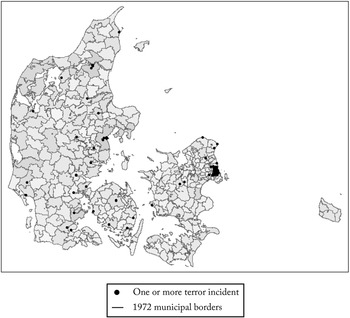
In total, more than one hundred Danish civilians were murdered or otherwise killed by German authorities and Danish collaborators during the German terror, at least nineteen people were the subject of attempted murder, and at least sixty-four people were wounded in bombings and other types of sabotage that also destroyed property amounting to over 84 million Danish kroner (in current valuation) and caused significant damages to notable buildings and entertainment facilities, some of which were never rebuilt.Footnote 19 These figures do not include Danish soldiers killed by German military forces, the execution or deportation of members of the Danish resistance movement, or the Danish police officers and the other Danish security personnel who were deported to German concentration camps in 1944, since these actors cannot reasonable be counted as civilian casualties.Footnote 20 The terror figures thus consist only of one-sided German violence and property destruction carried out against the Danish civilian population during the occupation. Figure 1 illustrates the geographical distribution of German-inflicted terror incidents.
Distribution of German Terror Incidents during the Occupation of Denmark

Historical sources provide some evidence for how the targets of the terror were chosen. After the decision to initiate terror in a given area of Denmark, usually as revenge for an act of sabotage or for the assassination of a Danish collaborator by the resistance movement, members of Petergruppen (a travelling entity) arrived at one of the five local Gestapo headquarters in DenmarkFootnote 21 and were given the names and addresses of potential local targets (either for sabotage or assassination) by the Gestapo personnel.Footnote 22
Court documents from the convictions of German authorities after the war reveal how Petergruppen seemed to have moved around with the purpose of carrying out acts of terror with remarkable speed.Footnote 23 The terror operations of the group were planned and carried out in extreme haste and under the increasing levels of administrative chaos and psychological stress that characterized German security forces in Denmark toward the end of the occupation.Footnote 24 The lifestyle of the German security forces and their Danish collaborators was also increasingly characterized by heavy drinking and drug use.Footnote 25 As a consequence, proposed assassinations were not always carried out, and plans frequently changed at the last minute. Moreover, a large number of assassination attempts were not successful and in some instances, bombs placed by members of the group failed to detonate.Footnote 26 This historical evidence suggests that at least within Danish regions, there was a great deal of randomness to the specific areas and targets chosen as well as in the relative severity of local acts of terror.
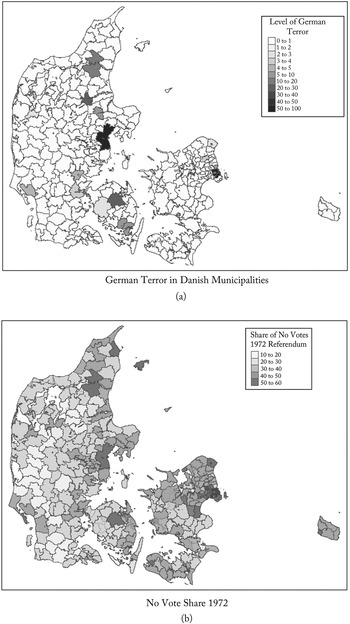
Although German atrocities against civilians in Denmark were relatively light compared to what occurred in the western and eastern European countries and territories under German rule during the war, the terror nonetheless became one of the defining aspects of the collective memory of the German occupation in Denmark—a memory that was very much kept alive after the war.Footnote 27 As shown in Figure 1, terror was unevenly distributed across and within Danish regions. Whereas some localities experienced terror incidents on a fairly regular basis in the last years of the occupation, others were not touched by it at all. The question, then, is whether this difference between localities in regard to the level of violence experienced during the German occupation had any political implications after the war and particularly, whether the experience of the terror affected the level of public support for engaging in international cooperation with the former occupation power, Germany. The latter became an option when Denmark became eligible for eec membership in the decades after the war.
The Danish EEC Referendum of 1972
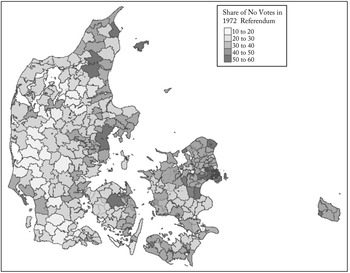
Even before official founding of the eec in 1957, but increasingly after, the possibility of Danish membership in the European economic integration project was discussed among the Danish political elite, especially among the center-right Liberal Party and the Social Democratic Party, the main parties on the right and the left, respectively. But Danish membership was vetoed by French President Charles de Gaulle in the early 1960s and again, later in the decade.Footnote 28 By 1970, however, de Gaulle had resigned and the United Kingdom, which was among Denmark's largest export markets, had applied for eec membership, which prompted the Danish government to apply for eec membership shortly afterward.Footnote 29 According to the Danish constitution, however, any transfer of sovereignty, including to supranational organizations, needed either support from a supermajority in the Danish parliament or the absence of a majority against it in a popular referendum. Thus, a referendum on yes or no to eec membership was held in October 1972. Consequently, during most of 1972, Danish eec membership was the object of lively debate and campaigns for and against it were held by various political actors. The country eventually voted in favor of joining the eec in October 1972 with 63.3 percent voting yes, but there was substantial geographical variation in the share of no votes (see Figure 2).
Share No Votes in the 1972 Referendum in Danish Municipalitiesa
aLines show municipal borders in 1972.

Most of the main Danish parties on the center left and the center right were in favor of eec membership in 1972 or held only small, marginalized skeptic factions. Consequently, the unconditional opposition to Danish eec membership came primarily from parties and organizations on the far left, including the Danish Communist Party and its two successor parties, the Socialist People's Party and the Left Socialists.Footnote 30 The Socialist People's Party split from the Communist Party in 1958 and the Left Socialists split from the Socialist People's Party in 1967. But small organizations on the nationalist right, including the Danish nationalist organization, Danish Unity (Dansk Samling), also opposed eec membership. The Communist Party, and to some degree its successor parties as well as Danish Unity, had members who had been very active in the Danish armed resistance, which was an important part of these organizations’ identities.Footnote 31 Ignoring their political differences, the Communist Party, the Socialist People's Party, and Danish Unity became founding members of the interparty anti-eec organization, the People's Movement against the eec, in the spring of 1972.
In the campaign against Danish membership in the eec, anti-German rhetoric featured prominently in the agitation of the parties of the far left and of the People's Movement against the eec. Among the opponents of eec membership, especially on the far left, the eec was seen to be dominated by GermanyFootnote 32 and was likened to the Nazi vision of Neuropa (new order in Europe). The threat of German dominance and control of Denmark after Danish entry into the eec was part of the campaign against Danish membership before and during 1972.Footnote 33 For sure, these were not the main themes in the 1972 campaign, which centered around economic issues. Nevertheless, opinion research does show that issues related to national sovereignty and even cultural-ethnic issues, which included anti-German attitudes, were nontrivial arguments against the eec stated by Danish opponents to membership in the organization.Footnote 34
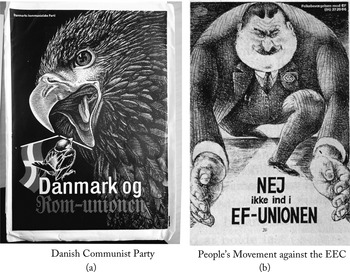
Parts of this campaign more or less explicitly used anti-German sentiments and invoked images of Nazi Germany and the German occupation of Denmark.Footnote 35 A prime example is an anti-eec propaganda poster from the Danish Communist Party that shows a black eagle with a swastika in its eye coming to swallow a small, helpless Danish birdFootnote 36 (see Figure 3 (a)). Other examples include a poster from the People's Movement against the eec, which showed a caricature of a thinly-mustached man (clearly German) with an eec lapel pin (in lieu of a swastika) coming from the south to grab Denmark (see Figure 3 (b)). In a similar tone, a widely read Danish left-wing tabloid ran the headline, “The Germans will sell Denmark in one day using informatics,” less than one week before the referendum.Footnote 37
Anti-EEC Propaganda with Anti-German Themesa
Source: Public domain. a The text in panel (a) translates to “Denmark and the union of Rome”; panel (b) translates to “No not into the EEC Union.”

It's important to note the temporal closeness of the 1972 referendum to the German occupation. The majority of the electorate in 1972 would have experienced the occupation,Footnote 38 but as evident from Figure 1, the level of German-inflicted violence and sabotage varied dramatically between Danish localities. This variation may have affected the degree of anti-German sentiment, and thus the effectiveness of the argument linking eec membership and German influence, and ultimately, the level of support for Danish eec membership in the referendum. This theoretical argument is drawn in greater detail in the next section.
Theory
In this section, I provide the theoretical foundation for why and how a legacy of local German-inflicted violence and material destruction during the occupation of Denmark might have affected local (lack of) support for the eec in the 1972 referendum. It builds on the argument that living in areas with more exposure to German-inflicted violence during the occupation would have made the framing of and arguments by anti-eec political actors (parties) using anti-German sentiments and memories of the occupation more effective. Plus, more local exposure to German-inflicted violence would have increased the popularity and credibility of political parties associated with the resistance, and those parties were also the main actors opposed to eec membership.
My arguments rest on the assumption that the memory and salience of the German occupation of Denmark and the violence inflicted during this period were greater in areas that experienced more of it. People living in an area with more German-inflicted violence and destruction during the occupation would be more likely to have been personally exposed to it at the time or to have had friends, coworkers, or family members who were. For example, many of the bombs used for sabotage by Petergruppen were so powerful, they would have been heard across an entire city.
Furthermore, the occupation itself and the violence inflicted during this period would presumably have been much more likely to be remembered in communities where German-inflicted violence and destruction took place, which again should affect the salience of these issues for individuals living in those communities. For example, individuals passing by areas and buildings on a regular basis that they knew had been bombed or in which they knew people had been murdered, would presumably help to keep the memory of that violence alive, even if they were never directly exposed to it themselves. What's more, local memorials for victims of the terror would also have kept the memory of it alive in areas where it took place.
The stronger memory and saliency of German-inflicted violence in areas more exposed to it during the occupation should have affected the local share of no votes in the 1972 referendum through two mechanisms. First, people in these areas would have been more receptive to arguments against the eec that played on anti-German sentiments. Applying the logic of public opinion formation theories, German violence during the occupation would have shifted the political predisposition and beliefs of those exposed to it toward a higher level of anti-German sentiment and a higher saliency of the memory of the occupation. These factors might have made them more receptive to later arguments against the eec by political parties and other opinion leaders who used specific frames and cues playing on anti-German attitudes and invoking memories of the occupation and the resistance to it.Footnote 39
Second, local experiences of German-inflicted violence may have boosted local support for the armed resistance and the perceived legitimacy and popularity of the struggle, especially after the end of the occupation, when German forces could no longer retaliate and punish this support.Footnote 40 The support would have directly increased the popularity of parties and organizations associated with the resistance (not least because of their use of this part of their history in their propaganda and campaigns), which in Denmark happened to be the organizations (mainly on the far left) that also opposed Danish eec membership.
For example, at the time of the 1972 referendum campaign, the leader of the Danish Communist Party was Knud Jespersen, who had been very active in the resistance movement, served time in an internment camp, and had lost his own father, also an active participant in the Communist part of the resistance movement, in the German concentration camp in Neuengamme. Another example is a leading member of the Socialist People's Party, Gert Petersen, who was very active in the campaign against the eec, and who had also been active in the Danish resistance. The Danish far-left parties would have been able to draw on numerous party members and activists who had personal experience with the resistance to the German occupation, including time spent in German prisons and concentration camps. Such party activists and leaders would have raised the credibility of these parties’ agitation during the campaign, including the use of anti-German sentiments and allusions to Nazi Germany, as well as increased the general popularity and credibility of the parties themselves, especially in areas with more exposure to the terror.
As suggested by Stefano Costalli and Andrea Ruggeri,Footnote 41 political parties’ popularity and credibility can be strongly affected by a history of resistance toward illegitimate rule. These arguments are also in line with theories of partisan attachment in which voters’ attachment to a political party is closely related to the party's ability to keep a strong brand.Footnote 42 In the case of Denmark, the far-left parties’ continued use of their role in the resistance and the linkage of this part their brand to their present political activities (including their resistance to the eec) should have helped them keep a high level of partisan attachment in areas where the local support for resistance to the occupation was stronger, which would be the areas most affected by the terror.
Consequently, we should expect areas with more German-inflicted violence and destruction during the occupation to have greater partisan attachment and electoral support for the (far-left) parties with a connection to the resistance movement. Therefore, the Danish far-left parties should have been better able to sway voters in these areas to vote in accordance with their policy stance (no to eec membership) in the 1972 referendum. This reasoning is in line with the theoretical arguments that political parties and other political elites can act as opinion leaders,Footnote 43 and that public opinion and to some extent political behavior are strongly affected by partisan cues, including within the European integration area.Footnote 44
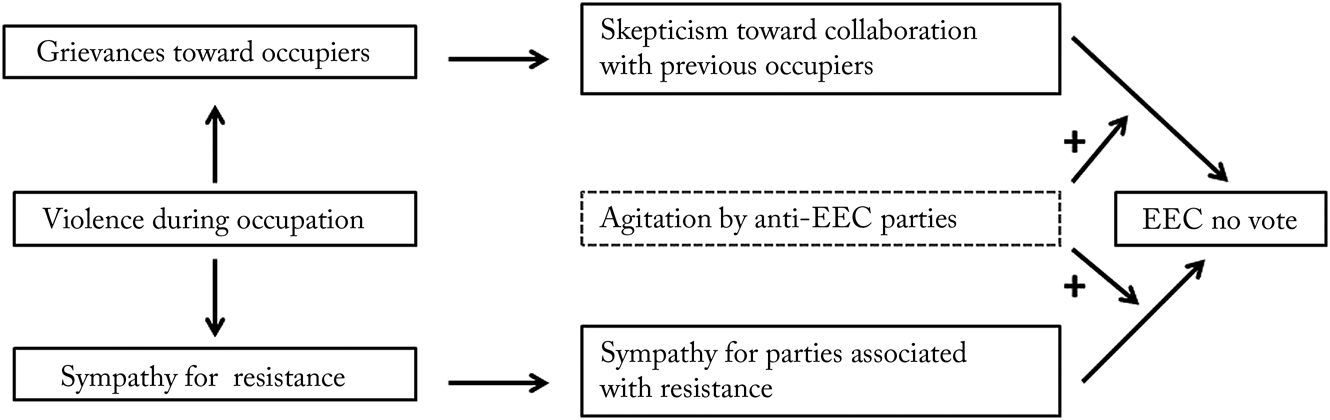
Thus, direct negative attitudes toward Germany as a consequence of the occupation terror as well as more positive attitudes and attachment to the parties associated with resistance both to the previous German occupation and to the eec, would be the relevant mechanisms through which local exposure to German-inflicted violence and destruction during the occupation could have affected later resistance to Danish eec membership. Agitation by anti-eec parties and organizations is the relevant factor for activating both mechanisms. The theoretical arguments are illustrated in Figure 4 above.
Theoretical Model

Data
The data to test the effect of localized German violence during the occupation on lack of support for entering the eec consist of a cross-section of all 278 Danish municipalities in 1972. These municipalities were formed by a series of amalgamations in 1970. This municipal reform typically amalgamated one larger (market) town with several surrounding rural (parish) municipalities that usually had strong ties to the local (market) town. As such, the 1970 municipalities had often formed meaningful local communities within their local economies and their own public spheres (mediated by local newspapers) at the time of the terror and in the decades leading up to 1970. Thus, they are meaningful units of analysis for the legacies of German terror in the 1970s.
The central dependent variable is the share of no votes (votes against Danish eec membership) in the 1972 referendum. These data come from the Danish Statistical Agency. The central independent variable is the level of German-inflicted violence and destruction experienced by the civilian population locally during the occupation. To measure these levels, I code known instances of German-inflicted terror against Danish civilians during the occupation by type (murder, attempted murder, injury, and property damage), as well as by geographical location. These data come from the official court documents of the 1948 trial against the leaders of the German security and army forces during the occupation, Werner Best, Hermann von Hanneken, Günther Pancke, and Otto Bovensiepen.Footnote 45 I then construct an index of German terror, which can be seen in equation 1.
 $$Terrorindex_i = K_i + ( {AT_i} ) /2 + ( {W_i} ) /2 + D_i, \;$$
where K is the number of peopled killed in municipality i as a consequence of German terror, AT is the number of people who were victims of an attempted murder, W is the number of people wounded as a consequence of German terror, and D is the amount of property damages inflicted by German sabotage of civilian facilities in millions of (1940s) kroner. Sabotage damages that cannot be specifically placed in one municipality are excluded from the calculation of damages. By constructing the index in this way, I weight terror incidents with deadly outcomes higher than terror incidents that merely resulted in wounded civilians. In addition, since the terror often targeted local notables and important places for the local communities, the index is unweighted by (1970s) municipal size and population given that it is less plausible to believe that the murder of a local doctor (a common victim), for example, would have had half the effect in a town of ten thousand inhabitants compared to a town of five thousand. Additionally, 1970s municipal size and population have potential posttreatment features.Footnote 46
Furthermore, I give relatively high importance to high-scale sabotage incidents because they would have been very visible for people living in affected areas. The sabotage incidents often targeted local places of entertainment, local newspapers, and even private homes, all places whose destruction should have evoked substantial local grievances.Footnote 47 The results are robust to various alternative ways of calculating the terror index, including increasing or decreasing the relative weight of attempted killings and the number of wounded, as well as including property damages in log points instead of millions of kroner.Footnote 48 The geographical variation in the terror index across Danish municipalities and the distribution of the no vote share in the 1972 referendum can be seen in Figure 5. Appendix D of the supplementary material contains an analysis in which the explanatory variable is a distance-weighted version of the terror index, where each municipality receives a distance-weighted score based on distance to the nearest municipality that experienced one or more terror incidents. These results are similar to the main analysis.
German Terror and No Vote Share in 1972a
a Lines show municipal borders in 1972.

In some estimations, I include a number of control variables. One is the demographic characteristics of each municipality that might have affected both the previous level of German terror and support for the eec, especially since German terror and no vote share in the 1972 referendum were concentrated in the urban areas of Denmark (see figures 1 and 2). Because nonurban areas were more economically reliant on agriculture, which in Denmark was heavily oriented toward eec export markets, one could be worried that the potential relationship between German terror and lack of support for the eec was spuriously related to urbanization rates.Footnote 49 A split sample between municipalities that experienced German terror and those that did not also reveals that terror-inflicted municipalities were generally more urbanized both before the occupation and in the early 1970s (see Appendix E of the supplementary material).
Consequently, I include the log of population in each municipality and urbanization rate (the share of the population living in urban areas) as controls in later estimations. I collect data for these two variables in 1940Footnote 50 (before the terror) and just before the referendum in 1972.Footnote 51 Data come from the Danish Statistical Agency's Statistics Denmark's Statistical Yearbook. Although relative urbanization rates and relative population levels should exhibit strong persistence in Denmark between the 1940s and the early 1970s, there might be concerns about biases arising from the posttreatment nature of the 1972 demographic controls. I therefore show the results including and excluding the 1970s demographic variables.
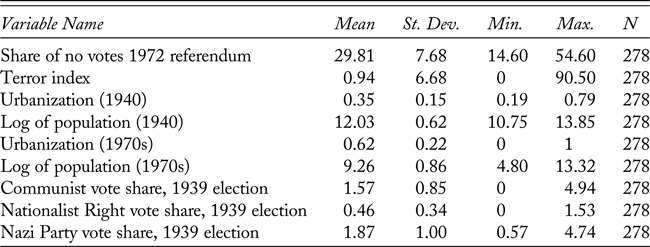
In some of the estimations, I include the vote share of the Danish Communist Party and the nationalist right-wing party, Danish Unity, in the 1939 Danish legislative election.Footnote 52 One could suspect that the German occupation authorities may have targeted areas with historically high far-left (communist) and nationalist public support during the terror campaign because these movements were also heavily involved in the resistance. Consequently, not addressing this issue might cause concern about potential endogeneity bias in the estimated effect of German terror on later support for the eec, especially if there is strong geographical persistence in the support for these political/ideological movements. Data from the 1939 election also come from Statistics Denmark.Footnote 53 As a final political control, I also account for the prewar (1939) vote share of the Danish Nazi Party, which served as a central engine of collaboration with the German occupation forces in the early years of the occupation. These data are also recorded at the then-county level and are from John Lauridsen.Footnote 54 Descriptive statistics can be seen in Table 1 above.
Descriptive Statistics

Estimation and Identification
As the main estimator for the effect of the level of German terror on the share of no votes in the 1972 referendum, I use ols regression with robust standard errors.Footnote 55 This estimation can be seen in equation 2.
 $$Sharenovotes_i = \beta Terrorindex_i + \beta Z_i + \beta _c + {\epsilon} _i, \;$$
where Sharenovotesi is the share of no votes in the 1972 eec referendum in municipality i; Terrorindexi is score on the terror index; Z is a vector of the demographic and political (communist and nationalist vote share in 1939) control variables; i is the error term; c is the county fixed effects, which are included in some of the estimations to control for regional patterns that might confound support for the eec as well as the level of German terror three decades earlier. As evidenced by previous research, taking into account regional fixed effects is important in political legacy studies.Footnote 56
Moreover, as noted above in the section on the German terror, it is plausible that the variation in terror intensity within Danish regions (counties) had a relatively larger exogenous component than variation between regions. Additionally, since Copenhagen and Frederiksberg, where the majority of German terror took place, had status in 1972 both as municipalities and as counties, including county fixed effects neutralizes observations from them (see figures 1 and 4). Including county fixed effects is thus a hard test of the relationship between German WWII terror and lack of support for entering the eec in 1972, and should better be able to capture any exogenous effect of German occupation violence on voting patterns in the 1972 referendum, especially with sufficient controls.
Main Results
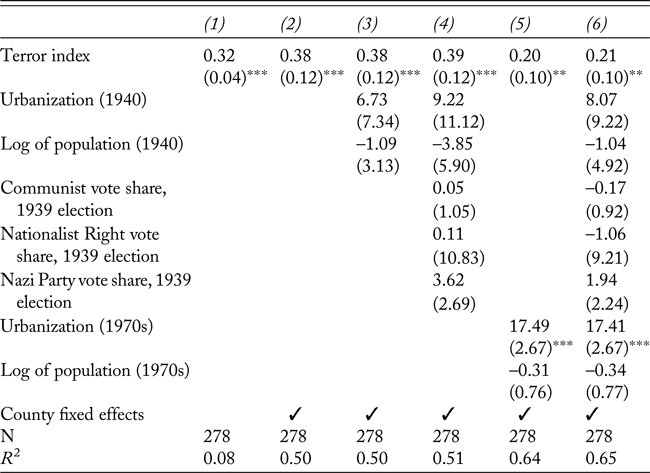
Table 2 presents the ols estimates for the effect of German occupation violence on opposition to Danish eec membership. Column 1 shows the pure bivariate relationship between the level of German occupation violence and no votes in the 1972 referendum. In accordance with the theoretical argument, there is a substantial and statistically significant relationship between these variables. An increase in the terror index of one standard deviation in a given municipality increases the share of no votes in the referendum by about two percentage points. One standard deviation on the terror index is the equivalent of six to seven additional murders or damages amounting to around six to seven million kroner.Footnote 57 This effect is statistically significant at the p < 0.01 level. Column 2 adds county fixed effects to the estimation to account for regional patterns in both German terror and support for the eec. Even though the inclusion of the county fixed effects effectively neutralizes the effect of the capital municipalities of Copenhagen and Frederiksberg (see figures 1 and 5), the terror index increases in effect size and keeps its level of statistical significance.Footnote 58
German Terror and No Votes in the 1972 EEC Referenduma

∗ p < 0.1, ∗∗p < 0.05, ∗∗∗p < 0.01; robust standard errors in parentheses
a Dependent variable is share of no votes in the 1972 referendum.
I begin adding the control variables in column 3. First, I add the pre-terror demographic control variables. Size effect and statistical significance of the terror index remain with these controls, which are themselves not statistically significant. Then, I address the possibility that German terror might have been specifically targeting areas with large support for political movements associated both with the resistance to German occupation during the war and later with key opponents of Danish membership in the eec. To take this potential endogenous factor into account, in column 4, I include the vote share of the Danish Communist Party; the nationalist right-wing party, Danish Unity; and the Danish Nazi Party in the 1939 Danish legislative election. None of these variables seems to have any statistically significant effect on the share of no votes in the 1972 referendum. In addition, with the inclusion of these variables, the effect of the terror index on the no vote share remains, and it is still statistically significant at the p < 0.01 level. The effect of the terror on later opposition to the eec does not seem to be merely reflecting Nazi attempts to target areas with larger numbers of electoral supporters of the parties (left and right) associated with the wartime Danish resistance movement, many of whom later became opponents of the eec. Notably, the result is not affected by relative support for the Danish Nazi Party, which had many members become German collaborators, especially as Waffen ss volunteers.Footnote 59
I control for demographic factors at the time of the 1972 referendum in column 5. The coefficient size of the terror index drops somewhat in effect size but is still substantially and statistically significantly associated with less support for eec membership. Although urbanization has a strong and statistically significant positive effect on the no vote share, municipal population size does not seem to matter. In column 6, I add all the control variables (pre- and post-terror) to the estimation. The size effect and statistical significance level from column 5 remains. Of the control variables, only urbanization in the early 1970s seems to be robustly associated with (less) local support for Danish eec membership in the 1972 referendum.
Thus, even controlling for regional patterns, prewar and postwar demographic factors, and prewar far-left, nationalist, and Nazi Party electoral support, there seems to be substantial evidence in favor of the argument that areas in Denmark that experienced more German-inflicted violence and destruction during the occupation had lower support for Danish eec membership almost thirty years later.Footnote 60
Exploring the Mechanism: German Terror and Support for Far-Left Parties
Judging from the results above, there is substantial evidence in favor of the argument that the level of German-inflicted violence and destruction during the occupation of Denmark did indeed affect the level opposition to Danish membership of the eec in the 1972 referendum. These results support my argument that previous exposure to violence during foreign occupation may breed opposition to engaging in international cooperation with the former occupiers. In this section, I explore one of the theory's mechanisms, namely increased support for political parties associated with resistance to the German occupation in areas that were more affected by occupation violence.
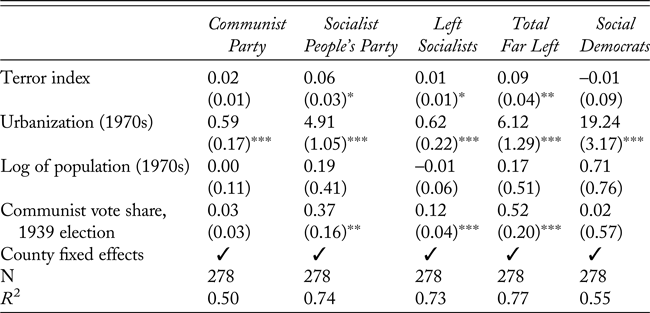
To test this mechanism, I obtain municipal-level data from the Danish legislative election of 1971, the year before the referendum.Footnote 61 In Table 3, columns 1 through 4, I analyze the effect of German terror on the vote share of the far-left parties in Denmark: the Communist Party, the Socialist People's Party (splinter party from the Danish Communist Party), and the Left Socialists (splinter party from the Socialist People's Party), as well as the combined vote share of the three. As noted above, these parties were, through their common affiliation with the 1940s’ Danish Communist Party, closely associated with armed resistance to the German occupation and actively opposed Danish eec membership. In accordance with the proposed theoretical mechanism, the local level of German terror experienced during the occupation seems to positively affect the level of support for the far-left parties, even controlling for the prewar electoral support for the Danish Communist Party, the ancestor party of the three, in the 1939 election.
Mechanism: German Terror and Electoral Support for the Far Lefta

∗ p < 0.1, ∗∗p < 0.05, ∗∗∗p < 0.01; robust standard errors in parentheses
a Dependent variable is the party's vote share in the 1971 election.
In Table 3, column 5, as a placebo test for the above mechanism, I analyze the effect of exposure to German terror on electoral support for the Danish Social Democratic Party. One could speculate that exposure to German terror during the occupation might have caused the local population to move to the left in regard to redistributive preferences and that it was this general leftward shift that caused the local population to vote against eec membership due to concerns over welfare state issuesFootnote 62 rather than increased sympathy for the far-left parties associated with the armed resistance and general anti-German sentiments.
Nevertheless, the level of local German terror during the occupation seems to have had no effect on the local vote share of the Danish Social Democratic Party. This party was in favor of Danish eec membership and had been the main party in the Danish coalition government collaborating with the German occupation forces until 1943 and it had also been the main party responsible for the expansion of the Danish welfare state in the decades before 1971. This result further suggests that exposure to German terror seems to have caused increased sympathy toward parties associated both with armed resistance during the war and opposition to eec membership postwar, and not just a general turn to the left in regard to redistributive preferences.
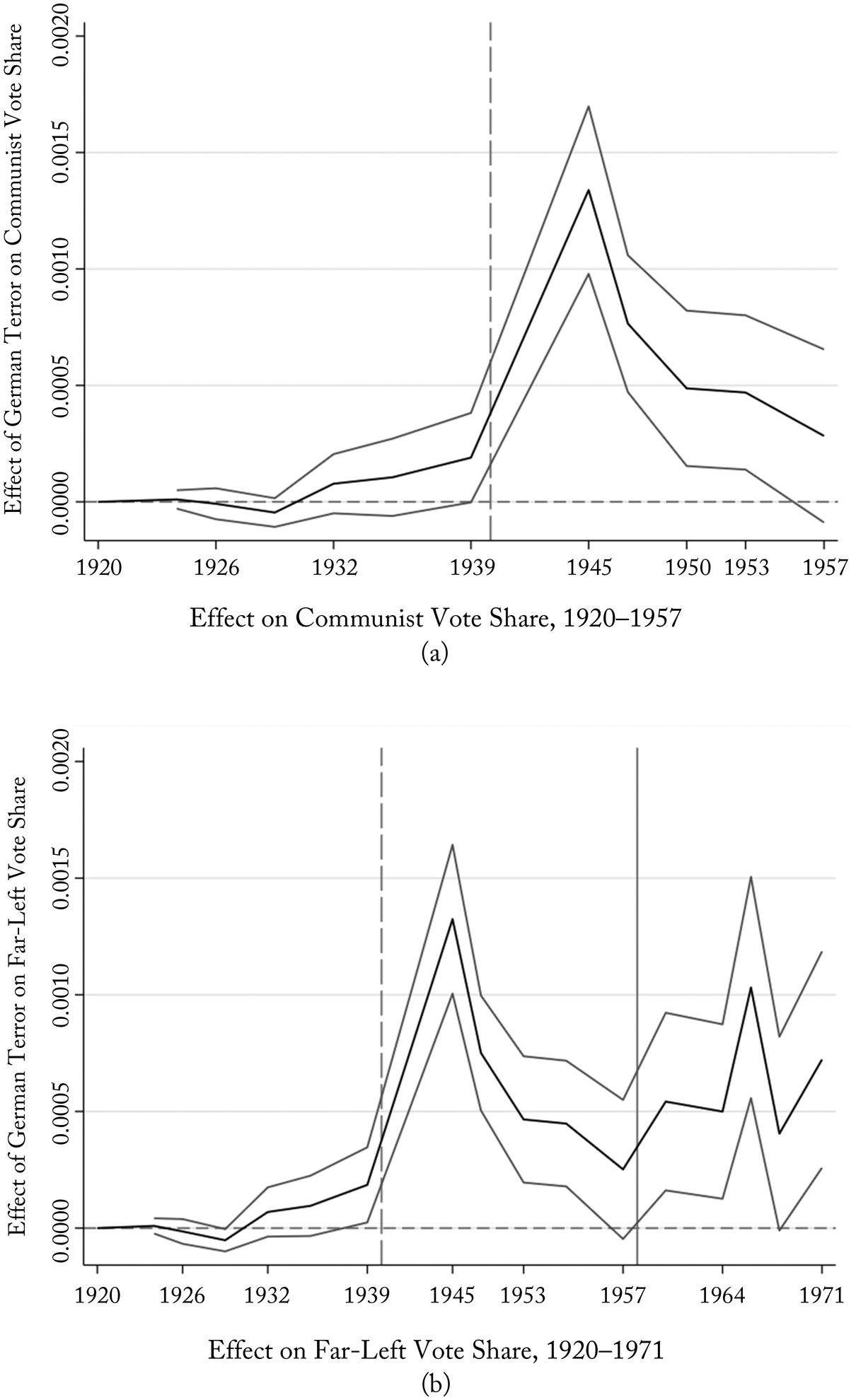
That German terror led to a substantial increase in local electoral support for the far left after the occupation,Footnote 63 and that this support is not merely a function of the German authorities selecting areas with high existing far-left support, is further evidenced by the results shown in Figure 6 (a). In it, the difference-in-differences estimate for the effect of German terror on vote share for the Danish Communist Party from 1920Footnote 64 (the year the party was founded) to 1957 (the last election before the Socialist People's Party split from it) can be seen. In this analysis, the terror index is interacted with calendar year (both leads and lags) to assess its effect on far-left vote share before and after the occupation.Footnote 65
German Terror's Effect on Far-Left Vote Share before and after the Occupation, County Levela
a Outer lines represent 90 percent confidence intervals. Vertical dashed lines represent the occupation of Denmark. Solid vertical line in panel (b) represents the founding of the Socialist People's Party.

This analysis is based on data from the Constituency-Level Elections Archive (clea) and Statistics Denmark. Its unit of analysis is (pre-1970) county year (counties also functioned as electoral constituencies). Apart from the interaction between calendar year and the terror index, the regression also contains county and year fixed effects, as well as controls for urbanization rate and log of county population. The regression is presented in equation 3. In it, the main difference-in-differences estimate is the interaction between the terror index and the calendar year. This interaction should have no effect on communist vote share before the occupation and a positive effect afterward. Z is the vector of control variables (time-varying urbanization and log of country population), while i and t are the county- and election-year fixed effects, respectively.
 $$Communistvoteshare_{it} = \beta Terrorindex_{it} + \beta Z_{it} + \beta _i + \beta _t + {\epsilon} _{it}.$$
The results in Figure 6 (a) show that German terror indeed led to a sharp increase in Communist vote share after the occupation, which seems to have echoed in the level of electoral support for this party and its socialist successor parties in the early 1970s. Figure 6 (b) plots the difference-in-differences estimate for the effect of German terror on vote share for the Danish Communist Party (before 1959) and its main successor party, the Socialist People's Party (from 1959) during the entire period.Footnote 66
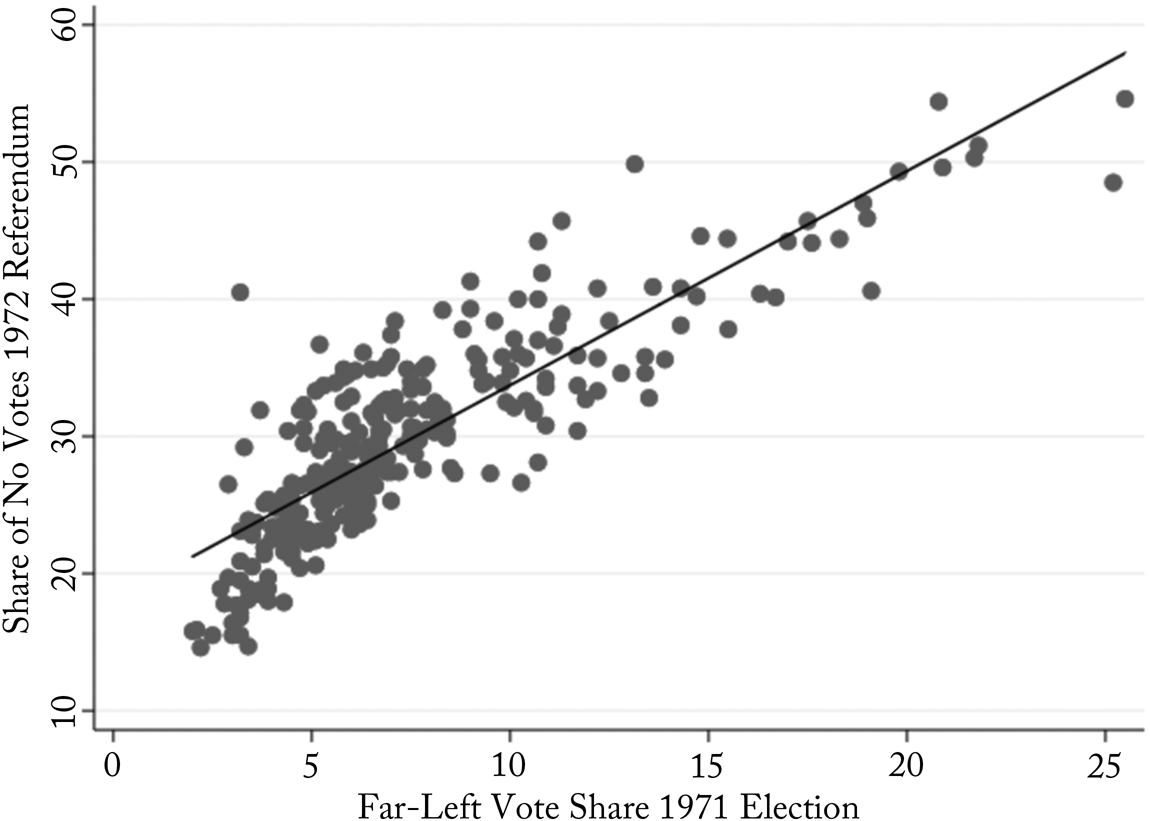
German occupation violence seems to have increased local support for the Danish far left, one of the key mechanisms for the effect of the terror on no vote share in the 1972 eec referendum. The strong link between local support for the far left in the 1971 election and local opposition to Danish eec membership is shown in Figure 7, where the relationship between far-left vote share (the combined vote share of the Communist Party, the Socialist People's Party, and the Left Socialists) in the 1971 election and the share of no votes in the 1972 eec referendum can be seen.
Far-Left Vote Share in 1971 Election and Share of No Votes 1972 Referendum

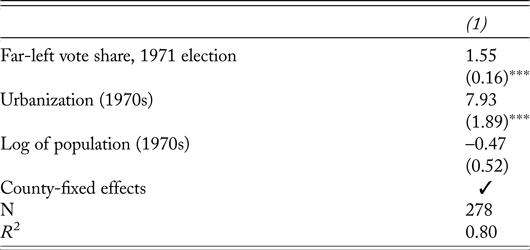
Table 4 above further illustrates the magnitude of this effect, where even holding demographic factors constant, a 1 percentage point increase in the vote share of the far left in the 1971 elections translates into about a 1.5 percentage point increase in the local share of no votes in the referendum one year later. Note that the size of this effect implies that these parties were able to convince voters outside of their party to vote against eec membership.
Far-Left Support and No Votes in the 1972 EEC Referenduma

∗ p < 0.1, ∗∗p < 0.05, ∗∗∗p < 0.01; robust standard errors in parentheses
a Dependent variable is share of no votes in the 1972 referendum.
Exploring the Mechanism: Anti-German Attitudes
As noted in the theory section above, another mechanism for how German terror may have affected the no vote share in the 1972 referendum is the increased grievances and thus, negative attitudes toward Germans and Germany in areas that experienced higher levels of violence. Such attitudes would have made anti-ecc agitation playing on anti-German sentiments more effective in these areas.
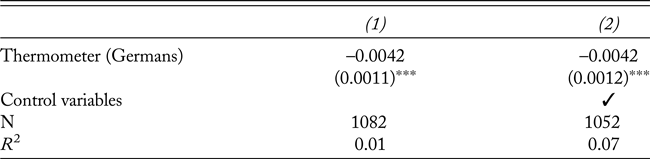
Unfortunately, Danish survey data containing attitudes toward Germany and Germans are quite difficult to obtain. But the Danish 1971 electoral survey contains a question about the respondents’ attitudes toward Germans. It takes the form of a thermometer with which the respondent is asked to provide his or her attitudes toward “the Germans” on a scale from –100 to 100, where higher degrees equal more positive attitudes and lower degrees correspond to more negative attitudes.
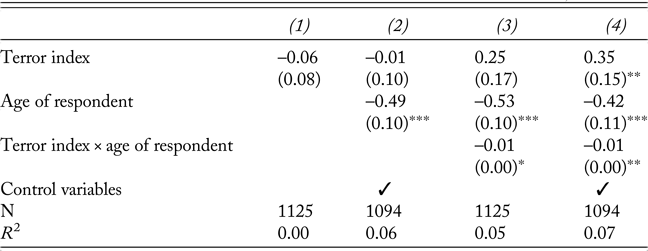
Regrettably, it is not possible, using the information from the survey, to locate each respondent at the municipal level. Instead, they can be placed in one of twelve geographical sampling districts, which makes locality-based variation quite limited (and is one reason why the main analysis relies on aggregate municipal-level data). Nonetheless, I calculate the average score (based on municipal-level data) on the terror index for each of these districts and regress it on the thermometer (Germans) variable. The results can be seen in Table 5.
Mechanism: German Terror and Attitudes toward Germans, 1971a

∗ p < 0.1, ∗∗p < 0.05, ∗∗∗p < 0.01; standard errors clustered by sampling district in parentheses; controls are respondent's income bracket, gender, years of education and urbanization in the respondent's area.
a Dependent variable is thermometer (Germans).
In column 1, we see a negative effect of the terror index on attitudes toward Germans, but it is not statistically significant. This effect becomes even weaker with the addition of various control variables, including the respondent's age, (see column 2). We should not expect the individual-level effect of local exposure to German terror to be equal across age groups. If grievances caused by violence are strongest for those with personal experience of this violence, as suggested by the weakening effect of the terror on hostility to the eec/EU over time, we should expect older generations (more likely to have personally experienced the terror during the occupation) to exhibit stronger effects of German terror on attitudes toward Germans. To test this, I interact the terror index with the respondent's age in column 3. Based on this estimation, there is some evidence in favor of the age-contingent argument. Older respondents have much more negative attitudes toward Germans than younger cohorts and this effect increases with the level of German terror experienced locally during the German occupation of Denmark and is in line with the theoretical mechanism I present. This effect becomes even more statistically significant with the addition of the extra control variables (see column 4).
Consequently, even with the relatively limited variance on the terror index in this analysis, there is some evidence in favor of the mechanism that the extent of German terror during the occupation affected attitudes toward Germans even twenty-five years later, at least among older Danes. And these attitudes, perhaps due to the use of anti-German messages in the campaign against eec membership, later had an effect on the local share of no votes in the 1972 referendum.
To test another link in the mechanism that anti-German attitudes (partly affected by the exposure to German terror during the occupation) increased resistance to Danish eec membership , I use another question from the 1971 electoral survey that asks whether the respondent agrees that Denmark should become a member of the eec at the same time as England using a Likert scale of one to five, where 1 is in full agreement and 5 is in total disagreement. In Table 6, I regress the thermometer variable on this survey question. In accordance with this link in the mechanism, an increase in the thermometer (Germans) measure decreases the score on the Likert scale, which means more support for Danish eec membership. Consequently, more hostile attitudes toward Germans are associated with lower support for Danish eec membership. This effect is strongly statistically significant and robust to the addition of various extra control variables in column 2.
Attitudes toward Germans and Attitudes toward Danish EEC Membershipa

∗ p < 0.1, ∗∗p < 0.05, ∗∗∗p < 0.0; robust standard errors in parentheses; controls are respondent's income bracket, gender, age, years of education and urbanization in the respondent's area.
a Dependent variable is agreement with Danish EEC membership on a one to five scale (1 = full agreement).
As such, there is some evidence for the two proposed mechanisms behind the effect of German terror on resistance to Danish eec membership. There seems to be somewhat more robust evidence for the mechanism regarding the effect of the terror on (electoral) support for far-left (and anti-eec) parties. To reiterate, however, it could be argued that the agitation against eec membership and the coupling of the issue of Germany and Germans with the question of that membership had a role in causing anti-German sentiments to be correlated with resistance toward Danish eec membership (see Figure 4).
In Appendix I of the supplementary material, I explore an alternative mechanism for the link between the level of German terror intensity during the occupation and the share of no votes and turnout in the 1972 referendum. One could speculate that the effect of a legacy of German-inflicted violence during the occupation would have had a mobilizing or de-mobilizing effect on later turnout, in line with earlier studies of the political effects of previous state repression,Footnote 67 but there seems to be no effect of the level of German terror on turnout in this referendum.
Effect of the German Terror on Opposition to the EEC/EU over Time
Judging from the results above, there is strong evidence for a negative effect of local exposure to German-inflicted violence during the occupation of Denmark on support for Danish eec membership in 1972. Apparently, the Danish far left's use of anti-German sentiments, explicit reference to the eec as a German-dominated entity resembling Nazi Germany's vision of Neuropa, and invocation of their own history of armed resistance to German rule apparently increased their general popularity and enabled them to better sway voters toward voting no to eec membership in areas that experienced more German-inflicted violence and property destruction during the German occupation of Denmark.
Nevertheless, the issue of the persistence of the effect of German occupation violence on anti-eec sentiments naturally arises. Although the literature on the political legacies of violence generally acknowledges that the political effects of violence and repression decline over time as memories fade and the people who have actually experienced the violence die,Footnote 68 there are also theoretical arguments and empirical evidence supporting the claim that the political effects of violent legacies at least partly persist over time, as parents transfer their attitudes to their children, and schools and other institutions, including political parties, keep memories of previous repression alive.Footnote 69 According to these arguments, we might expect that the effect of local German occupation violence on Danish anti-eec (later EU) attitudes persists over time and also decreases in relative size.
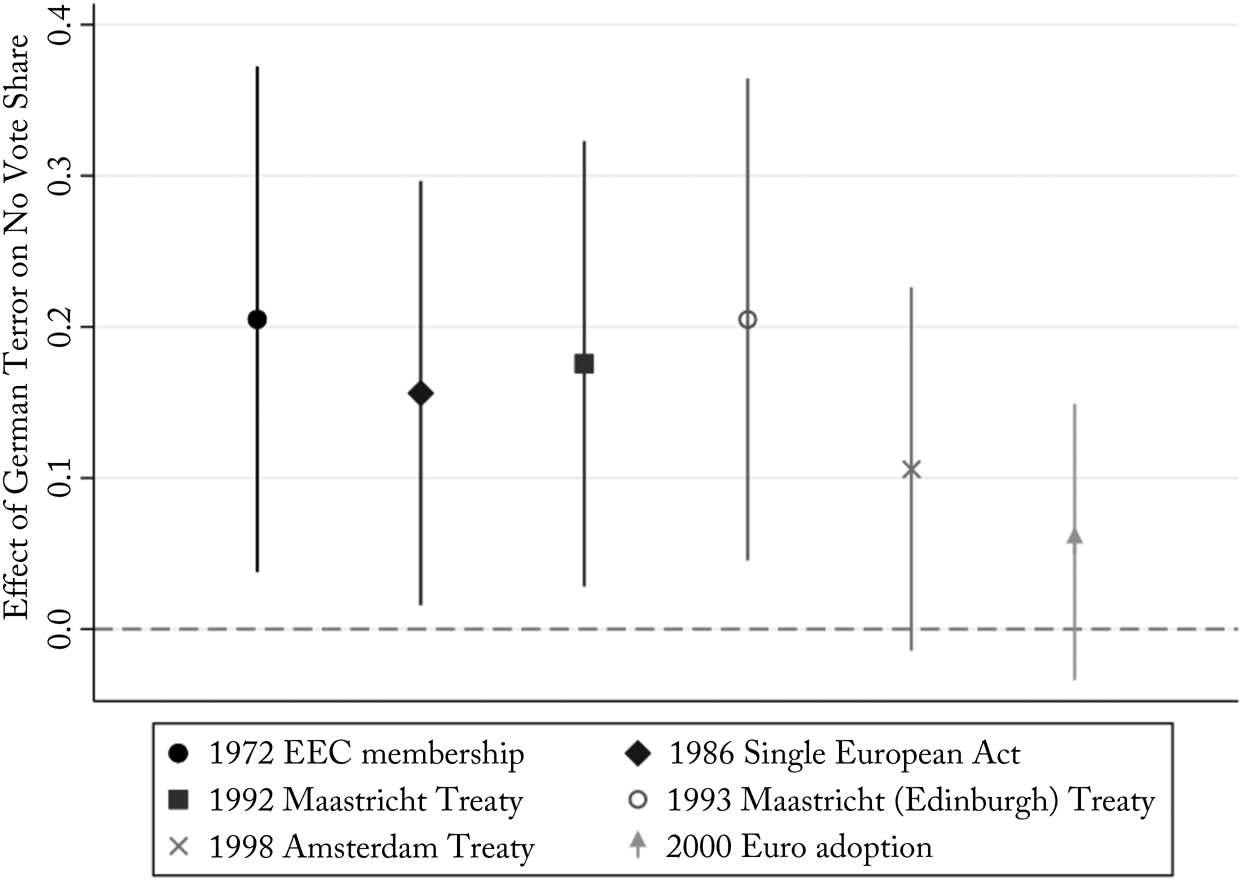
In much of the prior literature on the persistent political effects of violence and repression, there are large gaps in time between measurements of political outcomes and the measurements are often qualitatively different in nature.Footnote 70 In the case I study, the relative frequency of Danish eec/EU referenda after Denmark's entry into the eec in 1973Footnote 71 allows me to, in a very fine-grained way, track the effects of German terror on opposition to the eec/EU over time using the same measure: opposition to (further) integration within the eec/EU in popular referenda. Figure 8 illustrates the effect of the terror index on the no (to further European integration) vote share at the municipal level in other Danish eec/EU referenda 1972–2000.Footnote 72
A clear trend can be seen in Figure 8. Although the level of localized German terror during the occupation continues to have a positive effect on local voter opposition to (further) European integration. This effect becomes smaller over time and at the time of the referendum on the ratification of the Amsterdam Treaty in 1998, it is statistically indistinguishable from zero. At the time of the referendum about Denmark adopting the euro in 2000, roughly a generation after joining the eec, the effect of German terror is about one-fifth of its 1972 effect size and far from any level of statistical significance.
Effect of German Terror on No Vote Share in Later EEC/EU Referendaa
a Lines represent 90 percent confidence intervals. All estimations include county fixed effects and controls as in Table 2 column 6.

Apparently, as the number of people with personal experience of German terror declined, the saliency of the German occupation and anti-German sentiments seems to have decreased locally, which seems to have had an effect on the level of local opposition to eec/EU integration.
Moreover, the declining memory and salience of the German occupation and the violence associated with it may have made anti-eec/EU parties (especially on the far left) less likely to rely heavily on anti-German propaganda and the invocation of similarities between the eec/EU and Nazi Germany in their later campaigns against Danish eec/EU integration. For example, after the 1970s, the open use of the Swastika to represent eec/EU and Germany on posters and other types of propaganda seems to have gone out of fashion among activists and political parties on the Danish far left.
Additionally, in the 1990s, the end of the Cold War and the changing of the guard among the European far left, including in Denmark, may have shifted the international focus of those parties and pushed into retirement the older generation of far-left activists who had actually experienced the German occupation and who had direct involvement in the resistance movement. This shift coincided with a new and less radical approach to the eec/EU among the Danish far left. For example, Gert Petersen, the veteran leader of the Socialist People's Party mentioned above, who was a prominent Danish critic of the eec who had served time in an internment camp during the German occupation for his role in the Danish resistance movement, retired as political leader of the party in 1991 and was replaced by Holger K. Nielsen, who was born after the occupation. Around this time, the Party also began a slow reorientation of its stance against the eec/EU, leaving the People's Movement against the eec in 1991,Footnote 73 favoring reform of the eec/EU rather than an exit from the union, and eventually becoming pro-EU in the 2000s.Footnote 74 The Danish Communist Party also experienced substantial changes in organization and leadership around the end of the Cold War when the party leader Jørgen Jensen (who had joined the party during its illegality at the time of the occupation) died in 1987. In 1989, the Danish Communist Party and the Left Socialists formed an electoral alliance called the Red-Green Alliance, which eventually developed into a new party with its own identity and policy profile, of which Euroskepticism formed a much less significant part. When the Red-Green Alliance first entered parliament in 1994, the oldest of its mps was born in 1942.
Instead, the Danish far left increasingly brought Nazi accusations and allusions against members of the new (and usually Euroskeptic) Danish nationalist right, such as the Danish People's Party (founded in 1995). The Danish People's Party became a new Euroskeptic force on the Danish right.
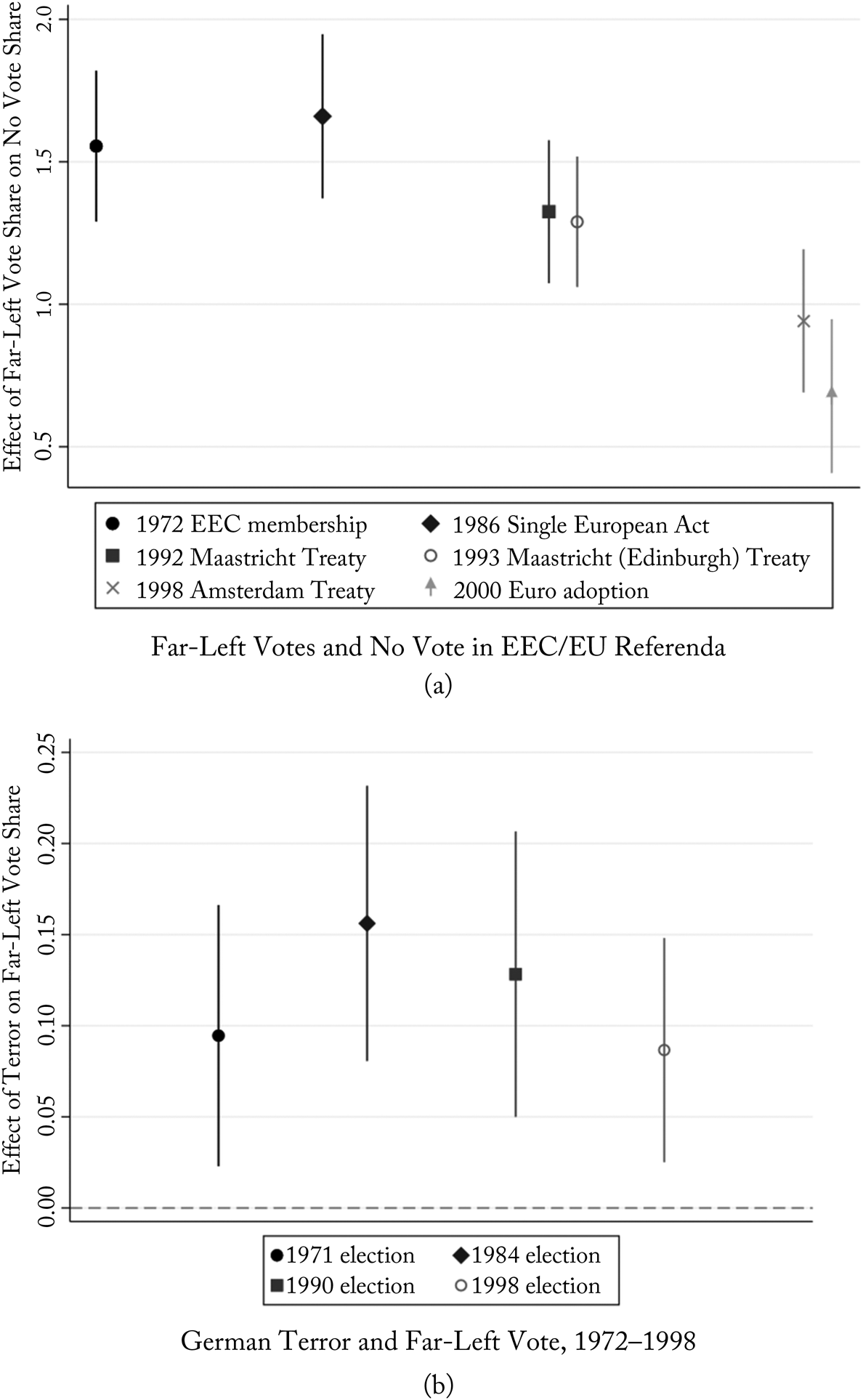
The changing role of the left-wing parties, especially during the 1990s, is illustrated in Figure 9 (a), which shows the effect of far-left vote share in the legislative election on the no vote share in Danish eec/EU referenda. Although left-wing electoral support still has a positive effect on resistance to ecc/EU integration over time, this effect substantially declines during the 1990s. This result suggests that left-wing parties were increasingly unwilling or unable to translate their popularity into electoral resistance to the EU to the same extent they had done so previously. Perhaps it is a consequence of the declining salience of the German occupation and the lack of credibility from not having been part of the resistance movement among these parties’ younger activists and politicians, as well as less of a focus on Euroskepticism in these parties’ policy profiles. However, as evident from Figure 9 (b), which plots the effects of German terror on far-left electoral support in the latest legislative election before each eec/EU referenda, a history of German-inflicted violence enabled the far-left parties to build a more lasting electoral loyalty locally, perhaps due to stronger local party organizations.Footnote 75 But these parties were increasingly unwilling or unable to enlist this historical legacy into a Euroskeptic cause.
The Role of the Far Left over Timea
a Lines represent 90 percent confidence intervals.

Discussion and Limitations
My research finds substantial evidence that the severity of German terror locally during the German occupation of Denmark affected local support for entering the eec in the 1972 Danish referendum: the more severe exposure, the lower support for eec membership. Additional analyses provide evidence that the mechanisms supporting my hypothesis seem to be an increase in electoral support for the far left in areas that saw more German terror, as well as a (more indicative) tendency for people living in areas with more German terror to hold more anti-German attitudes. But even though these results are fairly robust, some caveats in regard to the causal interpretation of the above results must be acknowledged.
First, is the issue of whether the effects just reflect that the German authorities (and their Danish collaborators) chose areas with existing high levels of left-wing support as targets for the terror. Even though the main results are robust to controlling for (county level) electoral support for the Danish Communist Party as well as for other political movements before the occupation, there could still be unobserved local levels of political activity that attracted higher levels of German retribution and were a cause of later far-left support in these areas. However, as noted above, the use of county fixed effects should alleviate at least some of this concern, as historical records of Petergruppen activitiesFootnote 76 suggest at least some randomness in regard to the severity of German violence within regions. Additionally, the terror took place when the Danish Communist Party was outlawed and its members were already held in custody by German authorities, underground, or in exile, so its members could not easily be picked as targets for the terror. Also, the victims of German terror do not generally seem to have held far-left sympathies; on the contrary, quite often they held bourgeois status.Footnote 77
It should be noted that the effect size of the terror index (in its various forms) is generally lower when the 1970s control variables are included.Footnote 78 As in many studies of historical legacies, these potential posttreatment variables constitute substantial challenges, especially, as in this case, when they are also potential confounders.Footnote 79 In addition, the main potential confounder of both eec support and German terror, urbanization, which appeared in the estimations in both the prewar and 1970 versions, could proxy for other potential (partly unobserved) confounders, such as reliance on agriculture and the presence of large industrial facilities, and these effects could be somewhat imprecisely measured. It should also be kept in mind, as stated above, that the main estimates with county fixed effects eliminate the effects of the two capital municipalities of Copenhagen and Frederiksberg,Footnote 80 which were among the main target areas for the terror. Consequently, it could be argued, most of the main estimates do not merely reflect a difference between the Danish (political and economic) capital/center and periphery during the German occupation and in the 1970s.
Conclusion
Can a legacy of violence during foreign occupation decrease the public support for later international cooperation with the former occupiers? This article has investigated this issue by looking at the effect of violence during the German occupation of Denmark (1940–1945) on public support for Danish membership in the eec in the 1972 referendum. The results show that the municipalities that experienced more German-inflicted violence and property destruction during the German occupation of Denmark indeed had higher levels of resistance to Danish eec membership in 1972 even holding demographic and pre-occupation political factors constant. The central mechanism seems to have been higher levels of support for the Danish far-left parties that opposed Danish membership, held strong connections to the resistance movement during the German occupation, and deliberately used anti-German sentiments and memories of the German occupation and the Danish resistance movement in campaigns against Danish eec membership. Greater levels of anti-German attitudes in areas hit harder by German occupation violence may also have played a role. However, the effect of German occupation violence on local resistance to the eec/EU seems to have declined over time, as the memory of and active use of references to the German occupation in Danish eec/EU referenda campaigns faded.
The results have important implications for how to view the role played by previous intra-European conflicts on intrastate cooperation and political and economic integration in Europe and other regions today. Although increasing integration of European countries via the eec (and later the EU) is often seen as one of the effects of World War II,Footnote 81 the results of my research suggest that the violence and repression experienced during the war may have been a nontrivial hindrance for popular support for further economic and political integration with Germany among previously occupied countries.
My results also give some perspective on the outcome of the 1972 Norwegian referendum on joining the eec compared to the Danish outcome that same year. Although the Danish electorate voted decisively in favor of entering the eec, Norwegian voters rejected eec membership with a small majority, even though the political establishment in both countries was generally in favor of it. The results of this article raise the question of whether the German-inflicted occupation violence during World War II, which was much more severe in Norway than in Denmark, could be at least part of the explanation of the very different sentiments in these two Scandinavian countries.Footnote 82 The results also suggest that had Denmark suffered a level of violence comparable to other Western countries under German occupation, the Danish eec referendum in 1972 might have had a different outcome.
In addition, the article raises the question of whether the memories of German occupation violence would have been politically activated and would potentially have been politically important in countries like the Netherlands and France if membership in the eec had been the subject of referenda in these countries, at least in the decades immediately following the occupation.Footnote 83 The results thus also raise questions about the extent memories of oppression during previous foreign occupations still play in public support for European and other types of supranational political and economic integration and cooperation.Footnote 84 As the results show, the political impact of German occupation violence in regard to resistance to European integration faded quite substantially over time in Denmark, but may have been more persistent in countries/regions in which German occupation violence was carried out on a larger scale, as was the case in most other countries occupied by Germany during the war. Future research could explore these issues further.
Public memories of historical violence and oppression might thus be a potent force within both national and international politics. This article shows that previous experiences of violence inflicted by foreign states might decrease the population's willingness to later engage in international cooperation with these states, including joining international organizations with the previous oppressor states. But the results also suggest, in accordance with previous research,Footnote 85 that political parties play a pivotal role in translating historical grievances and experiences of violence into political action, and that the linkage of certain political parties to certain political events might bolster their popularity and credibility during political campaigns, including campaigns against further supranational integration and cooperation.
If decisions about international cooperation and integration increasingly become the subject of direct public decision-making through referenda, as has been in the case in many European countries over the past decades, these insights hold substantial implications for the future of international cooperation and international organizations as well as for the study of these in a world where the past is evidently still with us.
Supplementary Material
Supplementary material for this article can be found at https://doi.org/10.1017/S004388712200003X.
Data
Replication files for this article can be found at https://doi.org/10.7910/DVN/5DCRCP.
Acknowledgments
The author thanks Jacob Nyrup, Marius Mehrl, Benjamin C. K. Egerod, Erik Gahner Larsen, Jonathan Homola, three anonymous reviewers and the editors of World Politics, as well as seminar participants at the University of Kent, Hertie School of Governance, and the Danish Political Science Association's 2019 meeting for comments and helpful suggestions. Special thanks to Henrik Lundbak for providing documents and advice on the terror, and to Klaus Petersen for reading suggestions. All errors and shortcomings remain my own.