




No CrossRef data available.
AGRICULTURAL POLE RITUALS AND RULERSHIP IN LATE FORMATIVE CENTRAL JALISCO
Published online by Cambridge University Press: 04 March 2004
Abstract
Recent research into the Teuchitlan tradition continues to improve our understanding of western Mexico's relationship to the rest of Mesoamerica. The tradition is defined on the basis of its distinctive public architecture, yet little research has been done to explore the significance of these temples for political organization. I propose that a more emic analysis of the political system can clarify the relationship among architecture, ritual, and political elites in Late Formative (300 b.c.–a.d. 200) Jalisco. I make use of indigenous ceramic dioramas; recent excavation data from Llano Grande, Jalisco; ethnohistoric accounts of the Xocotl Huetzi festival of the Postclassic and Contact periods; and ethnographic accounts of similar celebrations to propose a maize-focused interpretation of ritual and rulership in the Teuchitlan tradition.
Information
- Type
- Research Article
- Information
- Copyright
- © 2003 Cambridge University Press
At a time if someone is very estimable, wealthy—who always watches his wealth, his riches, or his rulership here on earth, it was said: “he hath reached his season of the green maize ear, of his maize tassel; he is much esteemed, he is praised.” Of one such as this it is said that he has achieved his merit [Sahagún 1950–1969 (1578–1580):Book 2:235].
The Teuchitlan tradition was a regional political system of central importance in the Late Formative and Classic periods of western Mexico. But recent discussions of the nature of its political system have begun to flounder in a debate over whether the tradition was a chiefdom (Mountjoy 1998) or a state (Weigand and Beekman 1998). This is not to say that more sophisticated approaches are not being used. Phil C. Weigand has noted a fundamental change in emphasis within central Jalisco, the core of the tradition, from shaft-tomb burials to monumental surface architecture between the Late Formative and Classic periods (Weigand 1985). I have preferred to describe this as a shift from factional competition through mortuary ritual toward a more corporate system in which factions were actively suppressed by the emerging political apparatus (Beekman 2000). I have also noted that the core area established boundary centers with this transition, further underlining this process of consolidation (Beekman 1996).
What is missing here is an understanding of what political authority meant to the people who submitted to it—that is, a more emic approach. Archaeological fieldwork in Mesoamerica from the 1950s through the 1970s tended to focus on reconstructing political complexity through the application of universalist social typologies and methods that were believed to crosscut different culture areas. But research over the past few decades, strongly colored by the growing corpus of hieroglyphic and iconographic material, has tended to emphasize specifically Mesoamerican concepts of rulership (e.g., Houston and Stuart 1996; Schele and Freidel 1990; Schele and Miller 1986; Townsend 1979). The recent research on the Teuchitlan tradition has begun to fulfill the requirements of the earlier approach in that scholars have documented differential access to wealth (Galván 1991; Ramos and López 1996), multi-tiered settlement hierarchies (Ohnersorgen and Varien 1996; Weigand 1985), and monumental architecture (Weigand 1996); sketched a rise-and-fall trajectory (Weigand 1979, 1985); suggested the use of specific political strategies (Beekman 1996, 2000);, and confirmed the existence of intensive agricultural systems (Stuart 2002; Weigand 1993). But our willingness or ability to deal with a more emic approach has been unsatisfactory to date. This is partly due to the minimal excavation that has taken place in the west, but we have also failed to capitalize on the data that are available to us. If any region in western Mexico exists that has the necessary data to embark on an emic analysis of its political system, it is the core of the Teuchitlan tradition, in central Jalisco.
THE TEUCHITLAN TRADITION
The label of the Teuchitlan tradition requires some explanation. It refers to the use of a distinctive form of public architecture found principally in the Tequila valleys of central Jalisco, with outliers in the seven surrounding states. These complexes date to the Late Formative through Classic periods (300 b.c.–a.d. 900) and are composed of successive concentric circles—a circular altar, a wider circular patio, and a ring of equally spaced structures facing the patio (Figure 1). Although they may share structures with adjacent complexes, each circle is a complete and independent unit, and individual elements do not occur without the others. Early circles have four structures around the central altar, but by the close of the Late Formative period (around a.d. 200), the circles typically have eight structures surrounding what is usually a much larger round pyramid (Weigand 1985). Teuchitlan refers to a town at the geographic center of the tradition's distribution, where the largest collection of this architecture can be found at the site of Guachimonton. All of the individual circles are thus referred to as guachimontones in recognition of that site's central importance.

Examples of guachimontones of the Teuchitlan tradition, from Santa Maria de las Navajas, Jalisco. From the 2002 Tequila Valley Regional Archaeological Project map.
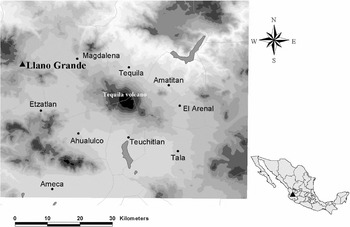
The core of the Teuchitlan tradition was composed of several closely linked valleys that ring the Volcán de Tequila (Figure 2). In pre-Columbian times, the Laguna de Magdalena was a major feature of the western part of the valleys, and some natural predecessor of the modern La Vega reservoir was located in the southern part (Weigand 1993). The Tequila valleys are in many respects reminiscent of other large lake basins of the Mexican highlands (Patzcuaro, Tetzcoco)—they possess ample farmland, mountain resources, and lake fish and fowl that would have resulted in a diverse subsistence base.

Map of central Jalisco.
Just as in the rest of Mesoamerica, farmers in the Tequila valleys had to contend with a pronounced dry season-rainy season distinction. Today, this means that approximately 900–1,000 mm of annual rainfall falls primarily between late May and early October (Vose et al. 1992). This places seasonal limits on rainfall agriculture, but the total rainfall and number of frost-free days are greater than in, say, central Mexico. Weigand (1993) has argued that irrigation, terracing, raised fields, and other forms of agricultural intensification greatly extended potential food production, but more chronologically precise studies of these features are continuing (Stuart 2002).
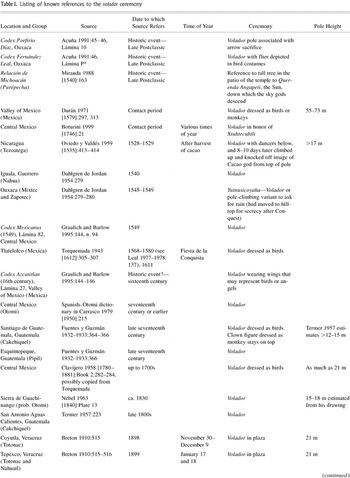
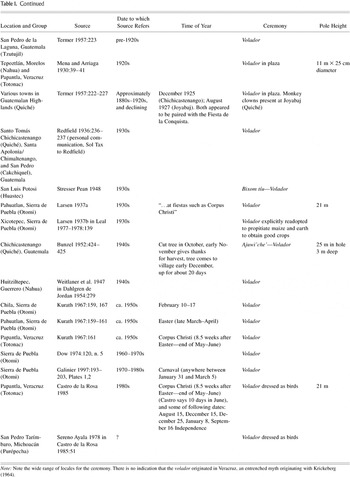
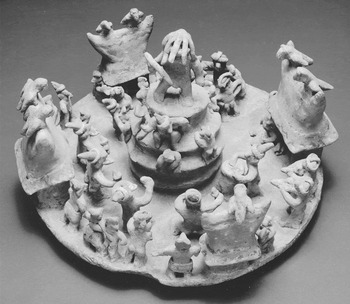
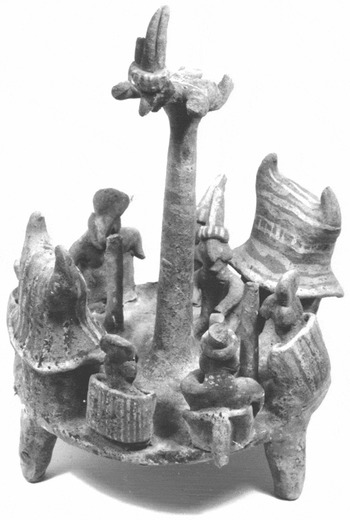
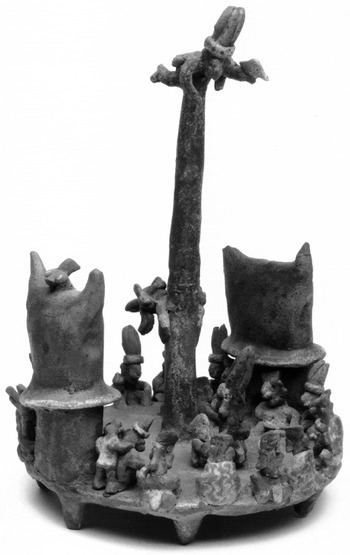
Existing studies of the activities that took place in the public buildings have taken advantage of a unique source of data—ceramic dioramas of the architecture that depict dancing, drinking, marriages, and other activities (Townsend 1998:Figures 2, 27; Von Winning 1971:348, Figures 10, 11, 1974:Figures 41–45; Von Winning and Hammer 1972:Figures 21–23) (Figure 3). Ignacio Bernal (1949), J. Charles Kelley (1974), and Weigand (1992a) have pointed more specifically to the numerous scenes in which a tall pole is set in the central altar (e.g., Kan et al. 1970:Figure 35; Von Winning 1969:Figure 155) (Figures 4 and 5). While a group of individuals stand in the patio below, someone usually climbs the pole or balances on top. All of the authors previously cited identify the scenes as depictions of the pan-Mesoamerican volador ceremony, which is still practiced in many areas (Table 1).
Listing of known references to the volador ceremony

Continued


North America, Mexico, Nayarit, village festival scene, ceramic, c. a.d. 200. Height, 7 cm; diameter, 15 cm. (Gift of Mr. and Mrs. Julian Goldsmith, 1989.639. Copyright 1999, Art Institute of Chicago. All rights reserved.)

1959.55.18. Pole scene, Nayarit. Two houses and a prone figure on top of a pole (volador). Several of the figures are wrapped in blankets. (Courtesy Yale University Art Gallery, New Haven, CT.)

Ceremonial scene, Nayarit, 600 b.c.–a.d. 1000. Painted terra cotta. (Accession number 5444.7265; courtesy Gilcrease Museum, Tulsa, OK.)
In the ethnohistorically documented form of the volador, four young males climb a 11–25 m pole and leap off at a climactic moment of the ceremony, allowing the ropes tying them to an apparatus at the top to unwind as they spiral down. The four flyers (frequently dressed as birds) hope to make 13 circuits around the pole before touching down, totaling 52, the number of years in a calendrical cycle. As many authors ancient and modern have noted, the ceremony makes symbolic reference to both the Mesoamerican temporal round and the spatial model based on four cardinal directions (e.g., Kelley 1974; Torquemada 1943 [1612]:305–307). Lorenzo Boturini de Benaducci (1999 [1746]:21) also related this fourfold aspect of the voladores to the solstices and equinoxes, and Christopher L. Witmore (1998) recently summarized some of the suggestive evidence relating the circular imagery of the Mesoamerican calendar to the form of the guachimontones.
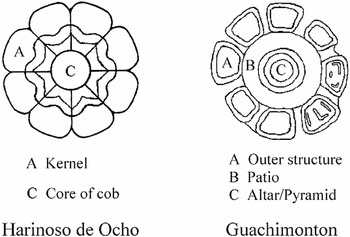
In a recent paper, I argued that the volador ritual was only the tip of the iceberg of guachimontón symbolism (Beekman 2002). The layout of the architecture itself was a metaphor for the Mesoamerican three-tiered model of the universe, with an upper world represented by the volador pole and the central mound, a middle world defined by the patio itself, and an underworld clearly referenced by the tombs sometimes found underneath the surrounding structures. This representation of sacred space has been identified at many other Mesoamerican centers (e.g., Ashmore 1991; Joyce 2000) as part of a conscious program relating political leaders to the sacred. The primary subsistence crop of Mesoamerica, maize, is also commonly related to this worldview both conceptually and iconographically (e.g., Bohrer 1994; Taube 2000). The most controversial part of my earlier paper was the claim that the concentric circular layout of the later guachimontones actually duplicated a cross-section of one of the eight-rowed maize varieties known to have evolved in western Mexico within the same general time frame (Figure 6).

Cross-section of maize variety Harinoso de Ocho next to a plan drawing of a sample guachimontón from Potrero de las Chivas. Redrawn by the author from Wellhausen et al. (1952:Figure 51) and Weigand (1975:Figure 4).
What I only alluded to previously was that the volador ritual may not be the best explanation for the imagery present in the ceramic dioramas of the Teuchitlan tradition circles. I aim to demonstrate this by first referring to recent archaeological excavations at Llano Grande that were partly guided by studies of the ceramic models. This will be followed by a discussion of an alternative source of inspiration for the dioramas and what this might mean for both our understanding of activities in the circles and of the role of political leaders in the Teuchitlan tradition.
EXCAVATIONS AT LLANO GRANDE
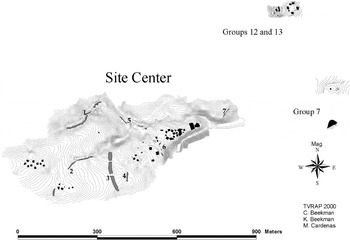
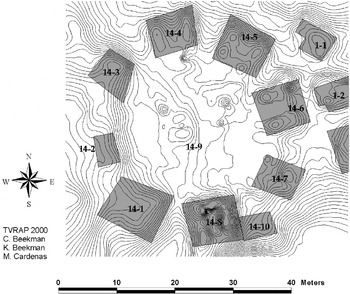
The 2000 Tequila Valley Regional Archaeological Project (TVRAP) excavations at the guachimontón of Llano Grande, although recent and unsynthesized, provide useful data that help explain the role of these complexes. The settlement is located on a mesa bounded to north and south by small seasonal streams. The mesa, in turn, lies within the terminus of a pass through the mountains that surround the Tequila valleys. The settlement is composed of a concentric circular arrangement of eight structures of the Teuchitlan tradition, an adjacent compound of restricted access (elite residences?), and another 50 structures grouped into 12 compounds (Figure 7). A conservative estimate of site area is 20 ha, and the inclusion of some compounds that are physically very close but separated by moderately deep arroyos would increase that figure. Ceramics pertain to the Early and Middle Tabachines phases (a.d. 1–400), and initial radiocarbon results (to be discussed elsewhere) support this assignment. Our excavations concentrated on three of the outer structures of the Llano Grande circle and on the patio (Figure 8), of which only the latter will be discussed here.

The Tequila Valley Regional Archaeological Project 2000 map of Llano Grande, Jalisco. Contour interval is 1 m.

The Tequila Valley Regional Archaeological Project 2000 map of the guachimontón at the Group 14 circular complex, Llano Grande, Jalisco. Contour interval is 10 cm.
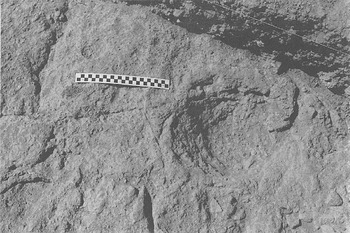
There was an obvious rise in the center of the patio that I had initially interpreted as the customary altar, obscured by debris tossed aside by the looters who had clearly been digging there. As excavation progressed, however, it became clear that no construction material was present. At a very shallow depth, in fact, we had reached a slightly raised solid surface that turned out to be a wide strip of consolidated ashflow that runs north-south across the center of the patio and quite close to the surface. Although solid, the surface of the ashflow was soft enough for the builders of the circle to cut into it. Numerous crisscrossing cuts had been made to produce a circular bowl-shaped depression of about 20 cm in depth and about 25 cm in diameter (Figure 9). Measurements confirmed that it lay at the direct center of the guachimontón patio, and no other holes were found in the patio. It appears that instead of constructing an altar, the builders of the Llano Grande circle had used the slight elevation for the same purpose. Several similar holes within central altars have since been found during excavations at the site of Guachimonton (Phil Weigand, personal communications 2000–2002).

Photograph of carved hole in center of patio in the Llano Grande guachimontón. Scale = 25 cm.
These holes in the patio centers clearly correspond to the location where poles are depicted in the ceramic dioramas mentioned earlier. Ethnographic descriptions of the volador ceremony usually refer to setting the pole upright in a deep pit (see especially Bunzel 1952:424–425), which was then supported by earth and stones (nicely depicted iconographically in the Codex Borbonicus). The hole at Llano Grande is obviously not deep enough to support a freestanding pole, which would have required guy lines leading to the edges of the patio for support. Some images of pole ceremonies other than the volador depict such a support system (e.g., those in Durán 1971 [1579]:Plates 19 and 47). Fray Bernardino de Sahagún's (1950–1969 [1578–1580]:Book 2:18) description of another pole ceremony similarly states, “The tree was made fast by many ropes from the top, as the rigging of a ship hangeth from the topsail.” Support lines of this sort would have made a volador ceremony impossible at Llano Grande: Flyers would have collided with the guy lines as they circled the pole. This is only one caution, but another is that a different ceremony may be more plausible.
POLE-CLIMBING CEREMONIES
There is a great deal more regarding pole ceremonies in Mesoamerica that has not yet been explored in the literature in western Mexico or elsewhere. We can start by noting that most of the ceramic models of the pole ceremony described earlier do not really look much like a volador ritual. Instead, figures are shown climbing or balancing atop the pole. This could be due to the difficulties inherent in representing swinging voladores in the ceramic medium. But there are other pole-climbing ceremonies in Mesoamerica that deserve more attention than they have received. Many of the ceramic models may better correspond to the Xocotl Huetzi, a ceremony recorded in central Mexico in the sixteenth century but recorded ethnohistorically and ethnographically across Mesoamerica (recently noted also by Butterwick 1998:102) (Figures 10 and 11). Indeed, Boturini (1999 [1746]:21) and Toribio de Motolinía (1903 [1536–1541]:Capítulo 16:46) even confused or conflated the volador ceremony with that of Xocotl Huetzi in their descriptions, suggesting an intimate relationship and overlapping symbolism.

Xocotl Huetzi ceremony, Codex Borbonicus (from Seler 1908:Figure 75).

Xocotl Huetzi ceremony, Primeros Memoriales (from Seler 1908:Figure 76).
The Xocotl Huetzi was the central ceremony from one of the 18 veintenas (20-day periods) of the central Mexican 365-day calendar. The veintena was alternately known as Hueymiccailhuitl (Great Feast of the Dead in Nahuatl), but both terms are used interchangeably and in combination with each other. As suggested later, they may refer to two different events from the same ceremony.
On another day named xocotlhuezi, in some areas, such as Tacuba, Cuyovacan, Azcapuzalco, they used to raise a great pole [from a] tree trunk of 10 brazas, and they made an idol of seeds bundled up and decorated with paper, and they put it atop that pole, and in the course of the celebration they raised this idol onto the pole, and on the day all danced around it, and in the morning of the day of the celebration they took some slaves and other captives that they took in war, and they brought them bound hand and foot, and tossed them in a great fire that they had built for this cruelty; and before they had finished burning, they took them from the fire not out of any pity they had, but to cause them a second torment or death, that they shortly followed, which was to sacrifice them, removing their hearts, and in the afternoon they knocked the pole to the ground, and they struggled to obtain part of that idol, of the seeds that were mixed with the dough that in this land they use to make bread, so as to eat some little part, which they believed would make them valiant men [Motolinia 1903 [1536–1541]:Capítulo 19:61; my translation].
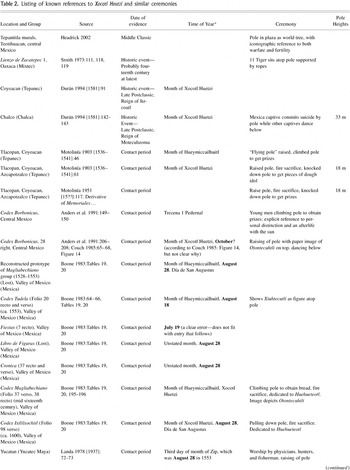
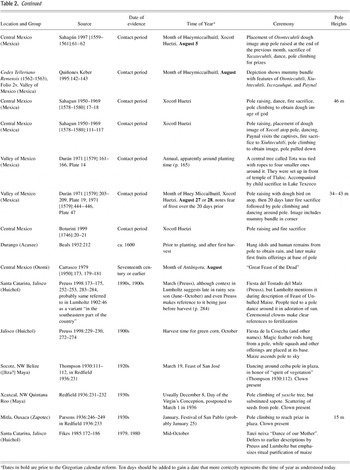
As described by various Spanish and native sources (Table 2), the ritual for this “month” involved the ceremonial raising of a pole, of approximately the same height (15–46 m) as that of the volador. Atop it were placed either banners or an image in amaranth dough of a bird, of the god of fire and time Xiuhtecuhtli, or the related Otomi deity Otontecuhtli. Dancing, feasting, and drinking of alcoholic pulque were part of the ceremony, which culminated in a race among male youths to reach the top of the pole and capture the image. Depending on which source one emphasizes, at some point during the ceremony one or more individuals were sacrificed by fire as an offering to Xiuhtecuhtli or the closely related Huehueteotl (the Old Fire God). The latter is specified only in two of the codices of the Magliabecchiano group.
Listing of known references to Xocotl Heutzi and similar ceremonies

Continued

Eduard Seler (1993a [1908]:Book 4:139–143) and more recently Annabeth Headrick (2002) have interpreted this ritual as martial in orientation and as devoted to the souls of dead warriors or princes who have gone to an afterlife with the sun. Headrick notes, however, that the Tepantitla mural painting that depicts the Xocotl Huetzi ceremony or its analogue at Classic-period Teotihuacan also includes agricultural motifs associated with the Great Goddess. Indeed, Betty Ann Brown (1988) actually argues that this monthly ritual was more oriented toward agriculture before the Aztecs turned it into an instrument of state terror, something the Teotihuacan state may have done, as well.
If we acknowledge this possibility, we can note that both the volador and Xocotl Huetzi rituals make a number of interesting parallel references to fertility—or, more specifically, to agriculture (Castro de la Rosa 1985; Kelley 1974:25–32; Leal 1977–1978). Both pole ceremonies have been seen by some scholars (Galinier 1997:193–203; Margain 1939; Stresser Pean 1948) as phallic in their symbolism, and, of course, much could be made of the climactic moment of the volador ceremony when the four flyers leap from the top of the pole. We have no pre-Columbian name for the volador ritual, but Xocotl Huetzi (Nahuatl for “The xocotl fruit falls”) may be a reference to ripening plants, or it could just refer to the collapse of the xocotl pole at the end of the ceremony. Walter Krickeberg (1964:160) thought that the volador represented agricultural crops descending from the heavens, and Konrad Theodor Preuss noted that the related Huichol spring and harvest-pole ceremonies represented maize's descent from and ascent to the heavens (Preuss 1998:229–230, 272–274). Barbro Dahlgren de Jordan (1954:279–80) describes volador ceremonies among the Zapotec and Mixtec as explicitly tied to pleas for rain for crops.
Rituals similar to the Xocotl Huetzi and recorded ethnographically among the Maya all share a strong emphasis on agricultural symbolism in the absence of most references to fire, warriors, or youths (Redfield 1936). Indeed, ethnographic cases of pole ceremonies from the Huichol, Zapotec, and the Maya indicate that the military and death aspects have been replaced since the Conquest with ritual clowns or monkeys (see the discussion in Redfield [1936] and compare Table 2) while retaining explicit agricultural references. Of course, no reason exists that militarism and fertility need be competing interpretations for the pole ceremonies. The annual cycles of warfare and agriculture appear to have been inversely correlated in Mesoamerica, partly because most warriors were also farmers. As Ross Hassig (1988:53–54) notes, Aztec military campaigns could not begin until the harvest had been brought in. David Webster (1999:80, 100–101) cites a variety of hieroglyphic and ethnohistoric accounts indicating that Maya warfare occurred primarily in the dry season, beginning in earnest right after harvest time. The Xocotl Huetzi ceremony, and that of the volador, thus has a twofold aspect, emphasizing the calendar, the sun, and agriculture on one side and elite ancestors and masculine youth on the other.
Indeed, the timing of both ceremonies and their relationship to annual cycles seem highly suggestive. The volador was never linked to a particular Mesoamerican “month.” Early accounts do not say much about its schedule, but I have already mentioned its association with pleas for rain, and one Nicaraguan source specifically assigns it to the end of the cacao harvest (see Table 1). The Xocotl Huetzi ceremony in the sixteenth century was firmly linked to late August among those sources from the central highlands of Mexico, as was another pole-raising ritual in Yucatan (Table 2). Because the Gregorian calendar reform was not implemented in the Spanish colonies until 1582, these dates in late August would actually correspond to early September in our current understanding of the seasonal round. This would typically be too early for a full-fledged maize harvest. But it does correlate reasonably well with the historically and ethnographically important early harvest of the green maize that has just turned milky, and thus edible, usually a month or two before the main harvest.
The changes that occurred after the Conquest as part of the general accommodation of native beliefs to the Catholic ritual schedule altered the original timing of these ceremonies. It appears as if the Xocotl Huetzi ceremony was broken up into its two aspects. The celebrations of the ancestral dead that were part of Hueymiccailhuitl and the veintena prior were recognized by Durán to have moved to November 1 and 2 to merge with All Saint's and All Soul's Days (Durán 1971 [1579]:441–443). Within the last century or so, pole ceremonies reminiscent of the Xocotl Huetzi (though long since forced to give up that name) have been documented from December through March (Table 2), and one Huichol case in October retains its connection to a green-corn ceremony (Fikes 1985:172–186; Preuss 1998:229–230, 272–274). The modern cases of the volador have nearly the same schedule (extending into April), with the better-known voladores of Papantla bucking the pattern and celebrating it several times a year (Table 1). There seems to be a special emphasis on Catholic holidays of spring renewal, such as Easter, perhaps a reinterpretation of the pre-Columbian meaning.
An interesting possibility suggests itself. The volador and Xocotl Huetzi, so frequently intertwined in their timing and meaning, may originally have been paired rituals occurring in the spring and fall. The western Mexican ceramic models are ambiguous as to which ceremony is truly being represented, but their overlapping symbolism suggests that a general reference to critical points in the agricultural cycle—specifically, maize—was meant. We cannot assume that these were the only ceremonies enacted within the circles, but the fact that the ancient ceramicists chose to represent these so frequently speaks to their importance.
GREEN-MAIZE CEREMONIES
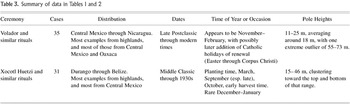
To summarize (Table 3), the symbolism and scheduling suggest that the pole ceremonies described from Spanish Contact were related in one way or another to agricultural fertility. Specifically, a few references exist that tie the volador to the spring and pleas for rain, and the Xocotl Huetzi is strongly associated with the fall and an early harvest ritual. The interpretation of the Xocotl Huetzi as a first-fruits ritual may, in fact, originate with Seler (cf. Brown 1988:181n.2, although I could not find the reference she indicates).
Summary of data in Tables 1 and 2

The green-maize harvest in many ways carries more symbolic significance than the full-fledged harvest, as it signifies an end to the long period of careful rationing of the previous year's stores. It was particularly well known among eastern North American maize farmers. Several groups in the east carried out green-corn ceremonies within architecture or specially dedicated plazas (Witthoft 1949:20, 64–65), and the Delaware, Cherokee, Creek, and Natchez even used a central pole as the focal point for the dances (Witthoft 1949:16–17, 48–49, 62, 71; note especially the description of the ceremony among the Delaware). Fire played a common role in these rituals, either through the renewal of fire throughout the community or in the roasting of the first green-maize ears (e.g., Witthoft 1949:32, 53–62). We might speculate that the Mesoamerican element of tossing human beings onto the fire during the Xocotl Huetzi symbolized the latter.
In Mesoamerica, ethnohistoric evidence for an early harvest exists in the numerous references to green corn and its dietary uses by sources as diverse as Sahagún (1950–1969 [1578–1580]:Book 2:64, Book 6:228, 235, Book 8:38, Book 10:42, 79, Book 11:279, 281, Book 12:75) and Thomas Gage (1958 [1648]:222–223). The Otomi of north-central Mexico were said to have held a special regard for green maize (Sahagún 1950–1969 [1578–1580]:Book 10:179–180, Book 12:75), although the story is presented as a cautionary tale against harvesting too much of one's crop before full maturity. In the past century, early maize harvests have been reported from September to November for Mesoamerica as a whole (Palerm 1967:29–30; Reina 1967:318–324). Alan Sandstrom (1991:124–125) reports green-maize harvests from September to early October among Nahua speakers in Veracruz. Ceremonies celebrating the green-maize harvest are reportedly held in several areas of the Maya Lowlands and Highlands (Stross 1994:n. 25; see also Collier 1975:72–74).
There seems to have been a particular emphasis on green-corn harvests in western Mexico. They have been reported repeatedly among the Sierra Purépecha of Michoacan (Beals 1946:20–22; West 1948:34–39, 45). Among the Huichol, Tepecano, and Cora, green-corn ceremonies have been held from August to the end of October, depending on local humidity and planting conditions (Fikes 1985:170–186; González Ramos 1972; Lumholtz 1902:Book 2:119, 126–127; Mason 1913:348–349; Weigand 1992b:56–60;). That of the Huichol is particularly relevant: Not only it makes use of a raised pole as its centerpiece; so does its companion ritual in the spring (Preuss 1998:173–175, 229–230, 272–274, 283–284). One of Preuss's descriptions of the October ritual is as follows:
At midday during the same fiesta (of Toasted Maize) they carry out a second very characteristic ceremony, accompanied by the song ipinári. The name refers to the “post that reaches to the sky”, which is located in the plaza in front of the temple and where they hang belts with attractive woven designs that are of the same type as those the Huichol use. The number of belts corresponds to the number of the custodians of the temple. The custodians appear as women, hold the belts, and dance around the post. One man named huna holds the post so that it doesn't fall…. On his back the man carries a bag with tamales made of raw and cooked maize…. Another man, the harapái … also holds the post, but he carries strapped over his shoulders a drum used by the singer that stands behind him. The most important role is of the yuhuname. The young men do not want the role, and so an old man holds it. He must run around with his penis exposed and imitating sexual relations with the dancers dressed as women. The idea that is expressed, so soon before the harvest, is too obvious to have to explain [Preuss 1998:284; my translation].
Lumholtz (1902:Book 2:46) describes the ritual in a more summary manner, as he did not witness it himself. Jay Courtney Fikes (1985:172–186) witnessed the same tatei neixa (Dance of Our Mother) as it was performed in 1979 and 1980, but he is sufficiently satisfied with the earlier descriptions that he focuses on interpretation. He notes that the ritual today is a first-fruits ceremony in which the new maize is ritually purified and thanks are given, but the tatei neixa also holds a wider symbolic significance, as it marks the beginning of the dry season and world renewal.
Each of the western Mexican groups cited so far has complementary spring rituals generally associated with requests for rain. The Tepecano have the Feast of Planting Corn in April and repeat it until the rains begin (Lumholtz 1902:Book 2:119; Mason 1913). The Cora have rain and planting festivals throughout the month of May (Lumholtz 1902:Book 1:509), and sources frequently state that the Huichol continue to ask for rain throughout the rainy season (Lumholtz 1902:Book 2:1, 6–14).
The ubiquity of green-maize ceremonies among western Mexican indigenous groups may relate to the presence of a variety of the maize race Harinoso de Ocho, known as the Elotes Occidentales (Wellhausen et al. 1952:70–73, Figure 24). According to E. J. Wellhausen and colleagues (1952:71), flour corns such as Harinoso de Ocho are excellent for roasting, which was a culturally preferred method of eating green maize still practiced today in Jalisco. However, maize harvested early must either be eaten relatively soon or boiled and dried to prevent rotting. An emphasis on an early harvest may signify that the previous year's maize stores will not hold out until the regular harvest (not particularly plausible in a relatively rich and diversified environment such as the Tequila valleys). It could also be a risk-avoidance practice, bringing in part of the harvest before frosts can wipe out the crop (again, not very plausible with the reduced risk of frost in this region).
Note, finally, that the appearance of green maize is not a single event. The first milky ears may appear up to two months before they are considered numerous enough to harvest (Berlin et al. 1974:120–121), and green-maize celebrations have been known in which the festivities were broken into two separate events spaced a month apart (e.g. Witthoft 1949:41–44). The Aztec feast of Huey Tecuilhuitl, in fact, occurs 40 days before the Xocotl Huetzi and marks the very first appearance of green maize in the ceremonial cycle (e.g., Durán 1971[1579]:437; Sahagún 1950–1969 [1578–1580]:Book 2:96–107). The veintena 20 days after Xocotl Huetzi, however, has been interpreted by N. C. Christopher Couch (1985:70) as a celebration of the full-fledged harvest, and various elements described by Sahagún (1950–1969 [1578–1580]:Book 2:124), such as the scattering of fully ripened seed, support this.
AGRICULTURAL RITUAL IN WESTERN MEXICO AFTER THE TEUCHITLAN TRADITION
The central pole continued to be an element of sacred centers in western Mexico well after the Teuchitlan tradition disappeared in the Epiclassic period (a.d. 600–900). Antonio Tello makes reference to a pine tree standing in the main plaza of Ocotlan, on the shores of Lake Chapala, when Nuño de Guzman invaded Jalisco in 1530 (Tello 1997 [1650–1653]:77). Around 1600, the two Jesuit priests Arnaya and Santarén each reported that a zapote tree stood in the plaza of the communal houses in Acaxee communities to the north, in Durango (Beals 1932:212). This tree was the centerpiece for two rituals. During planting time, the Acaxee would hang idols and the bones and skulls of the dead from the zapote so that the dead would sow the first seeds (a belief recorded among the Cora and Huichol of the late nineteenth century, as well [Lumholtz 1902:Book 1:509, Book 2:28, 49]; see Furst [1982] for the wider Mesoamerican parallel to this). Later, the Acaxee would give the first maize cobs to their deities by placing them at the foot of the same zapote (Beals 1933:27–29).
In the very early 1900s, J. Alden Mason (1918) recorded an annual cycle of rituals among the Tepecano Indians of northern Jalisco that is worth final consideration. Many of these rituals took place in patios (Mason 1913:348–349, 1918) that turn out to be ruined guachimontones (Weigand 1975:215–219). The translations are replete with references to the sky, the four cardinal directions, and requests for rain, extremely common features to ritual among the Huichol and Cora, as well. Among the various ceremonies transliterated and translated by Mason in Colotlan, several refer to the chanes (Mason 1913:125–129), apparently a locally used term for snake creatures called o'oikam in the actual Tepecano rituals.
The chanes are malevolent water-serpents which inhabit the springs and streams. They are horned and of many colors. They always travel in pairs, male and female, and love to stretch themselves through the clouds in rainy weather, head in one spring and tail in another, visiting. In this form they appear as rainbows. They are called the “winds of the water”. The chanes are vicious and will sting those who have not placated them…. When a man decides to build a house and make his home on a new site it is necessary for him to placate the chanes of the spring whence he draws his water supply [Mason 1913:126].
The chanes are known as haiku to the Huichol, who believe that they share most of the attributes described earlier, that they have wings (Seler 1993b [1908]:Book 4:194), and that they are associated with the four cardinal directions (Preuss 1998:100). They are known to the Cora as chacanes (Hinton 1972:36).
Similar creatures were recorded among the seventeenth-century beliefs of the Tecuexe, Nahua-speaking peoples of central and eastern Jalisco.
[T]he principal idols that they worshipped were the sun, and the moon, and other animals that they made of stone, such as snakes which they celebrate as water deities that they called chaneques [Paso y Troncoso 1946 (1652):17–18; my translation].
Ohhuican Chahnequeh (dwellers in dangerous places, in Nahuatl) were described by Ruíz de Hernando Alarcón (1984 [1629]:232) as forest spirits, and they are still known in some areas of Mexico today as chaneques, a kind of duende, or goblin. The koo savi of modern Mixtec belief are feathered serpents whose passage through the clouds produces rain (Monaghan 1995:105–110, Figures 6 and 7).
The chanes most closely relate to the Cholan and Tzotzilan Maya term for “snake,” chan, which can also mean the number “four” or “sky.” This is not a mere phonetic correspondence, as the chic-chan (in Chorti, “[deer?] snake”; Karl Taube, personal communication 2002) are rain spirits of the first order. The sky chic-chan are described by Charles Wisdom (1961:444–447) in his early-twentieth-century ethnographic work as horned, frequently traveling in mated pairs, and four in number, each associated with a major body of water and one of the cardinal directions. Rainbows are their bodies, thunder is their voice, and storms are caused by their passage across the sky. Chic-chan from the earth are similar, and they are described as living upstream during the dry season and moving downstream with the coming of the rains and the swelling of the rivers.
As mentioned earlier, the main section of the site of Llano Grande sits atop a mesa bounded by deeply cut seasonal arroyos to the north and south, which join at the head of the mesa. The arroyo below the junction is called the Arroyo el Chan, and our local informants could not provide us with an explanation for the toponym. The correspondence is tantalizing and would help to link the disparate evidence for agricultural ritual to the area around Llano Grande. But research among the rural populations of central Jalisco has tended to focus more on the rich history of tequila and haciendas than on the persistence of still older belief systems.
AGRICULTURAL RITUAL AND POLITICAL POWER
I have drawn on western Mexican imagery, later ethnohistoric and ethnographic data on ritual and religious beliefs, and their parallels elsewhere in Mesoamerica to argue that the guachimontón was intimately connected to important rituals of the agricultural cycle. Specifically, ceremonies linked to the planting and harvesting of maize are depicted in ceramic models of the architecture. The degree to which this religious significance may have translated into political power is an interesting question. The connections between Mesoamerican rulership and the agricultural symbolism discussed here are numerous. Virginia Fields (1989:18) and Brian Stross (1994:15, 21–25) have shown how maize imagery was frequently associated with lowland Mesoamerican rulers and their ritual duties during the Late Formative period. The practice of ritual bloodletting among Classic-period Maya royalty had fertility—especially agricultural fertility—as its goal (Schele and Miller 1986). Joyce (2000) has similarly argued that Formative- and Classic-period Zapotec rulers justified their status through their role as mediators between commoners and the divine in promoting agricultural success.
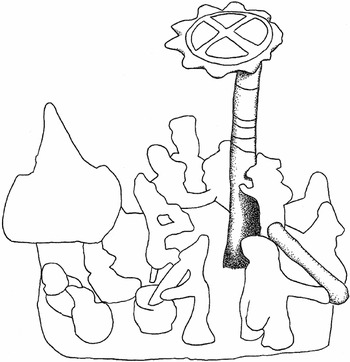
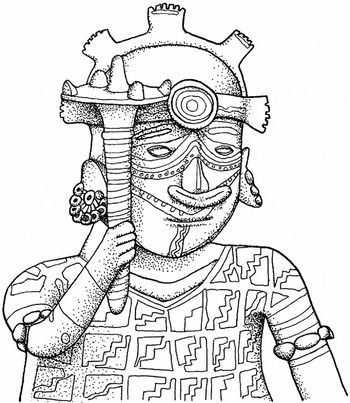
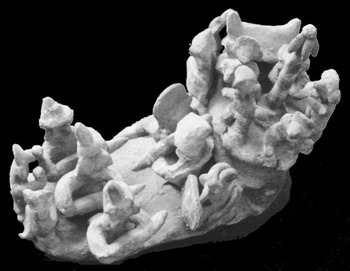
Depictions of ritual are one thing, but can any of the imagery discussed be considered an iconography of rulership, as Mark Miller Graham (1998) asks of the western Mexican corpus? One example of an architectural scene shows the central pole with a flat, starburst-shaped object atop it, with a painted circle surrounding a cross on the dorsal surface (Von Winning and Hammer 1972:Figure 50) (Figure 12). This may, of course, refer to the quadripartite concepts that we have discussed, though I suggest that another connection exists to be made here. Commonly depicted in western Mexican art are small, solid clay people seated or standing next to an upright pole with a disk on top (e.g., Von Winning and Hammer 1972:Figures 62–64). The captions commonly label the poles as sunshades. But consider the larger, hollow figure illustrated in Figure 13. A male, decorated with jewelry and body and facial tattoos, holds a staff that is clearly a larger and more detailed version of the object interpreted elsewhere as a sunshade. The vertical bar has latitudinal stripes, while the flat “shade” at the top has four equally spaced nubbins around the upper rim of the disk and a single larger nubbin in the center, forming a cross. The clay artists of western Mexico frequently simplified the guachimontón in a similar way to depict the circular complexes in a secondary role—for example, the battle scene depicted in Figure 14 (for another example, see Von Winning and Hammer 1972:Color Plate 5). Here a single structure, a circular patio, and a stubby central pole are enough to indicate the guachimontón form.

Detail of a small ceramic diorama, reportedly from Nayarit. Redrawn by Kathy Beekman from Von Winning and Hammer (1972:Figure 50).
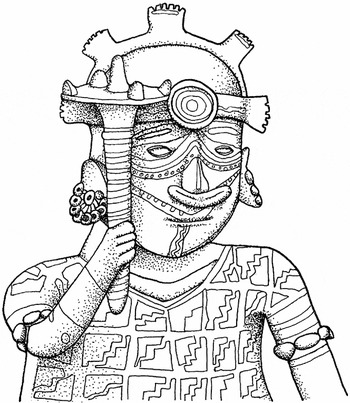
Detail of a hollow figure, Ixtlan del Rio style, Nayarit. Redrawn by Kathy Beekman from Anawalt (1998:Figure 1).

Pottery warrior group, Nayarit style. (Catalogue number 30.3/196; courtesy Division of Anthropology, American Museum of Natural History, New York, NY.)
If the staff in Figure 13 is a stylized representation of a guachimontón with pole, its context suggests that it is an emblem of office, whether religious, political, or both. In this sense, it may be comparable to the Classic Maya “Jester God,” or the “Double Headed Serpent Bar.” These symbols of rulership are not found with every image of Maya kings, but they identify the holder as a person of the greatest political power when they do occur (Freidel and Schele 1988:552; Schele and Miller 1986:72–73, 111). The associated sky imagery common to the Serpent Bar also relates the holder specifically to the celestial regions (Schele and Miller 1986:109, 120–121). On the sarcophagus lid of the ruler Pacal II of Palenque, the Double Headed Serpent Bar is even depicted as wrapped around the central World Tree (Freidel et al. 1993:77–79), again relating rulers and the tree (or pole) that links them to the heavens. Postclassic rulers from the central highlands were likened to cypress trees (Sahagún 1950–1969 [1578–1580]:Book 6:252), a common reference to their central position as a spiritual axis mundi and link to the heavens. Hasso von Winning once made a similar observation about the pole ceremonies depicted in western Mexico (Von Winning and Hammer 1972:25), citing them as conduits between this world and the upper world. The individual in Figure 13, by using an abstracted guachimontón and pole as a symbol of authority, is making a parallel statement: By virtue of his role as a mediator in ritual activity, he holds a special relationship with the celestial regions.
Although various concepts and imagery related Mesoamerican rulers to agricultural fertility, how may this relate to the activities that took place within guachimontones such as that at Llano Grande, where cosmological and agricultural symbolism created a locus for political power? The Franciscan Antonio Arias y Saavedra (McCarthy and Matson 1975:204–215) reported that, as of the mid-seventeenth century, Indians from the Pacific coast visited the highland Cora Sun temple at the ceremonial center of Nayarit to ascertain the timing of the first rains from the Sun God and the preserved corpses of past priests that were kept in its temple. The Sun God received these requests, because it was believed to be the one who sent rain, and the dead priests served as its oracles (McCarthy and Matson 1975:210). Later in the year, farmers brought the first fruits of the harvest to that temple. The modern Mestizo inhabitants of Tuxpan, Jalisco, have done the same thing in recent times, paying the town's Catholic priest a percentage of their crop and offering first fruits to the church (Silva 1956:71). No poles or trees are reported in these two cases, but the parallels to the Acaxee report seem clear. The use of dried and mummified past priests or rulers as oracles is a fascinating extension of Headrick's (1999) argument that preserved mummy bundles served the same purpose elsewhere in Mesoamerica and were important symbols of lineage at Classic-period Teotihuacan.
Similar themes have been recorded in more recent times and within the guachimontón architecture itself. Weigand (1975:216–220) has described how a ruined guachimontón at Cerro de Colotlan, in northern Jalisco, was used by the Tepecano Indians in the early twentieth century. There, priest singers, each representing a separate lineage and seated within a separate structure, communicated with their deities by passing messages through both a fire in the patio and with the help of an eagle, which would transmit messages skyward. The responses, relayed through the shaman, determined where individuals were to plant and who was to hold political office. Weigand adds that, as of the late 1960s and early 1970s, offerings were still left at the circle both before the beginning of the rainy season and later at harvest time. The Cora and Tepecano cases provide clear examples in which beliefs regarding the role of hereditary priests as mediators between farmers and the supernatural might have been transformed into a broader form of authority.
DISCUSSION AND CONCLUSIONS
The presence of a political elite in the Late Formative Teuchitlan tradition has been inferred from the archaeological evidence for unequal access to wealth and a growing settlement hierarchy, but more indigenous concepts of rulership are finally beginning to take shape. By the Late Formative period, Mesoamerican cosmological models with ties to maize agriculture were being drawn on to inform public architectural design (Beekman 2002). The similarities noted between the pole ceremonies described in the ceramic models and ethnohistoric accounts in western Mexico suggest that the guachimontones were the locations where public ritual relating to agriculture took place. Spring rituals probably related to requests for rain, but the Acaxee and Nayarita accounts suggest that farmers sought advice on scheduling, as well, and repaid the temple for its services once the harvest began to come in.
The familiar Mesoamerican relationship among the calendar, cosmology, ritual, architecture, and maize has been highlighted repeatedly in the evidence outlined in this paper and may provide the central kernel in the local conception of rulership. Temple officials carried out the rituals that renewed the natural cycle but may have been responsible for maintaining the calendar, as well. Some ceramic figures suggest the presence of individuals deriving special ties to the sky or upper world from their roles in temple ritual. The association of the wealthier shaft tombs with the guachimontones (Beekman 1999) suggests that this role was economically or socially profitable, allowing accumulation during life or attracting offerings at death.
The question remains whether political authority in the Teuchitlan tradition was limited to the almost passive form described in the ethnohistoric and ethnographic reports, or whether elites took a more active role. Were elites providing specialist knowledge about the calendar to farmers regarding the timing of planting, then reaping the benefits of this role after the harvest by receiving first fruits from a grateful populace? This in a sense is an exchange of services among specialists. But the ethnographic evidence from the Tepecano and Cora gives us an idea of how elites might have been able to exert greater political power through supernatural sanction. The critical points in the agricultural cycle when priests were consulted—planting and harvest—were also bottlenecks for labor allocation. The coordination of work in the pursuit of subsistence eventually may have been co-opted by elites.
Around the onset of the Classic period, guachimontones such as that at Llano Grande were built that incorporated a more pronounced form of maize symbolism, shaping the architectural plan itself (Beekman 2002). This corresponded to a gradual decline in the elaboration of the shaft tombs and mortuary ritual, even as the public architecture became larger and more complex. As the Teuchitlan tradition became more geographically extensive, more faceless, and more corporate (Beekman 2000:403–404), its priests may have succeeded in transforming their positions as keepers of esoteric knowledge into more coercive or managerial roles. Political authority in the Late Formative period was to experience increasing centralization in the centuries to follow.
RESUMEN
Las investigaciones actuales sobre la tradición teuchitlan siguen mejorando nuestro conocimiento de la relación entre el occidente de México y el resto de mesoamérica. Se define esta tradición por el uso de arquitectura pública distinta, pero hay pocos estudios que la relacionan a las élites y a la sociedad. Se propone que un análisis más emic del sistema político pueda clarificar la relación entre la arquitectura, el ritual y las élites políticas en el formativo tardío de Jalisco (300 a.C.–200 d.C.) En este estudio, se relacionan las maquetas de cerámica de la arquitectura con los datos arqueológicos de Llano Grande y las descripciones históricas de la celebración Xocotl Huetzi de las épocas posclásicas e histórica. También hay ejemplos etnográficos recientes del mismo rito que nos ayudan a interpretar las maquetas. Al final, se discute una interpretación del ritual y sistema político de la tradición teuchitalan que se enfoca en la agricultura y en el maíz.
ACKNOWLEDGMENTS
This paper has its origins in ongoing collaborative research on traditional agriculture with William Baden. I thank the Instituto Nacional de Antropología e Historia, which provided the permit to work at Llano Grande, and the National Science Foundation, which generously funded the field research. I also thank Wendy Ashmore, Alec Christensen, Byron Hamann, Annabeth Headrick, Steve Houston, Art Joyce, John Monaghan, Joel Palka, and Karl Taube for their very helpful comments and for copies of unpublished papers. Any sins of commission or omission are entirely my own.
References
REFERENCES
Acuña, René
1991
Códice Fernández Leal.
Instituto de Investigaciones Filológicas, Universidad Nacional
Autónoma de México,
Mexico, DF.
Anawalt, Patricia R.
1998
They Came to Trade Exquisite Things: Ancient West
Mexican-Ecuadorian Contacts. In
Ancient West Mexico: Art of the Unknown Past, edited by
Richard F. Townsend, pp.
233–250.
Art Institute of Chicago.
Anders, Ferdinand,
Maarten Jansen, and
Luis Reyes García
1991
El Libro del Ciuacoatl: Homenaje para el año del Fuego
Nuevo. Libro Explicativo del llamado Códice Borbónico.
Sociedad Estatal Quinto Centenario, Akademische Druck- und
Verlagsanstalt, and Fondo de Cultura Económica,
Mexico, DF.
Ashmore, Wendy
1991
Site-Planning Principles and the Concepts of Directionality among
the Ancient Maya.
Latin American Antiquity
2:199–226.Google Scholar
Beals, Ralph
1932
The Comparative Ethnology of Northern Mexico before 1750.
Ibero-Americana 2.
University of California Press,
Berkeley.
Beals, Ralph
1933
The Acaxee. A Mountain Tribe of Durango and Sinaloa.
Ibero-Americana 6.
University of California Press,
Berkeley.
Beals, Ralph
1946
Cherán: A Sierra Tarascan Village.
Smithsonian Institution Institute of Social Anthropology Publication
No. 2.
Smithsonian Institution,
Washington, DC.
Beekman, Christopher S.
1996
Political Boundaries and Political Structure: The Limits of the
Teuchitlán Tradition.
Ancient Mesoamerica
7:135–147.Google Scholar
Beekman, Christopher S.
1999
A Volumetric Assessment of Social Ranking in West Mexican Shaft
Tombs.
Paper presented at the 64th Annual Meeting of the Society for
American Anthropology,
Chicago.
Beekman, Christopher S.
2000
The Correspondence of Regional Patterns and Local Strategies in
Formative to Classic Period West Mexico.
Journal of Anthropological Archaeology
19:385–412.Google Scholar
Beekman, Christopher S.
2002
Fruitful Symmetry: Cosmology and Corn in the Public Architecture of
Late Formative and Early Classic Jalisco.
Mesoamerican Voices
1.Google Scholar
Berlin, Brent,
Dennis E. Breedlove, and
Peter H. Raven
1974
Principles of Tzeltal Plant Classification.
Academic Press,
New York.
Boone, Elizabeth
1983
The Codex Magliabechiano and the Lost Prototype of the
Magliabechiano Group.
University of California Press,
Berkeley.
Bohrer, Vorsila L.
1994
Maize in Middle American and Southwestern United States
Agricultural Traditions. In
Corn and Culture in the Prehistoric New World, edited by
Sissel Johannessen and
Christine A. Hastorf, pp.
469–512.
Westview Press,
Boulder, CO.
Boturini de Benaducci, Lorenzo
1999 [1746]
Idea de una nueva historia general de la América
septentrional.
Instituto Nacional de Antropología e Historia, Consejo Nacional
para la Cultura y las Artes,
Mexico, DF.
Breton, Adela
1910
Survivals of Ceremonial Dances among Mexican Indians.
XVI Internationalen Amerikanisten-Kongresses, Wien 1908, pp.
513–520.
A. Hartleben's Verlag,
Vienna.
Brown, Betty Ann
1988
All Around the Xocotl Pole: Reexamination of an Aztec Sacrificial
Ceremony. In
Smoke and Mist: Mesoamerican Studies in Memory of Thelma D.
Sullivan, edited by
J. Kathryn Josserand and
Karen Dakin, pp.
173–189.
BAR International Series 402.
British Archaeological Reports,
Oxford.
Bunzel, Ruth
1952
Chichicastenango, A Guatemalan Village.
American Ethnological Society Publication No. 22.
University of Washington Press,
Seattle.
Butterwick, Kristi
1998
Food for the Dead: The West Mexican Art of Feasting. In
Ancient West Mexico: Art of the Unknown Past, edited by
Richard F. Townsend, pp.
89–105.
Art Institute of Chicago.
Carrasco Pizana, Pedro
1979 [1950]
Los Otomies, cultura e historia prehispánica de los pueblos
mesoamericanos de habla otomiana.
Enciclopedía del estado de México,
Mexico, DF.
Castro de la Rosa, Ma. Guadalupe
1985
Voladores and Hua-Huas: Two Ritual Dances of the Region of Papantla.
UCLA Journal of Dance Ethnology
9:46–64.Google Scholar
Clavijero, Francisco Javier
1958 [1780–1781]
Historia Antigua de Mexico, Tomo II.
Edición y prólogo del R.P. Mariano Cuevas.
Colección de Escritores Mexicanos.
Editorial Porrua,
Mexico, DF.
Collier, George A.
1975
Fields of the Tzotzil: The Ecological Bases of Tradition in
Highland Chiapas.
University of Texas Press,
Austin.
Couch, N.C. Christopher
1985
The Festival Cycle of the Aztec Codex Borbonicus.
British Archaeological Reports,
Oxford.
Dahlgren de Jordan, Barbro
1954
La Mixteca: Su cultura e historia prehispanicas.
Imprenta Universitaria,
Mexico, DF.
Dow, James
1974
Santos y Supervivencias: Funciones de la religión en una
comunidad Otomí, México.
Instituto Nacional Indigenista y Secretaría de
Educación Pública,
Mexico.
Durán, Diego
1971 [1579]
Book of the Gods and Rites and the Ancient Calendar.
Translated into English and edited by
Fernando Horcasitas and
Doris Heyden.
University of Oklahoma Press,
Norman.
Durán, Diego
1994 [1581]
The History of the Indies of New Spain.
Translated, annotated, and with an introduction by Doris
Heyden.
University of Oklahoma Press,
Norman.
Fields, Virginia
1989
The Origins of Divine Kingship among the Lowland Classic Maya.
Unpublished Ph.D. dissertation,
University of Texas,
Austin.
Fikes, Jay Courtney
1985
Huichol Indian Identity and Adaptation.
Unpublished Ph.D. dissertation, Department of Anthropology, University
of Michigan.
University Microfilms,
Ann Arbor.
Freidel, David, and
Linda Schele
1988
Kingship in the Late Preclassic Maya Lowlands: The Instruments and
Places of Ritual Power.
American Anthropologist
90:547–567.Google Scholar
Freidel, David,
Linda Schele, and
Joy Parker
1993
Maya Cosmos: Three Thousand Years on the Shaman's Path.
William Morrow,
New York.
Fuentes y Guzmán, Francisco Antonio de
1932–1933
Recordación Florida: Discurso historial y
demostración natural, material, militar, y política del
reyno de Guatemala.
Prólogo del Licenciado J. Antonio Villacorta C. 3 vols.
Sociedad de Geografía e Historia,
Guatemala.
Furst, Jill
1982
Skeletonization in Mixtec Art: A Reevaluation. In
The Art and Iconography of Late Postclassic Central Mexico, edited
by
Elizabeth Boone, pp.
207–225.
Dumbarton Oaks,
Washington, DC.
Gage, Thomas
1958 [1648]
Travels in the New World.
University of Oklahoma Press,
Norman.
Galinier, Jacques
1997
La Moitié du Monde. Le Corps et le Cosmos dans le Rituel des
Indiens Otomi.
Presses Universitaires de France,
Paris.
Galván Villegas, Luis Javier
1991
Las Tumbas de Tiro del Valle de Atemajac.
Instituto Nacional de Antropología e Historia,
México, DF.
González Ramos, Gildardo
1972
Los Coras.
Colección de Antropología Social, Instituto Nacional
Indigenista,
Mexico, DF.
Graham, Mark Miller
1998
The Iconography of Rulership in Ancient West Mexico. In
Ancient West Mexico: Art of the Unknown Past, edited by
Richard F. Townsend, pp.
191–203.
Art Institute of Chicago.
Graulich, Michel, and
Robert H. Barlow
1995
Codex Azcatitlan.
Bibliothèque nationale de France, Société des
Américanistes,
Paris.
Hassig, Ross
1988
Aztec Warfare.
University of Oklahoma Press,
Norman.
Headrick, Annabeth
1999
The Street of the Dead … It Really Was: Mortuary Bundles at
Teotihuacan.
Ancient Mesoamerica
10:69–86.Google Scholar
Headrick, Annabeth
2002
Gardening with the Great Goddess at Teotihuacan. In
Heart of Creation: A Mesoamerican Legacy, edited by
Andrea Stone, pp.
83–100.
University of Alabama Press,
Tuscaloosa.
Hinton, Thomas B.
1972
Un Análisis del Sincretismo Religioso entre los Coras de
Nayarit. In
Coras, Huicholes, y Tepehuanes, edited by
Thomas B. Hinton, pp.
33–41.
Secretaría de Educación Pública, Instituto Nacional
Indigenista,
Mexico, DF.
Houston, Stephen, and
David Stuart
1996
Of Gods, Glyphs and Kings: Divinity and Rulership among the Classic
Maya.
Antiquity
70:289–312.Google Scholar
Kan, Michael,
Clement Meighan, and
Henry B. Nicholson
1970
Sculpture of Ancient West Mexico: Nayarit, Jalisco, Colima.
Los Angeles County Museum of Art.
Kelley, J. Charles
1974
Speculations on the Culture History of Northwestern Mesoamerica. In
The Archaeology of West Mexico, edited by
Betty Bell, pp.
19–39.
Sociedad de Estudios Avanzados del Occidente de México,
Ajijic.
Krickeberg, Walter
1964
Las antiguas culturas mexicanas.
Fondo de Cultura Economica,
Mexico.
Kurath, Gertrude
1967
Drama, Dance, and Music. In
Social Anthropology, edited by
Manning Nash, pp.
158–190.
Handbook of Middle American Indians, vol. 6.
University of Texas Press,
Austin.
Landa, Diego de Landa
1978 [1937]
Yucatan before and after the Conquest.
Translated by William Gates.
Dover,
New York.
Larsen, Helga
1937a
The Mexican Indian Flying Pole Dance.
National Geographic
71(3):387–400.Google Scholar
Larsen, Helga
1937b
Notes on the Volador and Its Associated Ceremonies and
Superstitions.
Ethnos
2:179–192.Google Scholar
Lumholtz, Carl
1902
Unknown Mexico.
Charles Scribner's and Sons.
Margain, Carlos
1939
El culto falico en Mexico.
Actas del XXVII Congreso Internacional de Americanistas
1:375–390.
Instituto Nacional de Antropología e Historia,
Mexico.
Mason, J. Alden
1913
The Tepehuan Indians of Azqueltan. In
Proceedings of the 18th International Congress of the Americanists,
pp.
344–351.
Mason, J. Alden
1918
Tepecano Prayers.
International Journal of American Linguistics
1(2):91–153.Google Scholar
McCarthy, Kieran, and
Dan S. Matson
1975
Franciscan Report on the Indians of Nayarit, 1673.
Ethnohistory
22(3):193–221.Google Scholar
Mena, Ramon, and
Juan Jenkins Arriaga
1930
Educación intelectual y física entre los Nahuas y
Mayas.
Mexico.
Miller, Arthur
1974
The Iconography of the Painting in the Temple of the Diving God,
Tulum, Quintana Roo: The Twisted Cords. In
Mesoamerican Archaeology: New Approaches, edited by
Norman Hammond, pp.
167–186.
University of Texas Press,
Austin.
Miranda, Francisco (editor)
1988 [1540]
La Relación de Michoacán.
Secretaria de Educación Pública,
Mexico, DF.
Monaghan, John
1995
The Covenants with Earth and Rain: Exchange, Sacrifice, and
Revelation in Mixtec Sociality.
University of Oklahoma Press,
Norman.
Motolinia, Toribio de
1903 [1536–1541]
Memoriales.
En Casa del Editor,
Mexico, DF.
Motolinia, Toribio de
1951
History of the Indians of New Spain.
Academy of American Franciscan History,
Washington, DC.
Mountjoy, Joseph
1998
The Evolution of Complex Societies in West Mexico: A Comparative
Approach. In
Ancient West Mexico: Art of the Unknown Past, edited by
Richard F. Townsend, pp.
251–265.
Art Institute of Chicago.
Nebel, Carlos
1963 [1840]
Viaje pintoresco y arqueológico sobre la parte más
interesante de la República Mexicana, en los años transcurridos
desde 1829 hasta 1834.
Librería de Porrúa,
Mexico.
Ohnersorgen, Michael, and
Mark Varien
1996
Formal Architecture and Settlement Organization in Ancient West
Mexico.
Ancient Mesoamerica
7:103–120.Google Scholar
Oviedo y Valdés, Gonzalo Fernandez de
1959 [1535]
Historia general y natural de las Indias, islas y tierra-firme del mar
oceano, IV.
Bilbioteca de Autores Españoles,
Madrid.
Palerm, Angel
1967
Agricultural Systems and Food Patterns. In
Social Anthropology, edited by
Manning Nash, pp.
26–52.
Handbook of Middle American Indians, vol. 6.
University of Texas Press,
Austin.
Parsons, Elsie Clews
1936
Mitla, Town of the Souls.
University of Chicago Publications in Anthropology,
Chicago.
Paso y Troncoso, Francisco
1946 [1652]
Relaciones Geográficas del Siglo XVIII [sic]
San Pedro Teocaltiche.
Biblioteca Aportación Histórico.
Editor Vargas Rea,
Mexico.
Preuss, Konrad Theodor
1998
Fiesta, Literatura, y Magia en el Nayarit. Ensayos sobre Coras,
Huicholes, Mexicaneros de Konrad Theodor Preuss.
Compiled by Jesús Jáuregui and Johannes Neurath.
Instituto Nacional Indigenista, Centro Francés de Estudios
Mexicanos y Centroamericanos,
Mexico, DF.
Quiñones Keber, Eloise
1995
Codex Telleriano-Remensis: Ritual, Divination, and History in a
Pictorial Aztec Manuscript.
University of Texas Press,
Austin.
Ramos, Jorge, and
Lorenza López
1996
Datos preliminares sobre el descubrimiento de una tumba de tiro en
el sitio de Huitzilapa, Jalisco.
Ancient Mesoamerica
7:121–134.Google Scholar
Reina, Ruben
1967
Annual Cycle and Fiesta Cycle. In
Social Anthropology, edited by
Manning Nash, pp.
317–332.
Handbook of Middle American Indians, vol. 6.
University of Texas Press,
Austin.
Ruíz de Alarcón, Hernando
1984 [1629]
Treatise on the Heathen Superstitions That Today Live among the Indians
Native to This New Spain, 1629. Translated and edited by
J. Richard Andrews and
Ross Hassig.
University of Oklahoma Press,
Norman.
Sahagún, Fray Bernardino de
1950–1969 [1578–1580]
Florentine Codex: General History of the Things of New Spain.
Translated by Charles Dibble and Arthur Anderson.
University of Utah Press,
Salt Lake City.
Sahagún, Fray Bernardino de
1997 [1559–1561]
Primeros Memoriales.
Translated by Thelma D. Sullivan.
University of Oklahoma Press,
Norman.
Sandstrom, Alan
1991
Corn Is Our Blood.
University of Oklahoma Press,
Norman.
Schele, Linda, and
David Freidel
1990
A Forest of Kings: The Untold Story of the Ancient Maya.
William Morrow,
New York.
Schele, Linda, and
Mary Ellen Miller
1986
The Blood of Kings: Dynasty and Ritual in Maya Art.
Kimbell Art Museum,
Fort Worth, TX.
Seler, Eduard
1908
Die holzgeschnitzte Pauke von Malinalco und das zeichen
atl-tlachinolli. In
Gesammelte Abhandlugen zur Amerikanischen Sprach- und
Alterthumskunde, pp.
221–304.
Seler, Eduard
1993a
[1908] The Carved Wooden Drum of Malinalco and the
Atl-Tlachinolli Sign. In
Collected Works in Mesoamerican Linguistics and Archaeology,
vol. 4, pp.
104–148.
Labyrinthos Press,
Culver City, NV.
Seler, Eduard
1993b [1908]
The Huichol Indians of the State of Jalisco in Mexico. In
Collected Works in Mesoamerican Linguistics and Archaeology,
vol. 4, pp.
179–197.
Labyrinthos Press,
Culver City, NV.
Sereno Ayala, Yolanda
1978
Los Voladores de San Pedro Tarímbaro: Se originó en
Michoacán el ritual de los 'Voladores de Papantla'?
La Voz de Michoacán: Suplemento Dominical
18(1025):1–5.Google Scholar
Silva, Roberto de la Cerda
1956
Los Indígenas Mexicanos de Tuxpan, Jalisco.
Instituto de Investigaciones Sociales, Universidad Nacional
Autónoma de México.
Smith, Mary Elizabeth
1973
Picture Writing from Ancient Southern Mexico: Mixtec Place Signs
and Maps.
University of Oklahoma Press,
Norman.
Stresser Pean, Guy
1948
Les Origenes du Volador et du Comelagatoazte. In
Actes du XXVIII Congres International des Americanistes, 1947.
Au Siège de la Societé des Americanistes, Musée de
l'Homme,
Paris.
Stross, Brian
1994
The Iconography of Power in Late Formative Mesoamerica.
RES
25:11–35.Google Scholar
Stuart, Glenn
2002
Agricultura de tierras húmedas en el núcleo de la
tradición Teuchitlan.
Paper presented at the conference El Occidente de México y el
Mundo Mesoamericano,
Guadalajara, Mexico.
Taube, Karl
2000
Lightning Celts and Corn Fetishes: The Formative Olmec and the
Development of Maize Symbolism in Mesoamerican and the American
Southwest. In
Olmec Art and Archaeology in Mesoamerica, edited by
John E. Clark and
Mary E. Pye, pp.
297–337.
Yale University Press,
New Haven, CT.
Tello, Antonio
1997 [1650–1653]
Libro Segundo de la Crónica Miscelanea de la Santa Provincia de
Xalisco.
Biblioteca Porrua (reprint of 1891 edition), vol. 116.
Editorial Porrua,
Mexico.
Termer, Franz
1957
Etnologia y Etnografia de Guatemala.
Translated by Ernesto Schaeffer and Alicia Mendoza.
Ministerio de Educación,
Guatemala.
Thompson, J. Eric S.
1930
Ethnology of the Mayas of Southern and Central British Honduras.
Field Museum of Natural History, Anthropological Series Vol. XVII, No.
2.
Field Museum of Natural History,
Chicago.
Torquemada, Juan de
1943 [1612]
Monarquia Indiana.
M. Rodriguez Franco,
Madrid.
Townsend, Richard F.
1979
State and Cosmos in the Art of Tenochtitlan.
Dumbarton Oaks Studies in Pre-Columbian Art and Archaeology No.
20.
Dumbarton Oaks,
Washington, DC.
Townsend, Richard F.
1998
Before Gods, before Kings. In
Ancient West Mexico: Art of the Unknown Past, edited by
Richard F. Townsend, pp.
107–135.
Art Institute of Chicago.
Von Winning, Hasso
1969
Pre-Columbian Art of Mexico and Central America.
Thames and Hudson,
London.
Von Winning, Hasso
1971
Keramische Hausmodelle aus Nayarit, Mexiko.
Baessler-Archiv, Neue Folge
19:343–377.Google Scholar
Von Winning, Hasso
1974
The Shaft Tomb Figures of West Mexico.
Southwest Museum Papers No. 24.
Highland Park,
CA.
Von Winning, Hasso, and
Olga Hammer
1972
Anecdotal Sculpture of Ancient West Mexico.
Ethnic Arts Council of Los Angeles.
Vose, R.S.,
Richard L. Schmoyer,
Peter M. Steurer,
Thomas C. Peterson,
Richard Heim,
Thomas R. Karl, and
J. Eischeid
1992
The Global Historical Climatology Network: Long-Term Monthly
Temperature, Precipitation, Sea Level Pressure, and Station Pressure
Data.
ORNL/CDIAC-53, NDP-041. Carbon Dioxide Information Analysis Center,
Oak Ridge National Laboratory, Oak Ridge, TN.
Available at:
http://www.ncdc.noaa.gov/ol/climate/climateresearchprograms.html.
Accessed February 5, 2002.
Webster, David
1999
The Not So Peaceful Civilization: A Review of Maya War.
Journal of World Prehistory
14:65–119.Google Scholar
Weigand, Phil C.
1975
Circular Ceremonial Structure Complexes in the Highlands of
Western Mexico. In
Archaeological Frontiers: Papers on New World High Cultures in
Honor of J. Charles Kelley, edited by
Robert Pickering, pp.
183–227.
Southern Illinois University Museum Studies No.4,
Carbondale.
Weigand, Phil C.
1979
The Formative-Classic and Classic-Postclassic Transitions in the
Teuchitlán-Etzatlán Zone of Jalisco. In
Los Procesos de Cambio en Mesoamérica y Areas Circunvecinas,
XV Mesa Redonda, Vol. 1, pp.
413–423.
Sociedad Mexicana de Antropología,
México, DF.
Weigand, Phil C.
1985
Evidence for Complex Societies during the Western Mesoamerican
Classic Period. In
The Archaeology of West and Northwest Mesoamerica, edited by
Michael S. Foster and
Phil C. Weigand, pp.
47–91.
Westview Press,
Boulder, CO.
Weigand, Phil C.
1992a
Ehecatl: ¿Primer Dios Supremo del Occidente? In
Origen y Desarrollo en el Occidente de México, edited by
Brigitte Boehm de Lameiras and
Phil C. Weigand, pp.
205–237.
El Colegio de Michoacán,
Zamora.
Weigand, Phil C.
1992b
Grupos Cooperativos de trabajo en actividades de subsistencia
entre los indios huicholes de las gubernancia de San Sebastian
Teponahuastlan, municipio de Mezquitic, Jalisco, Mexico. In
Ensayos sobre El Gran Nayar: Entre Coras, Huicholes, y Tepehuanos,
pp.
33–104.
Centro de Estudios Mexicanos y Centroamericanos de la Embajada de
Francia en Mexico, Instituto Nacional Indigenista, El Colegio de
Michoacan,
Zamora, Mexico.
Weigand, Phil C.
1993
Large Scale Irrigation Works in Prehispanic Western Mesoamerica.
In
Economic Aspects of Water Management in the Prehispanic New World,
edited by
V. Scarborough and
B. Isaac, pp.
223–262.
Research in Economic Anthropology, Supplement 7.
JAI Press,
Greenwich, CT.
Weigand, Phil C.
1996
The Architecture of the Teuchitlán Tradition of
Mexico's Occidente.
Ancient Mesoamerica
7:91–101.Google Scholar
Weigand, Phil C., and
Christopher S. Beekman
1998
The Teuchitlán Tradition: Rise of a Statelike Society. In
Ancient West Mexico: Art and Archaeology of the Unknown Past,
edited by
Richard Townsend, pp.
35–51.
Art Institute of Chicago.
Weitlaner, Roberto J.,
P. Velásquez, and
Pedro Carrasco
1947
Huitziltepec, Guerrero.
Revista Mexicana de Estudios Antropológicos
IX:47–77.Google Scholar
Wellhausen, E.J.,
L.M. Roberts, and
E. Hernandez X.
1952
Races of Maize in Mexico: Their Origin, Characteristics, and
Distribution.
Bussey Institution of Harvard University,
Cambridge, MA.
West, Robert C.
1948
Cultural Geography of the Modern Tarascan Area.
Smithsonian Institution Institute of Social Anthropology Publication
No. 7.
Washington, DC.
Wisdom, Charles
1961
Los Chortis de Guatemala.
Seminario de Integración Social Guatemalteca, no. 10.
Editorial de Ministerio de Educación Pública “Jose
de Pineda Ibarra”,
Guatemala.
Witmore, Christopher L.
1998
Sacred Sun Centers. In
Ancient West Mexico: Art of the Unknown Past, edited by
Richard F. Townsend, pp.
137–149.
Art Institute of Chicago.
Witthoft, John
1949
Green Corn Ceremonialism in the Eastern Woodlands.
University of Michigan Press,
Ann Arbor.

Examples of guachimontones of the Teuchitlan tradition, from Santa Maria de las Navajas, Jalisco. From the 2002 Tequila Valley Regional Archaeological Project map.
Map of central Jalisco.
Listing of known references to the volador ceremony
Continued
North America, Mexico, Nayarit, village festival scene, ceramic, c. a.d. 200. Height, 7 cm; diameter, 15 cm. (Gift of Mr. and Mrs. Julian Goldsmith, 1989.639. Copyright 1999, Art Institute of Chicago. All rights reserved.)
1959.55.18. Pole scene, Nayarit. Two houses and a prone figure on top of a pole (volador). Several of the figures are wrapped in blankets. (Courtesy Yale University Art Gallery, New Haven, CT.)
Ceremonial scene, Nayarit, 600 b.c.–a.d. 1000. Painted terra cotta. (Accession number 5444.7265; courtesy Gilcrease Museum, Tulsa, OK.)
Cross-section of maize variety Harinoso de Ocho next to a plan drawing of a sample guachimontón from Potrero de las Chivas. Redrawn by the author from Wellhausen et al. (1952:Figure 51) and Weigand (1975:Figure 4).
The Tequila Valley Regional Archaeological Project 2000 map of Llano Grande, Jalisco. Contour interval is 1 m.
The Tequila Valley Regional Archaeological Project 2000 map of the guachimontón at the Group 14 circular complex, Llano Grande, Jalisco. Contour interval is 10 cm.
Photograph of carved hole in center of patio in the Llano Grande guachimontón. Scale = 25 cm.

Xocotl Huetzi ceremony, Codex Borbonicus (from Seler 1908:Figure 75).

Xocotl Huetzi ceremony, Primeros Memoriales (from Seler 1908:Figure 76).
Listing of known references to Xocotl Heutzi and similar ceremonies
Continued
Summary of data in Tables 1 and 2
Detail of a small ceramic diorama, reportedly from Nayarit. Redrawn by Kathy Beekman from Von Winning and Hammer (1972:Figure 50).
Detail of a hollow figure, Ixtlan del Rio style, Nayarit. Redrawn by Kathy Beekman from Anawalt (1998:Figure 1).
Pottery warrior group, Nayarit style. (Catalogue number 30.3/196; courtesy Division of Anthropology, American Museum of Natural History, New York, NY.)
 You have
Access
- 13
- Cited by