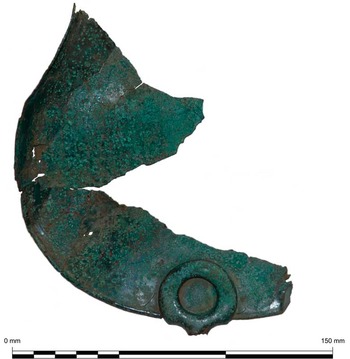
Three fragments of a copper-alloy decorated Iron Age mirror were found by Mr Simon Rowley in 1998, whilst metal detecting on a field near Ruxox Farm, in the parish of Maulden, Bedfordshire (tl 048365). The finder first mentioned his discovery and showed the fragments to one of the authors (VM) on a visit to Luton Museum in late 2003. The fragments were subsequently seen and recorded (by GB) at the finder's home in Luton in January 2007. Recording was completed during visits over the following year. The mirror remains in the finder's possession.
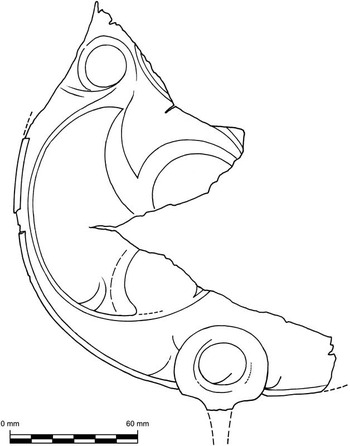
The three fragments (figs 1 and 2) were found together at a shallow depth in the plough-soil of an arable field.Footnote 1 These fragments are all that survives of a mirror that may well have been associated originally with a cremation burial, of which no trace was recognized by the finder. The broken, buckled and corroded condition of the mirror fragments, taken with the considerable missing parts, indicates that any burial had been destroyed and its contents dispersed by ploughing.Footnote 2
Fragments of copper-alloy mirror from Ruxox, Bedfordshire. Photograph: Simon Rowley, edited by Keith Fitzpatrick-Matthews

Fragments of copper-alloy mirror from Ruxox, Bedfordshire. Drawing: Garth Denning; © North Hertfordshire Archaeological Society

The mirror is the fifth to be recorded from Bedfordshire.Footnote 3 The design on the mirror back appears to be incomplete. Indeed, the surviving decoration is executed free-hand with a scriber and is suggestive of marking-out rather than of a completed design.Footnote 4 The absence of signs of hatching or fill-in might suggest that this is indeed an unfinished piece. On the other hand, this interpretation might seem unlikely in view of the presence, albeit only partial, of the cast handle. This might at first seem to be related to Joy's Type IIIB, ‘loop with boss and elaboration’,Footnote 5 as represented by Pegsdon, and its stylistically close relation, the mirror possibly from Oxfordshire. The latter we believe to have been made by a less accomplished craftsman attempting to emulate the former.Footnote 6 The absence of any loop fastening to the edge of the plate seems to militate against this, while no good explanation seems possible for the curved notches at the base of the ring. Since only the top ring of the Ruxox handle survives, it is not possible to classify it into a particular type.
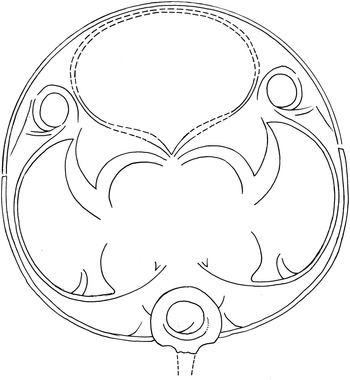
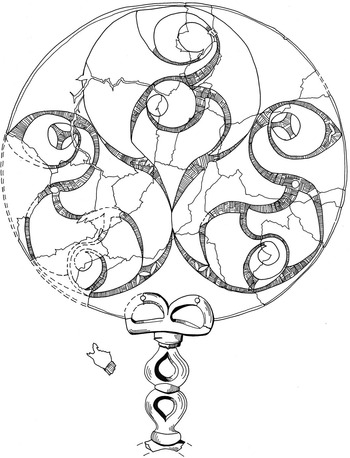
As to the design itself (fig 3), it would seem that the surviving layout forms part of the basic mirror design that Joy refers to as ‘tri-roundel’.Footnote 7 Some idea of a finished version of this may be seen on the back of another of the examples from Bedfordshire, again a metal-detectorist discovery, from Bromham and now in the Bedford Museum. Briefly referred to in our study of the Pegsdon mirror, this fragmented example awaits full publication.Footnote 8 The inclusion in the design of what Joy refers to as ‘a circled tricorn within a keeled roundel’Footnote 9 relates it, for example, to the Great Chesterford mirror,Footnote 10 as does its handle, which Joy places in his Type IV group handles, with a double loop within the grip (fig 4).Footnote 11
Reconstruction of possible original lay-out of copper-alloy mirror from Ruxox, Bedfordshire. Drawing: Garth Denning; © North Hertfordshire Archaeological Society

Copper-alloy mirror from Bromham, Bedfordshire. Drawing: Donna Watters

While the mirror fragments from Ruxox have no close association, one may suggest a date round the middle of the first century bc, similar to that of the other mirrors cited here. Whether or not the suggestion that the Ruxox mirror appears unfinished can be sustained, it is worth recalling the caveats recently advanced for using perceived quality of execution as an indication of relative dating.Footnote 12 If Ruxox really is an incomplete piece, it is unique as far as is known amongst the mirror series.
The archaeology of the Ruxox area
The area around Ruxox Farm is the site of an extensive Late Iron Age and Romano-British settlement, centred at tl 050360.Footnote 13 The site was first investigated by a local archaeologist, T H Gardner, in the late 1950s. He identified concentrations of Roman pottery in the plough-soil and dug a number of small trial trenches in various locations. The pottery and coins recovered gave a range of dates spanning the Roman period. Some of the finds lay in waterlogged peat deposits near the River Flit. Gardner located several scatters of building stone, but recorded no building plans.
Subsequent work in the 1960s and 1970s by the Ampthill and District Archaeological Society confirmed the richness of occupation, with finds of bronze pins, brooches, intaglios, painted wall plaster, tesserae and pipeclay figurines having been reported at the centre of the settlement. There is a strong possibility that these derive from a temple site. From widespread finds made through fieldwork over many years, the settlement perhaps extends to cover as much as one square kilometre. It is now bisected by the A507 Ampthill bypass, construction of which, in the 1980s, yielded further finds. Field evaluation of a water pipeline route in the 1990s produced a roughly north–south transect across the remains of the settlement. Both cremation and inhumation burials of the Roman period have been observed at more than one location, suggesting the presence of more than one cemetery.
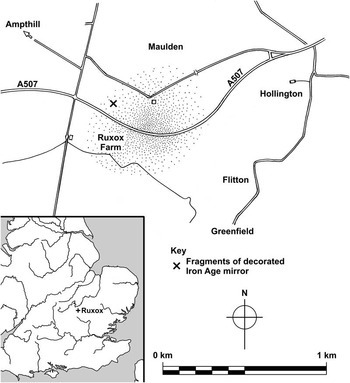
In recent decades, finds by metal detectorists across the whole settlement area have included unnumbered Roman coins, not least many denarii (some Republican), brooches, lead weights, a surveyor's plumb-bob and quantities of other finds, one of the most noteworthy being a late Roman gold finger-ring with keeled shoulders. Unfortunately, the majority of these finds have not been reported for recording. The mirror fragments came from a field to the north of the A507, on the north-west edge of the settlement area (fig 5). It is reported that several Iron Age gold staters and a quarter-stater came from the same field, although there has been opportunity to record fully only one of the staters.Footnote 14
Ruxox, Bedfordshire: site location and mirror find-spot. Drawing: Garth Denning; © North Hertfordshire Archaeological Society

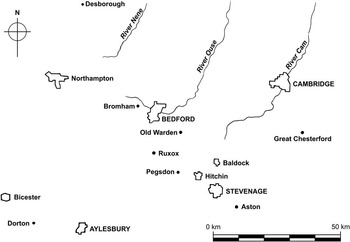
Clearly, recent finds demonstrate the importance of Bedfordshire and contiguous counties, particularly in a narrow corridor running between Bedford and Stevenage (Hertfordshire), for the deposition, if not necessarily production, of the ‘southeast England mirrors’, to use Joy's somewhat wayward geographical term (fig 6).Footnote 15
Iron Age mirror find-spots in the Bedfordshire area. Drawing: Garth Denning; © North Hertfordshire Archaeological Society

In a forthcoming publication, Burleigh will suggest that this latter concentration of mirrors may have been associated with high-status cremation burials placed on the boundaries between the important Late Iron Age settlement of Baldock and its neighbours at Sandy, Dunstable, Verulamium and Welwyn.Footnote 16 In any event, over a wider area, there is an apparent relative density of decorated mirrors in the first century bc distributed across the region later associated with the Catuvellauni.
Acknowledgements
We are grateful to Simon Rowley for the opportunity to study and record the Ruxox fragments. As previously, we are fortunate to be able to include examples of the draughting skills of Garth Denning and Donna Watters. Jody Joy has once more given us free access to his study of the British mirror series and related material and offered comments on Ruxox, which are incorporated here. Keith Fitzpatrick-Matthews has been kind enough to undertake digital editing of a number of our images. Thanks are due, too, to Stephen Coleman of the former Bedfordshire County Council, Historic Environment Department, for supplying unpublished details of the Ruxox settlement finds and previous work.