Introduction
The date palm (Phoenix dactylifera (Linnaeus); Arecaceae) is a major fruit crop in the Arabian Peninsula, Middle East, and North Africa. The Kingdom of Saudi Arabia is the world’s second largest producer of dates, supplying 17.6% of the world market (Siddiq and Greiby Reference Siddiq and Greiby2014).
The red palm weevil (Rhynchophorus ferrugineus (Olivier); Coleoptera: Curculionidae) (RPW) is one of the worst destructive pests of palms in the world (Abelardo et al. Reference Abelardo, Vicente, Enrique, Gervasio and Maria del Mar2010). Globally, the RPW infest 40 palm species in diverse agro-ecosystems (Anonymous 2013). The weevil has its home in south and southeast Asia where it is a key pest of coconut (Cocos nucifera Linnaeus; Arecaceae) and is reported from 15% of the coconut growing countries worldwide (Faleiro Reference Faleiro2006). Red palm weevil was discovered in the United Arab Emirates in mid-1980s and reached Saudi Arabia in 1987 through infested planting material (Abraham et al. Reference Abraham, Al-Shuaibi, Faleiro, Abozuhairah and Vidyasagar1998; Faleiro et al. Reference Faleiro, Al-Shuaibi, Abraham and Prem Kumar1999). It has spread over most of the date palm areas due to the transfer of infested off shoots and palm trunks (Bokhari and Abuzuhira Reference Bokhari and Abuzuhira1992; Abraham et al. Reference Abraham, Al-Shuaibi, Faleiro, Abozuhairah and Vidyasagar1998; Vidyasagar et al. Reference Vidyasagar, Hagi, Abozuhairah, Al-Mohanna and Al-Saihati2000). Currently, RPW is reported from all the continents with ecological niche modelling predicting its spread to new regions (Fiaboe et al. Reference Fiaboe, Peterson, Kairo and Roda2012).
The instars of the weevil are concealed within the palm. Infestation on date palm starts when females lay eggs on wounds, or cracks and crevices on the trunk around the collar region near the roots or offshoots, or the base of fronds in young date palms, with trunk less than 20 years old being most preferred (Abraham et al. Reference Abraham, Al-Shuaibi, Faleiro, Abozuhairah and Vidyasagar1998; Faleiro Reference Faleiro2006).
Larvae destroy the interior of the palm tree, often without the plant outwardly showing signs of deterioration unless damage is severe. Hollowing out of the trunk reduces its strength, making the plant susceptible to collapse and a danger to the public (Giblin-Davis Reference Giblin-Davis2001). The concealment of larvae within the plant makes early detection using traditional methods very difficult until visual symptoms manifest late in the stage of infestation. Consequently, infested planting material is often transported for plantation to a new location without the infestation being noticed until later (Mankin et al. Reference Mankin, Mizrach, Hetzroni, Levsky, Nakache and Soroker2008). Due to the high reproduction rate and the voracious feeding habit of the larvae, the RPW displace other insects present within the same date palm trunk. In addition, there is a great difference between RPW and other possible insect borer species as the activities of the former seem to be very aggressive (Murphy and Briscoe Reference Murphy and Briscoe1999).
Several preventive and remedial control methods have been adopted against RPW including pesticides (Soroker et al. Reference Soroker, Blumberg, Haberman, Hamburger-Rishard, Rench and Talebaev2005) and biological control using the entomo-pathogenic nematode Steinernema carpocapsae (Weiser) (Rhabditida: Steinernematidae) (Llácer et al. Reference Llácer, Martinez de Altube and Jacas2009). Currently, RPW is managed in several countries using area-wide pheromone based integrated pest management (IPM) programmes (Faleiro Reference Faleiro2006). However, the key to the success of any RPW-IPM strategy lies in the early detection of infested palms. Conventionally, food-baited pheromone traps (FBPTs) are commonly used to detect the red palm weevil, however, this traditional method is labour-intensive, expensive to implement particularly over large areas, and unreliable for early detection (Al-Saqer Reference Al-Saqer2012). Moreover, FBPTs require a very high level of servicing, as bait and water need to be replaced regularly (El-Shafie et al. Reference El-Shafie, Faleiro, Al-Abbad, Stoltman and Mafra-Neto2011).
There has been a growing interest in finding and implementing non-destructive methods for detecting insects inside plants (Shuman et al. Reference Shuman, Coffelt, Vick and Mankin1993; Hagstrum et al. Reference Hagstrum, Flinn and Shuman1996; Lemaster et al. Reference Lemaster, Beall and Lewis1997; Mankin et al. Reference Mankin, Brandhorst-Hubbard, Flanders, Zhang, Crocker and Lapointe2000, Reference Mankin, Osbrink and Anderson2002; Mankin and Fisher Reference Mankin and Fisher2002). Acoustic sensors with probes were inserted in the palm trunk to detect sounds produced by the feeding activity of early larval stages of the weevil. However, it was difficult to distinguish the sound produced by the larvae from background noise when insects were hidden in stiff, fibrous structures (Mankin et al. Reference Mankin, Mizrach, Hetzroni, Levsky, Nakache and Soroker2008). Electronic gas sensors have been used to detect volatiles emitted by plants infested by insects. Unfortunately, these sensors are also highly sensitive to the presence of other different compounds such as alcohols, ketones, fatty acids, and esters (Magan Reference Magan2001). This would negatively interfere with the performance of gas sensors. Therefore, these approaches suffered from limitations that hamper their success in detecting RPW at its early growth stages.
Soroker et al. (Reference Soroker, Suma, La Pergola, Cohen, Cohen and Alchanatis2013) reviewed recently developed RPW detection methods, discussing developing approaches, their advantages, pitfalls, and potential future implementation in RPW management. They stated that detection of RPW mainly depends on visual inspection in most areas despite the intensive effort that has been put in the development of modern detection techniques. Remote detection by thermal and olfactory cues is very promising for area wide inspection but still far from application. The temperature rise in the centre of the crown of heavily infested palms could be detected only when viewed from above (i.e., canopy sensing through aerial imaging) as the natural insulation of the palm tissue prevented detection in lateral view. They concluded that at this stage the temperature assessment cannot be considered as a confirmed application (Soroker et al. Reference Soroker, Suma, La Pergola, Cohen, Cohen and Alchanatis2013). Abe et al. (Reference Abe, Ohkusu, Kubo, Kawamoto, Sone and Hata2010) measured temperature of damaged tissues of P. canariensis trees taken from infested palm trees after being cut down by their owners or public services.
Identifying features that allow monitoring of the RPW presence inside date palm trunk would pave the way and aid designing and building a multisensory electronic system for early detection and timely pest management. Previous research outcomes did not effectively uncover tangible signs and features that confirm the presence of RPW inside life date palm trunk. Therefore, the present investigation was carried out to quantify the impact of RPW infestation on date palm trees in terms of their internal temperature changes in comparison to those of the healthy (uninfested) trunks and of the ambient atmosphere. The ultimate goal was to facilitate the development of nondestructive systems for early detection of RPW infestation in date palm.
Materials and methods
Adult RPW females and males were captured using insecticide-free pheromone (FerrolureFerrolure+, ChemTica International, Heredia, Costa Rica) traps deployed by Directorate of Agriculture in Al-Ahsa, Saudi Arabia. Active weevils for the experiments were carefully selected from freshly captured collections, placed in perforated plastic containers, and brought to the entomology laboratory of the Date Palm Research Center (DPRC) (King Faisal University, Al-Ahsa, Saudi Arabia). Weevils were sexed based on the presence of a tuft of fine bristles on the dorsum of the rostrum tip in males, which is absent in females. The collected insects were kept in large plastic containers (40×27×25 cm) and were fed ad libitum upon sugar cane for a week before being used in the experiments.
The most popular date palm cultivar (Khalas) in Al-Ahsa region was used in this study. Young date palms in the age range of 5–10 years and with average trunk circumference of 77.5 cm were selected, because palms at this stage are most liable to RPW infestation (Abraham et al. Reference Abraham, Al-Shuaibi, Faleiro, Abozuhairah and Vidyasagar1998; Sallam et al. Reference Sallam, Elshafie and Al-Abdan2012). The selected date palms were transplanted in an insect-proof lath house (mesh house) two months before the start of the experiment to exclude any immigration or emigration of weevils. Adult weevils as well as sensors of data loggers, one per each date palm were introduced inside the trunk through holes made by an electric drill. Holes were made at a height of about 75 cm from ground level where natural infestation usually occurs (Sallam et al. Reference Sallam, Elshafie and Al-Abdan2012). Three levels of forced infestation were used, one male:one female (infestation 1), one male:two females (infestation 2), and two males:four females (infestation 3). A group of date palms with only loggers’ sensors inside was used as a control representing the healthy (uninfested) palm. In addition, four loggers with their sensors were hung on the exterior of the date palm trunks to measure ambient atmosphere temperatures simultaneously during the experiment. The temperature probes were attached to nylon thread before being introduced inside the palm trunk to facilitate pulling them out at the end of the experiment. The entrances of the drilled holes were immediately covered with date palm fibres and mud to prevent the escape of the weevils, exclude intruders and the effect of ambient atmosphere. The experiment treatments were replicated four times. Electronic Tinytag data loggers (Gemini Data Loggers, Chichester, United Kingdom) were programmed to measure temperatures of infested and uninfested (control) palms and the surrounding atmosphere for a period of 24 days every 15-minute interval. The experiment was conducted in October–November 2012 and repeated in April–May 2013. This coincided with the main two RPW infestation peaks in Saudi Arabia as reported by Vidyasagar et al. (Reference Vidyasagar, Hagi, Abozuhairah, Al-Mohanna and Al-Saihati2000).
Treatments were arranged in a factorial completely randomised design with two factors (time in days having 24 levels, and infestation intensity having three levels), each treatment was replicated four times. Temperature values during the 24 days after infestation were tabulated into daily averages and inputted for statistical analysis using repeated measures analysis. MATLAB (2014) software statistics toolbox was used to subject data to analysis of variance (ANOVA) and separation of means using the least significant difference (LSD).
Results
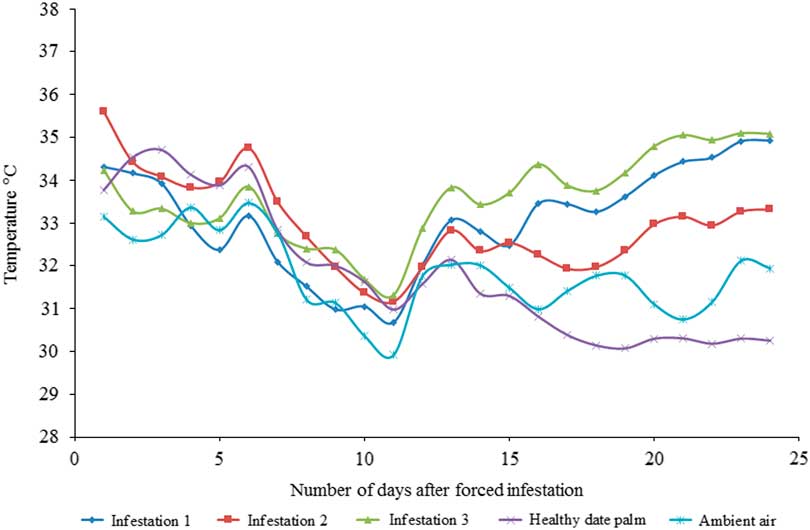
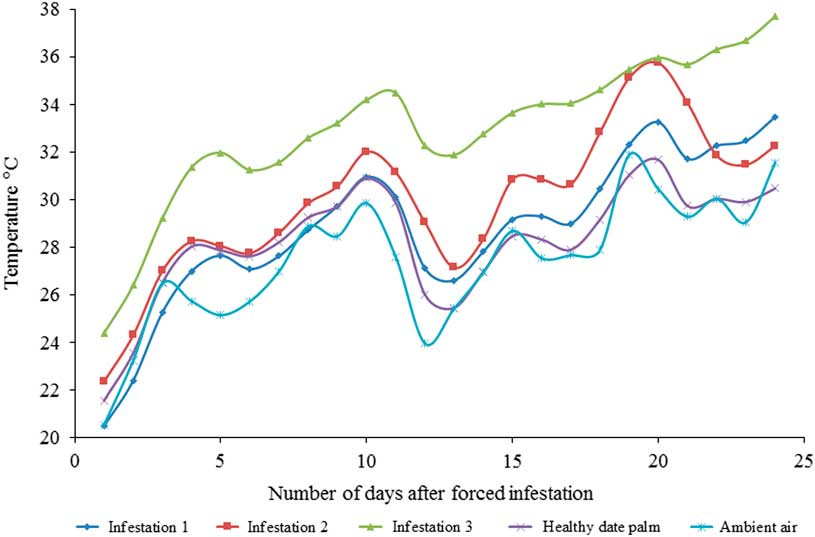
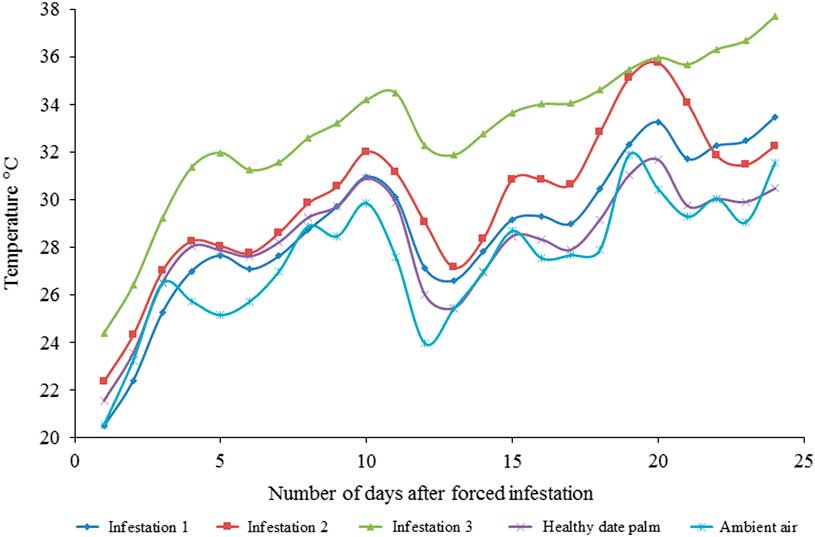
The daily average temperature profiles of the infested date palm (IDP), the healthy date palm (HDP), and the observed ambient atmosphere during the two insect infestation peaks of the study (two seasons) are shown in Figures 1 and 2. Starting from day 11 for the first peak and from day 13 for the second peak, temperature profiles of IDP deviated from both those of the HDP and ambient atmosphere with a more clear difference showing up after day 13. Temperature profiles of IDP trunk followed more adjacent paths at higher temperature values, compared with temperature profiles of both HDP and ambient atmosphere, which followed relatively neighbouring paths at considerably lower temperature values (Figs. 1 and 2). Regarding the first RPW infestation peak (first season), it can be noticed that despite the decrease in temperature profiles of IDP, HDP, and ambient atmosphere during the 11 days after infestation (Fig. 1), temperature profiles of the IDP virtually maintained higher values. After day 11, rates of all temperature profiles started to increase and continued to do so only for the IDP, while for HDP they started to decrease after day 13 and continued to do so up to day 18 and did not change much after that. Temperature profiles of ambient atmosphere did not decrease much and continued to fluctuate between 31 °C and 32 °C (Fig. 2). Regarding the second RPW infestation peak, although all temperature profiles increased with time at an increasing rate during the 10 days after infestation, but the IDP profiles were always the highest (Fig. 2).
Daily average temperatures of infested and healthy date palm trees and the ambient atmosphere during the first red palm weevil infestation peak.

Daily average temperatures of infested and healthy date palm trees and the ambient atmosphere during the second red palm weevil infestation peak.
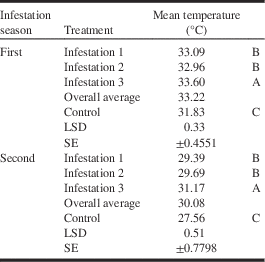
The temperature means of IDP and HDP trunks resulted from the ANOVA based on a repeated measurements model are shown in Table 1. The statistical analysis revealed that RPW infestation intensity had a main effect on the internal temperature of the IDP trunk during the first and second infestation peaks, with overall averages of 33.22 °C and 30.08 °C, respectively. The IDP temperatures were higher than the average temperatures recorded at the same time inside HDP trunk, which were 31.83 °C and 27.56 °C, with significant differences during the first (F=6.14, df=3, P=0.009) and the second (F=3.89, df=3, P=0.038) infestation peaks (Table 1). Likewise, differences were high between IDP temperatures and those observed in the surrounding environment during same infestation peaks, which were, 31.83 °C and 28.03 °C, respectively. The interaction between time and infestation was significant during both the first (F=8.12, df=69, P=0.003) and the second (F=6.82, df=69, P=0.006) infestation peak seasons.
Date palm mean temperatures recorded inside infested and healthy date palm trees for 24 days during two RPW peak infestation seasons.

Notes: Means followed by the same letter are not significantly different (P=0.05).
Infestation 1=one male: one female; Infestation 2=one male: two females; Infestation 3=two males: four females; Control=uninfested.
LSD, Fisher’s lease significant difference at 95% confidence level; SE, standard error.
Fisher LSD method was used for separation of treatment means. It showed that the three IDP trunk groups had population marginal means significantly different from that of the HDP trunk group (P⩽0.05) (Table 1). For IDP trunk, temperatures differ with increase in intensity of infestation, and although differences were not significant between the first (infestation 1) and the second (infestation 2) infestation intensities on one side, yet they were significant from the third (infestation 3) intensity on the other side. Consequently, date palm infested with two males and four females, i.e., third infestation intensity (infestation 3) recorded the highest temperature readings of the experiment for both infestation peaks and were 33.60 °C and 31.17 °C, respectively.
Discussion
The overall temperature profiles of IDP tend to increase after day 11 and onwards with evident differences in values between IDP on one side and HDP and ambient atmosphere on the other side, which is the earliest possible period where RPW larval damages can be detected and the palm still be rescued. It has been agreed that ambient atmospheric temperatures exert a very strong effect on the oviposition behaviour of females and developmental times for all pre-imaginal stages of RPW. This subsequently affects larval survivorship rates and the number of generations expected in any geographic location, which in turn affects infestation severity (Dembilio and Jacas Reference Dembilio and Jacas2011; Dembilio et al. Reference Dembilio, Tapia, Téllez and Jacas2012). However, the fermentation processes, which occur within IDP, may hinder predictions based on ambient atmosphere temperatures because internal temperatures are unlikely to be the same as those recorded outside the palm (Llácer et al. Reference Llácer, Negre and Jacas2012). The outcomes of this study provided the evidences to confirm the legitimacy of these concerns regarding reliability of predicting RPW life cycles based solely on ambient atmosphere temperature profiles. Results of the present investigation showed that the ambient atmosphere temperature profile has remarkable fluctuations with greater amplitudes unlike those of the interior environments of both IDP and HDP trunk, which is true for the whole experiment period, i.e., for the two RPW infestation peak seasons. It was evident that the temperature of the infested trunk was significantly different from the temperature of the healthy trunk. In the same time, observations of temperatures recorded simultaneously revealed that IDP temperatures were always higher than those of the surrounding environment. Such temperature differentials could be used in the detection of RPW infestation at early stages.
Conclusions
Our study has revealed that all temperature profiles of IDP trunk were above those of the HDP and the ambient atmosphere. According, a temperature differential between RPW infested and HDP can possibly be detected as early as 13 days after infestation. Therefore, electronic sensors sensitive to temperature differentials will be sought to detect RPW infestation at early stage. This study provides baseline information for further research pertaining to development of a real time multi-sensor fusion system for a nondestructive effective early detection of RPW infestations inside the date palm.
Acknowledgements
Appreciation and thanks are due to the Deanship of Scientific Research at King Faisal University, Al-Ahsa, Saudi Arabia for supporting and funding this study (project 130045).