


Introduction
The efficacy of individual cognitive behaviour therapy (CBT) for the treatment of Obsessive-Compulsive Disorder (OCD) has been well established (NICE, 2006; Whittal, Thordarson and McLean, Reference Whittal, Thordarson and McLean2005). However, evidence comparing group and individual CBT for OCD is still scarce, although the published results (Anderson and Rees, Reference Anderson and Rees2007; Jaurrieta et al., Reference Jaurrieta, Jiménez-Murcia, Alonso, Granero, Segalàs, Labad and Menchón2008) show that the group CBT condition can be as effective as the individual one. Additionally, there is also a lack of studies that have examined the efficacy of group CBT for OCD in the long term (NICE, 2006; Whittal, Robichaud, Thordarson and McLean, Reference Whittal, Robichaud, Thordarson and McLean2008).
The aim of this study was to conduct an open trial of individual versus group CBT for OCD, comparing the clinical and statistically significant changes in OCD severity obtained after the two therapy conditions at post-treatment and one year later.
Method
Participants
All the participants had a primary diagnosis of OCD (DSM-IV criteria) and were recruited from two countries, Spain and Argentina. The Spaniards came from two outpatient mental health clinics included in the network of the public Spanish National Health Care System. The Argentineans were treated in a private mental health outpatient clinic in Buenos Aires, and they were recruited via referrals from general practitioners and mental health professionals from the public Argentinean National Health Care System.
Regarding the Spanish participants, 14 (28%) of the 50 initially referred did not fit the inclusion criteria, and 3 (6%) did not consent to receiving any form of psychological treatment. The remaining 33 were randomly assigned to the Individual (18) or Group CBT condition (15). Of the 18 participants who started the individual treatment, 16 (88.8%) completed it and were available at follow-up. Of the 15 participants assigned to the Group condition, 13 started the treatment (two groups of 7 and 6 participants each), and 12 (92.3%) completed it, but only 10 were available at follow-up. In order to ensure that none of the participants in the two treatment modalities were affected by different time-delays in starting the treatments, they were put on a waiting list after the first assessment session was completed. Once 12 participants had been assessed, they were then randomly assigned to the group or individual treatment. The time on the waiting list ranged from 0 to 2 months.
In Argentina, of the 40 participants assessed, 20 did not fit the inclusion criteria, and 9 (22.5%) did not consent to receiving the treatment offered. The remaining 11 started the treatment in the Group condition (6 and 5 participants in each group), and only one participant dropped out of the treatment. In all, 10 (90.9%) participants completed the treatment and were available at follow-up. None of the participants were individually treated in Buenos Aires at the time of the study.
Measures
The Yale-Brown Obsessive-Compulsive Scale (Y-BOCS) is widely considered the gold-standard for assessing the severity of OCD. Scores range from 0 to 40 and lower scores indicate less severe OCD. The participants completed several self-report measures on OCD symptoms, depression, worry proneness, dysfunctional beliefs and thought control strategies, but only the results from the Y-BOCS are reported here as the main outcome measure.
Procedure
Before being included, all the potential participants were individually screened with a full history and examination by one of the authors, who also filled in the Y-BOCS and informed the subject about the study's purpose and assessment procedure. After giving his/her explicit consent to participate, the subject was referred to a therapist (one of the authors) who completed the OCD assessment in a 2-hour session. Once the treatment was completed, the participant was referred back to the first evaluator who again assessed the OCD severity (Y-BOCS). This evaluator was blind to the modality of treatment received by the subject. All the sessions in the group condition were video-recorded, and nearly 50% of the individual sessions were audio-taped. In the group treatment condition, the main therapist was accompanied by a co-therapist.
Treatment protocol
The two treatment modalities (individual and group CBT) were fully protocolized by all the authors before the study began. The individual CBT condition consisted of 18 one-hour sessions during a 6-month period (18 hours of treatment). The group treatment condition consisted of 16 two-hour sessions during a four and a half month period (32 hours of treatment).
Results
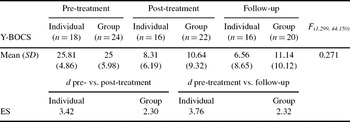
The homogeneity of the participants in the two treatment conditions at pre-treatment was first examined. No significant differences were observed between them on most of the socio-demographic variables, except for age, as the participants in the group treatment were older (30.44 ± 5.7 years vs. 37.14 ± 10 years; p = .01). There were no significant differences in the clinically relevant variables, with the exception of duration of the disorder, which was higher for the group treatment participants (4.81 ± 3.55 vs. 13.1 ± 12.7; p = .01). The two treatment conditions were comparable with regard to OCD severity (see Table 1).
Comparative effects of the two treatment conditions at post-treatment and at one year follow-up

Y-BOCS: Yale-Brown Obsessive Compulsive Scale; ES = Effect size
The participants from Spain and Argentina were comparable at pre-treatment on demographic and clinically relevant variables. The only difference found was in the marital status: 75% of the Spaniards were married, in comparison with 30% of the Argentineans (χ2 = 6.779; p = .03).
One-way mixed ANCOVAS, with the pre-treatment Y-BOCS scores as covariates and the post-treatment and follow-up Y-BOCS scores as dependent variables, were conducted, once the equivalence of the pre-treatment standard deviations had been verified. Duration of the disorder and age were introduced as covariate variables to control the effects of the differences observed at pre-treatment between the two treatment conditions.
The effects produced by the two treatments on the Y-BOCS scores were comparable, and the effect sizes (ES; Cohen's d) observed were large at the two time periods (see Table 1).
The recovered and improved rates of the participants at post-treatment and follow-up were calculated following the Jacobson and Truax (Reference Jacobson and Truax1991) criteria (Improvement = Y-BOCS ≤ 12, plus YBOCS pre- versus post-treatment decrease of at least 6 points; Recovery = YBOCS ≤ 7 plus YBOCS pre- versus post-treatment decrease of at least 6 points). At individual post-treatment, 11 out of 16 participants (68.75%) were recovered, and 3 (18.75%) reached the improvement criteria. In the group condition, 9 out of 22 participants (40.9%) were recovered, and 4 (18.18%) had improved. The difference in rates of recovery from pre to post-treatment between group and individual CBT was non- significant (χ2 = 2.88; p = .08). With regard to the stability of these outcomes one year later, one patient relapsed at follow-up in the individual treatment, and two relapsed after group treatment. Therefore, the rate of recovery decreased to 62.5% in the individual CBT and to 31.8% in the group CBT, and the differences between these two rates was significant (χ2 = 3.53; p = .05).
Discussion
The purpose of this study was to provide data about the comparative effectiveness of group and individual CBT in modifying OCD severity, and to measure the stability of the changes over one year.
The two CBT conditions were highly and equally effective in reducing the OCD severity, although the ES was slightly higher after individual CBT at the two assessment periods. This result reveals that group CBT is similar in efficacy to the individual treatment delivery and provides a promising new therapeutic tool for OCD patients. Similar results were obtained in the published studies comparing group and individual CBT (Anderson and Rees, Reference Anderson and Rees2007; Jaurrieta et al., Reference Jaurrieta, Jiménez-Murcia, Alonso, Granero, Segalàs, Labad and Menchón2008; Whittal et al., Reference Whittal, Robichaud, Thordarson and McLean2008).
Regarding the clinically relevant changes, the percentage of recovered participants after individual CBT was higher than that obtained after group CBT, although the difference between the two rates was not statistically significant. However, the difference in rates of recovery between the two treatment conditions increased at the one year follow-up, when more than two-thirds of the participants in the individual CBT condition were recovered, compared to slightly more than one-third of the participants in the group CBT condition. These data indicate the superior outcome produced by individual CBT compared to group CBT, and they support the NICE (2006) guidelines’ recommendation that group CBT is a less intensive treatment for OCD than the individual one. Finally, the relapse rates were relatively low in each case, since one patient in the individual condition and two in the group treatment relapsed one year later. On the whole, all these results are comparable to the Whittal et al., (Reference Whittal, Robichaud, Thordarson and McLean2008) two-year follow-up study, both for individual and group CBT, although these authors applied less strict criteria for recovery and improvement than those applied in the current study.
This study has several limitations. First, the heterogeneity of OCD has not been considered in the design. Each of the two treatment formats might be more or less appropriate depending on the obsession and compulsion symptom presentation experienced by the participants. Second, the different durations of the two treatments (18 and 16 sessions in the individual and group conditions, respectively) could be an additional limitation. Nevertheless, it should be noted that the sessions lasted one hour in the individual treatment, whereas in the group treatment all the sessions were two hours long. Finally, the fact that the therapists were in two different countries, Argentina and Spain, could be a further limitation. From the beginning of the study, we tried to overcome this possibility by strictly manualizing the two treatment conditions and then recording and examining a greater number of therapy sessions than is customary in this type of studies.
Acknowledgements
This study was supported by the Spanish Ministerio de Ciencia y Tecnología and EC Feder funds (Grant no. SEJ2006/03893-PSIC). Main Researcher: Amparo Belloch



Comments
No Comments have been published for this article.